
A $2.00 unsolicited bid for an Aussie software rollup just fired the starting gun. The board says no; the author says it’s just the beginning.
ReadyTech Ltd ( $RDY.AX) by @CapitalHInvest
📋 THE SETUP
The company is a vertical market software operator with "incredibly sticky" revenue. It’s currently the target of TSS (part of Topicus/Constellation), who are savvy, disciplined buyers of exactly this type of asset.
🧮 THE MATH
- Offer: $2.00 (implied 2.3x EV/Revenue)
- Author Range: $2.50 to $4.50
- Upside: 91% to 244% from pre-bid levels
🎯 THE RISK
TSS could establish a 10-20% blocking stake at these undervalued levels, which would complicate a future full-value sale process by the major holder, Pemba.
⚡ CATALYST STACK
The FY26 results will highlight new cost initiatives. If those lead to the expected FY27 margin improvement, the company becomes much harder to acquire at a discount.
MY TAKE
The board is right to push back on $2.00 given the underlying ARR quality and Constellation's involvement. The presence of a 32% PE holder adds a layer of complexity; they are in the box seat to either facilitate a higher bid or take the rest of it private themselves. The downside appears well-protected by the existing bid floor.
1
69


Jun 14
Asseco Poland: The Software Company Running Central Europe's Banks — And Trading at Half the Multiple It Deserves
34 years of profitability. 33,000 employees. 60 countries. The largest software company in Central and Eastern Europe runs NATO's incident response systems, Poland's tax authority, and virtually every bank in the region — and almost no Western investor has heard of it.
Why a $4.5 Billion Revenue Software Company Is Essentially Unknown to Western Investors
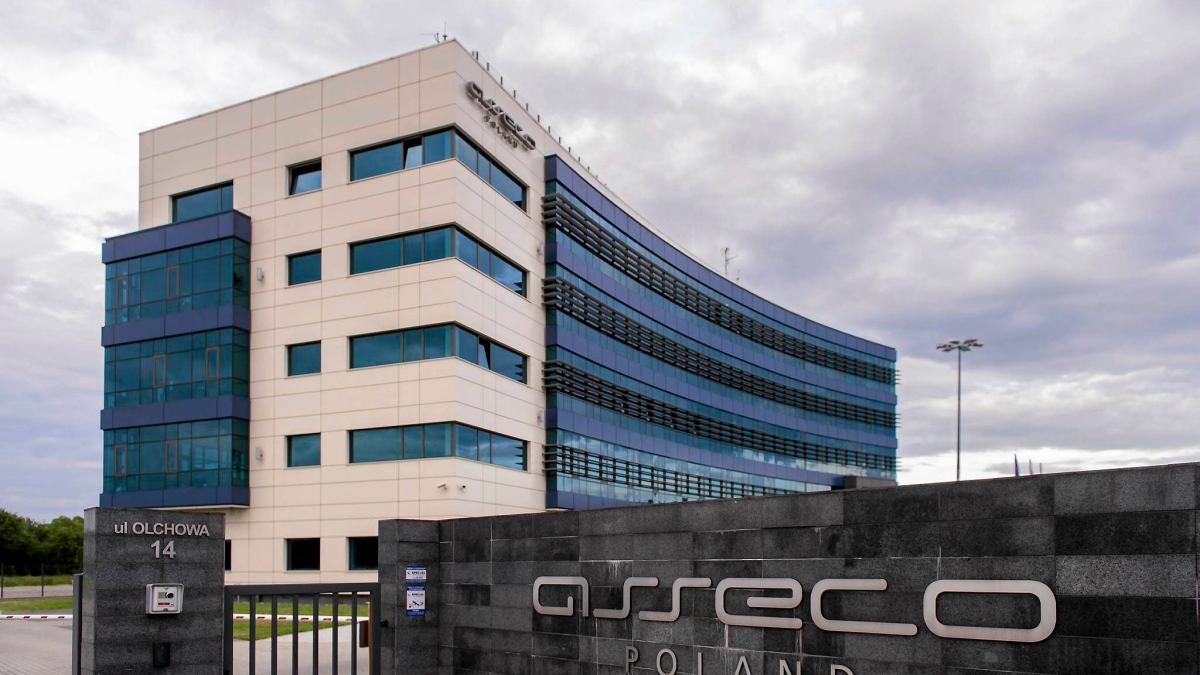
There is a company headquartered in the same city as PZL Mielec — the factory building Black Hawks and F-16 components for Lockheed Martin. It has been profitable every single year since 1991. It employs 33,752 people across 60 countries. Its software processes transactions in virtually every retail bank in Central Europe. It built NATO's Computer Incident Response Capability. It supplies battlefield management software and military drones to the Polish Armed Forces. It is the largest software company in Central and Eastern Europe, listed on the Warsaw Stock Exchange, and a constituent of the WIG20 — Poland's blue-chip index.
That company is Asseco Poland S.A. (WSE: ACP). And if you asked a senior analyst at a major Western European or American asset manager to name it, there is a reasonable probability they could not.
The reason is not business quality — the business quality is exceptional. The reason is geography. Asseco is listed in Warsaw, reports in Polish złoty, and its primary operating market is Central and Eastern Europe — a region that Western investment institutions have systematically underweighted since the post-2008 era and which remains, despite Poland's 2017 FTSE Russell upgrade to Developed Market status, structurally undercovered by English-language financial research. The consequence is a valuation gap that is not justified by fundamentals and that patient investors with the conviction to look east can exploit.
From a Ketchup Factory in Rzeszów to Central Europe's Largest Software Group
The origin story of Asseco is improbable in the way that only genuinely exceptional businesses tend to be. Adam Góral — an economist, not an engineer — founded COMP Rzeszów on 18 January 1991, the same year the Soviet Union began its final collapse and Poland was navigating the chaotic transition from command economy to market capitalism. The company was initially established within a food processing business; Góral recognised that the most urgent need in Poland's rapidly deregulating banking and public sector was not food but software — specifically, the kind of localised, compliant, mission-critical systems that transitioning Polish banks and government agencies desperately needed and that Western software companies were not going to build for a market they did not yet understand.
That insight — that local knowledge and regulatory fluency in an emerging market is a durable competitive moat — has remained the intellectual foundation of the Asseco strategy for 34 years. The company grew by solving problems that required understanding Polish law, Polish banking regulation, and Polish government procurement processes in ways that imported software simply could not. Revenue came initially from bespoke development contracts and long-term maintenance agreements with banks and state institutions. Those early relationships, built on specific local expertise, became extraordinarily sticky.
1991 · FOUNDATION
COMP Rzeszów — Born in the Transition
Adam Góral founds COMP Rzeszów in Subcarpathian Voivodeship. First clients: Polish banks and state institutionsnavigating the transition to market economy and desperately needing localised compliant software. The founding model — long-term maintenance contracts with mission-critical institutional clients — establishes the commercial DNA that still defines the company.
2004 · FIRST INTERNATIONAL STEP & GPW LISTING
Asset Soft Acquisition, Rename, and Warsaw Stock Exchange Debut
COMP Rzeszów acquires Slovak software company Asset Soft — its first international move — and is renamed Asseco. The company lists on the Warsaw Stock Exchange on 27 September 2004 under ticker ACP. This debut provides the capital base for the acquisition-driven expansion that follows. The IPO is a landmark: Asseco is one of the first significant Central European software companies to access public capital markets.
2006–2007 · POLISH SOFTWARE CONSOLIDATION
Softbank and Prokom — Building the Domestic Platform
Asseco acquires two of Poland's most significant software competitors: Softbank (formerly the largest Polish IT company, then renamed Asseco Poland S.A. in 2007) and Prokom Software. These deals make Asseco unambiguously the dominant Polish IT company, with the government, banking, and healthcare software relationships of all three legacy businesses now under one roof. The combined entity becomes the reference IT supplier for Polish public administration.
2010 · FORMULA SYSTEMS — THE ISRAELI PIVOT
Acquiring a Stake in NASDAQ-Listed Israeli Technology Holding
Asseco acquires a controlling stake in Formula Systems (1985) Ltd., a publicly listed Israeli technology holding company traded on both NASDAQ (FORTY) and the Tel Aviv Stock Exchange. Formula's subsidiaries include Magic Software Enterprises, Sapiens International Corporation (insurance software, $1.8B NASDAQ market cap), and Matrix IT (Israeli cybersecurity, cloud, and big data). This single acquisition transforms Asseco from a Central European IT company into a genuinely global holding group with exposure to Israeli and US technology markets.
2010–2024 · 160 ACQUISITIONS
Three Decades of Compounding Through Acquisition
Asseco executes over 160 acquisitions across its history, expanding across Asseco South Eastern Europe (SEE), Asseco South Western Europe (SWE), Asseco Central Europe, and Asseco International. The federated model — buying local market leaders, keeping management in place, cross-selling across client bases — closely mirrors the playbook of Constellation Software (TSX: CSU) and its European offshoot Topicus, a comparison that becomes directly relevant in 2025.
JANUARY–OCTOBER 2025 · THE CONSTELLATION SOFTWARE ENDORSEMENT
Topicus / TSS Acquires 24.84% — The Most Important Signal in Asseco's History
In January 2025, Topicus.com (TSXV: TOI) — a publicly listed subsidiary of Constellation Software, perhaps the most celebrated acquirer of vertical market software in the world — purchases 9.99% of Asseco Poland from Cyfrowy Polsat at PLN 85 per share. By October 2025, after regulatory approvals, its subsidiary TSS completes the purchase of a further 14.84% treasury stake. Total TSS/Topicus stake: 24.84%. The PLN 85 acquisition price was described by analysts at Outsider's Corner as paying "8x EV/EBITDA for LTM figures" — a valuation discipline that Constellation Software has practiced across hundreds of acquisitions. They bought at that price. The market has subsequently moved the stock well above it.
Who Owns Asseco — And Why the Constellation Connection Changes Everything
24.84%
TSS / TOPICUS.COM · CONSTELLATION SOFTWARE
Strategic stake completed October 2025 at PLN 85/share. Topicus is listed on TSX Venture (TOI). Constellation Software (CSU) holds controlling vote in Topicus. This is the most consequential external endorsement in Asseco's history.
10.01%
ADAM GÓRAL FAMILY FOUNDATION
Founder's vehicle. Góral is transitioning from CEO to Supervisory Board as part of the long-term succession plan aligned with the Topicus partnership. The Family Foundation and TSS have a shareholders' agreement governing joint voting on key matters.
~65%
FREE FLOAT · INSTITUTIONAL & RETAIL
State Street Global Advisors is a known institutional holder. Cyfrowy Polsat retains a residual position after selling the majority of its stake to Topicus. WIG20 index membership drives passive fund ownership from Polish pension funds (OFE) and ETFs.
Why the Topicus stake matters beyond the percentage: Topicus and its parent Constellation Software have deployed billions of dollars acquiring vertical market software businesses across hundreds of transactions. Their valuation discipline is legendary — they do not overpay. When they chose to pay PLN 85 per share for 24.84% of Asseco in 2025, they were expressing a view about the quality and durability of Asseco's competitive position that carries more analytical weight than any third-party equity research note. Constellation Software's track record of compounding returns is among the best in the history of public technology investing. They now sit on Asseco's shareholder register. That is a signal.
The Four Businesses Inside One Stock — and Why Each Is Individually Compelling
Asseco Poland S.A. (WSE: ACP) is a holding company as much as an operating business. The listed parent provides software and IT services primarily for the Polish market, while controlling a federation of separately operating — and in several cases separately listed — subsidiaries across Europe, Israel, and beyond. Understanding the valuation requires understanding what is inside the box, because the market frequently prices the parent as if the subsidiaries' independently verifiable market values do not exist.
THE POLISH DOMESTIC BUSINESS — THE ENGINE
In Poland, Asseco is the government's primary IT supplier, the banking sector's dominant core software vendor, and the healthcare system's most embedded technology partner. It built and maintains the tax collection systems for the Polish government — the software processing every corporate and personal tax return filed in the country. It provides core banking systems to Polish banks that have run on Asseco software for decades and have no realistic prospect of changing. It manages the IT infrastructure for the Polish Social Insurance Institution (ZUS), which administers pension and social welfare payments for 38 million people. It builds and operates health records systems under the national e-health programme. In each of these markets, switching costs are so high as to be functionally prohibitive — no bank, tax authority, or national health service changes its core software during a period of normal operations without a multi-year programme costing hundreds of millions of euros and carrying enormous execution risk.
DEFENCE AND GOVERNMENT SOFTWARE — THE OVERLOOKED ANGLE
Asseco's defence and uniformed services division receives almost no coverage in the English-language financial press despite being one of the most structurally interesting parts of the business. Asseco developed NATO's Computer Incident Response Capability — the alliance's primary cyber incident response system. It has delivered command and control software, battlefield management systems, training simulators, and military logistics platforms to the Polish Ministry of National Defence. It has supplied military UAV systems — specifically the Mayfly drone — to the Polish Armed Forces. It holds the security clearances required to bid on classified defence contracts, and it has been designated a trusted national IT contractor for Poland's ongoing military modernisation programme.
This defence exposure is not incidental to the valuation thesis — it is potentially transformative. Poland is spending 4.8% of GDP on defence and executing the largest peacetime military expansion in NATO history. Every platform acquired — 250 Abrams tanks, 96 Apache helicopters, 250 K2 Black Panther tanks, F-35A fighters, POLSARIS satellites — generates a downstream requirement for software: procurement management, inventory tracking, maintenance scheduling, operator training systems, logistics integration, and command networks. Asseco is the trusted incumbent supplier to the institution procuring all of these systems. The software contracts that follow the hardware contracts are, in aggregate, very large numbers — and they are not in any current analyst model we have seen applied to Asseco.
The Subsidiaries the Market Is Not Pricing Correctly
The Asseco Group operates through three main divisions: Asseco Poland (domestic market), Formula Systems (Israeli and US markets), and Asseco International (rest of the world). Several of these entities are independently listed, creating a verifiable sum-of-parts valuation that consistently exceeds the parent company's market capitalisation — a classic holding company discount that patient investors have historically been rewarded for navigating.
Formula Systems (1985) Ltd.
ISRAEL · NASDAQ TASE
Israeli IT holding. Subsidiaries include Sapiens International ($1.8B NASDAQ cap), Magic Software Enterprises, Matrix IT (cybersecurity, cloud, AI). Asseco holds controlling stake.
LISTED: NASDAQ: FORTY · TASE: FORT
Asseco South Eastern Europe
BALKANS · 16 COUNTRIES
Banking, government, and healthcare software across the Western Balkans and southeastern EU. Operations in Serbia, Croatia, Bosnia, Slovenia, North Macedonia, Montenegro, Kosovo, and beyond.
LISTED: WSE WARSAW
Asseco Business Solutions
POLAND · ERP FOCUS
ERP software for Polish SMEs and mid-market companies — Microsoft Dynamics and proprietary platforms. Separately listed on WSE with own analyst coverage and dividend.
LISTED: WSE WARSAW
Asseco South Western Europe
PORTUGAL · SPAIN · AFRICA
Banking software, payment systems, and government IT for Portuguese, Spanish, and African markets. Portugal's banking sector runs largely on Asseco core banking platforms.
LISTED: EURONEXT LISBON
Asseco Central Europe
CZECH REPUBLIC · SLOVAKIA · HUNGARY
Banking and insurance software for Central European markets. Complementary to the Polish domestic business and sharing technology platforms for regional bank clients.
PRIVATE
Asseco Data Systems
POLAND · CYBERSECURITY
Poland's leading qualified trust services provider — electronic signatures, document authentication, PKI infrastructure. Operates under EU eIDAS regulation as a national Trusted Service Provider.
LISTED: WSE NEWCONNECT
The holding company discount is the central analytical opportunity in Asseco Poland. The parent trades at approximately 19–21 times earnings on the Warsaw Stock Exchange. But embedded within that parent are controlling stakes in Formula Systems (whose subsidiary Sapiens International alone carries a NASDAQ market capitalisation exceeding $1.8 billion), Asseco South Eastern Europe (separately listed on WSE), Asseco South Western Europe (listed on Euronext Lisbon), and Asseco Business Solutions (listed on WSE). A rigorous sum-of-the-parts analysis consistently yields an implied value for the parent significantly above its quoted market price.
34 Years of Profitability — The Numbers That Make the Case
The backlog is the most important number in the current investment case. A PLN 12.5 billion order backlog growing double digits means Asseco has visibility into its near-term revenue trajectory that most software companies would envy. The backlog is built from long-term government and banking contracts — the kind that are signed for 3–10 year terms, are denominated in złoty (eliminating currency risk for a Polish investor), and are renewed at high rates because switching costs are prohibitive. This is not speculative pipeline — it is contracted revenue, already sold, waiting to be recognised.
The 6.6% dividend yield deserves specific emphasis. A profitable, growing, investment-grade-quality software company yielding 6.6% in a European developed market context is genuinely unusual. Western European software companies of comparable quality yield 1–2%. US SaaS companies often yield zero. Asseco has paid and grown its dividend every year, treating capital returns to shareholders as a non-negotiable commitment rather than a discretionary decision. At the current share price of approximately PLN 197, the PLN 13.05 trailing dividend represents one of the most attractive income yields in the Polish equity market.
The Multiple That Does Not Reflect the Business
Why 19× PE for a CEE Monopoly Software Business Is Too Cheap
Asseco Poland currently trades at approximately 19–21 times trailing earnings and around 17–18 times EV/EBITDA on a forward basis. At first glance this does not appear dramatically cheap — but the comparison set matters enormously. A direct peer for Asseco's banking and government software businesses in Western Europe or the US would trade at 25–35 times earnings. Constellation Software itself, whose subsidiary just paid 8× EV/EBITDA for 24.84% of Asseco in 2025, trades at well over 100 times earnings on the TSX. The discount to comparable Western businesses is not driven by business quality — it is driven entirely by geography and the residual institutional bias against CEE equities.
Simply Wall St's DCF model currently estimates intrinsic value at PLN 287 per share — a 46% premium to the current price of approximately PLN 197. Analyst consensus targets have been revised upward repeatedly through 2025 and 2026, currently sitting around PLN 142–153 — but note that these targets reflect conservative analyst assumptions and have consistently lagged the actual share price movement. The stock has returned approximately 40% per year over the past three years against earnings growth of only 13% per year — suggesting the market is slowly beginning to appreciate what Constellation Software has already priced in.
The sum-of-parts discount is the most mechanically compelling aspect of the valuation. Sapiens International, a Formula Systems subsidiary, is independently listed on NASDAQ with a market capitalisation exceeding $1.8 billion. Magic Software Enterprises trades on NASDAQ. Matrix IT trades on the Tel Aviv Stock Exchange. These are publicly verifiable, real-time market values. Asseco's controlling stake in Formula Systems alone — representing these listed subsidiaries — has a calculable market value that is a meaningful fraction of Asseco Poland's total market capitalisation. The parent is effectively offering its domestic Polish software franchise at a discount to zero relative to the market values of what it owns internationally.
Five Reasons to Own Asseco — and Two Risks to Understand
-34 years of uninterrupted profitability in a company nobody has heard of outside Poland. In technology investing, this is extraordinarily rare. Most software companies lose money for years before becoming profitable. Asseco has been profitable from effectively its first year of operation, through the 1998 Russian financial crisis, the 2001 dot-com crash, the 2008 global financial crisis, the 2020 pandemic, and the current period of elevated European inflation and energy costs. The business model — long-term contracts with mission-critical institutional clients who cannot switch — produces revenue stability that pure-play SaaS businesses take decades to build.
-The Constellation Software endorsement — the most powerful external signal possible. Mark Leonard built Constellation Software into a $90 billion company by buying vertical market software businesses with high switching costs, recurring revenues, and durable competitive moats. His methodology is the most respected in the software investing world. When his subsidiary pays 8× EV/EBITDA for 24.84% of Asseco in 2025, that is not a passive financial investment — it is a strategic vote of confidence in Asseco's business model, management quality, and growth trajectory. The Constellation network also provides Asseco with a playbook for accelerating its own acquisition programme and a partnership with one of the most active buyers of vertical software globally.
-Defence modernisation as an underappreciated earnings catalyst. Poland is spending 4.8% of GDP on defence and has signed over 150 major procurement contracts in 2024 alone. Every platform — tank, helicopter, fighter, satellite — generates software requirements downstream. Asseco has NATO-cleared credentials, existing defence relationships, and thirty years of government IT experience that new entrants cannot replicate. The defence software opportunity is completely absent from current analyst models because it does not yet appear in a single meaningful line of Asseco's segment reporting. When it does, it will be a re-rating catalyst.
-6.6% dividend yield with a track record of annual growth. For income investors, Asseco offers one of the most attractive yields in the Polish equity market from a company with genuine earnings quality, low leverage, and a committed dividend policy. The combination of a 6% yield and mid-single-digit earnings growth produces a double-digit total return expectation from a WIG20 blue-chip with institutional-quality governance — a combination that simply does not exist at this price in any Western European technology market.
-The sum-of-parts discount to listed subsidiary values. his is the single most mechanically defensible valuation argument. The combined market values of Asseco's stakes in Formula Systems, Sapiens International (via Formula), Asseco SEE (WSE listed), Asseco Business Solutions (WSE listed), and Asseco South Western Europe (Euronext listed) can be calculated in real time using public market prices. In multiple analyses, these calculated values exceed or approach the parent's own market capitalisation — implying the domestic Polish software franchise is being obtained at or near zero cost. This situation should not persist indefinitely, and the Topicus/TSS arrival on the register provides the kind of active, sophisticated shareholder base that tends to accelerate the resolution of holding company discounts.
-Risk 1 — The GPW Liquidity and Currency Premium. Asseco shares trade on the Warsaw Stock Exchange in Polish złoty. For non-Polish investors, this introduces currency risk relative to euro or dollar portfolios. Daily trading volumes, while adequate for institutional participation, are not comparable to major Western European large-caps. In periods of risk-off sentiment toward Central and Eastern European equities — which occur periodically regardless of specific company quality — Asseco will trade down with the broader market regardless of its own fundamentals.
-Risk 2 — The Succession Transition. Adam Góral has been the singular strategic vision behind Asseco for 34 years. His transition from CEO to Supervisory Board, with VP Rafał Kozłowski taking over as CEO, is managed and planned — the Topicus shareholders' agreement provides governance alignment, and the incentive programme for senior managers creates continuity. But founder-CEO transitions in founder-led compounders carry inherent risk, however well-managed, and investors should monitor the first 12–18 months of the Kozłowski tenure carefully.
The Software Company the Market Hasn't Finished Discovering
The case for Asseco Poland is straightforward once you accept a simple premise: that a company with 34 consecutive years of profitability, a 6.6% dividend yield, a PLN 12.5 billion order backlog, and the endorsement of one of the world's most respected software investors — trading at half the multiple of comparable Western European businesses — represents a structural mispricing driven by geography rather than business quality. That is exactly what Asseco Poland is.
The Constellation Software/Topicus investment at PLN 85 per share in 2025 was the moment at which the smart money said clearly and publicly what the valuation implied: this is an exceptional business being sold cheaply because it is listed in Warsaw rather than London, Amsterdam, or New York. The share price has moved above that acquisition price since. It has not yet fully closed the discount to fair value.
This is a private report I'm sharing and not investment advice. I do own shares under an investment vehicle.
3
4
41
5,517

Jun 13
Copart is cool kinda in the too hard pile for me though! I cloned Pabri on the Met COAL stocks last year some of my favourites as well for me I am much more in Topicus. What makes you like Constellation 🌌 more?
1
1
101

Jun 11
$TOI.V Clint van Haalen - Director ejecutivo de Topicus Finance sobre la IA como riesgo/evolución: “Lo que me da confianza es que ya veo este cambio en todos los ámbitos de Topicus. Veo equipos experimentando de forma responsable y lanzando productos al mercado. Veo a personas…
1
173


Jeff Bezos once said people are usually distracted by what will change. The bigger opportunities often come from identifying what won’t change.
Customers will always want things faster, cheaper, easier, safer, and more personalised.
Technology changes the delivery method.
It does not change the underlying need.
That is why Topicus is interesting.
European hospitals will still need compliant patient systems.
Municipalities will still need permitting software.
Legal firms will still need secure records.
Schools, governments, and financial institutions will still need reliable infrastructure that fits local regulation, language, and workflow.
AI may change how software is built.
But it does not remove the need for trusted, compliant, mission-critical systems.
Topicus owns the boring layer beneath the excitement.
The market is focused on what may change.
The opportunity may be in what will not.
If you’d like to read the full investment research, click here.therationalcapitalist.substa…
#Topicus #VerticalSoftware #Compounders #CapitalAllocation #LongTermInvesting

22

Jun 11
DCA’d Topicus from the 110s to the 80s. Same with Lumine from 27 all the way to sub 20
2
84

Like 30 percent CSU then topicus over 10 and Lumine 5 or so
1
62


$Topicus is down nearly 48% from its highs — yet the business just grew revenue 20% and free cash flow available to shareholders 23%.
$Topicus comes from the $Constellation Software family — one of the greatest serial acquirers in public markets. The model is simple: buy small, mission-critical software businesses, leave them decentralized, demand high returns on capital, reinvest the cash, repeat.
Management is not paid to chase size for its own sake. Incentives are tied to return on invested capital and organic growth. Executives buy shares with their own bonus money and hold them for years. The $Van Poelje family still owns a major stake. $Constellation Software remains heavily involved.
$Topicus generates cash from sticky recurring software revenue, then redeploys that cash into more niche European software businesses. The market opportunity remains enormous, with tens of thousands of potential acquisition targets across Europe. At 30 to 40 acquisitions per year, Topicus is barely scratching the surface.
But at roughly 13x trailing free cash flow, the market appears to be pricing $Topicus like a slowing software business. That may be too pessimistic for a company with low churn, recurring revenue, aligned owners, a long acquisition runway, and a proven capital allocation culture.
If you’d like to read the full investment research, click here.
therationalcapitalist.substa…
#Topicus #VerticalSoftware #Compounders #CapitalAllocation #LongTermInvesting

74
I make your Internet work retweeted

Interesting blog post on the Topicus website $TOI.V
AI lowers the barrier to building software, not the bar for running it in production. In mission-critical, regulated domains, deep expertise becomes more valuable, not less, and vertical AI amplifies that expertise rather than erasing it.
topicus.nl/nieuws-en-kennis/…
3
8
95
18,810

$Topicus was built for permanent ownership. Many private equity buyers acquire niche software, cut costs, raise prices, and flip the asset. Topicus offers something different: a permanent home.
For retiring $European founders, that matters.
They do not just want the highest price. They want their employees, customers, and software to survive.
That gives Topicus a sourcing advantage money alone cannot buy.
$Topicus has tens of thousands of potential acquisition targets across Europe. At 30 to 40 deals a year, it is barely touching the surface.
If you’d like to read the full investment research, click here. therationalcapitalist.substa…
#Topicus #VerticalSoftware #Compounders #CapitalAllocation #LongTermInvesting
47