
📢 NUEVO ESTUDIO PUBLICADO!
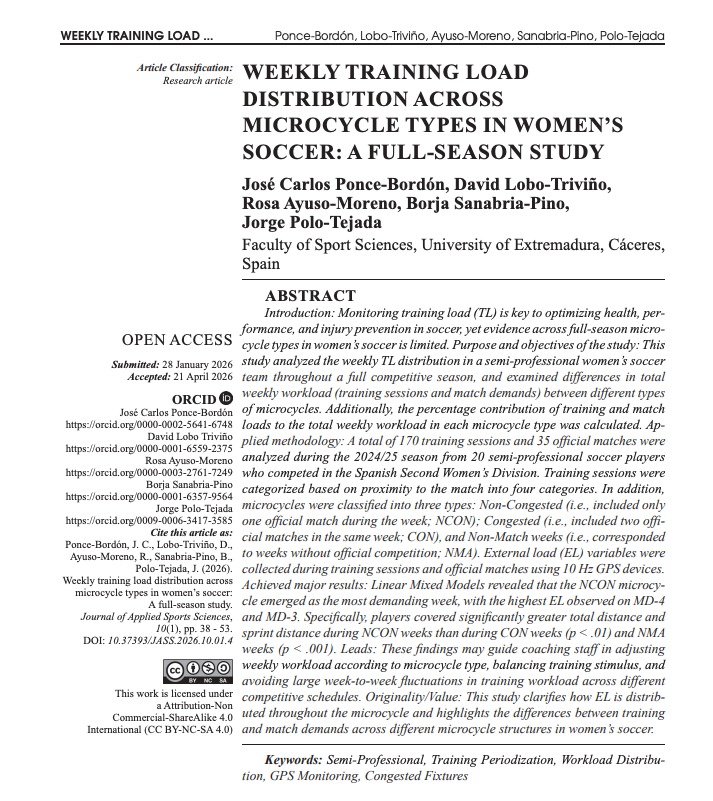
"Weekly Training Load Distribution Across Different Microcycle Types in a Semi-Professional Women's Soccer Team"
🎓 @13_JoseCarlos @david_lobo4 @Rosa_Ayuso @BorjaSanabria @Cokepolo_20
📖Journal of Applied Sports Sciences
¿Cómo se distribuye la carga de entrenamiento a lo largo de la semana en un equipo de fútbol femenino semiprofesional? ¿Y cambia según el número de partidos?
El fútbol femenino sigue siendo un contexto poco estudiado desde la ciencia del deporte. Nuestro trabajo analiza esto durante una temporada completa de liga y copa.
Os contamos las claves de este trabajo:
🎯 Objetivo principal
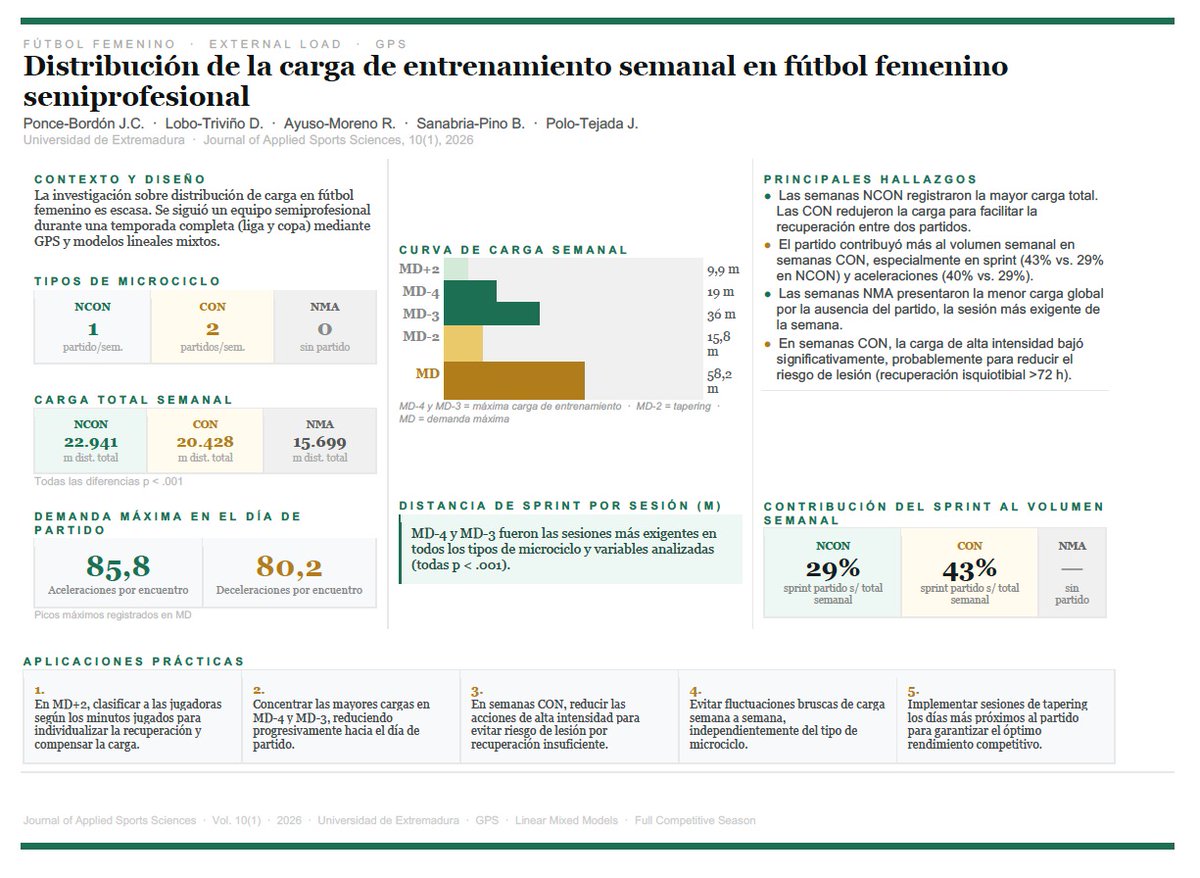
Analizar la distribución de la carga externa semanal en función del tipo de microciclo: sin congestión (NCON), con congestión (CON, dos partidos) y sin partido (NMA).
📋 Método
Seguimiento GPS de un equipo femenino semiprofesional durante una temporada completa. Se analizaron variables como distancia total, sprint, aceleraciones y deceleraciones mediante modelos lineales mixtos.
📊 Resultados principales
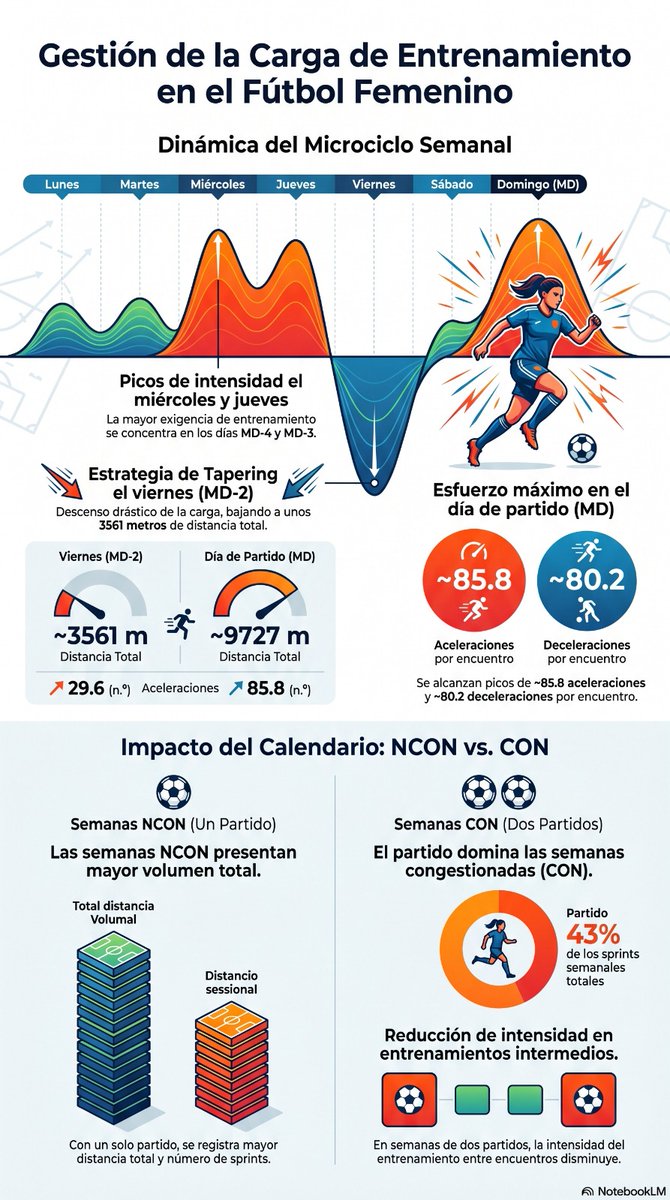
MD-4 y MD-3 fueron consistentemente las sesiones más exigentes de la semana, independientemente del tipo de microciclo.
En semanas CON, la carga de entrenamiento se redujo, pero el partido representó hasta el 43% del sprint semanal total (vs. 29% en semanas NCON).
Las semanas NMA registraron la menor carga global: el partido es la sesión más demandante y su ausencia lo cambia todo.
💡 ¿Por qué es importante?
Conocer estos patrones permite a los cuerpos técnicos ajustar mejor la intensidad, la recuperación y la prevención de lesiones según el calendario competitivo — especialmente en semanas con partidos seguidos.
Para citar este artículo:
Ponce-Bordón, J.C., Lobo-Triviño, D., Ayuso-Moreno, R., Sanabria-Pino, B., & Polo-Tejada, J. (2026). Weekly training load distribution across different microcycle types in a semi-professional women's soccer team. Journal of Applied Sports Sciences, 10(1).
#FutbolFemenino #WomensFootball #TrainingLoad #SportScience #GPS #ACAFYDE #Investigación
8
21
1,238

May 27
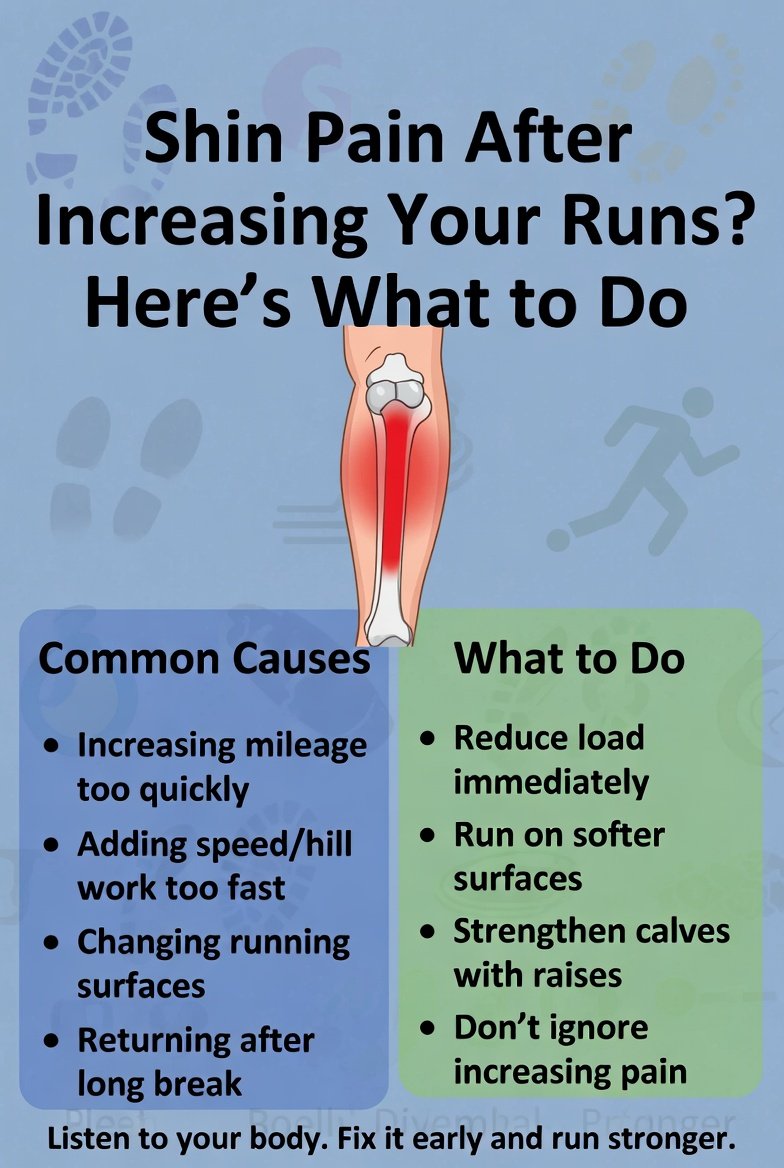
**Shin Pain Along the Shin Bone After a Few Weeks of Increased Running – Causes and How to Handle It**
This is a very common type of pain that new runners or people returning to running often experience.
At first, it’s just a dull ache on the inside of the shin or along the bone. It usually eases when you stop running. But if you keep ignoring it, the pain can become persistent and completely ruin the enjoyment of your runs.
Many people immediately blame their shoes.
Shoes *can* be part of the problem, but they’re rarely the whole story.
What I see happening more often is:
- Increasing mileage too quickly
- Adding intense workouts too fast
- Changing running surfaces before the legs have adapted
**Signs I usually notice:**
- Pain along the shin at the beginning of a run
- Slight tenderness when pressing on the area
- More noticeable when running fast or downhill
**Most common situations where this occurs:**
→ Recently increased the number of running days per week
→ Just added speed work, hill runs, or jump rope
→ Switched to completely different shoes
→ Took a long break and came back too aggressively
When I experience this, the first thing I do is **not** “push through it to get used to it.”
Instead, I **reduce the load** immediately: cut back on distance and intensity, avoid high-impact sessions for a few days, and monitor whether the pain subsides.
**Other helpful steps:**
→ Review the past week — did you increase volume or intensity too quickly?
→ Switch to softer surfaces for a few runs
→ Add calf raises and other strengthening exercises for the lower legs and ankles
→ Avoid turning every run into a heavy pounding session
If the pain gets progressively worse, hurts even while walking, shows clear swelling, or there’s a very sharp spot when you press on one specific point — don’t treat it as normal shin pain. Get it checked to rule out more serious issues.
**Shin pain doesn’t mean you’re weak.**
Most of the time, it’s just your body reminding you that the training load is increasing faster than your legs can adapt. Fix it early and you’ll usually get back into your rhythm much more easily.
#Running #ShinSplints #TrainingLoad #DailyRunning #RunningInjury #RunningTips #BeginnerRunner
2
14

Age-Group Triathlon Training Load: What 34,731 Training Sessions Reveal.
The study looks at age-group triathlon training load across race distance, training phase, and real-world athlete context.
trainingpeaks.com/coach-blog…
@TrainingPeaks @peaksware
#trainingload #agegrouptriathlon
4
6
124

May 22
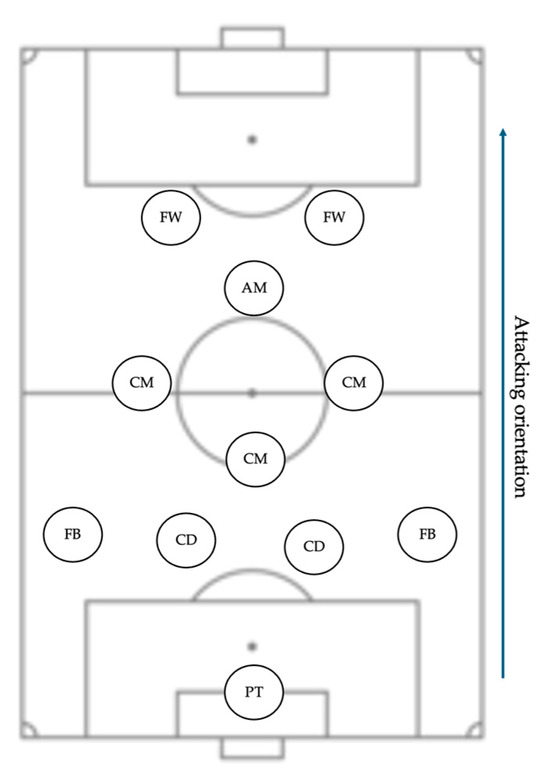
📢 #highlycited paper
📚 Differences in Accelerations and Decelerations Across Intensities in Professional Soccer Players by Playing Position and Match-Training Day
🔗 mdpi.com/2076-3417/15/16/893…
👨🔬 by Alejandro Moreno-Azze et al.
🏫 University of Zaragoza/RCD Espanyol de Fútbol
#speedchanges #trainingload #injuryrisk
2
44


⚽ ¿Preparador físico de fútbol? ¡Todo gratis para vos!
💪 Artículos, videos y programación
👉 pf-tnt-strength-and-conditio…
🎥 YT: @PF_TNT
📲 IG: @hugotinti
🤝 LinkedIn: Hugo Tinti
#StrengthAndConditioning #LoadManagement #TrainingLoad #PlayerLoad #GPSSoccer #ControlDeCarga
1
3
357

Apr 24
4. Recovery capacity becomes limited
Excessive cardio increases fatigue, reducing performance in resistance training.
#Recovery #TrainingLoad #Fitness
1
16

Apr 7
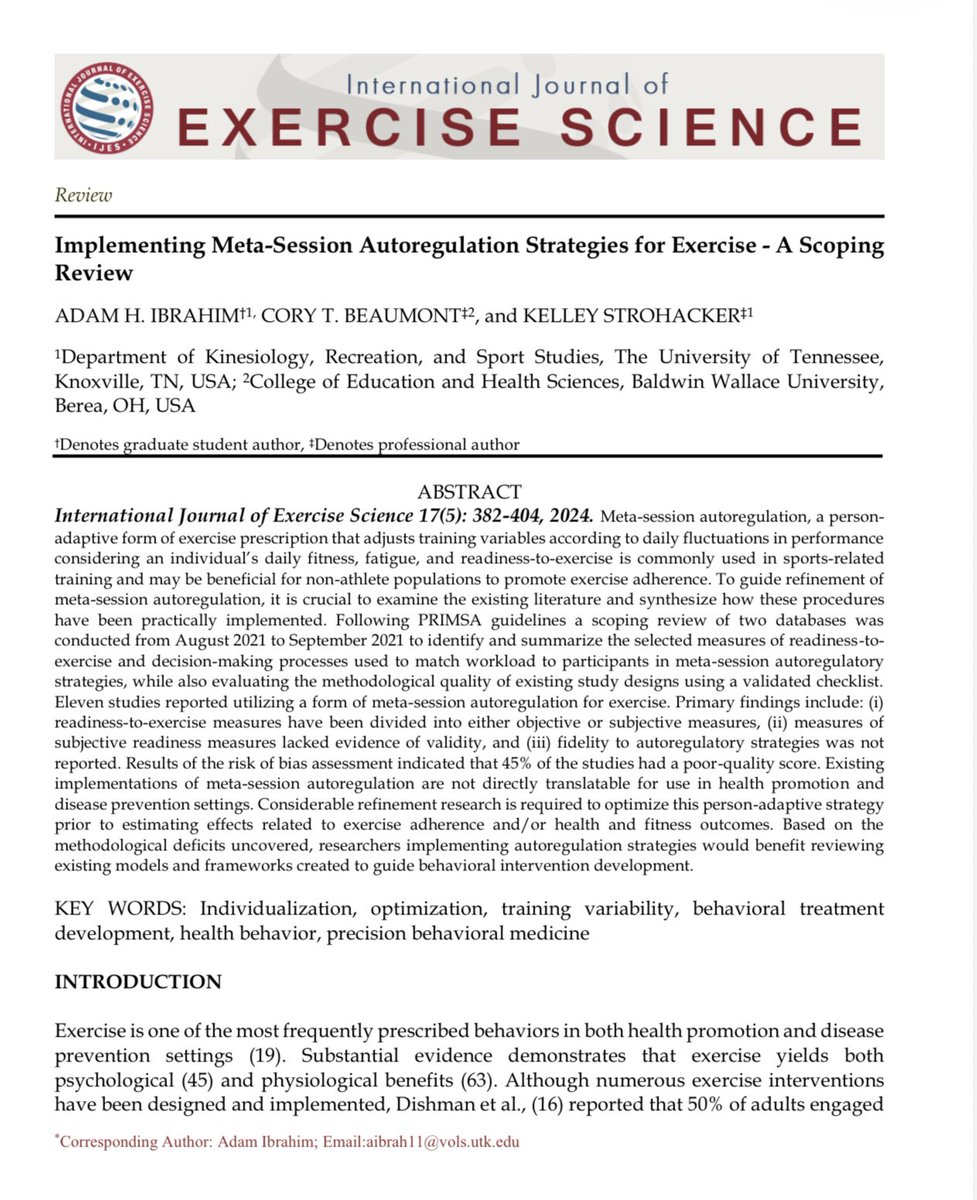
Autoregulation is bigger than the weight room.
A strong new scoping review frames meta session autoregulation as a person adaptive form of exercise prescription that adjusts training variables according to daily fluctuations in performance while considering fitness, fatigue, and readiness to exercise.
That matters because this is not just about athletes or fancy tech.
The review points out that day to day exercise consistency is influenced by non training stressors, the complexity of exercise behavior, and individual differences in how people perform and respond to training. It argues that exercise programming may need to be more flexible and person adaptive rather than one size fits all.
A key takeaway:
Readiness can be measured subjectively or objectively. The review found that existing meta session strategies generally fall into those two buckets, with subjective approaches often tied to flexible nonlinear periodization and objective approaches often tied to HRV based training.
But the paper is also honest about where the field still has work to do.
The authors found that:
- subjective readiness measures often lacked evidence of validity
- fidelity to autoregulatory strategies was often not reported
- 45% of the included studies were rated poor quality
- current implementations are not directly translatable to health promotion and disease prevention settings yet
That is an important point for human performance.
Autoregulation should not be treated like a vague excuse to do less. It should be treated as an effort to better match exercise demand to the human in front of us. But if we are going to use it well, we need better readiness measures, better fidelity, and better real world implementation.
That is where the real opportunity is.
Not just asking whether autoregulation “works.”
Asking whether we are actually measuring readiness well enough to dose exercise the way we think we are.
#Autoregulation #HumanPerformance #ExerciseScience #TrainingLoad #Readiness #StrengthAndConditioning #AerobicTraining
1
2
112
Apr 7
Autoregulation gets misunderstood.
It is not an excuse to skip hard training because you do not feel like it.
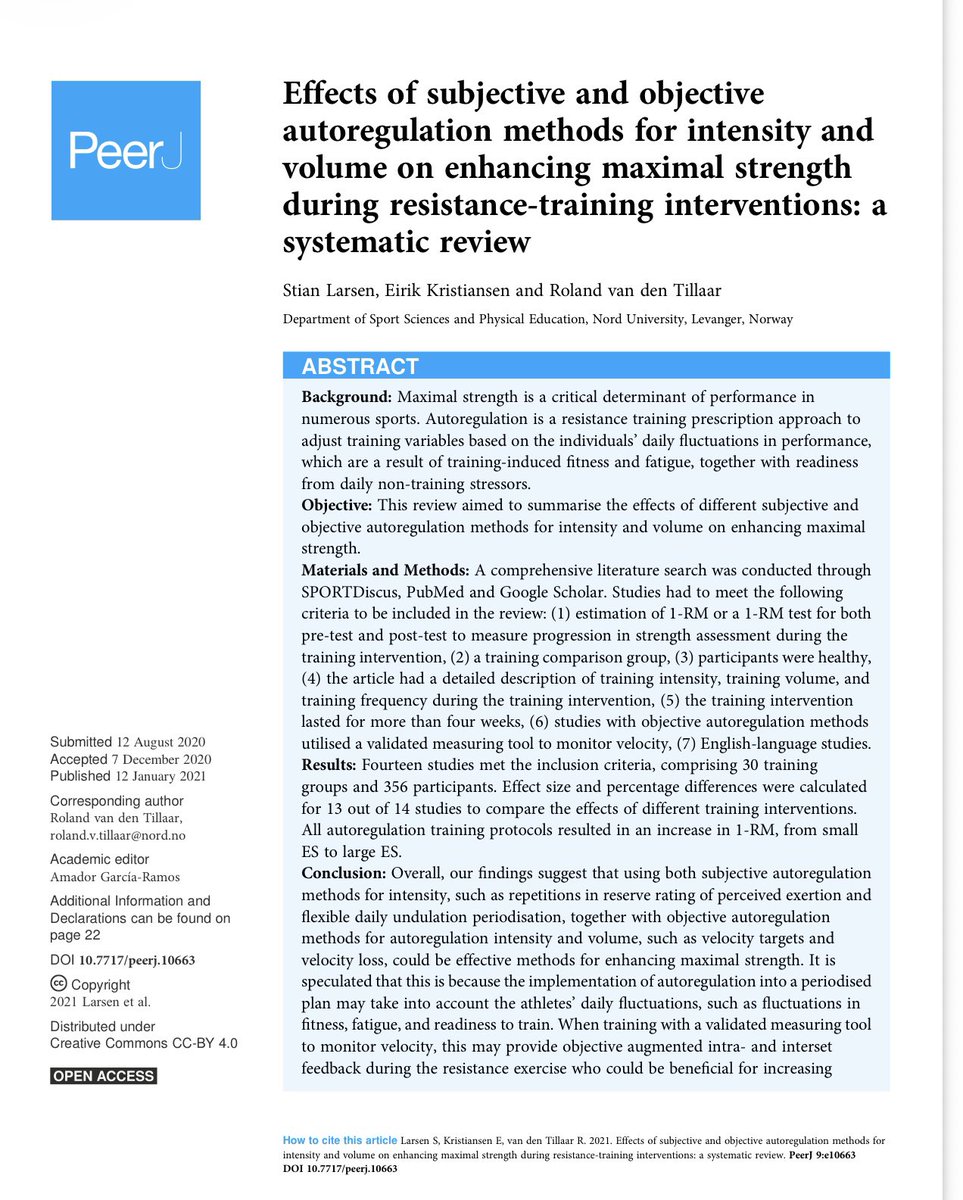
Properly understood, autoregulation is about adjusting training to the biological state of the human in front of you. Larsen et al. (2021) frame it around “daily fluctuations in performance” and the influence of “daily non training stressors” like sleep, nutrition, and illness.
That matters because autoregulation can be both:
• Subjective
RIR based RPE, RPE stops, readiness informed planning
• Objective
Velocity targets, velocity loss thresholds
Different tools. Same purpose.
The real point of autoregulation is to modulate the right dose, at the right time, at the right intensity, based on the biological state of the human as we understand it.
Done well, this does not lead to less.
It enables us to do more.
More tolerance for high intensity.
More tolerance for higher training volume.
Better enhancement of physical qualities.
Greater resiliency over time.
As the review concludes, both subjective and objective autoregulation methods “could be effective methods” for improving strength.
That is the conversation.
Not how to reduce stress.
How to dose stress appropriately so the human can adapt, perform, and ultimately handle more.
#HumanPerformance #StrengthAndConditioning #Autoregulation #TrainingLoad #Readiness #Performance
1
12
487

Mar 31
Player Pathway Resource Highlight
📊 Manage Your Training Load for Peak Performance!
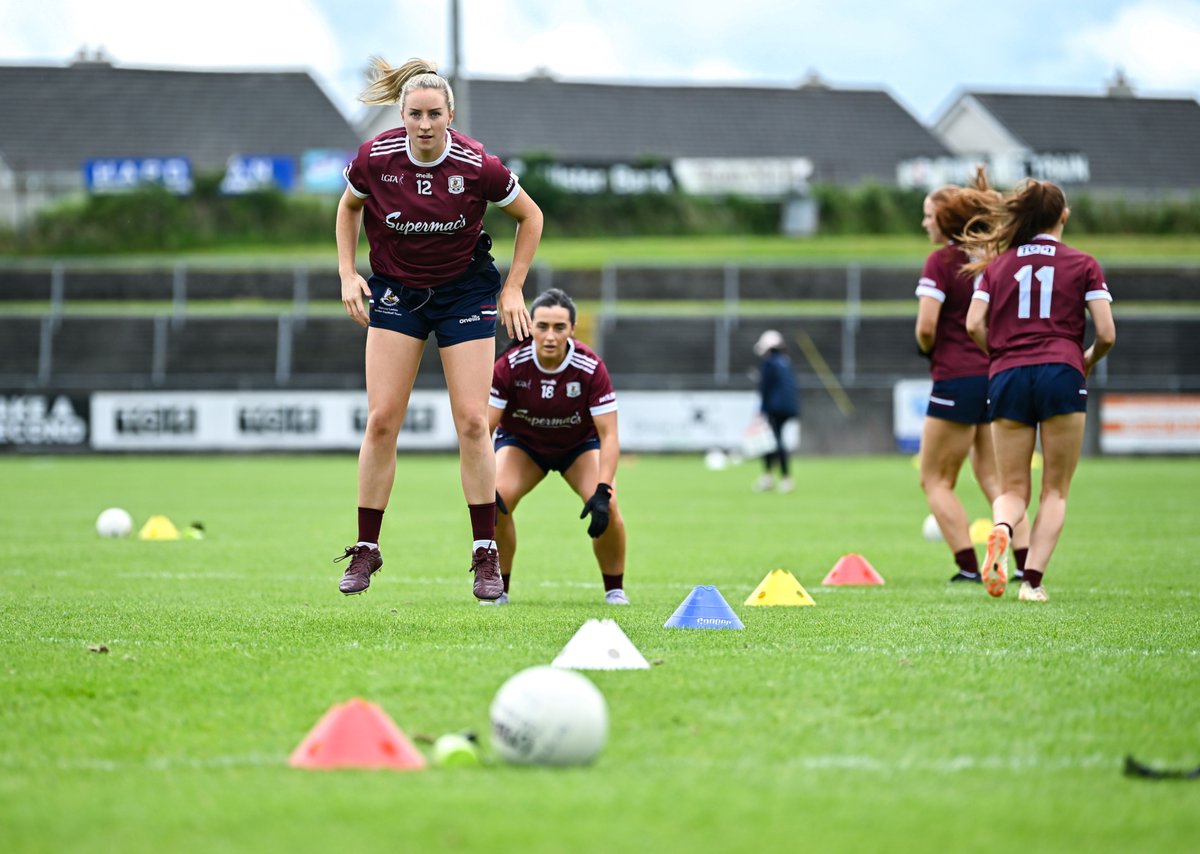
This webinar helps players understand how to manage training loads within LGFA and across multiple sports—so you can stay healthy, avoid burnout, and perform at your best.
🎥 Watch now: youtu.be/3hNpjJBAJlI
#PlayerPathway #TrainingLoad #AthleteWellness
1
1
544

Why do growing athletes get more overuse injuries?
During rapid growth phases, the body is using a large amount of energy to lengthen bones and build mass. That energy isn’t always available for tissue repair after the normal stresses of sports.
At the same time, increasing strength and power can place greater forces across joints, ligaments, and tendons.
In this Sports Medicine Minute, I explain why managing training loads and allowing time for adaptation is essential for young athletes.
youtube.com/shorts/YP7W1ZLZU…
#youthsports #sportsmedicine #growingathletes #sportsinjury #injuryprevention #athletehealth #sportsperformance #trainingload #sportsdoctor #youngathletes #returntosport

74

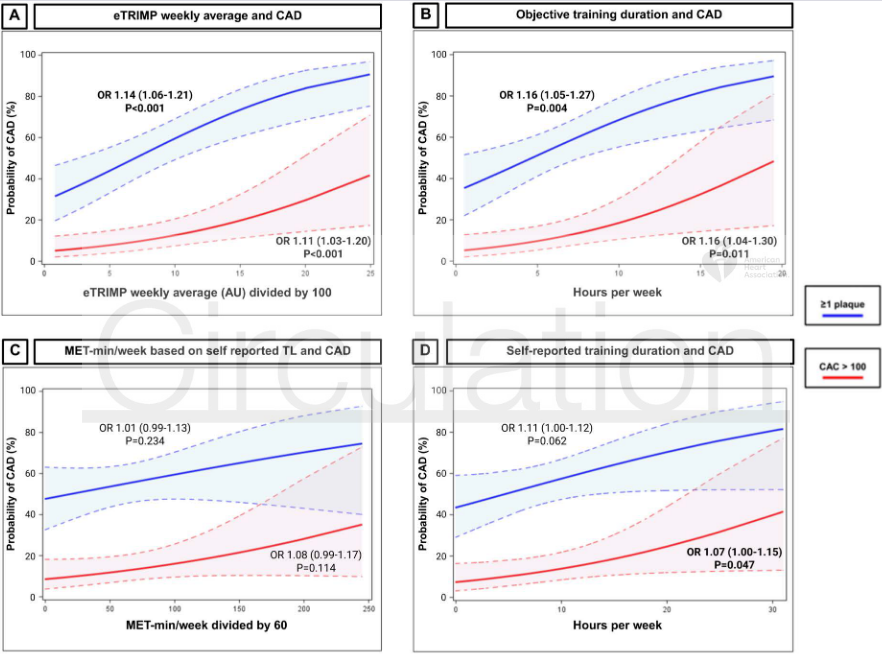
Wearable-Derived Training Load and Coronary Atherosclerosis in Middle-Aged and Older Athletes and Physically Active Controls: A New Perspective From the Master@Heart Study
ahajournals.org/doi/10.1161/…
#athlete #Coronaryarterydisease #trainingload #sportscardiology
1
4
15
695

Mar 5
Garmin Recovery Time is EPOC-based — it measures cardiovascular stress, not muscle damage. A hard interval session can generate the same figure as a long run. Heat and dehydration inflate it.
the5krunner.com/garmin-featu…
#garmin #garminrunning #trainingload
1
4
410
Mar 4
Garmin Training Effect scores aerobic and anaerobic stimulus separately on a 0–5 scale after each session. The aerobic score is driven by peak EPOC, not average effort — a brief hard effort scores lower than sustained intensity at the same peak. the5krunner.com/garmin-featu… #garmin #garminrunning #trainingload
270
Mar 4
Garmin Training Load is a rolling 7-day sum of physiological stress, calculated from EPOC generated by each recorded activity. A dropped load figure after a rest day is the window rolling, not fitness declining. the5krunner.com/garmin-featu… #garmin #trainingload #garminrunning
287
Mar 3
Garmin Training Status has seven labels — Productive, Maintaining, Peaking, Recovery, Unproductive, Overreaching, Detraining. Unproductive means load is high but VO2 max hasn't responded yet, not that training is wrong. Full breakdown: the5krunner.com/garmin-featu… #garmin #garminrunning #trainingload
1
284
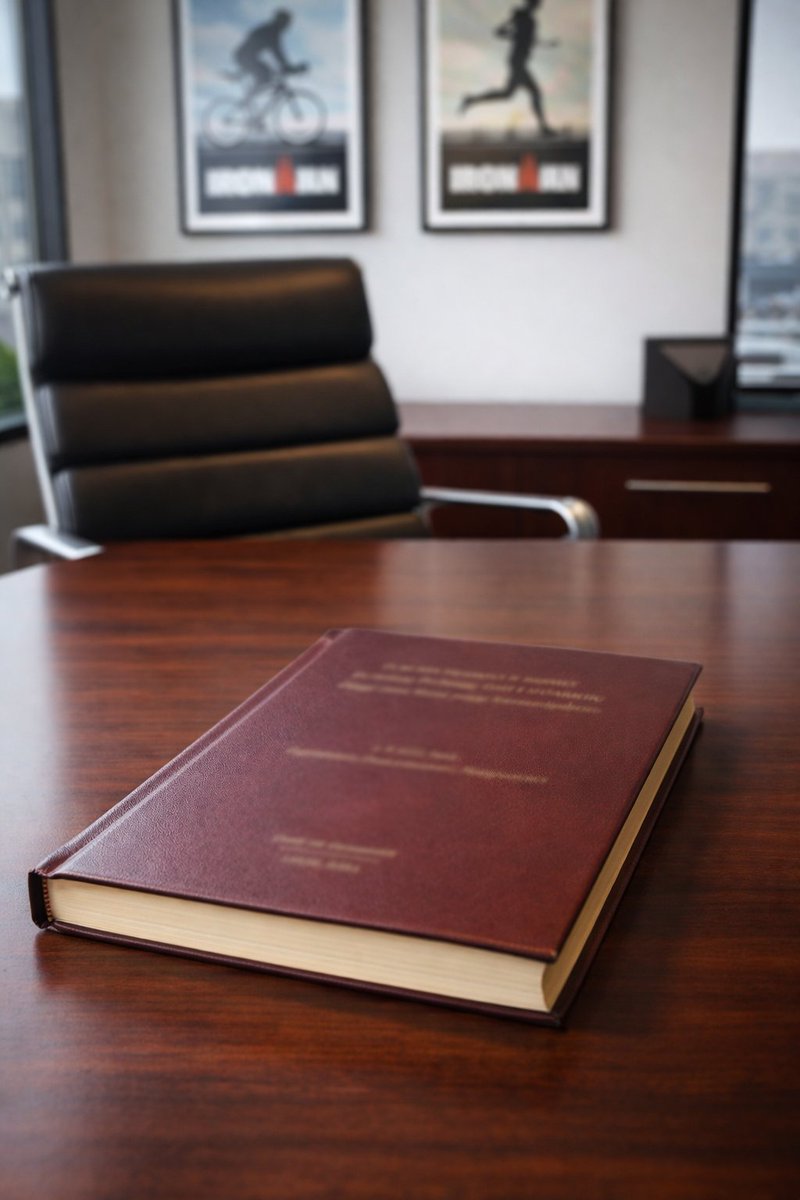
Triathlon Coaching PhD thesis is now publicly available:
>> Triathlon Coaching Practices: Optimising Training Load Processes & Communication <<
hdl.handle.net/10779/DRO/DU:…
#triathloncoaching #sportscience #trainingload
2
2
57

Key point: Fatigue isn’t purely physical. Sleep, stress, mindset, and recovery matter just as much as load selection.
#fatigue #strengthtraining #recovery #nervoussystem #trainingload #evidencebased #healthandperformance #theelitetrainer
9

Feb 2
Wearable sensor data machine learning can predict ratings of perceived exertion (RPE) in national-level soccer players. A step toward smarter, data-driven internal load monitoring
youtube.com/watch?v=Tftcmndo…
#SportsScience #Soccer #Wearables #MachineLearning #TrainingLoad #JSSM
1
1
5
813

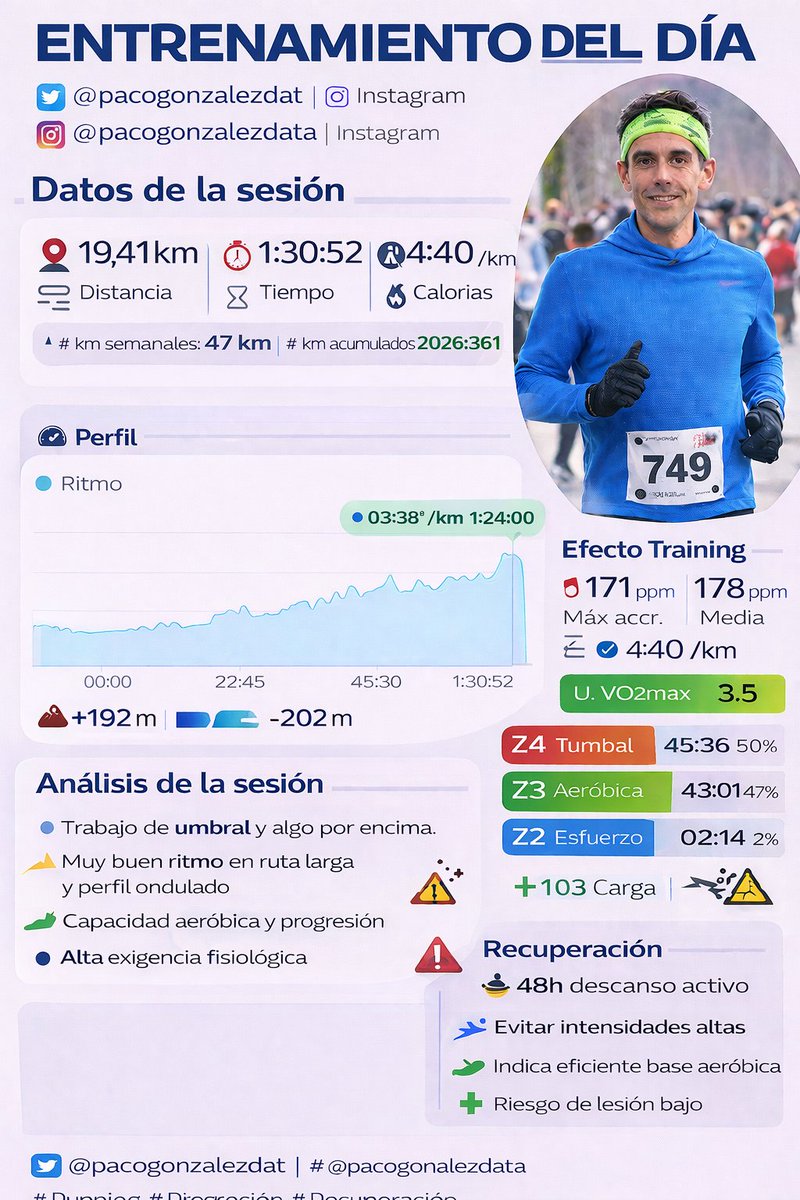
Entrenamiento del día 🏃♂️
19,41 km · 1:30:52 · 4:40/km
47 km esta semana
361 km acumulados en 2026
Constancia control de carga = progreso.
#Running #TrainingLoad #Performance
78