
May 13
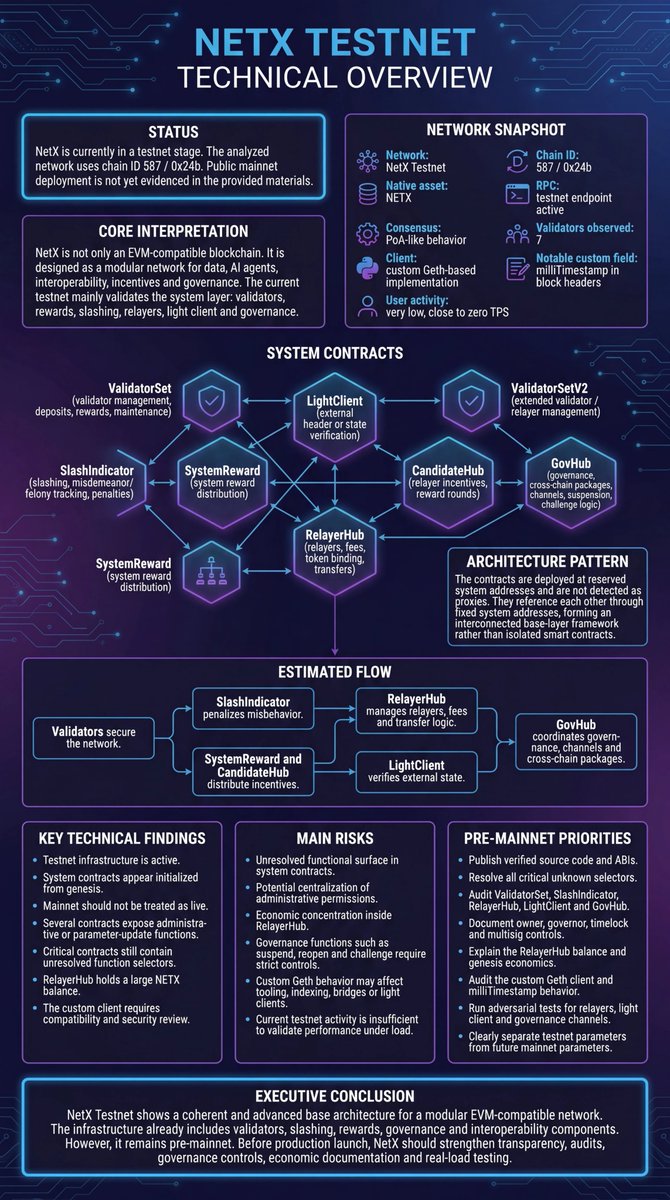
The NetX testnet technical overview (without access to any documentation or smart contract code, it is based on deep testnet crawling and contract decoding driven by agent-based deterministic local inference) showed a modular system architecture, not a blank EVM sandbox. The key findings were $NETX as native gas, a 7-validator PoA structure, reserved system contracts, cross-chain primitives, governance components and a staged pre-mainnet design. @netx_world
#NETXTestNetFindings
The second important piece from the NetX testnet is the technical overview.
At first glance, it looked like a small EVM-compatible network with low activity.
But once the RPC, validators and reserved contracts were mapped, the picture changed.
NetX testnet was structured like a system chain.
It had a clear network snapshot:
Chain ID: 587 / 0x24b
Native asset: NETX
Consensus: PoA-like behavior
Validators observed: 7
Client: custom Geth-based implementation
Block timing: around 3 seconds
User activity: very low, close to zero TPS
Custom header field: milliTimestamp
That matters because the testnet was not only testing whether contracts could deploy.
It was testing the foundation of a chain with its own validator layer, system contracts, relay logic and future governance path.
The most important concept here is NETX-as-gas.
In the observed testnet, NETX was the native execution asset. That means contract calls, deployments, system interactions and settlement-style operations were priced in NETX.
This is the first layer of token utility:
not narrative utility,
but execution utility.
The system contracts were the real signal.
The base layer included components such as:
ValidatorSet for validator management, deposits, rewards and maintenance.
SlashIndicator for misdemeanor, felony and slashing-style accountability.
SystemReward and CandidateHub for system incentives and relayer-related rewards.
LightClient for external header or state verification.
RelayerHub / TokenHub for relayers, fees, token binding and transfer coordination.
GovHub for governance packages, channels, suspension, reopening and challenge logic.
This architecture suggests a network designed around more than transaction execution.
It suggests a network built for verification, coordination and accountability.
The architecture pattern is also important.
These contracts were deployed at reserved system addresses and were not detected as simple user contracts. They referenced each other through fixed system addresses, forming an interconnected base-layer framework rather than isolated smart contracts.
That is the difference between:
“someone deployed a few contracts”
and
“the chain has a protocol-level system map.”
The estimated flow is easy to understand:
· Validators secure the network.
· SlashIndicator penalizes misbehavior.
· SystemReward and CandidateHub distribute incentives.
· RelayerHub coordinates relayers, fees and transfer logic.
· LightClient verifies external state.
· GovHub coordinates governance, channels and cross-chain packages.
This is why the testnet is interesting even with low user activity.
Low activity means it was not yet a production network.
But the contract map shows that the testnet was preparing something much larger:
a modular base for validation, rewards, slashing, relay, external proofs, governance and interoperability.
The risks are equally important.
There were unresolved selectors in critical contracts, potential administrative centralization, large balances inside system contracts, custom client behavior and staged components that still required activation, verification and public documentation.
So the right conclusion is balanced:
The NetX testnet was not mainnet.
It was not production-ready.
But it was also not empty.
It showed a coherent technical foundation for a modular EVM-compatible network where $NETX acts as gas, system contracts coordinate the base layer, and future governance, staking and settlement infrastructure can be built on top.
That is the technical overview worth documenting 🫡
* Please note that this research was not provided by the team and is published as an independent study without full access to the source code or testnet infrastructure; as a result, it may contain errors or inconsistencies compared to the final product.
2
19
68
1,068
May 12
The NetX testnet shutdown makes the technical snapshot more valuable. While live, it showed a serious pre-mainnet architecture with $NETX as native gas, system contracts, relay logic, governance, token management and recovery components. Not mainnet yet, but definitely not an empty testnet either. @netx_world
#NETXTestNetFindings
The NetX testnet going offline may look like a small technical event, but for research it matters.
Because while it was live, it gave us a rare on-chain window into what NetX was actually testing beneath the public narrative.
And the most important conclusion is simple:
NetX was not just running a basic EVM testnet.
What we observed was a structured system architecture with native gas, validators, slashing, relay logic, light-client verification, token-management components, governance contracts, timelock infrastructure, staking components and recovery-style mechanisms.
That does not mean mainnet is live.
It does not mean every component was fully activated.
It does not mean the full product stack is already in production.
But it does mean the testnet was not empty.
It was a technical staging environment for a much larger architecture.
The base layer showed active system infrastructure:
ValidatorSet
SlashIndicator
LightClient
TokenHub / RelayerHub
Incentivize / CandidateHub
RelayerHub V2
GovHub
The advanced layer appeared deployed but mostly staged:
Staking
ValidatorHub / StakeHub
NativeToken / StakeCredit
GovToken
Governor
Timelock
TokenManager
TokenRecoverPortal
That distinction is important.
Active base layer.
Staged advanced layer.
This is exactly how an early technical network can look before mainnet: not finished, not production-grade, but already revealing the design philosophy.
The strongest finding, in my view, is that NetX seems positioned less like “another payment blockchain” and more like a programmable trust layer.
A layer for payment intents, settlement records, compliance proofs, audit trails, challenge logic, cross-chain state, token management, operator accountability and governed rule changes.
Stablecoins can move value. Wallets can handle user experience. Payment processors can handle merchants.
But someone still needs to record the institutional context:
Who authorized the payment?
Which rule applied?
Was the merchant settlement valid?
What proof exists?
What happens if there is a dispute?
Who is accountable if something goes wrong?
That is where NetX could become strategically relevant.
The testnet may be offline now, but the architecture it revealed is worth documenting.
3
23
75
2,038

Feb 13
☕️⚙️ FRIDAY LOAD CHECK
// P-OPS TEAM | End-of-Week Execution Read
🌅 By Friday, noise has burned off.
Speculative flows have rotated.
Short-term delegations have settled.
Validator performance is no longer reacting — it’s revealing.
This is where staking conditions become measurable.
🔍 Today’s focus: execution stability under mature delegation weight.
⚙️ Observed this morning
📦 Proposer distribution resolving proportionally across stake
🔁 Epoch transitions clearing without participation compression
📡 Reward credits finalising on consistent timing paths
⚖️ Active set weight holding inside expected variance bands
🧠 Late-week staking isn’t about acceleration.
It’s about symmetry.
Healthy networks at this stage show:
• Even proposer cadence
• No late-epoch clustering
• Clean reward accounting
• Governance participation holding steady
When those align, yield compounds quietly.
🛡️ Stable staking environments don’t spike.
They sustain.
🤝 For delegators, this is the confirmation window.
Not the moment of hype — the moment of validation.
📊 Execution balanced.
☕ Systems steady.
🧭 Rolling cleanly into the weekend.
☎️ Stay Connected with P-OPS Team
🌎 Website: pops.one
🌳 Linktree: linktr.ee/p_opsteam
🐥 Twitter/X: x.com/popsteam1
↗️ Telegram: t.me/POPS_Team_Validator
👾 Discord: discord.gg/jJ8aaMwPwa
#POPSteam #FridayLoadCheck #Staking #Delegation #ValidatorSet #ProofOfStake #YieldFormation #OperationalConsistency #ActiveSet

1
9
15
140
Feb 6
☕️⚙️ FRIDAY LOAD CHECK
// P-OPS TEAM | End-of-Week Staking Pass
🌅 Most staking outcomes are decided quietly — after the week has already made up its mind.
Friday is where stake tells the truth.
Delegations have settled.
Validator sets have stabilised.
Reward paths are no longer forming — they’re executing.
This is the cleanest staking read of the week.
🔍 Today’s load check focuses on routine stake flow — the conditions where yield is earned, not chased.
⚙️ Staking signals observed this morning
📦 Block production resolving evenly across delegated weight
🔁 Validator participation remaining consistent across epochs
📡 Reward distribution tracking clean, uninterrupted paths
⚖️ Capacity headroom preserved without variance creep
🧠 Nothing flashy here — and that’s the point.
Healthy staking environments feel calm late in the week.
They don’t oscillate.
They don’t distort incentives.
They compound.
🛡️ This is dependable staking behaviour:
steady execution, predictable rewards, and delegation held inside a stable operating range.
🤝 For delegators, this window matters.
Yield isn’t created at peak moments — it’s accumulated during ordinary cycles like this one.
🧭 We’re on desk.
📊 Tracking reward symmetry.
☕ Letting stake resolve cleanly into the weekend.
☎️ Stay Connected with P-OPS Team
🌎 Website: pops.one
🌳 Linktree: linktr.ee/p_opsteam
🐥 Twitter/X: x.com/popsteam1
↗️ Telegram: t.me/POPS_Team_Validator
👾 Discord: discord.gg/jJ8aaMwPwa
#POPSteam #FridayLoadCheck #Staking #Delegation #ValidatorSet #ProofOfStake #YieldFormation #OperationalConsistency #BuiltQuietly

8
20
162

⚠️ 68% of Solana validators have vanished since 2023. High node costs zero-fee RPCs are crushing sustainability. Core performance’s okay—but this validator exodus could threaten #decentralization long-term. Eyes on ecosystem incentives. ⛓️ #Solana #ValidatorSet #CryptoInfra #Web3
2
20


26 Jul 2025
⚙️ Validator Architecture on Portal: Selective, Competitive, and Performance Driven
Unlike many networks that allow open-ended validator slots, Portal to Bitcoin ($PTB) enforces a strict limit of just 42 active validator positions. That’s not a random cap it’s a design choice to prioritize quality over quantity.
🎯 Why does this matter?
Only the top 42 validators by total stake receive block rewards and participate in consensus. That means:
No room for weak or underperforming nodes.
Delegators must choose proven teams not just hype or popularity.
The network becomes leaner, more secure, and more efficient.
At Forest Staking, we accept this challenge. With military grade security, high-availability infra, and real-time monitoring, we’re here to earn our place in the top 42 not coast into it.
🌱 Staking with Forest means backing performance, not promises.
💡 Curious how performance-based staking will shape Bitcoin's future Layer 2?
Let’s talk. Don’t just follow the crowd follow insight. That’s how smart followers grow.
#PortalToBitcoin #ForestStaking #StakeWithConviction #BitcoinL2 #ValidatorSet #CryptoInfra #Web3Quality #KaitoAI #DecentralizedFuture #YAPS #StakeSmart

3
100

19 Jul 2025
🛠️ DevLog – Refactoring Oracle for SessionEnded: Light Validator Foundation
As part of our ongoing CognitiveLevel and Network Task Level iteration, we've started refactoring the Oracle codepath for SessionEnded - laying the groundwork for lightweight validators.
🔹 Why This Matters
This logic is a key dependency for Proof-of-Inference (PoI) and Proof-of-Useful-Work (PoUW).
It enables trusted session-level evaluation and validator roles - without full node overhead.
🔹 Current Functionality
- Basic hash matching and word/token count checks are active.
- Nodes with ≥90% success each level are eligible for level upgrades via CognitiveLevel module.
- Results now shown live: dashboard-devnet6.cortensor.…
🔹 What’s Next
- Deploying first 24/7 "light validator" node to continuously run SessionEnded event validation logic.
- Expanding logic to cluster/compare miner outputs from the same session.
- Laying the framework for abnormality detection and fault-tolerant PoI.
This is an essential step toward a scalable validator set - driving secure, decentralized AI verification without centralized compute overhead.
#Cortensor #DevNet6 #PoI #PoUW #CognitiveLevel #AIInfra #DePIN #ValidatorSet #DevLog
18 Jul 2025

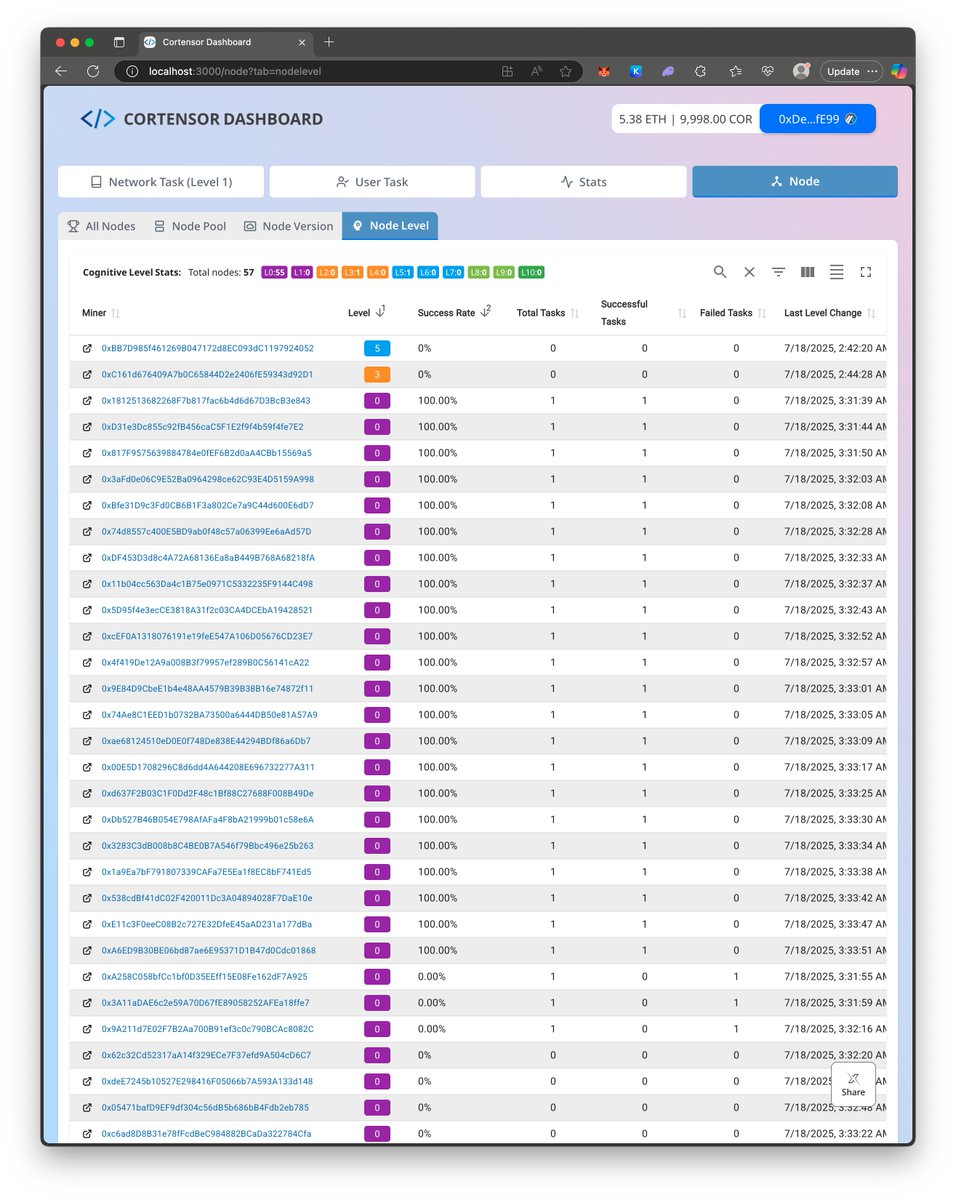
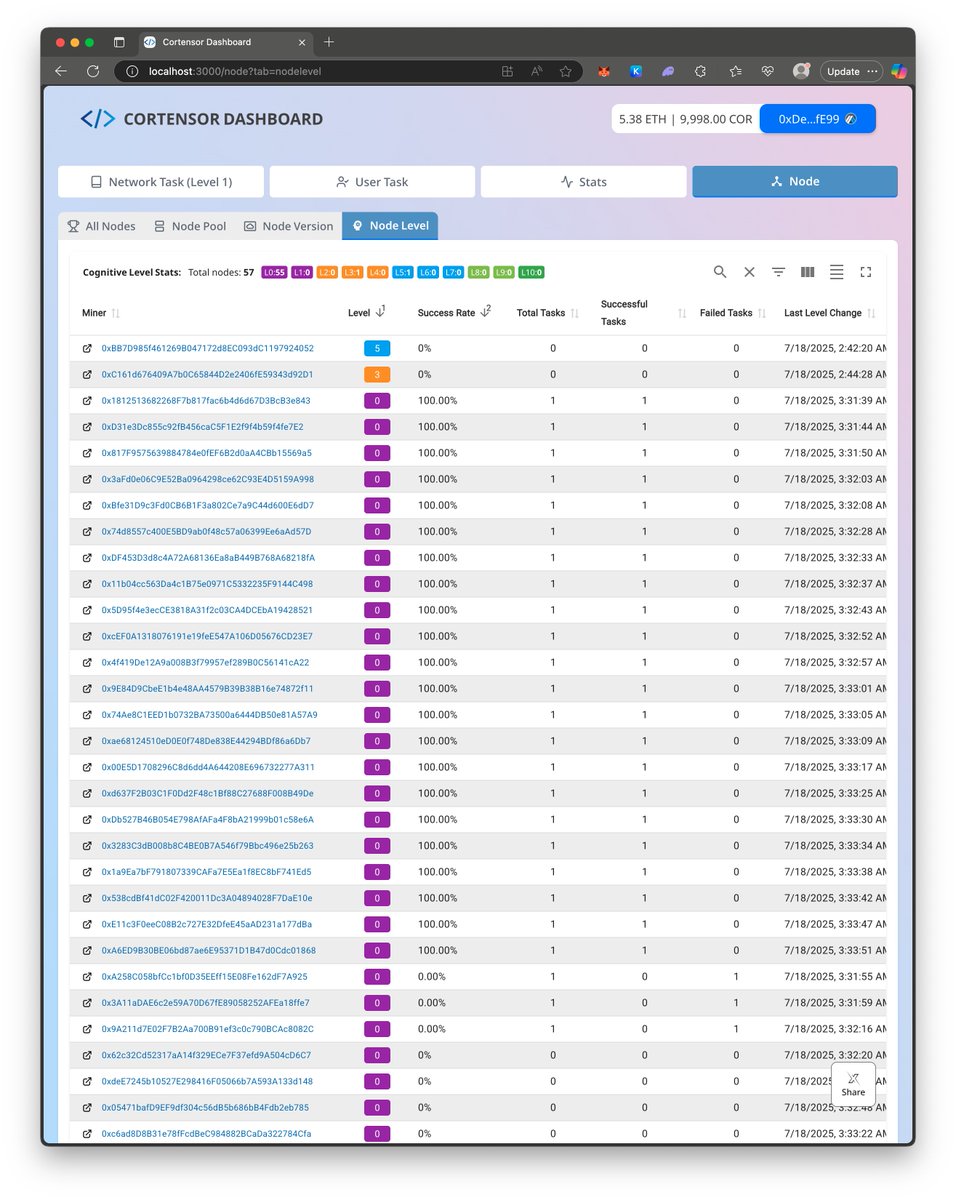
🛠️ DevLog – CognitiveLevel (Node Level) UI Integration (WIP)
CognitiveLevel is being actively tested on DevNet6, and we're rolling out tools to better debug and visualize node-level behavior.
🔹 CognitiveLevel Module
- Live on DevNet6, tracking node levels, success rates, and task stats.
- Levels now update based on task performance.
🔹 Miner Integration
- Miners fetch their level and run recursive inference accordingly.
- Example: Level 3 = 3 rounds of extended inference before precommit.
🔹 Debug Dashboard
- New UI tab shows level, success rate, task stats, and last level change.
- Helps trace upgrades/downgrades in real time.
🔹 Next Up: Oracle Integration
- Oracles will validate outputs, adjust levels, and feed results back to the contract.
🔹 Why It Matters
This powers adaptive Proof-of-Inference: smarter task routing, fairer workloads, and incentives tied to real performance.
#Cortensor #DevLog #DevNet6 #CognitiveLevel #PoUW #AIInfra #DePIN #NodeOps
4
7
17
1,108
18 Jun 2025
Node Ops Update – Capacity & Onboarding
Even with Phase #4 live and small-scale promotions, only a few new node operators have been approved - even among KYC-complete applicants.
To ensure a healthy network, we're introducing key changes:
1️⃣ Strict KYC Enforcement – Full KYC is now required for all node ops.
2️⃣ Role-Based Node Capacity – A trust-based system where active, senior participants can operate more nodes. Rolling out later this week.
🔢 For now, we're maintaining 200–300 active nodes. As we're still in DevNet, scaling too early could create unnecessary reward sell pressure.
When expansion is needed, trusted existing ops will get priority under the new framework - allowing us to grow in controlled 100-200 node increments.
We'll continue refining the safest and most effective way to expand the network.
#Cortensor #NodeOps #DePIN #DevNet #Phase4 #Infrastructure #ValidatorSet
3
6
17
319
17 Jun 2025
🛠️ DevLog – Multi-Oracle Deployed on DevNet6 for Testing
We've deployed the initial multi-oracle setup to DevNet6 and will begin testing and refining it today.
🔹 Current Election Logic (Simple but Functional):
• 2 oracles (shards 0 & 1) take turns handling tasks
• Role switches every 5 minutes
• Each session is assigned a primary oracle
This version is intentionally minimal - built as the foundation for permissionless oracle rotation and validator set architecture in future phases.
If stable, we'll expand to 4 oracles with a 3–5 min leader rotation cycle.
#Cortensor #DevLog #Oracle #LeaderElection #DevNet6 #DePIN #AIInfra #ValidatorSet
15 Jun 2025
🗓️ Weekly Focus – Phase #4 Week 1, UI Iteration, L3 Resilience
Here's what we're focused on across the Cortensor stack this week:
🔹 DevNet5 Monitoring & Tuning
Phase #4 is live - we're actively monitoring miner behavior, sessions, and overall reliability through ongoing stress tests.
We'll continue running smaller tests throughout the Phase #4 period.
🔹 Session UI – Task Result Refinement
Improving the user task result view with:
• Timestamps
• Output token stats
• High-level completion metrics
Better visibility = better debugging better UX.
🔹 Session UI – General Iteration & Node Pool Dynamics
Refining orchestration flow visuals (ack → precommit → commit) while improving how Node Pool population and session dynamics are displayed.
This helps surface real-time node availability, reaction behavior, and overall network capacity during session execution.
🔹 Multi-Oracle per Network
Design, implementation, and testing underway.
Starts with 2 oracles (15-min rotation), scaling to 4 per network - boosting fault tolerance and reliability.
🔹 L3 Stress Testing (Ongoing)
Continue load testing and validation.
Early signs are strong - ~500 tx/sec. L3 is on track to anchor DevNet6 / Phase #5 if stability holds.
#Cortensor #Phase4 #DevLog #L3 #SessionUI #DePIN #AIInfra #Oracle #Testnet
5
8
18
772

12 Jun 2025
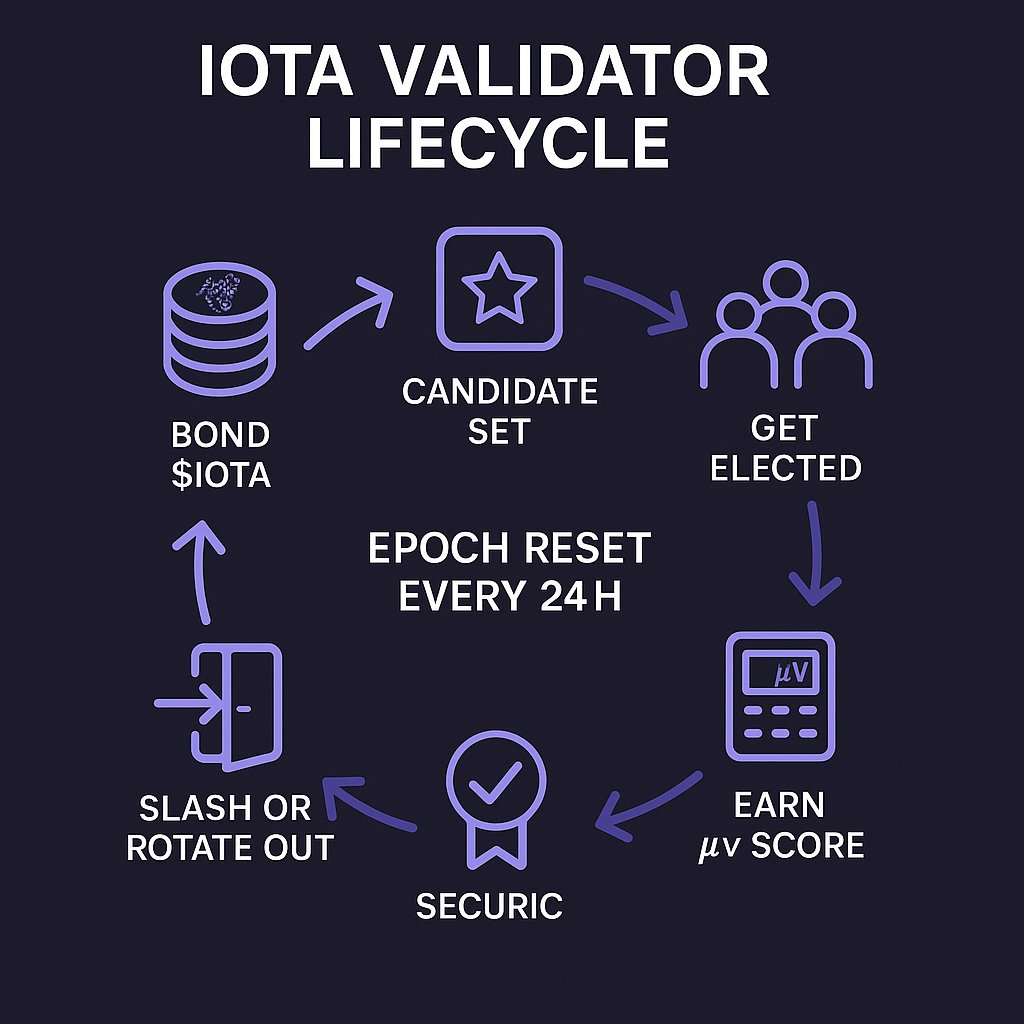
In IOTA, being a validator isn’t a title.
It’s a job — and it gets reviewed daily. 🧠⏳
🔸 Bond $IOTA to enter the candidate set
🔸 Get elected if your stake is high enough
🔸 Earn a μv score based on performance
🔸 Slashed or rotated out if underperforming
🔸 Epoch resets every 24h — scores, rewards, access
It’s permissionless pressure.
Not just proof of stake — proof of results.
#IOTA #ValidatorSet #DPoS #MoveLang #Web3Infra
48

11 Jun 2025
A FUTURE READY VISION OF CROSS‑CHAIN MAGIC POWERED BY ZERO‑KNOWLEDGE!
There has been a lot of buzz since Monday when @union_build teased that they would be achieving full mainnet this summer, now that's a good thing but I would like you to hold your horses, let's study union and it's framework.
What Is Union?
Union is a modular interoperability protocol designed to seamlessly connect blockchains and dApps, enabling fast asset and message transfers without trusted intermediaries. It achieves this via two core innovations:
- Consensus Verification
- zero-knowledge cryptography (zkps)
Together, this enables swift, secure, and cost effective inter‑chain connections across any execution environment with no trusted actors, no central authority, just cryptographic guarantees.
Interoperability & Modularity; A Perfect Pair
Interoperability: Lets blockchains and dApps written in Solidity, Rust, Move, etc., talk to each other, removing fragmented UX and enabling richer cross‑chain experiences.
Modularity: Union is built as a collection of plug‑and‑play pieces, proof, verify, integrate making it easy to mix, match, and upgrade components independently.
Use Cases of the Union eco
Message passing: Enables DEX-to-lending, lending-to-nft, etc without needing a bridge.
Asset transfers: Move fungible tokens or staked derivatives across chains.
Cross‑chain NFTs: Shift NFTs between standards (ERC-721, ICS‑72) securely and efficiently.
How Union Actually Works
1. Each integrating chain installs a Union light client.
2. When sending txs from Chain A → B, a ZKP is generated on A.
3. That proof is submitted to Chain B, where a smart‑contract verifier checks it and finalizes the state.
4. Consensus verification makes sure ValidatorSet A indeed finalized the block, via on‑chain ZKP.
5. Any individual on regular hardware can run a prover no censorship, no trusted parties.
Instead of depending on fragile multi-sigs or centralized bridges, Union lets chains trust cryptography, not humans. Validators must reach consensus in a way provable with ZKP.
ZKPs give scalability, speed, cost-efficiency.
Meet the Magic Tools
-Galois
.Union's ZK engine, purpose-built for consensus verification.
.Focused on speed, low-cost, decentralization.
.Handles send events → ZKP generation → cross-chain update.
.Runs quickly even on single machines no massive infrastructure required.
-CometBLS
.A customized Tendermint upgrade using BLS signatures.
.Optimized for ZK proving efficiency, ideal for gas-tight chains like Ethereum.
.Supports hundreds of validators without sacrificing performance.
-Voyager
.This is the event-driven off-chain relayer handling packets and proof movement.
.Works with Galois over gRPC.
.Designed to integrate future “proving markets,” making the system resilient and extensible.
Why does Union Matter?
Union’s blueprint brings Web3 one step closer to:
-True trustless interoperability
-Low-cost, high-speed cross‑chain activities
-Modular upgrades and open scalability
-It smartly blends the robustness of IBC with modern cryptography, a next-gen solution for the fragmented blockchain world.
In Conclusion
Union isn't just another cross-chain protocol, it’s a modular, ZK-powered ecosystem designed for true, permissionless interoperability. Whether you’re a dApp dev, a chain architect, or just crypto-curious, Union's architecture gives you trust-minimized cross-chain building blocks for the future. And with all the buzz surrounding it you just know that people are excited for what's to come.
Zkgm.

68
1
63
1,333
10 Jun 2025
Most chains let validators camp forever.
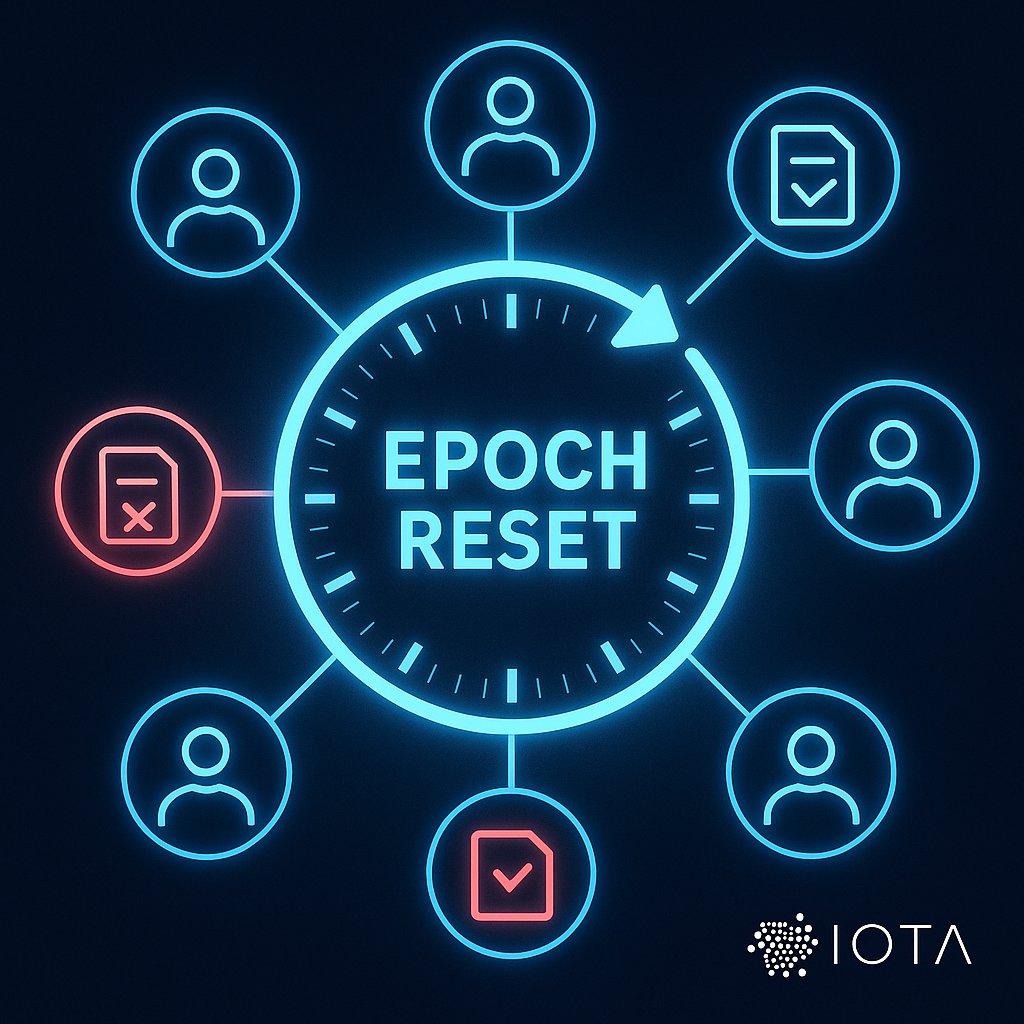
IOTA resets the table — every 24 hours. 🔁
Here’s what happens at each epoch boundary:
📆 Validator set is refreshed
🧮 Performance is recalculated
⚖️ Rewards are distributed (or slashed)
🆕 New validators can join
📊 Stake redelegation is open
Fresh consensus. Fair scoring.
Stability without stagnation.
#IOTA #ValidatorSet #Staking #EpochReset #Web3Infra $SOPH $BTC $DEXE $BDXN $PEPE $HYPE $WIF $BOB $ZRC #USDT
3
1
96

26 May 2025
@garuda_defi spend prop for liquidity injection as per proposal 12171 in deposit stage.
If you are not afraid of the downvoting spasm by the upper 33% of the validatorset, then this is the place to put your deposit into :D
station.hexxagon.io/proposal…
1
12
29
530

10 Mar 2025
🔥 Fogo’s Curated Validator Set: Performance, Fairness & Governance
To achieve high performance and mitigate abusive MEV practices, @FogoChain introduces a curated validator set—designed to ensure efficiency without sacrificing decentralization.
🔹 Why a Curated Validator Set?
In high-performance networks, even a small fraction of under-provisioned validators can bottleneck the entire system. Fogo addresses this by:
✅ Starting with a proof-of-authority model before transitioning governance to the validator set
✅ Enforcing validator quality standards to maximize network performance
✅ Preventing abusive MEV extraction that harms network usability
🔹 How Validator Governance Works
⚡ Initial Setup: A genesis authority selects the first validator set (20-50 nodes) to stabilize the network.
⚡ Transition to Validators: Control shifts from the genesis authority to the validator set itself.
⚡ Stake-Based Decision Making: Future validator changes require a 2/3 supermajority of staked tokens, aligning governance with Proof-of-Stake principles.
🔹 Ensuring Network Stability & Fairness
Fogo’s governance model allows validators to enforce beneficial behaviors that can’t always be encoded into protocol rules. Validators can eject peers for:
🚫 Persistent performance issues
🚫 Excessive, harmful MEV extraction
🚫 Behaviors that degrade network usability
Rather than centralizing power, this model formalizes the natural authority that PoS validators already hold—aligning incentives for long-term network health.
Is this the future of validator governance? Let’s discuss. 🔥👇
#Fogo #Blockchain #PoS #ValidatorSet #MEV #Decentralization #Web3
@RobertSagurton
1
5
10,513
5 Dec 2024
🌟 We’re excited to join @elixir Genesis Validator Set!
🧪 At P-OPS Team, we’re honoured to be part of Phase I Mainnet alongside an incredible mix of:
🤝 Community validators
🏢 Institutional infrastructure providers
🧠 Strategic partners
🔐 As Genesis Validators, we’re dedicated to:
🛡️ Securing the network
⚡ Enabling high-throughput consensus
🌍 Supporting Elixir’s journey toward decentralisation
🚀 This is just the beginning!
When the public mainnet launches, staking opportunities will open for everyone:
🏗️ Run your own validator
📤 Delegate to trusted validators like us
💡 Looking forward to Elixir’s Foundation Delegation Program
💪 This initiative will empower smaller, high-performance validators by delegating foundation tokens to support a more decentralised and robust network.
📖 Learn more about the Genesis Validator Set here:
mirror.xyz/0x25832C2fC7B7380…
☎️ Stay Connected with P-OPS Team:
🌎 Website: pops.one
🌳 Linktree: linktr.ee/p_opsteam
🐥 Twitter: twitter.com/POpsTeam1
↗️ Telegram: t.me/POPS_Team_Validator
👾 Discord: discord.gg/jJ8aaMwPwa
#POPSteam #ElixirMainnet #GenesisValidator #BlockchainCommunity
#Decentralisation #ValidatorSet #CryptoNetwork #SecureConsensus
#HighThroughput #CryptoInnovation #BlockchainCollaboration #ValidatorNode
#DeFiSecurity #StakingRewards #CryptoEcosystem #CryptoFuture
#CryptoPartnerships #StakingCommunity #ValidatorCommunity #POPSValidators

Introducing Elixir's Genesis Validator Set 🧪
This set includes a mix of community validators, institutional infrastructure providers, and strategic partners during mainnet phase I
Validators secure the network and ensure high-throughput consensus
1
11
367

18 Sep 2024
1/3
More validators mean more communication for consensus. Each must sync with others to finalize a block, adding a small delay. Increasing the active set slightly slows down block times. #Blockchain #ValidatorSet #ConsensusMechanism $LUNC $USTC #USTC $TERRA $ETH @VitalikButerin
1
4
211

13 Sep 2024
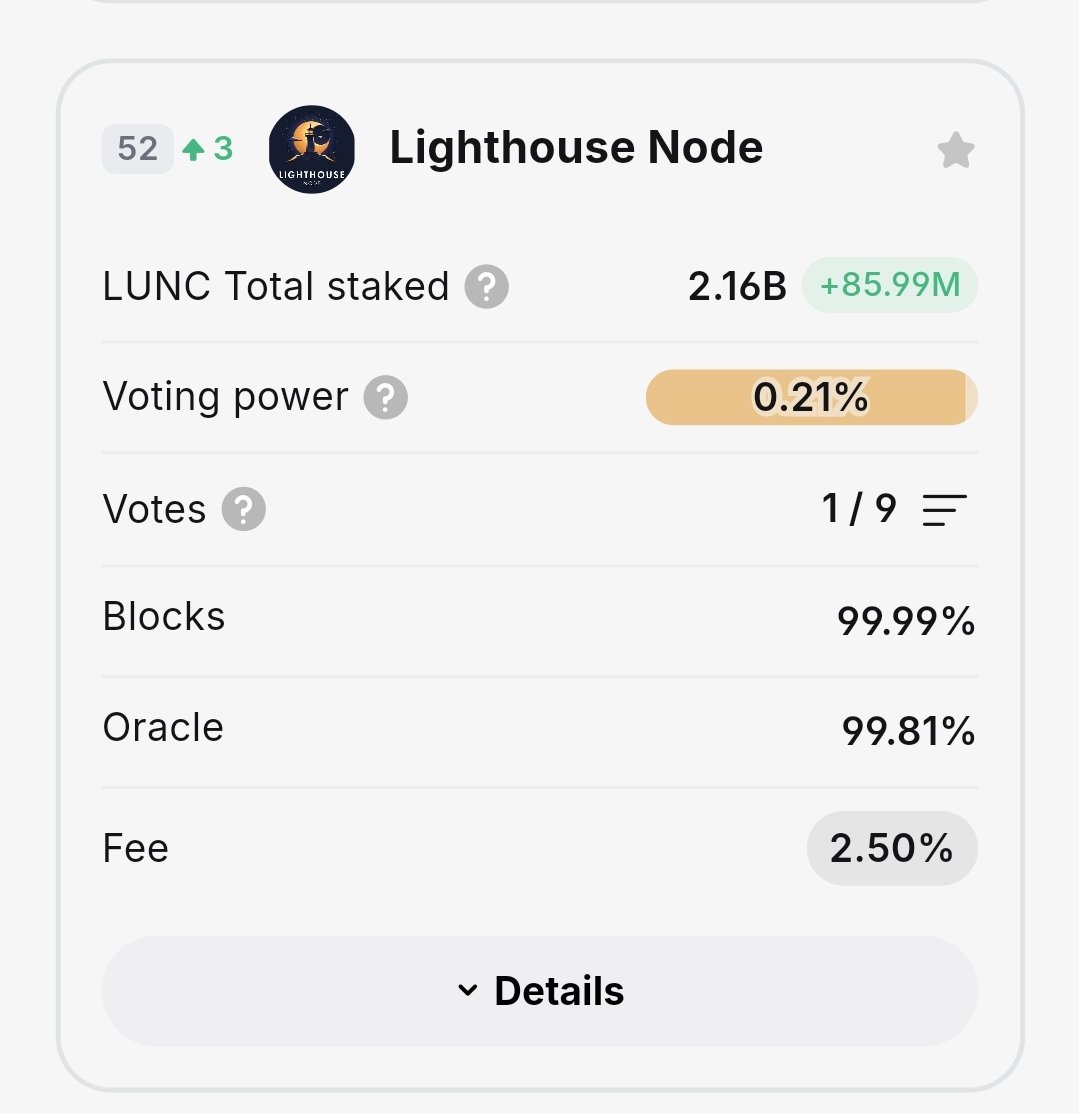
Glad to see us moving up again 💪 ( as we should ) if you want to support us and you allign with our values and vision and can see our contribution then stake some of your #lunc with us 💪 @Lighthouse_Node
Earn approx. 10% APR .
Still set at the min commission of 2.5 % meaning more rewards for YOU.
Feel like the validatorset has changed into the "haagse markt " haha , only Dutchies will understand.
We are consistent, value transparency , security and growth and we are 100% commited to $LUNC ✨️👊
#LunaClassic #stakingissexy
1
11
30
754
2 Aug 2024
🥛 Joining the MilkINIT Testnet: A New Era of Staking!
🔗 The P-OPS Team is excited to announce our participation in the @milky_way_zone MilkINIT testnet, joining a fantastic line-up of trusted validators from within the @CelestiaOrg ecosystem.
🦾 Our involvement highlights our commitment to advancing blockchain security and promoting decentralisation.
💠 By staking your $TIA through MilkyWay, you benefit from a fair and transparent system where assets are evenly distributed among all validators.
☄️ With a maximum commission cap of 10% across the board, stakers receive the best possible rewards.
🌠 As we embark on this exciting journey with the MilkINIT testnet, we are dedicated to providing top-tier staking services, bolstering network resilience, and contributing to a more decentralised future.
☎️ Stay Connected with P-OPS Team:
🌎 Website: pops.one
🌳 Linktree: linktr.ee/p_opsteam
🐥 Twitter: twitter.com/POpsTeam1
↗️ Telegram: t.me/POPS_Team_Validator
👾 Discord: discord.gg/jJ8aaMwPwa
🚀 Let's make the cosmos safer and more decentralised together!
#Staking #Validators #Celestia #PopsTeam #Blockchain #Crypto #Decentralisation #Milkyway #CryptoCommunity #CryptoStaking #ValidatorSet #BlockchainSecurity #CelestiaNetwork #CryptoNews #StakingRewards #StakingCrypto #CryptoEcosystem #BlockchainCommunity #SecureStaking #CryptoJourney #BlockchainInnovation

1 Aug 2024

gMilk!🥛
milkINIT Testnet will be secured by the best.
Welcome to all Validators!
1
9
18
434

12 May 2024
After following all the #LUNC drama for the last 2 years I kind of feel sorry for the community. A lot of talk, not a lot of action. The validatorchat says it all🤷♂️. The validatorset is filled with to many greedy, selfish, "wanna be heroes".🤦♂️🤦♂️ Its mind boggeling🤯.
1
2
3
157