
Jun 11
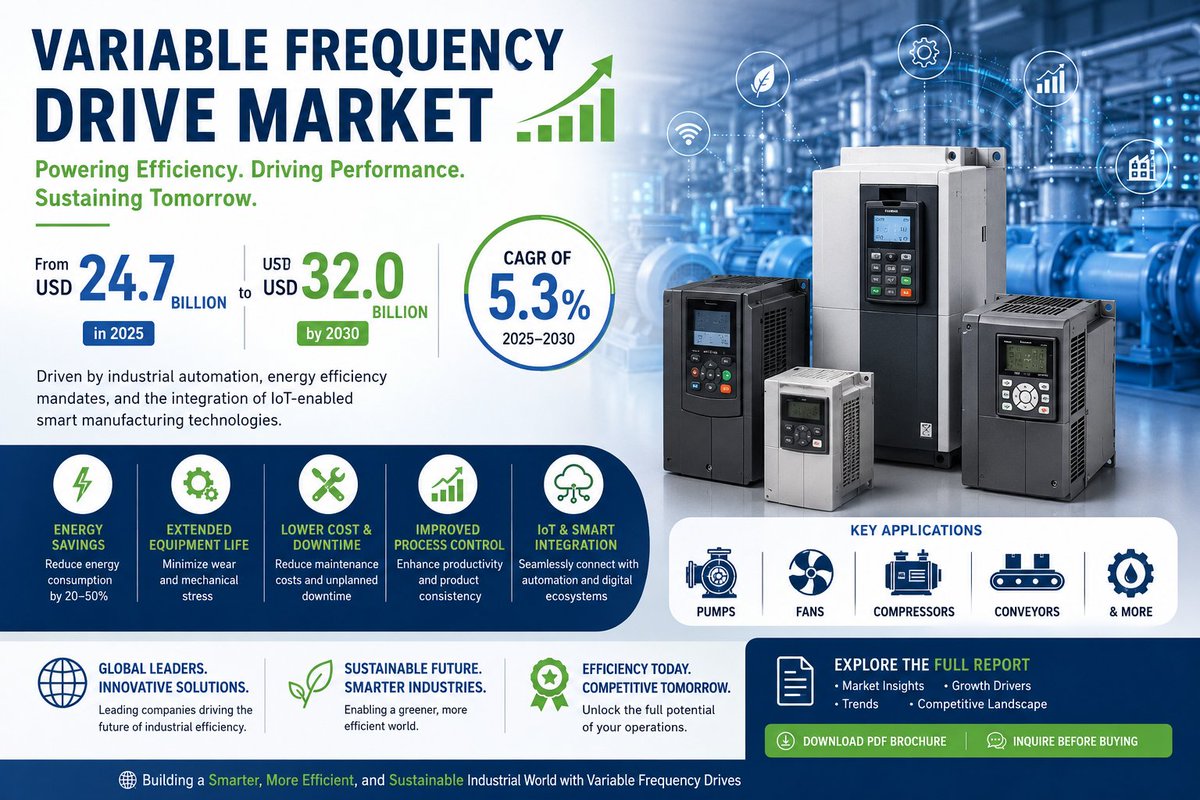
#VariableFrequencyDrive Market Set to Reach USD 32.0 Billion by 2030, Driven by Industrial Automation and Energy Efficiency Mandates
marketsandmarketsblog.com/va…
#VFD #VariableFrequencyDrive #vfdpanel #Vfddrive #variablefrequencytechnology
1
6

How to manage dozens of solar water pumps?
Supports remote monitoring on PC and mobile phones. #SolarPumpInverter #FrequencyConverter #VFD #VariableFrequencyDrive #SolarWaterPump
11

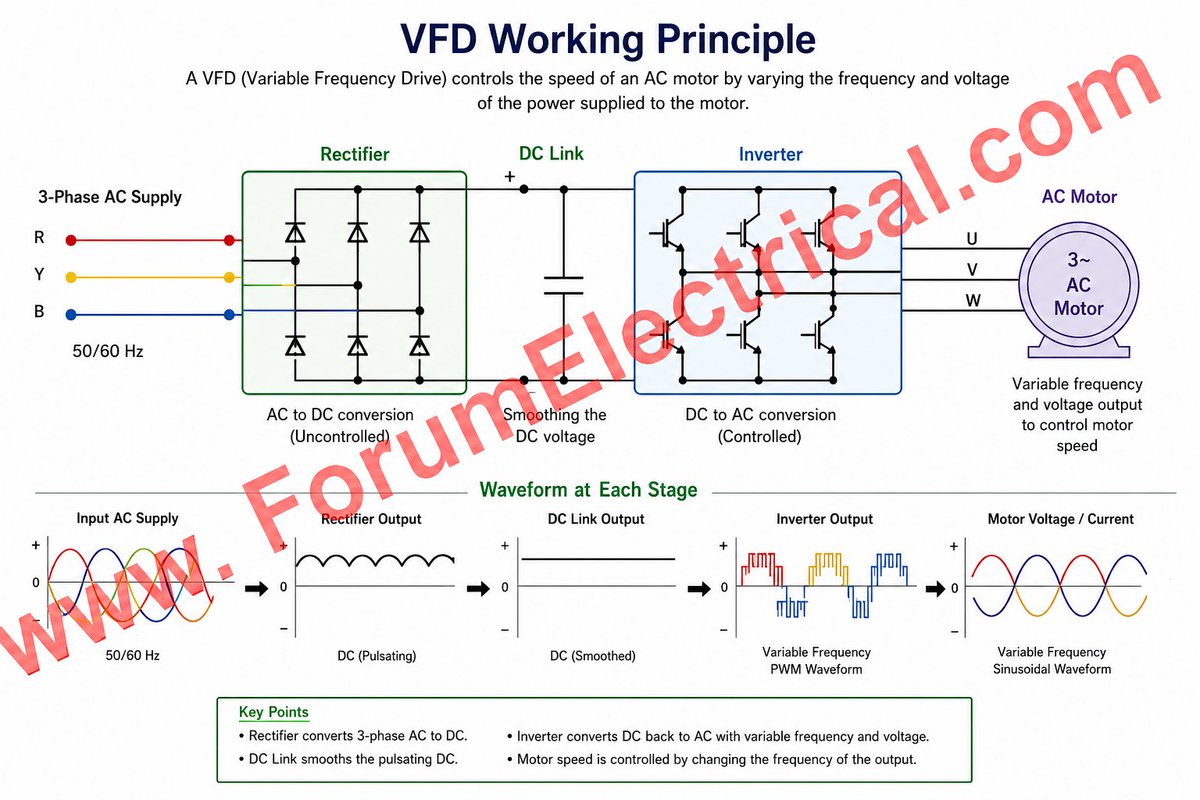
VFD (Variable Frequency Drive) Working Principle forumelectrical.com/working-…
A VFD converts AC → DC AC because it needs to
produce an AC supply with a variable frequency.
Here's why each stage is used:
1. Why convert AC into DC?
The incoming AC supply (50 Hz) has a fixed frequency. If we sent it directly to the motor, the motor speed would remain fixed.
By converting AC to DC, the VFD creates a stable intermediate power source that can later be converted into AC at any desired frequency.
AC (50 Hz)
DC
2. Why use capacitors in the DC bus?
After rectification, the DC is not perfectly smooth. It contains ripples.
Capacitors are used to:
Smooth the DC voltage
Store electrical energy
Reduce voltage fluctuations
Provide a stable DC supply to the inverter
Without capacitors, the inverter would receive an unstable DC voltage, causing poor motor performance.
3. Why use IGBTs to convert DC back into AC?
IGBTs (Insulated Gate Bipolar Transistors) act as very fast electronic switches.
The VFD turns the IGBTs ON and OFF thousands of times per second to create a PWM (Pulse Width Modulation) waveform that closely resembles AC.
By controlling the switching pattern, the VFD can: Generate AC at different frequencies (e.g., 10 Hz, 25 Hz, 50 Hz)
Control motor speed
Control motor torque
Simple flow
AC Supply (50 Hz)
Rectifier Converts AC to DC
Capacitors (DC Bus) Smooth and store DC energy
IGBT Inverter AC Converts DC into variable-frequency
Motor
This is why a VFD can run a motor at different speeds while the power grid still provides a fixed 50 Hz AC supply.
Website: forumelectrical.com
Facebook: facebook.com/profile.php?id=…
LinkedIn: linkedin.com/showcase/911302…
Twitter (X): x.com/ForumEIectrical
Pinterest: ru.pinterest.com/ForumElectr…
WhatsApp Channel: whatsapp.com/channel/0029VbB…
Telegram Group: t.me/F0rumElectrical
#VFD #VariableFrequencyDrive #vfdrepair #vfdpanel #Vfddrive #variablefrequencytechnology
forumelectrical.com/working-…
1
144

VFD (Variable Frequency Drive) Working Principle forumelectrical.com/working-…
#VFD #VariableFrequencyDrive #vfdrepair #vfdpanel #Vfddrive #variablefrequencytechnology
forumelectrical.com/working-…
8

Jun 8
⚡ 💨 🌀 Reliable VFD Solutions for Critical Fan and Blower Applications 🏭 ⚙️🛠️
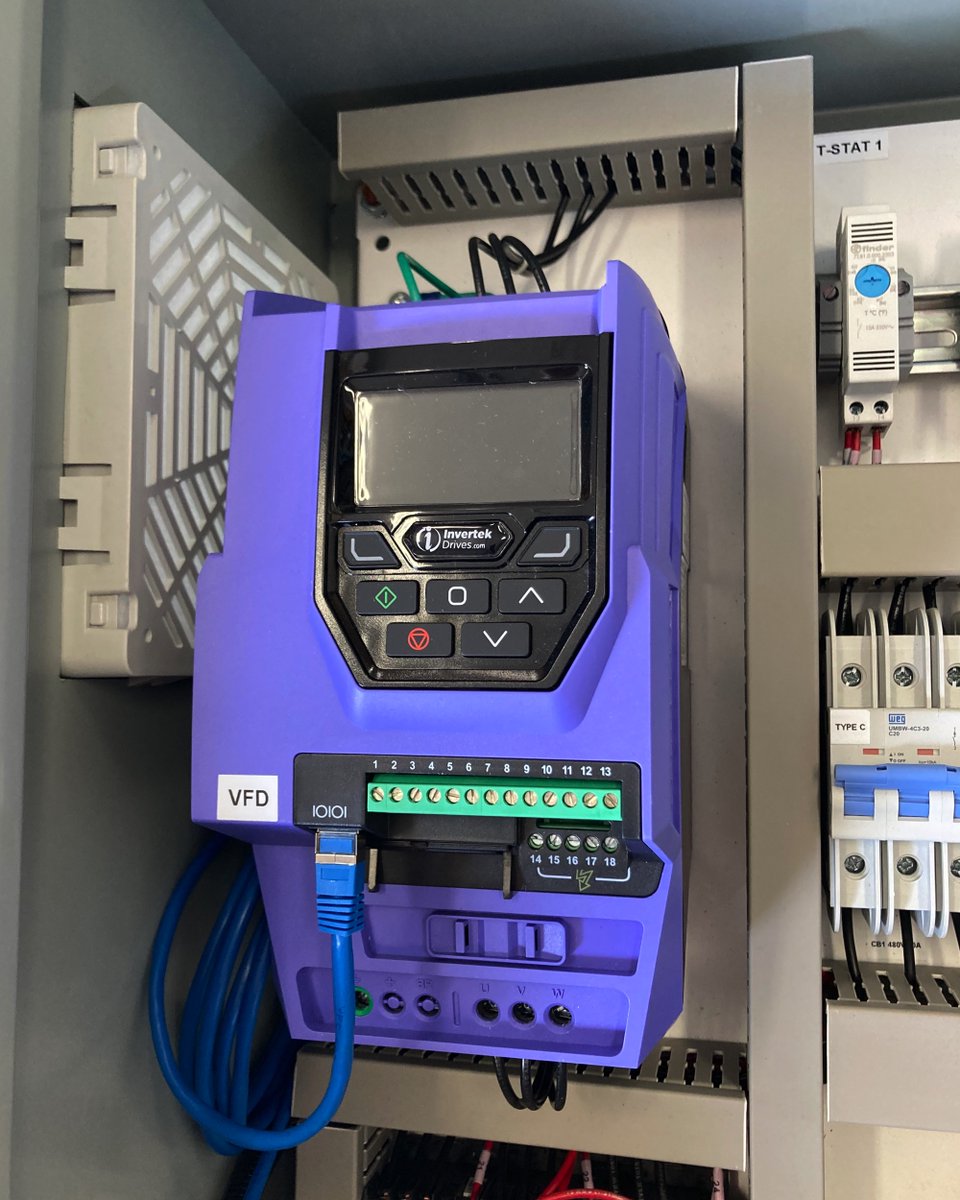
Variable Frequency Drives (VFDs) are a critical component for industrial HVAC fan and blower systems, delivering precise control of motor speed, torque, and airflow across exhaust fans, air handlers, and cooling tower applications. By modulating frequency and voltage, VFDs optimize motor performance to match real-time demand, improving system efficiency while reducing mechanical stress and energy consumption. Integrated communication capabilities such as Modbus and Ethernet/IP allow seamless control within building automation systems.
For critical HVAC operations, reliability is paramount, and VFD systems can be engineered with bypass functionality to enable direct-on-line (DoL) operation during maintenance or fault conditions. This ensures continued airflow and system uptime in mission-critical environments such as hospitals, high-rise buildings, data centers, and industrial facilities. Bypass architectures, typically utilizing interlocked contactors, allow automatic or manual transfer between VFD and line power, maintaining operational continuity. With options for single-phase and three-phase input, and compatibility with generator or solar power, these systems provide flexibility for both urban infrastructure and remote installations.
We support HVAC contractors and engineers with proper drive sizing, application engineering, and 7-day technical support to ensure reliable and optimal system integration.
The VFD Exchange
#VFD #VariableFrequencyDrive #HVAC #HVACControls #MotorControl #IndustrialAutomation #FanControl #BlowerSystems #EnergyEfficiency #BuildingAutomation #BAS #Modbus #EthernetIP #EngineeringSolutions #MechanicalEngineering #ElectricalEngineering #AirHandlingUnits #CoolingTowers #IndustrialHVAC #PanelMount #CircuitBreaker #DisconnectSwitch #VFDBypass #BypassVFD #VFDs #VariableFrequencyDrives #ElectricMotorControls
23
Jun 8
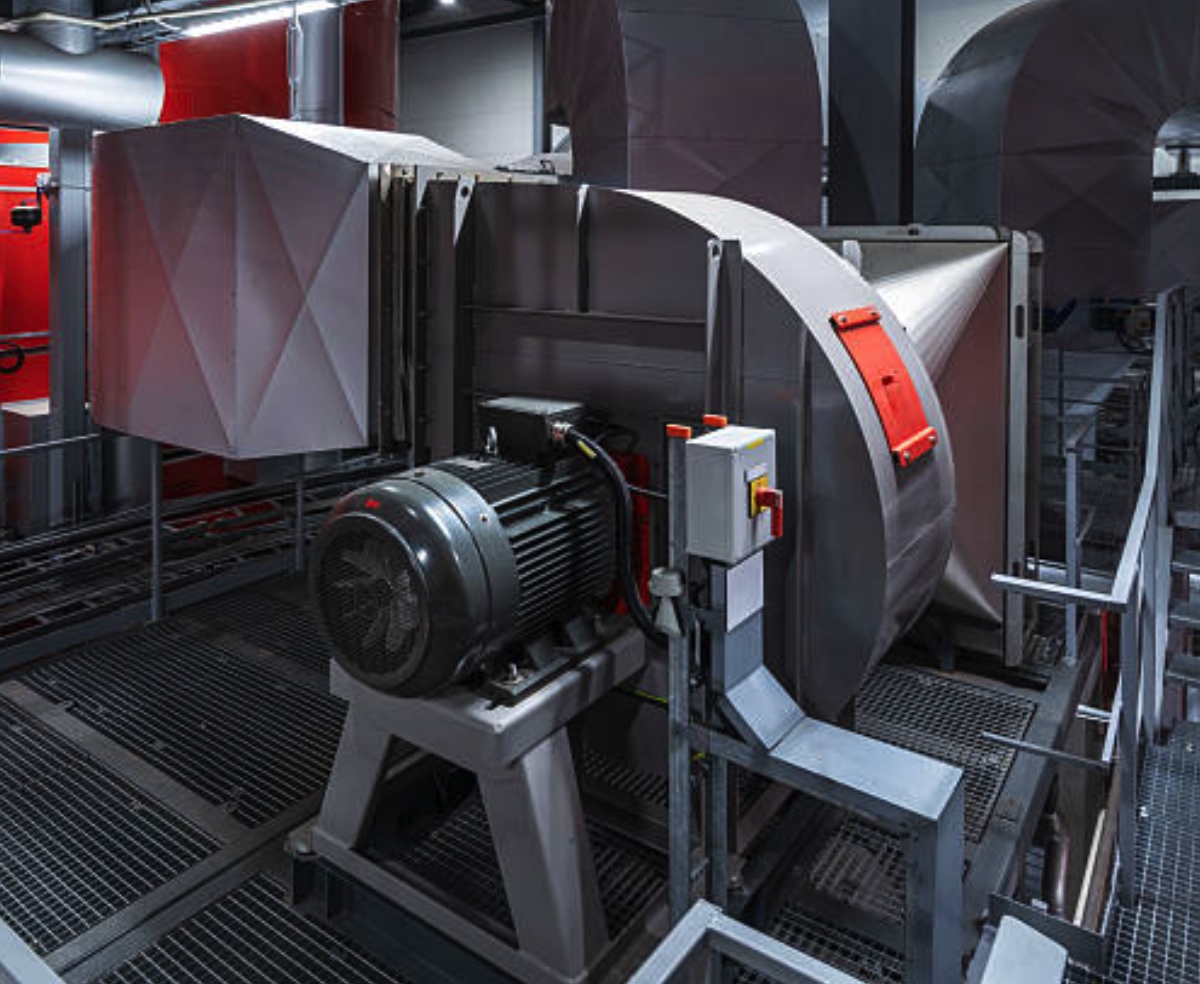
💨 Variable Frequency Drives Optimizing Fan and Blower Performance ⚡
Variable Frequency Drives (VFDs) play a critical role in modern commercial air handling systems by providing precise control of AC motor speed, torque, and airflow performance. By integrating VFDs with fans and blowers, HVAC systems can dynamically match output to demand, significantly improving efficiency while reducing mechanical stress on motors. Advanced control technologies, including sensorless vector control and built-in communication protocols, enable seamless integration with building automation systems.
Modern HVAC designs are engineered to operate under widely varying load conditions, making variable speed control essential for optimal performance and energy management. VFDs allow operators to fine-tune airflow, maintain consistent pressure, and optimize system response across exhaust fans, cooling towers, and industrial blowers. This results in improved indoor air quality, reduced energy consumption, and extended equipment life.
The VFD Exchange
#VFD #VariableFrequencyDrive #HVAC #AirHandlingUnits #IndustrialAutomation #MotorControl #EnergyEfficiency #BuildingAutomation #FanControl #BlowerSystems #CommercialHVAC #DataCenterCooling #ElectricalEngineering #MechanicalEngineering #AutomationSolutions #ACMotors #HVACControls #ElectricMotorControls #VFDs #VariableFrequencyDrives
20

12 Sep 2025
🎥 𝐄𝐌𝟕𝟑𝟎 𝐔𝐧𝐛𝐨𝐱𝐢𝐧𝐠 𝐕𝐢𝐝𝐞𝐨 𝐢𝐬 𝐇𝐄𝐑𝐄! 🎥
✅ 𝐑𝐨𝐛𝐮𝐬𝐭 𝐃𝐞𝐬𝐢𝐠𝐧
✅ 𝐀𝐝𝐯𝐚𝐧𝐜𝐞𝐝 𝐓𝐞𝐜𝐡𝐧𝐨𝐥𝐨𝐠𝐲
✅ 𝐔𝐬𝐞𝐫-𝐅𝐫𝐢𝐞𝐧𝐝𝐥𝐲
#VariableFrequencyDrive #VFD #IndustrialAutomation #MotorControl #Engineering #Unboxing #TechReview #Innovation
1
5
8
95

14 Aug 2025
When an oil and gas pipeline operator needed to replace an outdated 18-pulse drive package for a midstream pump, space limitations made the retrofit especially challenging. Yaskawa and a distributor partner engineered a compact VFD solution that improved efficiency and kept the system performing at its best: empoweringpumps.com/yaskawa-… @YASKAWA #PumpEfficiency #OilAndGas #VariableFrequencyDrive #EngineeringSolutions

1
2
65
25 Jul 2025
✨ 𝐁𝐨𝐨𝐬𝐭 𝐘𝐨𝐮𝐫 𝐖𝐢𝐫𝐞 𝐃𝐫𝐚𝐰𝐢𝐧𝐠 𝐄𝐟𝐟𝐢𝐜𝐢𝐞𝐧𝐜𝐲 𝐰𝐢𝐭𝐡 𝐒𝐈𝐍𝐄𝐄 𝐕𝐅𝐃 𝐒𝐨𝐥𝐮𝐭𝐢𝐨𝐧𝐬! ✨
#VFD #VariableFrequencyDrive #WireDrawingMachine #AutomationSolutions #EnergySaving #IndustrialControl💡
3
5
89

28 Feb 2025
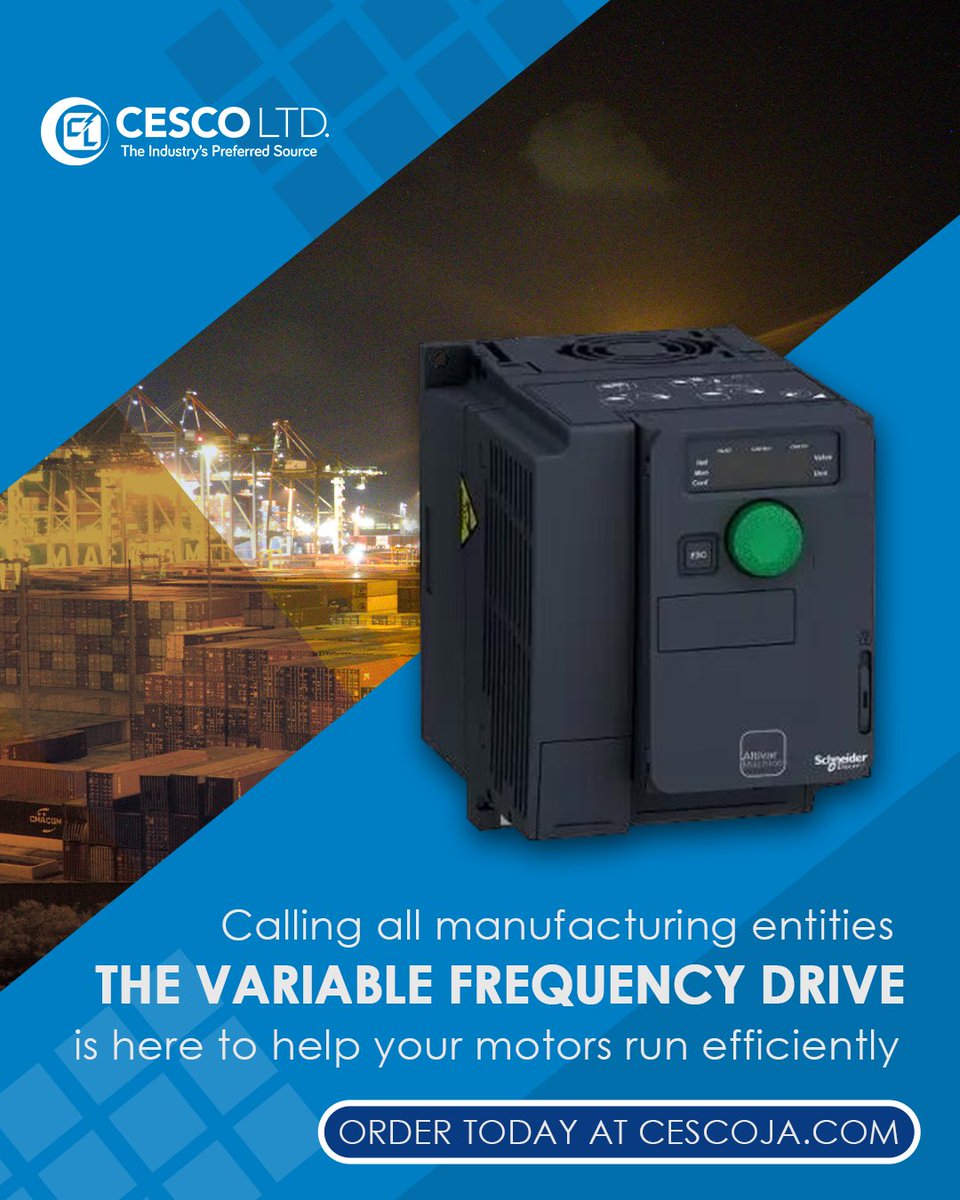
Our Variable Frequency Drive lets you customize motor speed for optimal efficiency & performance. Because your power solution should work exactly how you need it! ⚡🔌
📞 Call or WhatsApp us at (876) 618-6790 to today!
#CESCO #VariableFrequencyDrive #PowerYourWay
1
22

27 Dec 2024
It's estimated that 120 Million people will travel by plane this year over the holiday season. Flight simulators are designed with sophisticated automation components to help prepare pilots for realistic flight situations, feeling pitch, roll, and yaw without endangering lives or equipment. KEB can tackle these demanding applications with a robust and flexible line of motors, drives, brakes, and motion control. kebamerica.com/blog/automati…
#KEB_America #KEB_Automation #industrialautomation #flightsimulator #actuator #motioncontrol #servo #servomotor #vfd #variablefrequencydrive #pilot #training

1
34

7 May 2024
🔧Exciting update about our splitting machine! 💡 We've implemented the EM610 Tension control variable frequency drive, and the results are impressive. 📈
EM610📍: sineedrive.com/dedicated-vfd…
Contact📬: info@sineedrive.com
#tensioncontrol #SplittingMachine #VariableFrequencyDrive
8
9
69


17 Mar 2024
The growth of single-phase applications create new opportunities and challenges for #OEMs. bit.ly/4c9BdCO
#variablefrequencydrive #VFD
2
86
2 Feb 2024
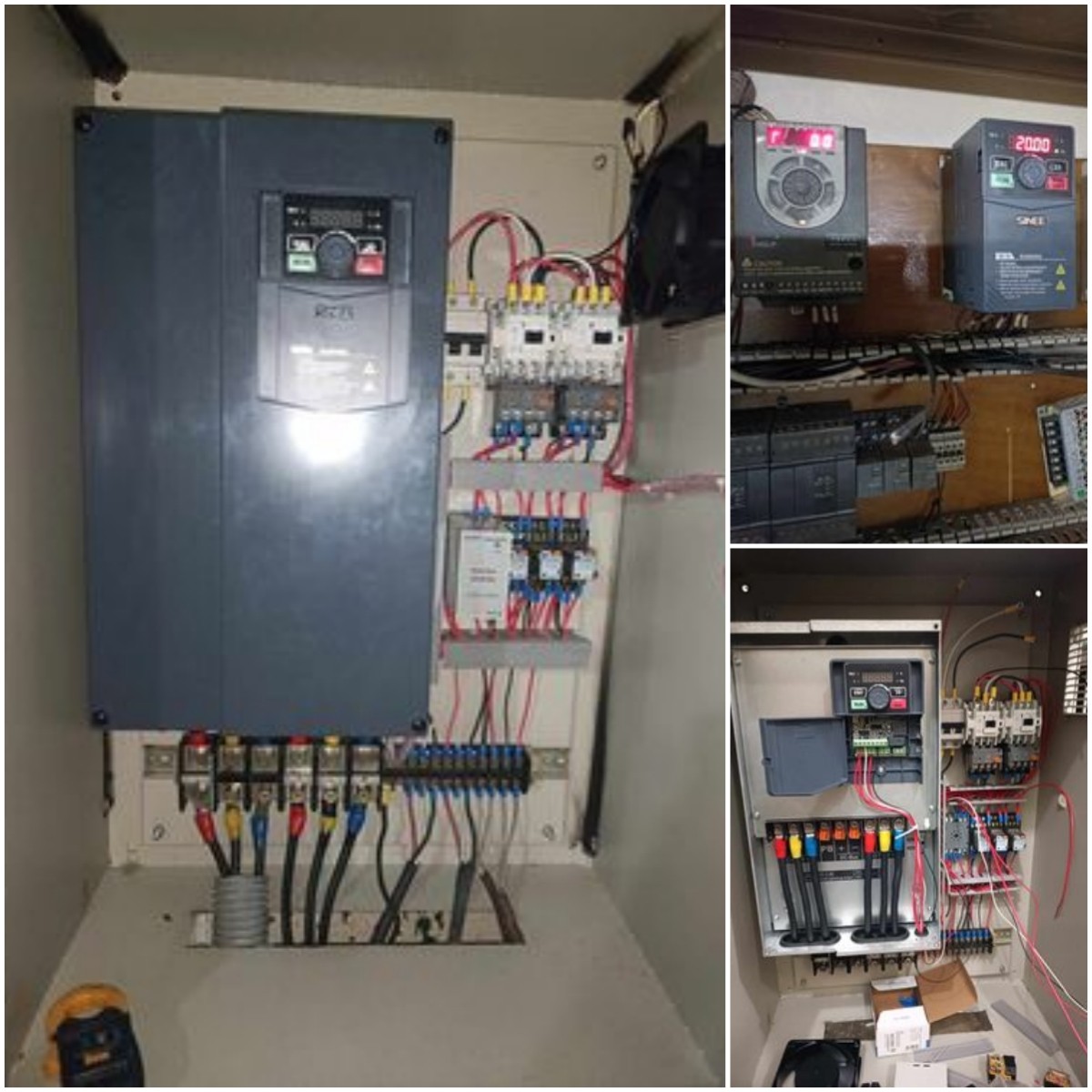
🚀Just had a successful installation of our EM730 Universal Variable Frequency Drive! 🛠️ Our valued customer utilized it for Indication Motor, Compressor, and Submersible Water Pump applications.
🔧#VariableFrequencyDrive
EM730 details📷: sineedrive.com/Variable-Freq…
9
12
96

23 Jan 2024
Introducing CFW900 – The System Drive! Unleash innovation with the CFW900, the Next-Gen High-Performance Variable Frequency Drive revolutionizing industrial operations.
ow.ly/JJ2T50QtL2N
#WEG #CFW900 #VariableFrequencyDrive #VFD
2
3
50
22 Jan 2024
#WEG shares the experience and expertise when working with our #OilandGas partners! #variablefrequencydrive #oil #gas #upstream #midstream #engineering #engineers #power #VFD #VFDs #drives #drive #softstarter #softstarters #electrical #electricalengineering #energy
1
3
117
19 Jan 2024
Empower your operations with precision and efficiency. WEG's CFW900 Variable Frequency Drive is here to transform the way you control motors.
ow.ly/G5ap50QsGIY
#WEG #CFW900 #VariableFrequencyDrive #VFD #HighPerformaceDrive #SystemDrive
2
4
80

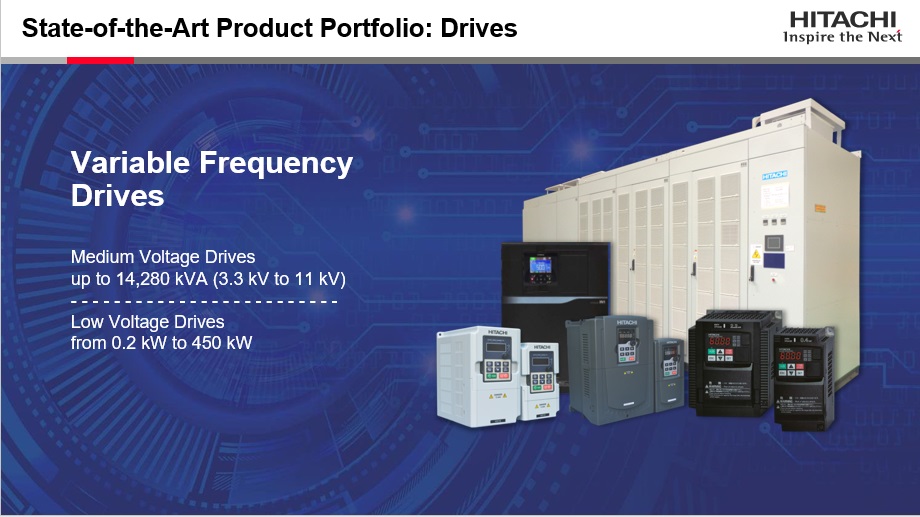
Are you looking for energy-efficient solutions to control the speed of your medium voltage industrial motors? Look no further than Hitachi Hi-Rel Power Electronics Medium Voltage Variable Frequency Drives!
hitachi-hirel.com/inquiry/pr…
#HitachiHiRel #Hitachi #VariableFrequencyDrive
1
27