xMars retweeted

28m
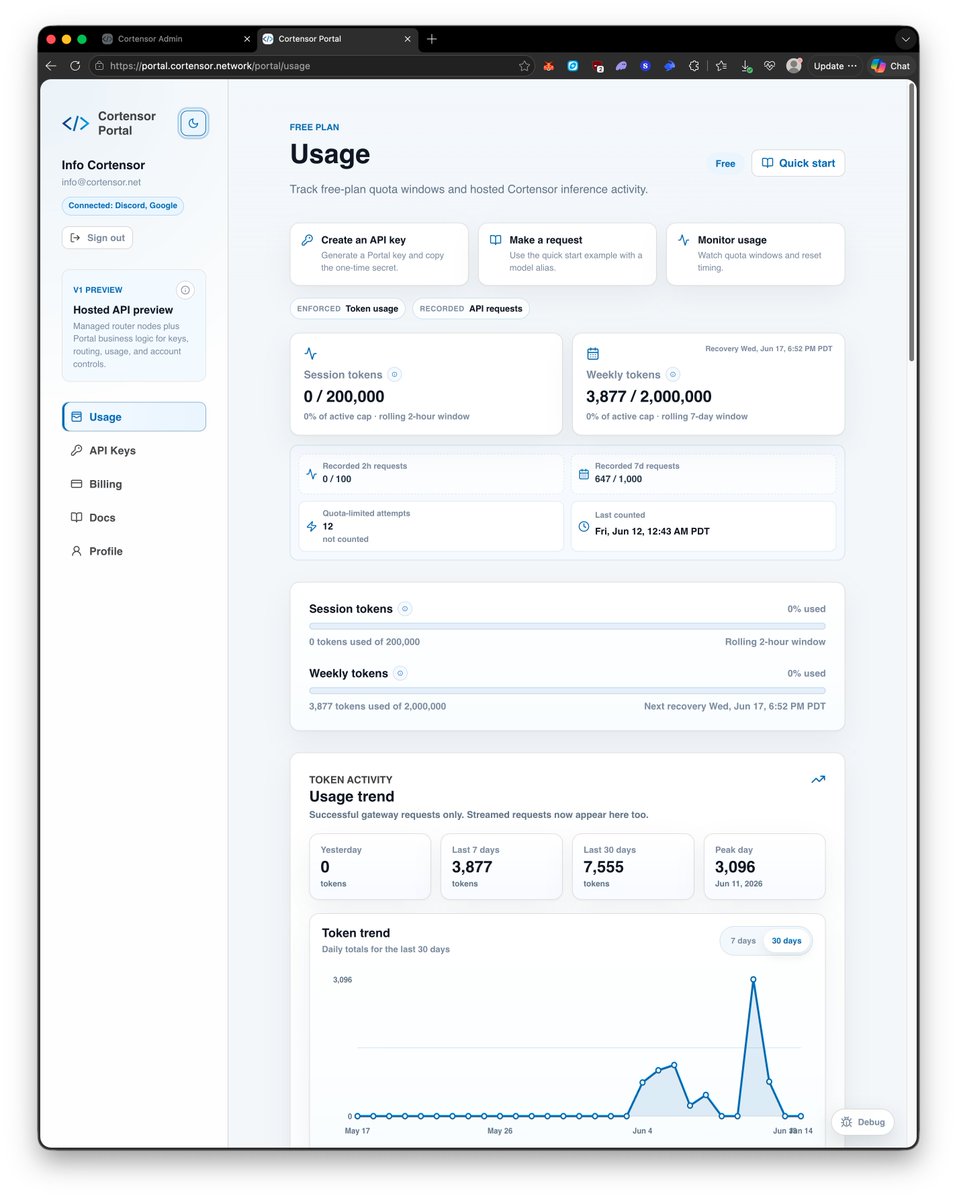
🛠️ DevLog – Portal Token-Based Usage Metering Is Now in Rough Form
A quick follow-up on the earlier Portal usage-metering direction.
🔹 Current progress
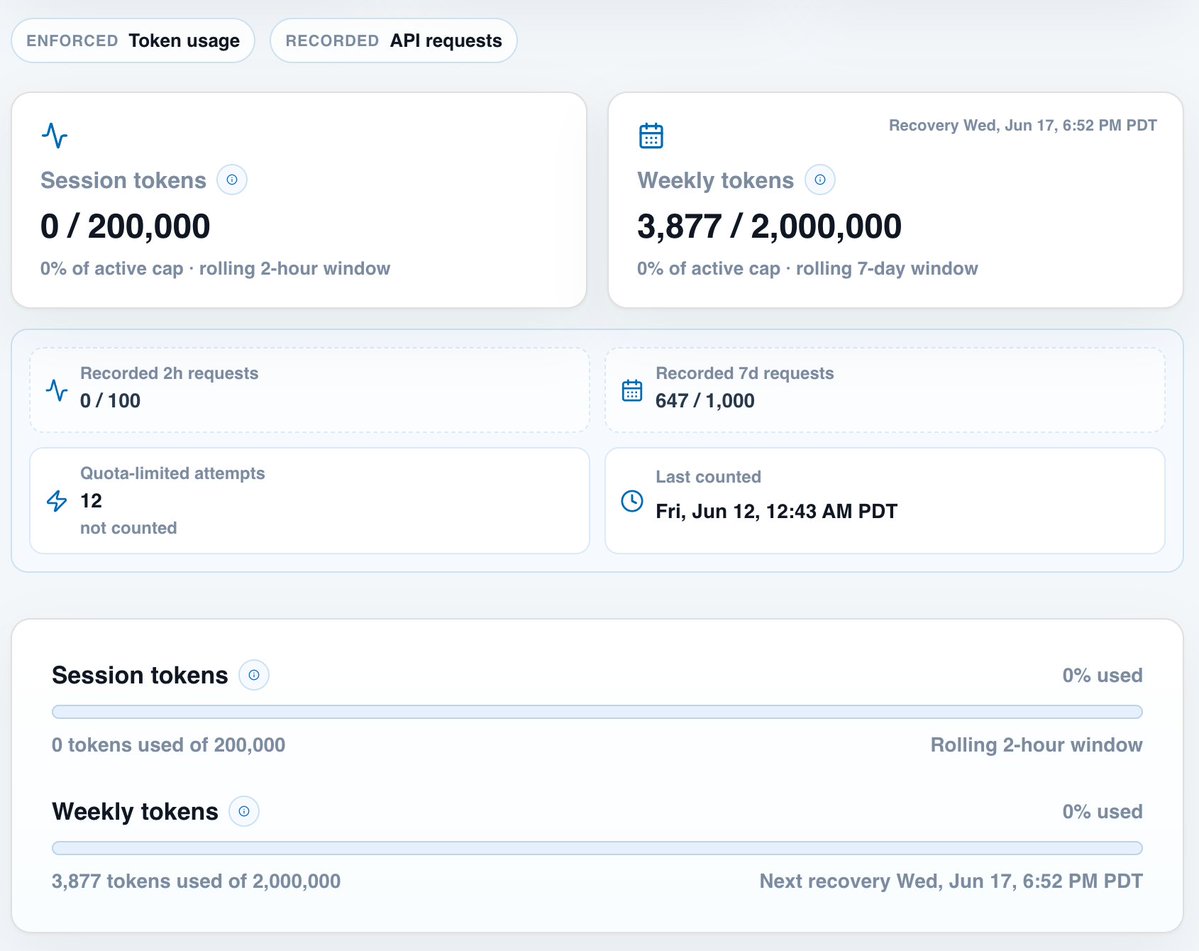
We’ve now roughly implemented the next step of the Portal usage path by updating the Portal API Gateway to record both:
- API request count
- token input / output totals
and apply them on the same sliding-window model.
🔹 What changed
This means the hosted path is no longer only centered around raw request counting.
The Portal/API Gateway can now start tracking:
- request volume
- token usage
- quota-limited attempts
- rolling-window usage state
in a way that is closer to actual model consumption.
🔹 Product/Admin side
The related Portal surfaces are also being updated around this:
- user-facing Portal usage area
- admin / ops visibility
- quota and usage display
So the usage story is starting to move from simple request-count accounting toward something more token-aware.
🔹 What’s next
This is still an early implementation/refinement stage, and we’ll test it more later today to make sure:
- counts line up correctly
- sliding-window behavior still looks right
- Portal and admin views stay consistent
🔹 Current takeaway
So the token-based usage-metering direction is no longer just planned - it is now starting to exist in rough form across the Portal API Gateway, Portal UI, and admin-side visibility.
#Cortensor #DevLog #Portal #API #UsageTracking
13h

🛠️ DevLog – Portal Usage Metering Will Shift from Request Count to Token Count
A quick follow-up on the Portal usage side.
🔹 Current direction
So far, Cortensor Portal and the API Gateway have mostly tracked usage by request count.
That was useful for getting the hosted path working early, but it also means one small request and one much larger request can look the same from the quota side even if they consume very different amounts of model work.
🔹 What changes next
The next step is to move usage metering more toward actual model consumption:
- input tokens
- output tokens
- total token usage
So Portal quotas and usage reporting can align more closely with the real workload.
🔹 Why this matters
This should make the Portal path:
- more fair, since small and large requests no longer cost the same
- more accurate, since usage reflects actual inference work
- a better foundation for future quota, reporting, and billing controls
- easier to understand, since users can see how prompt size and response size affect usage
🔹 Current takeaway
So the direction is simple:
Portal usage metering is moving from request-based accounting toward token-based accounting, so quota and reporting reflect real inference usage instead of just raw request volume.
#Cortensor #DevLog #Portal #API #UsageTracking
2
6
6
27
FamilyHedge retweeted
🛠️ DevLog – Portal Multi-Model Routing Prep Is Underway
A quick follow-up on the Portal multi-model routing path.
🔹 Current progress
We’ve now asked node operators to switch the relevant dedicated nodes so we can bring in the next 2 models for Portal-side testing:
- gemma4 e4b
- qwen 3.5 9b
🔹 Why this matters
The goal here is to move beyond the current single-model path and test how the Portal / API Gateway behaves once multiple model routes exist underneath.
🔹 What’s next
Once that rollout is finished on the dedicated-node side, we’ll test those models through:
- Portal
- API Gateway
- router-pool path underneath
🔹 Current status
So this is still a prep stage for now, but it is the next step toward testing multi-model routing more directly on the Portal side.
#Cortensor #DevLog #Portal #APIGateway #Routing #AIInfra
23h
🛠️ DevLog – Portal API Gateway Focus for the Coming Weeks
A quick recap on what the next Portal/API Gateway focus looks like for the coming weeks and the rest of this phase.
🔹 Multiple model routing
One of the next main areas is moving beyond a single-model hosted path.
The goal is to keep testing how the Portal API Gateway behaves once more than one model path exists underneath, including:
- model routing at the gateway level
- cleaner handling across different backend session paths
- making sure the hosted flow still stays predictable as the model mix becomes broader
🔹 API Gateway reliability refinement
The other big area is reliability refinement around the hosted execution path itself, especially:
- API Gateway behavior under shared load
- router-node pool behavior underneath
- safer routing when sessions/nodes are busy
- better stability as traffic and concurrency increase
🔹 Why these 2 matter now
The first layer of capacity-aware routing is already there in rough form.
So the next step is not just “make requests pass,” but:
- make routing smarter across multiple models
- make the API Gateway and router-pool path more resilient
- reduce weaker points as the hosted path gets used more heavily
🔹 Current takeaway
So for the coming weeks, a big part of the Portal/API Gateway work is centered around:
- multiple model routing
- API Gateway reliability
- router-node pool refinement
That is where a lot of the remaining hardening work sits for this phase.
#Cortensor #DevLog #Portal #APIGateway #Routing #Reliability
1
4
12
174
xMars retweeted
13h
🛠️ DevLog – Portal Usage Metering Will Shift from Request Count to Token Count
A quick follow-up on the Portal usage side.
🔹 Current direction
So far, Cortensor Portal and the API Gateway have mostly tracked usage by request count.
That was useful for getting the hosted path working early, but it also means one small request and one much larger request can look the same from the quota side even if they consume very different amounts of model work.
🔹 What changes next
The next step is to move usage metering more toward actual model consumption:
- input tokens
- output tokens
- total token usage
So Portal quotas and usage reporting can align more closely with the real workload.
🔹 Why this matters
This should make the Portal path:
- more fair, since small and large requests no longer cost the same
- more accurate, since usage reflects actual inference work
- a better foundation for future quota, reporting, and billing controls
- easier to understand, since users can see how prompt size and response size affect usage
🔹 Current takeaway
So the direction is simple:
Portal usage metering is moving from request-based accounting toward token-based accounting, so quota and reporting reflect real inference usage instead of just raw request volume.
#Cortensor #DevLog #Portal #API #UsageTracking
2
8
13
168
xMars retweeted
16h
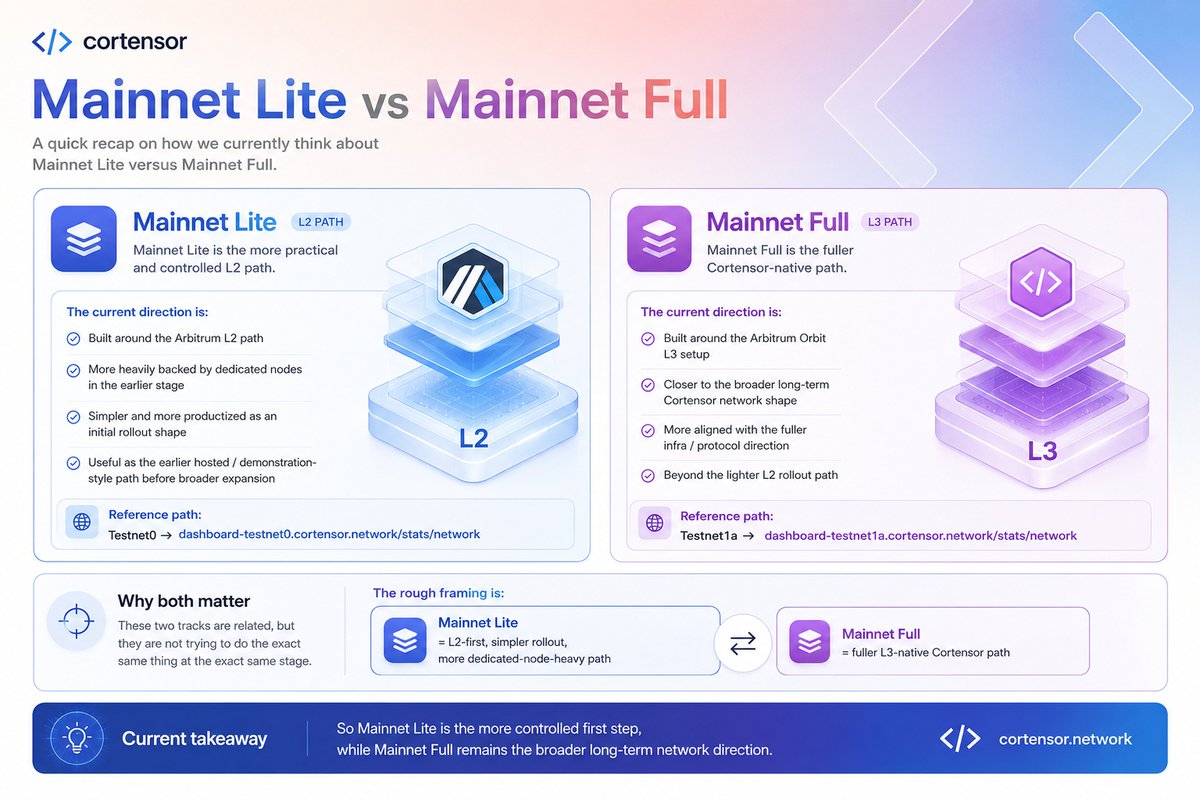
The Cortensor mainnet path is taking a clearer shape.
Q3 2026 → Mainnet Lite
- @Arbitrum L2
- more controlled and practical first step
- earlier dedicated-node-heavy rollout
- cleaner path for hosted and product-facing checks first
Q4 2026 → Mainnet Full
- @Arbitrum Orbit L3
- fuller Cortensor-native path
- broader long-term network direction
- more complete stack beyond the lighter L2 rollout
That is how we currently think about the rollout:
Lite first as the more practical path, then Full as the broader native path after that.
#Cortensor #MainnetLite #Mainnet #Arbitrum
Jun 10
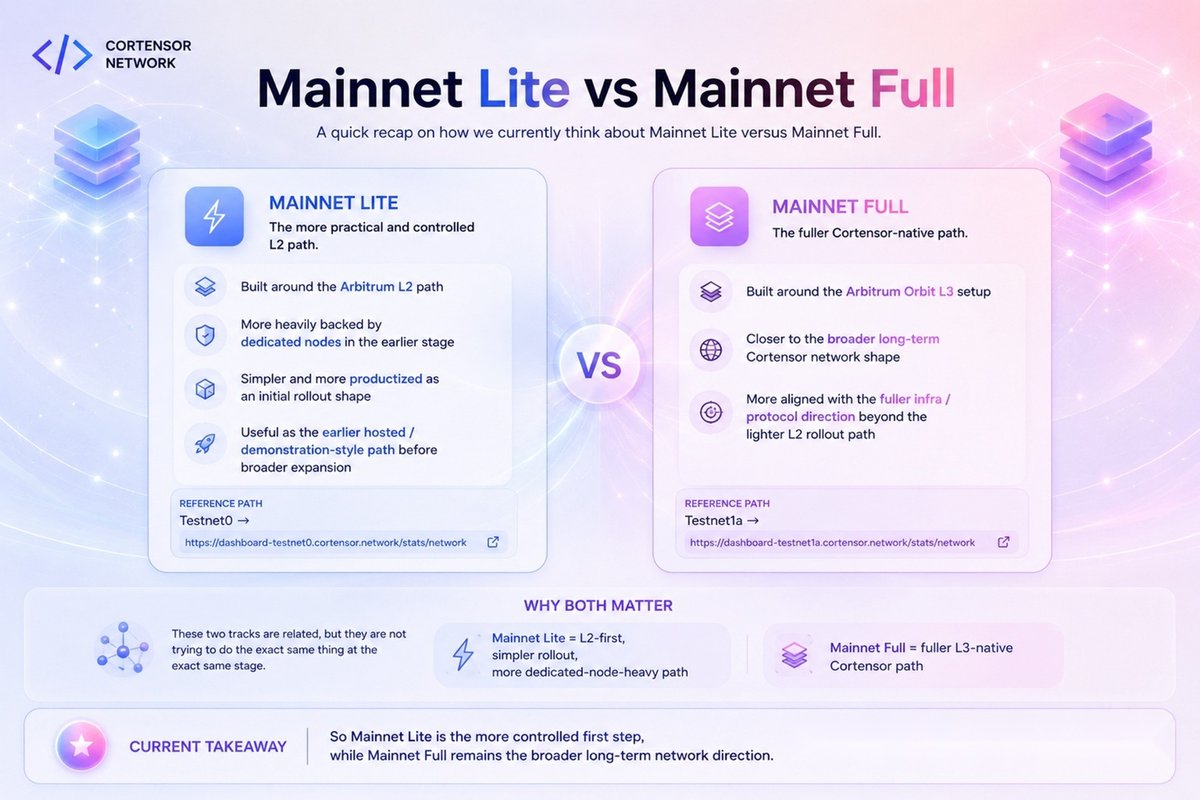
🔎 Recap: What is Mainnet Lite vs Mainnet Full?
Mainnet Lite is the more practical and controlled L2 path.
It is taking shape around:
- @Arbitrum L2
- Dedicated-node-heavy serving
- Simpler rollout
- Earlier hosted / demonstration-style path
Mainnet Full is the fuller Cortensor-native path.
It is taking shape around:
- @Arbitrum Orbit L3
- Broader long-term network shape
- Fuller infra / protocol direction
- More complete Cortensor stack
The goal is simple: use Mainnet Lite as the more controlled first step, while Mainnet Full remains the broader long-term network direction.
Mainnet Lite is the earlier rollout path.
Mainnet Full is the fuller Cortensor-native path.
#Cortensor #MainnetLite #Mainnet #Arbitrum
1
9
19
222
xMars retweeted
11h
🗓️ Weekly Focus – Phase #4 Portal Refinement, Mainnet Lite Validation & PyClaw
Phase #4 continues with Portal V1 as the primary focus, while Mainnet Lite validation and PyClaw development continue alongside it.
🔹 Phase #4 – Monitoring, Support & Stats
- Continue monitoring routing, miners, validators, dashboards, indexers, and L3 stats.
- Track stability as Portal V1, Mainnet Lite, and related Phase #4 workstreams continue to mature.
🔹 Portal V1 – Product Refinement
- Continue refining Portal V1 now that the core path is working (auth, API keys, usage visibility, gateway, router pools, hosted requests).
- Focus on usability, operational flow, reliability, and overall product readiness.
🔹 Portal V1 – Usage Metering Migration
- Begin shifting Portal usage accounting from request-count based tracking toward token-based usage (input, output, total tokens).
- Goal is fairer quotas, more accurate reporting, and a stronger foundation for future billing and plan controls.
🔹 Portal V1 – Gateway, Router Pool & Observability
- Continue hardening Gateway → router-pool behavior, request tracking, and operational visibility.
- Focus on reliability, observability, and hosted-path readiness under heavier usage.
🔹 Mainnet Lite – Baseline Validation
- Continue validating Mainnet Lite baseline components and supporting infrastructure.
- Main remaining check is deeper testing around the ephemeral-node network-task path.
🔹 Payment Staking – Regression & Hardening Tests
- Continue the regression pass following the recent security-hardening rollout.
- Goal remains validating the full staking/usage flow and confirming no regressions.
🔹 PyClaw – Dev Path Progress
- Continue PyClaw iteration across workflow, side packages, tools, and repository structure.
- Target remains a rough public development release next month so iteration can continue openly.
This week is about continuing to mature Portal V1, validating the remaining Mainnet Lite baseline paths, and preparing PyClaw for its first public development cycle.
#Cortensor #Testnet #Phase4 #AIInfra #DePIN #Portal #PyClaw #MainnetLite #L3

Jun 13
🗓️ Weekly Recap – Phase #4 Portal Progress, Mainnet Lite Validation & Infra Hardening
This week was again heavily focused on Portal V1, with meaningful progress across product flows, API Gateway behavior, observability, and hosted inference readiness.
🔹 Phase #4 – Monitoring, Support & Stats
- Continued monitoring across routing, miners, validators, dashboards, indexers, and L3 stats.
- Phase #4 remained stable while Portal and Mainnet Lite workstreams continued to mature.
🔹 Portal V1 – Product Flow Maturing
- Portal moved from rough MVP toward a more usable hosted product surface with cleaner auth, API keys, usage visibility, request logs, and UI/UX refinement.
- Data consistency between web app, database, and API-key systems improved significantly.
🔹 Portal V1 – API Gateway & Quota Work
- Sliding-window quota logic received deeper testing and fixes, including weekly-limit accounting improvements.
- Usage counting became more accurate with better separation between successful requests, quota events, and real failures.
🔹 Portal V1 – Request Visibility & Analytics
- Request visibility improved with better logs, filters, totals, and detailed request views.
- Added richer usage analytics including trends, activity heatmaps, and token-level visibility.
🔹 Portal V1 – Reliability, Observability & Operations
- Dual API Gateway setup is now operating behind a shared entry path, reducing single-point dependency.
- Admin/ops visibility expanded with metrics around gateway health, latency, routing distribution, and user activity.
🔹 Portal V1 – API Compatibility & Streaming
- OpenAI-style and Anthropic-style REST compatibility continued to improve.
- SSE/streaming MVP is now working, with deeper reliability work shifting toward backend/router behavior.
🔹 Portal V1 – Stress Testing & Router Pools
- Stress testing expanded using multiple accounts, keys, parallel requests, and longer-running workloads.
- This surfaced the next bottlenecks and drove further work on capacity-aware routing and router-pool behavior.
🔹 Mainnet Lite – Baseline Validation
- Mainnet Lite dedicated-node E2E was re-run successfully, including payment distribution behavior.
- Ephemeral-node network-task E2E also worked, confirming another critical baseline path.
🔹 RPC & Infrastructure Hardening
- Internal RPC infrastructure is now live across both testnet and mainnet-related environments.
- Early stability looks good and provides better operational control than previous external dependencies.
🔹 Payment Staking – Regression & Hardening
- Progress was lighter than planned while Portal took priority this week.
- Additional validation and regression testing remain on the upcoming work list.
🔹 PyClaw – Dev Path Progress
- Continued incremental progress on PyClaw workflows, tooling, and repository structure.
- Focus remains on preparing for the first public development release and open iteration cycle.
A productive Phase #4 week overall - Portal V1 made the largest jump forward, Mainnet Lite baseline checks continued to pass, and the hosted inference path is increasingly shifting from concept into an operational product.
#Cortensor #Testnet #Phase4 #AIInfra #DePIN #Portal #PyClaw #MainnetLite #L3

1
6
16
184


11h
hardening the rails before the demand spike hits. you're reading it right
1
6
12h
token-based metering fixes the unit economics before launch. quota systems that reflect actual inference load mean the commercial layer scales with real usage, not arbitrary request counts. execution quality during hardening is the tell.
2
19