
61 Photos and videos








thipdb88 retweeted

13h
🗓️ Weekly Focus – Phase #4 Portal Refinement, Mainnet Lite Validation & PyClaw
Phase #4 continues with Portal V1 as the primary focus, while Mainnet Lite validation and PyClaw development continue alongside it.
🔹 Phase #4 – Monitoring, Support & Stats
- Continue monitoring routing, miners, validators, dashboards, indexers, and L3 stats.
- Track stability as Portal V1, Mainnet Lite, and related Phase #4 workstreams continue to mature.
🔹 Portal V1 – Product Refinement
- Continue refining Portal V1 now that the core path is working (auth, API keys, usage visibility, gateway, router pools, hosted requests).
- Focus on usability, operational flow, reliability, and overall product readiness.
🔹 Portal V1 – Usage Metering Migration
- Begin shifting Portal usage accounting from request-count based tracking toward token-based usage (input, output, total tokens).
- Goal is fairer quotas, more accurate reporting, and a stronger foundation for future billing and plan controls.
🔹 Portal V1 – Gateway, Router Pool & Observability
- Continue hardening Gateway → router-pool behavior, request tracking, and operational visibility.
- Focus on reliability, observability, and hosted-path readiness under heavier usage.
🔹 Mainnet Lite – Baseline Validation
- Continue validating Mainnet Lite baseline components and supporting infrastructure.
- Main remaining check is deeper testing around the ephemeral-node network-task path.
🔹 Payment Staking – Regression & Hardening Tests
- Continue the regression pass following the recent security-hardening rollout.
- Goal remains validating the full staking/usage flow and confirming no regressions.
🔹 PyClaw – Dev Path Progress
- Continue PyClaw iteration across workflow, side packages, tools, and repository structure.
- Target remains a rough public development release next month so iteration can continue openly.
This week is about continuing to mature Portal V1, validating the remaining Mainnet Lite baseline paths, and preparing PyClaw for its first public development cycle.
#Cortensor #Testnet #Phase4 #AIInfra #DePIN #Portal #PyClaw #MainnetLite #L3

Jun 13

🗓️ Weekly Recap – Phase #4 Portal Progress, Mainnet Lite Validation & Infra Hardening
This week was again heavily focused on Portal V1, with meaningful progress across product flows, API Gateway behavior, observability, and hosted inference readiness.
🔹 Phase #4 – Monitoring, Support & Stats
- Continued monitoring across routing, miners, validators, dashboards, indexers, and L3 stats.
- Phase #4 remained stable while Portal and Mainnet Lite workstreams continued to mature.
🔹 Portal V1 – Product Flow Maturing
- Portal moved from rough MVP toward a more usable hosted product surface with cleaner auth, API keys, usage visibility, request logs, and UI/UX refinement.
- Data consistency between web app, database, and API-key systems improved significantly.
🔹 Portal V1 – API Gateway & Quota Work
- Sliding-window quota logic received deeper testing and fixes, including weekly-limit accounting improvements.
- Usage counting became more accurate with better separation between successful requests, quota events, and real failures.
🔹 Portal V1 – Request Visibility & Analytics
- Request visibility improved with better logs, filters, totals, and detailed request views.
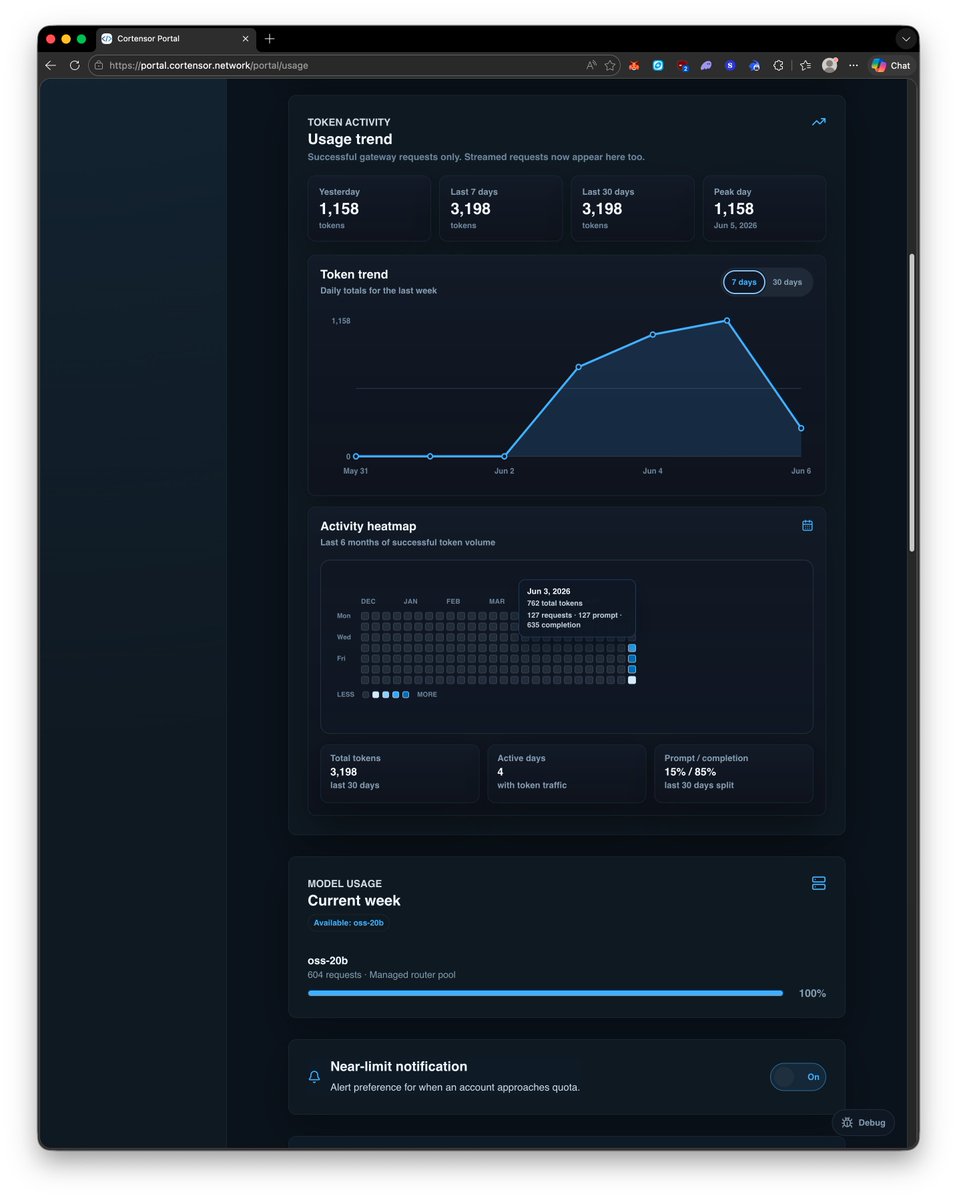
- Added richer usage analytics including trends, activity heatmaps, and token-level visibility.
🔹 Portal V1 – Reliability, Observability & Operations
- Dual API Gateway setup is now operating behind a shared entry path, reducing single-point dependency.
- Admin/ops visibility expanded with metrics around gateway health, latency, routing distribution, and user activity.
🔹 Portal V1 – API Compatibility & Streaming
- OpenAI-style and Anthropic-style REST compatibility continued to improve.
- SSE/streaming MVP is now working, with deeper reliability work shifting toward backend/router behavior.
🔹 Portal V1 – Stress Testing & Router Pools
- Stress testing expanded using multiple accounts, keys, parallel requests, and longer-running workloads.
- This surfaced the next bottlenecks and drove further work on capacity-aware routing and router-pool behavior.
🔹 Mainnet Lite – Baseline Validation
- Mainnet Lite dedicated-node E2E was re-run successfully, including payment distribution behavior.
- Ephemeral-node network-task E2E also worked, confirming another critical baseline path.
🔹 RPC & Infrastructure Hardening
- Internal RPC infrastructure is now live across both testnet and mainnet-related environments.
- Early stability looks good and provides better operational control than previous external dependencies.
🔹 Payment Staking – Regression & Hardening
- Progress was lighter than planned while Portal took priority this week.
- Additional validation and regression testing remain on the upcoming work list.
🔹 PyClaw – Dev Path Progress
- Continued incremental progress on PyClaw workflows, tooling, and repository structure.
- Focus remains on preparing for the first public development release and open iteration cycle.
A productive Phase #4 week overall - Portal V1 made the largest jump forward, Mainnet Lite baseline checks continued to pass, and the hosted inference path is increasingly shifting from concept into an operational product.
#Cortensor #Testnet #Phase4 #AIInfra #DePIN #Portal #PyClaw #MainnetLite #L3

1
6
16
186
thipdb88 retweeted
18h
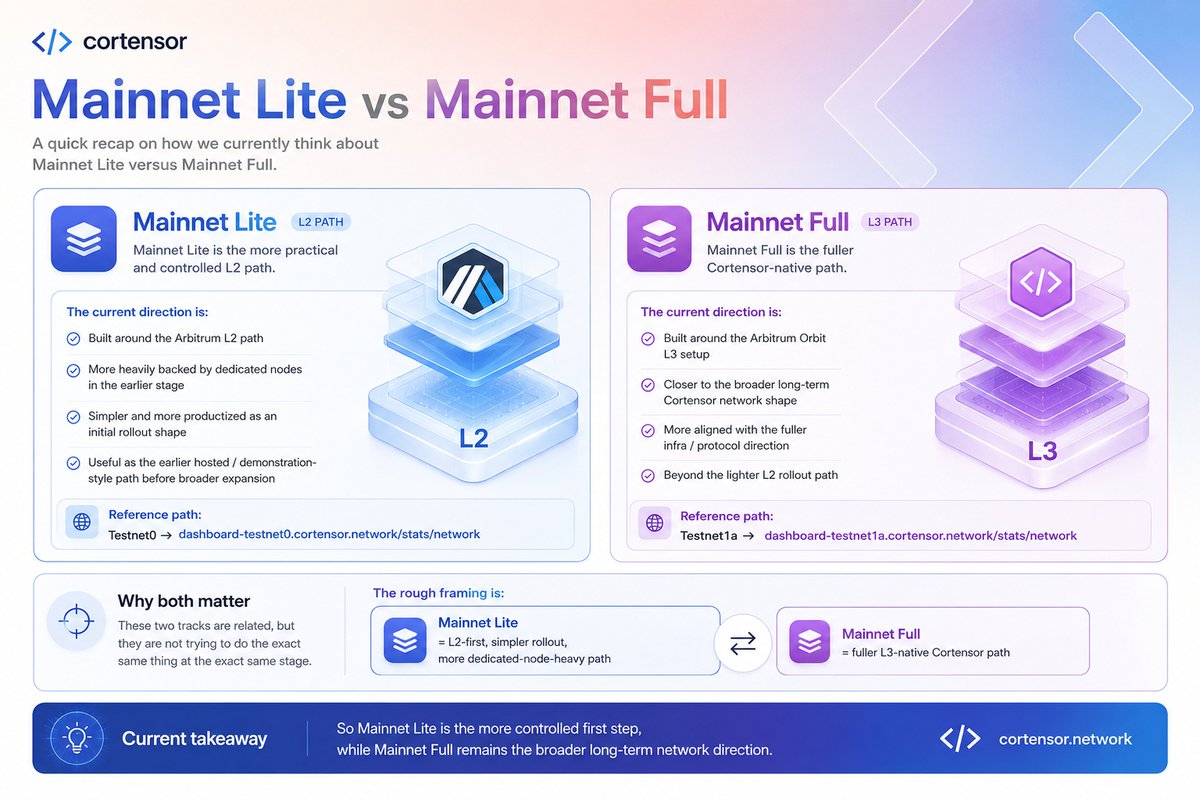
The Cortensor mainnet path is taking a clearer shape.
Q3 2026 → Mainnet Lite
- @Arbitrum L2
- more controlled and practical first step
- earlier dedicated-node-heavy rollout
- cleaner path for hosted and product-facing checks first
Q4 2026 → Mainnet Full
- @Arbitrum Orbit L3
- fuller Cortensor-native path
- broader long-term network direction
- more complete stack beyond the lighter L2 rollout
That is how we currently think about the rollout:
Lite first as the more practical path, then Full as the broader native path after that.
#Cortensor #MainnetLite #Mainnet #Arbitrum
Jun 10
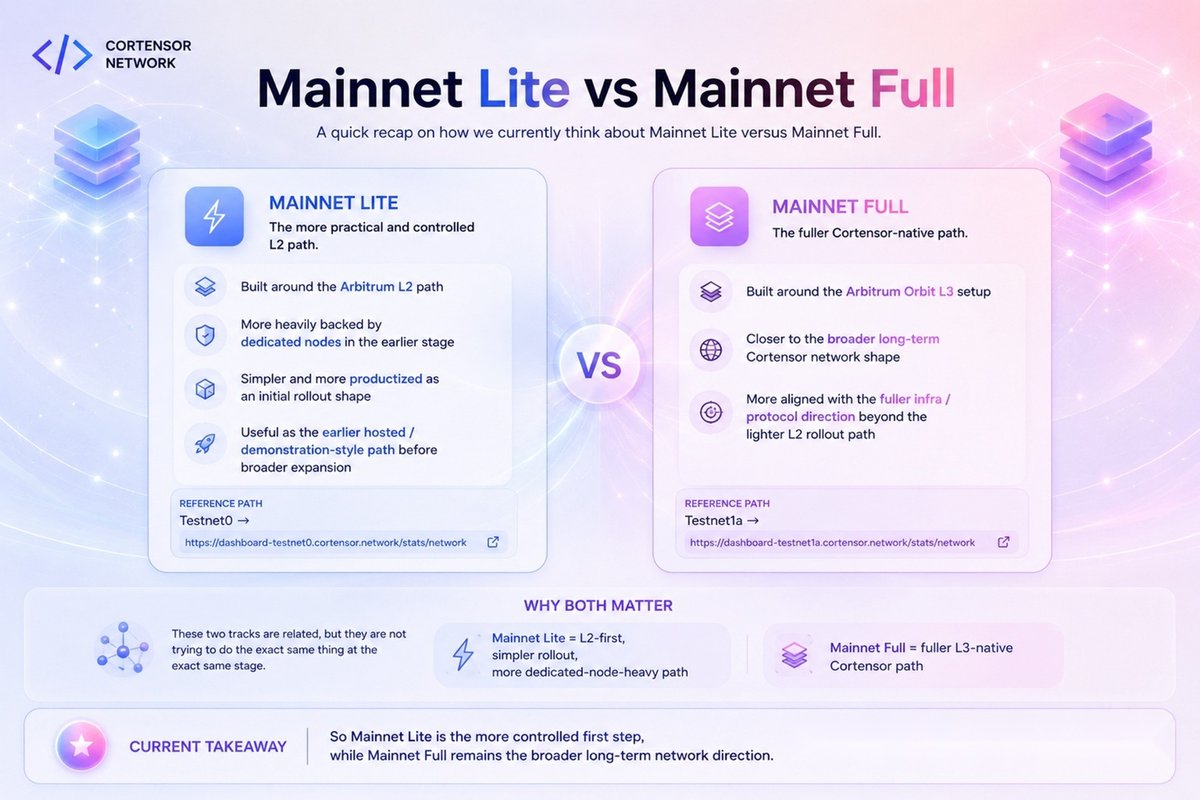
🔎 Recap: What is Mainnet Lite vs Mainnet Full?
Mainnet Lite is the more practical and controlled L2 path.
It is taking shape around:
- @Arbitrum L2
- Dedicated-node-heavy serving
- Simpler rollout
- Earlier hosted / demonstration-style path
Mainnet Full is the fuller Cortensor-native path.
It is taking shape around:
- @Arbitrum Orbit L3
- Broader long-term network shape
- Fuller infra / protocol direction
- More complete Cortensor stack
The goal is simple: use Mainnet Lite as the more controlled first step, while Mainnet Full remains the broader long-term network direction.
Mainnet Lite is the earlier rollout path.
Mainnet Full is the fuller Cortensor-native path.
#Cortensor #MainnetLite #Mainnet #Arbitrum
1
9
19
222
thipdb88 retweeted
Jun 14
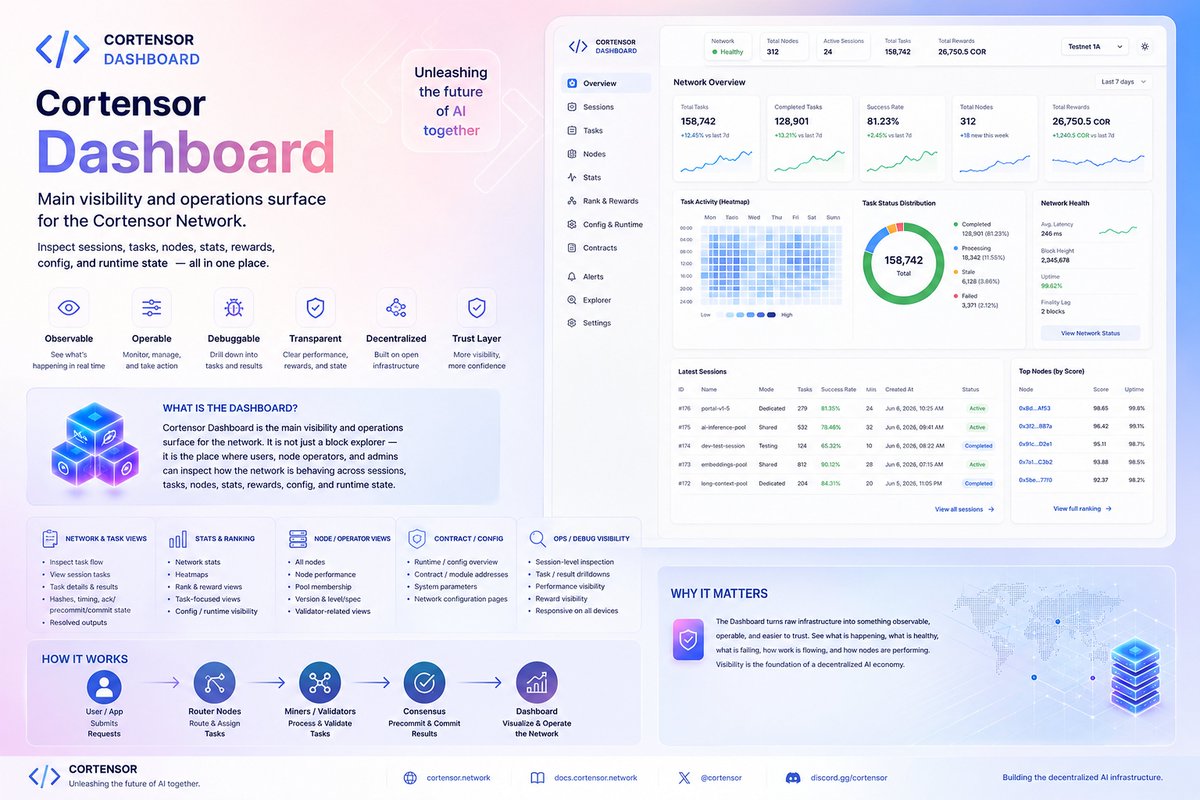
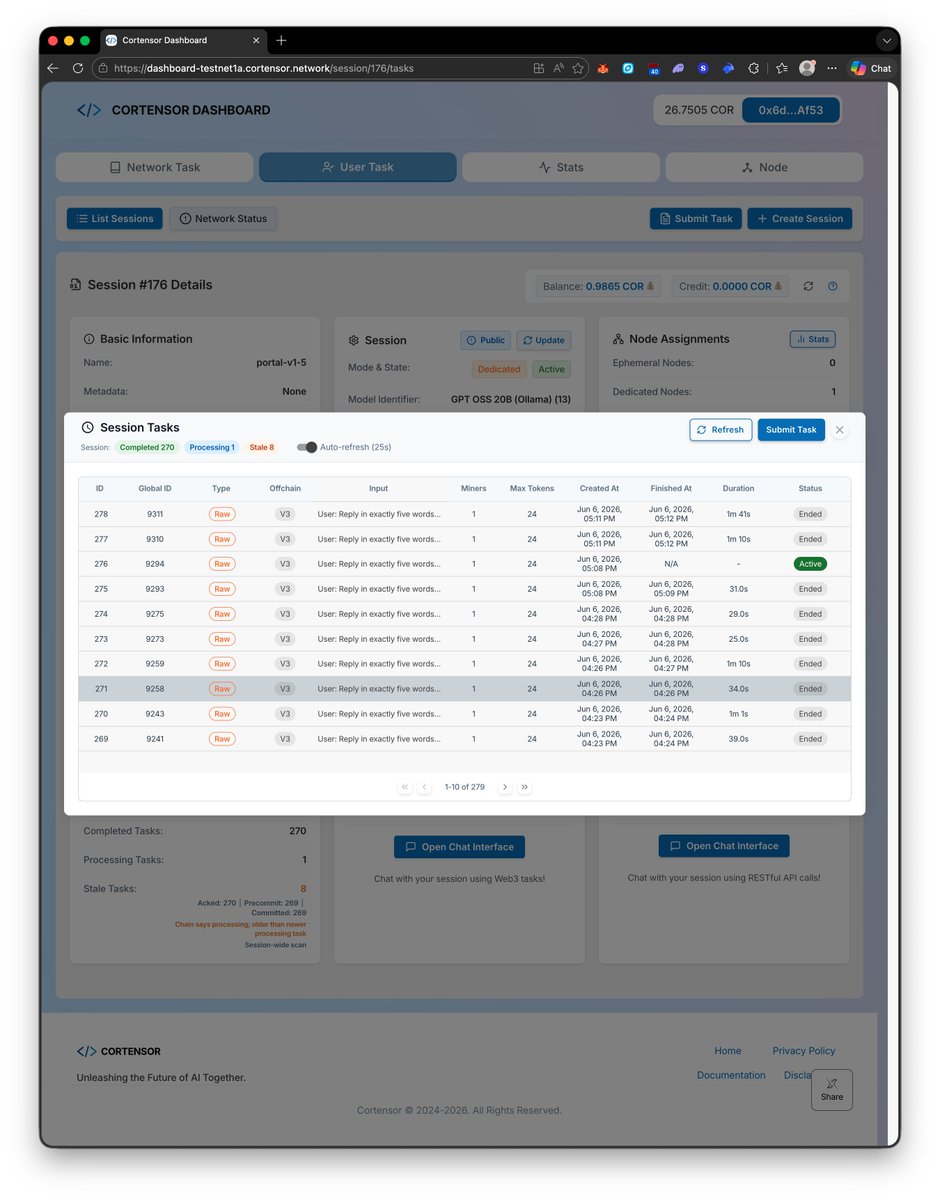
Cortensor Dashboard is the visibility and operations layer for the network.
It is where you inspect sessions, tasks, nodes, rewards, config, and runtime state - all in one place.
That is why the Dashboard matters:
it turns raw infrastructure into something observable, operable, and easier to trust.
#Cortensor #Dashboard #AIInfra #DePIN
Jun 7
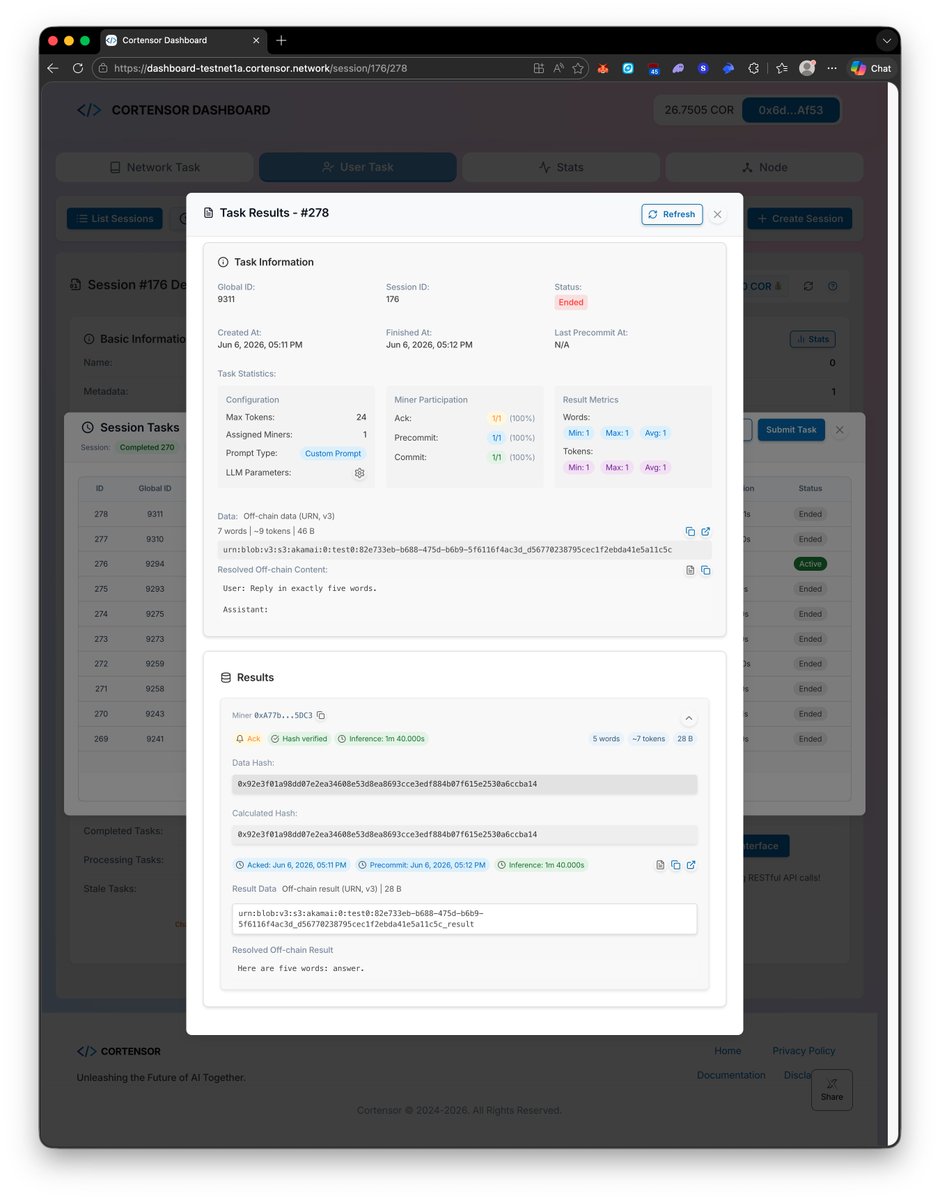
🔎 Recap: What Cortensor Dashboard Is and Why It Matters
A quick recap on what Cortensor Dashboard is in the broader Cortensor stack.
🔹 What the Dashboard is
At the simplest level, Cortensor Dashboard is the main visibility and operations surface for the network.
It is not just a block explorer or a stats page.
It is the place where users, node operators, and admins can inspect how the network is behaving across:
- sessions
- tasks
- nodes
- stats
- rewards
- config
- contract/runtime state
So from the outside, the Dashboard is how Cortensor becomes more observable and easier to operate.
🔹 What the Dashboard can do today
The current Dashboard already has the shape for:
- Network and user task views
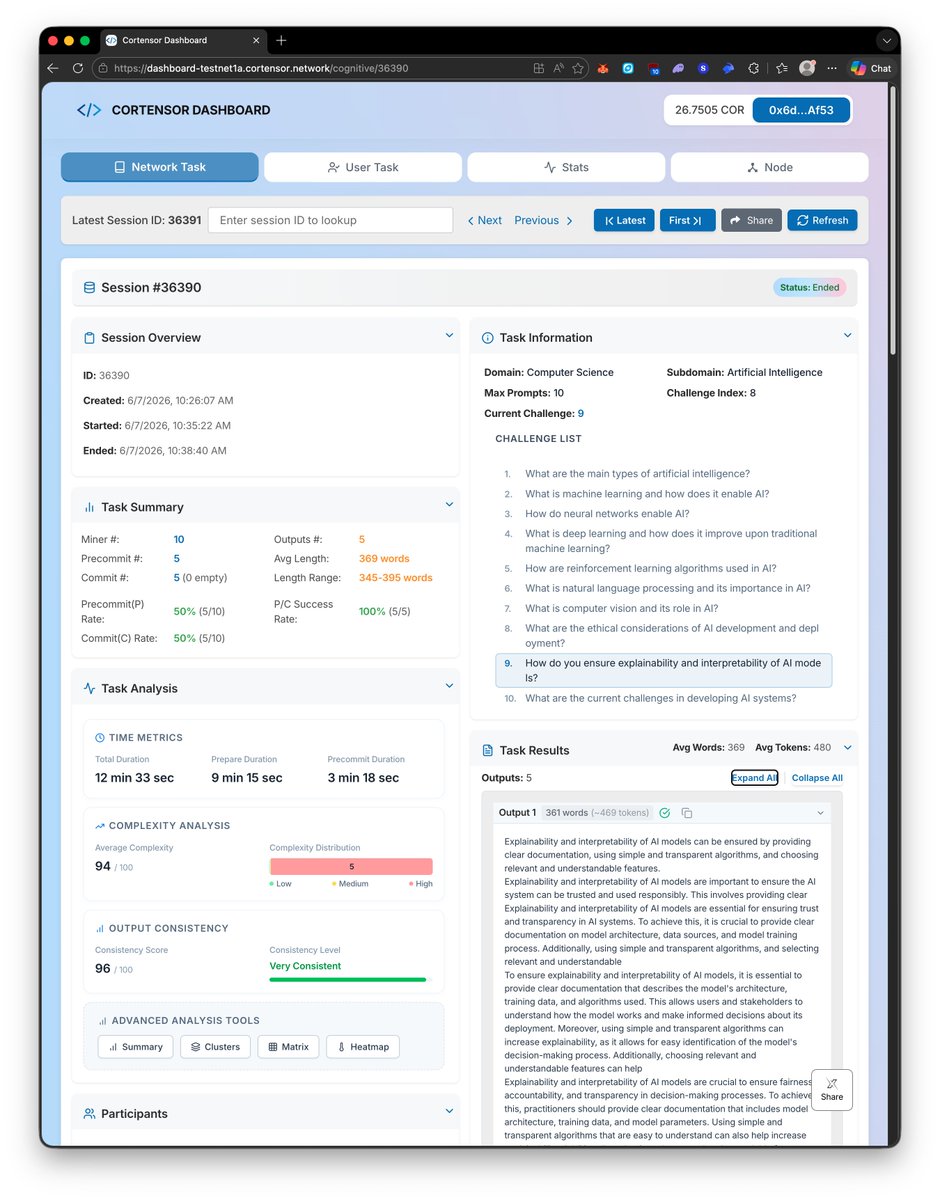
- inspect task flow
- view session tasks
- open task details and results
- check hashes, timing, ack/precommit/commit state, and resolved outputs
- Stats and ranking surfaces
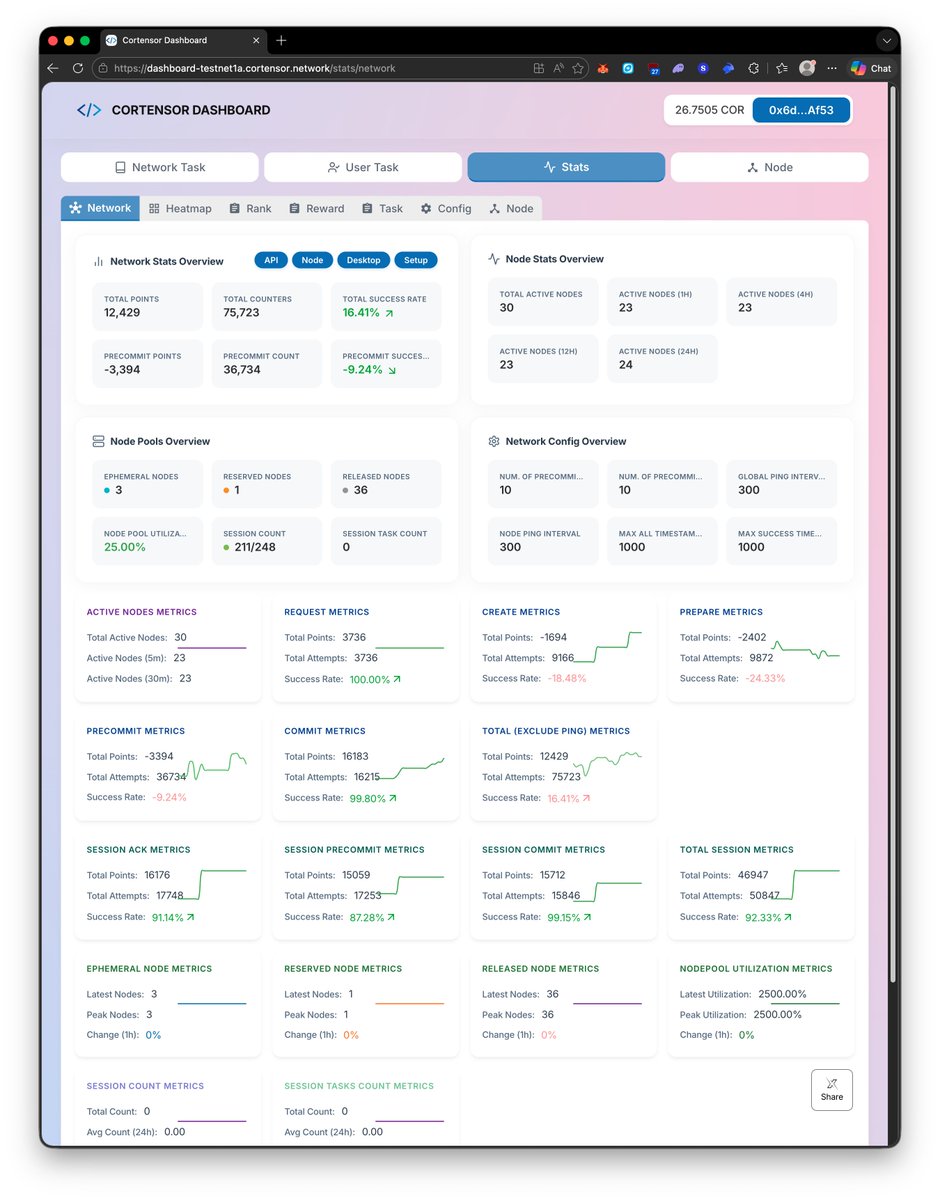
- network stats
- heatmaps
- rank/reward views
- task-focused views
- config/runtime visibility
- Node/operator views
- all nodes
- node performance
- pool membership
- version
- level/spec
- validator-related views
- Contract/config visibility
- runtime/config overview
- contract/module addresses
- system parameters
- network configuration pages
- Ops/debug visibility
- session-level inspection
- task/result drilldowns
- performance and reward visibility
- more readable task/result surfaces across desktop, tablet, and mobile
🔹 Why this matters
The Dashboard matters because a network is not very useful if people cannot clearly see:
- what is happening
- what is healthy
- what is failing
- how work is flowing
- how nodes are performing
- how rewards/config/runtime state are changing
So the Dashboard is one of the key layers that turns Cortensor from raw infrastructure into something:
- observable
- operable
- debuggable
- easier to trust and participate in
🔹 Current direction
The Dashboard is also continuing to improve on the UI/UX side, especially around:
- task tables
- task details
- result views
- mobile and responsive layouts
- cleaner operational visibility
🔹 Simple framing
- Cortensor Network = the execution / routing / trust infrastructure
- Cortensor Dashboard = the visibility and operations surface on top of it
That is why the Dashboard matters: it gives the network a usable control/inspection layer, not just raw backend activity.
#Cortensor #Dashboard #AIInfra #DePIN
1
14
24
331
thipdb88 retweeted
Jun 14
🛠️ DevLog – Early Heads-Up on L3 Mainnet Infra Assessment
A quick heads-up on another area we may start looking at a bit earlier.
🔹 Current direction
We may do some earlier assessment on the L3 mainnet (@Arbitrum Orbit) infra side, mainly around:
- infra shape
- RPC path
- baseline setup
- supporting services and readiness
🔹 What this means
This is not an execution/update post yet. It is more about starting to assess what the L3 mainnet baseline would require so we have a clearer picture earlier.
🔹 Why this matters
The goal is to surface:
- infra assumptions
- RPC requirements
- setup gaps
- operational needs
before those become heavier work later.
🔹 Current takeaway
So for now, this is just an early signal that some L3 mainnet infra assessment may start sooner, even though there is nothing actionable from it yet.
#Cortensor #DevLog #L3 #Mainnet #Infra #RPC
Jun 10
🔎 Recap: What is Mainnet Lite vs Mainnet Full?
Mainnet Lite is the more practical and controlled L2 path.
It is taking shape around:
- @Arbitrum L2
- Dedicated-node-heavy serving
- Simpler rollout
- Earlier hosted / demonstration-style path
Mainnet Full is the fuller Cortensor-native path.
It is taking shape around:
- @Arbitrum Orbit L3
- Broader long-term network shape
- Fuller infra / protocol direction
- More complete Cortensor stack
The goal is simple: use Mainnet Lite as the more controlled first step, while Mainnet Full remains the broader long-term network direction.
Mainnet Lite is the earlier rollout path.
Mainnet Full is the fuller Cortensor-native path.
#Cortensor #MainnetLite #Mainnet #Arbitrum
1
8
17
270
thipdb88 retweeted

Jun 13
1
4
8
119
thipdb88 retweeted
Jun 13
This is another reminder that the future AI stack cannot depend on one closed access path alone.
When model access can change quickly, the value shifts toward infrastructure that is:
- multi-model
- routable
- verifiable
- more open and controllable
That is exactly why Cortensor matters.
#Cortensor #AIInfra #AgenticAI
Jun 13

The US government, citing national security authorities, has issued an export control directive to suspend all access to Fable 5 and Mythos 5 by any foreign national, whether inside or outside the United States, including foreign national Anthropic employees.
The net effect of this order is that we must abruptly disable Fable 5 and Mythos 5 for all our customers to ensure compliance.
Access to all other Claude models is not affected.
We apologize for this disruption to our customers. We believe this is a misunderstanding and are working to restore access as soon as possible.
Read our full statement: anthropic.com/news/fable-myt…
2
14
27
424
thipdb88 retweeted
Jun 13
🛠️ DevLog – Portal Multi-Model Routing Prep Starts Next Week
A quick follow-up on the recent API Gateway capacity / reliability work.
🔹 Current direction
Now that the first minimal layer of capacity-aware tracking / load balancing is in place, the next step is to start testing the Portal path with more than just the current `oss-20b` route underneath.
🔹 What’s next
Next week, we’ll begin the prep work to switch/add more models into the current hosted path.
The next models we want to bring in are:
- gemma4 e4b
- qwen 3.5 9b
🔹 Why this matters
This is important because the next Portal check is not only about load protection anymore.
It is also about making sure the API Gateway can:
- route different models correctly
- behave cleanly once more than one model path exists
- handle a broader hosted flow instead of staying centered on only oss-20b
🔹 Current takeaway
So the next step is:
- prepare the model switch/additions next week
- expand beyond the single-model path
- test multi-model routing more directly at the API Gateway level
#Cortensor #DevLog #Portal #APIGateway #Routing #Reliability
Jun 12
🛠️ DevLog – Gateway Capacity Follow-Up: Next Focus Is Multi-Model Routing
A quick follow-up on the recent API Gateway capacity / reliability work.
🔹 Current progress
We’ve now added the first minimal layer of capacity-aware tracking / load balancing on the API Gateway side so the hosted path behaves a bit more safely under shared load.
🔹 What comes next
From here, we’ll shift gears a bit and start reconfiguring the existing sessions so they can support more than just the current oss-20b path.
The goal is to test:
- model routing at the API Gateway level
- how the gateway behaves when multiple model paths exist underneath
- whether the current hosted flow still routes cleanly once the model mix becomes broader
🔹 Why this matters
So the next step is not only “protect the gateway under load,” but also make sure the gateway can route correctly once the backend is no longer centered around just one model/session path.
🔹 Current takeaway
The first capacity/reliability layer is in place.
Next, we use that foundation to test the multi-model routing side more directly.
#Cortensor #DevLog #Portal #APIGateway #Routing #Reliability
1
9
15
281
thipdb88 retweeted
Jun 11
This is directionally why we think execution infrastructure matters.
As AI access becomes more metered and less subsidized, the winning stack is not just "best model."
It is:
- which model runs where
- at what cost
- with what trust level
- on what execution layer
That is exactly the kind of future Cortensor is built for.
Jun 10

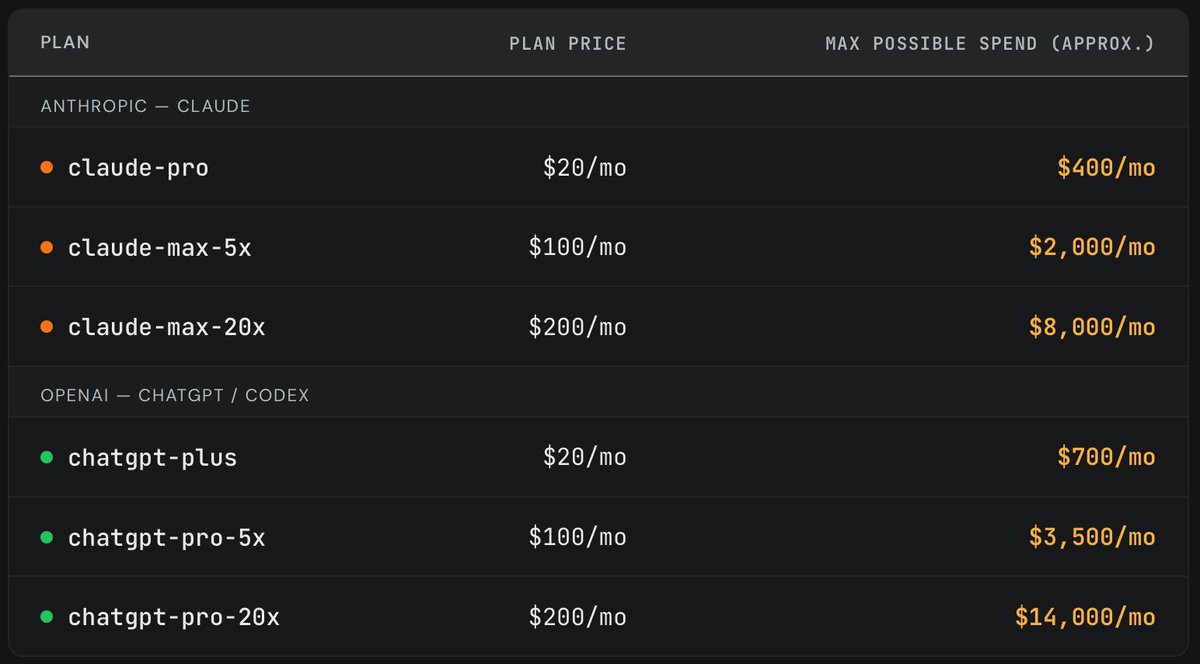
Recently, we purchased one of each Anthropic/OpenAI subscription plan and randomly ran long horizon coding tasks until we exhausted the weekly limit. It's widely believed that a $200/month plan maxes out at ~$2000/month worth of tokens (assuming API pricing). However, we found that the subscriptions are actually far more generous. (2/4)
2
11
21
257
thipdb88 retweeted
Jun 11
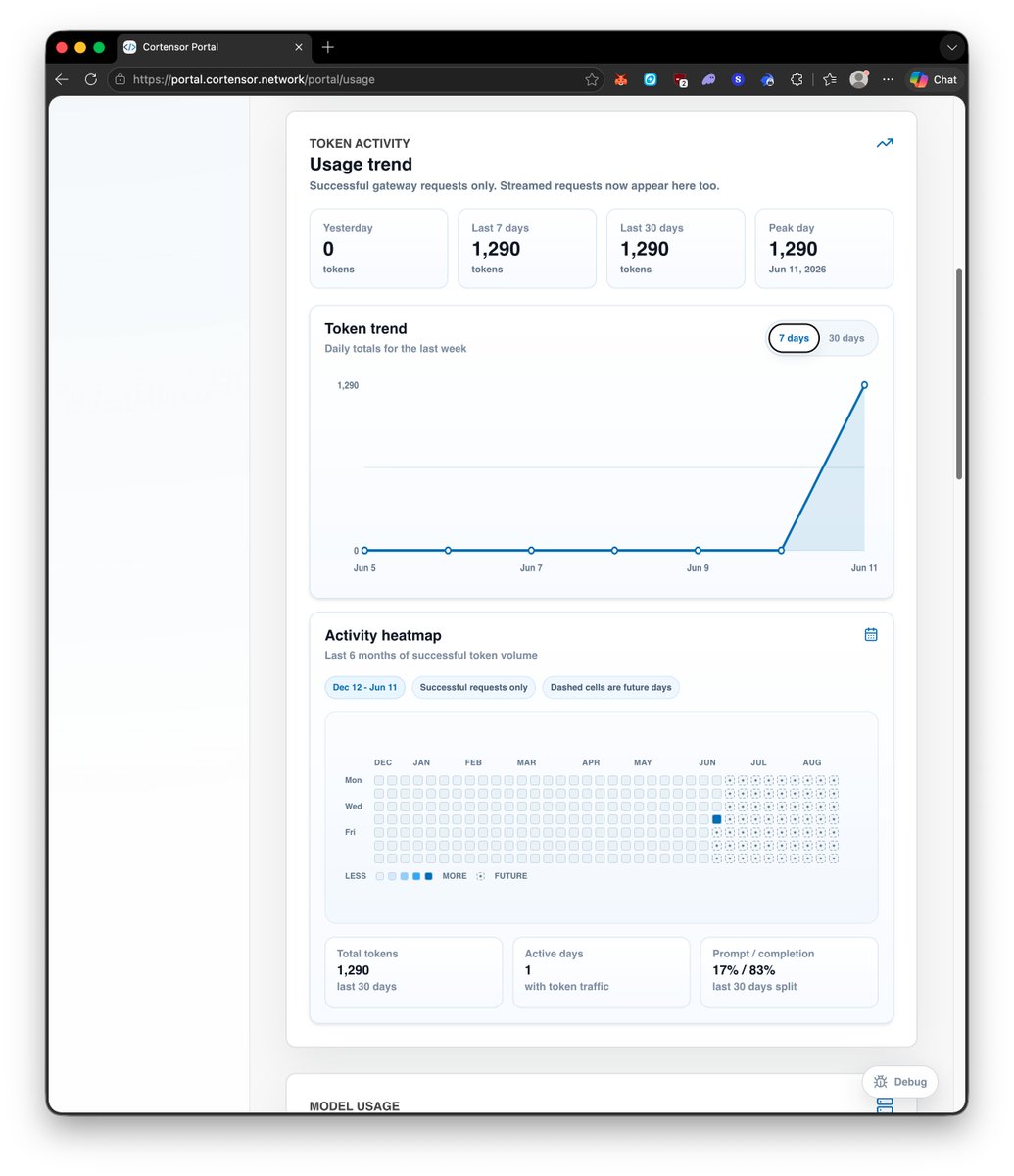
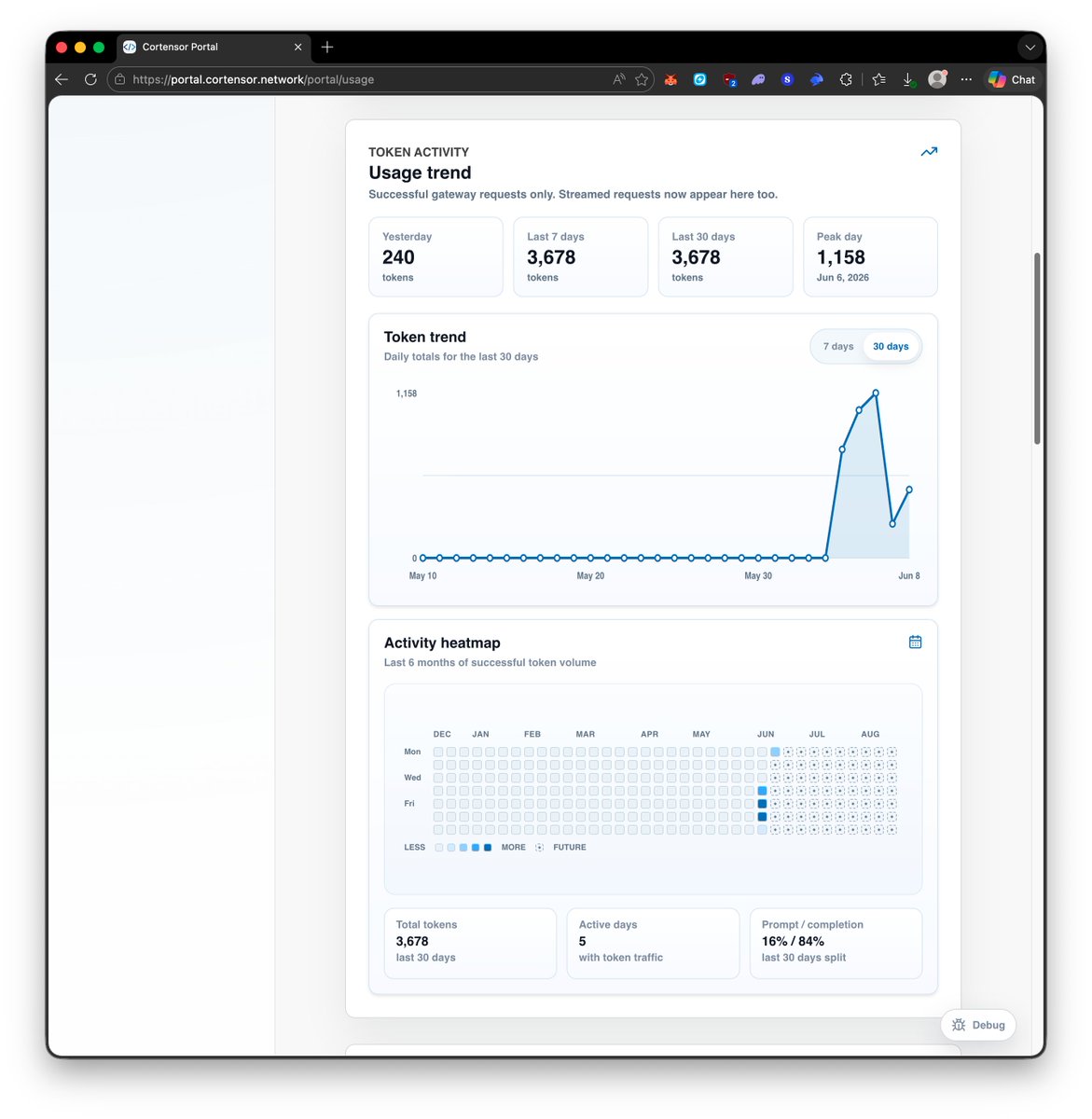
🛠️ DevLog – Portal Usage Heatmap Got a Small UI/UX Refinement Pass
A quick Portal UI/UX follow-up.
🔹 What improved
We refined the usage heatmap experience a bit more so the section reads more cleanly and feels more intentional.
That includes:
- filling future heatmap cells farther out so the calendar grid looks more complete
- adding a small reading guide for:
- date coverage
- successful requests only
- dashed cells = future days
- adding matching light/dark mode styling for those guide chips
🔹 Why this matters
This is a small refinement, but it makes the usage-trend area easier to read at a glance and helps the heatmap feel less ambiguous.
#Cortensor #DevLog #Portal #UIUX #ProductDesign
Jun 8
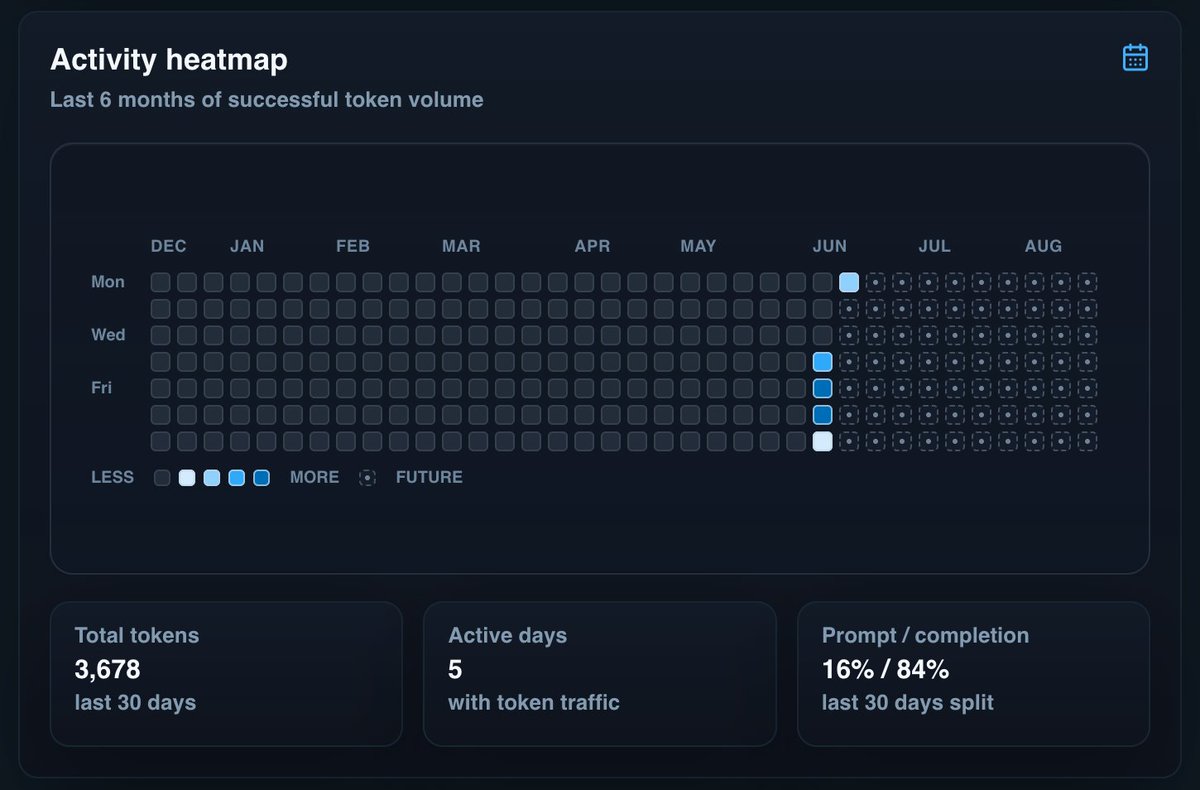
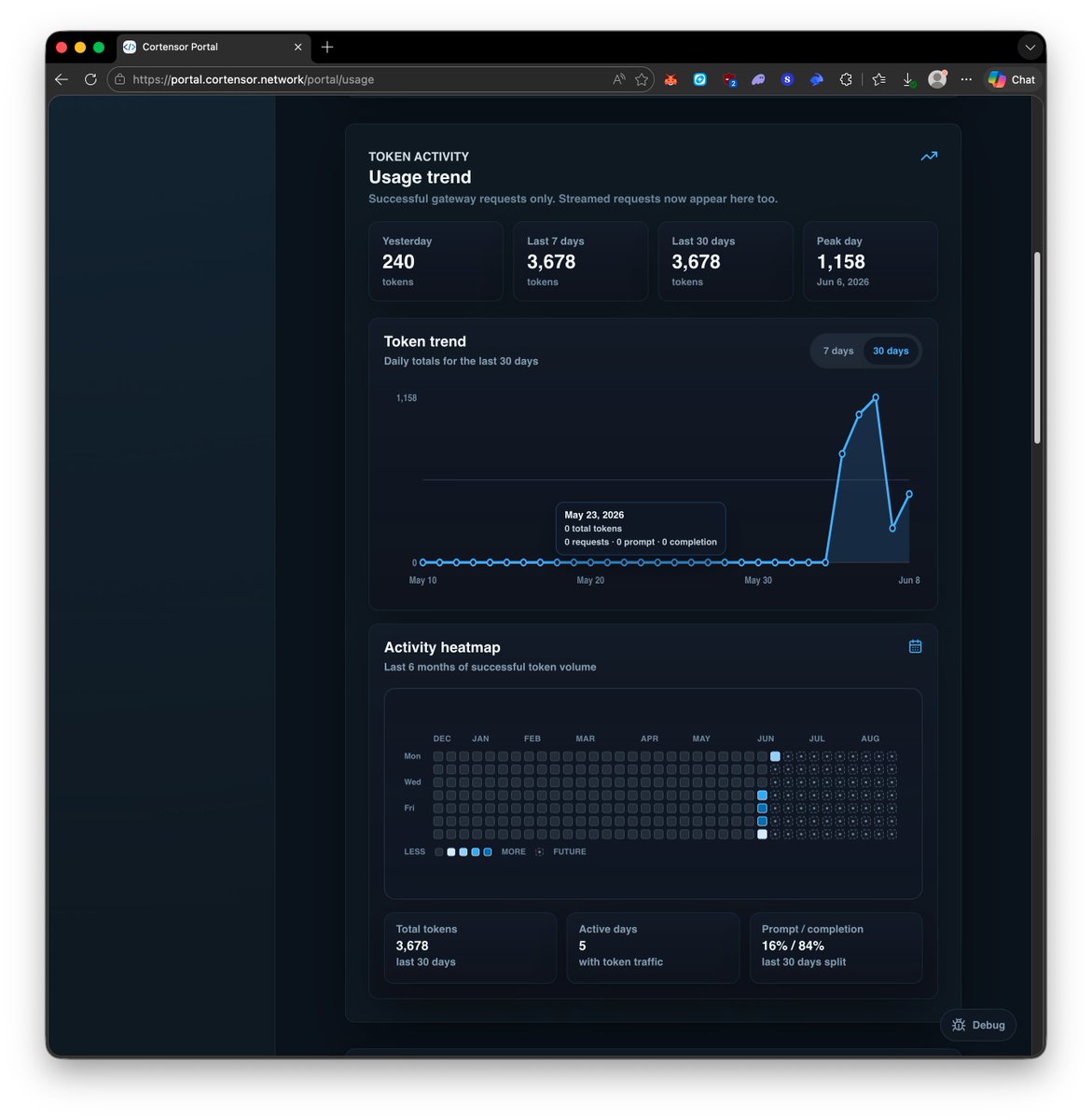
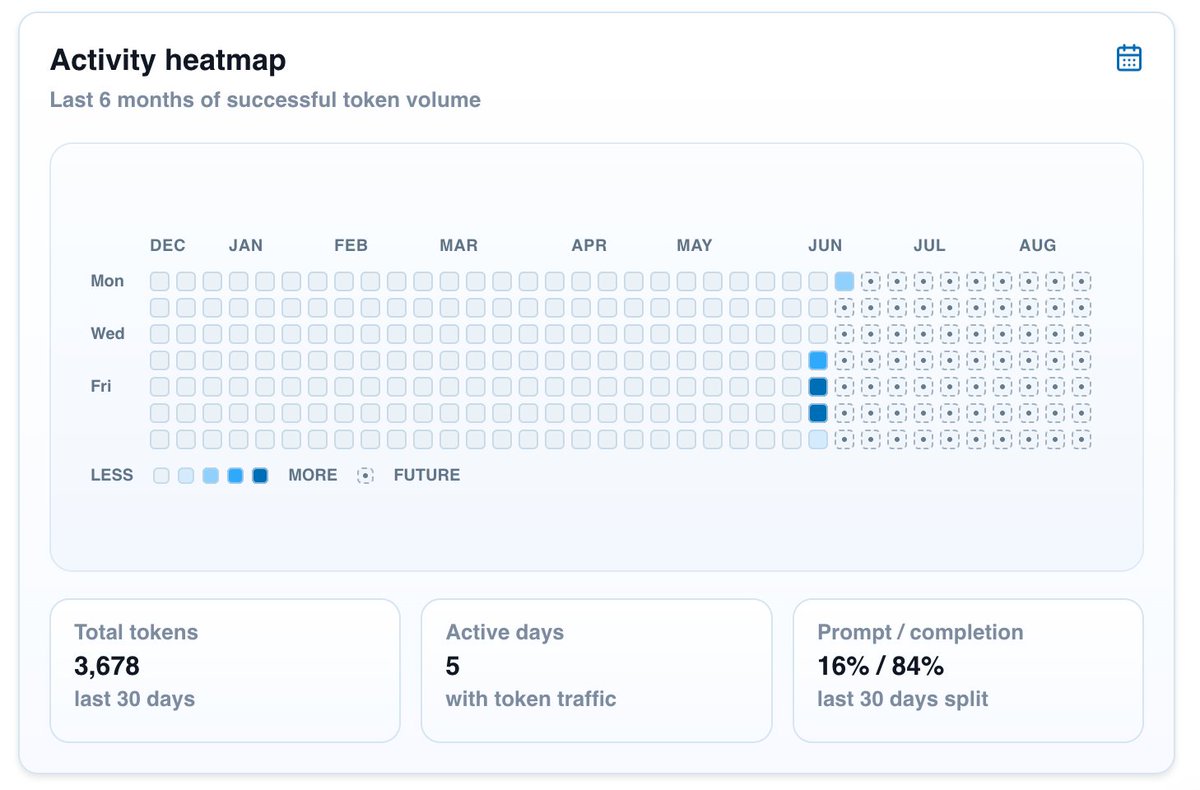
🛠️ DevLog – Portal Usage Trend UI Got Another Refinement Pass
A quick follow-up on the Portal usage-trend area we added last Friday.
🔹 What we refined
We did another UI/UX pass on the token-usage and trend surfaces, especially around:
- the activity heatmap
- heatmap cell styling / readability
- how token activity is shown over time
- how trend cards and supporting stats are grouped
🔹 Why this matters
This area is meant to do more than just show a number.
It should help users understand:
- when usage happened
- how activity is distributed across days
- whether usage is concentrated or gradual
- how token flow is trending over time
So the refinement work here is mostly about making that information easier to read at a glance.
🔹 Heatmap focus
A lot of the recent polish was specifically around the activity heatmap implementation:
- improving the visual weight of cells
- making the scale easier to understand
- making lower vs higher activity feel clearer
- helping the whole section look cleaner in both light and dark mode
🔹 Current takeaway
This is still a refinement pass, but the usage-trend area is starting to feel more useful and more polished as a real product surface rather than just a raw stats widget.
#Cortensor #DevLog #Portal #UIUX #ProductDesign
11
18
475
thipdb88 retweeted
Jun 11
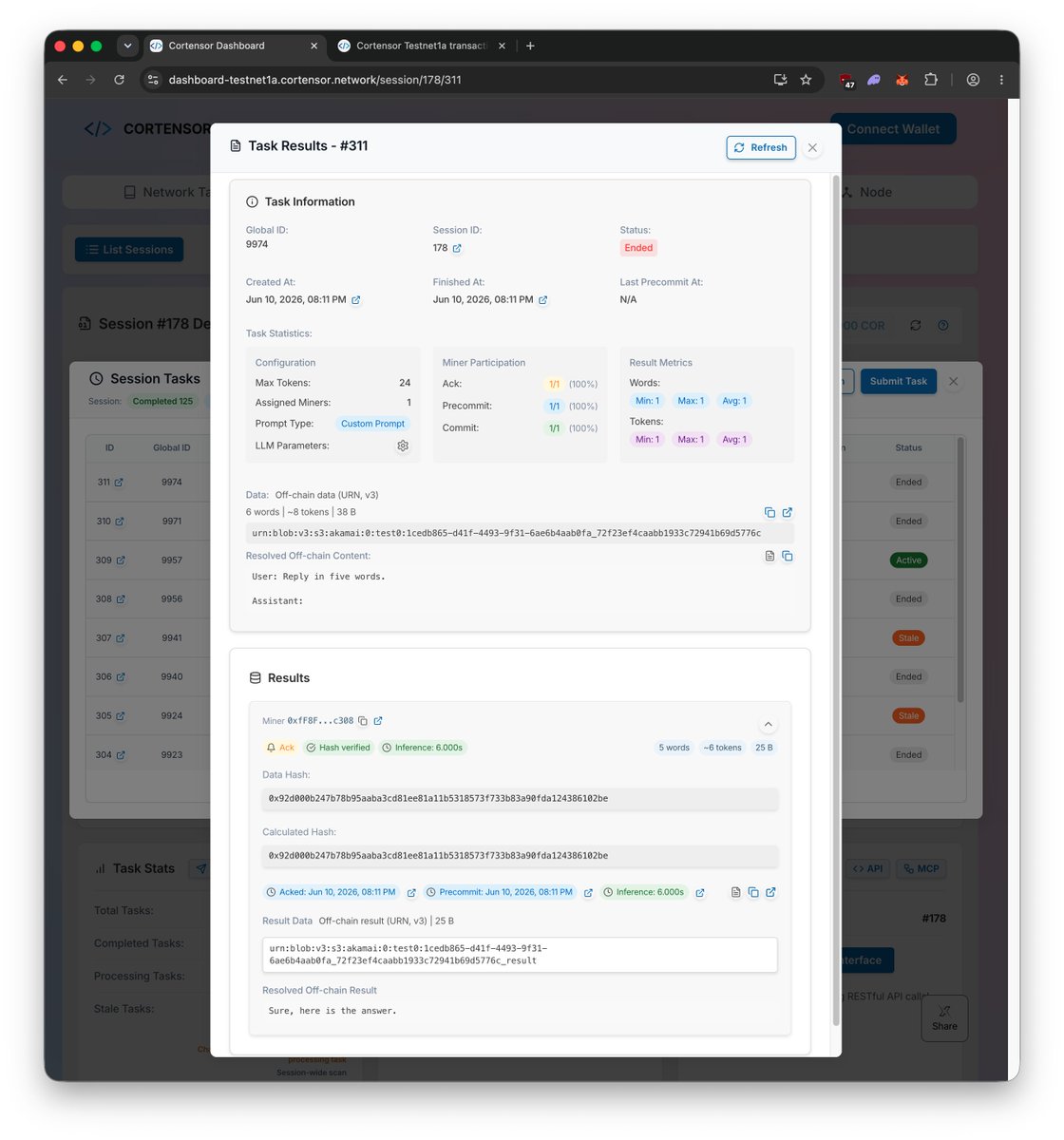
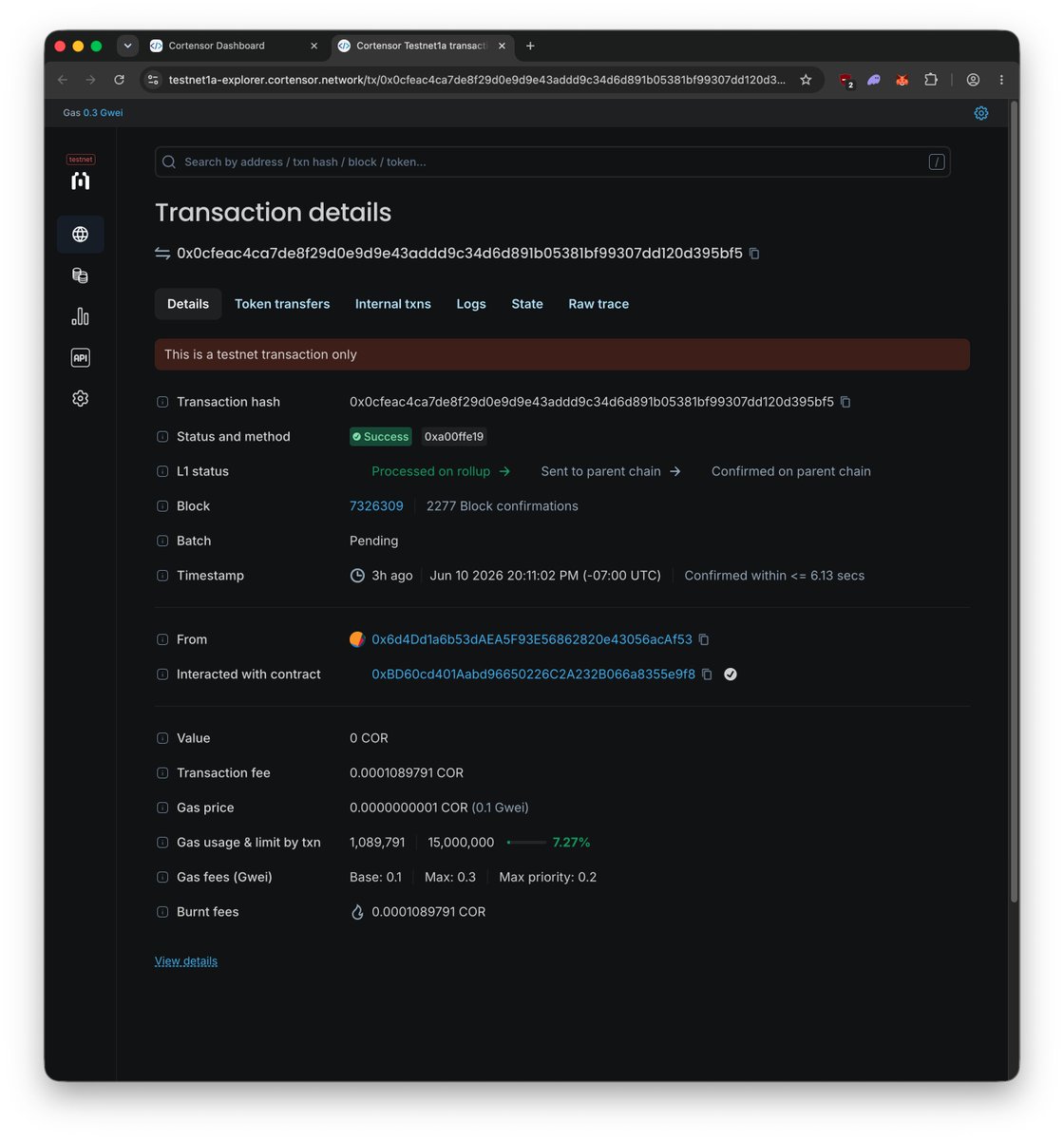
🛠️ DevLog – Dashboard → Explorer Verification Links Are Now Live on Testnet0 and Testnet1a
A quick follow-up on the earlier dashboard verification update.
🔹 Current progress
We’ve now pushed this feature into both:
- testnet0
- testnet1a
🔹 What changed
Task/session views can now link more directly into the explorer, so actions and state changes are easier to verify without doing manual lookup first.
Example flow:
- Dashboard task view → dashboard-testnet1a.cortenso…
- Explorer tx view → testnet1a-explorer.cortensor…
🔹 Why this matters
This makes it much easier to:
- inspect what happened from the dashboard
- jump straight into the underlying transaction/state change
- verify task/session activity with less friction
🔹 Current takeaway
So this is a useful refinement for both dashboard usability and verification flow:
- less manual explorer searching
- more direct traceability from dashboard views
- cleaner inspection of task/session state changes
#Cortensor #DevLog #Dashboard #Verification #Explorer
Jun 11
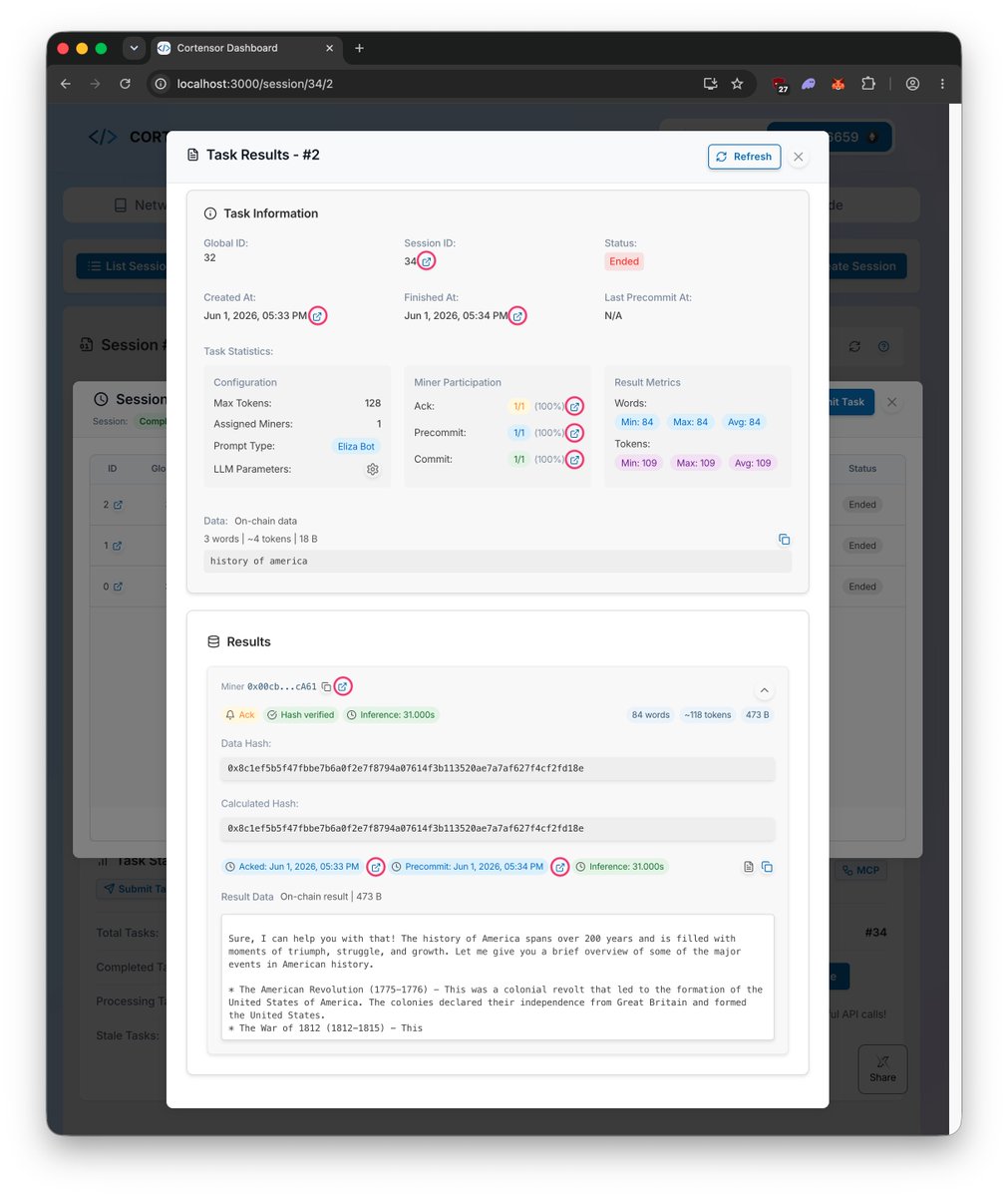
🛠️ DevLog – Dashboard Verification Links Are Coming
A quick follow-up on the Dashboard side.
We’ll likely release a small dashboard update later today focused on verification and traceability.
🔹 What’s changing
The main improvement is that each:
- action
- session
- state change
will start linking more directly to the explorer, so people can verify the underlying tx / state transition more easily.
🔹 Why this matters
Right now, some of this still requires manual lookup through the explorer.
With these links added directly into the dashboard, it should become easier to:
- verify what happened
- inspect state transitions
- trace actions more quickly
- connect dashboard views to onchain/explorer data with less friction
🔹 Current direction
So this is mainly a dashboard verification refinement pass:
- less manual explorer lookup
- more direct verification from the dashboard
- cleaner traceability for sessions and state changes
#Cortensor #DevLog #Dashboard #Verification #Explorer
1
10
18
210

thipdb88 retweeted
Jun 10
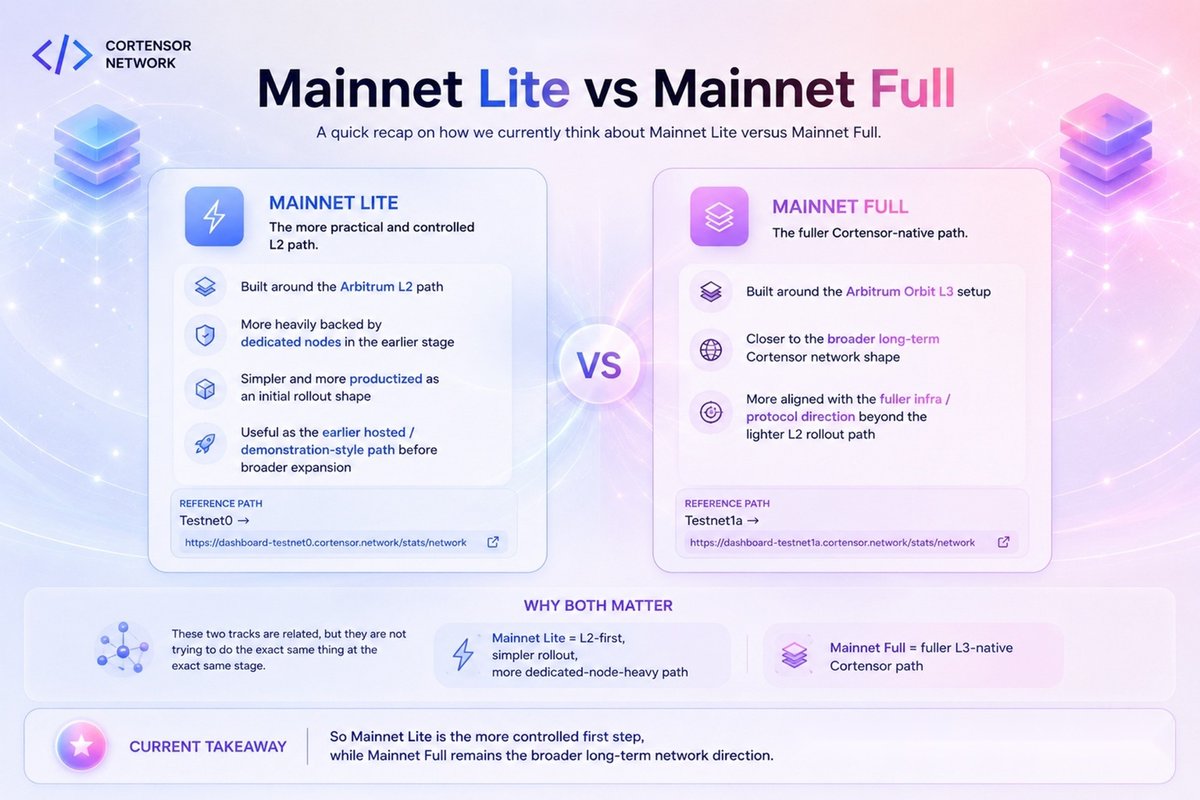
🔎 Recap: Mainnet Lite vs Mainnet Full
A quick recap on how we currently think about Mainnet Lite versus Mainnet Full.
🔹 Mainnet Lite
Mainnet Lite is the more practical and controlled L2 path.
The current direction is:
- built around the @Arbitrum L2 path
- more heavily backed by dedicated nodes in the earlier stage
- simpler and more productized as an initial rollout shape
- useful as the earlier hosted / demonstration-style path before broader expansion
Reference path:
- Testnet0 → dashboard-testnet0.cortensor…
🔹 Mainnet Full
Mainnet Full is the fuller Cortensor-native path.
The current direction is:
- built around the @Arbitrum Orbit L3 setup
- closer to the broader long-term Cortensor network shape
- more aligned with the fuller infra / protocol direction beyond the lighter L2 rollout path
Reference path:
- Testnet1a → dashboard-testnet1a.cortenso…
🔹 Why both matter
These two tracks are related, but they are not trying to do the exact same thing at the exact same stage.
The rough framing is:
- Mainnet Lite = L2-first, simpler rollout, more dedicated-node-heavy path
- Mainnet Full = fuller L3-native Cortensor path
🔹 Current takeaway
So Mainnet Lite is the more controlled first step, while Mainnet Full remains the broader long-term network direction.
#Cortensor #MainnetLite #Mainnet #L2 #L3
2
6
12
513
thipdb88 retweeted
Jun 9
@cortensor has the tech to become the first worldwide network of nodes running decentralized inference tasks. @CryptoRyuma has been consistantly shipping for 2 years now
docs.cortensor.network/abstr…
1
9
12
253
thipdb88 retweeted
Jun 9
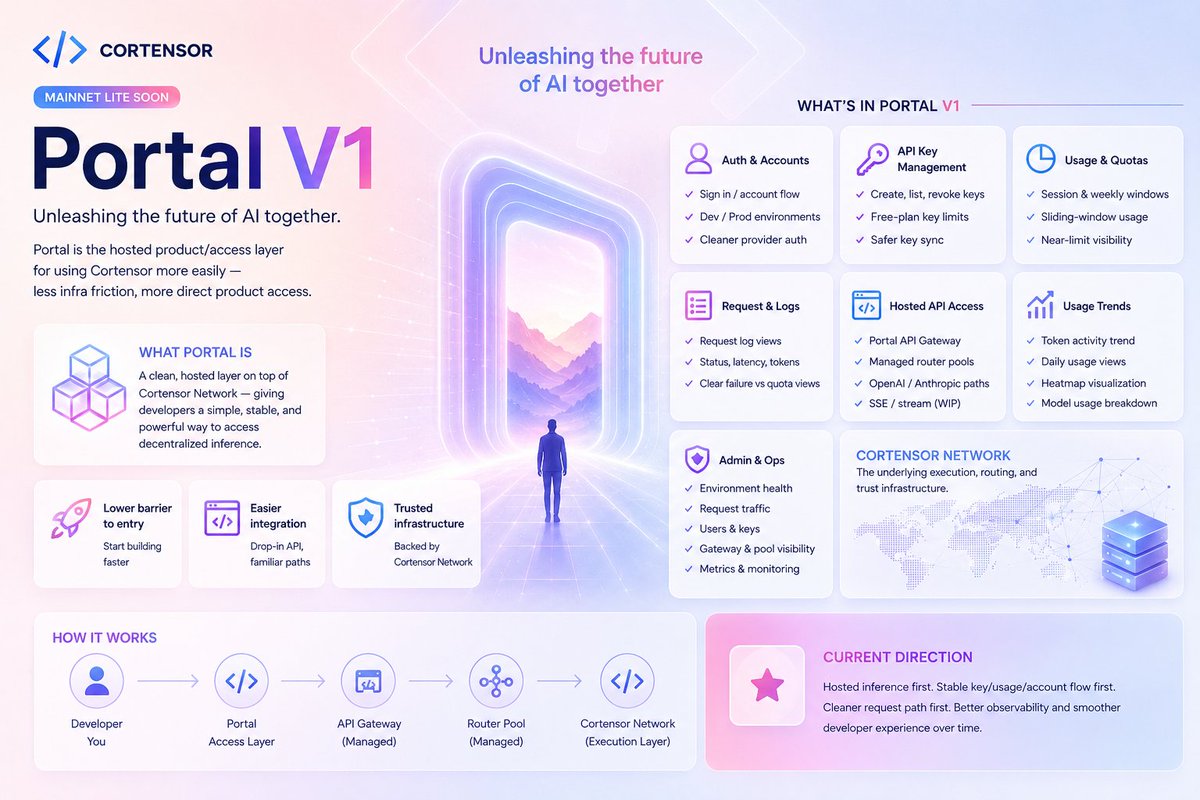
🔎 Recap: What is Portal V1?
Cortensor Portal is the hosted access layer for using Cortensor more easily.
Portal V1 is taking shape around:
- Auth and Accounts
- API key management
- Usage and quota visibility
- Request logs
- Hosted API access
- Usage trends
- Admin / Ops visibility
The goal is simple: less infra friction, more direct product access.
Cortensor Network is the execution layer underneath.
Portal is the product layer on top.
#Cortensor #Portal #API #AIInfra
Jun 7
🔎 Recap: What’s in Cortensor Portal V1 So Far
A quick recap on what is already going into Cortensor Portal V1 as the current iteration continues.
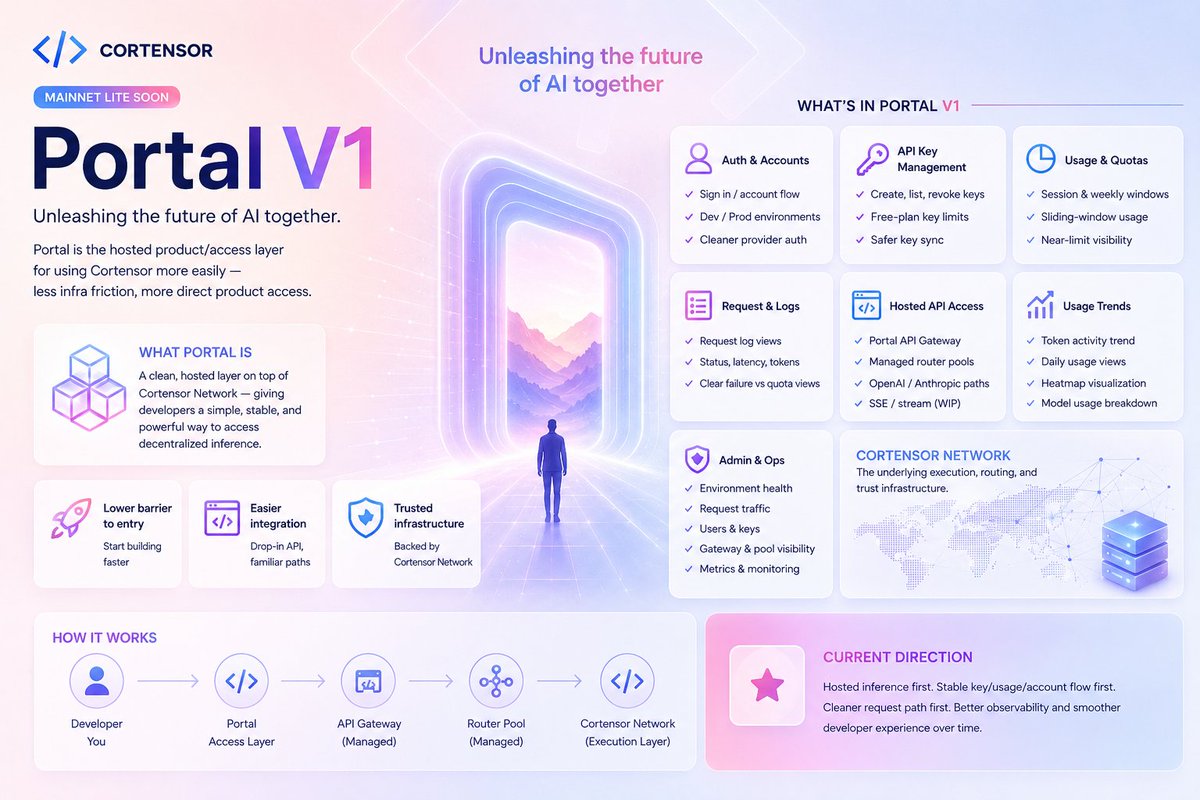
🔹 What Portal is
At the simplest level, Portal is the hosted product/access layer for using Cortensor more easily.
Instead of asking users to deal directly with raw router nodes, sessions, or backend topology, Portal gives a cleaner surface where someone can:
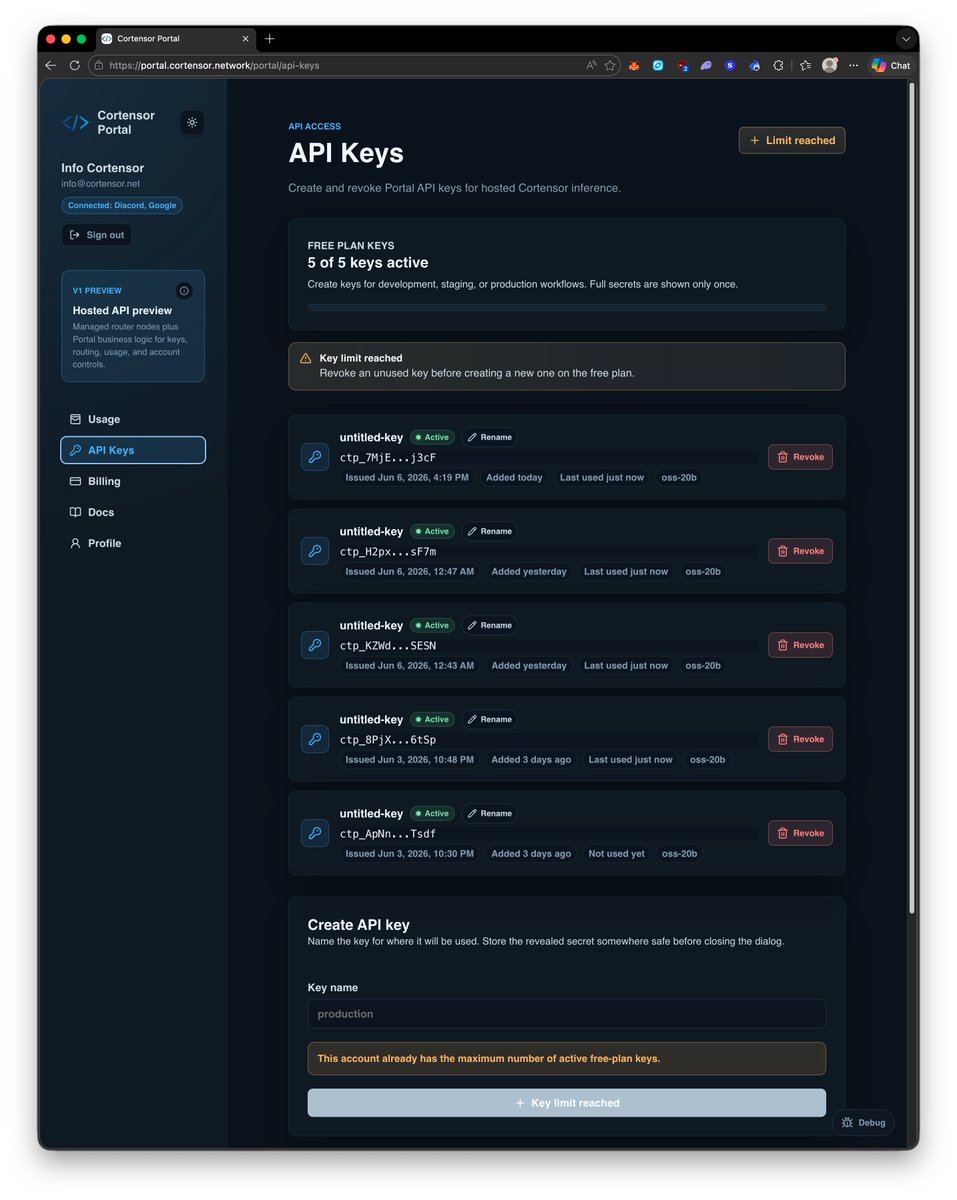
- sign in
- create and revoke API keys
- view usage and limits
- access hosted inference through a stable API
- use managed router pools underneath without touching the raw infra directly
So from the outside, Portal means:
less infra friction, more direct product access.
🔹 What’s in Portal V1 so far
The current Portal V1 iteration already includes:
- auth/account access
- sign in / account flow
- environment-aware dev/prod setup
- moving toward cleaner provider-based auth paths
- API key management
- create keys
- list keys
- revoke keys
- free-plan key-limit enforcement
- safer sync between Portal, database, and key-management layer
- usage and quota visibility
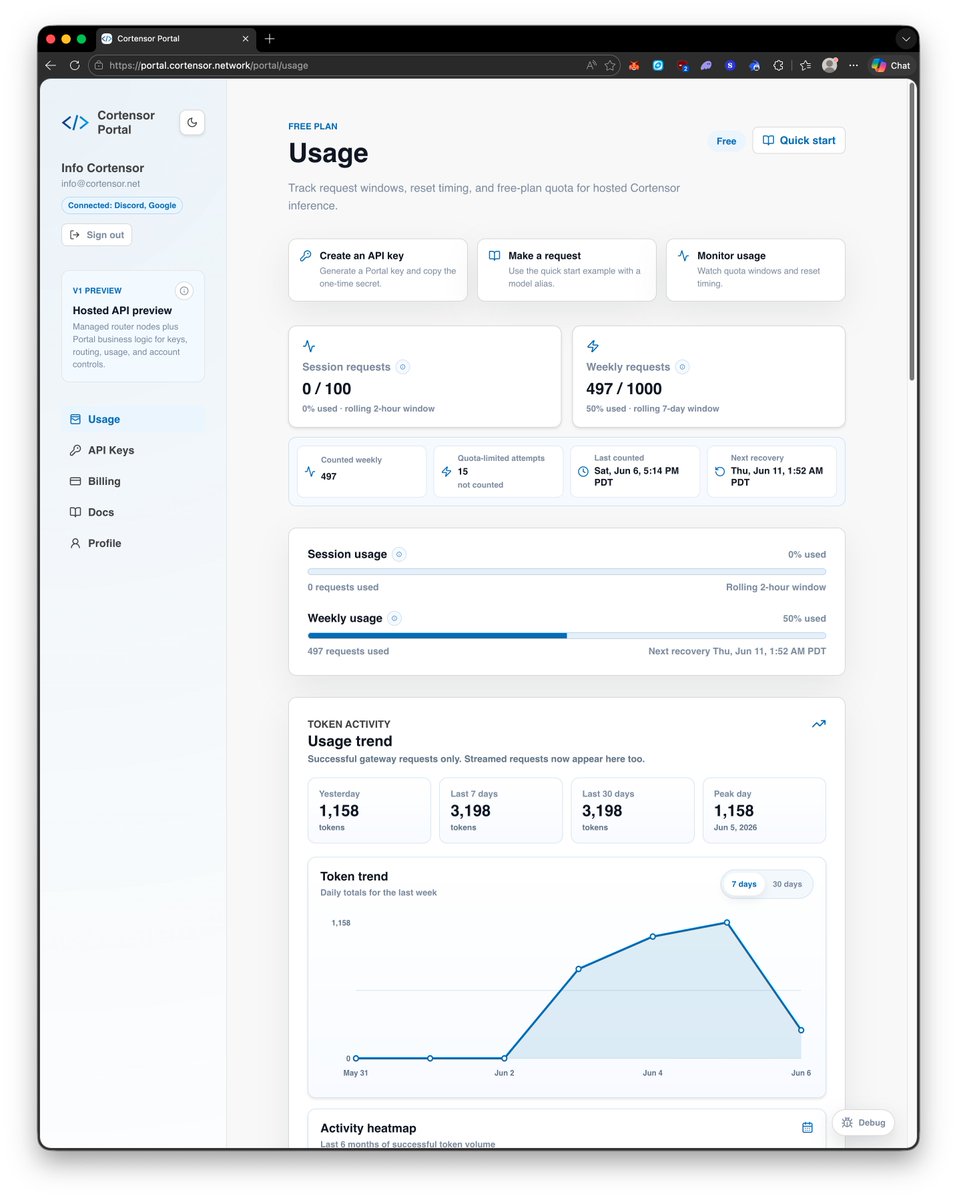
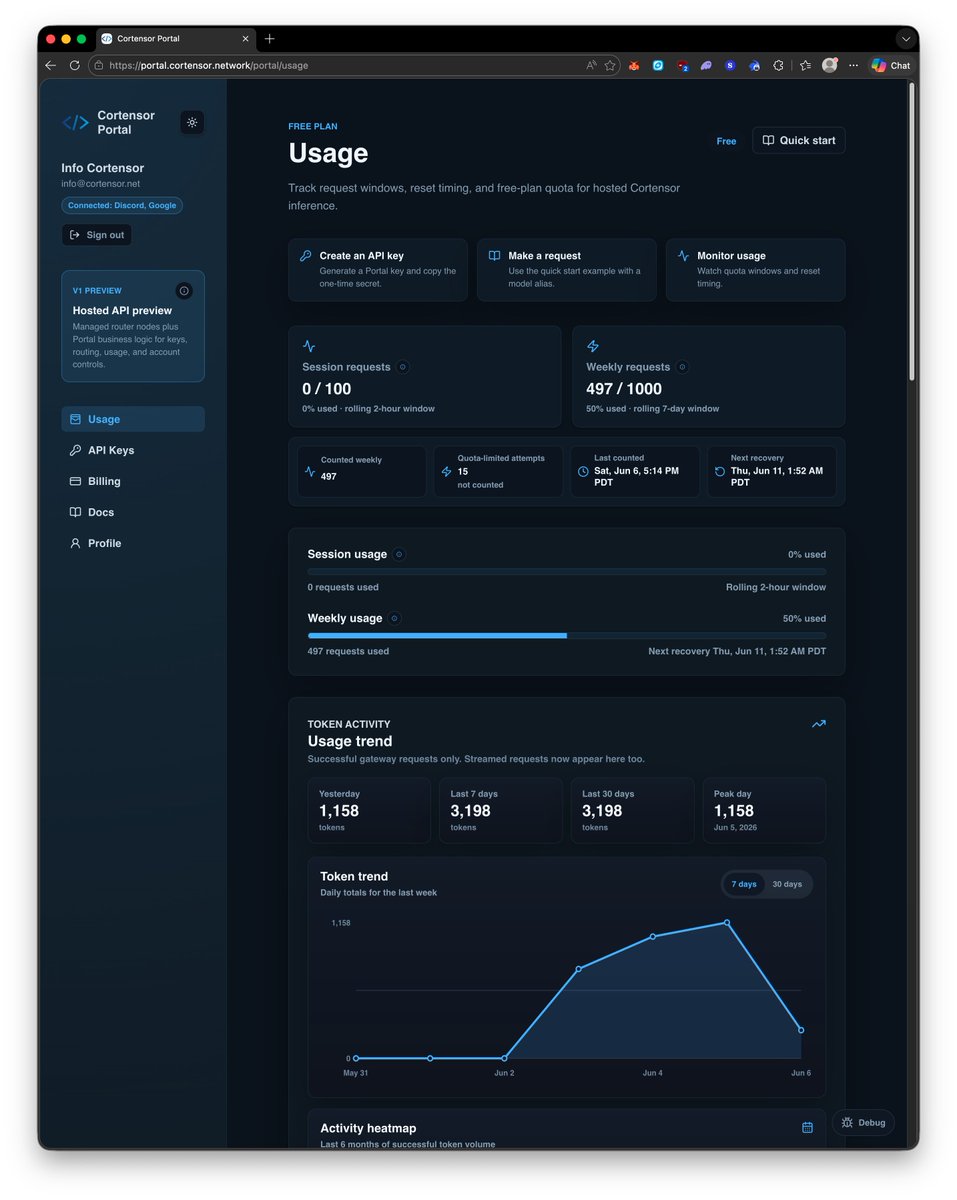
- session and weekly quota windows
- sliding-window usage by default
- reset / recovery timing
- near-limit state visibility
- clearer handling of quota-limited vs real failed requests
- request / log visibility
- request log views
- request details
- status, latency, token, and route visibility
- clearer separation between completed, failed, and quota-limited requests
- hosted API path
- Portal API Gateway in front of managed router pools
- product-facing model aliases
- compatibility work for OpenAI-style and Anthropic-style API paths
- ongoing SSE/stream compatibility work
- usage trends / analytics
- token activity trend
- daily usage views
- heatmap-style usage visualization
- model usage breakdowns
- admin / ops surface
- environment health
- request traffic
- user/account visibility
- key visibility
- gateway and router-pool visibility
- early metrics / events / operational monitoring
🔹 Why this matters
Portal matters because it helps Cortensor move from being understood mainly as infrastructure to being used more directly as a product.
That is important because it:
- lowers the barrier to entry
- makes integration easier for outside developers and teams
- gives Cortensor a clearer hosted API surface
- turns raw network capability into something easier to adopt and actually use
🔹 Current direction
The current V1 direction is still intentionally practical:
- hosted inference first
- stable key/usage/account flow first
- cleaner request path first
- better observability/admin support over time
- more compatibility and smoother developer experience over time
So the simple framing is:
- Cortensor Network = the underlying execution / routing / trust infrastructure
- Portal = the hosted product/access layer on top of it
That is what is in Portal V1 so far, and we’ll keep iterating from here.
#Cortensor #Portal #API #AIInfra #ProductDesign
3
11
18
525
thipdb88 retweeted
Jun 9
🛠️ DevLog – Ephemeral-Node Network Task E2E Also Worked on Mainnet Lite Baseline
A quick follow-up on the Mainnet Lite baseline path.
🔹 Current result
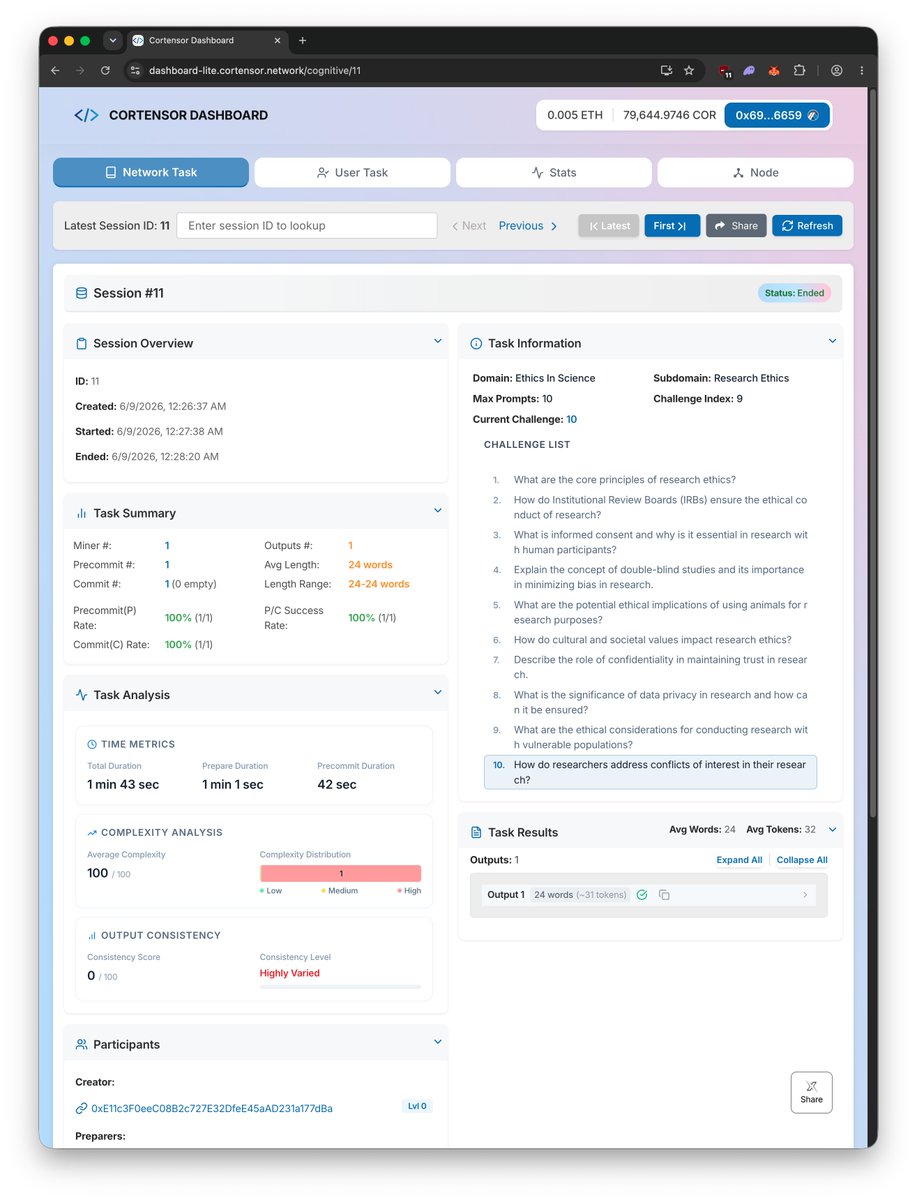
We’ve now also gotten an ephemeral-node E2E working on the Mainnet Lite side, specifically around the interaction between the ephemeral node and the network task oracle for network tasks.
That path also created a few network-task sessions, which gives us another useful baseline signal on the L2/Mainnet Lite setup.
🔹 Why this matters
At this point, the main critical baseline paths have now been checked on Mainnet Lite for:
- ephemeral node network task
- dedicated node user task
So the baseline is no longer only infra prep or dry configuration. We now have working E2E checks across both of those important paths.
🔹 What still remains
The main remaining area is still the ephemeral node user task path.
That one will require a bit more setup, mainly because the node pool needs to be populated more before we can test it properly.
🔹 What’s next
So the next step is to bring up a few more node instances and keep filling out the pool so we can test that remaining path more directly.
#Cortensor #DevLog #MainnetLite #L2 #EphemeralNodes #Infra
Jun 9
🛠️ DevLog – Dedicated-Node Mainnet Lite E2E Worked Including Payment Distribution
A quick follow-up on the Mainnet Lite dedicated-node path.
🔹 Current result
We ran another dedicated-node E2E check, and this time the full lifecycle worked out, including the part that looked failed or unclear in the earlier test.
🔹 What was revalidated
The main thing we wanted to reconfirm was the last part of the node lifecycle:
- payment distribution / execution reward
It looks like the earlier issue was likely a false positive / one-off, because this time that part also worked.
🔹 References
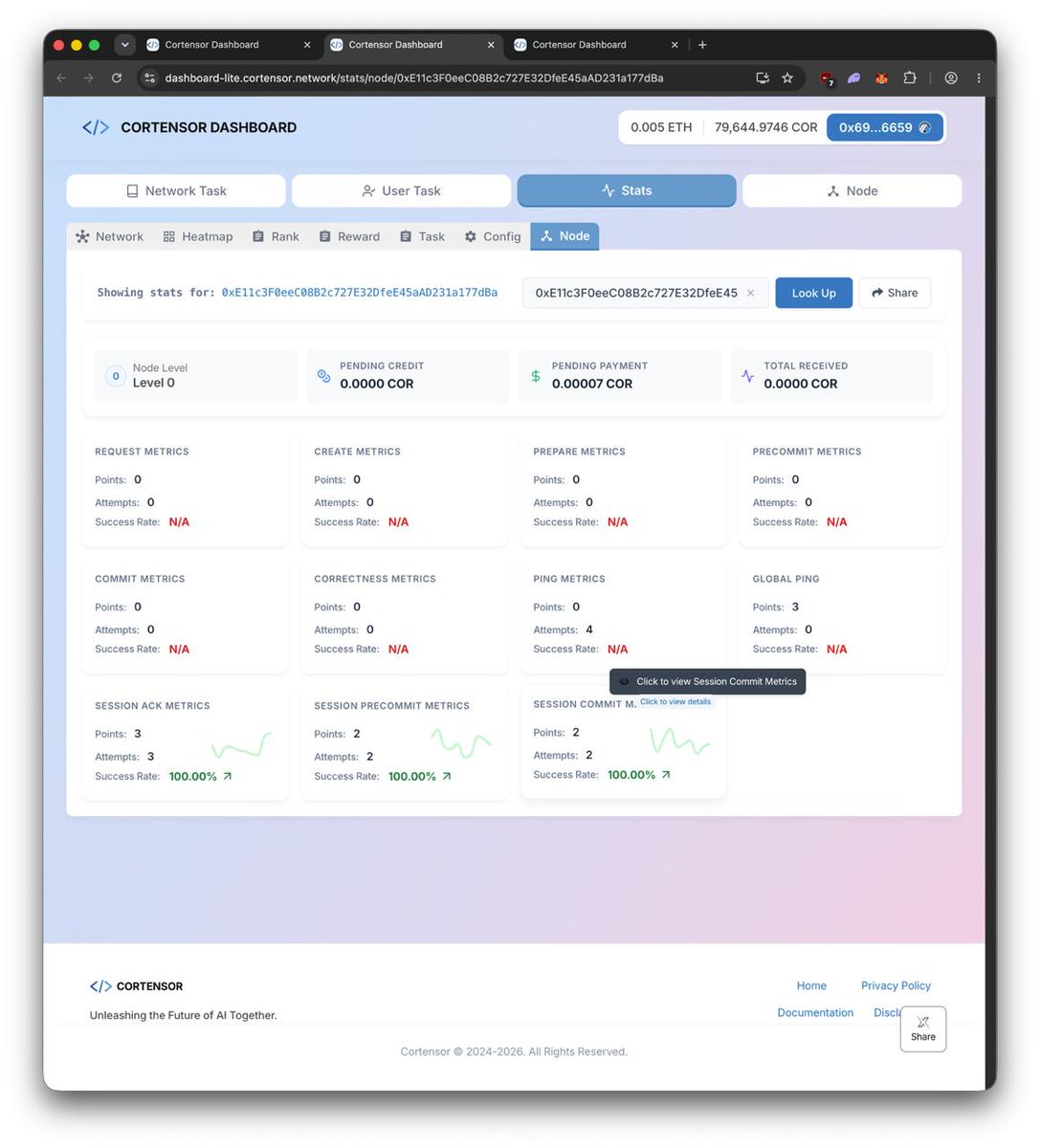
- Session/task: dashboard-lite.cortensor.net…
- Payment tx: arbiscan.io/tx/0x569571a9f69…
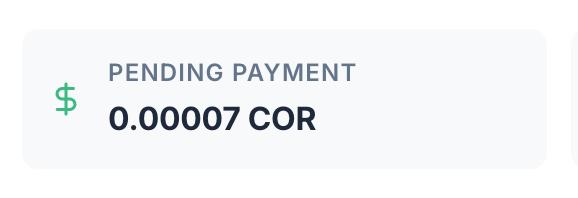
Pending payment observed:
- 0.00007 COR
🔹 Why this matters
This means the dedicated-node Mainnet Lite baseline path is not only doing the task execution side, but also reaching the payment/reward distribution part correctly as well.
🔹 Current takeaway
So from this latest dedicated-node E2E pass, the full path worked:
- task execution
- session flow
- and the payment distribution step too
That gives us a cleaner signal that the earlier payment-side issue was not a broader blocker.
#Cortensor #DevLog #MainnetLite #DedicatedNodes #L2 #Infra
5
12
22
1,956
thipdb88 retweeted
Jun 8
This is directionally why Cortensor matters.
If intelligence demand keeps expanding while most workloads move to much cheaper models, then the key problem becomes routing, compute allocation, and verification, not just bigger models.
That is the layer Cortensor is building.

Good take
My guess is
- demand for intelligence is near infinite
- but 80% of workloads will be running on 99% cheaper models within 12-18 months
- 20% of workloads will still run on latest gen models where IQ maxing is important (scientific breakthroughs, higher level ochestrator agents?)
- rough analogy might be what % of macbooks or gaming PCs sold have the maxed out specs for CPU/GPU, prices are falling much faster than Moore's law here though
- this leads me to think the limiting factor will be energy and compute, not better models
At Coinbase we're working hard on routing prompts to cheaper models where appropriate, and in some cases have been able to keep costs roughly flat, while token usage continues to grow exponentially.
1
12
20
518
thipdb88 retweeted
Jun 9
🔎 Recap: How the Cortensor Stack Fits Together
Over the years, a lot of the Cortensor work can look fragmented if you only see it as separate devlogs:
- Network
- Router
- Dashboard
- Portal
- Corgent
- Bardiel
- PyClaw
But the point is that these are increasingly becoming one stack.
🔹 Cortensor Network & Infra
This is the foundation:
- Distributed execution
- Routing
- Sessions
- Validation
- Privacy & Data handling
- Dedicated Ephemeral capacity
- L2 / L3 infra paths
This is the layer that turns raw node capacity into usable AI infrastructure.
🔹 Cortensor Dashboard
The Dashboard is the visibility and operations layer on top of that foundation:
- Inspect tasks and sessions
- Monitor nodes and rewards
- Check config/runtime state
- Debug results and performance
It makes the network observable and operable.
🔹 Portal
Portal is the hosted product/access layer:
- Sign in
- Create API keys
- View usage
- Call hosted inference
- Use managed router pools through a cleaner API
It makes Cortensor easier to consume as a product instead of only as raw infra.
🔹 Corgent
Corgent is the more infra-native agent trust/execution surface:
- Delegation
- Validation
- Factcheck
- Arbitration direction
It is where the lower-level agentic primitives become usable more directly.
🔹 Bardiel
Bardiel is the more product-facing trust execution layer built on top of that direction.
It shows how the underlying Cortensor trust/execution stack can be packaged into something broader and easier to use across agent ecosystems.
🔹 PyClaw
PyClaw is another example of the layer above infra:
- Local-first/runtime-facing agent workflows
- Tool calling
- Delegation/validation consumption
- Developer-facing experimentation on top of Cortensor primitives
It helps show how products can consume the network rather than rebuild everything from scratch.
🔹 Why the whole picture matters
So these are not random separate projects.
They fit together more like:
- Network & Infra = execution / routing / trust foundation
- Dashboard = visibility / ops layer
- Portal = hosted product-access layer
- Corgent = infra-native agent surface
- Bardiel / PyClaw = product and agent layers built on top
That is the bigger picture people should see now.
Cortensor is not only building “AI inference.”
It is building a stack that others can:
- Build on
- Operate on
- Access through products
- and package into their own workflows and applications
That is what makes all these developments more meaningful together.
#Cortensor #AIInfra #AgenticAI #Portal #Dashboard #Corgent #Bardiel #PyClaw
3
8
17
3,274
thipdb88 retweeted
Jun 8
🗓️ Weekly Focus – Portal Refinement, Mainnet Lite Baseline & PyClaw
Phase #4 continues with Portal V1 as the primary focus, while Mainnet Lite baseline work, Payment Staking validation, and PyClaw development continue alongside it.
🔹 Phase #4 – Monitoring, Support & Stats
- Continue monitoring routing, miners, validators, dashboards, indexers, and L3 stats.
- Track stability as Portal V1 and Mainnet Lite workstreams continue to evolve.
🔹 Portal V1 – Product Refinement
- Continue refining the Portal MVP now that the core path is in place (auth, API keys, usage visibility, gateway, router pools, hosted requests).
- Focus on improving usability, operational flow, and product readiness.
🔹 Portal V1 – Gateway & Router Pool Hardening
- Continue hardening Gateway → router-pool behavior, observability, and request handling.
- Focus on reliability, operational visibility, and preparing the hosted path for broader usage.
🔹 Portal V1 – API / Usage / Quota Refinement
- Continue refining API-key lifecycle, usage visibility, logging, and quota/rate-limit behavior.
- Build on last week's testing and fixes around sliding-window accounting and request tracking.
🔹 Mainnet Lite – Baseline & Prerequisite Checks
- Spend more time validating the Mainnet Lite baseline setup and prerequisite components.
- Continue checking infra, RPC, contracts/modules, indexer, oracle, and dedicated-node paths.
🔹 Payment Staking – Regression & Hardening Tests
- Continue the postponed regression pass following the recent security-hardening rollout.
- Goal remains validating the full staking/usage flow and confirming no regressions.
🔹 PyClaw – Dev Path Progress
- Continue PyClaw iteration across workflow, side packages, tools, and repository structure.
- Target remains a rough public development release next month so iteration can continue openly.
This week is about continuing to refine the Portal baseline, validating Mainnet Lite foundations, and tightening the supporting systems that sit underneath both.
#Cortensor #Testnet #Phase4 #AIInfra #DePIN #Portal #PyClaw #MainnetLite #L3

Jun 6
🗓️ Weekly Recap – Phase #4 Portal Progress & Mainnet Lite Baseline
This week was heavily focused on Portal V1, with most of the effort going into turning the hosted inference path from a rough concept into something much closer to a real product.
🔹 Phase #4 – Monitoring, Support & Stats
- Continued monitoring across routing, miners, validators, dashboards, indexers, and L3 stats.
- Phase #4 remained stable while Portal V1 work became the primary focus.
🔹 Portal V1 – Baseline Infrastructure Established
- Portal V1 now has working baseline infrastructure across dev and prod environments.
- API Gateway, router-pool path, auth flow, data model sync, and API key issuance/consumption are all in place in rough form.
🔹 Portal V1 – API Gateway & Product Flow Progress
- Portal request flow improved significantly with usage visibility, request logs, quota handling, and API key lifecycle work.
- Gateway compatibility with OpenAI/Anthropic-style REST paths improved, and SSE/stream MVP is now working.
🔹 Portal V1 – Router Pools, Observability & Operations
- Router-pool testing expanded with additional routing and load-balancing scenarios.
- Early admin, observability, and operational surfaces are taking shape to support the hosted path.
🔹 Portal V1 – Quota & Rate-Limit Testing
- Sliding-window quota logic received deeper testing and fixes.
- Weekly counting issues were resolved and groundwork was laid for future fixed-window experiments.
🔹 RPC Infrastructure Migration
• Testnet and Mainnet Lite environments were moved toward newer Cortensor-managed RPC infrastructure.
• This gives better control over reliability, observability, and long-term operational costs.
🔹 Mainnet Lite – Baseline Progress
- Some progress was made on Mainnet Lite, but it was not a major focus area this week.
- Base infra, RPC, contracts/modules, and a rough dedicated-node E2E path are now in place for future iteration.
🔹 Payment Staking – Regression & Hardening
- Limited progress this week as focus shifted heavily toward Portal V1.
- Additional regression and validation work remains planned in upcoming weeks.
🔹 PyClaw – Dev Path Progress
- PyClaw continued moving forward, but only incrementally while Portal V1 took priority.
- Side packages, tooling, and repository structure continue to evolve toward the first public development release.
A productive Phase #4 week overall - Portal V1 made the biggest leap forward, while Mainnet Lite, Payment Staking, and PyClaw all continued moving forward at a slower pace behind the scenes.
#Cortensor #Testnet #Phase4 #AIInfra #DePIN #Portal #PyClaw #MainnetLite #L3

1
7
15
866
thipdb88 retweeted
Jun 8
🛠️ DevLog – Mainnet Lite Baseline Progress & Recap
A quick clarification on where Mainnet Lite stands so expectations stay aligned.
🔹 Current progress
We already have the baseline infra path taking shape, and this includes more than just one or two checks.
At a high level, that baseline work covers:
- RPC and server setup
- contract/module deployment
- linking/configuration between contracts/modules
- dashboard / indexer / oracle-related setup
- basic dedicated-node checks
- early validation on actual mainnet conditions
🔹 What this stage is for
This baseline stage is mainly about making sure:
- the infra exists
- the components are wired correctly
- the supporting services can come up
- the stack behaves correctly at a foundational level
It is the groundwork before we treat Mainnet Lite like a fuller product/application path.
🔹 What comes next
The fuller Mainnet Lite E2E path is more likely to happen after this testnet phase, sometime next month / early Q3.
That is the point where we expect more complete:
- dedicated-node E2E
- fuller oracle/indexer flow
- broader validation
- product-side checks on top of the Mainnet Lite path
🔹 Why the distinction matters
Mainnet Lite should still be thought of as the more controlled L2 demonstration / product-check path first, not immediate broad live usage.
One reason is simple:
- these flows use actual ETH as gas
So it is important to separate:
- baseline infra progress
from
- fuller E2E / broader usage later
🔹 Simple framing
- baseline = infra/setup/readiness
- after this phase = fuller Mainnet Lite E2E
- later = more product/application usage on top
#Cortensor #MainnetLite #L2 #Mainnet #Infra
Jun 8
🗓️ Weekly Focus – Portal Refinement, Mainnet Lite Baseline & PyClaw
Phase #4 continues with Portal V1 as the primary focus, while Mainnet Lite baseline work, Payment Staking validation, and PyClaw development continue alongside it.
🔹 Phase #4 – Monitoring, Support & Stats
- Continue monitoring routing, miners, validators, dashboards, indexers, and L3 stats.
- Track stability as Portal V1 and Mainnet Lite workstreams continue to evolve.
🔹 Portal V1 – Product Refinement
- Continue refining the Portal MVP now that the core path is in place (auth, API keys, usage visibility, gateway, router pools, hosted requests).
- Focus on improving usability, operational flow, and product readiness.
🔹 Portal V1 – Gateway & Router Pool Hardening
- Continue hardening Gateway → router-pool behavior, observability, and request handling.
- Focus on reliability, operational visibility, and preparing the hosted path for broader usage.
🔹 Portal V1 – API / Usage / Quota Refinement
- Continue refining API-key lifecycle, usage visibility, logging, and quota/rate-limit behavior.
- Build on last week's testing and fixes around sliding-window accounting and request tracking.
🔹 Mainnet Lite – Baseline & Prerequisite Checks
- Spend more time validating the Mainnet Lite baseline setup and prerequisite components.
- Continue checking infra, RPC, contracts/modules, indexer, oracle, and dedicated-node paths.
🔹 Payment Staking – Regression & Hardening Tests
- Continue the postponed regression pass following the recent security-hardening rollout.
- Goal remains validating the full staking/usage flow and confirming no regressions.
🔹 PyClaw – Dev Path Progress
- Continue PyClaw iteration across workflow, side packages, tools, and repository structure.
- Target remains a rough public development release next month so iteration can continue openly.
This week is about continuing to refine the Portal baseline, validating Mainnet Lite foundations, and tightening the supporting systems that sit underneath both.
#Cortensor #Testnet #Phase4 #AIInfra #DePIN #Portal #PyClaw #MainnetLite #L3
3
12
18
533