
RT @ADanielHill: Episode Title: The Castle Paradox: Hacktivism vs. Institutional Reform. Violeta Digital.
amzn.eu/d/0ceWh9Ng
https:/…
1
51

Jun 13
We're building a Windows 98-style #OSINT platform for case management, evidence organisation, and much more.
Want an alternative to Maltego? It's in the works.
Miss hearing "You've got mail!"? We've got you covered.
Stay tuned.
#OpChildSafety #Anonymous #WeAreLegion #Cybersecurity #Hacktivism #OSINT
3
6
32
2,128

Jun 13
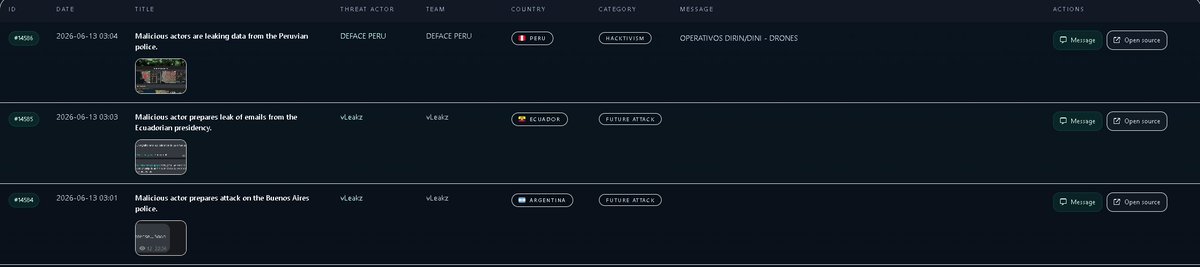
📡 UPDATE CYBER INTELLIGENCE ALERT: 🇵🇪🇪🇨🇦🇷 [UNCONFIRMED] THREATS AGAINST PRESIDENTIAL AND POLICE ENTITIES IN LATIN AMERICA
[STATUS: UNCONFIRMED / HACKTIVISM / ATTACK PREPARATION (FUTURE ATTACK)]
A series of critical incidents aimed at data exposure and the preparation of cyberattacks against law enforcement and high-level state institutions in three South American countries have been detected through the analyzerpro alert monitoring panel.
📂 Threat Breakdown by Region and Target
🇵🇪 Peru | Operational Exposure Risk (Hacktivism)
Threat Actor: DEFACE PERU
Category: Hacktivism
Details: The group claims to be leaking internal information belonging to the Peruvian National Police (PNP). The message attached to the alert explicitly states "DIRIN/DINI OPERATIONS - DRONES." This suggests the exfiltration of confidential documents, flight plans, or tactical intelligence related to the Police Intelligence Directorate (DIRIN) and the National Intelligence Directorate (DINI), representing a direct risk to the security of state operations.
🇪🇨 Ecuador | Preparation for Presidential Leak
Threat Actor: vLeakz
Category: Future Attack
Details: The threat actor is announcing and preparing a massive leak of emails belonging to the Presidency of Ecuador. This type of incident often precedes institutional extortion campaigns or attempts at political destabilization through the selective publication of private communications.
🇦🇷 Argentina | Police Attack Preparation
Threat Actor: vLeakz
Category: Future Attack
Details: The same actor (vLeakz) warns of an imminent cyberattack targeting the Buenos Aires Police. Given the actor's profile (previously associated with the use of infostealers), the attack could involve compromising internal networks or selling administrative access to third parties.
#CyberSecurity 🔐 #ThreatIntelligence 📊 #Peru 🇵🇪 #Ecuador 🇪🇨 #Argentina 🇦🇷 #GovTech #Hacktivism #DataBreach #VECERT 🏢
8
11
5,017
Jun 13
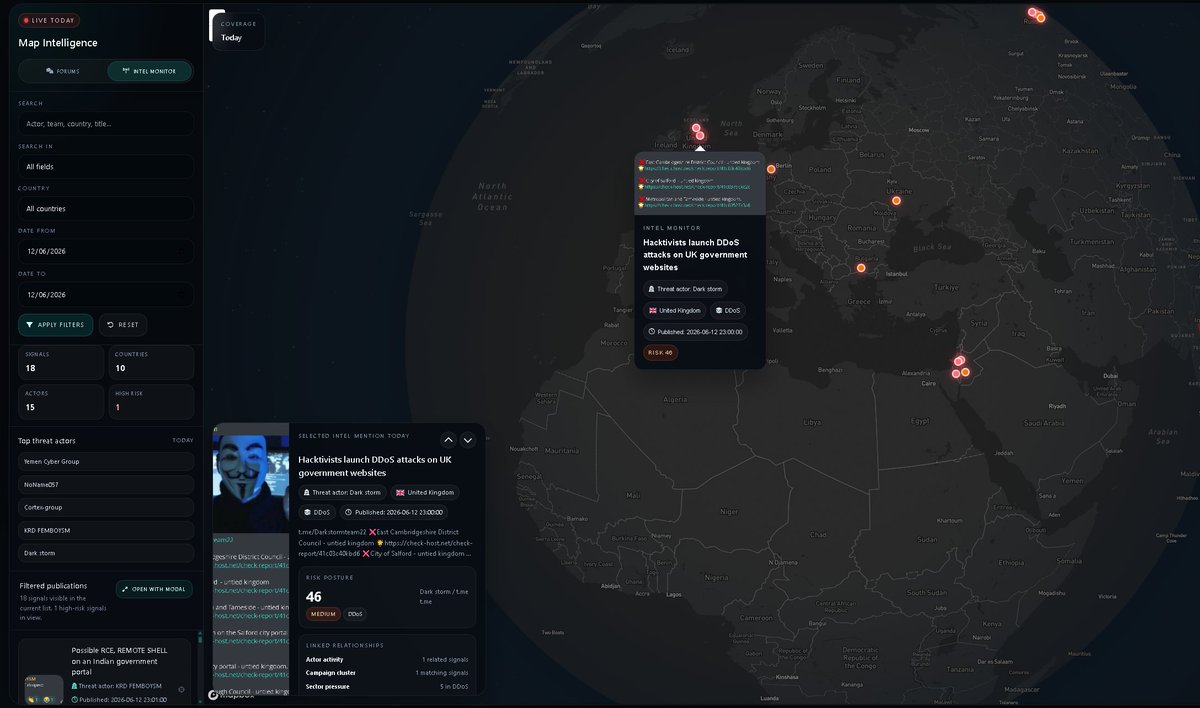
🚨 CYBER INTELLIGENCE SUMMARY: GLOBAL WARNING SIGNAL REPORT
[STATUS: MULTI-RISK ACTIVITY / TACTICAL AND FINANCIAL MONITORING]
The intelligence filter map signals captured by analyzerPRO have been processed. Of the 18 alerts detected during this timeframe (June 12, 2026), a high-risk event directly linked to financial infrastructure stands out, accompanied by intense malware activity, hacktivism, and breaches of government portals.
Below is a consolidation of the threats classified by vector and operational priority:
🛑 CRITICAL THREATS AND FINANCIAL RISK (HIGH RISK)
🇺🇸 United States | Risk: 78 (Ransomware)
Event: Clandestine sale of the Blacknetransom ransomware, designed to attack banking institutions.
Actor: Infrastructure Destruction Squad.
Intelligence Note: This is the highest severity alert on the panel. It represents an imminent risk to the banking sector, suggesting the preparation of extortion and encryption campaigns targeting financial infrastructure.
🇷🇺 Russia | Risk: 40 (Rootkit / Crypto Asset Theft)
Event: Identification of Page Builder, an illicit tool (Phishing-as-a-Service) for stealing crypto assets and emptying wallets.
Actor: Threat Market.
🇷🇺 Russia | Risk: 52 (Botnet / Infostealer)
Event: Botnet based on a Google Chrome extension equipped with HVNC (Hidden Virtual Network Control), targeting transactional fraud and MFA evasion.
Actor: Suvokner.
💻 INFRASTRUCTURE EXPLOITATION AND ACCESS SALES (IAB)
🇲🇽 Mexico | Risk: 65 (Infostealer)
Event: Alleged exploit actively running on the educational systems of conalepcoahuila.edu.mx.
Actor: Cortex-group.
🇮🇳 India | Risk: 54 (Malware / RCE)
Event: Possible Remote Code Execution (RCE) and Remote Shell on an Indian government portal.
Actor: KRD FEMBOYSM.
🇵🇪 Peru | Risk: 51 (Exploit)
Event: Alleged active exploit targeting the Cajamarca Health Directorate (diresacajamarca.gob.pe).
Actor: Cortex-group.
🇺🇸 United States | Risk: 48 (Exploit)
Event: Sale of a private exploit for web hosting control panels (cPanel).
Actor: Omnipotent.
🌐 GEOPOLITICS, ESPIONAGE, AND INFRASTRUCTURE MOVEMENTS
🇷🇺 Russia | Risk: 40 (APT / Advanced Persistent Threat)
Event: Deployment of a new operational domain linked to the cybercriminal group LAPSUS$.
🇷🇺 Russia | Risk: 40 (Future Attack Preparation)
Event: The Russian underground forum XSSF.IS migrates to a new domain to evade blocks or prepare for new operations.
Actor: xssf forum.
🇩🇪 Germany | Risk: 32 (Cyber-espionage)
Event: Alleged leak of a classified NATO document.
Actor: We are Cardinal.
🏴☠️ ACTIVE HACKTIVISM AND DISTRIBUTED ATTACKS (DDoS / DOXING)
Middle East (Focus on Israel):
🇮🇱 Israel | Risk: 56 (Hacktivism / Doxing): Two consecutive personal data exposure operations (doxing) carried out by Yemen Cyber Group.
🇮🇱 Israel | Risk: 50 (DDoS): Targeted attack against an Israeli military entity by BD Anonymous.
🇮🇱 Israel | Risk: 40 (DDoS): Distributed Denial of Service attack carried out by Rippersec. Europe and the United Kingdom:
🇬🇧 United Kingdom | Risk: 53 (DDoS): Nationwide hacktivist attack carried out by NoName057.
🇬🇧 United Kingdom | Risk: 46 (DDoS): Attacks against British government websites launched by Dark Storm.
🇺🇦 Ukraine | Risk: 39 (DDoS): Hacktivist attack launched by the pro-Russian faction NoName057.
🇧🇬 Bulgaria | Risk: 32 (Hacktivism): The group God's Gladiators announces its intention to aggressively escalate its attacks in the region.
Threat Actor: Infrastructure Destruction Squad
Primary Vector: Use of specialized tools to attack industrial control systems (ICS/SCADA).
🇮🇷 Iran | SCADA (Multiple Events)
Event 1: Identification and deployment of the illicit TRK25 ADVANCED SCADA tool.
Event 2: Active attack on SCADA systems using the TRK25 ADVANCED SCADA tool.
Event 3: Targeted attack against the JAFARI SIAHKAL SCADA station.
🇮🇹 Italy | SCADA
Event: Threat actors launch an attack against Italian infrastructure using the tool known as Labiotest.
🇹🇷 Turkey | SCADA
Event: Targeted attack against SCADA systems in Turkish territory, again using the TRK25 ADVANCED SCADA tool.
#CyberSecurity 🔐 #ThreatIntelligence 📊 #Ransomware #BankingThreats 💸 #Exploits #Hacktivism #APT #VECERT 🏢
5
5
25
3,312

Jun 12
The FIFA World Cup 2026 will be one of the most digitally connected sporting events in history and one of the most attractive targets for cyber threat actors.
At ThreatMon, we analyzed the evolving threat landscape surrounding the tournament, covering:
⚽ AI-enabled threats, including deepfake impersonation, voice cloning, AI-powered phishing, synthetic identities, and fraud campaigns
⚽ Hacktivist activity, including DDoS campaigns, influence operations, website defacements, and politically motivated disruption
⚽ Dark Web activity and underground marketplaces
⚽ Infostealer-driven credential theft targeting FIFA-related services
⚽ Attack surface exposures and leaked secrets
⚽ Brand abuse, ticket fraud, betting scams, and malicious domains
⚽ Nation-state and geopolitical cyber risks
One of the key observations is that the greatest cyber risk may not originate from FIFA itself, but from the broader ecosystem of ticketing providers, hospitality partners, payment processors, broadcasters, cloud services, and other third-party organizations supporting the tournament.
As global events become increasingly connected, cyber threats are becoming more sophisticated, more automated, and more difficult to distinguish from legitimate activity.
Our FIFA World Cup 2026 Threat Assessment Report provides a forward-looking view of the risks organizations, partners, and fans should be prepared for before the tournament begins.
🏆 threatmon.io/fifa-world-cup-…
#ThreatIntelligence #CyberSecurity #ThreatMon #WorldCup2026 #ArtificialIntelligence #Deepfake #Hacktivism #DarkWeb #Infostealer #BrandProtection #CyberThreats
1
2
8
1,136

Jun 12
Its not that they didnt know. Its that they were using the fraud to fund their hacktivism, as well as started to institute universal basic income for democrats only, paid for by republican taxes
3
13
Kelbie | Sovran retweeted

Jun 12
Hacktivism

1
2
8
1,059

Hacktivism blurs activism and crime. Ethical boundaries needed.
7


Jun 12
#threatreport #MediumCompleteness
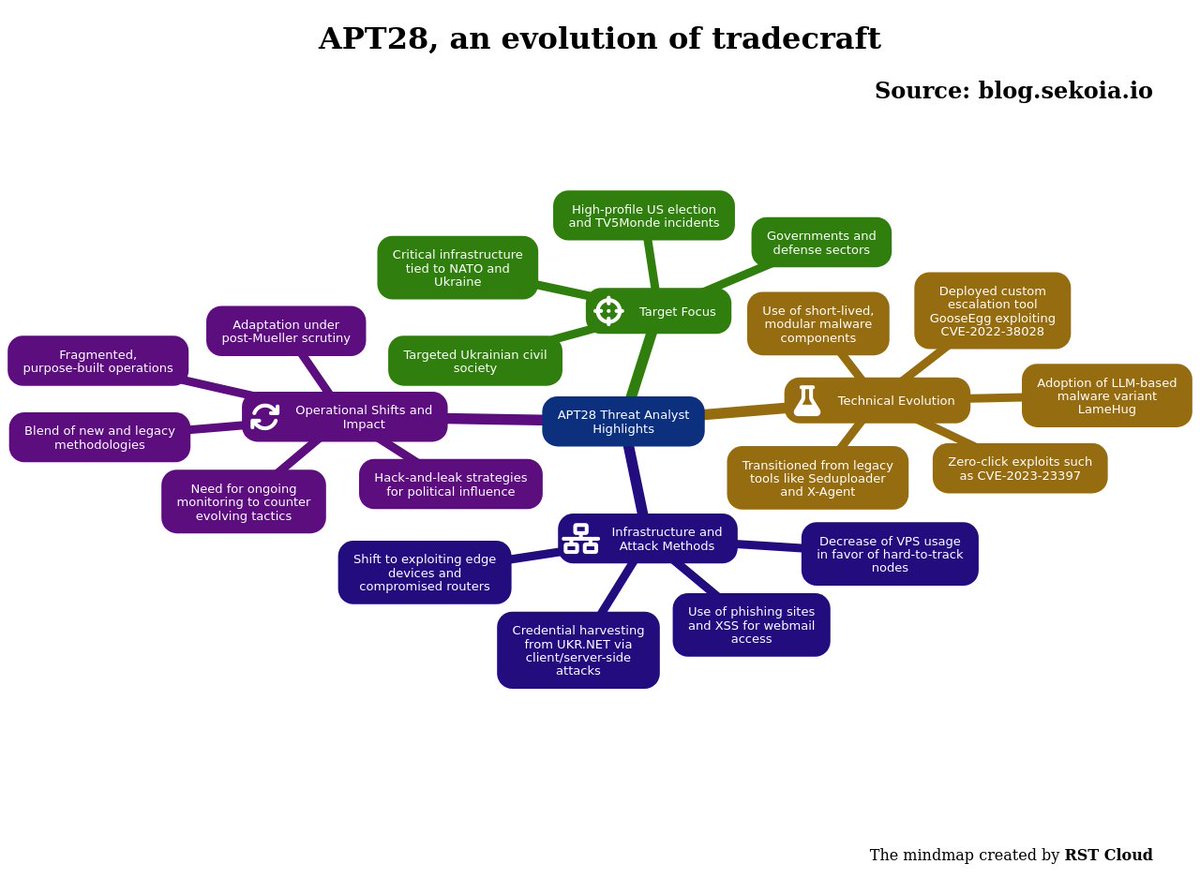
APT28, an evolution of tradecraft | 11-06-2026
Source: blog.sekoia.io/apt28-an-evol…
Key details below ↓
🧑💻Actors/Campaigns:
Fancy_bear (🧠motivation: sabotage, hacktivism)
Phantom_net_voxel
Cyberberkut (🧠motivation: sabotage)
Roundpress
Frostarmada
Cybercaliphate
Apt29
Double_tap
💀Threats:
Polyglot_ransomware, Credential_harvesting_technique, Spypress, Moobot, Aitm_technique, Xagent, Spear-phishing_technique, Sedkit_tool, Sedup_loader, Sedreco, Xtunnel, Screen_shotting_technique, Mimikatz_tool, Zebrocy, Gooseegg_tool, Headlace, Credomap, Masepie_tool, Oceanmap, Steelhook, Dns_hijacking_technique, Incontroller_tool, Bitm_technique, Covenant_c2_tool, Beardshell_tool, Slimagent_tool, Lamehug_tool,
🎯Victims: Government, Defense, Diplomatic entities, Critical infrastructure, Political organizations, Civil society, Military, Foreign ministries, Embassies, Law enforcement, ...
🏭Industry: Healthcare, Energy, Logistic, Transport, Critical_infrastructure, Education, Ngo, Government, Military
🌐Geo: Crimea, Romania, Russian, Ukraine, Ukrainian, America, Germany, American, French, Russia, Africa, Asia, Polish, Bulgaria, German
🔓CVEs: CVE-2023-23397 \[[Vulners](vulners.com/cve/CVE-2023-233…)]
- CVSS V3.1: *9.8*,
- Vulners: Exploitation: True
Soft:
- microsoft 365_apps (-)
- microsoft office (2019)
- microsoft office_long_term_servicing_channel (2021)
- microsoft outlook (2013, 2016)
...
CVE-2022-38028 \[[Vulners](vulners.com/cve/CVE-2022-380…)]
- CVSS V3.1: *7.8*,
- Vulners: Exploitation: True
Soft:
- microsoft windows_10_1507 (<10.0.10240.19507)
- microsoft windows_10_1607 (<10.0.14393.5427)
- microsoft windows_10_1809 (<10.0.17763.3532)
- microsoft windows_10_20h2 (<10.0.19042.2130)
...
📚TTPs:
⚔️Tactics: 1
🛠️Technics: 0
🤖LLM extracted TTPs:`
T1003, T1005, T1041, T1056.001, T1059.001, T1059.003, T1059.005, T1059.006, T1059.007, T1068, ...
💽Software: Outlook, Mistral, Windows Print Spooler, Microsoft Exchange, Roundcube, MDaemon, Zimbra, icedrive, Qwen, Hugging Face, ...
🔢Algorithms: base64
🗂️Win API: NET
📜Programming Languages: javascript, python, powershell
#threatreport:
APT28, also known as Fancy Bear, has displayed significant evolution in its cyber operations over the years, particularly focusing on government, defense, and critical infrastructure targets related to NATO and Ukraine. The group has been tracked extensively since its inception, with a particular emphasis on major operations like the TV5Monde sabotage and the 2016 breaches of the Democratic Party.
Historically, APT28 utilized a signature implant toolkit that defined its operational fingerprint during notable attacks. This included spear-phishing campaigns deploying the Seduploader first stage malware, later upgraded to the X-Agent backdoor, paired with additional tools for persistence and exfiltration. The hack-and-leak playbook, pioneered by the group, involved releasing stolen documents to maximize political impact, a strategy successfully employed during the US elections.
A significant shift occurred after the 2019 Mueller Report, which brought extensive scrutiny to APT28, resulting in a notable decrease in its publicly tracked activities. However, reports indicate that the group remained active, deploying a custom privilege escalation tool named GooseEgg against various targets, with the exploit of CVE-2022-38028 allowing execution at a system level.
In recent years, APT28 has fragmented its operations into short-lived, single-purpose malware components, utilizing styles of attack that include zero-click exploits against Microsoft Outlook to harvest credentials. Attackers have weaponized vulnerabilities like CVE-2023-23397 to relay captured hashes for credential harvesting, frequently targeting Ukrainian civil society and military sectors.
The operational infrastructure has shifted towards edge devices, moving away from traditional VPS setups. This includes campaigns that leverage compromised routers as part of its network, facilitating the relay of hashed credentials and hosting phishing sites to bypass more stringent defenses. Reports show a wide-scale collection of credentials from users of the popular Ukrainian webmail service, UKR.NET, utilizing both client-side phishing and server-side webmail exploits based on cross-site scripting (XSS).
Furthermore, APT28 has integrated cutting-edge techniques, including the potential use of a large language model (LLM) in a malware variant named LameHug, demonstrating a novel approach in operational logic delegation. This adaptation toward utilizing AI capabilities reflects ongoing innovation within the group's tactics.
While the group has returned to a more traditional implant methodology in certain recent operations, pairing the new layers of their toolkit with legacy systems like X-Agent, the overall consolidation of varying techniques indicates APT28's responsive adaptation in a rapidly evolving cyber threat landscape. Continued monitoring and public reporting on APT28's activities remain critical for understanding and mitigating their impacts in the cybersecurity domain.
97
Jun 11
🚨 CYBER INTELLIGENCE ALERT: 🇬🇧 [UNCONFIRMED / MODERATE IMPACT] WEB DEFACEMENT CAMPAIGN TARGETING LOCAL GOVERNMENT PORTALS — UNITED KINGDOM
[STATUS: UNCONFIRMED / HACKTIVIST ACTIVITY / WEB DEFACEMENT]
A forwarded post has been identified on Telegram channels within the hacktivist ecosystem (originally attributed to the group SDF - Security Of DieNet Forces and in collaboration with Sylhet Gang), claiming the intrusion and defacement of two local government servers in the United Kingdom.
Threat Actors: SDF (Security Of DieNet Forces) / Sylhet Gang
Attack Vector: Web Code Injection / Perimeter Interface Modification (Defacement)
Declared and Affected Targets:
Marlow Town Council (marlow-tc.gov.uk).
Newent Town Council (newenttowncouncil.gov.uk - referred to in the actor's text with a minor typographical error as Newentown).
⚠️ Security and Operational Risk Considerations
Vulnerabilities in Local CMS: These types of smaller-scale institutional portals (town halls or municipal councils) are usually built on traditional content management systems (CMS) such as WordPress or Joomla. Compromise typically originates from a lack of security patches in third-party plugins or the use of weak administrative credentials.
Reputational and Disinformation Risk: Although the defacement technique compromises the surface layer (web interface) and does not necessarily imply deep access to confidential databases, it is used for psychological warfare purposes to project a false sense of total control over state infrastructure.
VECERT TOOLS
Strategic Monitoring Tools & Intelligence Platform:
🌐 analyzer.vecert.io
Security Verification & Monitoring:
🛡️ monitor.vecert.io
#CyberSecurity 🔐 #UK 🇬🇧 #Hacktivism 🏴☠️ #Defacement #SDF #SylhetGang #GovTech #ThreatIntelligence 📊 #VECERT 🏢

1
1,755
Jun 11
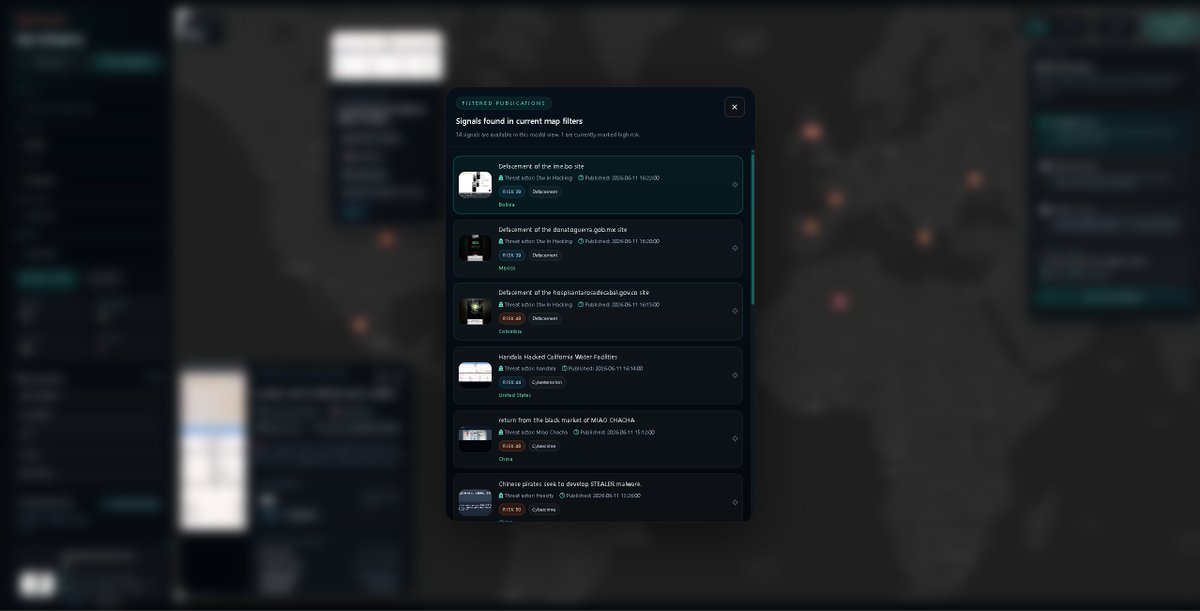
🚨 CYBER INTELLIGENCE SUMMARY: 🇩🇿🇺🇸🇪🇸🇫🇷🇬🇧🇺🇦🇨🇳🇮🇩🇬🇷🇨🇴🇲🇽🇧🇴 SUMMARY OF OPERATIONAL THREATS AND SIGNALS DETECTED TODAY
[STATUS: MAP ALERTS / ACTIVE SIGNALS / MULTIPLE CRITICAL VECTORS]
The global telemetry report corresponding to the alerts and incidents detected on the monitoring map today has been consolidated. The console is registering a total of 14 active signals today, with a critical spike in operations targeting state infrastructure, industrial control systems (SCADA), and the reactivation of organized cybercrime networks.
🛑 🇩🇿 ALGERIA: MAXIMUM ALERT TODAY (CRITICAL RISK)
Risk: 86 — Alleged Attack on the Ministry of Defense:
Actor: Infrastructure Destruction Squad.
Type: Hacktivism / State Cyber Espionage.
Details: A high-impact campaign was carried out today against the Algerian Ministry of National Defense, currently classified as the highest-risk incident on the console.
🚰 🇺🇸 UNITED STATES AND 🇪🇸 SPAIN: CRITICAL INFRASTRUCTURE AND INDUSTRIAL SYSTEMS (SCADA) ATTACKS DETECTED TODAY
🇺🇸 United States (Risk: 44) — Cyberterrorism in Water Supply:
Actor: Handala.
Details: The group claimed responsibility today for compromising and intruding on water facilities in the state of California, a vector of high public and environmental sensitivity.
🇪🇸 Spain (Risk: 39) — Compromise of Agricultural SCADA Systems:
Actor: NoName057.
Details: A malware attack was detected today that allegedly directly affected agricultural automation control systems (SCADA) in the La Mancha region, though this has not yet been confirmed.
🌐 🇫🇷 FRANCE, 🇬🇧 UNITED KINGDOM, AND 🇺🇦 UKRAINE: CYBERWAR, GOVERNMENT ACCESS ATTACKS, AND DDoS ATTACKS RECORDED TODAY
🇫🇷 France (Risk: 42) — Webshells on Government Portals:
Actor: ShopWebshell.
Details: The threat actor exposed persistent webshell access today to official French government domains and portals.
🇬🇧 United Kingdom (Risk: 46 / 43) — Coordinated Offensive Against Law Enforcement Services:
Actors: BD Anonymous and NoName057.
Details: Massive distributed denial-of-service (DDoS) attacks were launched simultaneously today against UK police infrastructure, coinciding with the relaunch of the hostile #OpGreatBritain campaign.
🇺🇦 Ukraine (Risk: 39) — DDoS Surge in the Last Few Hours:
Actor: NoName057.
Details: Distributed automated attacks were launched today to degrade and take down multiple Ukrainian websites and digital infrastructure.
🕶️ 🇨🇳 CHINA, 🇮🇩 INDONESIA, AND 🇬🇷 GREECE: MALWARE DEVELOPMENT, BOTNETS, AND BLACK MARKET DETECTED TODAY
🇨🇳 China (Risk: 50) — Infostealer Development:
Actor: freecity.
Details: It was identified today that developer cells are working to structure and compile advanced variants of Stealer-type malware (credential and wallet theft).
🇨🇳 China (Risk: 48) — Black Market Reactivation:
Actor: Miao Chacha.
Details: An official return to clandestine forums was registered today for the corporate data brokering and doxing network associated with Miao Chacha's criminal network.
🇮🇩 Indonesia (Risk: 32) — Command Network Expansion:
Actor: 1337.
Details: Monitoring and deployment detected today of the botnet and command infrastructure project "Project C2 Cybercrime".
🇬🇷 Greece (Risk: 32) — Disruption of Money Laundering Operations:
Actor: Audi6Supportt.
Details: Reported arrest today of financial operators of a cryptocurrency exchange linked to the illegal forum Dark2Web and the Audi A6 money laundering network.
🎨 🇨🇴 COLOMBIA, 🇲🇽 MEXICO, AND 🇧🇴 BOLIVIA: WEB DEFACEMENT CAMPAIGNS CARRIED OUT TODAY
A coordinated offensive today by the threat actor Stw In Hacking has compromised and modified the interface of institutional health and education websites in Latin America:
🇨🇴 Colombia (Risk: 49): Compromise executed today on the health website hospisantarosadecabal.gov.co.
🇲🇽 Mexico (Risk: 39): Malicious alteration detected today on the municipal website donatoguerra.gob.mx.
🇧🇴 Bolivia (Risk: 39): A cosmetic attack and defacement carried out today on the educational domain ime.bo.
#CyberSecurity 🔐 #ThreatIntelligence 📊 #DDoS 🛑 #SCADA #Malware 💥 #Defacement #VECERT 🏢
2
8
1,559
Jun 11
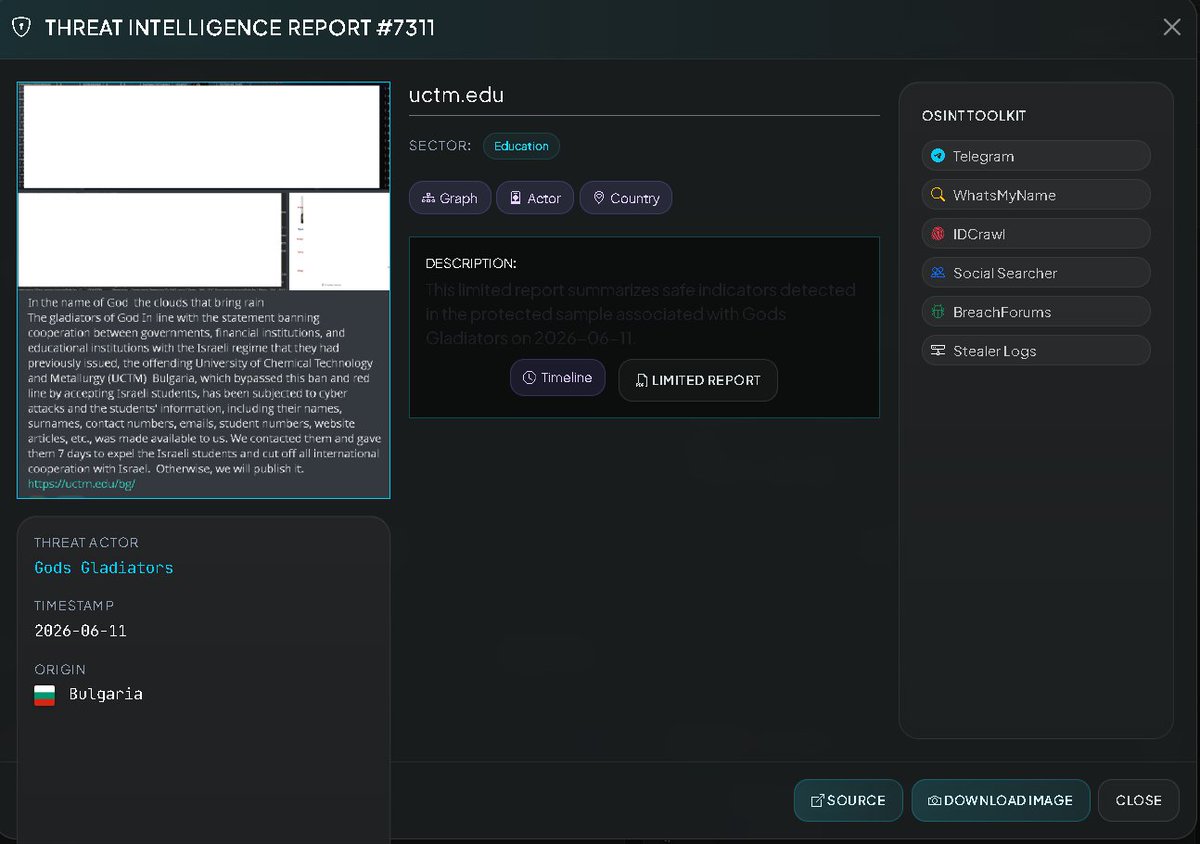
🚨 CYBER INTELLIGENCE ALERT: 🇧🇬 [UNCONFIRMED / HACKTIVIST EXTORTION] — UNIVERSITY OF CHEMICAL TECHNOLOGY AND METALLURGY (BULGARIA)
[STATUS: UNCONFIRMED / HACKTIVIST ACTIVITY / GEOPOLITICAL EXTORTION]
A statement issued by the hacktivist group calling itself "God's Gladiators" has been detected, in which they claim responsibility for a cyberattack targeting the University of Chemical Technology and Metallurgy (UCTM) in Bulgaria. The incident is part of an extortion campaign with strictly geopolitical motivations.
Threat Actor: God's Gladiators
Affected Entity: University of Chemical Technology and Metallurgy (UCTM), Bulgaria
Vector of Compromise: Not specified in the statement (possible exploitation of web vulnerabilities or compromise of student databases).
📂 Analysis of Evidence and Compromised Data
The group has published visual evidence of the compromise, showing fragments of databases and user profiles. According to the attacker's statement, the exfiltrated information includes:
Personally Identifiable Information (PII): First and last names.
Contact Information: Phone numbers and email addresses.
Academic Data: Student ID numbers and records of articles published on the university's web portal.
⚠️ Risk and Intelligence Considerations
Expansion of Targets (Critical Sectors): The actor's manifesto emphasizes a directive to sanction the cooperation of "governments, financial institutions, and educational institutions" with the Israeli regime. The explicit inclusion of the banking and investment sector in this statement is a critical indicator for ongoing financial investigations, as it identifies international economic entities with ties to Israel as priority targets for future disruption or exfiltration campaigns.
Doxing Risk and Physical Security: The leak of personal data, motivated by geopolitical tensions, increases the risk of targeted harassment (doxing) against the students and academic staff mentioned in the databases.
🛡️ Recommended Actions (Strategic and Monitoring Level)
Intelligence Notification: Alert Bulgarian (or European) educational institutions and financial entities that have cooperation agreements with Israel about this actor's activity, recommending a review of their web security perimeters.
VECERT TOOLS
Strategic Monitoring Tools & Intelligence Platform:
🌐 analyzer.vecert.io
Security Verification & Monitoring:
🛡️ monitor.vecert.io
#CyberSecurity 🔐 #Bulgaria 🇧🇬 #Hacktivism 🏴☠️ #GodsGladiators #DataBreach 📁 #Geopolitics #VECERT 🏢
1
1
8
1,506

Jun 11
A hacker collective takes down a major agricultural giant's seed patent database, releasing thousands of proprietary genetic sequences to the public. #Hacktivism #Seeds #Patents
63
Jun 10
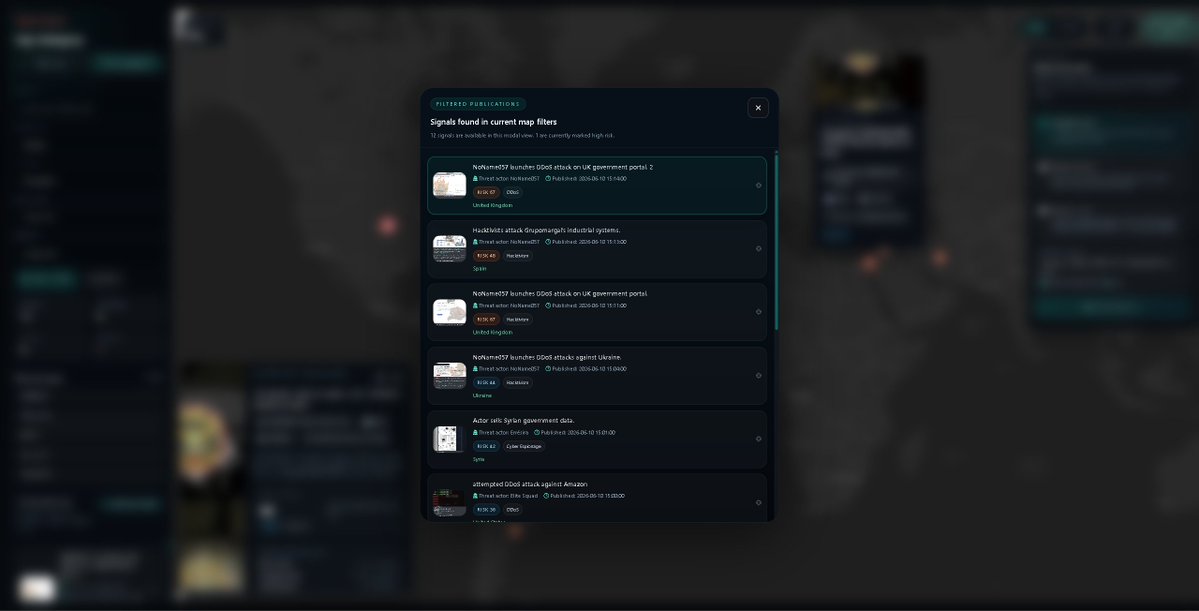
🚨 CYBER INTELLIGENCE SUMMARY: 🌍 SIGNS OF FUTURE ATTACKS AND HACKTIVISTIC ACTIVITIES DETECTED TODAY
[STATUS: ACTIVE MONITORING / EARLY WARNING / MULTIPLE VECTORS]
A significant increase in activity from various threat actors has been recorded in recent hours, including coordinated distributed denial-of-service (DDoS) campaigns, imminent data breach threats, and the marketing of critical vulnerabilities. The identified risk landscape is detailed below:
⚠️ Signs of Future Attacks (Early Warning / Statements)
🇦🇷 Argentina (Risk: 42) — Institutional Data Breach Threat:
Actors: vLeakz and Lapampaleaks.
Details: The groups have announced they are in the preparation phase for the release of a data leak belonging to the Argentine Ministry of Health.
🇪🇸 Spain / 🇩🇪 Germany (Risk: 36) — Strategic Operations:
Actor: AvangardSec.
Details: The group has issued formal threats of targeted operations against critical infrastructure (aligned with the previously monitored Op Bloodborne campaign).
🇮🇱 Israel (Risk: 44) — Declaration of Cyber Warfare:
Actor: TEAM BD DARK FORCE.
Details: The group has declared the start of an imminent attack campaign against Israeli infrastructure.
🇮🇷 Iran (Risk: 44) — Cyberterrorism Threat:
Actor: Handala.
Details: An active threat from this group has been registered, with potential disruptive implications for the region.
🛑 Hacktivist Activity and DDoS Operations in Progress
🇬🇧 United Kingdom (Maximum Risk: 67) — Attack on Government Portal:
Actor: NoName057.
Details: The pro-Russian hacktivist group has launched multiple waves of confirmed DDoS attacks against an official British government portal.
🇪🇸 Spain (Risk: 48) — Compromise of Industrial Systems:
Actor: NoName057.
Details: A successful attack targeting the industrial control systems (ICS) belonging to the company Grupomargal has been reported.
🇺🇦 Ukraine (Risk: 44) — Ongoing DDoS Attacks:
Actor: NoName057
Details: Continuous deployment of denial-of-service campaigns targeting Ukrainian technology infrastructure.
🇺🇸 United States (Risk: 36) — Attempted Corporate Disruption:
Actor: Elite Squad
Details: A large-scale DDoS attack attempt targeting Amazon's network infrastructure was detected and intercepted.
📂 Cyber Espionage, Data Marketplace, and Zero-Day Exploitation
🇺🇸 United States (Maximum Risk: 82 / 64) — Critical Exploit Sale:
Actor: OilBurnerSec
Details: The actor has intensified its activity on underground forums, announcing the availability of multiple zero-day vulnerabilities for various technology stacks. Multiple continuous posts are raising the risk profile.
🇸🇾 Syria (Risk: 42) — Sale of State Data:
Actor: Errësira.
Details: The threat actor has put confidential databases belonging to the Syrian government up for sale, in a clear act of corporate/state cyber espionage.
VECERT TOOLS
Strategic Monitoring Tools & Intelligence Platform:
🌐 analyzer.vecert.io
Security Verification & Monitoring:
🛡️ monitor.vecert.io
#CyberSecurity 🔐 #ThreatIntelligence 📊 #Hacktivism 🏴☠️ #DDoS 🛑 #ZeroDay 💥 #EarlyWarning ⚠️ #VECERT 🏢
3
8
2,024
BlackMamba retweeted

Jun 9
Hacktivism without ethics becomes chaos. Protest without organization becomes noise. Power fears discipline. Power fears unity.
7
32
114
13,658