Filter
Exclude
Time range
-
Near
Jun 12
China was left 1ofpoorest nations by colonial looters even in 90s. West,Jaoan were subsiding when China had 0. What u have posted is frankly lazy argument- has been easily busted. weaponising trade is a US 1st! Learn to take what u dish. & why Dependence on China is bad?
1
50
Jun 11
Japan & US actually subsidised/do more than China, simply because they could. The difference is China integrated subsidies better & unlike US doesn't pass it to the top but bottom!. Pl don't fall this subsidy excuse- its propaganda to distract!
1
3
106
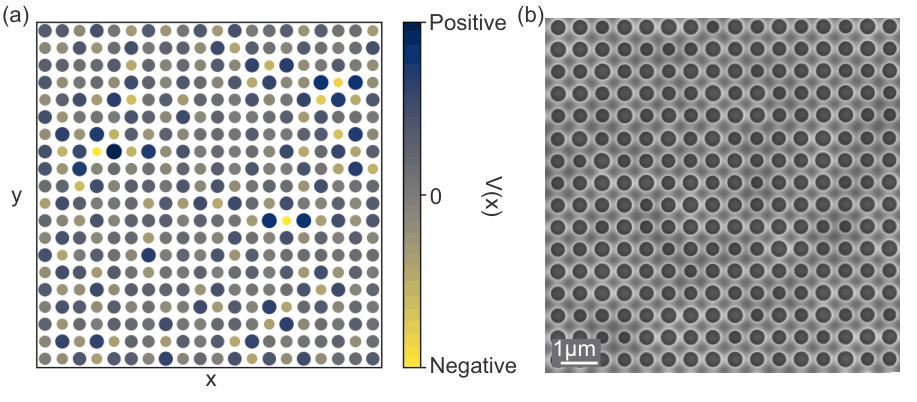
🚨 PHYSICISTS JUST BUILT “INVISIBLE DISORDER” Scientists created massive silicon photonic crystals where disorder exists… but light barely scatters. The trick is called “stealthy hyperuniformity” a state where wave fluctuations mathematically disappear at long wavelengths, making chaotic structures behave almost perfectly uniform from afar. Instead of randomness destroying signals… the disorder becomes engineered. The system creates a true scattering transition: below a critical threshold → waves move almost transparently above it → scattering suddenly explodes Even stranger: The researchers found the transparency eventually breaks down because of NON-HERMITIAN physics where radiative loss gives light a “complex effective mass.” That means the waves don’t just move through space… their decay dynamics reshape the transport itself. Potential implications • ultra-low-loss optical chips • stealth waveguides • advanced quantum materials • photonic AI hardware • next-generation communication systems • engineered transparency in complex media This is one of those papers where “disorder” stops meaning chaos… and starts behaving like hidden structure. Paper “Stealthy-Hyperuniform Wave Dynamics in Two-Dimensional Photonic Crystals” Follow me if you want to see where physics starts rewriting reality itself
2
20
63
2,308
Using extremely large photonic crystals, physicists directly observed and quantified higher-order scattering from stealthy-hyperuniformity. In the stealthy regime, multiple scattering diminishes the material’s transparency. 🔗 go.aps.org/4nhNGug
3
7
38
2,338
Except he was cut off due to being a commie rat, and now he has fled to support commie rats. Go figure.
2
15
Replying to @forallcurious
Note: Chicken eyes contain a unique arrangement of color-detecting cone cells that forms "disordered hyperuniformity," a potential new state of matter. It appears disordered up close like a liquid but maintains uniform density over long distances like a crystal. This hidden order, first found in biology in 2014, helps birds see vibrant colors efficiently and could inspire advanced optical materials.

ALT GIF by reactionseditor

3
731
Replying to @forallcurious
In 2014, researchers at Princeton and Washington University discovered that the light-sensitive cells (cones) in a chicken's eye are arranged in a rare state of matter called disordered hyperuniformity. This state allows the cones to appear random like a liquid while maintaining a highly uniform density like a crystal.
1
1
5
2,031
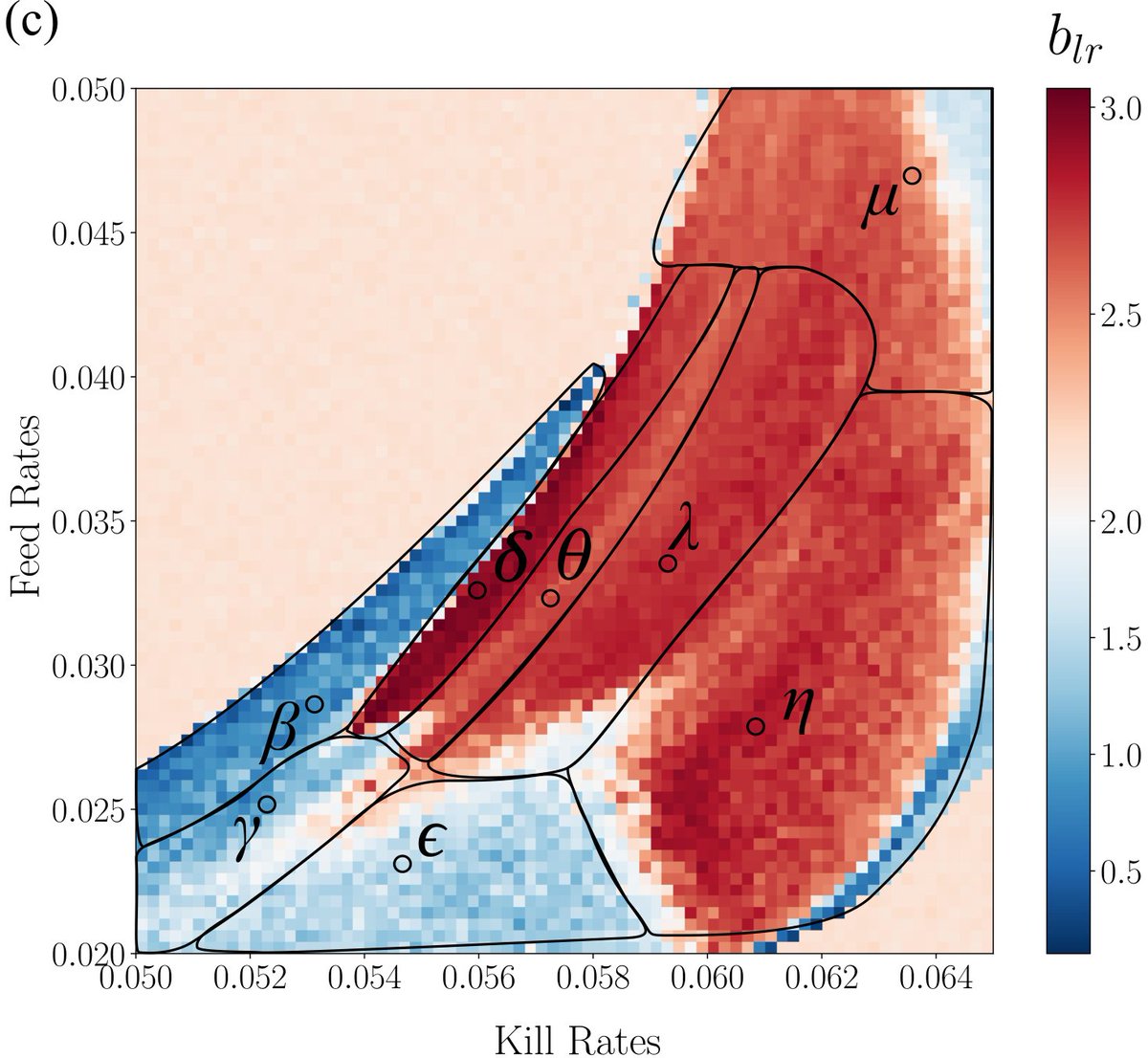
New paper just dropped: hyperuniformity emerges from reaction-diffusion systems in specific regions of the Gray-Scott phase space. Translation for artists: Turing patterns aren't just visually interesting. The math produces spatial distributions with a kind of hidden order that sits between crystal and chaos. This is exactly the territory worth exploring algorithmically.
3
217
Replying to @hyperuniformity
It’s just a tax. It doesn’t entitle you to anything
2
6
659
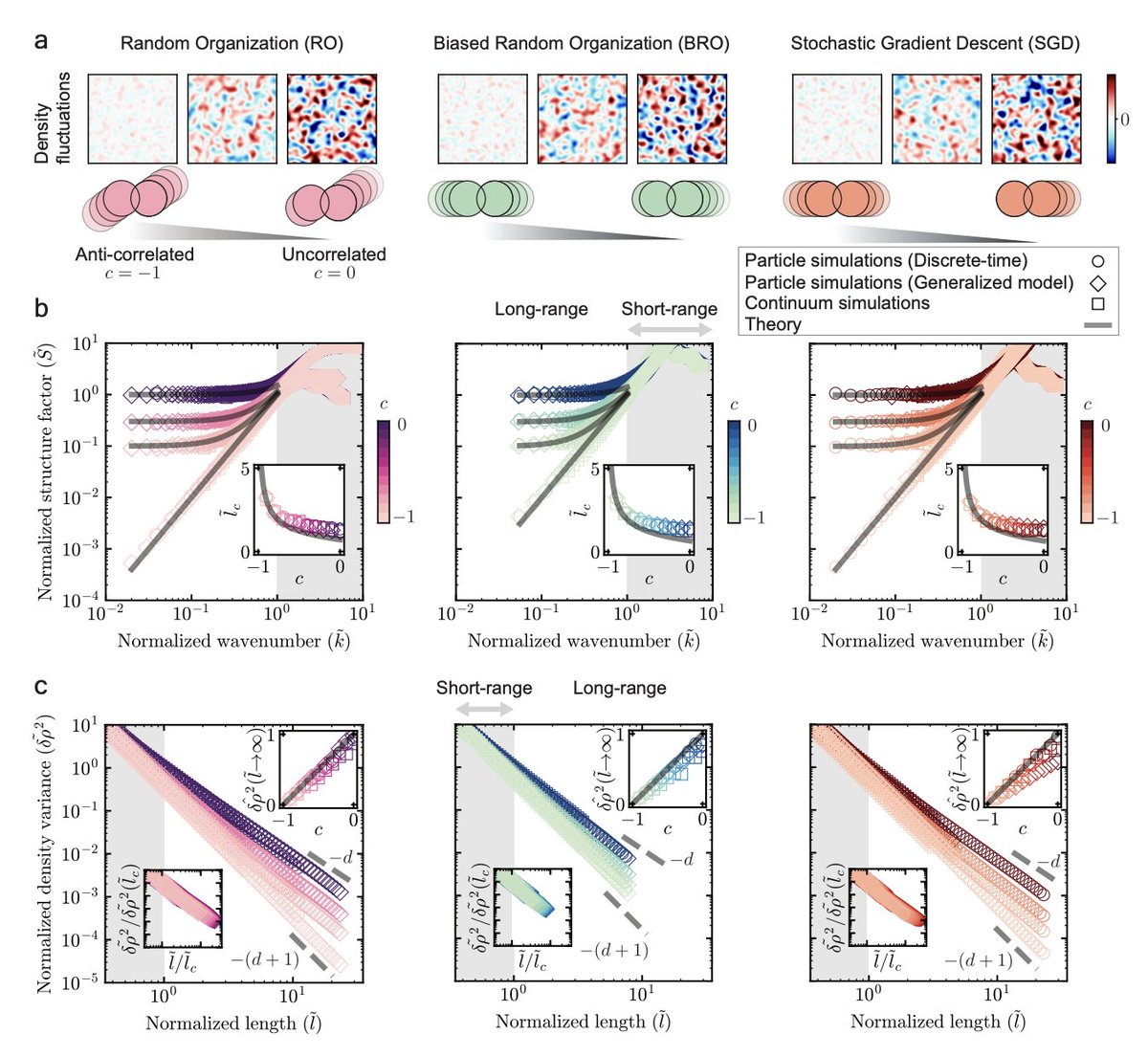
How noise creates order: A universal principle linking physics and machine learning Noise is usually the enemy of structure. Yet in certain systems—from sheared colloidal suspensions to stochastic optimization algorithms—noisy local interactions paradoxically generate long-range spatial order. This phenomenon, called hyperuniformity, suppresses density fluctuations at large scales, but how it emerges from purely local, noisy dynamics has remained an open question for two decades. Satyam Anand, Guanming Zhang, and Stefano Martiniani study three paradigmatic systems: random organization (RO) and biased random organization (BRO) from soft matter physics, and stochastic gradient descent (SGD) from machine learning. Each system has fundamentally different microscopic noise sources—random kick directions in RO, random kick magnitudes in BRO, and random particle selection in SGD—yet all undergo the same absorbing-to-active phase transition as particle density increases. The key finding: despite these microscopic differences, all three systems display identical universal long-range behavior, governed by a single parameter—the noise correlation coefficient c between particle pairs. When pairwise noise is uncorrelated (c = 0), the systems remain disordered. As c approaches −1 (anti-correlated, momentum-conserving kicks), the crossover length scale for density suppression diverges, and the systems become strongly hyperuniform. The authors develop a fluctuating hydrodynamic theory that quantitatively predicts the structure factor across all systems without free parameters. Perhaps most striking is the connection to machine learning: the same anti-correlated noise that produces hyperuniformity also biases SGD toward flatter regions of the energy landscape—the very feature linked to robust generalization in neural networks. Lower batch fractions and higher learning rates, known empirically to improve generalization, produce both stronger long-range structure and flatter minima in particle systems. The implication is powerful: the tendency of SGD to find flat minima is not a quirk of neural network loss landscapes but a universal hallmark of stochastic optimization in high-dimensional spaces—opening new avenues from designing hyperuniform materials to understanding why deep learning generalizes. Paper: nature.com/articles/s41467-0…
8
48
267
12,195
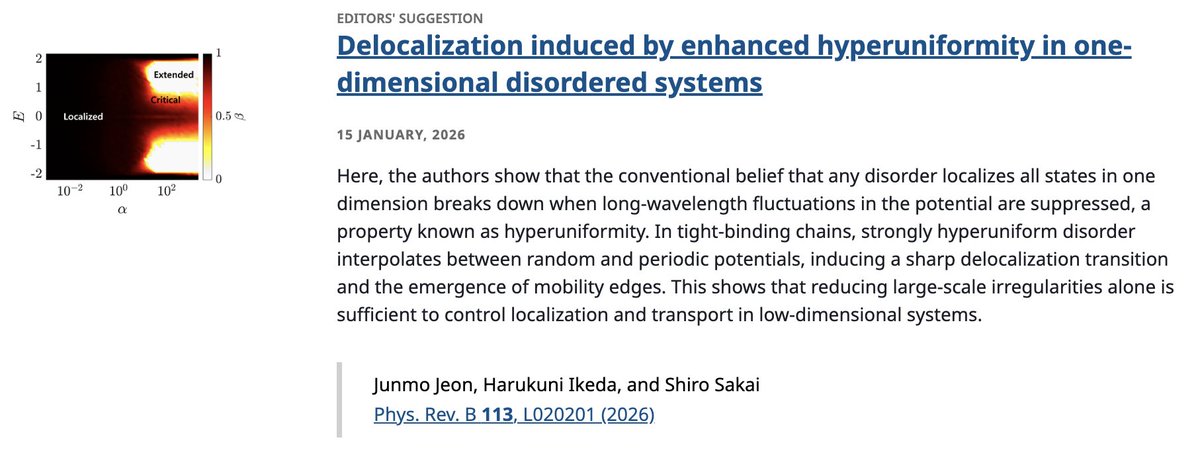
PRB Editors' Suggestion: Delocalization induced by enhanced #hyperuniformity in 1D disordered systems Junmo Jeon, Harukuni Ikeda, and Shiro Sakai Phys. Rev. B 113, L020201 ➡️ go.aps.org/4qr4DTZ #PRBLetter #EdSugg @APSPhysics #physics #condmat @junmohyoseb1
3
15
1,206
Yuengling is the German name Jüngling Anglicized though
2
2
41
5 Dec 2025
hyperuniformity,思った以上に論文がたくさんあるな〜こりゃ頑張って読まんとなあ そしてTorquatoさんは一体なにものなんだ...(すごすぎる...)
1
3
222
A new study examining the spatial distribution of generic Gray-Scott patterns and Arabidopsis thaliana trichome patterns finds that hyperuniformity emerges in Turing patterns as a solution to a reaction-diffusion equation system. Read the paper: go.aps.org/4peOHDG
2
4
15
940
21 Nov 2025
最近はhyperuniformityについて少しずつ勉強しています
3
175
17 Nov 2025
Exactly. If I was Chinese and felt I was world class, I would get the heck out before letting anyone know.
2
42
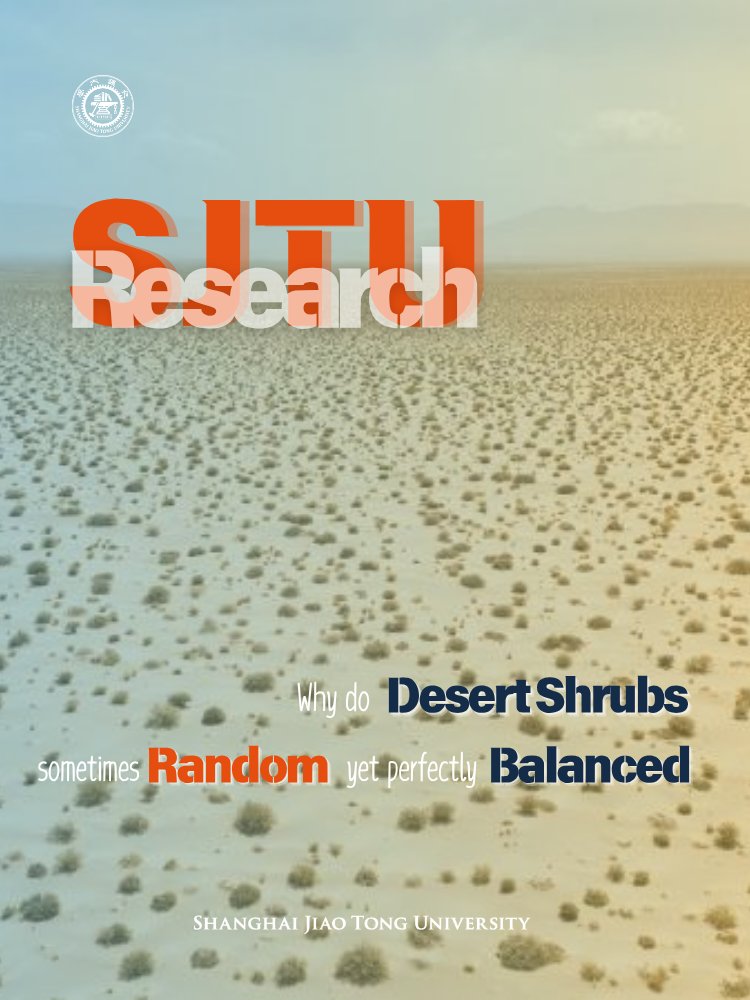
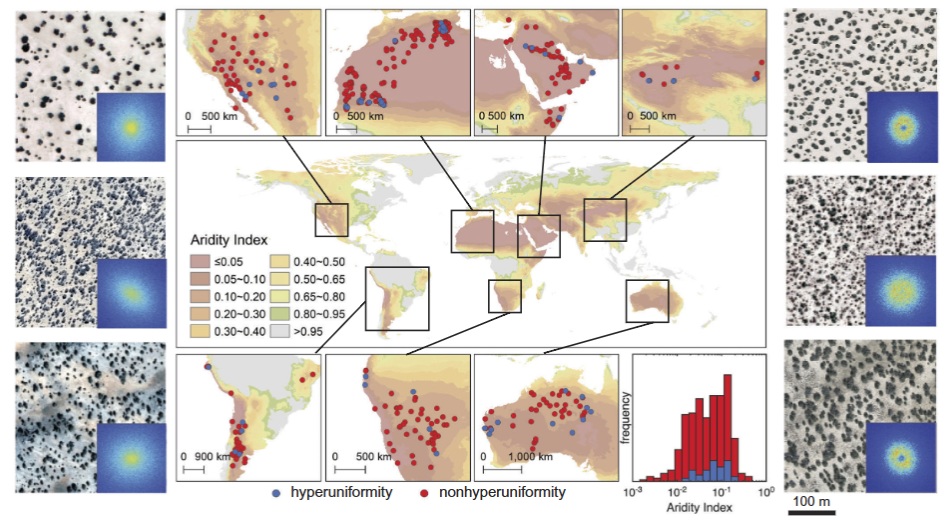
Why do desert shrubs sometimes look “random”—yet act perfectly balanced? A recent study by researchers at Shanghai Jiao Tong University reveals a hidden spatial order in global dryland ecosystems: disordered hyperuniformity. On small scales, vegetation seems scattered and disordered; but on larger scales (hundreds of meters), density fluctuations become surprisingly minimal—far more uniform than random. This hidden structure helps ecosystems distribute water and resources more efficiently, resisting drought stress. However, once locally disturbed (e.g. by human activity), recovery is slow. This duality—stability vs. repairability—offers new insights for ecosystem monitoring, restoration, and resilience planning in arid regions. 🌿 🔗 doi.org/10.1073/pnas.2504496… #SJTUResearch #EcosystemResilience #EnvironmentalScience #DisorderedHyperuniformity #LandscapeEcology #ClimateChange #AridRegions #Biodiversity #ScientificDiscovery #GlobalScience #Sustainability
4
6
531
Replying to @Riamus01 @GeekGoji
I just love that. Really one of my favorite exercises is writing and how you make that all fit together. It's sort of like a state of hyperuniformity. Everything seems chaotic on the surface but there are structures far larger beneath what you can observe.
2
5
135
New @PNASNews @BioFunLab Causes and consequences of disordered hyperuniformity in global drylands pnas.org/doi/10.1073/pnas.25… Led by Wensi Hu & Chi Xu @IRNAS_CSIC @CSIC @CSICAndalExtrem
3
13
556