
Unless you used MongoDB you didn't have any webscale!
1
120


May 24
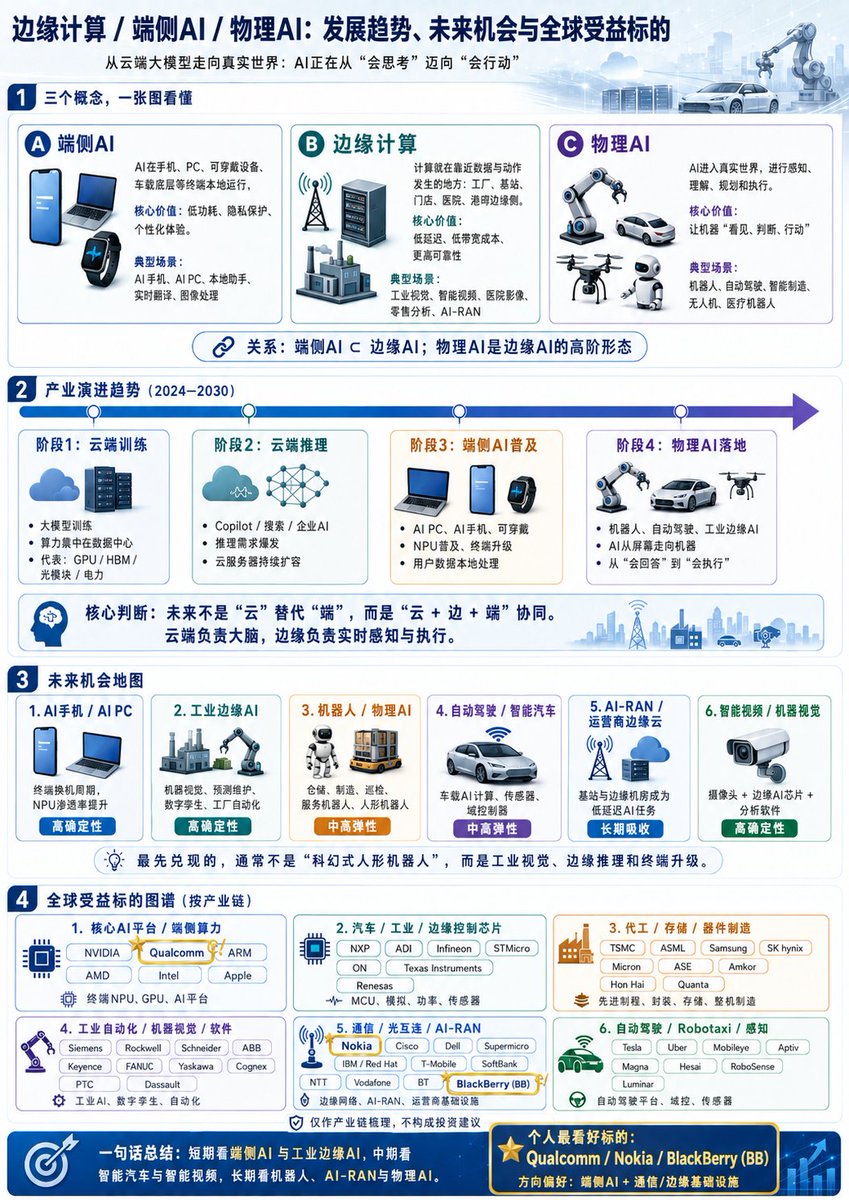
站在光和边缘计算AI-RAN里,昨天发边缘计算端侧AI及物理AI趋势,有人问为何看好诺基亚。个人角度它正在被市场重新定价为“AI时代的连接基础设施公司”,正好再聊聊诺基亚,核心是两点:1)光互连/AI数据中心互连是短中期最确定的业绩抓手,已经实打实体现在最近几个季度财报里;
2)AI-RAN/边缘计算想象空间更大,但商业化节奏会慢一些,算是长期估值期权。
光互连是当下发动机,边缘计算 AI-RAN是未来大期权。诺基亚正从5G卖基站的旧身份,切换到AI云、光网络、数据中心互连、AI-native网络的综合平台。
1、为什么市场今年在重新关注诺基亚?
六大催化剂
1)之前英伟达10亿美元入股 战略合作,直接把诺基亚拉进AI叙事(AI-RAN、数据中心交换、SR Linux、光技术)。
2)Infinera并购完成,在光传输、webscale客户、北美DCI能力大幅升级。
3)26年一季度财报验证:AI&Cloud收入 49%、订单10亿欧元、光互连 20%,不再是“讲故事”。
4)战略重塑:
网络连接基础设施业务定为当下增长发动机;
移动通信基础设施守基本盘,未来还能进一步拓展到AI-RAN;
清理非核心业务,把资本和管理力集中到AI连接上。
5)AI-RAN在MWC 2026大放异彩,与英伟达、T-Mobile、SoftBank、NTT DOCOMO、Vodafone等合作落地,GPU加速AI-RAN测试全面推进。
6)传统5G capex消化期后,市场需要新增长曲线:AI数据中心DCI、光互连、边缘AI正好接棒。
2、光互连的业绩正在放量被验证
AI数据中心瓶颈从算力转向网络,光互连分层看,诺基亚之所以在这些领域“最强”,是因为它拥有强大的相干光DSP芯片(Coherent)研发能力。利用这个核心芯片,诺基亚做出了顶级的可插拔模块(Pluggables),并把它们应用在数据中心互联(DCI)和现代的IP over DWDM架构中;同时配合其市场领先的光传输(Optical Transport)骨干网设备和线路系统(Line Systems),在光纤网络市场里占据主导地位。
1)收购Infinera加持后,1.6T/2.4T/3.2T 光模块下游客户开始样品测试27年量产,号称最高70% TCO节省。
2)2026一季度是业绩真正爆发的季度。营收45亿欧元( 3%),运营利润2.81亿欧元( 54%)。其中网络基础设施增加 6%,光互连 20%,AI&Cloud客户收入 49%(占集团8%),单季度新订单10亿欧元。
公司直接把2026年Network Infrastructure增长预期上调至12-14%,Optical IP合计18-20%,AI&Cloud可服务市场CAGR从16%上调至27%。
财报把AI光网络逻辑从PPT变成了硬指标,这就是股价重估的根本触发。
也要注意诺基亚不是纯光模块股(短距那块是Coherent、Lumentum、中际旭创的战场),它是系统级供应商,吃的是AI网络架构升级的钱
3、边缘计算/AI-RAN:想象力最大,但还需要时间爆发
AI-RAN核心是把基站 运营商边缘机房变成分布式AI算力节点:低延迟推理、工业AI、机器人、智慧城市全能跑。
诺基亚优势明显:全球RAN软件、无线集成、运营商关系 英伟达GPU适配 生态(Dell、Supermicro、Red Hat)。目前10个客户公开承诺,2026年晚些启动试验。
诺基亚在光模块/光传输上的技术(如前文提到的 1.6T/3.2T 超高速光网络)将与 AI-RAN 深度结合。未来的边缘基站本身就是一个微型 AI 数据中心,而诺基亚能够提供“边缘算力 算力之间超高速光互联”的端到端方案。而且它也成功搭上了英伟达等 AI 巨头的战车,并通过 anyRAN 实现了电信技术与 IT 算力的融合
但它还是早期:技术验证阶段,运营商边缘AI商业模式还没完全跑通。
短期英伟达把边缘计算在财报里单列是估值催化,中期才是真正RAN升级机会,未来有升级到“卖边缘AI服务”的平台的可能性。
个人看诺基亚会受益于边缘 AI 和光互连,但受益排序是:
1)光互连AI 数据中心互连:最确定,已体现在收入和订单。
2)IP 网络和数据中心 fabric:中等确定性,机会大但竞争强。
3)AI-RAN / 边缘计算:空间最大,但商业化还在早期;
4)6G标准专利是长期底座和战略价值。
从上面的角度看诺基亚不是纯光模块股,也不是纯 AI 芯片股,而是 AI 时代“连接层”的再定价标的。它的核心价值在于:
AI 基础设施从 GPU 算力扩展到数据中心互连、城域光网络、运营商边缘网络和未来 AI-RAN 时,诺基亚有可能成为西方阵营(地缘因素也需要考虑)重要的网络基础设施供应商。
个人看法仅供参考。

23
59
191
225,127

May 20
Robotics fundamentally involves understanding the dynamics of how things change in the world in response to action and force. This is impossible to learn from static images; instead, it’s far more effective and more data-efficient to learn from video.
@elvisnavah joins us to talk about @mimicrobotic. One of the key findings from mimic-video is that pretraining on webscale video allows robots to learn physics priors; as a result, policies train faster, generalize better, and are capable of more impressive dexterity, versus training on static images or image-language pairs as per a VLM.
Watch Episode #81 of RoboPapers with @micoolcho and @chris_j_paxton to learn more!
2
10
51
46,340

May 19
we've totally lost the plot with AI cloud sandboxes. honestly feels like mongodb is webscale territory
2
8
984

May 18
I’ve been buying $NOK.
The real debate is whether the market is re-rating @nokia from a legacy telecom equipment vendor into an AI network infrastructure asset.
The common perception is outdated (Especially in China): Nokia = phones (Old school type). That company is effectively gone.
Nokia sold substantially all of its Devices & Services business to @Microsoft in 2014, then rebuilt around networks, patents, Bell Labs, and telecom infrastructure.
$NOK is no longer a handset story.
The current business is much more institutional:
Network Infrastructure: optical, IP, fixed networks
Mobile Infrastructure: radio, core software, standards
Portfolio Businesses: non-core assets under review
The market cares most about Network Infrastructure.
Why?
AI infrastructure is not just GPUs.
It also needs optical transport, IP routing, data-center interconnect, lower latency, and higher-capacity networks.
That is where the $NOK re-rating thesis sits. Not in nostalgia.
Q1 2026 was the first hard data point:
Net sales: EUR 4.5B
Comparable operating profit: EUR 281M, 54% YoY
FCF: $EUR 629M
Net cash: $EUR 3.8B
AI & Cloud sales: 49%
AI & Cloud orders: $EUR 1.0B
Optical Networks: 20%
The @Infinera acquisition is central. It gives @nokia more optical scale and better exposure to cloud/webscale customers.
Management targets > $EUR 200M of comparable operating profit synergies by 2027 and >10% comparable EPS accretion in 2027.
That matters for $NOK.
The $NVDA partnership matters too, but I would frame it correctly. It is not a near-term earnings guarantee. It is a strategic option on AI-RAN, 5G-Advanced, 6G, and software-defined mobile networks. Powerful narrative. Still needs revenue proof.
The valuation is the constraint.
At roughly $14, $NOK is up ~170% over 52 weeks.
Approximate valuation:
Trailing P/E: ~85x
Forward P/E: ~33x
P/FCF: ~49x
EV/EBITDA: ~26x
This is not a deep value setup anymore.
So the key question is not:
"Is $Nok cheap?"
Whatever,
I bought in.
My monitoring framework for $NOK:
AI & Cloud orders
Optical/IP growth vs 18%-20% FY assumption
Network Infrastructure margin
Infinera synergy delivery
FCF conversion
Evidence that AI-RAN moves from demo to deployment
Execution matters from here.
Also, peer context matters, i mean collabration.
$ERIC is the closest telecom equipment comp.
$CIEN is the optical/networking comp.
$CSCO and $ANET sit closer to enterprise/data-center networking.
$NVDA is the narrative accelerator, not the comp.
$NOK is trying to move across that map.
My current view:
Long $NOK, but not adding aggressively after the move.
This is now a verification trade, not a cheap stock trade.
The next few quarters need to prove that Nokia is becoming an AI network infrastructure asset, not just receiving an AI multiple.
NFA.
2
15
1,905

所有人都在买英伟达,没人注意到这根连接所有AI芯片的管道——Nokia
上一篇写了为什么nokia是最便宜的光,今天再来详细分析一下4月份的财报和未来方向。有没有可能重现1999-2000年的parabolic move?
一、先说一个被忽视的逻辑
AI投资的讨论永远围绕着芯片——谁的GPU更快、谁的HBM供货更足。但没人问一个更基础的问题这些GPU之间,用什么连接?
数据中心里成千上万颗GPU需要实时互相通信,传输的数据量是普通网络的数百倍。现有的网络基础设施正在被这股流量压垮。打通这个瓶颈,就是下一个十亿美元级别的机会。Nokia就站在这个瓶颈的收费站口。
二、4月份财报说了什么
表面数据:Q1净营收45亿欧元,整体年增率4%。很多人看到这个数字转头就走。
但分开来看:
1. AI与云端客户营收年增49%
2. 光通讯业务单季成长20%
3. 营业利益率冲上6.2%,年增200个基点
4. 自由现金流单季6.29亿欧元
5. EPS大超分析师预期31%
6. 净现金储备近40亿欧元
7. 已启动股票回购
更关键的是,管理层把光通讯与网络互联业务全年指引从10-12%直接上修到18-20%。大型设备商几乎从不这么做——除非手头的订单已经多到藏不住。10亿欧元实质采购订单,带明确交付日期,不是框架协议。客户之所以愿意压上日期,说明数据中心土建已完成,服务器准备进场,就等Nokia的设备到货。
三、为什么是Nokia,不是别人
重点一:与英伟达深度绑定
Nokia与英伟达达成AI-RAN战略合作,把GPU算力直接整合进无线电网络。年底还有双方合作的光电共封(LPO)现场试验数据即将公布。
黄仁勋说Agentic AI带来1000%的算力需求暴增。这1000%的算力要运转,需要1000%更宽的传输通道。Nokia在造这个通道,英伟达需要这个通道。
两家公司的利益高度一致。
重点二:Infinera并购协同效应超预期
高利率环境下,Nokia凭借近40亿欧元净现金逆势完成对Infinera的收购,并购带来的毛利率提升速度远超华尔街预期。这笔并购很完美,营收规模越大,利润爆发力越强。
重点三:主动放弃低毛利,聚焦Webscale巨头
Nokia正在主动削减消费者光纤等低毛利业务(固网业务Q1下滑13%),把所有产能死死锁定在谷歌、亚马逊这类超大型云端数据中心客户。
表面营收看起来疲软,实际是在牺牲数量,保住利润率。这种"价值重于数量"的策略,在产业周期里往往是股价主升段的前兆。
订单出货比持续大于1,接单速度快过交货速度,积压需求将在未来几季持续转化为营收。
四、市场有多大
云端巨头2026年资本支出超过7250亿美元,整个潜在市场年复合成长率从16%跳升至27%。目前AI驱动的网络流量只占整体的20%。随着Agentic AI和Physical AI的普及,机器对机器的数据传输将呈指数级增长——现有网络根本撑不住。Nokia不需要抢市场,只需要站在这条必经之路上收过路费。
五、风险在哪
供应链瓶颈: 光通讯产品交期被拉长至12-18个月,上游数字信号处理器(DSP)大缺货,营收认列速度被掐住。订单很多,但转化成钱需要时间。
无定价权: Nokia的增长靠的是出货量,不是涨价。光通讯产品长期价格向下,利润扩张依赖规模经济,这是苦活不是躺赢。
新交换器业务存在转换空窗期: Q1拿到的设计导入(Design Wins)不会立即贡献营收,需要等Q2-Q3的订单转化。
2027年新架构才放量: 下一代光电共封架构能降低客户总置成本70%,但量产要等2027年下半年,别把2027年的故事算进2026年的EPS。
六、会不会重现1999-2000年的parabolic move行情?
1999年Nokia是全球最大手机厂,市值一度超过2000亿美元,两年内股价涨了超过10倍。那次是5G前身的2G/3G爆发周期。
这次不同,也更扎实。那次靠的是终端设备消费,周期性极强。这次靠的是基础设施刚性需求,数据中心建好就要配套设备,不存在等等看再说。
抛物线行情需要三个条件:
1. 需求端爆发: 7250亿资本支出,明年资本开支持续增加,AI流量暴增
2. 供给端瓶颈: 交期12-18个月,产能跑不赢订单
3. 市场认知滞后: 大部分人还把Nokia当5G周期股在看
认知差就是超额收益的来源。当市场还在争论Nokia是不是无聊的电信设备商,机构资金已经在悄悄重新定价。
七、三个必须持续跟踪的数据
1. Q2开始看设计导入转化率: Q1拿到的客户认证,有没有在Q2变成真实采购单,这决定下半年营收基础
2. 光通讯交期有没有开始收缩: 从18个月降到12个月是一个信号,意味着上游供应链开始松动,营收加速的拐点就在附近
3. 年底LPO试验数据: 与英伟达合作的光电共封现场测试,一旦数据亮眼,Nokia的估值逻辑将从"电信设备商"切换到"AI基础设施核心供应商",PE重估空间巨大
八、总结
这不一定会是1999年的抛物线,但认知差带来的重估行情,逻辑上已经非常清晰。等年底英伟达LPO试验数据出来,才是真正的验证时刻。
#NOK #Nokia #NVDA #AIInfrastructure #OpticalNetworking #Datacenter #AI超级周期 #光通信
40
44
213
38,272


May 14
hold up, I'm interested to hear about this eventually-consistent rendering engine.
sounds webscale af
2
678

May 14
WI-FI 7 AND ENTERPRISE ACCESS SEMICONDUCTOR CONTENT (READ-THROUGH 8)
Affected companies: Qualcomm (QCOM: United States); Broadcom (AVGO: United States); MediaTek (2454: Taiwan); Skyworks Solutions (SWKS: United States).
Directional impact and magnitude: Positive, low to medium magnitude. The read-through is high conviction for Wi-Fi 7 adoption but more diffuse for individual suppliers because Cisco did not disclose chipset suppliers or bill-of-material allocations.
Supporting Cisco commentary and data points: Cisco reported its highest-ever wireless orders, up more than 40% YoY. Wi-Fi 7 made up half of the wireless mix in Q3, and the presentation stated that Wi-Fi 7 orders continue to grow high double digits sequentially while generating demand for bundled multi-gig switches.
Transmission mechanism: Enterprise Wi-Fi 7 adoption increases demand for higher-performance Wi-Fi chipsets, RF front-end content, Ethernet switching silicon, and multi-gig access infrastructure. The most direct supplier impact is higher chipset and RF content per access point as enterprises migrate from older Wi-Fi standards to Wi-Fi 7. Broadcom is mixed because it benefits from Wi-Fi silicon demand but faces the separate negative read-through from Cisco Silicon One in AI networking.
Near-term catalyst versus longer-duration shift: The near-term catalyst is Cisco’s disclosure that Wi-Fi 7 already represents half of wireless mix. The longer-duration shift is enterprise access networks becoming higher-bandwidth, AI-ready, and more tightly bundled with multi-gig switching.
FIREWALL AND NETWORK SECURITY COMPETITIVE RESET (READ-THROUGH 9)
Affected companies: Fortinet (FTNT: United States); Palo Alto Networks (PANW: United States); Check Point Software (CHKP: Israel).
Directional impact and magnitude: Negative for firewall competitive sentiment, medium magnitude. Positive for the broader cybersecurity demand environment, but the company-specific read-through for firewall incumbents is negative because Cisco’s product refresh appears to be gaining traction.
Supporting Cisco commentary and data points: Cisco said core security excluding Splunk saw double-digit order growth across new and refreshed products, with strong double-digit firewall order growth. Robbins said the legacy drag was less severe than in the first half and added: “We got a several-quarter run of big win rates, and we’re feeling good about that.” Cisco also stated that more than 1,000 new customers purchased new security products in Q3, bringing total net new customers to approximately 5,000 since launch.
Transmission mechanism: Cisco’s firewall and security momentum creates competitive pressure through bundling secure networking, firewalls, XDR, Secure Access, Hypershield, AI Defense, and network fabric security. If Cisco is improving win rates while customers modernize networks for AI and security, Fortinet, Palo Alto, and Check Point may face tougher refresh competition, pricing pressure, or slower share gains in enterprise accounts where Cisco is the incumbent networking vendor.
Near-term catalyst versus longer-duration shift: The near-term catalyst is Cisco’s strong double-digit firewall order commentary. The longer-duration shift is network security becoming more embedded into the switching, routing, and campus fabric, potentially favoring vendors with deep network installed bases.
AGENTIC AI SECURITY, IDENTITY, AND VULNERABILITY MANAGEMENT (READ-THROUGH 10)
Affected companies: CrowdStrike (CRWD: United States); Zscaler (ZS: United States); CyberArk Software (CYBR: Israel); Okta (OKTA: United States); Qualys (QLYS: United States); Rapid7 (RPD: United States); Palo Alto Networks (PANW: United States).
Directional impact and magnitude: Positive long-term, medium to high magnitude. Near-term impact is low to medium because Cisco explicitly said Q3 had no meaningful Mythos-driven orders. The secular read-through is stronger than the immediate revenue read-through.
Supporting Cisco commentary and data points: Cisco discussed Project Glasswing, private testing of Anthropic’s Claude Mythos Preview model for proactive cybersecurity defense testing, OpenAI’s Trusted Access for Cyber program, DefenseClaw for protecting AI agents, zero-trust access for AI agents, and the intent to acquire Galileo and Astrix for agentic identity, access management, and behavior monitoring. Robbins said customers are concerned about “unpatched technology” and especially equipment past “last day of support” that cannot be patched. He also said there were effectively no meaningful Q3 orders driven by Mythos, but “that could change in the future.”
Transmission mechanism: Agentic AI creates new identities, access paths, behavioral risks, and machine-speed attack surfaces. This supports demand for identity security, zero trust, cloud security, vulnerability management, exposure management, endpoint protection, SOC automation, and AI application security. CyberArk and Okta benefit from machine and agent identity demand; Zscaler benefits from zero-trust access and traffic inspection; CrowdStrike and Palo Alto benefit from platform security and SOC automation; Qualys and Rapid7 benefit from vulnerability and exposure remediation tied to unpatched infrastructure.
Near-term catalyst versus longer-duration shift: The near-term catalyst is limited because Cisco said Mythos did not materially affect Q3 orders. The longer-duration shift is potentially significant: AI agents expand the identity and attack surface beyond human users and traditional workloads, creating a new security budget category.
SPLUNK CLOUD TRANSITION AND OBSERVABILITY MODEL SHIFT (READ-THROUGH 11)
Affected companies: Datadog (DDOG: United States); Elastic (ESTC: United States); Dynatrace (DT: United States); Cisco Systems (CSCO: United States).
Directional impact and magnitude: Positive for cloud-native observability and security analytics vendors, medium magnitude. Negative near-term for Cisco/Splunk reported revenue growth, medium magnitude. The read-through is less about customer demand weakness and more about revenue-model transition risk for legacy on-premise or license-heavy observability/SIEM businesses.
Supporting Cisco commentary and data points: Cisco said Splunk continued to see an acceleration in the shift to cloud subscriptions and away from on-premise deals, creating a near-term drag on revenue growth. Robbins said Splunk’s FY27 trajectory depends on whether the cloud versus on-prem mix stabilizes, noting that the cloud mix shifted another 2 to 3 points in Q3 from Q2. Cisco reported Observability revenue growth of only 3% and Security revenue flat.
Transmission mechanism: Cloud-native observability vendors benefit when customers prefer cloud subscriptions, faster deployment, and usage-based models. Splunk’s transition may improve long-term quality but depress near-term recognized revenue. Datadog, Elastic, and Dynatrace can use the transition period to compete for cloud-native observability, security analytics, and AI monitoring workloads, particularly where buyers want to avoid legacy on-premise migration complexity.
Near-term catalyst versus longer-duration shift: The near-term catalyst is Cisco’s explicit warning that Splunk’s cloud shift is a revenue drag. The longer-duration shift is the observability/SIEM market migrating toward cloud-native, AI-assisted, subscription-based platforms.
IT DISTRIBUTION, VARS, AND PUBLIC SECTOR INTEGRATORS (READ-THROUGH 12)
Affected companies: CDW (CDW: United States); TD SYNNEX (SNX: United States); Insight Enterprises (NSIT: United States); Arrow Electronics (ARW: United States); Leidos Holdings (LDOS: United States); Booz Allen Hamilton (BAH: United States); CACI International (CACI: United States); Science Applications International Corp (SAIC: United States).
Directional impact and magnitude: Positive, medium magnitude for IT channel and integration demand. The strongest read-through is to revenue activity and backlog conversion rather than gross margin, because Cisco price increases may lift revenue but also create pricing and working capital complexity for channels.
Supporting Cisco commentary and data points: Cisco disclosed total product orders up 35% YoY and up 19% excluding hyperscalers. Enterprise product orders grew 18%, Public Sector grew 27%, and all geographies delivered double-digit product order growth, with Americas up 35%, EMEA up 39%, and APJC up 25%. Cisco also described broad-based demand for campus networking, data center switching, wireless, security, and industrial IoT.
Transmission mechanism: Cisco’s broad order strength implies higher enterprise and public sector network modernization activity flowing through resellers, distributors, and integrators. CDW, TD SYNNEX, Insight, and Arrow can benefit from higher Cisco-related product flow, attached services, and refresh programs. Public sector integrators such as Leidos, Booz Allen, CACI, and SAIC benefit if government customers accelerate secure networking, AI readiness, and cyber modernization programs. Cisco did not disclose specific channel partner beneficiaries, so the read-through is sector-level rather than relationship-specific.
Near-term catalyst versus longer-duration shift: The near-term catalyst is product order acceleration across Enterprise and Public Sector. The longer-duration shift is network modernization becoming a prerequisite for AI, zero trust, and cyber resilience across government and enterprise environments.
TELCO AND SERVICE PROVIDER ROUTING RECOVERY (READ-THROUGH 13)
Affected companies: Nokia (NOKIA: Finland); Ciena (CIEN: United States); Adtran Holdings (ADTN: United States); AT&T (T: United States); Verizon Communications (VZ: United States); T-Mobile US (TMUS: United States).
Directional impact and magnitude: Positive for routing and optical equipment demand, low to medium magnitude. Mixed to slightly negative for telco operators near term because AI readiness implies incremental capex without a clearly disclosed monetization mechanism. Competitive impact for Nokia, Ciena, and Adtran is mixed because Cisco’s own routing strength may indicate Cisco share gains, but the demand signal is constructive for the broader network equipment cycle.
Supporting Cisco commentary and data points: Cisco disclosed Service Provider & Cloud orders up 105% YoY, telco orders up 9%, and triple-digit growth in service provider routing and compute. Robbins said telcos are investing in Cisco technology “as they prepare their networks to handle the scale, speed, and complexity of AI.”
Transmission mechanism: AI traffic, distributed inference, and cloud connectivity require higher-capacity routing, optical transport, and network automation. Equipment vendors benefit from routing and transport upgrade budgets. Telco operators face higher capex intensity as they modernize networks for AI traffic, although the call did not provide evidence that operators are receiving incremental AI monetization sufficient to offset that spend.
Near-term catalyst versus longer-duration shift: The near-term catalyst is Cisco’s telco and service provider order acceleration. The longer-duration shift is AI traffic potentially becoming a new driver of IP routing and transport capex after a multi-year period of uneven telco spending.
INDUSTRIAL IOT, ONSHORING, AND PHYSICAL AI (READ-THROUGH 14)
Affected companies: Rockwell Automation (ROK: United States); Siemens (SIE: Germany); Schneider Electric (SU: France); Emerson Electric (EMR: United States); Fortinet (FTNT: United States); Cisco Systems (CSCO: United States).
Directional impact and magnitude: Positive, low to medium magnitude today, with medium longer-duration potential. The signal is high quality because Cisco reported its strongest-ever Industrial IoT quarter and linked demand to manufacturing, utilities, onshoring, agentic AI, and physical AI, but the absolute size relative to large industrial automation vendors was not disclosed.
Supporting Cisco commentary and data points: Cisco stated that its Industrial IoT portfolio reported its strongest quarter ever in Q3 and has grown double digits for 8 consecutive quarters. The presentation said growth was driven by manufacturing and utilities. Robbins said Cisco expects demand to continue “with the onshoring of manufacturing to the United States and as agentic and physical AI are expected to drive massive increases in network traffic.”
Transmission mechanism: Industrial AI, robotics, factory automation, grid modernization, and onshoring require hardened networking, secure OT connectivity, edge compute, and integration with automation systems. Rockwell, Siemens, Schneider, and Emerson benefit from broader industrial automation modernization. Fortinet benefits from OT security demand, although Cisco is also a competitor through secure networking. Cisco benefits directly through Industrial IoT networking and edge connectivity.
Near-term catalyst versus longer-duration shift: The near-term catalyst is Cisco’s strongest-ever Industrial IoT quarter. The longer-duration shift is the convergence of industrial automation, secure networking, edge compute, and physical AI as factories and utilities modernize infrastructure.
HARDWARE PRICE INCREASES AND ENTERPRISE IT INFLATION (READ-THROUGH 15)
Affected companies: Dell Technologies (DELL: United States); Hewlett Packard Enterprise (HPE: United States); Arista Networks (ANET: United States); Extreme Networks (EXTR: United States); Fortinet (FTNT: United States); Palo Alto Networks (PANW: United States); CDW (CDW: United States); TD SYNNEX (SNX: United States).
Directional impact and magnitude: Mixed. Positive for hardware vendors’ revenue and margin defense if price increases stick, medium magnitude. Negative for customers and potentially for unit demand elasticity, low to medium magnitude. Positive for distributors’ reported revenue but mixed for reseller margins and working capital.
Supporting Cisco commentary and data points: Cisco disclosed that hardware price increases contributed 4 to 5 points of acceleration to ex-webscale order growth in Q3, with no software price increases. Management also said pricing impact should be higher in Q4 as increases are fully absorbed, and that Q4 revenue will begin to reflect pricing benefits. Cisco tightened price-increase terms from a multi-month exposure window to roughly 30 days.
Transmission mechanism: Cisco’s ability to pass through memory and component inflation creates a pricing umbrella for other networking and hardware vendors. This can support revenue and protect gross margins across hardware vendors, but it also raises the risk that order growth overstates unit demand. For the channel, higher list prices can lift revenue dollars but may compress margins if customers resist or if vendors alter discounting and quote windows. The fact that Cisco explicitly separated unit growth from price growth is important because it reduces the pure-volume interpretation of enterprise IT demand.
Near-term catalyst versus longer-duration shift: The near-term catalyst is higher Q4 hardware pricing flowing into orders and revenue. The longer-duration shift is a more inflationary enterprise hardware environment where vendors with supply security and installed-base leverage can preserve margin, while smaller or less differentiated vendors may struggle.
BOTTOM-LINE MARKET IMPLICATION
Cisco’s call is broadly positive for AI infrastructure, coherent optics, memory suppliers, enterprise private AI infrastructure, data center physical infrastructure, Wi-Fi 7, industrial IoT, and agentic cybersecurity. The highest-conviction positive read-throughs are to coherent optics, memory, enterprise AI infrastructure, power/cooling infrastructure, and security categories tied to AI agents and unpatched infrastructure. The highest-conviction negative read-throughs are competitive: Cisco’s Silicon One momentum pressures AI networking peers and merchant silicon narratives; Cisco’s campus and wireless refresh pressures enterprise networking challengers; Cisco’s firewall order momentum pressures firewall incumbents; and hyperscaler AI network orders reinforce capex/free-cash-flow pressure on cloud platforms. The most important non-consensus conclusion is that AI infrastructure demand is becoming more network-, optics-, memory-, and security-intensive, not merely GPU-intensive.
SOURCE MATERIALS
Cisco Q3 FY26 earnings call transcript.
Cisco Q3 FY26 conference call presentation.
2
1,919
May 14
BEAR CASE
The strongest bear case is that Q3 order strength overstates sustainable demand because it includes hyperscaler non-linearity, price increases, some pull-forward, and supply-driven customer behavior, while revenue growth is shifting toward lower-margin hardware. Under this interpretation, Cisco is growing faster, but the growth quality is lower than headline numbers suggest, and the stock could de-rate if AI orders slow or margins compress.
The evidence for caution is also meaningful. Product gross margin declined 330 bps YoY, and management identified mix as a larger factor than memory. Software revenue grew only 1%, ARR grew only 2%, subscription revenue declined, and Security revenue was flat. The fastest-growing revenue streams are hardware-led, including AI infrastructure, optics, switching, routing, and wireless. Price increases contributed 4 to 5 points of the ex-webscale order acceleration, and management acknowledged some pull-forward. Q4 hyperscaler AI order guidance implies a very large sequential step-up to approximately $3.7B, which may prove difficult to repeat.
The balance sheet also reflects rising execution risk. Inventory and purchase commitments increased sharply to support AI and supply-chain needs. This de-risks near-term availability but increases exposure to demand changes, customer timing shifts, component price changes, and product transitions. If hyperscaler customers delay deployments, change architectures, or reduce orders, Cisco could face working capital pressure or inventory risk.
The Security/Splunk transition remains unresolved. New products and firewalls are improving, but reported Security revenue was flat and Splunk’s cloud shift continues to create a near-term revenue drag. If Splunk’s mix shift does not stabilize in FY27, revenue growth could disappoint despite new logos. If organic security fails to translate order growth into revenue growth, the software-led portion of Cisco’s narrative remains weak.
The downside transmission mechanism is straightforward. AI orders fail to scale as expected in Q4 or FY27; gross margin pressure persists as AI hardware mix grows; price increases cause elasticity or customer pushback; inventory commitments weigh on cash flow; and software/ARR metrics remain weak. In that scenario, estimates may rise initially but later reverse, and the multiple could compress as investors reframe the company as a hardware cyclical with AI concentration rather than a durable AI infrastructure compounder.
WHAT CHANGED VERSUS PRIOR PERIODS
The most important change was the AI infrastructure outlook. Cisco moved from a prior FY26 hyperscaler AI order expectation of $5B to approximately $9B and from a prior FY26 AI revenue expectation of $3B to approximately $4B. This is not a marginal adjustment; it materially changes the size of the AI opportunity and provides a stronger revenue bridge into FY27.
The second change was the visibility of FY27 AI revenue. Management’s statement that at least $6B of FY27 hyperscaler AI revenue is reasonable gives investors a preliminary forward-year anchor. Prior-period formal FY27 guidance was not provided in the source material, but this commentary materially reduces uncertainty around whether FY26 AI revenue is a peak or a ramp.
The third change was stronger evidence of Silicon One adoption. The Q3 disclosure of 2 P200 scale-across design wins, 1 G200 scale-out win, and a subsequent early-Q4 P200 win shows that Cisco is winning across multiple AI network architecture use cases. This strengthens the strategic case versus prior periods when Silicon One was more of a roadmap narrative.
The fourth change was Acacia’s acceleration. More than $1B of Q3 Acacia orders and expected FY26 growth of more than 200% YoY indicate that coherent optics are becoming a major growth vector. The scale-across AI data center thesis gives Acacia a clearer role in AI infrastructure than traditional optical transport demand alone.
The fifth change was stronger campus evidence. Campus networking orders grew more than 25%, wireless orders grew more than 40%, Wi-Fi 7 reached half the wireless mix, and Smart Switch orders grew triple digits sequentially. The provided material also disclosed a pre-Catalyst 9K installed base in the tens of billions nearing end of support. This makes the campus refresh thesis more tangible and more multi-year.
The sixth change was margin stabilization despite worse mix. Gross margin declined materially YoY, but management guided Q4 non-GAAP gross margin to the same 66% midpoint as Q3 and said gross margins have stabilized. This suggests prior concerns about memory inflation and hardware mix have not worsened enough to break the model, though they remain central risks.
The seventh change was increased transparency on pricing. Management disclosed that price increases contributed 4 to 5 points to ex-webscale order acceleration and that Q4 should see greater pricing impact on both orders and revenue. This improves modeling clarity but also tempers the interpretation of order strength.
The eighth change was a more constructive tone on organic security. Management said legacy drag was less severe than in the first half and expressed confidence in approaching double-digit revenue growth exiting FY26 for the organic Cisco security portfolio. Security is not yet fixed at the reported revenue level, but the tone was better.
The ninth change was the restructuring announcement. Cisco expects up to $1B of pre-tax restructuring charges, with $450M in Q4 FY26 and the remainder in FY27. Management framed this as reallocation to silicon, optics, security, and AI rather than savings. This underscores a strategic shift in resource allocation toward growth areas.
READ-THROUGHS AND CROSS-SECTOR IMPLICATIONS
The strongest positive read-through is to AI networking and coherent optics demand. Cisco’s Acacia orders, 800G traction, and scale-across design wins suggest that AI data center architectures require substantial interconnect capacity beyond conventional front-end networking. The presentation’s scale-across bandwidth multiplier highlights a structural demand driver for coherent pluggables as GPUs are connected across multiple data centers. This supports broader demand for optical components, photonics, and vendors exposed to AI interconnect, while also increasing competitive pressure on suppliers lacking coherent pluggable scale.
The call is a positive read-through for vendors with differentiated networking silicon and a negative read-through for networking competitors without silicon-level control. Management explicitly framed Silicon One as the reason Cisco is winning with hyperscalers and argued that companies without silicon will struggle to remain relevant to hyperscalers. The transmission mechanism is customer preference for performance, power efficiency, roadmap control, and supply assurance.
Memory suppliers receive a positive demand and pricing read-through, while hardware OEMs face margin pressure. Cisco described memory pricing as unprecedented and market-wide, implemented price increases, shortened quote windows, and launched more than 20 memory utilization programs. Cisco also disclosed a strategic investment and 3-year supply agreement with Nanya. The read-through is that memory remains tight enough to influence product design, pricing, and customer terms across networking hardware.
Campus networking and Wi-Fi suppliers receive a positive enterprise refresh read-through. Cisco’s record campus and wireless orders, Wi-Fi 7 mix, Smart Switch ramp, and pre-Catalyst 9K end-of-support opportunity indicate enterprise networks are being upgraded for higher traffic, AI inference, and security requirements. The mechanism is increased access point, switch, and management demand as enterprises modernize branch and campus networks.
Security vendors receive a mixed read-through. AI-driven security threats, Project Glasswing, Claude Mythos Preview, agentic SOC, AI Defense, zero-trust access for AI agents, and acquisitions of Galileo and Astrix all point to rising customer concern around AI-enabled threats and agentic identity. However, Cisco’s reported Security revenue was flat, showing that product relevance does not automatically translate into near-term revenue acceleration when customers are migrating platforms or when legacy products are declining.
Telco and service provider infrastructure receives a cautiously positive read-through. Cisco reported telco orders up 9% and Service Provider & Cloud product orders up 105%, with telcos investing to prepare networks for AI scale, speed, and complexity. The implication is that AI traffic growth can drive routing and transport upgrades beyond hyperscaler data centers, though the hyperscaler component is clearly the dominant contributor to the Service Provider & Cloud growth rate.
Enterprise IT spending receives a positive but targeted read-through. The strength was not generic IT spending; it was concentrated in AI readiness, network modernization, security posture, Wi-Fi 7, campus switching, data center switching, and industrial IoT. This suggests enterprise budgets are being allocated toward infrastructure that supports AI and security, while other areas such as Collaboration remain weaker.
KEY RISKS AND WHAT WOULD CHANGE THE VIEW
Key risks:
• Hyperscaler AI concentration risk. AI infrastructure orders are large, non-linear, and likely concentrated among a small number of hyperscaler customers. Any deployment delay, architecture change, or vendor shift could materially affect orders, revenue conversion, and sentiment.
• Q4 AI order execution risk. The raised FY26 hyperscaler AI order target implies approximately $3.7B of Q4 orders. The required step-up is large, and failure to hit it would challenge the credibility of the AI ramp.
• Gross margin mix risk. Product gross margin declined 330 bps YoY, and management said mix was the larger pressure point. If AI infrastructure remains the fastest-growing business, gross margin pressure may prove more structural than transitory.
• Memory and component cost risk. Cisco is mitigating memory pressure through pricing, redesign, DDR transitions, and supply agreements, but memory inflation remains a margin headwind. The Q4 guide assumes current dynamics and tariff policy.
• Inventory and purchase commitment risk. Inventory and purchase commitments increased substantially. This improves supply assurance but raises exposure to demand changes, customer delays, component normalization, and product obsolescence.
• Pull-forward and price-driven order risk. Management acknowledged some pull-ahead and disclosed that pricing contributed 4 to 5 points to ex-webscale order acceleration. If underlying unit demand is weaker than order growth suggests, FY27 comparisons could be tougher.
• Splunk transition risk. The shift from on-premise deals to cloud subscriptions continues to drag near-term revenue. If the mix shift does not stabilize in FY27, reported growth could remain pressured despite new logo acquisition.
• Security execution risk. Core security orders are improving, but reported Security revenue remains flat. Failure to convert new products, firewalls, and AI security innovation into revenue growth would weaken the software and platform narrative.
• Competitive risk in AI networking. Hyperscaler AI networking is a highly competitive and technically demanding market. Cisco must sustain Silicon One performance, optics leadership, supply reliability, and pricing competitiveness.
• Pricing elasticity risk. Cisco implemented hardware price increases and shortened quote windows. Customer tolerance may remain high during supply tightness but could weaken if component markets normalize or competitors discount.
• Tariff and trade-policy risk. Q4 and FY26 guidance assume current tariffs and exemptions remain in place. Changes in trade policy could pressure margins, pricing, demand, or supply-chain decisions.
• Restructuring execution risk. The restructuring is intended to reallocate resources, not primarily reduce costs. Execution missteps could disrupt product development or go-to-market momentum without delivering near-term savings.
Evidence that would strengthen the positive view includes Q4 hyperscaler AI orders near the implied target, FY27 formal guidance at or above the preliminary AI revenue commentary, stable or improving product gross margin despite higher AI mix, continued campus and enterprise data center switching order growth, Splunk cloud mix stabilization, and reported Security revenue acceleration.
Evidence that would weaken the view includes AI order slippage, customer decommits, declining Q4 or FY27 pipeline quality, gross margin falling below the 66% stabilization level, inventory build without revenue conversion, campus orders decelerating after price increases, or continued flat-to-declining Security and ARR metrics.
BOTTOM LINE
The call was positive for Cisco’s investment case. The quarter delivered record revenue, above-guide EPS, broad-based product order strength, and a major upward reset to AI infrastructure expectations. The most important investment implication is that Cisco now has a quantified and accelerating AI networking and optics growth engine, supported by Silicon One design wins, Acacia momentum, and an order-backed revenue bridge into FY27. The call also strengthened the campus refresh and enterprise AI readiness narratives.
The call was not clean from a quality-of-earnings perspective. Growth is increasingly hardware-led, gross margin is under mix and memory pressure, recurring revenue metrics are modest, Security revenue remains flat, and Splunk is still transitioning. The stock should benefit if investors prioritize the AI order raise and FY27 revenue bridge. The stock could struggle if investors focus on hardware mix, pull-forward, pricing contribution, and working capital risk. The next key variables are Q4 AI order conversion, FY27 formal guidance, product gross margin stability, campus order durability, and Security/Splunk revenue reacceleration.
COMPANY EMPLOYEES ON THE CALL
• Chuck Robbins — Chair and Chief Executive Officer • Mark Patterson — Executive Vice President and Chief Financial Officer • Sami Badri — Vice President, Head of Investor Relations & Strategic Finance
RESEARCH ANALYSTS ON THE CALL
• Aaron Rakers — Wells Fargo • Amit Daryanani — Evercore • Ben Bollin — Cleveland Research • Ben Reitzes — Melius Research • David Vogt — UBS • George Notter — Wolfe Research • Meta Marshall — Morgan Stanley • Michael Ng — Goldman Sachs • Sam Feldman — BNP Paribas Exane • Samik Chatterjee — J.P. Morgan • Tal Liani — Bank of America Securities
SOURCE MATERIALS REVIEWED
Cisco Systems Inc Q3 FY26 earnings call transcript.
Cisco Q3 FY26 conference call presentation.
2
1,165
May 14
$CSCO EXECUTIVE CALL SUMMARY: Cisco Systems Inc (05/13/26)
Cisco delivered a materially positive Q3 FY26 call, with the investment debate shifting further from “legacy networking recovery” toward “AI infrastructure scale, campus refresh durability, and margin absorption under hardware mix pressure.” The quarter was strong on reported results and stronger on orders. Revenue reached a record $15.8B, up 12% YoY, above the high end of guidance. Non-GAAP EPS was $1.06, up 10% YoY, also above the high end of guidance. Product revenue grew 17%, led by Networking revenue up 25%, while product orders grew 35% and remained broad-based even after excluding hyperscaler demand, with ex-hyperscaler product orders up 19%. The quality of demand was better than a simple AI-driven hyperscaler spike: Enterprise product orders grew 18%, Public Sector grew 27%, and all geographies posted double-digit product order growth. The key caveat is that order growth was not purely unit-driven; management disclosed that price increases accounted for 4 to 5 points of the acceleration in ex-webscale order growth, and acknowledged some pull-ahead, though characterized it as modest.
The most important incremental message was the step-up in AI infrastructure expectations. Cisco raised expected FY26 hyperscaler AI infrastructure orders to approximately $9B from the prior $5B target and raised expected FY26 hyperscaler AI infrastructure revenue to approximately $4B from $3B. Hyperscaler AI orders reached $1.9B in Q3 and $5.3B YTD, already exceeding the prior full-year target with 1 quarter remaining. The new FY26 target implies approximately $3.7B of Q4 hyperscaler AI orders, a large sequential acceleration, which management framed as non-linear but supported by design wins, optics strength, and Silicon One adoption. Management also said it is “reasonable to expect” at least $6B of hyperscaler AI revenue in FY27, which creates a tangible bridge from order strength into next-year revenue growth, though it is not formal FY27 guidance.
The quarter also strengthened the campus refresh narrative. Campus networking orders grew more than 25% YoY, wireless orders grew more than 40% YoY, Wi-Fi 7 represented half of the wireless mix, and data center switching orders grew more than 40% YoY. Management linked enterprise demand to AI inference, agentic workloads, network modernization, and security hardening rather than only cyclical replacement. The company presentation also highlighted a pre-Catalyst 9K installed base in the tens of billions of dollars nearing end of support, which supports a multi-year refresh thesis. This is important because the stock can work better if investors conclude that Cisco’s growth is not solely hyperscaler concentration risk but also includes a large enterprise and campus modernization cycle.
Margins were the main offset. Non-GAAP gross margin declined 260 bps YoY to 66.0%, and product gross margin declined 330 bps YoY to 64.3%, driven primarily by negative mix and higher memory costs, partly offset by productivity improvements and pricing. Management said gross margins have stabilized, with Q4 non-GAAP gross margin guided to 65.5% to 66.5%, but the mix shift toward hardware and AI infrastructure is structurally less favorable than a software-led mix. Operating discipline protected earnings quality: non-GAAP operating margin was 34.2%, only down 30 bps YoY, as non-GAAP operating expenses fell to 31.9% of revenue from 34.1% a year ago. The implication is that Cisco can absorb gross margin pressure for now through price, supply-chain productivity, scale, and opex discipline, but the model is becoming more dependent on hardware execution and supply availability.
Security remained mixed. Core security orders excluding Splunk grew double digits, firewalls grew strong double digits, and more than 1,000 new customers purchased new products including Secure Access, XDR, Hypershield, and AI Defense in Q3. However, Security revenue was flat as new and refreshed products continued to be offset by prior-generation declines and the Splunk transition from on-premise deals to cloud subscriptions. Management sounded more constructive on the organic security portfolio than in prior periods, stating that the legacy drag was less severe than in the first half and that the company remains on pace to exit FY26 approaching double-digit revenue growth in organic Cisco security. Splunk remains a revenue headwind near term, and FY27 performance will depend heavily on whether the cloud mix shift stabilizes.
The guidance was strong. Q4 revenue guidance of $16.7B to $16.9B implies a record quarter, approximately 6% sequential revenue growth at the midpoint versus Q3, and management stated that it implies 14.5% top-line growth. Q4 non-GAAP EPS guidance of $1.16 to $1.18 implies approximately 10% sequential growth at the midpoint. FY26 revenue guidance of $62.8B to $63.0B and non-GAAP EPS guidance of $4.27 to $4.29 indicate Cisco is positioned for its strongest year ever and for double-digit top-line and bottom-line growth. Prior full-year revenue and EPS guidance values were not disclosed in the provided material, so the magnitude of the full-year guidance raise cannot be quantified beyond management’s statement that FY26 guidance was raised.
The stock implication is positive but not without quality debate. The call likely supports upward revisions to revenue estimates for Q4, FY26, and FY27, particularly in AI infrastructure and Networking. It also supports a higher strategic narrative multiple if investors increasingly view Cisco as a beneficiary of AI networking, coherent optics, and enterprise inference rather than a mature campus networking incumbent. The principal risk is that the mix of growth is becoming more hardware-heavy, more hyperscaler-influenced, more supply-chain dependent, and more exposed to memory inflation and inventory commitments. The call was therefore positive on demand, positive on revenue visibility, positive on AI relevance, mixed on gross margin quality, and still inconclusive on Security/Splunk.
QUARTERLY PERFORMANCE AND QUALITY OF RESULTS
Q3 FY26 was a high-quality top-line quarter, with record revenue of $15.8B, up 12% YoY, above the high end of guidance. Product revenue was $12.1B, up 17%, and Services revenue was $3.7B, down 1%, primarily due to timing of service contract start dates. The growth engine was clearly product-led and heavily skewed toward Networking, AI infrastructure, campus refresh, and data center switching. Services weakness was not framed as demand deterioration, but the negative growth in Services and the modest growth in software and ARR reduce the “quality” of the quarter from a recurring-revenue perspective.
Networking was the standout contributor. Networking revenue was $8.8B, up 25% YoY, reflecting accelerating growth in AI infrastructure and campus refresh. Security revenue was $2.0B, flat YoY. Collaboration revenue was $1.0B, down 1%, with Webex declines partly offset by devices. Observability revenue was $269M, up 3%. Services revenue was $3.7B, down 1%. This mix indicates Cisco’s growth was not broad across all reported revenue categories; it was highly concentrated in Networking and product-led infrastructure. That concentration is positive if the AI and campus cycles prove durable, but it creates margin and cyclicality questions because the fastest-growing areas are more hardware-intensive.
Product orders were the most important performance metric in the quarter. Total product orders grew 35% YoY, and excluding hyperscaler orders grew 19%. This is materially stronger than reported revenue growth and gives Q4 and FY27 greater visibility. Management emphasized broad-based strength: Americas product orders grew 35%, EMEA grew 39%, and APJC grew 25%. By customer market, Enterprise grew 18%, Public Sector grew 27%, and Service Provider & Cloud grew 105%. The breadth matters because it reduces the risk that the quarter was solely a hyperscaler AI order spike. However, the Service Provider & Cloud growth rate was the largest driver and was clearly lifted by hyperscaler AI demand.
The order quality had several positive attributes. First, growth was broad across geographies and customer segments. Second, Networking product orders grew more than 50%, marking the seventh consecutive quarter of double-digit growth in the portfolio. Third, enterprise data center switching orders grew more than 40%, suggesting enterprise AI and private data center infrastructure are contributing, not only public cloud. Fourth, campus orders grew more than 25%, and wireless orders reached a record level, up more than 40%. These data points support a multi-cycle demand environment: hyperscaler AI, enterprise AI readiness, campus modernization, and security-driven infrastructure refresh.
The order quality also had caveats. Management acknowledged some pull-ahead into Q3 and disclosed that price increases contributed 4 to 5 points of acceleration in ex-webscale product order growth. Ex-webscale order growth accelerated from 10% in Q2 to 19% in Q3, meaning approximately half of the 9-point acceleration was price-related. Management also said pipeline pull-forward from Q4 into Q3 did not differ meaningfully from the prior-year pattern and that the Q4 pipeline did not degrade during Q3. The practical conclusion is that order strength was real, but not purely volume-driven. Price, tariff/memory responses, and customer behavior ahead of supply constraints likely contributed.
Gross margin was the main negative in the results. Non-GAAP gross margin was 66.0%, down 260 bps YoY and 150 bps sequentially. Non-GAAP product gross margin was 64.3%, down 330 bps YoY and 210 bps sequentially. Management attributed product gross margin pressure primarily to negative mix and higher memory costs, partly offset by productivity improvements. Management later clarified that mix was the larger of the 2 factors, with memory also important. This matters because mix pressure is less transitory than spot component inflation if AI infrastructure and hardware remain the growth engines.
Operating leverage was strong. Non-GAAP operating margin was 34.2%, down only 30 bps YoY despite the 260 bps decline in total non-GAAP gross margin. Non-GAAP operating income was a record $5.4B. Non-GAAP operating expenses were $5.0B, flat sequentially and equal to 31.9% of revenue, down from 34.1% in the prior-year quarter. This indicates Cisco used opex discipline and revenue scale to offset hardware mix and memory pressure. The earnings beat therefore appears higher quality than the gross margin decline alone would suggest, because the company preserved operating margin while investing in AI, security, optics, and silicon.
Cash flow quality was mixed. Operating cash flow was $3.8B, down 7% YoY, due to continued investments to meet growing demand, especially in AI infrastructure. Cash, cash equivalents, and investments ended at $16.6B. Inventory increased to $4.7B from $2.8B a year ago and $3.9B in Q2 FY26. Inventory purchase commitments increased to $16.0B from $6.3B a year ago and $10.1B in Q2 FY26. Combined inventory and purchase commitments increased by approximately $6.7B over 90 days and approximately $11.6B YoY, consistent with management’s comments. This is strategically rational if AI orders convert as expected and supply remains tight, but it raises working capital, execution, and obsolescence risk.
Capital allocation remained shareholder-friendly. Cisco returned $2.9B to shareholders in Q3, including $1.7B in dividends and $1.3B in repurchases. The company repurchased 16M shares at an average price of $80.28 and had $9.6B remaining under the repurchase authorization. The dividend per share was $0.42. Capital return remains a core part of the equity story, but the incremental investment debate is now less about buybacks and more about whether AI infrastructure can re-rate Cisco’s growth profile without structurally diluting margins.
Recurring metrics were not as strong as headline revenue and orders. Total RPO was $43.5B, up 4%, decelerating from 5% growth in Q2 FY26 and 7% growth in Q3 FY25. Product RPO was $22.1B, up 6%, and Services RPO was $21.4B, up 2%. ARR was $31.2B, up 2%; Product ARR was $17.5B, up 4%; Services ARR was $13.8B, down 1%. Total subscription revenue was $7.8B, representing 49% of revenue, but was down modestly YoY and sequentially. Software revenue was $5.7B, up only 1%. These metrics show that the strongest growth is not coming from recurring software expansion. That is a valuation consideration because the market may reward the AI growth narrative but apply a lower multiple if growth is viewed as hardware-heavy and less recurring.
SEGMENT AND PRODUCT ANALYSIS
Networking is the core of the current investment case. Networking revenue of $8.8B grew 25% YoY, and networking product orders grew more than 50%. Management cited triple-digit growth in service provider routing and compute, double-digit growth in data center switching, campus switching, wireless, enterprise routing, and industrial IoT. This performance suggests Cisco is participating in multiple infrastructure cycles at once: hyperscaler AI networking, data center switching, campus modernization, wireless refresh, routing, and industrial edge. The strongest evidence of acceleration is that the networking portfolio has now posted 7 consecutive quarters of double-digit order growth.
Hyperscaler AI infrastructure was the most important product theme. Q3 hyperscaler AI infrastructure orders were $1.9B, compared with $600M in the prior-year period. YTD hyperscaler AI orders were $5.3B, already above the prior FY26 expectation of $5B. Management raised expected FY26 hyperscaler AI infrastructure orders to approximately $9B, implying a 4.5x increase versus FY25’s $2B total. Management also raised expected FY26 hyperscaler AI revenue to approximately $4B from $3B. The magnitude of this raise is the single most important change in the call because it provides an order-backed basis for revenue revisions and for a more durable AI networking narrative.
Silicon One is central to the hyperscaler thesis. Cisco disclosed 3 systems design wins in Q3: 2 Silicon One P200-powered systems for major scale-across use cases and 1 Silicon One G200-powered system for a scale-out use case. Management also disclosed that a third hyperscaler P200 scale-across design win occurred in early Q4. The Silicon One portfolio spans integrated access, services router, enterprise switch, scale-across data center, and scale-within data center use cases, with the presentation highlighting P200 at 51.2T and G300 at 102.4T. Management’s message was that differentiated silicon is now a prerequisite for relevance with hyperscalers. This is strategically important because it positions Cisco as more than a system integrator and gives the company more control over product roadmap, supply chain, and differentiation.
Acacia was the other major AI product driver. Acacia generated more than $1B in orders in Q3, up triple digits YoY, and management said the business is on track to grow more than 200% YoY in FY26. The presentation highlighted more than 750,000 coherent 400G port shipments and more than 40,000 coherent 800G port shipments. Acacia’s role is particularly important in scale-across AI data center architectures, where coherent optics are required to connect GPUs across multiple data centers. The presentation described scale-across as a 14x bandwidth multiplier relative to conventional WAN/DCI connectivity. This creates a credible mechanism for sustained optics demand as AI workloads become distributed across campuses and regions rather than confined to single clusters.
Enterprise data center switching was also strong. Orders grew more than 40% YoY and have grown double digits in 7 of the past 9 quarters. Nexus switch orders tagged for AI deployments were up almost 50% sequentially in Q3. This is an important detail because it supports the view that enterprise AI infrastructure is beginning to move from concept to procurement. It also helps address the risk that Cisco’s AI story is entirely hyperscaler-driven. The enterprise AI ramp remains earlier-stage than hyperscaler orders, but the order trajectory and pipeline suggest a potentially meaningful second leg.
Campus networking is in a major refresh cycle. Campus networking orders grew more than 25% YoY, with the next-generation portfolio ramping faster than prior product launches. Management cited modern Wi-Fi, multi-gig switching, AI-driven traffic growth, and end-of-support dynamics as demand drivers. The presentation highlighted recently launched Smart Switch orders growing triple digits sequentially in Q3, Wi-Fi 7 orders continuing to grow high double digits sequentially, and Wi-Fi 7 demand generating bundled demand for multi-gig switches. The presentation also disclosed that the pre-Catalyst 9K installed base is in the tens of billions of dollars and nearing end of support. This provides a concrete installed-base replacement mechanism, not merely a high-level AI traffic story.
Wireless was particularly strong. Cisco reported its highest-ever wireless orders, up more than 40% YoY. Wi-Fi 7 represented half of the wireless mix in Q3 and grew strong double digits sequentially. This supports a campus upgrade cycle driven by device density, AI-enabled applications, and higher throughput requirements. Wireless strength also matters because it can pull through switching, security, and management software. The durability of wireless demand will depend on whether Wi-Fi 7 adoption remains early and whether enterprise budgets continue prioritizing edge modernization.
Industrial IoT posted its strongest quarter ever and has now grown double digits for 8 consecutive quarters. Management cited manufacturing and utilities in the presentation and also linked future demand to onshoring of manufacturing, agentic AI, and physical AI. This is a smaller part of Cisco’s total revenue than core Networking, but it is strategically relevant because industrial networks are likely to require secure connectivity, edge compute, and deterministic performance as automation and physical AI adoption increase.
Security remains in transition. Security revenue was flat at $2.0B. Core security excluding Splunk posted double-digit order growth, and the new/refreshed portfolio grew double digits, including strong double-digit firewall order growth. More than 1,000 new customers purchased new security products in Q3, bringing total net new customers to approximately 5,000 since launch. However, prior-generation declines continued to offset growth, and Splunk’s shift from on-premise deals to cloud subscriptions created a near-term revenue drag. The business is improving but has not yet translated order momentum and product refresh into reported revenue acceleration.
Splunk is a key swing factor for FY27. Management said the expected acceleration in the shift to cloud subscriptions and away from on-premise deals continued in Q3 and is expected to continue in Q4. Cisco remains on track to exceed 1,000 new Splunk customer logos in FY26. Management said the cloud mix shifted another 2 to 3 points in Q3 versus Q2 and that FY27 depends on whether the mix shift stabilizes. If it stabilizes, revenue comparisons should improve as Cisco laps the transition. If it continues to accelerate, revenue growth could remain suppressed even if customer adoption is healthy.
Collaboration remains a drag. Collaboration revenue declined 1%, with Webex declines partially offset by device growth. The call did not present Collaboration as a strategic growth driver. The segment appears stable to slightly declining and is not central to the investment debate. Any upside from devices is likely insufficient to change the overall Cisco thesis without a broader Webex reacceleration that was not evident in the provided material.
Observability grew 3% to $269M, but the call focused far more on Splunk’s cloud transition than on standalone observability revenue. Observability remains strategically important because it intersects with security operations, AI monitoring, and Splunk, but the reported segment growth was modest. The current issue is not product relevance; it is the revenue recognition and mix transition from on-premise to cloud subscription.
Geographically, the Americas generated $9.6B of revenue, up approximately 14% YoY and 8% sequentially, but gross margin fell to 63.7% from 67.7% a year ago and 65.8% in Q2. EMEA generated $4.1B, up approximately 9% YoY but down sequentially from $4.4B, with gross margin of 71.3%. APJC generated $2.2B, up approximately 9% YoY and 11% sequentially, with gross margin of 66.1%. Product order growth was broad geographically, with EMEA orders up 39%, Americas up 35%, and APJC up 25%. The regional order breadth reduces macro concentration risk, though Americas margin pressure appears most pronounced.
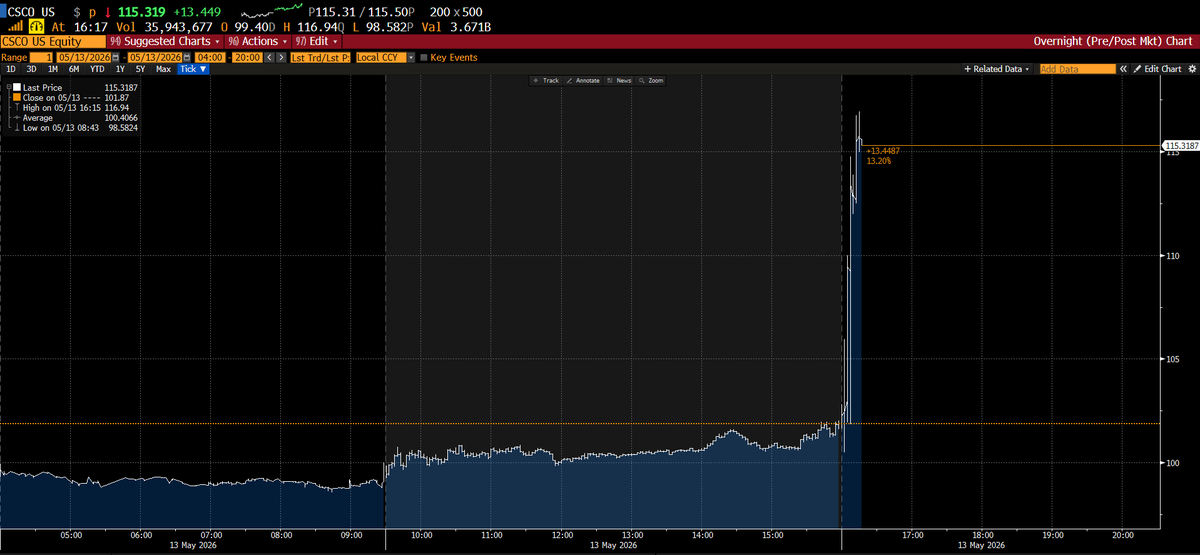
May 13

(Bloomberg) -- Cisco boosted its adjusted earnings per share guidance for the full year; the guidance beat the average analyst estimate.
YEAR FORECAST
Sees adjusted EPS $4.27 to $4.29, saw $4.13 to $4.17, estimate $4.16 (Bloomberg Consensus)
Sees revenue $62.8 billion to $63 billion, saw $61.2 billion to $61.7 billion, estimate $61.64 billion
Still sees Adjusted Effective Tax Rate about 19%, estimate 19%
FOURTH QUARTER FORECAST
Sees revenue $16.7 billion to $16.9 billion, estimate $15.82 billion
Sees adjusted EPS $1.16 to $1.18, estimate $1.07
Sees adjusted gross margin 65.5% to 66.5%, estimate 66.6%
Sees adjusted operating margin 34% to 35%, estimate 34.4%
Sees Adjusted Effective Tax Rate about 19%, estimate 19%
THIRD QUARTER RESULTS
Adjusted EPS $1.06, estimate $1.04
Revenue $15.84 billion, estimate $15.57 billion
Product revenue $12.12 billion, estimate $11.79 billionNetworking revenue $8.82 billion, estimate $8.47 billion
Security revenue $2.01 billion, estimate $2 billion
Collaboration rev. $1.02 billion, estimate $1.06 billion
Observability revenue $269 million, estimate $276.8 million
Service revenue $3.72 billion, estimate $3.78 billion
Remaining performance obligations $43.46 billion, estimate $43.27 billion
Adjusted gross margin 66%, estimate 66.2%
Adjusted operating margin 34.2%, estimate 34%
COMMENTARY AND CONTEXT
Systems Announces Restructuring Plan
Orders From Hyperscalers to Date at $5.3B
Systems to Record Pretax Charges to Gaap Finl up to $1B
Systems Expects to Record ~$450M of Charges in 4Q
Systems: Remaining Charges to Be Recognized in Fy2027
Declares Qtrly Div of 42c/Shr, Meets Bdvd Projections
To Cut Less Than 4,000 Jobs, Fewer Than 5% Workers
Margin and EPS guidance includes the estimated impact of tariffs based on current trade policy
Data center switching orders grew greater than 40% year over year
Campus networking orders grew greater than 25% year over year
Cisco estimates that GAAP EPS will be $0.80 to $0.85 for the fourth quarter of fiscal 2026.
1
1
5
12,013
