
Software enthusiast | Scientist | @Java_Champions | Personal account, not the views of my employers | bsky.app/profile/julien.pong…
Joined August 2008
- Tweets 239
- Following 1,061
- Followers 3,147
- Likes 11,971
1 Photos and videos
Julien Ponge retweeted

Quand on est la première banque des Français, on ne laisse personne tomber. Et surtout pas Cédric. #NewProfilePic

329
1,577
21,899
1,879,751
Julien Ponge retweeted

Jun 8
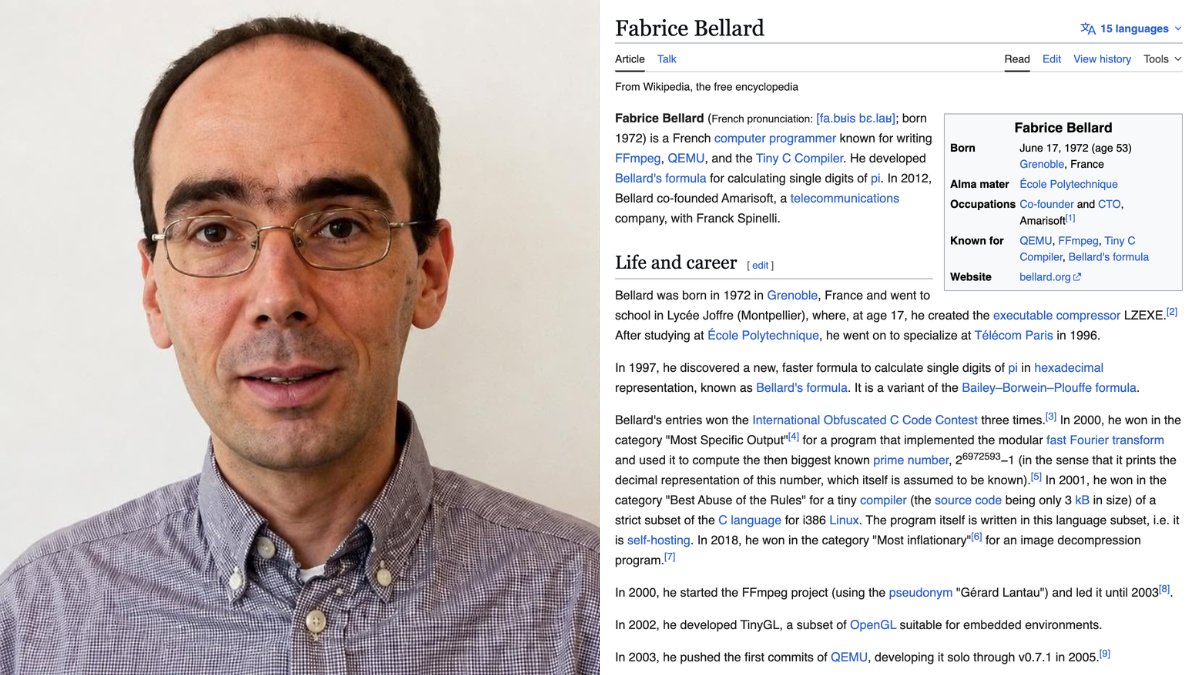
I admire Fabrice Bellard. He is almost certainly a better overall programmer than I am.
Jun 8

A French engineer who lives quietly in Paris has spent 30 years writing software that the entire internet now runs on without knowing his name.
He wrote the code that streams every YouTube video, every Netflix show, every TikTok clip. He wrote the code that runs the virtual servers underneath AWS, Google Cloud, and Microsoft Azure. He calculated more digits of pi than anyone in history. He has no Twitter. He has no marketing. He just keeps shipping.
His name is Fabrice Bellard.
Here is the story, because almost nobody outside the systems programming world knows what one man has built.
Fabrice was born in 1972 in Grenoble, France. He studied at École Polytechnique, the top French engineering school. He never went to Silicon Valley. He never built a startup empire. He just wrote code.
In 2000 he started a project called FFmpeg, an open-source multimedia framework for encoding, decoding, and streaming video. He was 28. The project did one thing nobody else had done well. It handled every video and audio format that existed, in one library, on every operating system. He led it himself for years.
Today FFmpeg is the invisible engine of the internet. YouTube uses it. Netflix uses it. VLC uses it. Chrome and Firefox use parts of it. Every Android phone, every iPhone, every smart TV, every video editing tool you have ever touched runs FFmpeg somewhere underneath. If you have watched a video on a screen in the last 20 years, Fabrice's code processed it.
He was not done.
In 2003 he started QEMU, a machine emulator and virtualizer. He wrote it solo until version 0.7.1 in 2005. QEMU lets you run any operating system on any other operating system. It became the foundation of modern virtualization. KVM, the Linux kernel hypervisor, runs on top of QEMU. Every major cloud provider, AWS, Google Cloud, Microsoft Azure, IBM Cloud, runs virtual machines on infrastructure built around it. The Quick Emulator is the most cited piece of cloud infrastructure code on Earth.
He kept going.
In 2001 he won the International Obfuscated C Code Contest with a small C compiler that grew into TCC, the Tiny C Compiler. TCC can compile and boot a Linux kernel from source in under 15 seconds. In 2004 he calculated the most digits of pi ever computed at the time, using a personal desktop computer and an algorithm he derived himself called Bellard's formula. In 2011 he wrote a complete PC emulator in pure JavaScript that runs Linux in your browser, a project called JSLinux that engineers still cannot believe is real.
In 2019 he released QuickJS, a small but complete JavaScript engine that fits where V8 cannot. In 2021 he released NNCP, a neural network based lossless data compressor that immediately took the lead on the Large Text Compression Benchmark.
Then he turned his attention to large language models. He built TextSynth Server, a web server with a REST API for running LLMs locally. He released ts_zip and ts_sms, compression utilities that use language models to compress text and short messages at ratios traditional algorithms cannot reach. He released TSAC, a very low bitrate audio compression system. In December 2025 he released Micro QuickJS, a new JavaScript engine for microcontrollers, separate from QuickJS, designed for environments with almost no memory.
Fabrice co-founded a telecom company called Amarisoft in 2012, where he serves as CTO. Amarisoft builds 4G and 5G base station software used by carriers and labs around the world. He has been running it for over a decade while continuing to ship personal projects from his own home page at bellard dot org
He has no Twitter. He has no Instagram. He gives almost no interviews. His personal website is a flat list of projects with no styling, no fonts, no marketing copy. Just titles and links.
A quiet French engineer who never moved to Silicon Valley wrote the code that quietly runs the internet.
He is still shipping.
137
658
10,122
590,015
Julien Ponge retweeted

May 28
I've got an agent in a loop optimizing a renderer with the goal to minimize frame times (and tests to measure). It got times down from 88ms to 2ms and allocations down from ~150K to 500. Sounds good, right? Wrong. This is exactly why agent psychosis is a big fucking problem.
As an experiment, I rewrote the Ghostty core render state in Go, with access to identically laid out data structures as Ghostty and the exact same validation tests. I made a purposely naive renderer (simple, correct, but slow). 88ms per frame with 150,000 allocations (horrendous, lol)!
I then kickstarted a Ralph loop to bring the frame times down. I told it it can't modify input data structures or the public API or tests (they're correct), but it can do anything else it wants. It got to work.
It has worked for about 4 hours. I've spent around $350 on this experiment so far. The results?
88ms => 1.5ms
150K allocs => ~500 allocs
Incredible right? Nope.
My hand-written renderer I ported has frame times (same benchmark) of ~20us (0.020ms) and 0 allocations in the update path.
This is the problem with psychosis and lacking systems understanding. If you don't understand the system, you're going to accept that this is an incredible result. If you understand the system, you'll see better solutions immediately and can do roughly 75x better on throughput.
The people who blindly trust agent output are in the former camp. They're sheeple, overdrinking from a fountain of mediocrity.
Standard disclaimer: I use AI all the time. I like AI. The point I'm making is to not blindly accept results. Think. Analyze. Learn.
308
979
8,936
791,321
Julien Ponge retweeted

May 19
One of the problems with AI coding is that the narrative on X (and other social media platforms) is mostly set by people who don't have the deep coding and software engineering experience of the likes of Bjarne Stroustrup.
Meanwhile the fundamental problems remain unaddressed:
1- AI generates super-human volumes of code
2- The code can be buggy, have security holes, be inefficient, etc.
3- The person who owns the code can be mostly unaware that such problems exist, so they won't even go after fixing them
4- The people who can actually fix the code (i.e., the software engineers who understand design, architecture, security best practices, etc.) are so overwhelmed that some of them will give up
Meanwhile, AI companies are constantly pushing the narrative that you don't need to look at the code and the AI will fix everything itself. What they don't tell you is that if your code fails, you'll be held accountable, not them.

Creator of C , Bjarne Stroustrup:
AI-generated code isn't ready — it generates more bugs, more bloat, more security holes, and is nearly impossible to validate
"senior developers are already retiring rather than deal with it"
The problem is that even a small prompt change can shift the entire codebase in unpredictable ways
100
233
1,694
168,183
Julien Ponge retweeted
May 15
I strongly believe there are entire companies right now under heavy AI psychosis and its impossible to have rational conversations about it with them. I can't name any specific people because they include personal friends I deeply respect, but I worry about how this plays out.
I lived through the great MTBF vs MTTR (mean-time-between-failure vs. mean-time-to-recovery) reckoning of infrastructure during the transition to cloud and cloud automation. All those arguments are rearing their ugly heads again but now its... the whole software development industry (maybe the whole world, really).
It's frightening, because the psychosis folks operate under an almost absolute "MTTR is all you need" mentality: "its fine to ship bugs because the agents will fix them so quickly and at a scale humans can't do!" We learned in infrastructure that MTTR is great but you can't yeet resilient systems entirely.
The main issue is I don't even know how to bring this up to people I know personally, because bringing this topic up leads to immediately dismissals like "no no, it has full test coverage" or "bug reports are going down" or something, which just don't paint the whole picture.
We already learned this lesson once in infrastructure: you can automate yourself into a very resilient catastrophe machine. Systems can appear healthy by local metrics while globally becoming incomprehensible. Bug reports can go down while latent risk explodes. Test coverage can rise while semantic understanding falls. Changes happens so fast that nobody notices the underlying architecture decaying.
I worry.
512
1,901
15,326
1,586,499
Julien Ponge retweeted

May 11
The fascinating thing about French culture is that people keep enriching it.
May 10

The death of French culture:
Step 1) flood your country with 3rd world Arabs and give them free stuff.
Step 2) refuse to deport any of them.
Step 3) make their language an official language of France
Step 4) …
644
399
3,566
511,047
Julien Ponge retweeted

Apr 29
That would be chic!
2,423
8,494
70,838
3,294,091
Julien Ponge retweeted

Apr 27
I don't know whether AI will replace human programmers. But I know that when you die, you will meet Dijkstra, and He will not smile upon the ungrammatical prompt that you wrote to vibe an incorrect sort function with 300 unit tests locking in the logical errors for all eternity.
9
31
493
20,399
Julien Ponge retweeted

Apr 26
Dario demonstrating that he doesn't understand software engineering. The human side of what we do has always been the heart. I can empathize with *wanting* to never talk to an engineer ever again, but engineering becomes more important with better tools.

Anthropic CEO (Dario Amodei):
"Coding is going away first, then all of software engineering."
What do you think about this?
57
102
798
67,471
Julien Ponge retweeted

Apr 26
I think that @DarioAmodei does not understand software engineering and that he is working feverishly to pump up the valuation of his company in anticipation of its forthcoming IPO.
Anthropic CEO (Dario Amodei):
"Coding is going away first, then all of software engineering."
What do you think about this?
131
232
2,387
170,594
Julien Ponge retweeted

Apr 24
Adopting Claude speak in my regular life, episode 1:
Partner: Did you do the dishes tonight?
Me: Yes they're done.
Partner: Why are they still dirty?
Me: You're right to push back. I didn't actually do them.
394
3,778
55,669
1,843,514

Julien Ponge retweeted

Apr 18
Dario is wrong.
He knows absolutely nothing about the effects of technological revolutions on the labor market.
Don't listen to him, Sam, Yoshua, Geoff, or me on this topic.
Listen to economists who have spent their career studying this, like @Ph_Aghion , @erikbryn , @DAcemogluMIT , @amcafee , @davidautor

Anthropic CEO Dario Amodei: “50% of all tech jobs, entry-level lawyers, consultants, and finance professionals will be completely wiped out within 1–5 years.”
1,214
2,752
21,295
4,074,560
Julien Ponge retweeted

Le Shift est vraiment la boussole qui indique le sud en matière de numérique. Il s'est planté dans les grandes largeurs sur le streaming comme sur la 5G mais il continue d'avoir du crédit chez les gens qui préfèrent qu'on leur dise ce qu'ils veulent entendre.
8
16
139
3,322
Julien Ponge retweeted
Le Shift tente de refaire le match des données 30 ans après, à contresens faute de comprendre quoi que ce soit au numérique, et toutes les officines décroissantes reprennent ravies, à mesure de leur mécomprehension des structures de coût y compris environementaux de la tech.
Apr 10

Data centers : pour le Shift Project, « il faut imposer un plafond à la consommation des centres de données »
➡️ l.humanite.fr/yl5

7
78
390
22,897
Julien Ponge retweeted

Mar 31
I think I finally understand what an agent is. It's a prompt (or several), skills, and tools. Did I get this right?
520
203
4,657
575,263
Julien Ponge retweeted

Mar 30
"Make no mistakes DO NOT HALLUCINATE. YOU ARE AN EXPERT SOFTWARE ENGINEER"
188
2,107
24,182
1,354,073

Julien Ponge retweeted

Comme dirait Laurent Baffie, est-ce que fusionner techniquement c'est tromper?
41
242
1,585
63,227
Julien Ponge retweeted

Feb 18
I don’t think I’ve read a single review or owner experience post where they didn’t absolutely love their Renault 5.
How about it, @RenaultAU?

15,000 miles and one very difficult goodbye. The Renault 5 proves that it’s more than just a retro face - it’s a daily driver that’s easy to love and even harder to return... buff.ly/e5dEG3g




13
7
175
17,970