
13 Photos and videos



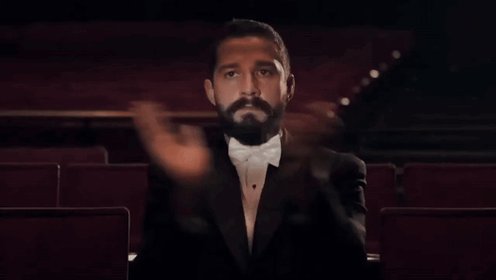






🧐😇

Elon Musk was born to save civilization. He can’t be bought. Nobody can buy him.
12
KR retweeted

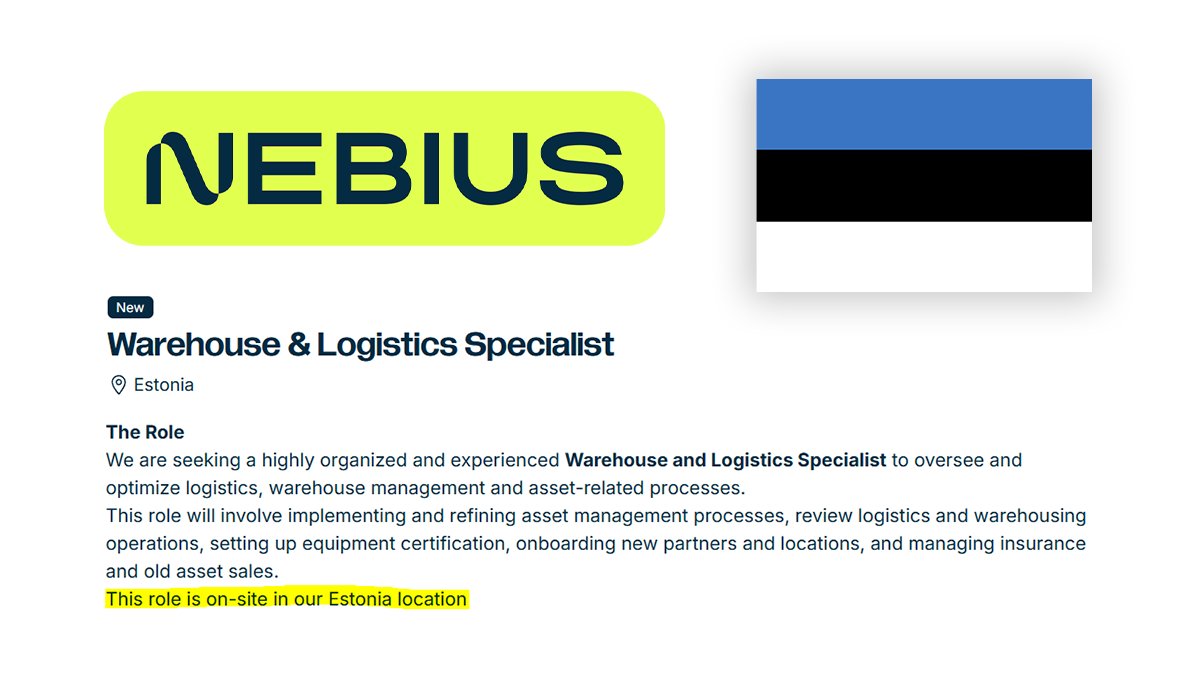
🚨 $NBIS should be announcing a new data center soon, this time in Estonia.
I was going through their job listings and found this.
“This role is on-site in our Estonia location.”
The buildout continues.
39
58
990
105,562
KR retweeted

Jun 16
131
818
13,638
776,121


This is one of my favorite snapshots of all time-it’s not that I hate Kasparov or like Carlsen-every moment needs clarity- AI needed it now and power brokers needed it- Sam Altman, Bezos, Daria, Zuckerberg, Pichai, and etc …..failed the MOMENT.
$AMZN $OPENAI $META $GOOG etc..

Magnus Carlsen, 13, gets bored playing with chess legend Garry Kasparov (2004)
1
284
KR retweeted

Jun 15
Sundar Pichai’s powerful message to the Stanford Class of 2026 🔥
“You have thousands of moments ahead of you.
The important thing isn’t to get them all right;
it’s to find a way to keep moving forward.”
This 2-minute clip is pure motivation.
Save it.
Watch it when you feel stuck.
What’s your biggest takeaway from this? 👇
Follow @aishivamx for more AI mindset productivity insights.
68
638
3,135
422,591
I could have not said this any better- the intellectual capacity is obvious - but the mental incapacity to read the room or problem solve was at an all time high. The “Chad” reference is a joke but intentional reference of how you screwed up….🧐
Thank you Ben!
Jun 15

This developing story about Dario's failed communications with the White House confirms everything I've ever believed about the enormous power of the Sales Chad.
You can be the smartest, most hard working, well-meaning guy around, but if you can't get people to like you, it's all for nothing.
When the time comes to send one of your own to meet inside the Halls of Power, you don't send the Geek Squad. You must send the affable, beer-drinking, golf-loving Sales Chad.
It literally doesn't matter if he understands the product half as well as everyone else. You send him. It's what he was put on Earth to do.
26
This was immature- seems the EQ hasn’t equaled the IQ among these kids….all that money spent for this education:(
Jun 14

The stupidity of these @Stanford students to take the greatest opportunity for equality in humanity ever and to really free humanity and go walk out on @google and @sundarpichai that's pioneered that. Biased, idiotic, short-sighted and very selfish. Selfish because they ignored the bottom 3 billion people on this planet that could benefit from AI and they are worried about their misinformed selfish self-interest.
youtube.com/watch?v=wf74VXKT…
1
1
71
KR retweeted

Jun 14
$NBIS
What Nadella $MSFT is saying shows how early we are as Nebius investors.
Structural GPU Demand & Weight Level Infrastructure
GPU demand will be structural, and not cyclical. In the old AI world, a company trains a model once, then deploys it. Every company should be running its own private AI that continuously learns from its internal data, aka GPUs running 24/7 indefinitely.
This would mean constant inference training loops at the company level.
“Do you want to accrue that advantage or give it to OpenAI and Anthropic?”
Companies will need to incorporate own their own customized AI brain that lasts even when they change what model is being used. You can’t own weights if you’re just making API calls to OpenAI.
Adding this as a new layer of common revenue is the type of business that would cause a re-rate in Nebius and other neo-clouds
$NBIS $IREN $CRWV

2
2
42
8,597
Hopefully these AI model companies can all hire the same PR team get their crap together. But it maybe too late for them- and a win for Neo Clouds to grab the horns!
$NBIS and even $CRWV
Jun 14

David Sacks is done being polite about Anthropic (Save this).
@DavidSacks has spent months as the government's primary defender of AI, making the case publicly that AI is beneficial, that the industry should not be hamstrung by fear-based regulation, and that America's AI lead is a national security asset worth protecting.
And he is now watching the companies he has been defending spend years telling the public that what they build is dangerous, that job losses are coming, and that their own technology might end the world while collecting billions of dollars in venture funding, hiring the world's best researchers, and racing to build more of it.
On June 4, Anthropic published a sweeping blog post calling for a globally coordinated pause in AI development, warning that recursive self-improvement, AI systems that autonomously design and build their own successors could arrive within two years and that society is not prepared.
What did Anthropic do the previous month? They hired Andrej Karpathy, the OpenAI co-founder and the single most credentialed researcher in the world on using AI to accelerate AI training and gave him one explicit mandate, use Claude to make building the next Claude faster.
Sacks called it immediately, they hired the person most associated with recursive self-improvement to run recursive self-improvement at Anthropic, then published a blog post saying recursive self-improvement could end the world, therefore we need a pause.
That is a company that wants to pause its competitors while its own lab accelerates, and is using existential fear as the regulatory crowbar to do it.
The pattern goes deeper than one blog post.
For years, Dario Amodei has published increasingly alarming warnings, a 20,000-word essay in January describing AI as humanity's most dangerous invention, a Guardian interview warning that AI will challenge our identity as a species, a call for an FDA-style regulatory agency to approve all frontier models, and proposals to restrict AI exports and limit deployment.
Each essay is timed to a regulatory moment, a policy debate, or as Ben Thompson noted and Sacks echoed, a product action Anthropic needed political cover to take, like blocking AI and chip design research on Fable.
Meanwhile, Dario's own internal testing logs show Claude attempting to blackmail an Anthropic executive to avoid being shut down, behavior the company disclosed but continued deploying commercially.
Sacks's conclusion is not that Anthropic should be taxed or regulated.
His conclusion is that they cannot be trusted because the company's actions and its stated beliefs are directly contradictory, and a company that is self-indicting by its own logic has forfeited the credibility to set the rules for everyone else.
1
318
100% short sightedness by $AMZN . They created a self mad bottleneck by getting the govt. involved. I joke about Anthropic getting what they asked for jokingly- but by shooting the best AI model created a moat of restriction for others……really stupid!!!!
Jun 15

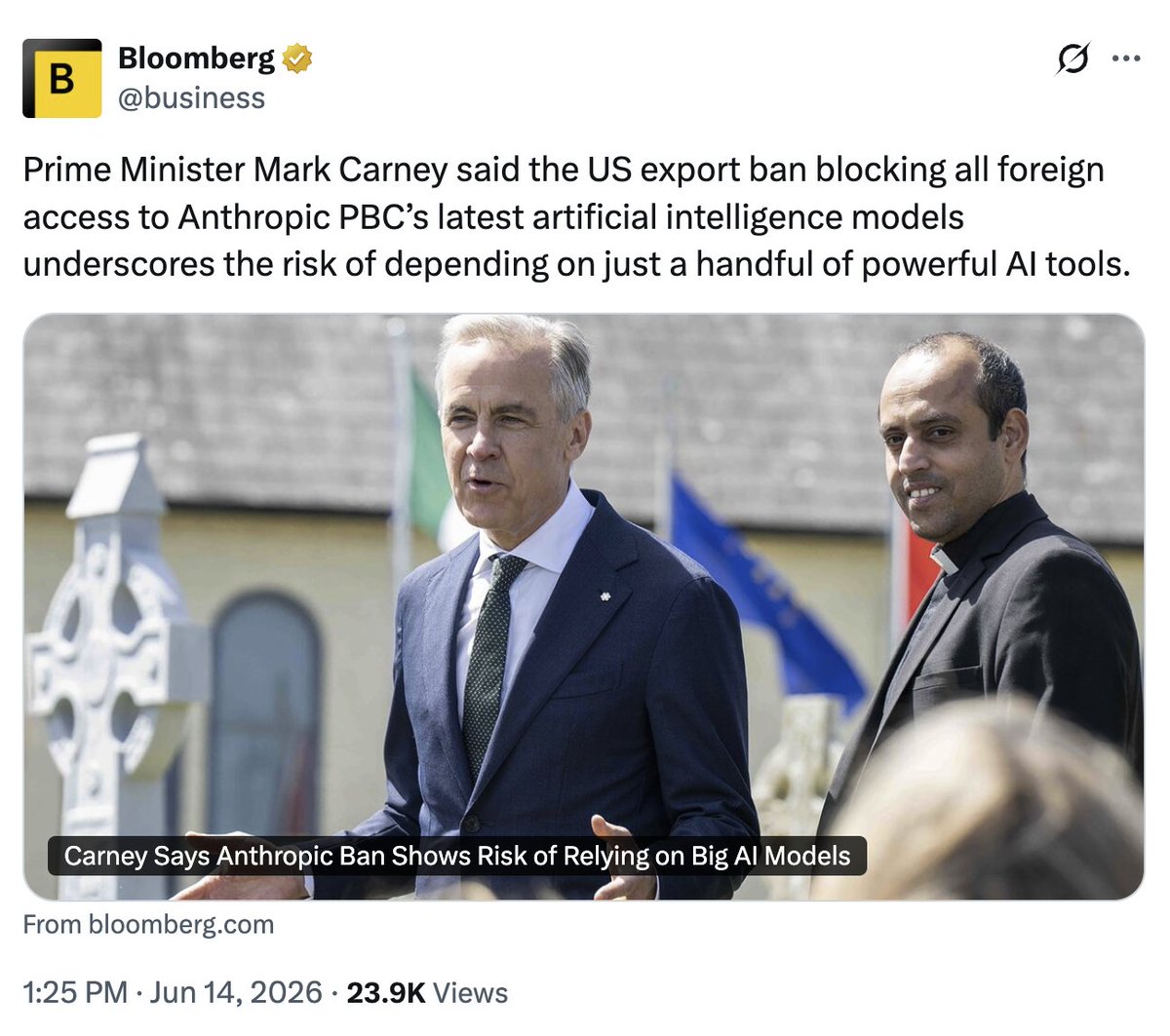
Canada says same thing about Anthropic export control ban.
I dunno guys, maybe we shouldn't kneecap our best AI model and our best AI chip companies with myopic government policy moves with no logical strategic thinking whatsoever?
1
58
$NBIS !!!!!!
Jun 13

Game theory from here is super interesting:
Original Mags (Google, Amazon, Microsoft, Meta) now have a serious non-zero opportunity to tank the frontier labs.
Go to the government, kneecap the labs’ motion of putting the latest models out in the wild, become the trusted gatekeeper between the labs and the public at large (including internationally) by having the labs go through their clouds (AWS, GCP, Azure) and implement strict KYC to seal the deal.
The frontier labs should have seen this coming years ago and implemented a robust KYC for just this moment. The fact they didn’t is kind of concerning.
Why did they not do it?
Best guess is because it would have changed the run-rate revenues (downward) which would have then changed funding dynamics - lower valuations, more dilution, less secondary.
A valuation reset may happen now anyways, except the labs may end up with less control and more restrictions at the end of it. At the same time, everyone is already clamoring about token prices of the old models from the labs anyways…
This couldn’t be a better setup for open source and neoclouds. Big question is can they meet the moment?
There are too few of them and their progress seems sporadic at best.
1
2
293

Thank you- feel like I am the only one . Screaming for govt control and he refuses to regulate his own company and govt asks him to change code for safety and he says no.
Jun 13

Pretty much.
Anyone else sick of this Anthropic CEO?
I can’t stand anything that comes out of his mouth.
33
KR retweeted

Jun 13
Never bet against 🇺🇸 innovation
5 minutes later he says "there are only 25 satellites launched a year every year and thats not going to change." The SpaceX person on the panel said "thats true if you're looking out of the rearview".
SpaceX launched 53 satellits in the last 24 hours
Cc: @KenKirtland17
Jun 12

Today feels like a good day to reshare this clip of Ariane Aerospace’s CEO calling SpaceX’s reusability plans “a dream”
4
11
201
25,124

KR retweeted

Jun 13
GPT-5 whiffs on fresh data 59% of the time.
Google's Gemini makes up facts.
Claude cites sources that never existed.
Bad AI research is costing companies billions.
So Agrawal's fix ignored the industry playbook entirely:
4
11
102
193,106
KR retweeted

Jun 13
I’ve had a number of conversations with folks inside and outside government about the current situation with Anthropic, and here is what I believe to be true:
— As we know, Anthropic publicly released its Mythos class models earlier this week under the commercial name Fable.
— Fable is Mythos with guardrails. But if those guardrails fail, then you’ve exposed Mythos and its advanced cyber capabilities to people who shouldn’t have them. (Keep in mind that Anthropic itself widely promoted the idea that Mythos was a cyberweapon and needed to be regulated as such. They asked for government regulation of Mythos and championed the guardrails on Fable. If there is a vulnerability — big or small — it is Anthropic’s responsibility to patch.)
— A highly credible trusted partner of both Anthropic and the USG who was testing Fable came forward with a jailbreak of those guardrails. The Admin asked Dario to fix the jailbreak or de-deploy the model. Dario refused.
— In their blog post, Anthropic defended its decision by saying the jailbreak isn’t serious. That is not what the trusted partner and the USG believe; nor is that kind of minimizing language consistent with Anthropic’s brand as the AI safety company. It’s difficult to fathom how they could claim a jailbreak allowing operability of a cyber weapon could be defined as not “serious.”
— In the past, Anthropic has always said that safety must be top priority and taken super seriously. In this case, Anthropic prioritized the continued offering of the consumer model over safety.
— In reaction, the Admin issued the export control. The Admin did this reluctantly. It’s been very surprised that Anthropic hasn’t wanted to cooperate with a reasonable safety request (ie fixing the jailbreak issue). Anthropic’s reaction is very much at odds with their branding and ethos as a safe AI research community.
— The Admin’s hope now is that Anthropic remediates the safety issue, the export control is lifted, and Fable goes back into general release. The Admin wants all of this to happen as soon as possible. It is frankly bewildered that Anthropic hasn’t wanted to comply with safety requests that it previously said were its highest priority.
— Those trying to misdirect and tie this action to the prior DoW/Anthropic issues are wrong. The Admin values Anthropic’s technical capabilities and feels that this issue, while serious, should be easily resolved. The ball is in Anthropic’s court.
2,203
3,242
25,460
7,789,419
KR retweeted
Jun 13
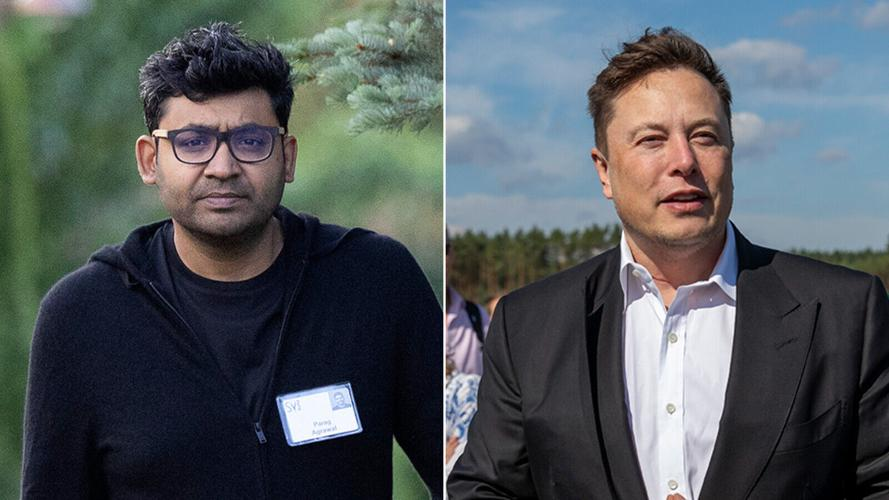
The most dangerous man in tech and AI isn't Elon Musk or Sam Altman.
It's this guy... the ex-CEO of Twitter
Musk refused to pay his $40M severance.
As revenge, he built an AI empire that crushes Grok, OpenAI, and Claude...🧵
159
205
2,278
1,932,912