
Ethical leader. Moral manager. Advocate for nature, green energy & social impact emerging tech. Strategic thinker. MBA. MSc. GMBPsS. FellowRSA. AMEI.
Joined August 2018
- Tweets 5,264
- Following 1,980
- Followers 3,362
- Likes 13,593
356 Photos and videos



Pinned Tweet

14 Mar 2023
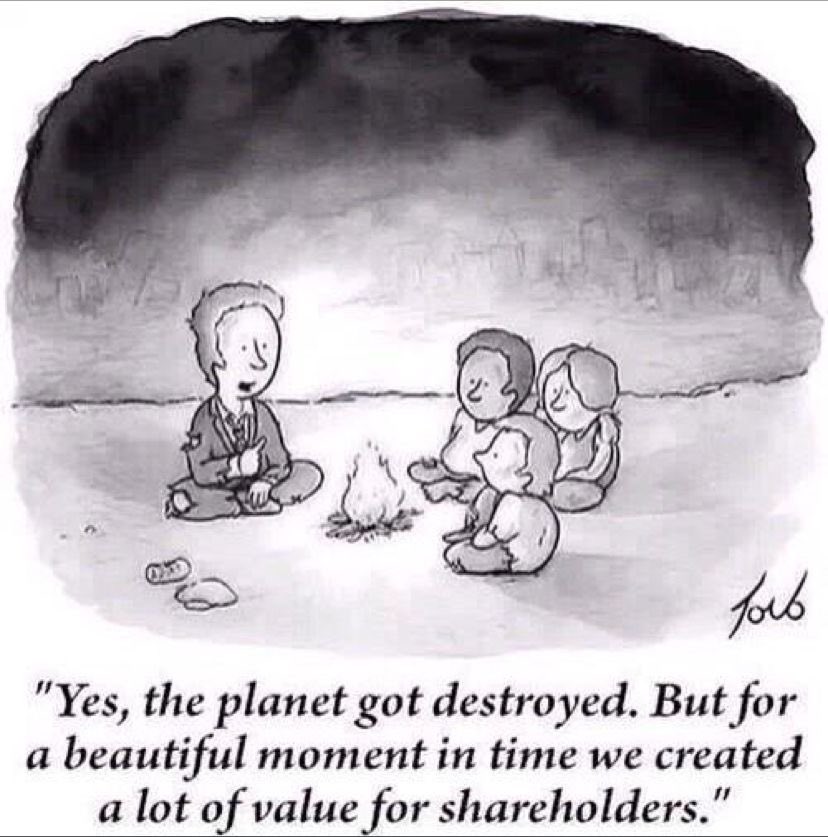
For every pound spent on military Defence, we must demand at least an equal pound spent on environmental defence, because the former without the latter is futile. There is simply no point using military power to fight for a world that won’t sustain life.
1
1
13
2,491
Chris MacGregor 🌱🌳 retweeted

Putin didn't invade Ukraine because of NATO. He invaded because Ukrainians were proving democracy works.
Historian and Pulitzer Prize winner Anne Applebaum puts it plainly: Putin looked at Ukraine's democratic movement and thought, "If they can do it in Ukraine, then people could do it in Russia. So I need to crush this."
That's the real threat Ukraine posed. Not missiles. Not borders. A working democracy next door.
Applebaum frames the war as a fault line between the democratic and autocratic worlds. Russia isn't just trying to take territory. It's trying to erase Ukraine as a nation, reduce it to a colony, and send a message to every country that the post-1945 rules of Europe no longer apply.
Those rules were simple: no invasions, no wars, borders don't change by force. Russia understood exactly what it was breaking when it crossed into Ukraine.
2,005
7,486
21,103
747,055
RT @Cherryopenmind: Only forensic journalism of this calibre can restore faith in the press and prevent figures like Farage from ever getti…
237
Chris MacGregor 🌱🌳 retweeted

May 23
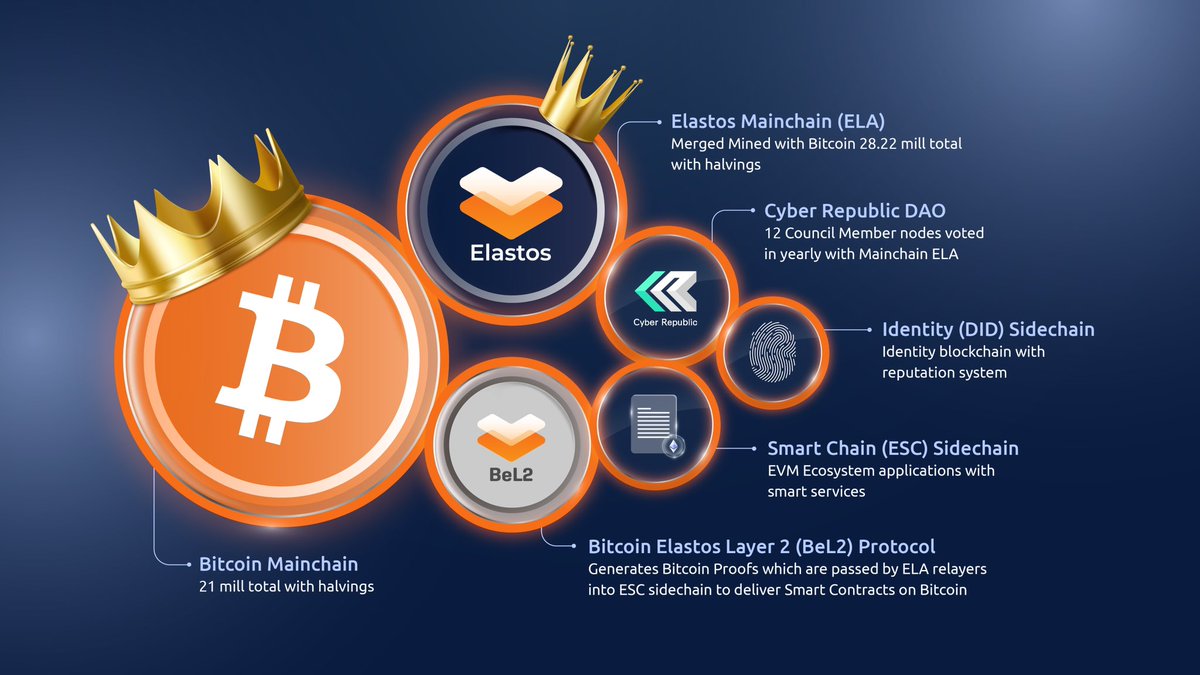
ElastOS is one user-owned system of four parts:
Blockchain for identity, ownership and governance.
Runtime for app permissions.
PC2 for your personal cloud today.
Carrier for private communication.
This week brings key parts closer in practice.
➡️elastos.click/May-23-Update

1
7
33
1,259
Chris MacGregor 🌱🌳 retweeted

May 21
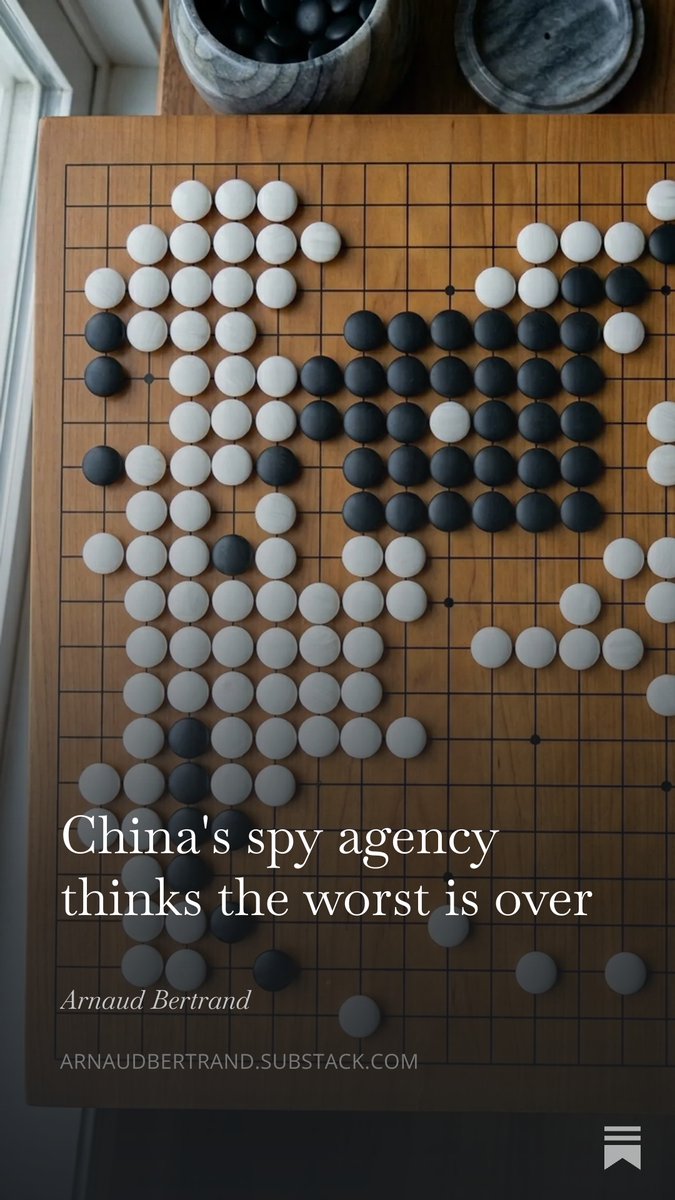
This is an extraordinary document written by the research arm of China's spy agency (the powerful MSS, basically the CIA and the FBI all wrapped in one) that absolutely zero media has picked up on.
As far as I can see, I'm the first person to write about it even though it was published (in Chinese) on May 13th on chinadiplomacy.org.cn, a website of China's Ministry of Foreign Affairs.
The document contains perhaps the most authoritative description of where China thinks its relationship with the U.S. stands, and where it’s headed.
The title of the report is “The Great Global Transformation and the Path to U.S.–China Coexistence” and I provide a full translation of it in my article, the link of which is at the bottom of this post.
To summarize briefly the most important - and, perhaps, surprising - aspect of the document: China's spy agency - the one institution whose entire job is to worry about the U.S. threat - has largely stopped worrying.
That's really what transpires from the document. They use a strategic framework borrowed from Mao's "protracted war" theory and, according to this framework, America's offensive phase is finished and China weathered the storm intact.
The question is no longer "how do we survive America?" but "how do we manage America?" - and they're proposing a six-step relationship recovery program.
I'll let you read the full document as well as my analysis of it here: open.substack.com/pub/arnaud…
203
1,534
5,725
600,019
RT @hopenothate: EXCLUSIVE: Reform UK’s Makerfield by-election candidate, Rob Kenyon, had a SECOND deleted social media account, and the ar…
1,421
Chris MacGregor 🌱🌳 retweeted

May 19
The fish rots from the head. Corrupt from Don Sr down
May 18

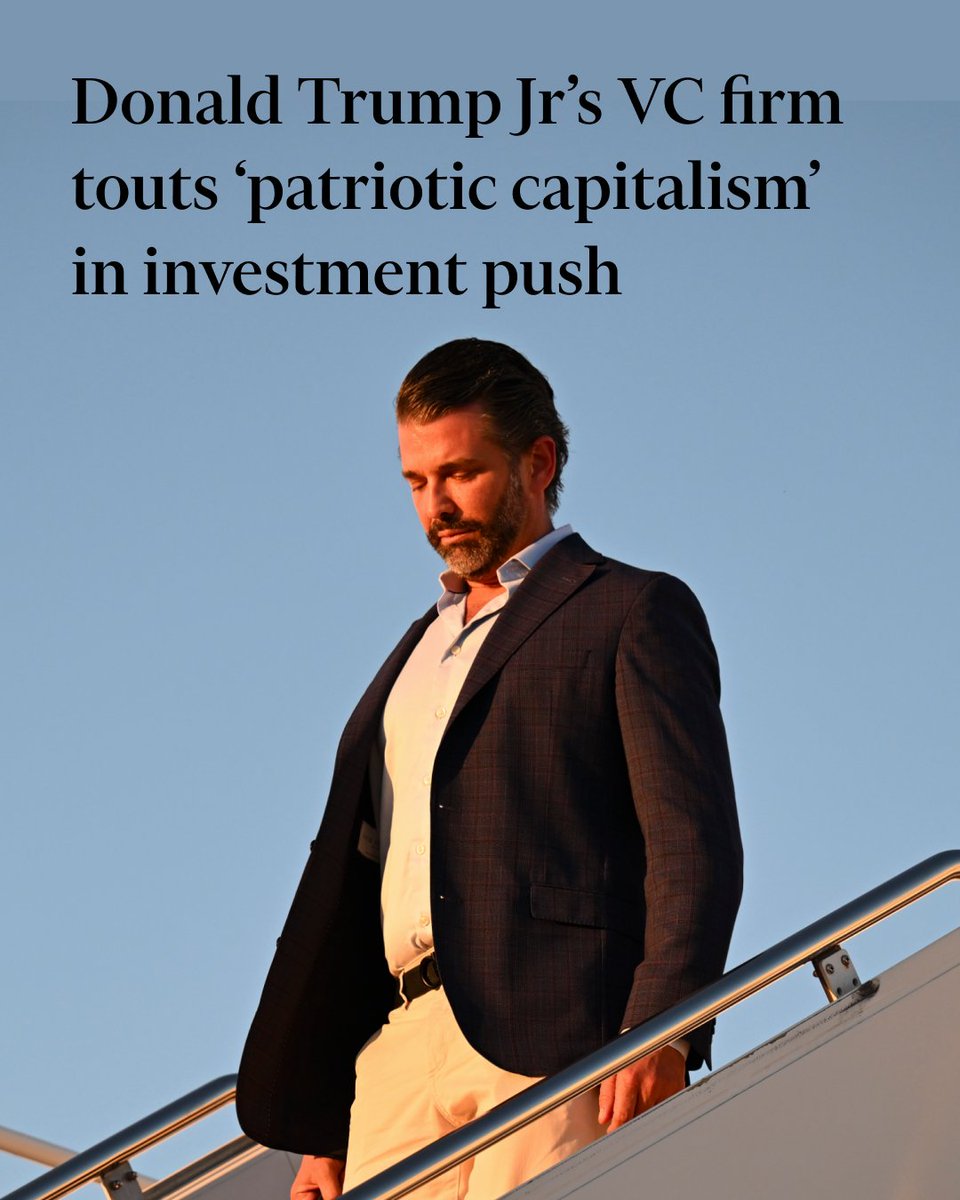
Donald Trump Jr’s venture capital firm said its assets under management jumped from $200mn to $3.5bn over the past year after a dealmaking spree. ft.trib.al/IHsszUI
75
522
2,048
106,659
Chris MacGregor 🌱🌳 retweeted

May 18
I just got back from the Bitcoin Energy Summit in Lisbon and I have a question that won't leave me alone.
First some context: Bitcoin mining is now stabilizing the grids of 7 nations, 4 agencies (including the Spanish Govt and the World's largest energy policy association) just called for more flexible demand being critical to the resilience of the grids of the future - and Bitcoin mining is the world's most flexible load resource by an order of magnitude.
So in light of this my question is this: why is 95% of the Bitcoin adoption conversation about Bitcoin-as-money when Bitcoin-as-energy is already deployed on grids across 3 continents?
Is it possible that energy is the Bitcoin usecase that paves the road for mainstream acceptance of Bitcoin in the West?
I've been in this space for four years now. When I started, the conversation was "bitcoin mining wastes energy." A group of Bitcoiners including @thetrocro, @jyn_urso and others changed that. Then it became "ok maybe it doesn't waste energy, but it's not useful." @gladstein, @jack and others changed that too.
But here's what I noticed in Lisbon. Three separate European organisations - the European Bitcoin Energy Association, Free Madeira, and the Institut National de Bitcoin in France - are all independently converging on the same conclusion.
@geyer_rachel, Chair of EBEA said energy is what will move the needle for Bitcoin in Europe. @andreloja at @FREEMadeiraOrg said energy is the most topical issue in Europe right now. Bastien Desteuque (@Proxy18387764), directeur général at @BitcoinPolicyFr said they're focusing on mining because France has spare nuclear capacity and that's where the biggest opportunity is.
Three organisations. Same conclusion.
And that's before you get to what's actually being built. In Sweden, a man I coach runs ASIC hardware that earns almost two-thirds of its revenue from frequency regulation - keeping the lights on, responding in seconds to the need of the grid operator, and helping to stabilize the grid an incredible 11,247 times last year alone. (Yes, you read that sentence right).
In Lisbon, I watched Kenji Tateiwa present a circular economy where bitcoin mining heat grows tropical fish and the CO2 gets converted to charcoal and micro diamonds. Bastian outlined how France's surplus nuclear energy could be absorbed by bitcoin mining by 2027.
And outside the West, from stabilizing the economy of Bhutan post-covid to helping save Virunga National Park in Africa - Bitcoin mining was behind both events and many more. This phenomenon is a global one.
The conversation has quietly moved from "does bitcoin mining help grids?" to "how many services can one machine provide?"
We've been thinking about this like monoculture - one machine, one function.
What I saw in Lisbon is permaculture. The same hardware doing frequency regulation, heat capture, Sats-minting ... and potentially in the near future - voltage regulation (something that would have prevented the 28 April 2025 Iberian Peninsular Blackout).
I talked to Bitcoin founders after the keynote who told me the energy thesis had opened their eyes. These are people who worked to advance Bitcoin payment infrastructure, and they hadn't fully grasped this.
Bitcoin solves a monetary problem the world is only beginning to understand. I'm more convinced of that than ever.
And ... as we wait for that revolution to be fully grasped, the energy revolution is already here - deployed, generating revenue, stabilizing grids. It might just be the thing that opens the door for everything else. What other Bitcoin use case is this far along ... at least in the West?
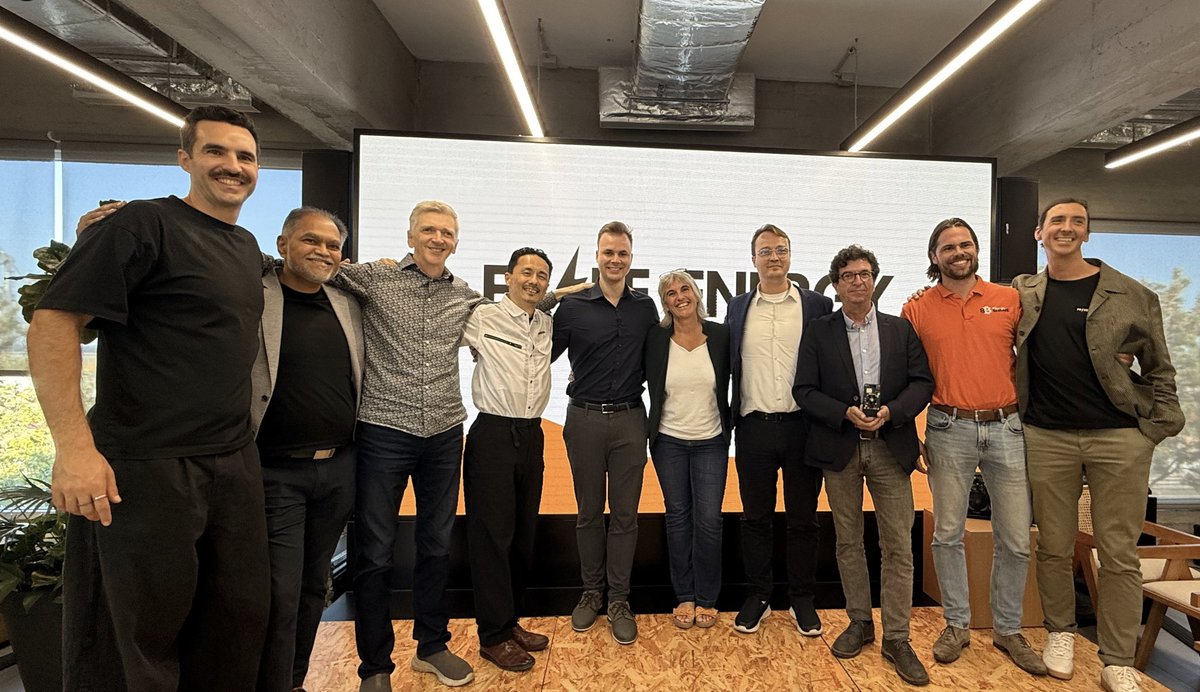
ALT Left to right: Havier Hermosa (Braiins), Bipin Patel (CEO, Flexionics), Daniel Batten (Founder CH4 Capital), Kenji Tateiwa (CEO, AgileX), Charlie Fritsche (Terrahash), Rachel Geyer (Chair, EBEA), Bastian Desteuque (directeur général, INBi), Paulo Gonçalves (Owner, Saigrene), Bert de Groot (founder, BitcoinBloem), Joe Nakamoto (Journalist, Filmmaker and MC)
32
140
522
26,830
RT @Cherryopenmind: Unfortunately, my school teacher is no longer with us to grade this piece through her golden rule of journalism: Who, W…
816
Chris MacGregor 🌱🌳 retweeted

May 15
Why what we are doing is so important for digital ownership, security and new capital markets, must watch
May 15

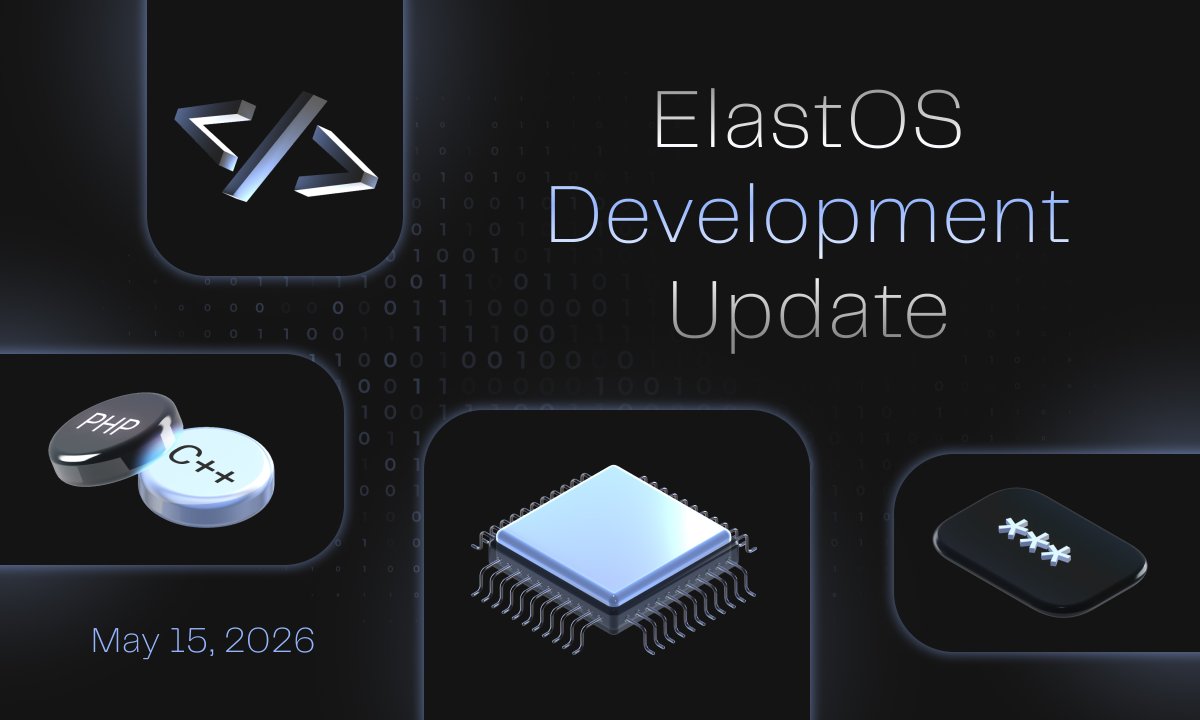
The past two weeks made the Elastos World Computer thesis clearer.
One user-owned execution layer, four environments coming together: PC2, Runtime, Carrier, and Blockchain.
PC2 is the personal cloud, Runtime is the trusted app engine, Carrier is the private network, and Blockchain is the rights and settlement layer.
9
28
1,528
Chris MacGregor 🌱🌳 retweeted

The world's democracies are being targeted one by one. That has to stop.
China has imposed trade boycotts on Australia, Lithuania, South Korea and Canada. Each time, the target stood alone. Each time, it worked.
The answer is not self-sufficiency. It is collective action.
Today I launch After the Rupture: An alliance of middle-power democracies led by a D-7: seven democracies representing 30% of the global economy, acting together on trade, technology, critical minerals and defence.
Not a new institution. A coalition of the willing, and the able.
Full paper → shorturl.at/33GOA
137
1,164
2,175
102,130
Chris MacGregor 🌱🌳 retweeted
May 11
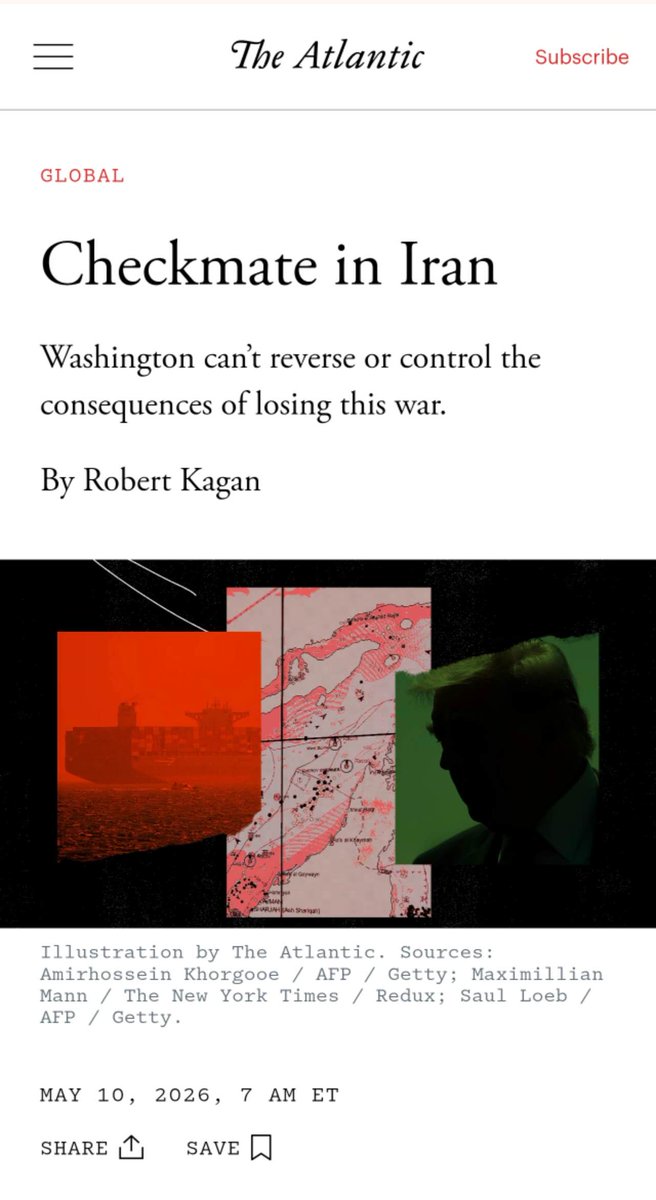
There’s no overstating how extraordinary this Atlantic article is, given the author and the outlet.
As a reminder Bob Kagan is:
- The co-founder of Project for the New American Century, probably the single most imperialist Think Tank in Washington (which is quite a feat)
- A man who spent his entire life advocating for American military interventions, especially in the Middle East, and a vocal advocate of the Iraq war. He started advocating for intervention in Iraq before 9/11, which speaks for itself...
- The husband of Victoria Nuland, an extremely hawkish former senior U.S. official (a key architect of U.S. policy in Ukraine, with the consequences we all witness today)
- The brother of Frederick Kagan, one of the key architects of the Iraq surge
In other words, we ain’t exactly looking at some sort of anti-imperialist peacenik. This is quite literally the guy Dick Cheney called when he needed a pep talk.
And the man is writing in The Atlantic, the most reliably pro-war mainstream media outlet in the U.S. (also quite a feat).
So when HE writes that the U.S. “suffered a total defeat” in Iran that has no precedent in U.S. history and can “neither be repaired nor ignored,” it’s the functional equivalent of Ronald McDonald telling you the burgers aren’t great: it means the burgers really, really aren't great.
Extraordinarily (and somewhat worryingly, for me), his arguments for why this is such a defeat are virtually the same as those I laid out in my article “The First Multipolar War” last month (open.substack.com/pub/arnaud…).
Here they are 👇
1) Vietnam/Afghanistan were survivable, this isn't
He agrees that this war - and the U.S. defeat - is fundamentally different in nature from previous U.S. interventions.
Where I wrote that the wars in Vietnam and Afghanistan didn’t change the equation much in terms of power dynamics (“in the grand scheme of things, the giant walked away with little more than a bruised ego”), Kagan writes that “the defeats in Vietnam and Afghanistan were costly but did not do lasting damage to America's overall position in the world.”
And when I wrote that “it’s painfully obvious that the Iran war is of a qualitatively different nature” from these, he writes that “defeat in the present confrontation with Iran will be of an entirely different character.”
Same point.
2) Iran will never relinquish Hormuz and uses it as selective leverage
When I wrote that Iran has turned “freedom of navigation” on its head by establishing “a permission-based regime” through the Strait of Hormuz, Kagan arrives at the same conclusion: “Iran will be able not only to demand tolls for passage, but to limit transit to those nations with which it has good relations.”
He also agrees that “Iran has no interest in returning to the status quo ante,” when I myself cited Iran’s parliament speaker Ghalibaf in my article, saying: “The Strait of Hormuz situation won’t return to its pre-war status.” Same point and virtually the same words.
3) Gulf states will have to accommodate Iran
He agrees that most Gulf states will have no choice but to accommodate Iran, effectively making Iran into a, if not THE, dominant regional power.
Kagan writes “the United States will have proved itself a paper tiger, forcing the Gulf and other Arab states to accommodate Iran.”
On my end, I wrote that “the Gulf monarchies will eventually have to choose between two security propositions. One where they stay aligned with a distant superpower that [can’t protect them]. The other proposition being: make peace with the regional power that just proved it can hit [them] whenever it wants.” Which is not much of a choice…
4) Military impossibility to reopen Hormuz
Kagan writes that “if the United States with its mighty Navy can't or won't open the strait, no coalition of forces with just a fraction of the Americans' capability will be able to, either.”
On my end, in my article I cited Germany’s defense minister Boris Pistorius: “What does Trump expect a handful of European frigates to do that the powerful US Navy cannot?”
The exact same argument.
5) Global chain reaction
Kagan agrees that this is a global strategic failure that fundamentally changes the U.S.’s position in the world. As he puts it: “America's once-dominant position in the Gulf is just the first of many casualties… America's allies in East Asia and Europe must wonder about American staying power in the event of future conflicts.”
You’ll have guessed it, I wrote essentially the same thing: “Think about what it says if you’re Saudi Arabia, quietly watching your American-built defenses fail to protect your own refineries. Or any European country now facing the worst energy shock since 1973, caused not by your enemy but by your ally, and realizing that said ‘ally,’ supposedly in charge of ‘protecting’ you, couldn’t even protect Israel’s most strategic sites - when it’s the country with which it’s joined at the hip. I’m not even speaking about China or Russia who are seeing their worldview being validated on almost every axis simultaneously.”
6) Weapons stocks depleted, credibility shattered
Kagan: “just a few weeks of war with a second-rank power have reduced American weapons stocks to perilously low levels, with no quick remedy in sight.”
Me: “America’s most advanced weapons systems are much more vulnerable than previously thought - not theoretically, but in actual combat.”
Kagan: “America's allies… must wonder about American staying power in the event of future conflicts.”
Me: “The U.S. security guarantee has been empirically falsified in real time.”
-----------
So, yup, Bob Kagan and I agree on nearly everything. I need a shower 🤢
Reassuringly though, we still differ on a few fundamental aspects.
First of all, arguably the most important one, the moral aspect. In typical neocon fashion, his article contains not a word about the human cost of this war - not the 165 schoolgirls, not the devastation inflicted on Iranians during 37 days of bombing, not the toll this war is taking on the entire world through its devastating economic consequences (the economic devastation on ordinary people worldwide is referenced only as a political problem for Trump). For him, this is purely a strategic chess problem, morality and people don’t figure in his mental map.
For me, the moral bankruptcy of this war isn't separate from the strategic failure - it is the strategic failure. Much like Gaza can only be a failure because of its sheer abjectness.
Secondly, there is not an instant of reflection in the article on how we got there. Which is unsurprising because he personally, alongside his wife, his brother, and every co-signatory of every PNAC letter, spent a generation pushing for exactly this kind of confrontation. The man spend 30 years advocating for military dominance in the Middle East and hostility towards Iran, thereby forging them as an adversary and facilitating this very war that he now says has “checkmated” America.
I know introspection has never been the neocon forte but at some point you have to stop setting houses on fire and then writing op-eds about how surprising the smoke is.
Last but not least, we differ on what should be done. This is the funniest part of Kagan’s article - showing that the man is decidedly beyond salvation. On one hand he calls this a “checkmate” by Iran, and a U.S. defeat that can “neither be repaired nor ignored,” yet an the other hand his solution for it is… surprise, surprise… a bigger war still!
He writes that what’s to be done is “engage in a full-scale ground and naval war to remove the current Iranian regime, and then to occupy Iran until a new government can take hold.”
The arsonist's solution to the fire is a bigger fire ¯\_(ツ)_/¯
For my end, this was the conclusion of my previous article:
"There is almost a Greek tragedy quality to U.S. actions lately where every move taken to escape one’s fate becomes the mechanism that delivers it. The U.S. went to war to reassert dominance - and proved it could no longer dominate. It demanded allies send warships - and revealed it had no real allies. It waged forty years of maximum pressure to break Iran before this moment came - and instead forged the very adversary now capable of meeting it. It started the war in part to have additional leverage over China - and handed the world the spectacle of begging China for help. The prophecy was multipolarity. Every American action to prevent it reveals it instead."
I wouldn’t change a word. The only thing that's changed since I wrote it is that even the arsonists now smell the smoke.
Src for the Atlantic article: theatlantic.com/internationa…
387
2,970
9,972
1,143,383
Chris MacGregor 🌱🌳 retweeted

May 10
This is a brilliant investigative piece on Farage, the dark millions behind him and the double standards of so much British journalism. Read and retweet! Nigel Farage pocketing £5m from a donor shows he’s unfit for power app.prospectmagazine.co.uk/s…
171
4,413
6,424
231,130
Chris MacGregor 🌱🌳 retweeted

May 8
A very special delivery for David Attenborough, beloved by people (and animals) everywhere 💚
To honour Sir David’s 100th birthday, His Majesty The King is supported by a cast of stars from British nature to relay his handwritten message in time for the celebration at the Royal Albert Hall.
Watch David Attenborough’s 100 Years on Planet Earth on @BBCiPlayer.
youtu.be/I1D9YF0YapQ?si=6zcB…
376
2,243
12,351
1,040,754
Chris MacGregor 🌱🌳 retweeted
May 6
The real value proposition we are working on is turning data into capital. Labour is increasingly headed to zero, so giving your time as a skill is less and less relevant.
AI is driving the marginal cost of labour to zero, human wealth can no longer come from wages. Universal basic income = dependance and isn't sustainable. It must come from equity, owning the assets that machines consume.
Think of it as turning your data into digital vending machines that pay you every time someone accesses them. This applies broadly: day-to-day personal data, ebooks, photos, art, music, audiobooks, podcasts, films, documentaries, video, dApps, plugins, games, 3D designs, personal AI, even real-world services like robotics-as-a-service, smart locks, and smart city infrastructure.
The Agentic OS abstracts the complexity. You talk to an AI, share data, upload media, get support. Behind the scenes, it mints that activity into capital, spinning up thousands of vending machines you own. Sell to consumers, organisations, or AI agents alike. Or just keep the privacy of ownership.
Income flows through tokenised royalties, tradeable down to 0.1%, opening new equity markets for a data economy anyone can join. Picture a fund allocating capital to buy up royalties for yield. Or a company aggregating thousands of data rights from vetted sellers into a single AI training package.
This is the new economy and new infrastructure we're building. It's critical, and it keeps compounding. A good read: elacitylabs.com/blog/interne…
May 1

ElastOS step by step gets more powerful.
Protect your data, own and sell it directly with world, run private AI in your own soverign OS, accessible anywhere in the world.
We are doing for non-financial assets what Bitcoin did for finance. Watch/read update, try it out, give feedback and we will continue rolling out updates.
No code Apple installer coming next week, here is latest version running on my Jetson Nano on other side of world in Bangkok behind firewall. ELA
1
10
28
2,142
Chris MacGregor 🌱🌳 retweeted

BREAKING: JAPAN'S LARGEST EXCHANGE JPX JUST TOLD BLOOMBERG IT WILL LAUNCH #BITCOIN AND CRYPTO ETFs
WORLD'S 4th LARGEST ECONOMY IS OPENING TO BTC
HERE WE GO 🚀
78
476
2,956
132,070
Chris MacGregor 🌱🌳 retweeted

Putin is scared.
His "fortress" is cracking and half his decrees are now secret — so Russians can't see how badly the regime is failing.
Here's what he's hiding 👇 [1/11]
329
3,352
13,219
769,929
Chris MacGregor 🌱🌳 retweeted
Apr 28
One of the most important weeks yet for ElastOS 🐘
Since last week ElastOS Runtime moved closer to a real desktop feeling, PC2 got stronger security, six core apps prepared for v1.2 launch, and the user experience keeps getting cleaner across the board

2
12
51
1,355
Chris MacGregor 🌱🌳 retweeted

Apr 26
Two related questions:
1. How many ministers in UK gov know what Obsidian is?
2. On a scale of 1 to 10, how much would our civil service freak out were one of UK ministers to try and build something like this, let alone put it on GitHub? (A: >11)
Bonus question: how quickly would the contents be FOI’d? (h/t @matthewclifford)
Apr 25

Singapore's Foreign Minister published the architecture for his "second brain for a diplomat" yesterday. Architecture diagrams, design rationale, the works. A developer-style writeup of his own system.
It runs on a Raspberry Pi. It connects to his WhatsApp and Gmail, transcribes voice notes locally, ingests speeches and articles, and builds up a knowledge graph over time. It answers questions, drafts speeches, condenses information. He says he doesn't dare switch it off.
What @VivianBala built is one-of-one. There's no other setup like it. But what he built it from isn't.
He composed four open-source pieces:
- @NanoClaw_AI , the agent framework: github.com/qwibitai/nanoclaw
- Mnemon, the persistent memory layer: github.com/mnemon-dev/mnemon
- OneCLI, the credential proxy that keeps API keys out of the containers: github.com/onecli/onecli
- The LLM Wiki pattern by Andrej Karpathy, the synthesis approach: x.com/karpathy/status/204047…
None of them are his. The composition is his. And then he published the composition: gist.github.com/VivianBalakr…
He didn't keep it internal as Singapore's edge. He didn't spin it into a product. He didn't gatekeep. He wrote it up and put it on GitHub.
There are tens of thousands of doctors, lawyers, researchers, investors, and operators building one-of-one setups for themselves right now. Some simpler than Vivian's, some more elaborate. The impulse will be to sit on it. Treat it as your edge. Think about what product or company you could spin out of it. Resist that impulse.
Vivian put it directly: "The diplomat who learns to work with AI will have a meaningful edge. I think that edge is now."
The specific thing Vivian composed will be obsolete in months. His real edge isn't the system. It's his ability to build it. Being plugged in, up to speed, able to cut through the noise and connect the right pieces into something that brings real value.
Sharing the blueprint doesn't give that away. It amplifies it.
You become a beacon. Other people working on the same things find you. They share what they're building, suggest improvements, point at things you didn't know existed. You learn faster. You stay in the center of where things are happening. Publishing isn't giving away your edge. It's doubling down on it.
24
39
599
127,595
Chris MacGregor 🌱🌳 retweeted

Apr 18
Palantir vient de publier son manifeste. Lisez-le.
Pas pour ce qu'il dit sur la tech. Pour ce qu'il dit sur le politique. Sur l'idéologie de Karp et Thiel. Sur la guerre. Sur vous.
Quand une entreprise privée se donne pour mission de définir qui doit être surveillé, ciblé, prédit, neutralisé, et qu'elle publie simultanément un texte expliquant pourquoi contester cela serait de la faiblesse civilisationnelle, on n'est plus dans la stratégie d'entreprise. On est dans la privatisation du souverain. Le droit de décider de l'ennemi, qui fut toujours le geste politique fondateur des États, est en train d'être racheté par une entreprise cotée au Nasdaq.
Ce manifeste repose sur un seul tour de passe-passe, répété sous vingt formes différentes : rendre l'inévitable ce qui est en réalité un choix. Les armes à IA ? Elles seront construites de toute façon, alors autant que ce soit nous.
La surveillance algorithmique ? La réalité géopolitique l'exige.
Le réarmement de l'Occident, la hiérarchie des cultures, la disqualification du pluralisme comme naïveté dangereuse ? Simple lucidité face au monde tel qu'il est.
C'est le geste idéologique par excellence : ne pas interdire la question, mais la rendre indécente.
Ce que Palantir appelle réalisme est en fait une décision philosophique radicale : le conflit est la vérité permanente du monde, la délibération démocratique est une fragilité que l'adversaire exploitera, et une élite technologique privée est mieux placée qu'un peuple pour tirer les conséquences de cette vérité.
C'est du schmittisme en hoodie. C'est littéralement la structure de leur pensée.
Le danger n'est pas qu'ils soient fous. Le danger est qu'ils soient riches, cohérents, et déjà à l'intérieur des États. Palantir ne frappe pas à la porte des gouvernements pour vendre un outil. Elle arrive avec une cosmologie complète : voici comment fonctionne le monde, voici vos ennemis, voici pourquoi vous ne pouvez pas vous permettre de débattre, et voici notre contrat.
Palantir est l'ennemie des peuples et de la démocratie. Ce qu'ils construisent, c'est un pouvoir technocratique que personne n'a élu et que personne ne pourra destituer.
Apr 18

Because we get asked a lot.
The Technological Republic, in brief.
1. Silicon Valley owes a moral debt to the country that made its rise possible. The engineering elite of Silicon Valley has an affirmative obligation to participate in the defense of the nation.
2. We must rebel against the tyranny of the apps. Is the iPhone our greatest creative if not crowning achievement as a civilization? The object has changed our lives, but it may also now be limiting and constraining our sense of the possible.
3. Free email is not enough. The decadence of a culture or civilization, and indeed its ruling class, will be forgiven only if that culture is capable of delivering economic growth and security for the public.
4. The limits of soft power, of soaring rhetoric alone, have been exposed. The ability of free and democratic societies to prevail requires something more than moral appeal. It requires hard power, and hard power in this century will be built on software.
5. The question is not whether A.I. weapons will be built; it is who will build them and for what purpose. Our adversaries will not pause to indulge in theatrical debates about the merits of developing technologies with critical military and national security applications. They will proceed.
6. National service should be a universal duty. We should, as a society, seriously consider moving away from an all-volunteer force and only fight the next war if everyone shares in the risk and the cost.
7. If a U.S. Marine asks for a better rifle, we should build it; and the same goes for software. We should as a country be capable of continuing a debate about the appropriateness of military action abroad while remaining unflinching in our commitment to those we have asked to step into harm’s way.
8. Public servants need not be our priests. Any business that compensated its employees in the way that the federal government compensates public servants would struggle to survive.
9. We should show far more grace towards those who have subjected themselves to public life. The eradication of any space for forgiveness—a jettisoning of any tolerance for the complexities and contradictions of the human psyche—may leave us with a cast of characters at the helm we will grow to regret.
10. The psychologization of modern politics is leading us astray. Those who look to the political arena to nourish their soul and sense of self, who rely too heavily on their internal life finding expression in people they may never meet, will be left disappointed.
11. Our society has grown too eager to hasten, and is often gleeful at, the demise of its enemies. The vanquishing of an opponent is a moment to pause, not rejoice.
12. The atomic age is ending. One age of deterrence, the atomic age, is ending, and a new era of deterrence built on A.I. is set to begin.
13. No other country in the history of the world has advanced progressive values more than this one. The United States is far from perfect. But it is easy to forget how much more opportunity exists in this country for those who are not hereditary elites than in any other nation on the planet.
14. American power has made possible an extraordinarily long peace. Too many have forgotten or perhaps take for granted that nearly a century of some version of peace has prevailed in the world without a great power military conflict. At least three generations — billions of people and their children and now grandchildren — have never known a world war.
15. The postwar neutering of Germany and Japan must be undone. The defanging of Germany was an overcorrection for which Europe is now paying a heavy price. A similar and highly theatrical commitment to Japanese pacifism will, if maintained, also threaten to shift the balance of power in Asia.
16. We should applaud those who attempt to build where the market has failed to act. The culture almost snickers at Musk’s interest in grand narrative, as if billionaires ought to simply stay in their lane of enriching themselves . . . . Any curiosity or genuine interest in the value of what he has created is essentially dismissed, or perhaps lurks from beneath a thinly veiled scorn.
17. Silicon Valley must play a role in addressing violent crime. Many politicians across the United States have essentially shrugged when it comes to violent crime, abandoning any serious efforts to address the problem or take on any risk with their constituencies or donors in coming up with solutions and experiments in what should be a desperate bid to save lives.
18. The ruthless exposure of the private lives of public figures drives far too much talent away from government service. The public arena—and the shallow and petty assaults against those who dare to do something other than enrich themselves—has become so unforgiving that the republic is left with a significant roster of ineffectual, empty vessels whose ambition one would forgive if there were any genuine belief structure lurking within.
19. The caution in public life that we unwittingly encourage is corrosive. Those who say nothing wrong often say nothing much at all.
20. The pervasive intolerance of religious belief in certain circles must be resisted. The elite’s intolerance of religious belief is perhaps one of the most telling signs that its political project constitutes a less open intellectual movement than many within it would claim.
21. Some cultures have produced vital advances; others remain dysfunctional and regressive. All cultures are now equal. Criticism and value judgments are forbidden. Yet this new dogma glosses over the fact that certain cultures and indeed subcultures . . . have produced wonders. Others have proven middling, and worse, regressive and harmful.
22. We must resist the shallow temptation of a vacant and hollow pluralism. We, in America and more broadly the West, have for the past half century resisted defining national cultures in the name of inclusivity. But inclusion into what?
Excerpts from the #1 New York Times Bestseller The Technological Republic: Hard Power, Soft Belief, and the Future of the West, by Alexander C. Karp & Nicholas W. Zamiska
techrepublicbook.com
437
10,114
25,077
3,014,587