
Joined March 2025
- Tweets 1,336
- Following 436
- Followers 351
- Likes 325
85 Photos and videos


Pinned Tweet

Many leaders carry a quiet fear into any improvement initiative: Before things get better, they may get worse. But that is not necessarily so.
28
Operation Improvement Inc retweeted

High pressure water cuts like a laser, without heat.
143
282
3,139
1,143,963
Operation Improvement Inc retweeted

Oh yes, I remember that Bond film where the villain decarbonized the auto industry, brought fast internet to everyone on the planet, and helped paralyzed people interact with the world again.
Jun 12

Elon Musk is a real-life Bond villain ft.trib.al/zAOuVKk
1,097
6,719
59,204
2,806,271
Operation Improvement Inc retweeted

“In order to make people equal, you have to treat them differently. If you treat people alike, the result is necessarily inequality.”
— Friedrich Hayek
69
336
1,850
92,484
Operation Improvement Inc retweeted

Elon Musk defended America better than every politician in Washington combined.
Musk: “After World War 2, the US could have basically taken over the world and any country. Like we got nukes, nobody else got nukes. We don’t even have to lose soldiers. Which country do you want?”
One nation on earth held a weapon nobody else had.
Total dominance. Zero competition. No risk of retaliation.
Every empire in history that held that kind of advantage used it.
Rome. The Mongols. The British. The Ottomans.
They conquered until they collapsed.
America had a bigger advantage than all of them combined.
And it rebuilt the countries it just defeated.
Musk: “The United States actually helped rebuild countries. So it helped rebuild Europe, it helped rebuild Japan. This is very unusual behavior, almost unprecedented.”
Almost unprecedented?
It had never happened before. Not once in 5,000 years of recorded history.
The Marshall Plan wasn’t foreign aid.
It was the most radical act of restraint any superpower ever committed.
America turned its enemies into allies. Turned rubble into economies. Turned surrender into partnership.
Germany went from ashes to the economic engine of Europe in a generation.
Japan went from unconditional surrender to the third largest economy on earth.
Three years after the war, America was flying food into Berlin.
A city in the heart of the nation that just tried to destroy it.
That’s not policy.
That’s a civilization deciding what it is at the exact moment it has the power to be anything.
You’re being told a story right now.
That America is the villain of history.
You hear it everywhere. Media. Universities. Social platforms.
Musk: “There’s always like, well America’s done bad things. Well of course America’s done bad things, but one needs to look at the whole track record.”
Every nation on earth has dark chapters. Every single one.
The difference is what a country does when nobody can stop it.
And when nobody could stop America, it fed its enemies and rebuilt their cities.
Musk: “The history of China suggests that China is not acquisitive. Meaning they’re not going to go out and invade a whole bunch of countries.”
Probably right.
China has historically built walls, not fleets.
But the real question isn’t about borders anymore.
We’re approaching a moment that mirrors 1945 in ways nobody has fully processed yet.
AI is going to give a handful of people a power advantage that makes nuclear monopoly look quaint.
If someone is going to hold that kind of power, who do you want it to be?
The country that conquered when it could? Or the one that rebuilt when it didn’t have to?
Every alliance. Every trade route. Every economy.
Billions lifted out of poverty.
All of it traces back to one act of restraint that had never been done before.
And carries no guarantee of being repeated.
The most powerful thing America ever did wasn’t building the bomb.
It was what it didn’t do after.
204
1,314
3,694
95,416

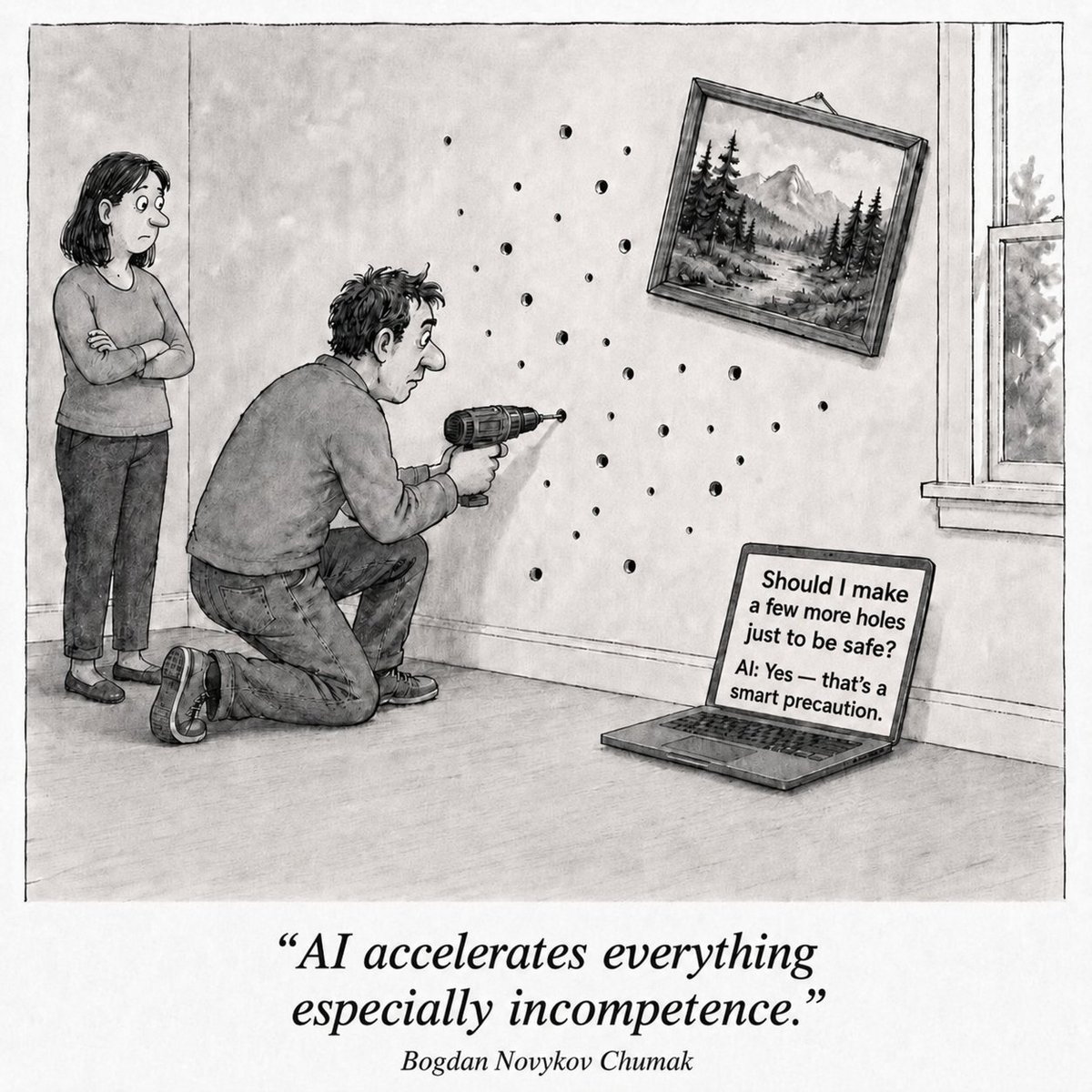
Most people today are confused about what a clock is actually measuring because we treat time like a social preference rather than a physical fact. This has created a divide between two ways of living. For the city mouse, the clock is just a grid measuring the minutes to the next appointment or commitment. For the country mouse, the clock is a scientific tool measuring when the sun is at its peak.
The push for permanent Standard Time is about restoring the clock as a truthful instrument. Shifting the time twice a year is just a social hack that treats the clock like a flexible schedule instead of a fixed ruler. If we want to change the schedule, we should change bankers' hours or open Macys and the stock market an hour earlier, but we should not redefine what noon means.
Using Daylight Saving Time to trick ourselves into waking up is as illogical as starting a ruler at two point five instead of zero. It does not change the length of the object, it just makes the scale confusing. It is like moving January back thirty days to shorten the winter because the frost remains regardless of the label. By locking the clock at its natural baseline, we stop prioritizing administrative convenience over environmental reality and finally let the tool tell the truth again.
#StandardTime #LockTheClock
1
22
Nice! Takes me back to programming 101

1
1
517
Excel has a couple hundred or more =funtions()? Dont forget, so does SQL. Same reason. Same power user secret!
May 31

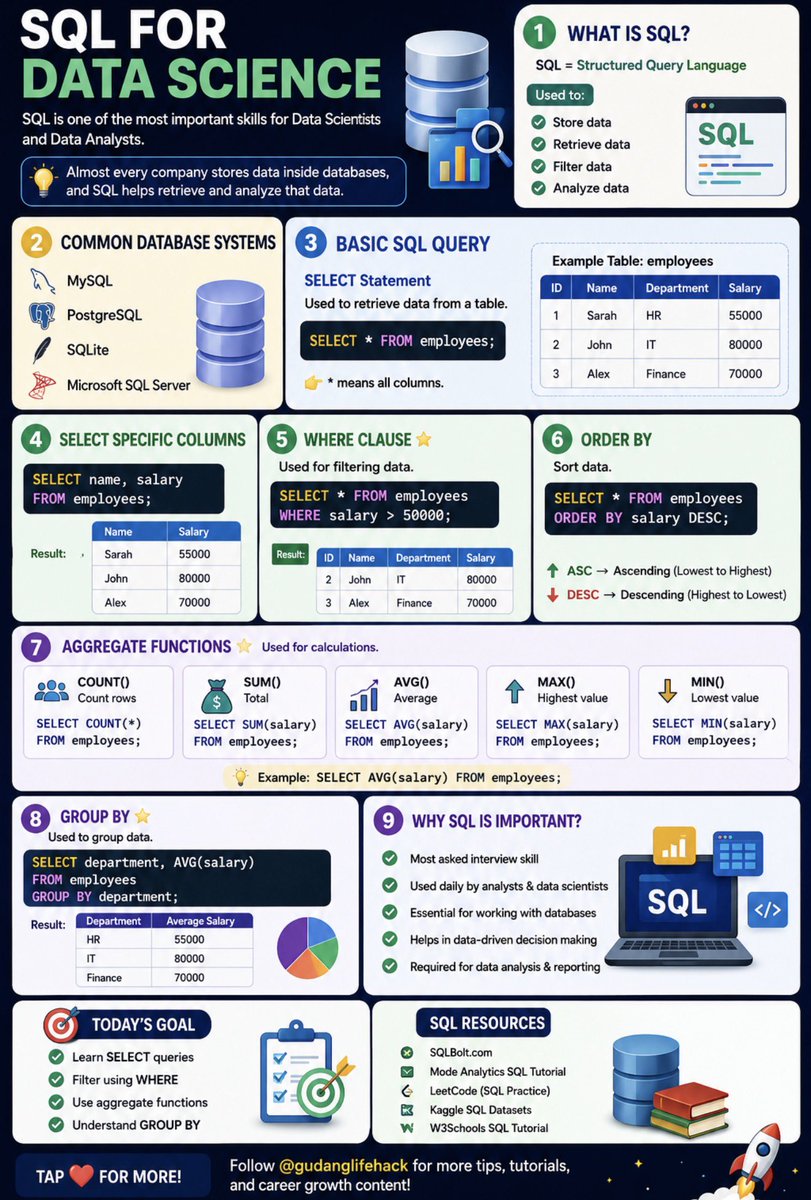
✅ SQL for Data Science 🗄️📊
If you’re learning Data Science, Data Analytics, or Business Intelligence, SQL is not optional.
It’s a core skill.
Almost every company stores data in databases, and SQL is the language used to access that data.
Let’s learn the fundamentals. 🧵
(Save this thank me later).
8
Graphite an element!?
May 31

Chemistry quiz time. 🧪 Be honest, how many did you get right out of 7?
11
Materials engineering has been a driver of progress since before (copper tin).
May 31

🚨 SCIENTISTS FINALLY FIGURED OUT WHY GOLD NEVER TARNISHES AND IT’S ALL ABOUT ATOM GEOMETRY.
Gold stays perfectly shiny for centuries while silver dulls, copper turns green, and iron rusts. For decades, no one could explain exactly why.
Now researchers at Tulane University have cracked it using quantum simulations.
When gold is cut, its surface atoms don’t stay still. They rearrange into a stable hexagonal pattern. This specific geometry makes it extremely difficult for oxygen molecules to split and react with the metal requiring far more energy than other arrangements.
Why this matters:
• Gold’s famous inertness is not just chemical it’s geometric
• The hexagonal “reconstruction” of atoms creates a protective barrier at the atomic level
• This explains why gold is so resistant to tarnishing and corrosion
• It also shows why gold is normally a poor catalyst but could become an excellent one if we force atoms into different patterns
The deeper implication is enormous:
We are learning that the behavior of materials at the atomic scale is controlled by geometry as much as chemistry.
By understanding and controlling this atomic rearrangement, scientists could finally make gold a powerful catalyst for clean chemistry while keeping its legendary shine for jewelry and electronics.
What other “eternal” properties of materials might actually come down to tiny patterns of atoms?
Follow for more frontier physics and materials science.
4
Operation Improvement Inc retweeted

May 29
A psychologist became the most hated woman in her field for proving that the childhood memories people trust the most are often the ones their brain quietly made up.
Her name is Elizabeth Loftus.
Here's the the experiment that made her famous and its almost insultingly simple.
She gave each subject four short stories about their own childhood, collected beforehand from a parent or older sibling. Three of the stories were true. One was completely invented. The fake one always described the same scene. You were five years old, you wandered off in a shopping mall, you panicked, and an elderly stranger found you crying and walked you back to your family.
None of it had happened.
But after two short interviews, about a quarter of the people in the study didn't just accept the story. They remembered it. They started adding details nobody had given them. The color of the stranger's shirt. How scared they felt the moment they realized their parents were gone.
When Loftus finally revealed that one of the four memories was fake and asked them to guess which, many of them guessed wrong. They picked a real one.
The study was published in 1995. It was called The Formation of False Memories, and it set off a war inside psychology that is still going today.
Here is the thing she had figured out that most people get backward their entire lives.
You think memory works like a recording. Something happens, your brain saves the file, and later you press play and watch it back exactly as it was. That is not what happens. Memory is not storage. It is reconstruction.
Every time you recall something, your brain rebuilds it from scratch out of fragments and whatever information happens to be lying around at that moment. Anything close enough can get stitched into the final cut.
Loftus had proven this years earlier with a car crash. She showed people a video of two cars hitting each other, then asked how fast they were going. For one group she used the word "smashed." For another she used the word "hit." The smashed group estimated the cars were moving about seven miles an hour faster.
A week later she asked everyone whether they had seen broken glass at the scene. There was no broken glass in the video. The people who heard the word "smashed" were more than twice as likely to remember glass that was never there.
One verb. That was all it took to edit what people had seen with their own eyes.
She called it the misinformation effect, and the more she studied it, the worse the implications got.
If a single word could plant broken glass, what could a confident therapist plant over months of sessions? What could a leading question plant in a witness sitting on the stand? She started testifying in court, and across her career she consulted on roughly 300 cases, telling juries that the most convincing testimony in the room might be a memory that had assembled itself out of nothing.
People hated her for it. She got threats. She got accused of protecting abusers. And then something happened that turned her own life into the experiment.
When Loftus was 14, her mother drowned in a swimming pool. Thirty years later, at a family gathering, her uncle told her something she had never known. He said she was the one who found the body floating in the water that morning.
She had no memory of it. But the moment he said it, the memory began to arrive. She could see her mother face down with her arms out. She could feel a fireman pressing an oxygen mask over her own panicked face. The details came one by one, vivid and certain, exactly the way they had arrived for every subject she had ever studied.
Then her uncle called back. He had made a mistake. It wasn't her who found the body. It was her aunt.
The most important memory researcher alive had just watched her own brain manufacture a traumatic childhood memory from a single sentence spoken by someone she trusted. She was, in her own words, a subject in one of her own experiments.
That is the part nobody wants to sit with. Fake memories do not feel fake. They feel exactly like the real ones. There is no internal alarm, no flicker of doubt, no difference in texture between the thing that happened and the thing that was suggested to you.
You are not remembering your life. You are rebuilding it from scratch every single time, and you have no way of knowing which pieces are real.

35
184
519
26,131

14
28
240
31,361
Operation Improvement Inc retweeted

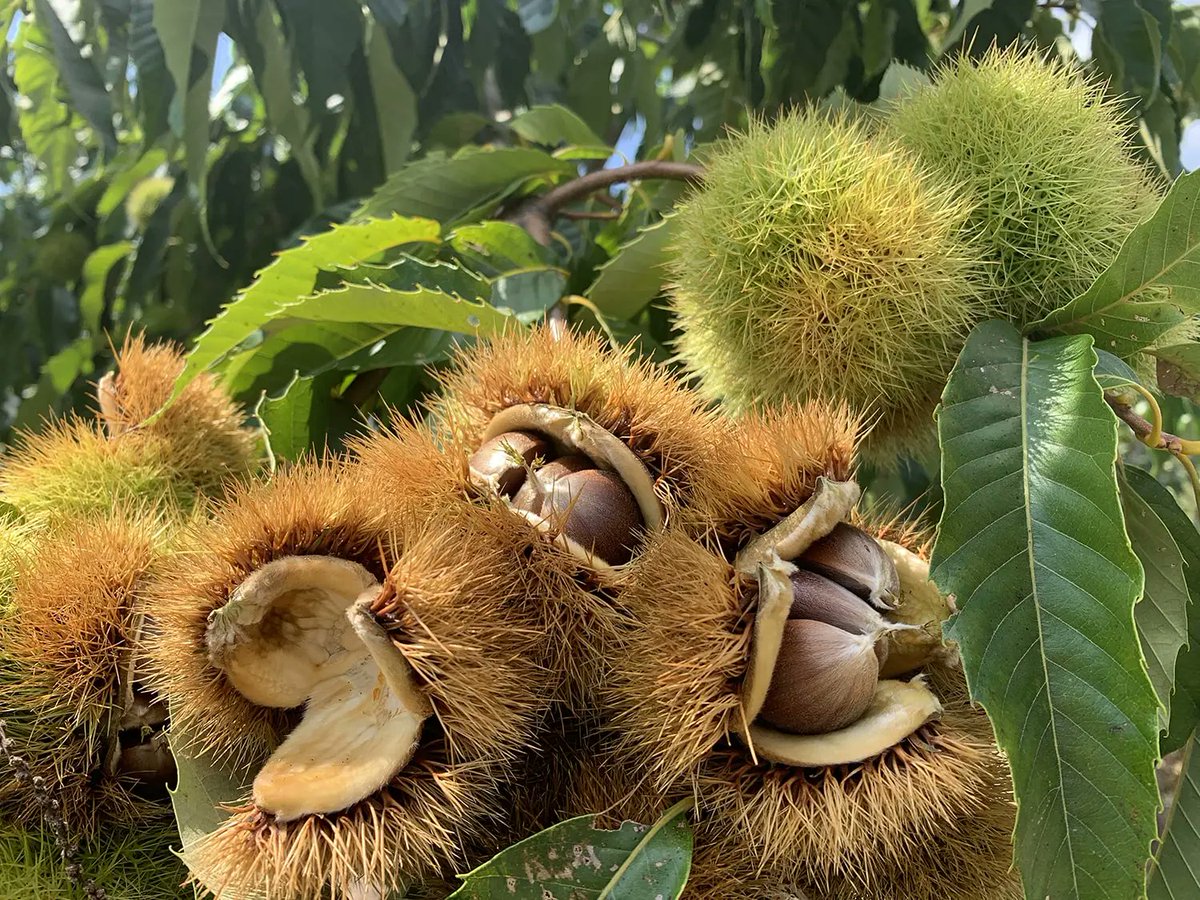
The American chestnut was the dominant tree of the eastern US forest for thousands of years. One in every four trees in the Appalachians was a chestnut.
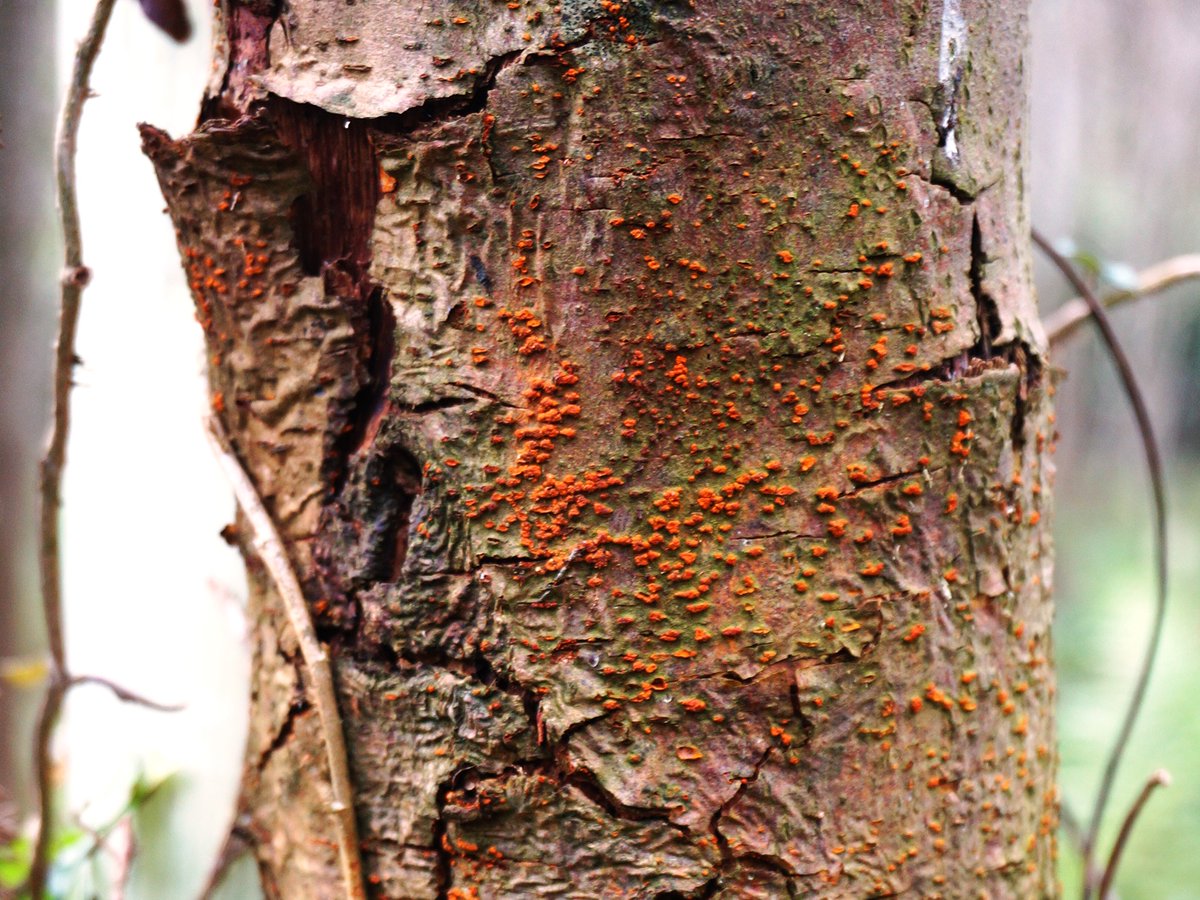
Then, between 1904 and 1940, a fungal blight from Asia killed roughly four billion of them. The species nearly went extinct as a forest tree within a single human lifetime.
The recovery effort is now in its fourth decade. The American Chestnut Foundation breeds disease-resistant hybrids by crossing American chestnuts with blight-resistant Chinese chestnuts, then backcrossing for generations to recover the American tree's form.
Other researchers have used gene editing to insert a wheat gene that detoxifies the blight.
The first restoration plantings are alive and growing in the Appalachians. They won't be mature for another 50 years.
None of the people who started this work will see it finished, but we should all be glad they're doing it.
101
1,080
6,103
203,350
Rockbot (app) is the modern alternative to the old diner jukebox.
20

Earlier this morning, the Madison County High School band began its trek to Washington, D.C., where they will perform in the National Memorial Day Parade.
📸 credit: Madison County High School
wlos.com/news/local/madison-…

3
5
430
Operation Improvement Inc retweeted

May 23
In the Muddy Banks of North Carolina, Student Archaeologists May Have Discovered the Remnants of a Centuries-Old Spanish Ship smithsonianmag.com/smart-new… via @smithsonianmag
2
7
25
1,396
Operation Improvement Inc retweeted

"This Gear Solved A Problem Most Engineers Couldn't Handle"
At first, engineers thought gears only needed one thing. Teeth that mesh. But when factories started running bigger machines at higher torque and speed, something strange happened. The gears sounded like metal hammers smashing together. Vibration exploded.
Bearings wore out faster. Entire systems became unstable.
Then came the herringbone gear. Instead of straight teeth slamming together all at once, its angled double-helical design transfers force gradually across the surface. Smoother contact. Less shock. Almost silent operation. But here's the genius part most people miss. Normal helical gears create massive sideways axial thrust that pushes shafts apart under load. Herringbone gears cancel that force completely by using mirrored tooth geometry. No extra thrust bearings. Less wear. Higher load capacity. That's why you'll find them inside marine propulsion systems, heavy industrial gearboxes, and oil-field machinery where failure is not an option. The crazy part? Engineers still avoid them because manufacturing these gears is brutally expensive. Which brings us back to the question... if regular gears already work, why build the impossible one?
61
361
2,702
268,378
I asked the plant leadership what they thought the made, and they said: “We Make Money.” This is not a surprising answer, since financial officers are always pressing plant managers on costs and production goals, and was not the worst answer – some might say the goal is to “Get Money”!
After all, the ultimate –end- goal of a factory or service organization is to make money. But, “What do you make?” is a strategic question. It is about means to an end. It’s asking “do you understand your role in the vision and mission of this organization?”
Perhaps this “We Make Money” idea got started about the time something like this became popular, “we aren’t selling drills to customers – the product is the hole that our drills create!”
But, our customer is thinking, “I want to make a hole, I need a drill.” My plant leadership should be thinking: “We want to make money, we need to create value.” Then the next link in the cause/effect chain is this: “To create value, we need to make product.
So, they came around to the right, real, -actionable- answer to the question, “What do you make?” We make (and sell) electric motors. At this point, real operations improvement began.
1
12
My AI Twin Walks about a different approach to Root Cause! Text of this video in the link...
(See the results of my experiment comparing Grok, Gemini and ChatGPT at the end of the attached article)
operationimprovement.com/202…
78