
Engineer, Entrepreneur, Investor. Founder @AICouncilConf @ZeroPrimeVC. Helping 10k engineers start companies 🤓🖖
Joined March 2008
- Tweets 3,404
- Following 1,567
- Followers 3,177
- Likes 5,322
194 Photos and videos
Pete Soderling retweeted

Jun 12
finance teams watching devs use fable to center a div
3
4
76

May 14
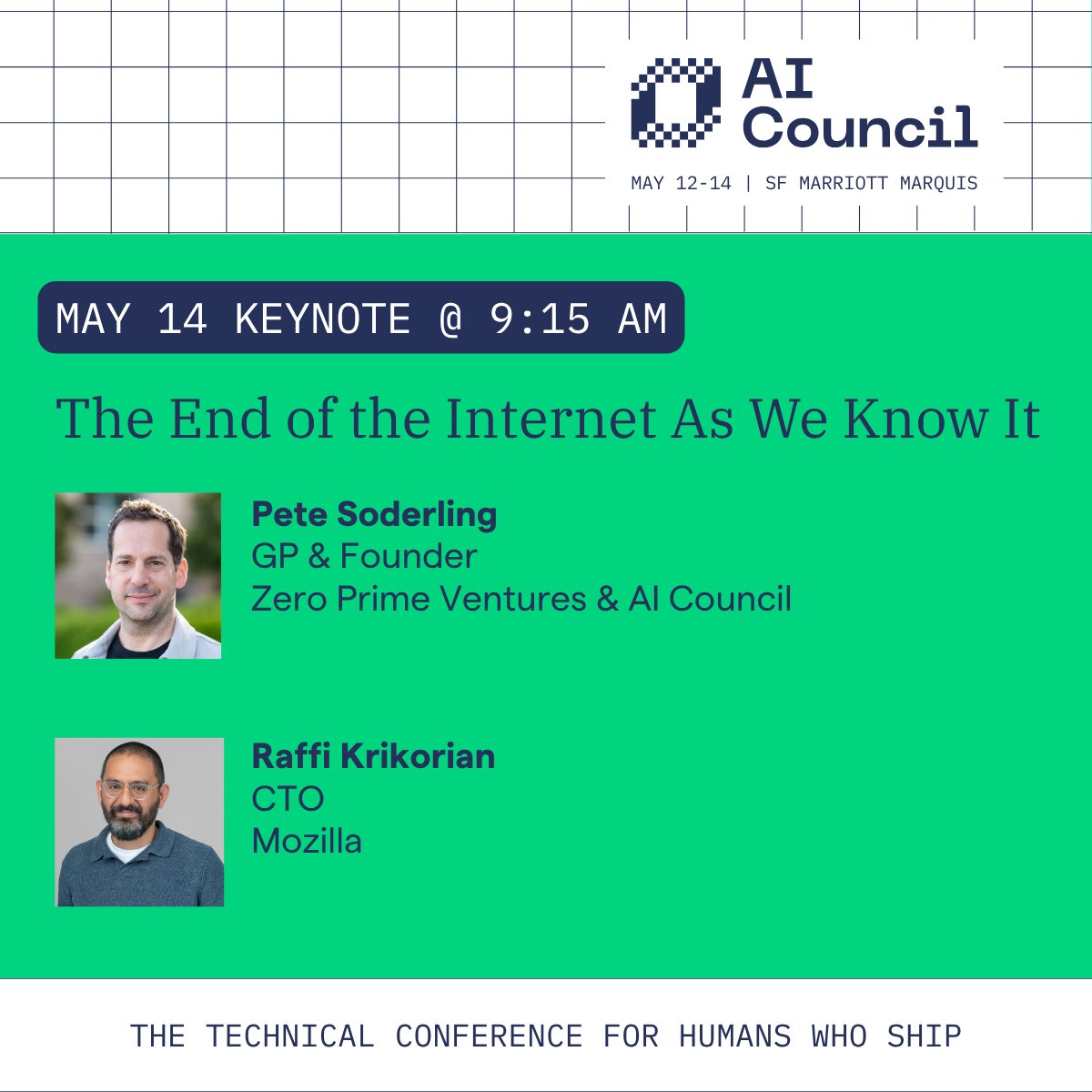
For decades, 2 things kept the internet safe: writing code was hard, and finding bugs was hard.
AI just ended both of those.
@Mozilla CTO @raffi laid it out in his guest essay in The New York Times called "The End of the Internet as We Know It," and this morning he takes the @AICouncilConf stage w/ me to talk about what comes next.
See you at 9AM!
2
2
280
Pete Soderling retweeted

We are gonna have some fun 😈
May 13

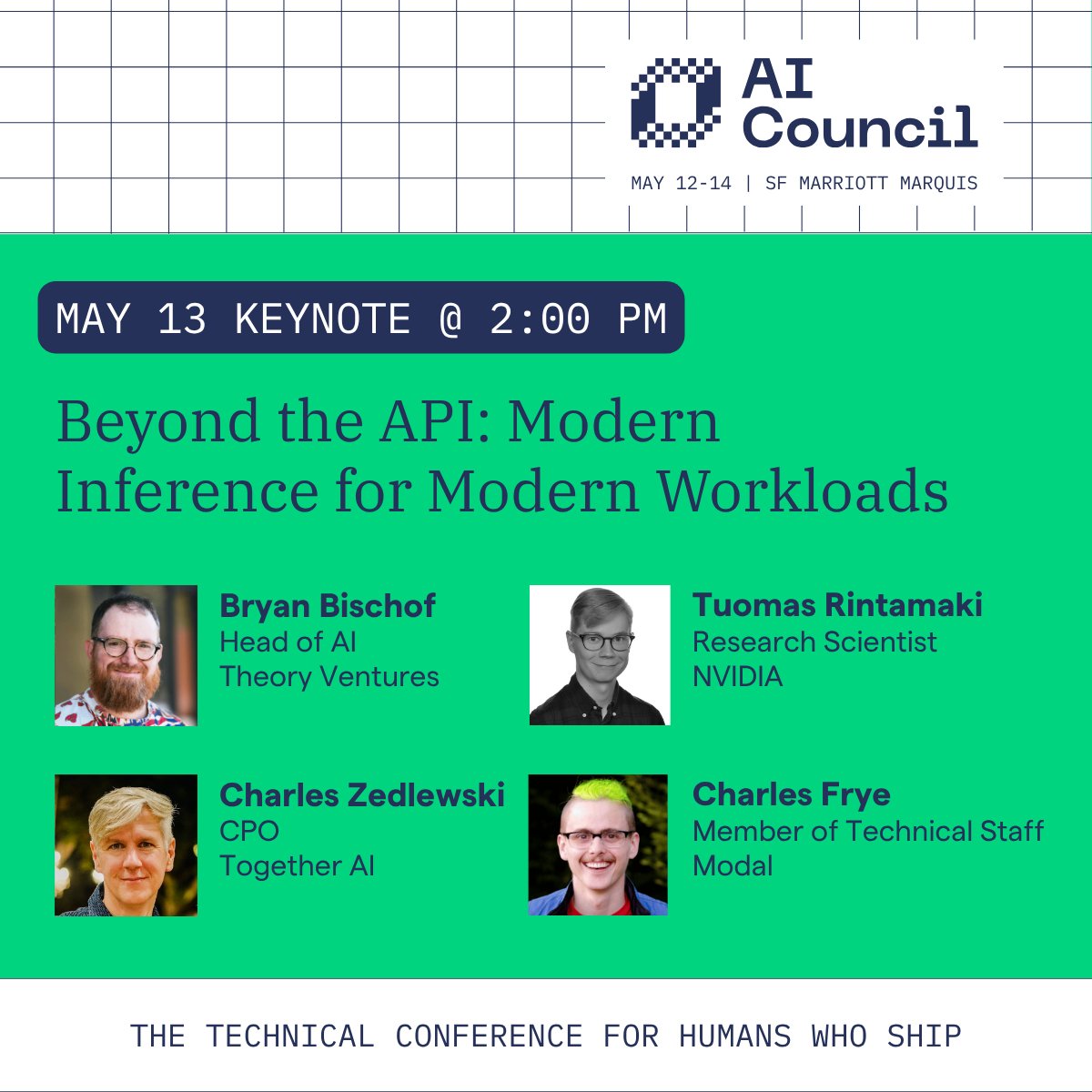
Our Day 02 afternoon keynote "Beyond the API" is beyond stacked.
New panelist just added... welcome back @charles_irl - Member of Technical Staff @Modal, joining:
@BEBischof, Head of AI, @theoryvc
Charles Zedlewski, CPO, @togethercompute
@tuomars, Research Scientist, @nvidia
2 PM on the Main Stage, see you there.
2
2
424
Pete Soderling retweeted
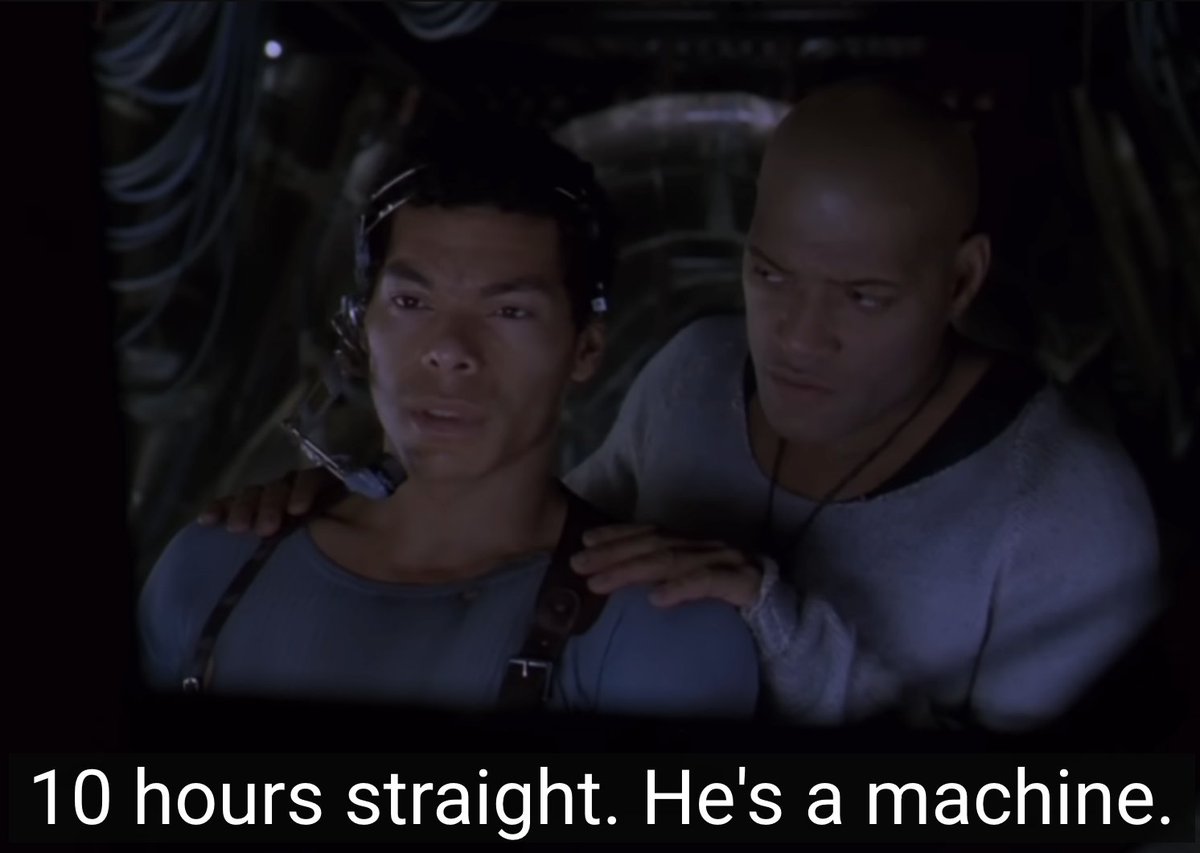
It me
May 13
You: at AI Council workshops all day
Them, admiring your extraordinary diligence:
1
6
328
May 13
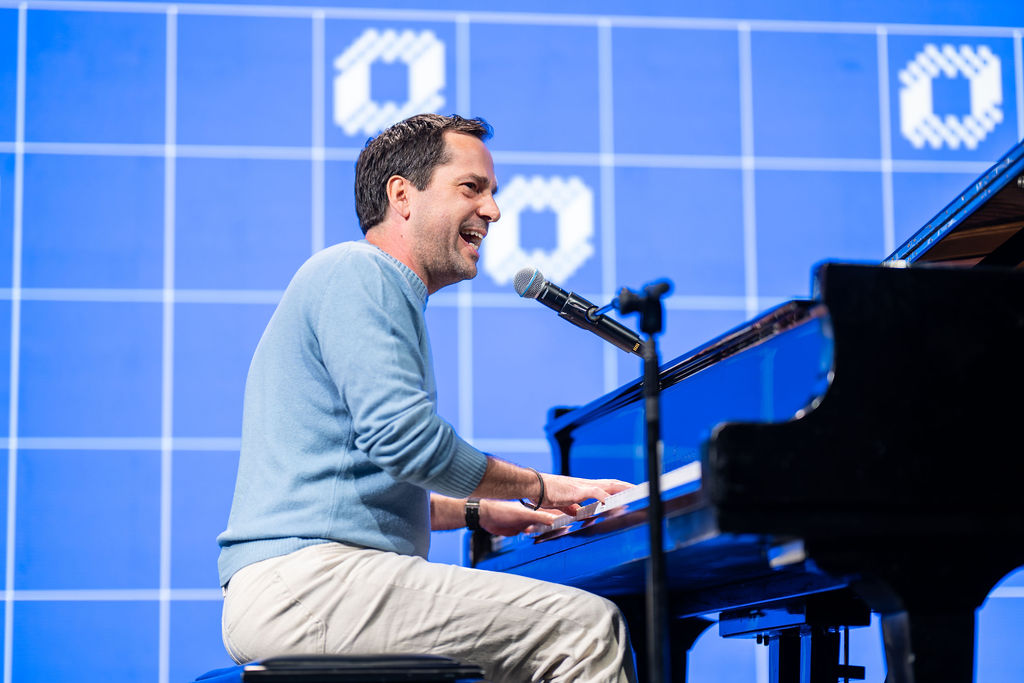
I'll need a green room and a bowl of M&Ms (no brown ones)
91
May 13
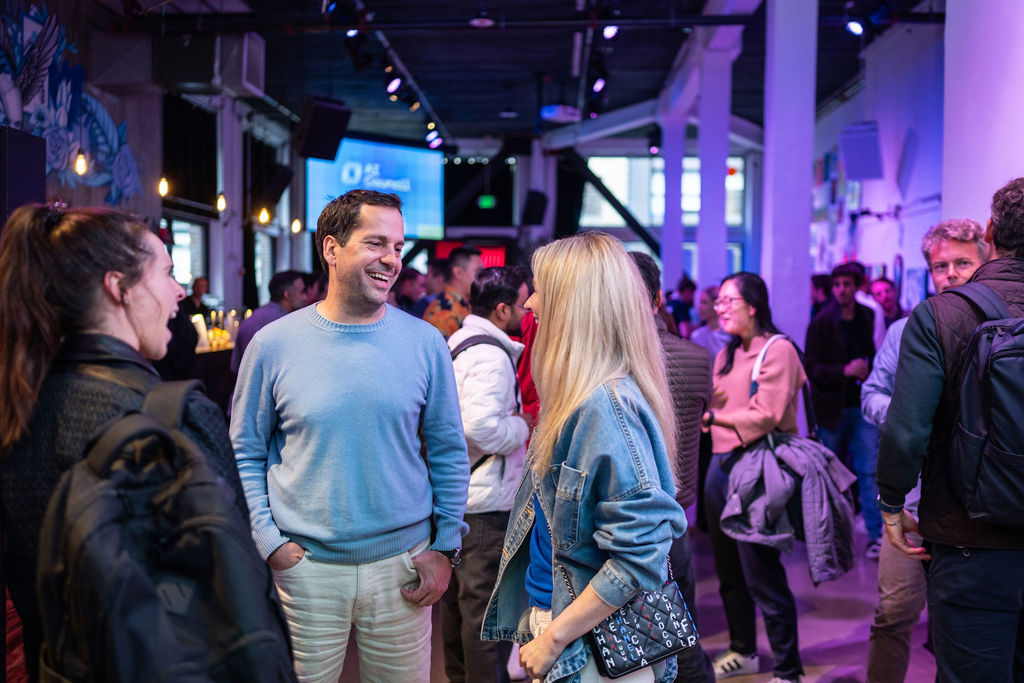
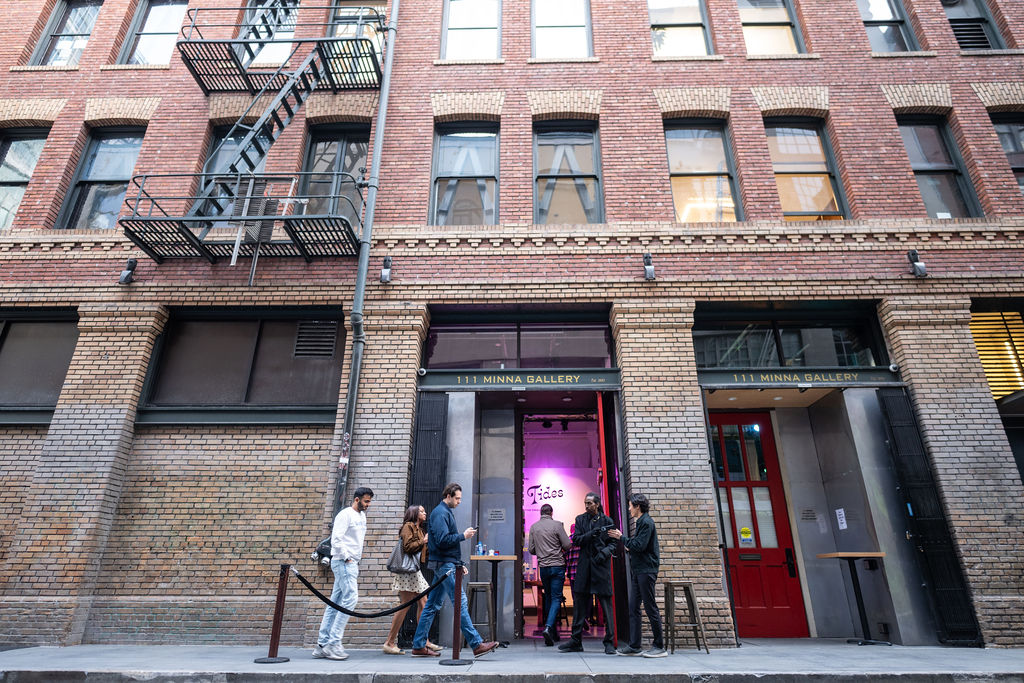
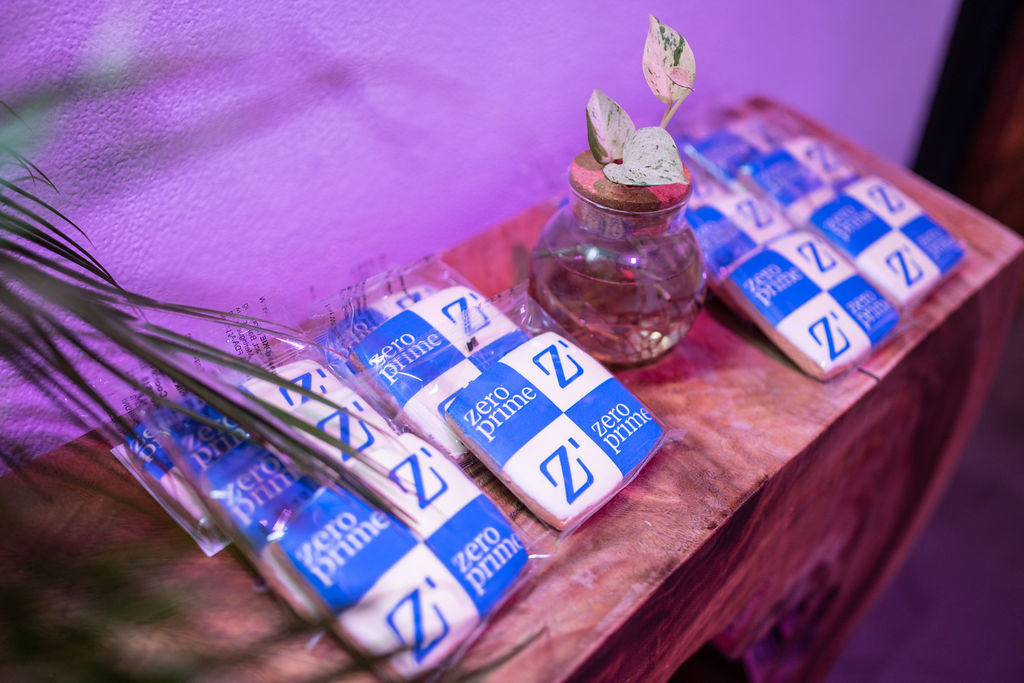
Last night at 111 Minna (an SF classic) w/ the @AICouncilConf speakers off the clock 📷.
Day 02, let's go.

1
5
275
Pete Soderling retweeted
Last year i brewed coffee during my talk at AI council; this year i'll be forcing speakers in my track to shoot espresso before they speak

will be talking about how we built our inference engine tomorrow. so i have to fix my sleep schedule by then
3
7
833
Pete Soderling retweeted

May 10
Over the weekend, I reviewed slide decks from all the speakers in the Databases and Data Engineering track at the @AICouncilConf . The talks are incredibly strong across a wide range of topics — transactional, analytical, search, vector databases; ETL/CDC; real-world case studies at massive scale, all with a forward-looking perspective on the critical role of Data Infra in supporting AI.
I’m so excited about this track and expecting it to be absolutely epic!!
Huge thanks to all the speakers for being an integral part of it and helping make it happen Hannes Mühleisen from @duckdblabs , @nikhilbenesch from @turbopuffer , @J_ and Pierre Lacave from @datadoghq, @iskakaushik from @ClickHouseDB , @kelvich from @databricks , Bhargavi Reddy Dokuru from @netflix , Robin Tang from @artie_labs 🙏
The track is on on May 12 (Day 1), starting at 10 AM, don’t miss it if you’re attending AI Council.
@petesoder @ZeroPrimeVC
1
3
23
2,099
May 7
Most teams building AI agents are reaching for bigger context windows. @thesephist thinks they're solving the wrong problem.
Hear more from Linus, Head of AI at @thrivecapital, at @AICouncilConf next week — and get a preview in our Q&A here:
petesoder.substack.com/p/lin…
11
7,854
May 6
"Most importantly, how are we going to [build AI] in a responsible way?" — @EnoReyes, CEO of @FactoryAI
That's the importance of getting world-class builders in the same room. See you all next week.
aicouncil.com/sf-2026
5
311
May 5
A lot of AI observability tools are fantastic as long as the security team never logs in. With @honeyhiveai v2 (announced today!) you can keep full raw traces inside your own environment and still look your CISO in the eye.
@mohak__sharma, @ds3638 and team have rebuilt HoneyHive so raw agent traces stay in a customer‑controlled data plane and evaluators execute on that data, w/ the control plane pared back to metadata & RBAC/rollout aligned to how big orgs divide teams and workloads.
It’s an important building block for running AI agents as first‑class auditable production systems in large, regulated enterprises. Congrats to the HoneyHive team on v2 - and see you next week at @AICouncilConf!
More on HoneyHive v2 from CEO Mohak, rolling out to users the next few weeks: honeyhive.ai/post/introducin…
2
3
348
May 1
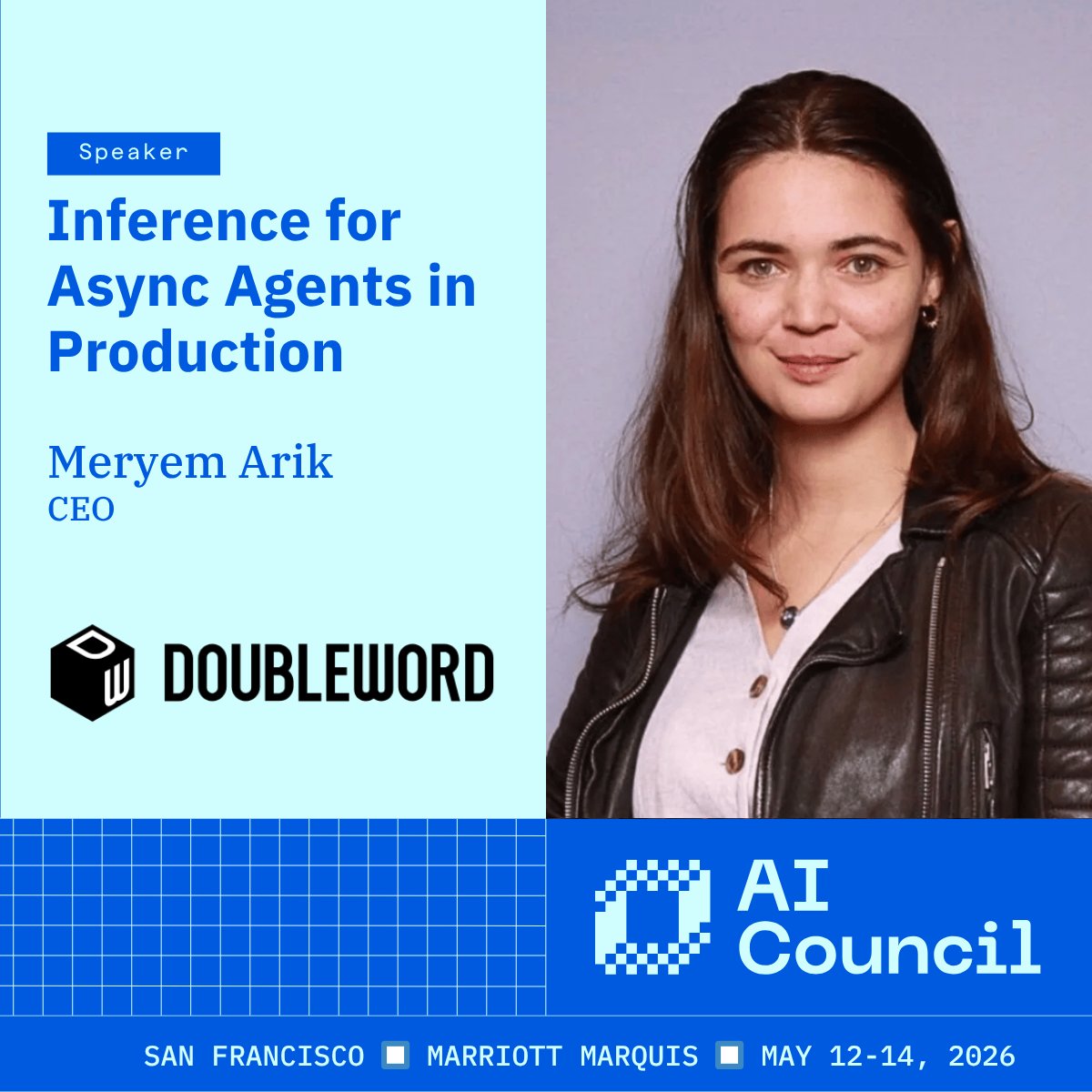
1 billion tokens in, 1 billion tokens out. Opus 4.6 runs you about $30,000, real-time. DeepSeek‑V4‑Pro async on @Doubleword_ lands closer to $4,100.
Roughly the same intelligence, ~86% cheaper. That delta is what @MeryemArik9 has been building around.
Most inference stacks were designed for humans sitting and waiting on a response - ChatGPT, Claude, Perplexity, Cursor, Codex. Everything optimized for that near real-time loop, including the spinner verbs you read while you wait.
An async agent is a different pattern entirely. It chugs along for hours and nobody's watching. What matters is the total cost when the job finishes.
The teams not lighting cash on fire are getting deliberate about which tokens need a frontier model and an immediate response. Sometimes you pay for the realtime closed frontier reasoner. Sometimes the async open model gets you there just fine.
This is the territory Meryem is covering at AI Council - long-running async agents that don't torch your token budget.
Her talk will cover strategies builders can use to maximize async agent performance while keeping inference costs under control, covering context engineering, compaction, cache maintenance, model routing and batch inference.
Highly relevant for builders.
@AICouncilConf 2026. May 12–14. See you in SF!
2
4
450
Apr 29
Earlier this month, a 30-person US open-source startup shipped a 400B-parameter Mixture-of-Experts reasoning model for long-horizon agents.
The model is Trinity-Large-Thinking from Arcee AI, built on Trinity Large, one of the most ambitious open foundation models ever trained from scratch by a US team. Its predecessor, Trinity-Large-Preview, is already one of the most-used open-weight models on OpenRouter.
OpenRouter, where Trinity has been racking up that traffic, is the unified API for hundreds of open and closed models. The inference runs on platforms like Fireworks AI, which serves open-weight and fine-tuned models to Cursor, Notion, DoorDash, and Uber. On top, you get applications like Kilo Code, the fastest-growing open-source coding agent. Four companies, four layers of the open stack — model, routing, inference, agent.
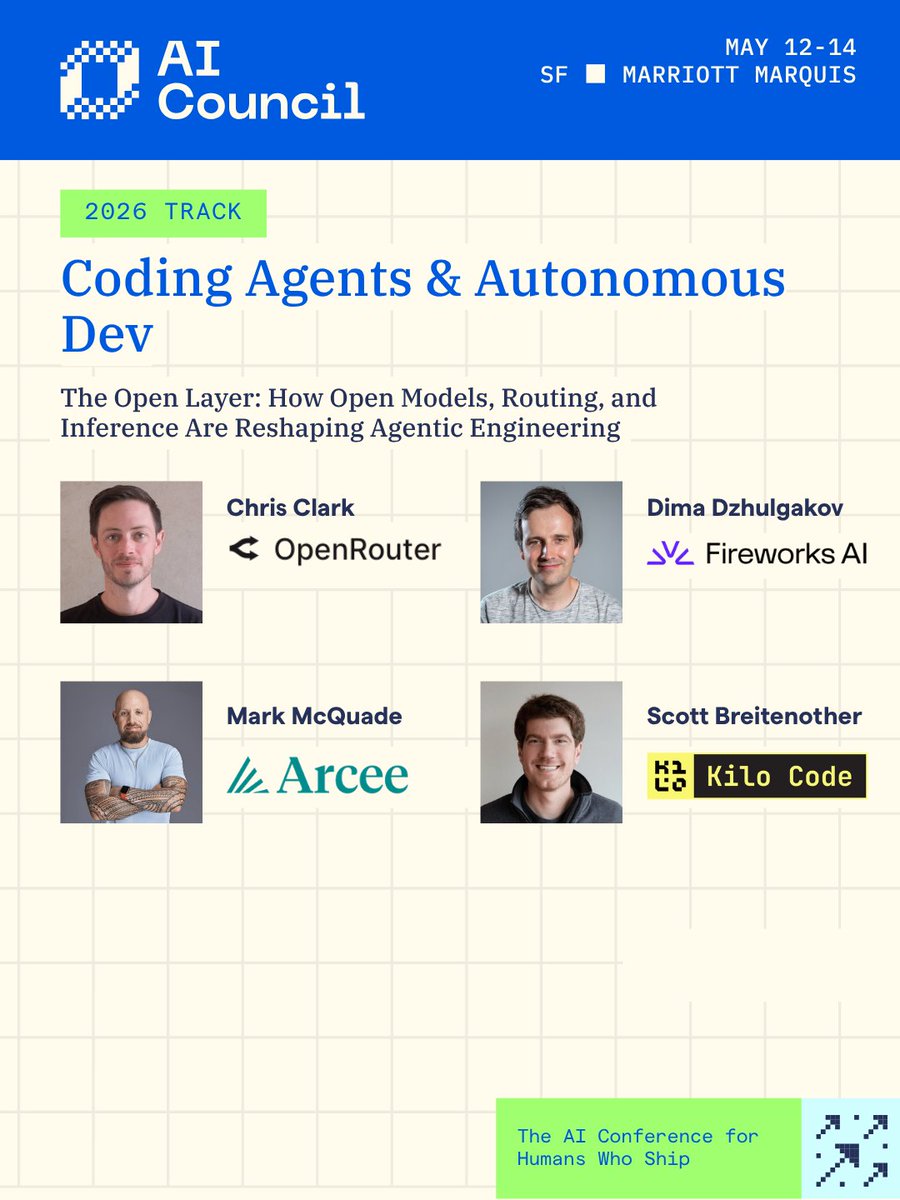
We've invited all four founders on stage at @AICouncilConf this year to talk about this "open layer."
Their upcoming talk, "The Open Layer: How Open Models, Routing, and Inference Are Reshaping Agentic Engineering," gets into what "open" actually means in 2026 (and where it falls short), when open-weight models win (and when they don't), and what it really takes to keep always-on agents reliable on this stack.
On stage:
@MarkMcQuade, Founder & CEO — @arcee_ai
@cclark, Co-Founder & COO — @OpenRouter
@dzhulgakov, Co-Founder & CTO — @FireworksAI_HQ
@s_breitenother, Co-Founder & CEO — @kilocode
Four exceptional founders on one stage. Looking forward to this discussion!
May 12–14, SF.
aicouncil.com/sf-2026
1
6
576
Apr 28
One of my favorite things about running @AICouncilConf for eleven years? The founders.
There's a secret "track" that's not on the schedule — an invisible hallway of builders. And the next wave is showing up at SF 2026: 🧵
@EnoReyes of @FactoryAI
@vikhyatk of @moondreamai
@ds3638 of @honeyhiveai
Emilie Schario of @kilocode
@ianlivingstone of @KeycardLabs
@neilmovva of @sailresearchco
@CompleteSkeptic of @typesafeai
@HessianFree of @PrismML
@latkins of @arcee_ai
Iona Hreninciuc of @runware
petesoder.substack.com/publi…
4
16
2,156
Apr 27
Meet @lloydtabb. Bike mechanic, co-creator of Malloy, founder and former CTO of Looker.
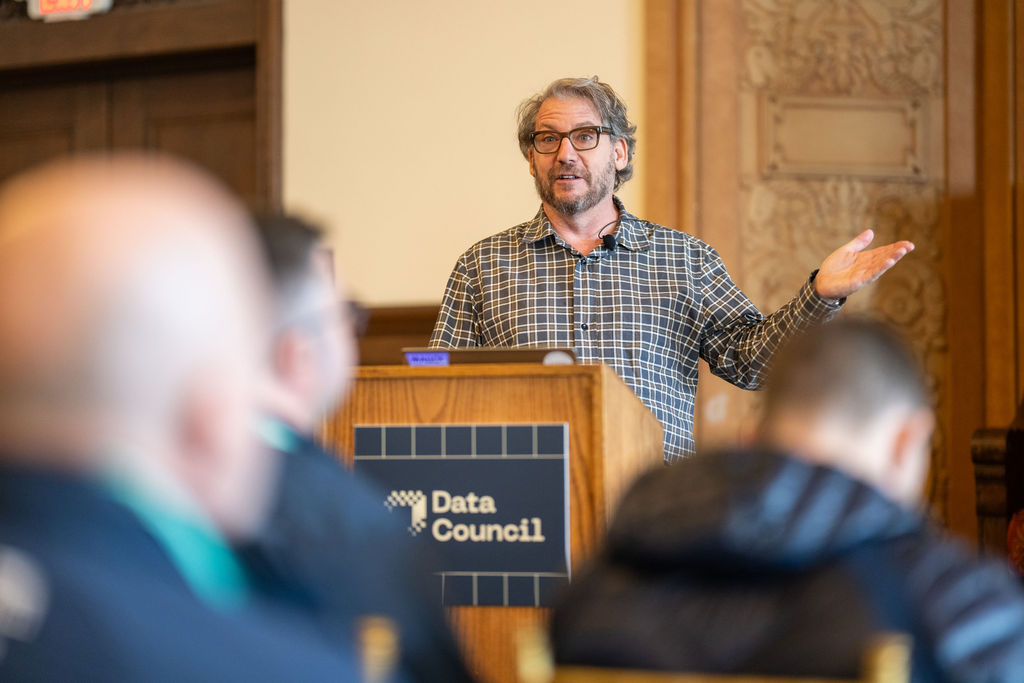
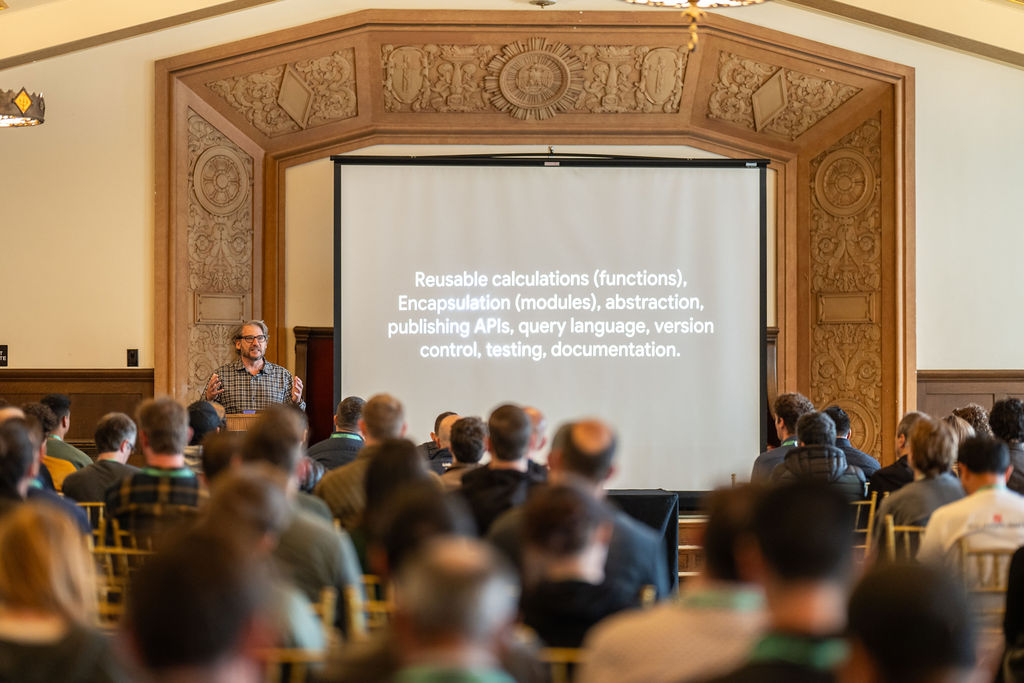
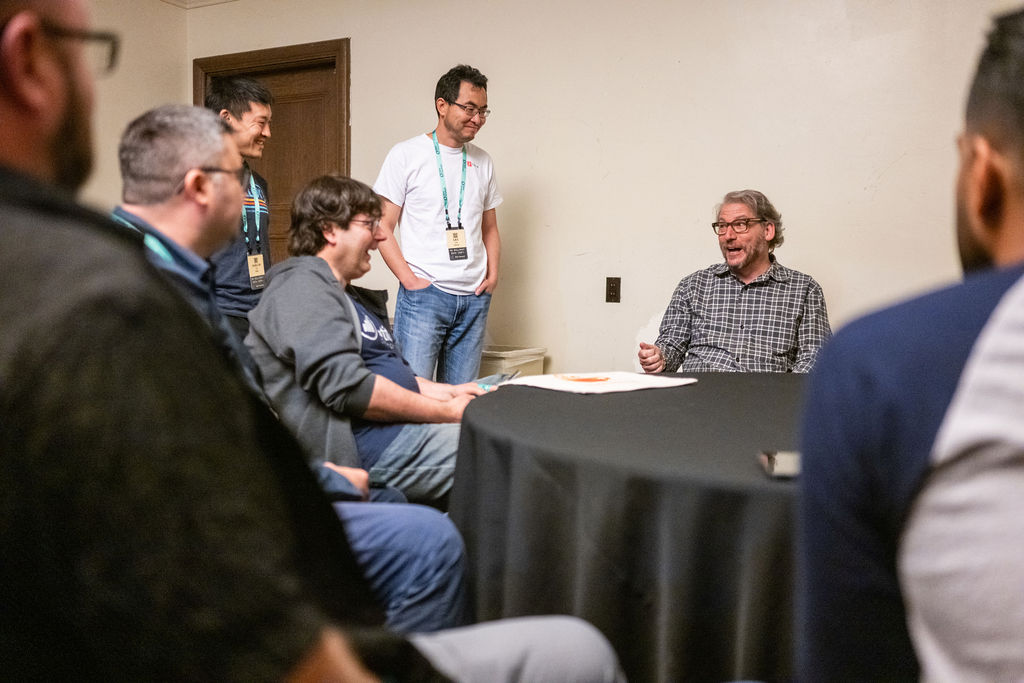
At last year’s AI Council (fka Data Council), you could listen to Lloyd demo Malloy while making the case that semantic modeling is what makes LLMs actually useful on top of your data. Then you’d stick around for Office Hours to ask him a question.
Every year, people tell me the speaker Office Hours is their favorite part of the conference. This year will be no different. It’s not often you can be in the same room with your AI & data heroes and the builders of your favorite tools for intimate, small-group chats.
The @AICouncilConf 2026 agenda is live. Pre-plan your must-see talks and Office Hours to get the most out of the conference: docs.google.com/document/d/1…
1
1
6
522
Apr 23
Talked to @changhiskhan of @lancedb and it's got me thinking:
Most of the current data stack was built for a human hitting "search" a few times a minute. Not for an agent firing a hundred queries in parallel and chaining them across a long reasoning path.
Curious what others are seeing. If you're running AI in production right now — what's breaking first? Throughput? Latency? The coordination tax between systems?
Full conversation from our sit-down ahead of @AICouncilConf:
open.substack.com/pub/peteso…
1
1
5
502
Apr 23
Engineers in the early days of DNS used to joke it stood for "Does Not Secure." Eventually DNSSEC arrived to harden DNS against spoofing and cache poisoning.
It's a reminder that every new layer of the internet goes through this same arc: something useful ships, everyone adopts it, attackers exploit the gaps, and the security rigor shows up later, after a few breaches force the issue.
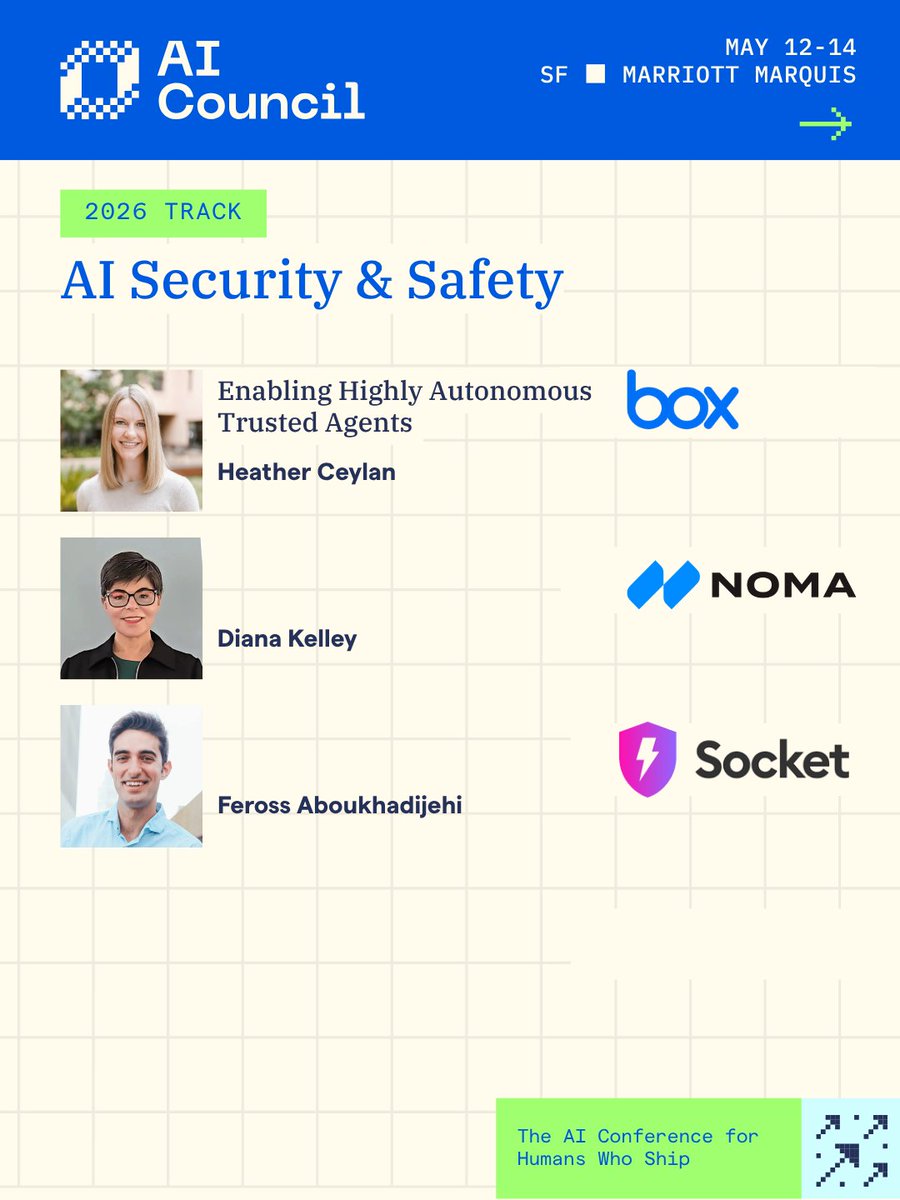
Agentic AI is squarely in that phase right now. Agents hold credentials, take actions across tools and data stores on our behalf, and consume untrusted inputs along the way. The equivalent of DNSSEC — a widely-adopted, well-understood set of controls for bounding that kind of trust — doesn't yet exist.
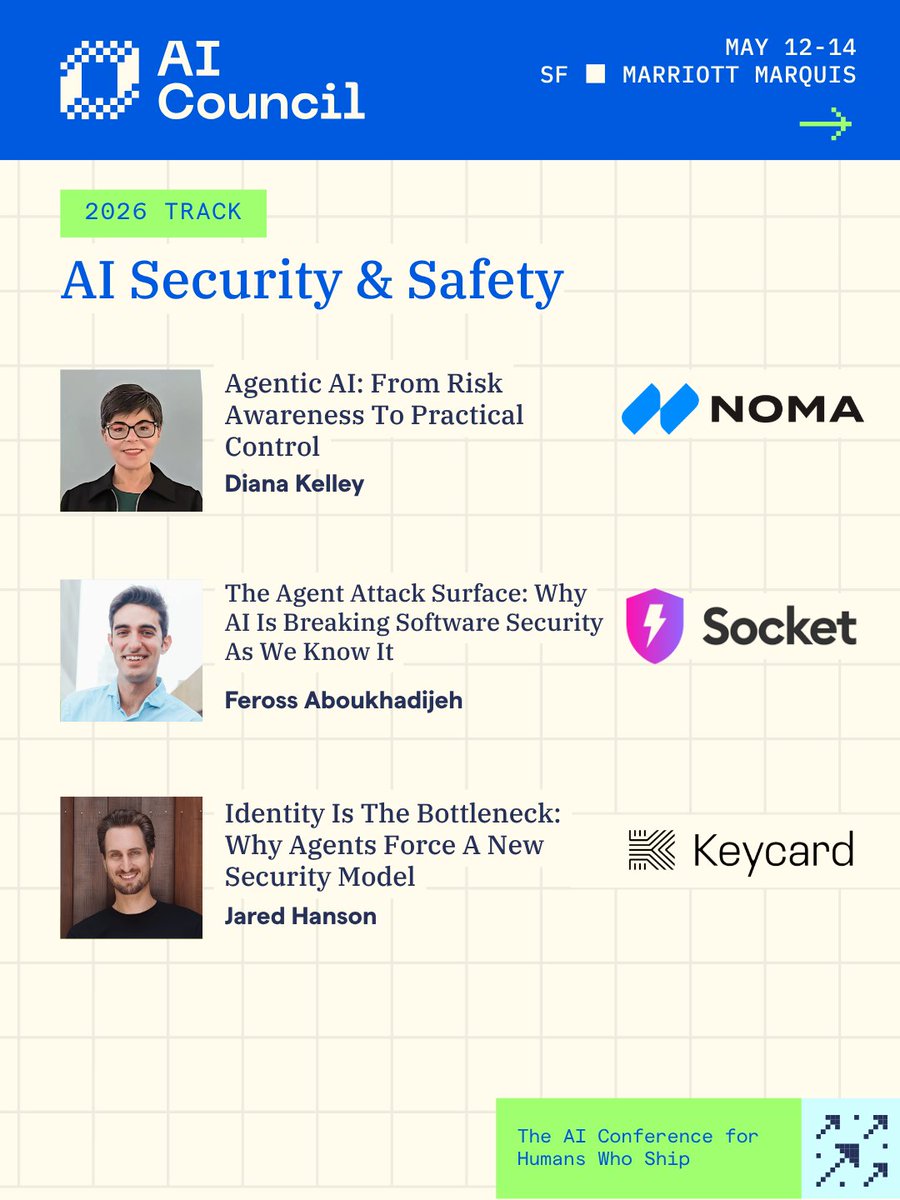
We built a dedicated AI Security & Safety track into AI Council 2026 to put the people doing that work into one room.
Diana Kelley is one of them. She's CISO at @NomaSecurity, and before Noma, held senior security roles at Microsoft, IBM, and Symantec. She's also in the Cybersecurity Hall of Fame (among many other honors), and co-wrote the book on cybersecurity architecture.
If you ship anything with agent access to production, her session — "Agentic AI: From Risk Awareness to Practical Control" — is one I'd make room for.
Excited for this track!
May 12–14, SF. aicouncil.com/sf-2026#ai-sec…
116
Apr 21
really proud to show up in lists like this with other high-quality peer funds 👊 doing god's work, most of the time in secret, with the occasional pop of recognition 😎 @alanaagoyal @mantisvc @AlexPallNY @GauravBhogale @atShruti @ileri @YTR4N_
Apr 21

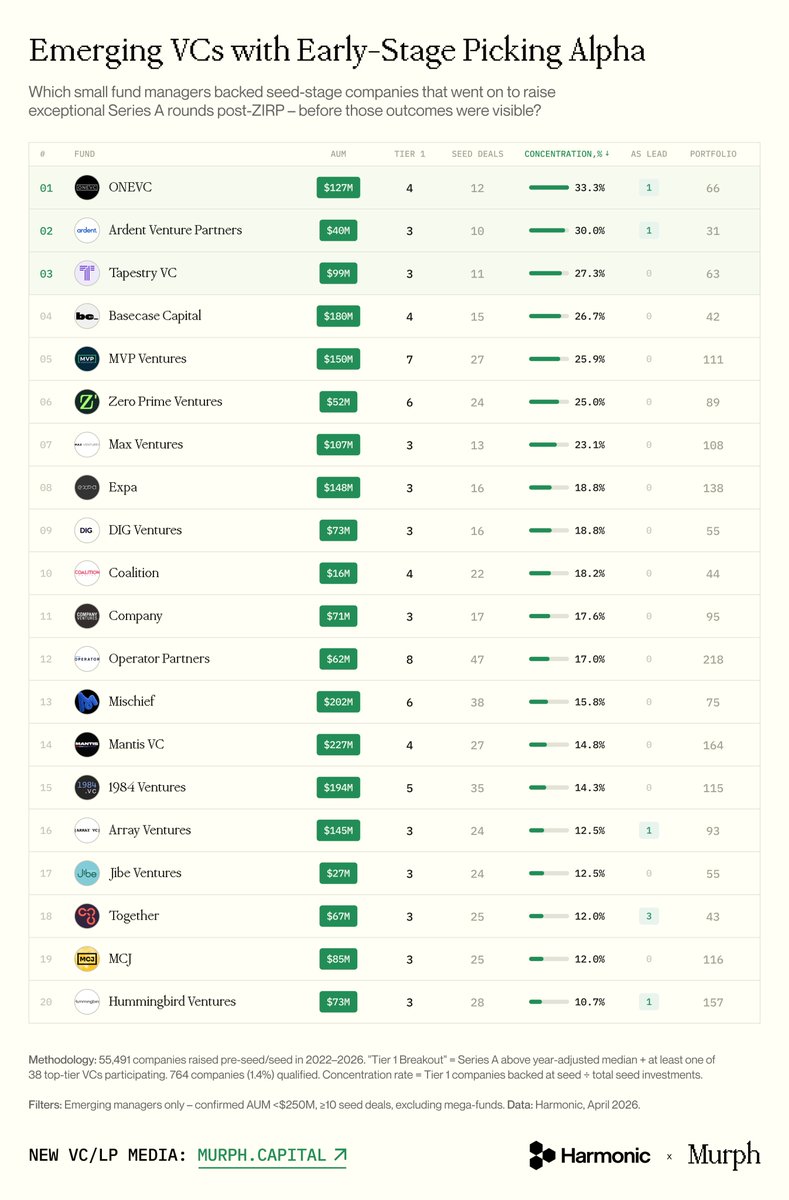
Which emerging VCs have the strongest early-stage picking alpha?
Standard emerging manager evaluation still leans heavily on qualitative signals – GP background, thesis articulation, founder references. All useful, but by the time TVPI and DPI tell you something meaningful, you're usually already in or already too late.
So I experimented with a quantitative framework to answer a core LP allocator question: which small, early-stage fund managers consistently back seed-stage companies that go on to raise exceptional Series A rounds – before those outcomes are visible to the broader market?
I started with @harmonic_ai Scout (my fav research tool!) and checked every company globally that raised a first pre-seed or seed round between 2022–2026 (Post-ZIRP). The funnel looks like this:
1/ 55,491 companies raised a pre-seed or seed round – the full opportunity set
2/ 4,368 (7.9%) went on to raise a Series A – the base rate, roughly 1 in 13
3/ 764 (1.4%) qualified as Tier 1 Breakouts – above-median Series A for their vintage year, with at least one top-tier institutional VC (from a defined set of 38 firms: @a16z, @sequoia, @lightspeedvp, @IndexVentures, and peers)
For each of those 1,604 companies, I traced back to every investor who backed them at pre-seed or seed — before the outcome was visible. 4,176 unique investors across the breakout set.
Then I computed a simple ratio for each: breakout companies backed at seed divided by total seed investments in the period. I'm calling this the "Tier 1 Concentration Rate".
After filtering out mega-platforms, accelerators, CVCs, and angels and requiring a minimum of 10 seed deals – 20 emerging managers (sub-$250M AUM) surfaced with notably high concentration rates.
A few things stood out:
1/ Several micro-funds under $100M were placing 25–35% of their seed bets into companies that later raised from @Sequoia, @a16z, @lightspeedvp – consistently, not as one-off flukes.
2/ Participant concentration and lead concentration are different signals. Participant = network and access. Lead = independent conviction before consensus forms. For LP diligence, these deserve to be evaluated separately.
3/ The data has real limitations: ~12% of breakout companies had no named seed investor in the database, we can't cleanly separate Fund I from Fund III for a given manager, and small sample sizes mean some high concentration rates likely reflect luck rather than repeatable skill.
But the core idea holds. "Tier 1 Concentration Rate" is an early, measurable signal of picking ability – observable years before fund-level metrics tell you anything.
For LP allocators evaluating Fund I–III managers, that timing gap is the whole problem. This is one attempt to close it.
What’s your take on this experiment?
2
8
841