
CEO @ Cresta.ai. x-googler / Co-founded: GCP Vertex AI; Google Contact Center AI;
Joined October 2008
- Tweets 1,863
- Following 1,043
- Followers 567
- Likes 8,435
14 Photos and videos







The biggest @cresta launch in a very long time: today we're introducing Cresta Conductor, an AI agent that builds customer-facing AI agents.
Most agent-building tools optimize for one thing: describe what you want, generate a first version. That's useful. But there's a world of difference between a demo prototype and a production agent you'd actually put in front of a customer.
Picture a real call. A traveler’s flight got canceled and they needed to rebook. Simple enough until they mention a $200 travel credit from their last trip, then ask whether flying a day earlier is cheaper and if a second bag is included. Getting this "mostly right" means a lost credit, a surprise fee at the gate, or a seat that was never actually held. That's a normal day in production.
Enterprise-grade agents that hold up in moments like this require deep business context, rigorous testing and evaluation, and continuous improvement from real customer interactions. Until now, much of that work has lived inside forward deployed engineering teams: heavy on domain expertise, heavy on manual effort.
Cresta Conductor changes that. It's a developer-native, natural-language environment that automates the full CX agent lifecycle: discovery, blueprinting, test case generation, evaluation, simulation, deployment, and continuous optimization.
What makes it different is what it's grounded in. Conductor uses the entire Cresta platform as its tools: conversation insights, topic discovery, knowledge, automation flows, and expert human agent calls. Each becomes a signal that guides the agent design process, so you start from real operating context, not a blank prompt.
Our goal in building Conductor is to democratize the expertise and design patterns that used to require a forward deployed engineer, and to dramatically accelerate how fast teams build and iterate. We've been running it internally for a while now, and it's cut our agent build times by more than half. Custom functions that took a week now take a day or two. And we are just scratching the surface of what is possible with a long list of ideas for improvement!
Learn more: cresta.com/blog/cresta-condu…
2
112
I'm proud to announce that @cresta is launching AI Agent Testing 2.0.
A key challenge in AI agent deployments is whether AI agents can be trusted to perform consistently in production, build a testing program rigorous enough to prove it, and maintain that same rigor as the AI agent evolves and scales.
Three places where most testing programs break down are:
- Defining what great looks like in _verifiable_ terms.
- Trusting that your evaluators grade correctly.
- Building coverage that reflects how customers actually behave in practice.
AI Agent Testing 2.0 hands the heavy lifting of testing and evaluation to AI, but keeps human experts in the loop at the most critical points of leverage:
- Requirements are automatically drafted from existing documentation, diagnosed for issues, and refined by domain experts. Those validated requirements become reusable evaluators, calibrated against labeled data so teams can consistently apply expert judgment at scale.
- Test cases generate automatically from production feedback, requirements violations, knowledge base, and the questions customers actually ask.
More than anything else, successfully scaling AI Agents will depend on how confidently organizations can evaluate, improve, and govern them over time.
That confidence is exactly what AI Agent Testing 2.0 delivers: cresta.com/blog/introducing-…
4
184
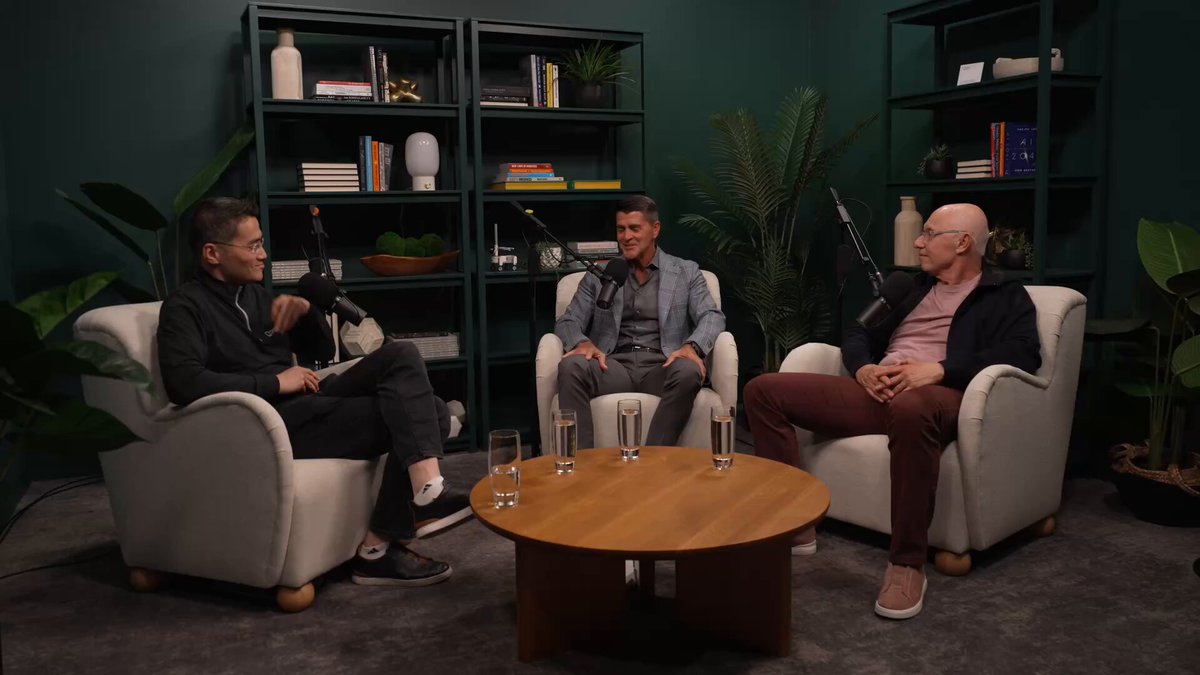
After @cresta hit $100M in ARR, I sat down with @dougleone and @carl_eschenbach of @sequoia to talk about the impact of customer experience AI on the enterprise, and what’s coming next.
The companies winning with AI aren't automating isolated touchpoints. They're transforming the entire customer experience with a unified context, where every interaction makes the entire system (AI, humans, and the business processes) smarter.
Check out our discussion below.
2
96
This is the day I have been looking forward to since I started working on Customer Experience AI almost a decade ago. @cresta has launched Synthetic Customers: realistic, representative customer personas derived directly from an enterprise’s own conversation data.
Every call, chat, email and review contains signals about what customers need, how they behave under pressure, what drives escalation, and what leads to successful outcomes. Synthetic Customers put all of that data to work to help you understand your customers better than ever before.
Synthetic Customers solve multiple problems in the CX AI stack: validate AI agents before deployment via simulation, train human agents with realistic practice conversations via role-play AI Coach Agents, simulate how customer groups may respond to business decisions, and uncover deeper behavioral insights.
Synthetic Customers are not generic personas or artificially constructed profiles. They are grounded in real conversations and organized around representative behavioral patterns observed across the customer base. As customer behavior changes over time, those models evolve alongside it.
Cresta customers can create their own personas by training them from any cluster of customer conversations.
This is a foundational shift in how enterprises understand, test, and prepare for customer interactions. Any company with a continuously updated, evidence-based model of its customer base will make faster decisions, launch with greater confidence, and deliver better customer experiences across every channel.
Learn more: cresta.com/synthetic-custome…
2
33
ping_wu retweeted

May 16
Or go to the Presidio, jump in the ocean, get a coffee at The Mill, watch sunset at Twin Peaks, ride a bike anywhere, see live music, eat a burrito, take a grass nap in GG Park, have beer at The Page, watch the Bay Bridge lights, wander Chinatown, wander Ferry building, run across GG Bridge, walk Fort Funston, eat the best meal of your life with friends…drive any direction for 2hrs. And be deeply grateful for the heavenscape you live in.

The vibes in SF feel pretty frenetic right now. The divide in outcomes is the worst I've ever seen.
Over the last 5yrs, a group of ~10k people - employees at Anthropic, OpenAI, xAI, Nvidia, Meta TBD, founders - have hit retirement wealth of well above $20M (back of the envelope AI estimation).
Everyone outside that group feels like they can work their well-paying (but <$500k) job for their whole life and never get there.
Worse yet, layoffs are in full swing. Many software engineers feel like their life's skill is no longer useful. The day to day role of most jobs has changed overnight with AI.
As a result,
1. The corporate ladder looks like the wrong building to climb.
Everyone's trying to align with a new set of career "paths": should I be a founder? Is it too late to join Anthropic / OpenAI? should I get into AI? what company stock will 10x next? People are demanding higher salaries and switching jobs more and more.
2. There’s a deep malaise about work (and its future).
Why even work at all for “peanuts”? Will my job even exist in a few years? Many feel helpless. You hear the “permanent underclass” conversation a lot, esp from young people. It's hard to focus on doing good work when you think "man, if I joined Anthropic 2yrs ago, I could retire"
3. The mid to late middle managers feel paralyzed.
Many have families and don't feel like they have the energy or network to just "start a company". They don't particularly have any AI skills. They see the writing on the wall: middle management is being hollowed out in many companies.
4. The rich aren’t particularly happy either.
No one is shedding tears for them (and rightfully so). But those who have "made it" experience a profound lack of purpose too. Some have gone from <$150k to >$50M in a few years with no ramp. It flips your life plans upside down. For some, comparison is the thief of joy. For some, they escape to NYC to "live life". For others still, they start companies "just cuz", often to win status points. They never imagined that by age 30, they'd be set. I once asked a post-economic founder friend why they didn't just sell the co and they said "and do what? right now, everyone wants to talk to me. if i sell, I will only have money."
I understand that many reading this scoff at the champagne problems of the valley. Society is warped in this tech bubble. What is often well-off anywhere else in the world is bang average here.
Unlike many other places, tenure, intelligence and hard work can be loosely correlated with outcomes in the Bay. Living through a societally transformative gold rush in that environment can be paralyzing. "Am I in the right place? Should I move? Is there time still left? Am I gonna make it?" It psychologically torments many who have moved here in search of "success".
Ironically, a frequent side effect of this torment is to spin up the very products making everyone rich in hopes that you too can vibecode your path to economic enlightenment.
83
200
4,116
287,222
ping_wu retweeted

It’s time to return to the place where I know I can have the most impact. I am beyond excited to be rejoining @sequoia as a Partner. Here is what I shared with @gradypb @alfred_lin on how I am approaching my next chapter.
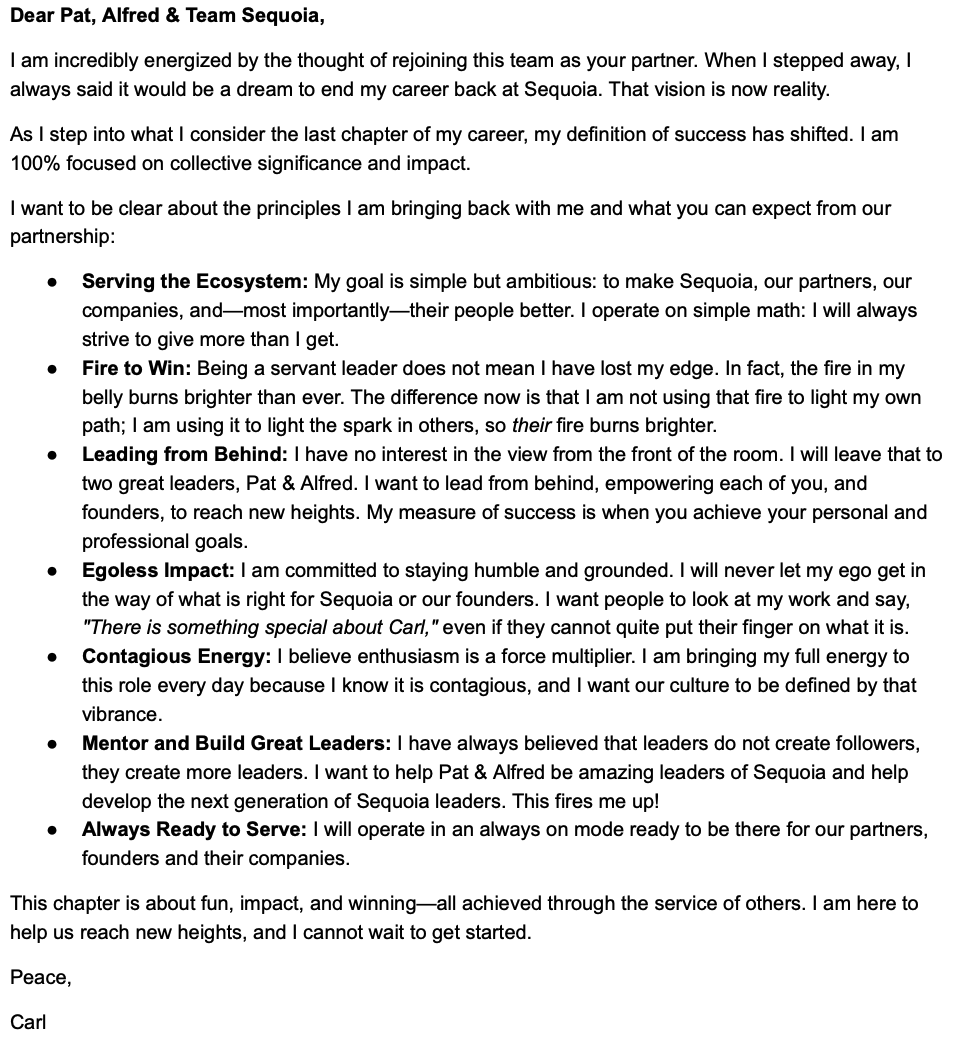
52
28
441
169,322
ping_wu retweeted

Jan 3
Men without degrees built this.

550
2,321
20,626
375,569
ping_wu retweeted

28 Dec 2025
David Friedberg reply set to music.
Reply transformation to lyrics by Claude Opus 4.5.
Music by Suno v5.
65
95
1,254
68,186
ping_wu retweeted

21 Dec 2025
Can I please have this job
154
606
8,242
376,194
ping_wu retweeted

16 Dec 2025
Last Uncapped episode of the year, feeling really grateful for what a fun project this has turned out to be.
Closing out the year with one of my best friends @saammotamedi. Although I don't like to admit it to him, he's a remarkable investor and person.
Greylock has been producing amazing returns for sixty years and I tried to stay serious for long enough stretches of time during this episode to hear some of Saam's insights about how it works. Hope you enjoy.
(0:00) Intro
(1:32) Greylock turning 60 this year
(4:11) What’s persisted since 1965
(8:59) Apprenticeship
(11:34) What's durable in venture
(16:29) Greylock’s ethos
(19:33) Incentive misalignments
(24:44) Breadth vs depth in venture
(29:28) Managing the team on inputs
(34:00) Why incubations are so hard
(43:22) Finding alpha
(52:38) Greylock’s approach to portfolio services
(59:18) Assessing wild revenue ramps
(1:08:10) Horizontal vs vertical SaaS
(1:11:34) Friendships and work
(1:16:26) Saam's biological age 😂
20
40
187
255,515

if they ever release old google TGIF’s of larry & sergey, the world would know how fucking hilarious these two dudes were up there every damn friday.
it was like watching a live comedy show all while knocking back few beers at charlie’s.
what a time that was. i don’t think many ppl grasped how unique it was to be a google employee back then.
30
12
550
54,502
ping_wu retweeted

23 Oct 2025
What a legend
23 Oct 2025

This newspaper delivery man from India has been perfecting his throw for 17 years — a true master of precision and dedication.
46
56
1,785
113,366

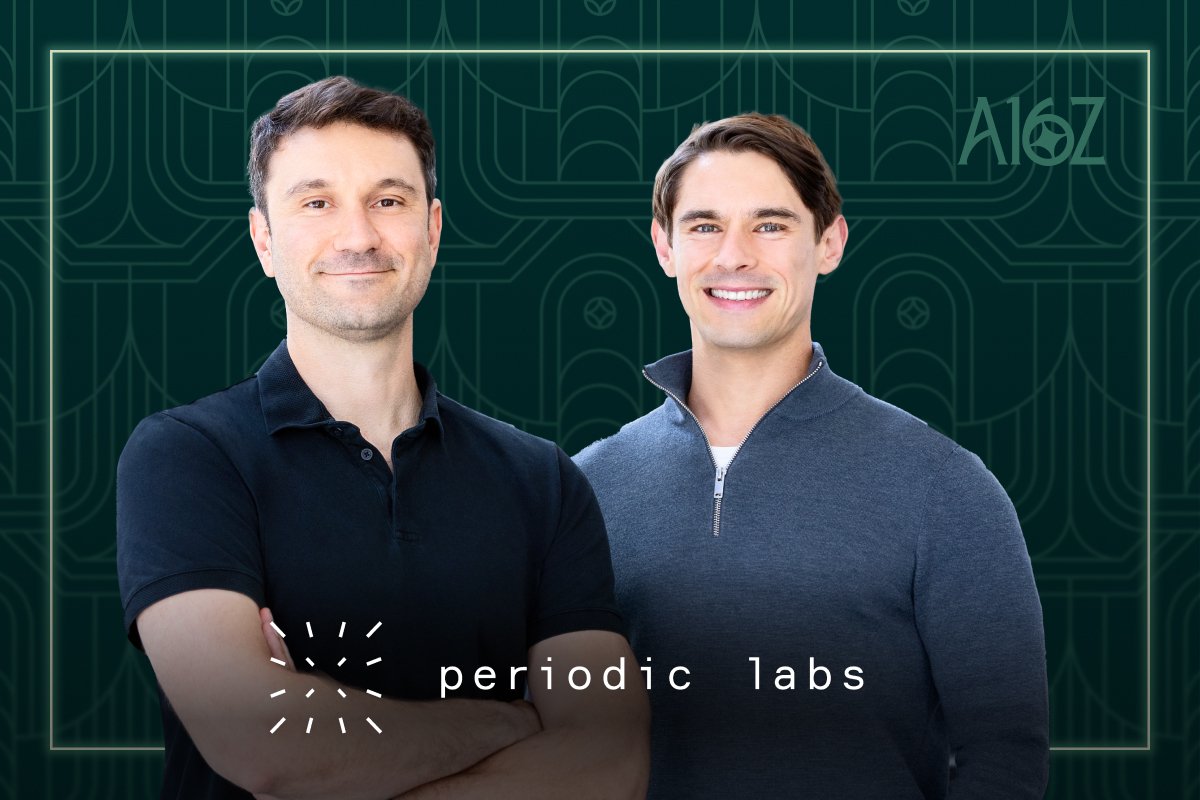
We’re leading a $300M founding round for @periodiclabs.
Science today is bottlenecked by slow, manual experimentation. Periodic is changing that. They’re building AI scientists paired with autonomous laboratories that can hypothesize, experiment, and iterate at speeds impossible for human-led labs.
Their first target: superconductors and semiconductors that could unlock breakthroughs in transportation, energy grids, and next-gen chips.
This is what happens when frontier AI meets the scientific method. Excited to partner with @LiamFedus @ekindogus and the team as they reimagine how science gets done.
30 Sep 2025

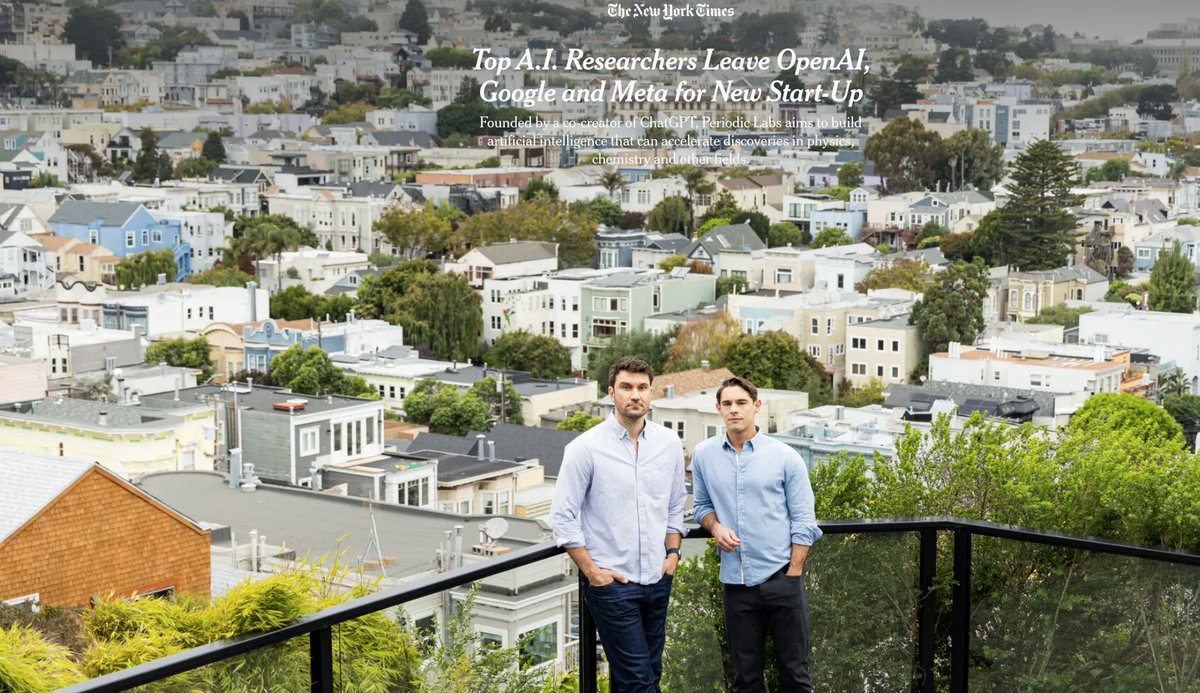
Today, @ekindogus and I are excited to introduce @periodiclabs.
Our goal is to create an AI scientist.
Science works by conjecturing how the world might be, running experiments, and learning from the results.
Intelligence is necessary, but not sufficient. New knowledge is created when ideas are found to be consistent with reality. And so, at Periodic, we are building AI scientists and the autonomous laboratories for them to operate.
Until now, scientific AI advances have come from models trained on the internet. But despite its vastness — it’s still finite (estimates are ~10T text tokens where one English word may be 1-2 tokens). And in recent years the best frontier AI models have fully exhausted it.
Researchers seek better use of this data, but as any scientist knows: though re-reading a textbook may give new insights, they eventually need to try their idea to see if it holds.
Autonomous labs are central to our strategy. They provide huge amounts of high-quality data (each experiment can produce GBs of data!) that exists nowhere else. They generate valuable negative results which are seldom published. But most importantly, they give our AI scientists the tools to act.
We’re starting in the physical sciences.
Technological progress is limited by our ability to design the physical world.
We’re starting here because experiments have high signal-to-noise and are (relatively) fast, physical simulations effectively model many systems, but more broadly, physics is a verifiable environment. AI has progressed fastest in domains with data and verifiable results - for example, in math and code. Here, nature is the RL environment.
One of our goals is to discover superconductors that work at higher temperatures than today's materials. Significant advances could help us create next-generation transportation and build power grids with minimal losses. But this is just one example — if we can automate materials design, we have the potential to accelerate Moore’s Law, space travel, and nuclear fusion.
We’re also working to deploy our solutions with industry. As an example, we're helping a semiconductor manufacturer that is facing issues with heat dissipation on their chips. We’re training custom agents for their engineers and researchers to make sense of their experimental data in order to iterate faster.
Our founding team co-created ChatGPT, DeepMind’s GNoME, OpenAI’s Operator (now Agent), the neural attention mechanism, MatterGen; have scaled autonomous physics labs; and have contributed to some of the most important materials discoveries of the last decade. We’ve come together to scale up and reimagine how science is done.
We’re fortunate to be backed by investors who share our vision, including @a16z who led our $300M round, as well as @Felicis, DST Global, NVentures (NVIDIA’s venture capital arm), @Accel and individuals including @JeffBezos , @eladgil , @ericschmidt, and @JeffDean. Their support will help us grow our team, scale our labs, and develop the first generation of AI scientists.
18
36
467
75,247
ping_wu retweeted

25 Jun 2025
YIPPIT JUST SHARED: $GOOGL GEMINI ADDED 13M USERS IN MAY -- OVER 2X CHATGPT’S GROWTH
69
119
1,211
149,537
ping_wu retweeted

19 Jun 2025
One of the most effective things the U.S. or any other nation can do to ensure its competitiveness in AI is to welcome high-skilled immigration and international students who have the potential to become high-skilled. For centuries, the U.S. has welcomed immigrants, and this helped make it a worldwide leader in technology. Letting immigrants and native-born Americans collaborate makes everyone better off. Reversing this stance would have a huge negative impact on U.S. technology development.
I was born in the UK and came to the U.S. on an F-1 student visa as a relatively unskilled and clueless teenager to attend college. Fortunately I gained skills and became less clueless over time. After completing my graduate studies, I started working at Stanford under the OPT (Optional Practical Training) program, and later an H-1B visa, and ended up staying here. Many other immigrants have followed similar paths to contribute to the U.S.
I am very concerned that making visas harder to obtain for students and high-skilled workers, such as the pause in new visa interviews that started last month and a newly chaotic process of visa cancellations, will hurt our ability to attract great students and workers. In addition, many international students without substantial means count on being able to work under OPT to pay off the high cost of a U.S. college degree. Gutting the OPT program, as has been proposed, would both hurt many international students’ ability to study here and deprive U.S. businesses of great talent. (This won’t stop students from wealthy families. But the U.S. should try to attract the best talent without regard to wealth.)
Failure to attract promising students and high-skilled workers would have a huge negative impact on American competitiveness in AI. Indeed, a recent report by the National Security Commission on Artificial Intelligence exhorts the government to “strengthen AI talent through immigration.”
If talented people do not come to the U.S., will they have an equal impact on global AI development just working somewhere else? Unfortunately, the net impact will be negative. The U.S. has a number of tech hubs including Silicon Valley, Seattle, New York, Boston/Cambridge, Los Angeles, Pittsburgh and Austin, and these hubs concentrate talent and foster innovation. (This is why cities, where people can more easily find each other and collaborate, promote innovation.) Making it harder for AI talent to find each other and collaborate will slow down innovation, and it will take time for new hubs to become as advanced.
Nonetheless, other nations are working hard to attract immigrants who can drive innovation — a good move for them! Many have thoughtful programs to attract AI and other talent. There are the UK’s Global Talent Visa, France’s French Tech Visa, Australia’s Global Talent Visa, the UAE’s Golden Visa, Taiwan’s Employment Gold Card, China’s Thousand Talents Plan, and many more. The U.S. is fortunate that many people already want to come here to study and work. Squandering that advantage would be a huge unforced error.
Beyond the matter of national competitiveness, there is the even more important ethical matter of making sure people are treated decently. I have spoken with international students who are terrified that their visas may be canceled arbitrarily. One recently agonized about whether to attend an international conference to present a research paper, because they were worried about being unable to return. In the end, with great sadness, they cancelled their trip. I also spoke with a highly skilled technologist who is in the U.S. on an H-1B visa. Their company shut down, leading them — after over a decade in this country, and with few ties to their nation of origin — scrambling to find alternative employment that would enable them to stay.
These stories, and many far worse, are heartbreaking. While I do what I can to help individuals I know personally, it is tragic that we are creating such an uncertain environment for immigrants, that many people who have extraordinary skills and talents will no longer want to come here.
To every immigrant or migrant in the U.S. who is concerned about the current national environment: I see you and empathize with your worries. As an immigrant myself, I will be fighting to protect everyone’s dignity and right to due process, and to encourage legal immigration, which makes both the U.S. and individuals much better off.
[Full text, with links: deeplearning.ai/the-batch/is… ]
298
321
2,057
524,450
ping_wu retweeted

30 Apr 2025
Giannis has multiple all-time great press-conference answers on his resume. Add this to the list after he was asked about Tyrese Haliburton's father taunting him on the court.
257
1,354
12,971
1,055,756
ping_wu retweeted

3 Apr 2025
Skydiver Luigi Cani dispersing 100 Million tree seeds to revive the Amazon Rainforest.
157
293
4,159
1,011,185
It is not just about the models.
When talking about AI products, the spotlight tends to focus on latest AI model performance against benchmarks. As a subscriber to every major AI assistant on the market, I have been thinking about what really drives the long-term advantage in this space. Here are a few thoughts:
■ Scale Economics
By aggregating potentially billions of subscribers, leaders in consumer ai assistant will have unit economics others cannot match.
◆ Model: amortization of model cost (training and r&d) over a much larger subscriber base.
◆ Compute: more subscribers means better compute resource utilization. Different ways to optimize through the entire stack from batching & caching, to customized chips and owning and operating entire data centers.
◆ Data: favorable unit economics to acquire proprietary IP and data. Data flywheel from more subscribers, especially valuable for long tail subjects and intent.
■ Switching cost
◆ Memory: every token (words, photos, files, etc) into the ai assistant helps build the memory that will make future performance more personal.
◆ Accounts (payment, log-in): as the assistant starts doing things (like Manus), AI assistants will control the browser, sign into websites with user’s credentials and make payments in the future.That’s real switching friction.
■ Network effects:
It is not clear yet how specific network effects are for AI assistants.
In some sense, classic search engine business is a two sided marketplace with traffic and advertisers. For AI assistants, my bet will be from connectors/plug-ins for it to link to commerce directly.
■ “Death star in striking distance”
John Malone referred to Amazon Prime as “the death star in striking distance to every direct-to-consumer company on the planet”. Similarly, I think the winning consumer AI assistant will suck in more and more consumer AI features into its input box.
■ Shipping the org chart → One click is too far
Paradigm shift like AI creates windows of opportunity for startups to get distribution before incumbents get innovation.
However, as shown again and again in history, organizational complexity will inevitably impact the user experience often in the negative way, because, at the end of the day, users do not write performance reviews.
1
112