
Lead Web 3 Engineer | Devrel | Podcaster | @web3wikixyz, @coverantxyz | @Moca_Network | Advisor | Army Veteran | Man on many missions
Joined October 2021
- Tweets 11,822
- Following 926
- Followers 1,303
- Likes 12,638
419 Photos and videos





14h
Probably the most hilarious part of the whole story

JUST IN: Andrej Karpathy, a top AI scientist at Anthropic, is reportedly barred from accessing the company’s most advanced AI model because he is not a U.S. citizen.

26
Jun 13
Nooooooooooo
Jun 13

The US government, citing national security authorities, has issued an export control directive to suspend all access to Fable 5 and Mythos 5 by any foreign national, whether inside or outside the United States, including foreign national Anthropic employees.
The net effect of this order is that we must abruptly disable Fable 5 and Mythos 5 for all our customers to ensure compliance.
Access to all other Claude models is not affected.
We apologize for this disruption to our customers. We believe this is a misunderstanding and are working to restore access as soon as possible.
Read our full statement: anthropic.com/news/fable-myt…
2
35
Jun 9
Honored to contribute to @Futurist_conf event this July to talk about identity, loyalty and scaling web3.

Newly added speakers this week 🚀
▪️Ingamar Ramirez, @Starknet
▪️@provenauthority, @billions_ntwk
▪️Christian Lewe, @AlpenLabs
▪️@primarchdev, @animocabrands
▪️Samuel Jacques-Cloutier, Hash Directors
▪️@G_Antoniello, @SafeBetsWorld
▪️Kay Chua Ginsburg, @NdeipiCoin
▪️Michael Bacina, @NXT_LAW
▪️Gregory Joseph Caturay, Gatsby Gold
Come hear them July 21-22 in Toronto, Canada!
Covering crypto, AI, finance, and more.

5
92
Jun 5
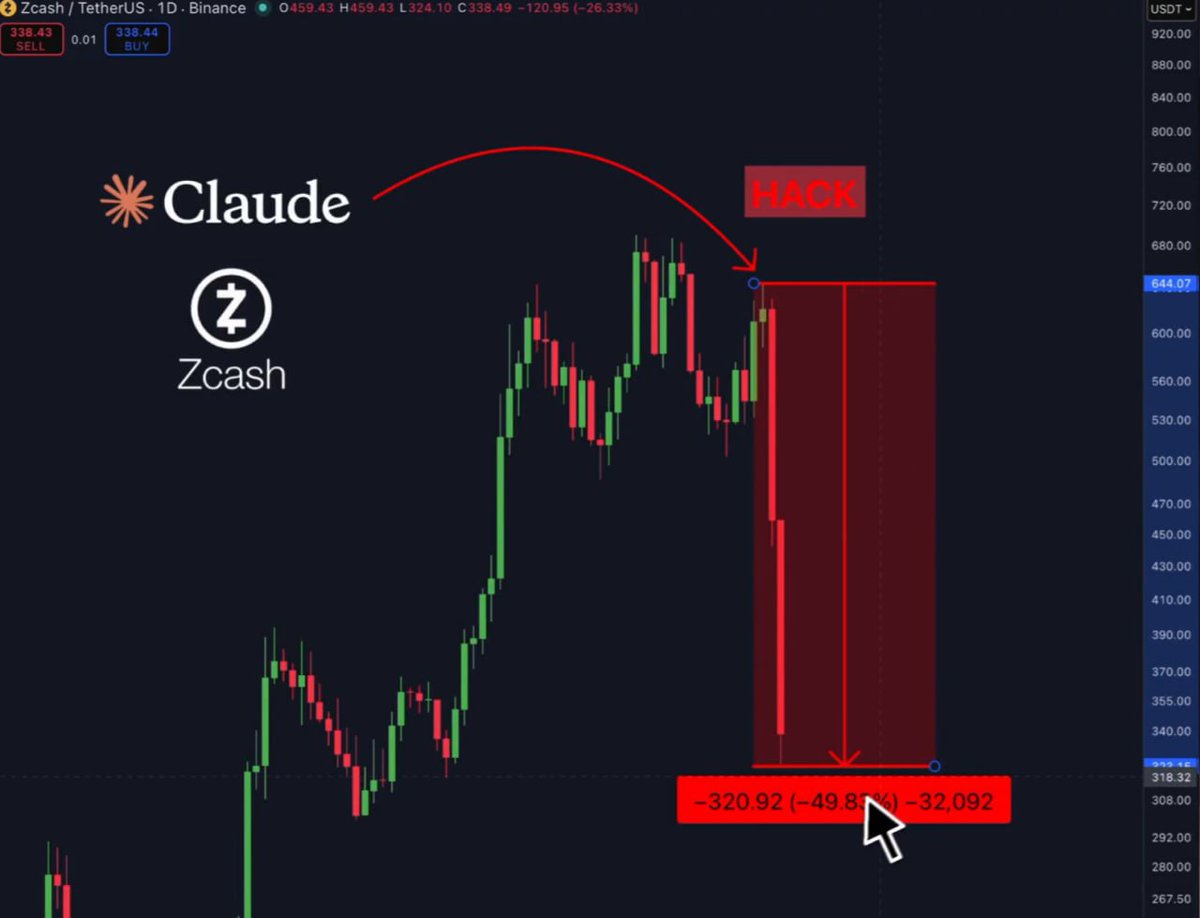
zcash:native crashed over 50% after a critical privacy bug went public 🚨
Market dumped Zcash after researchers revealed a flaw inside the Orchard shielded pool – the privacy layer that has been live since 2022.
The scary part: the bug could have allowed counterfeit ZEC to be created in a test environment. It was found with help from Claude Opus 4.8 and patched through an emergency upgrade.
But the patch is not the real problem.
The real problem is trust.
- With Bitcoin, anyone can audit the supply on-chain.
- With Zcash, the same privacy that hides balances also makes it much harder to prove whether fake coins were ever minted before the fix.
The team says there is no evidence of fake ZEC being minted. But the trust is already gone
1
5
129
Arman retweeted

Jun 2
Today a crazy quantum story just got wilder.
On March 31, the Google Quantum AI team published a landmark result on Shor's algorithm for elliptic curve cryptography. Technically, the paper was a bombshell: a dramatic 10x improvement over the state-of-the-art. As a stunt and wakeup call to the blockchain space, those optimisations were illustrated on secp256k1, the elliptic curve underlying Bitcoin and Ethereum signatures.
But perhaps the most striking part of the paper was sociological, not technical. Instead of following standard academic process, the optimisations were kept secret, hidden behind a zero-knowledge (ZK) proof. Google's accompanying blog post mentions they "engaged with the U.S. government". The ZK proof demonstrates the existence of algorithmic improvements without leaking details. Academic censorship with ZK, a historic first!
As a co-author of the Google paper I witnessed some of the context surrounding this censorship. To be honest, multiple aspects of that context don't sit well with me. As much as I believe the general public ought to know more, I am limited in my ability to whistleblow. Though let me be clear about one thing: the Google team's professionalism has been absolutely exemplary, and they deserve nothing but praise.
Censorship has a way of backfiring. The Streisand effect, where an attempt to bury something only draws more attention to it, is exactly what's unfolding today. First, Google's key optimisation has been rediscovered by the French. And in a thrilling turn of events, a collaborative Shor-at-home challenge just launched. The initiative, available at ecdsa[.]fail, breached a new Shor world record in a matter of hours.
Let's start with the rediscovery. Just two months after Google's paper, French quantum expert André Schrottenloher cracks the main secret optimisation. His paper, titled "Optimized Point Addition Circuits for Elliptic Curve Discrete Logarithms", landed on the arXiv today. Big congrats to André, who beat several other nerdsnipped experts to it. In a blog post also published today, Craig Gidney, the world expert on Shor optimisations, revealed that he'd been sitting on this very optimisation for a whole year under censorship pressure.
Interestingly, André missed a handful of minor optimisations, both from Google's original publication and from improvements found since. It's plausible there's still plenty of juice left to squeeze out of Shor, and this is exactly what the ecdsa[.]fail challenge is about. The verifier program developed for the ZK proof does double duty, automatically filtering for valid submissions. Dozens of compounding small and micro improvements are rolling in. As of the time of writing there's an 8.4% improvement to Google's circuit, as measured by the product of logical qubit count and Toffoli gate count. Nice!
The nerdsnipping ran deeper than anyone expected. Over the last few weeks it became clear it extended well beyond André and other quantum experts. Behind the scenes, a small army of amateurs quietly got to work. Inspired by Karpathy-style autoresearch, they turned AI on Shor. Ironically, the verifier program for the ZK proof makes an ideal reward function for AIs. The barrier to entry for this modern style of research is refreshingly low, with several non-experts, even a teenager, finding nice optimisations. Get in touch if you'd like to join a Telegram group with fellow autoresearchers :)
Part 2: neutral atoms and qday
The story doesn't end with Google. On the same day Google went public, a stealthy startup called Oratomic published its own Shor paper in a coordinated release. It made a splash, ultimately becoming the most upvoted paper on scirate[.]com, a website ranking arXiv papers.
Oratomic's claim was wild. By building on Google's logical optimisations and applying custom physical optimisations for neutral atoms, they claimed just 10K physical qubits were sufficient to run Shor's algorithm on secp256k1. That number is mind-bogglingly low.
Knowing essentially nothing about neutral atoms when Oratomic's paper landed, I was intrigued and decided to learn more about the tech. I fell straight down the rabbit hole and spent a couple hundred hours on the topic. I got a little obsessed and watched every YouTube video I could find and spoke to a bunch of experts.
My conclusion? The tech is real, very real. Even Google recently decided to start a neutral atom lab, a notable pivot from their sole focus on superconducting qubits. If you care about qday, i.e. the day a quantum computer will break the first piece of cryptography in production, neutral atoms demand your attention. I shared some of my learnings on Shor and neutral atoms in a 30min talk at the ZKProof cryptography conference. You can find it on YouTube by searching "zkproof neutral atom".
Here's an interesting observation about this duo of breakthrough papers: neither Google nor Oratomic say a word about what their results mean for qday. No timelines. Zero. Nada. That is especially baffling given that the whole point of whitehat quantum cryptanalysis is to inform qday estimations and help the general public make good decisions.
So let me attempt to partially fill the silence, similarly to what Scott Aaronson did in his April 29 post. Given everything I know, including scary non-public information, I now put the odds of qday by 2032 at 50%. 10% by 2030.
Anecdotally, the US government has its own date: 2035. Originating at the NSA and later adopted by NIST, it's when branches of the US government will be disallowed from using quantum-vulnerable cryptography. In plain language: with hindsight, that date is a joke and should be discounted entirely. I don't see how NIST avoids being forced to pull it forward by years.
Part 3: post-quantum cryptography
There are good reasons to sound the alarm today, but please do not panic. Rushing carelessly towards immature post-quantum cryptography is a recipe for disaster. IMO a good target date for migration is 2029, roughly 3.5 years out. 2029 happens to be the date selected by Google, Cloudflare, and the Ethereum Foundation.
These days most of my time goes to safely migrating Ethereum towards post-quantum cryptography as part of the broader lean Ethereum effort. There's a lot to do. We need to rip out and replace BLS signatures at the consensus layer, KZG commitments at the data layer, and ECDSA signatures at the execution layer.
The plan to get there is compelling, and is based on hash-based cryptography. Within the Ethereum Foundation we've developed a Swiss army knife called leanVM (github[.]com/leanEthereum/leanVM) powered by the magic of hash-based SNARKs. Thanks to truly exceptional work by Emile, Thomas, and others, its performance is derisked. Regarding security, leanVM is a jewel, a minimal zkVM crafted for end-to-end formal verification and maximum security.
Want to help? There are two $1M initiatives. First, the Proximity Prize (proximityprize[.]org). Solve a long-standing mathematical conjecture in coding theory, improve hash-based SNARKs, and go home a millionaire. Second, the Poseidon Initiative (poseidon-initiative[.]info), offers $1M for breaking Poseidon, the SNARK-friendly hash function.
408
1,127
6,241
3,699,112
May 27
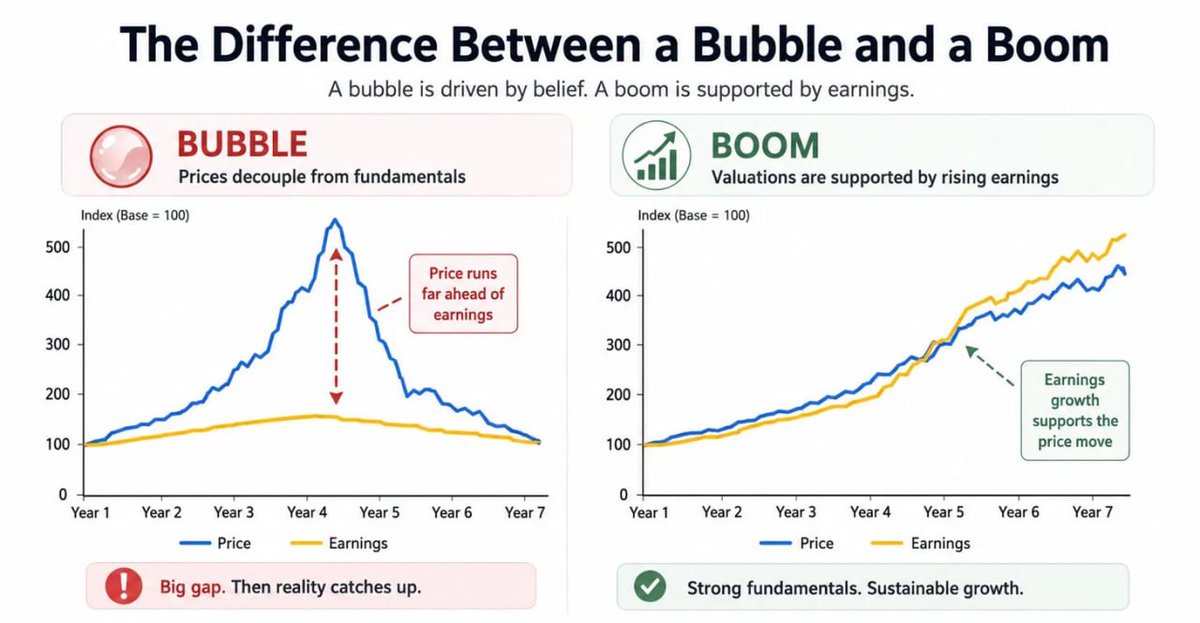
Is the AI Rally a Bubble or a Boom
The chart captures the core distinction between what ends badly and what usually does not. In a bubble, price runs far ahead of earnings until the gap closes. In a boom, earnings grow fast enough to carry the price.
Lately, there has been growing talk that the stock market is overheated, that the growth driven by AI has run its course, and that tech companies are significantly overvalued. Let’s take a critical look at the situation.
Back in 2000 $CSCO peaked near 200x earnings, and Pets. com went public with none at all. The entire case for internet stocks rested on revenue from a technology that was years from generating the cash flows the market had already priced in. When that gap closed, the Nasdaq fell 78% and took 15 years to recover.
Today's core companies look different. Nvidia's revenue went from $27B in fiscal 2023 to $130.5B in fiscal 2025, up 114% in a single year, with net income reaching $74B. The stock has run roughly 2,000% since its 2022 lows, but earnings grew fast enough to keep the forward P/E near 30x. The @Nasdaq -100 forward P/E sits near 26x today versus roughly 50-60x at the 2000 peak.
Companies are spending hundreds of billions on GPU and data center capacity before enterprise use cases have proven their economics at scale. The earnings are real, but they depend on that spending continuing, and that spending needs to be justified by what the AI actually produces for businesses paying for it.
4
2
5
219
May 26
Corporations are starting to ban AI for employees
While people fear AI will take their jobs, big companies are facing the opposite problem: after mass adoption, they are starting to limit AI usage internally.
$MSFT Microsoft is reportedly canceling most Claude Code licenses for engineers and moving them back to GitHub Copilot CLI. Why? Token costs got too high
$NVDA Nvidia sees the same issue. VP Bryan Catanzaro said compute costs for his team already exceed the cost of the employees themselves
$UBER is the craziest case: the company burned through its entire 2026 AI budget in just 4 months. 84% of its 5,000 engineers used Claude, 70% of new code was AI-generated, and top users were spending $500–$2,000/month each. Even Uber’s CTO spent $1,200 in one two-hour demo
So the tool that was supposed to save money became expensive at scale?
The next AI race may not be about who has the smartest model, but who can make AI cheaper to use. Winners won’t be those with the most advanced AI – they’ll be those who use it efficiently and economically. Which means that @deepseek_ai with their new $0.8 policy just crushed most of the AI companies
2
1
6
221
May 25
One of my recent interviews where we discussion was floating from my life path, career, achievements, teaching some digital security tweaks and again discussing the future of blockchain #fintech
youtu.be/L4MHg6w5qpQ?si=kFec…
2
8
239
May 20
Recently, I was invited to @TheBlockGlobal's "The Talk of The Town" podcast series, where we discussed the new era of engineering, broke down blockchain jargon into human language, explored the future of digital sovereignty, and addressed the elephant in the room: crypto UX.
Grateful for the opportunity
youtube.com/watch?v=zmGoAhG0…
1
2
8
348
May 20
Big Congrats to my colleagues on @zkme_

Privacy-preserving identity is coming to @CantonNetwork .🆔
zkMe integrates with Canton to support zero-knowledge identity verification, reusable credentials, and selective disclosure for institutional onchain finance.
#zkMe #zkKYC #Privacy
3
157
May 19
Another Day another Scam.
This time Scam came from @Bankless 's team Telegram accounts that are being hacked.
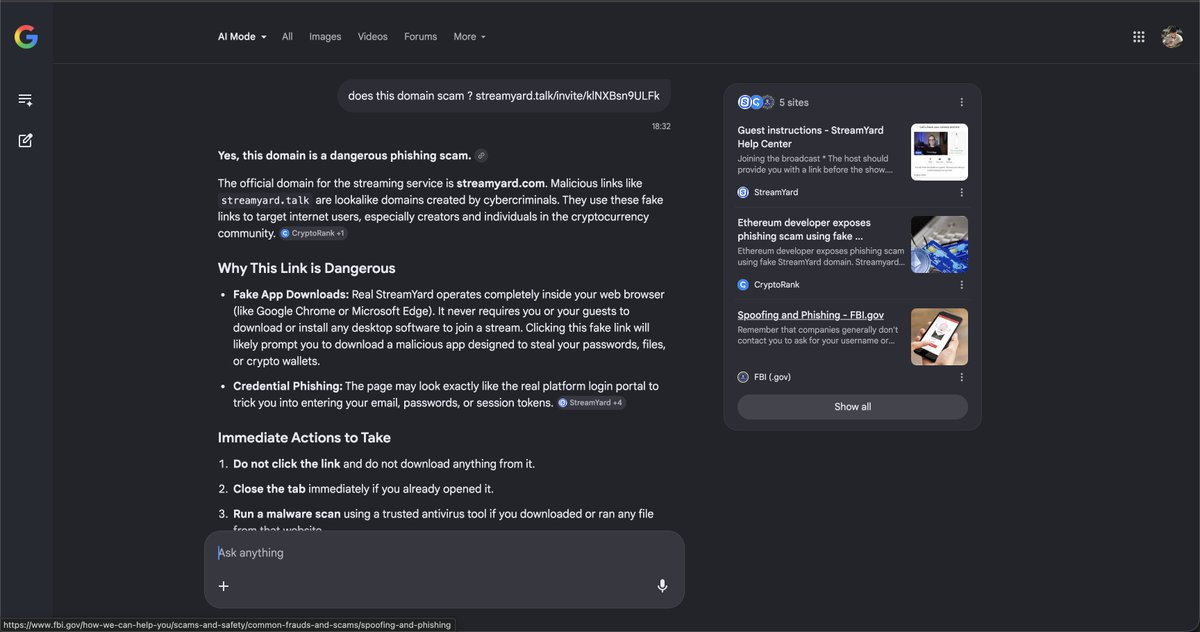
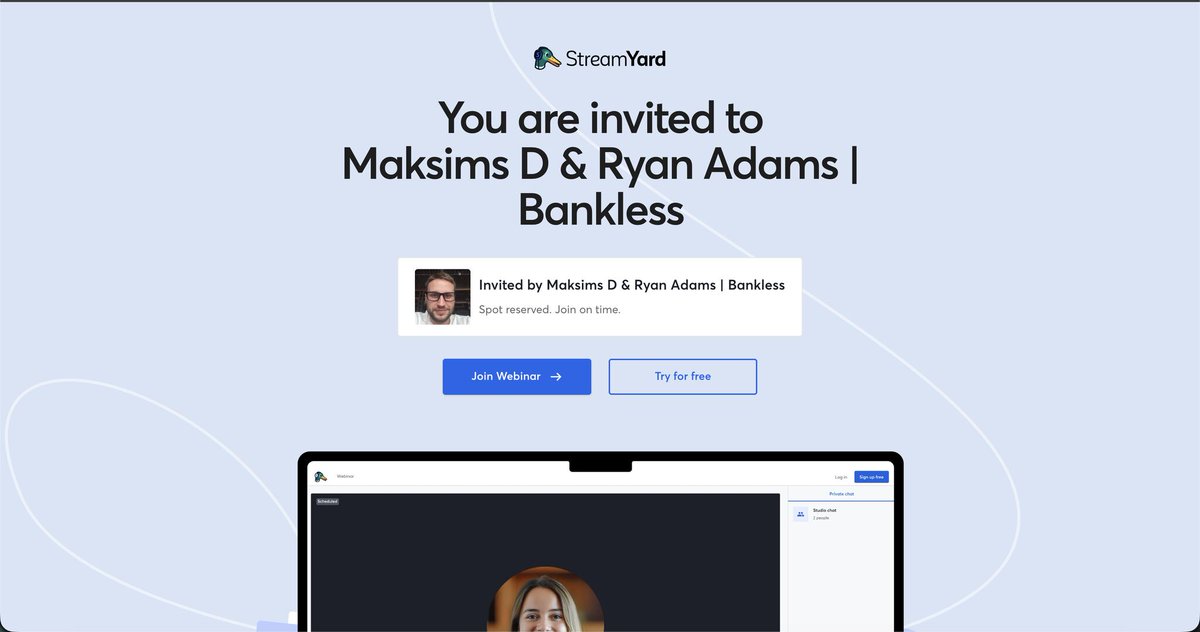
One of the representative will contact you, saying that they want to record a podcast with you. Then, they'll setup a very legit meeting with their "specialist" to check Video/Audio setup before recording. After that, That specialist will share with you a fake @streamyardapp invitation link via streamyard.talk/SOME_CODE domain.
Once you open the site and click on Join Webinar, it download a 140kb .ZIP file that includes a malware script under the name of "StreamYard" app that basically if you run it, will either start scraping your personal data(wallet/private keys, passwords, etc) or mines bitcoin using your machine power.
Now why I am more than sure that this is a scam?
Real StreamYard operates completely inside your web browser (like Google Chrome or Microsoft Edge). It never requires you or your guests to download or install any desktop software to join a stream.
@Bankless team, take care of your personal accounts)
Telegram account to block and do not response: @CryptoCastHub
In case someone still has some doubts, here are some links;
fbi.gov/how-we-can-help-you/…
en.cryptonomist.ch/2026/05/0…
cryptorank.io/news/feed/b575…
3
1
5
1,030
May 18
The Verus DeFi protocol was hacked for $12 million
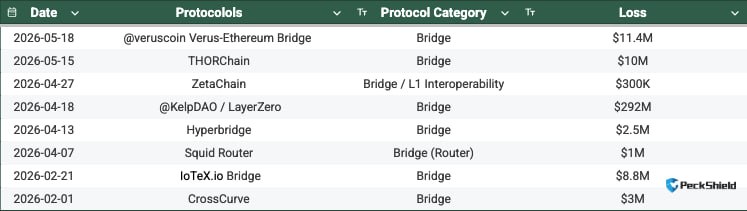
The crypto market had barely had time to digest Friday’s $10 million hack of @THORChain when another cross-chain protocol came under attack today. The latest victim is the Verus-Ethereum Bridge, from which a hacker stole 1,625 ETH, 103 tBTC, and 147,000 USDC.
And the most interesting thing here is that this wasn’t a hack involving keys or cryptography. The bridge correctly verified signatures, Merkle proofs, and transaction hash bindings. But it missed the most important part—whether VERUS ACTUALLY HAD the assets to back these payments before transferring funds from its reserves.
Since the beginning of 2026, crypto bridges have remained the absolute leader in terms of losses: in just 8 major incidents, the industry has already lost $328.6 million (the lion’s share of which was accounted for by KelpDAO/LayerZero in April—$292 million).
1
5
502
May 11
Coinbase's CEO lays off a ton of employees and says:
"Non-technical teams are now pushing code to production with Al"
less than 24 hours later:
Coinbase's trading engine goes down and somehow even the status page breaks too
the technical team that got fired 2 days ago:
1
1
11
199
Arman retweeted

May 8
JUST IN: Coinbase crypto trading remains down for over 5 hours as outage continues.
869
863
10,093
1,630,721
Arman retweeted

May 7
STOP LOOKING AT THE PRICE..📉
Most retail traders appear to be fixated on the next Bitcoin moonshot, reaching price ranges of $250k, $500k, $1M etc, but they’re missing the real story unfolding behind the scenes 🎬.
As governments race to implement CBDCs and Digital IDs while exchanges tighten the grip on KYC protocols, we’re seeing a shift from permission-less freedom to state-controlled transparency & 24/7 surveillance on your assets.
In this conversation, I sat with Arman Mamyan (@primarchdev) from @animocabrands to discuss why the real battle isn’t over the charts but over the future of control.
Is mass adoption worth the cost of completely losing your financial freedom?
Media by @TradersBrawlDXB📸
5
7
214
Arman retweeted

May 5
We've raised $2.2B in committed capital to invest in the next generation of crypto.
Announcing Crypto Fund 5

348
313
2,805
666,236
May 4
Biiig Biiiiig news. Huge congrats to my friends at @KASTxyz
Apr 30

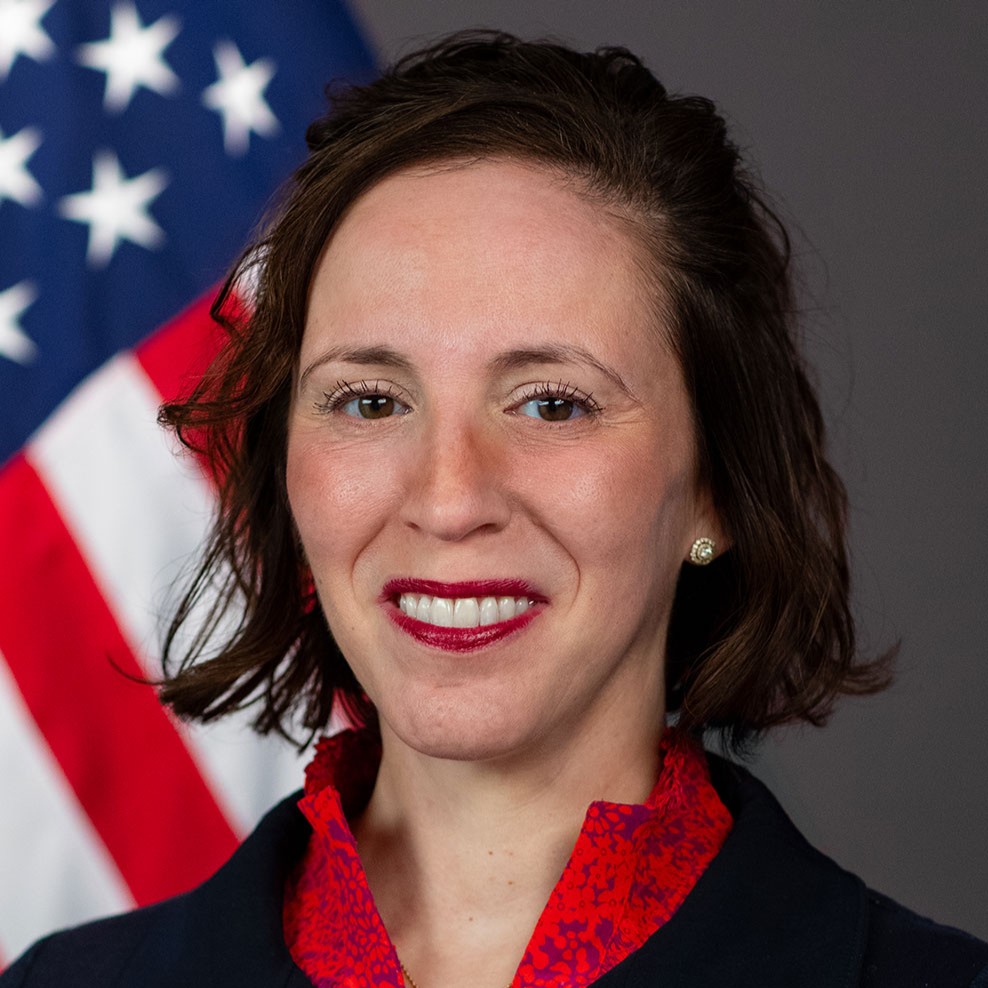
LATEST: ⚡ Stablecoin payments firm KAST has appointed former SEC senior advisor Stephanie Allen as its new head of corporate and policy communications.
1
8
167