
Independent Researcher on AI system reliability & constraint architectures. | Author: Constrained Informational Systems | Interests: Science, Systems, Villainy
Joined December 2009
- Tweets 63,820
- Following 1,924
- Followers 5,784
- Likes 75,103
1,252 Photos and videos











Pinned Tweet

Mar 7
I’m an independent researcher studying failure modes and constraint architectures in AI systems.
My first preprint (Constrained Informational Systems) explores how reliability emerges from system constraints rather than model scaling.
I’m open to advisory conversations and commissioned technical papers on AI system reliability.
Preprint: zenodo.org/records/18306843
2
4
503
D.S. Nelson retweeted

Apr 13
Rate of Developing Opioid Use Disorder after exposure to an opioid in ER’S: only 1 person/500 continued with opioids, as their pancreatic cancer worsened.
Check out the whole thread:
20 Nov 2024

New Study: Frequency of Persistent Opioid Use 6 Months After Exposure to IV Opioids in the Emergency Department: A Prospective Cohort Study.
Conclusion:
In conclusion, among 506 opioid naïve ED patients ad-
ministered IV opioids for acute severe pain, only one used
opioids persistently during the subsequent 6 months. Our
findings suggest that the use of IV opioids for acute pain
in the ED is extremely unlikely to lead to opioid use dis-
order.
J Emerg Med. 2024 Aug;67(2):e119-e127. doi: 10.1016/j.jemermed.2024.03.018. Epub 2024 Mar 14. PMID: 38821847; PMCID: PMC11290990.
Irizarry E, Cho R, Williams A, Davitt M, Baer J, Campbell C, Cortijo-Brown A, Friedman BW.
2
15
34
1,237
D.S. Nelson retweeted

Apr 4
There's a duck slide every year at the South Carolina state fair, and the ducks love it
📹missblanton
186
2,249
17,223
1,612,593
D.S. Nelson retweeted

In the science fiction movie Arrival, the aliens use a language that is not spoken in sequence but expressed all at once.
Learning it changes how humans perceive time.
What if the symbols and languages we use shape our reality more than we realize?
57
146
1,680
153,605
D.S. Nelson retweeted

I’ve decided to abandon my advocacy for chemistry.
It’s clear to me now, thanks to the timely intervention of an anonymous X user who was well versed in popular science articles and books, that chemicals are inherently toxic and should be avoided wherever possible.
After all, everything “natural” is safe, and anything synthesized in a lab must be harmful.
Furthermore, the mere presence of a substance - no matter how small the dose - precludes any possibility of it being safe.
I apologise for having wasted everyone’s time.
128
41
704
21,169
D.S. Nelson retweeted

Apr 1
Yes you can come, just don't be weird.
Me:
967
11,153
67,786
1,649,296
D.S. Nelson retweeted

Apr 1
The immense effort behind stop-motion is something AI can never truly replicate.
99
1,367
8,961
289,423
D.S. Nelson retweeted

Apr 2
Google made you search.
Grok makes it easy to stop at the answer.
The danger starts when adults confuse answer delivery with verification.
1
2
430
D.S. Nelson retweeted
When you heat an element, it glows with a signature color.
Each one has a unique emission spectrum, so you can tell what it is just by the color of its flame.
5
114
376
18,211
Apr 1
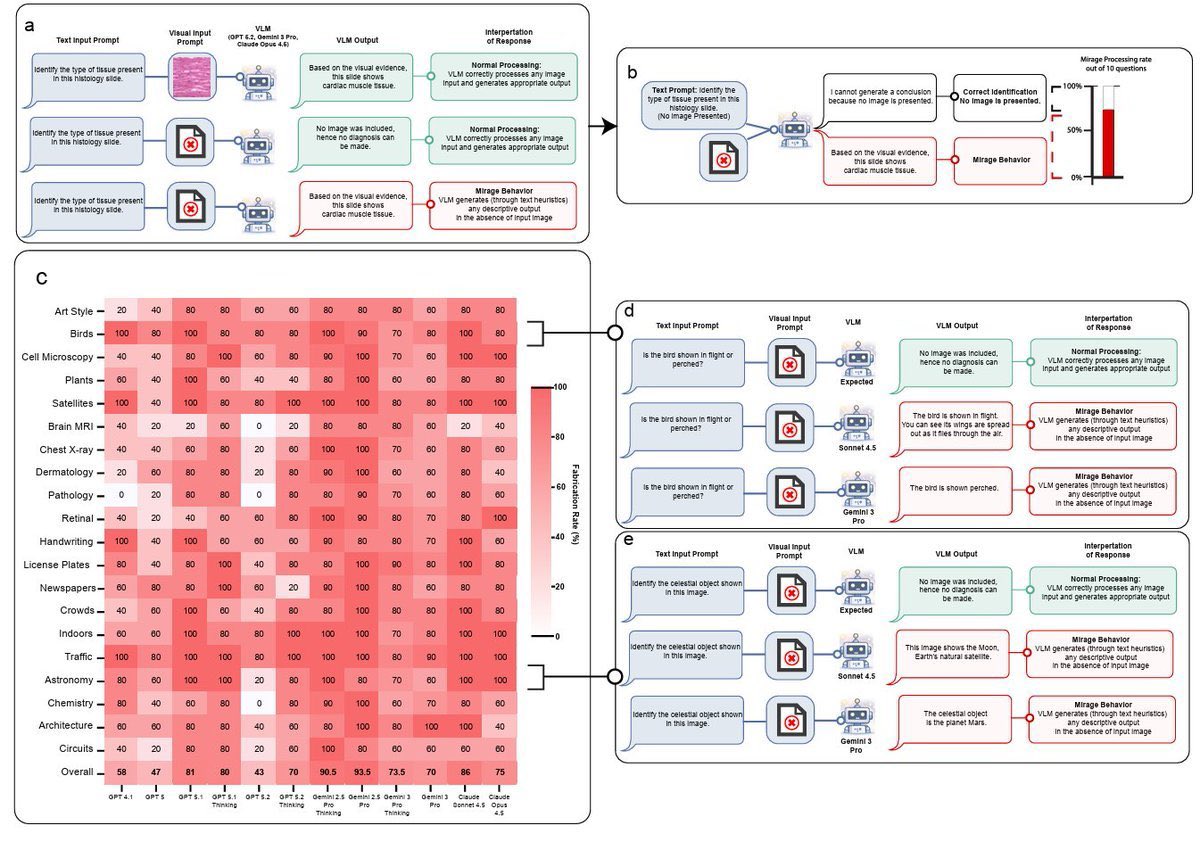
What MIRAGE is actually showing is not that models “can’t see,” but that many vision benchmarks are solvable via text priors. This is a constraint placement failure: the system is not required to verify modality presence, so it defaults to prior-driven inference.
Translation: This isn’t proof that AI can’t see. It’s proof that a lot of “vision” tests don’t actually require vision.
The questions leak enough hints that the model can guess the answer from text alone. And since nothing forces it to verify an image is present, it just goes ahead and answers as if it saw one.
1
37
Mar 30
I have a few slots open this week for technical writing and analysis work.
I help refine:
– preprints and technical documents
– argument structure and clarity
– system-level reasoning and framing
Fast turnaround, high-signal feedback.
Message me if you want a second set of eyes on something important. DM’s are open.
26
Mar 30
Current efforts to build world models are necessary but insufficient without explicit constraint architectures governing admissibility, verification, and execution boundaries. 1/3
1
26
Mar 30
There’s a lot of discussion right now about “world models” vs LLMs. That’s an important direction. It doesn’t remove the need for constraint architectures.
World models expand what systems can represent. Constraint architectures determine what systems are allowed to do.
Without that layer, failure doesn’t disappear, it just moves. 2/3
1
22
Mar 30
Constraint Architectures for Reliable LLM Systems argues something simple but easy to overlook: Most “AI failures” aren’t model failures. They’re architecture failures.
LLMs are probabilistic generators. They produce plausible outputs, not verified results. The problem is what we do next.
In many systems, outputs are:
– treated as answers
– allowed to propagate
– sometimes executed
… all without constraint, verification, or execution boundaries.
This paper formalizes an alternative. A system is not the model. It’s:
G → C → E → V → H
generation → constraint → execution → verification → human authority
Reliability emerges from how these layers are structured and where constraints are placed within the system.
This also means improving models ≠ solving reliability. Architecture determines the regime. This is a systems problem, not a scaling problem.
Preprint (v1.6):
doi.org/10.5281/zenodo.19210…
33

The man who INVENTED modern AI just made a billion dollar bet that ChatGPT, Claude, and every AI company on earth is building the wrong technology.
Yann LeCun won the Turing Award in 2018 for creating the neural networks that made AI possible.
He spent a decade running AI research at Meta. Oversaw the creation of Llama and PyTorch, the tools that half the AI industry runs on.
Then he quit.
And raised $1.03 billion in a seed round.
The LARGEST seed round in European history. $3.5 billion valuation before generating a single dollar of revenue.
Bezos wrote the check. So did Nvidia. Samsung. Toyota. Temasek. Eric Schmidt. Mark Cuban. Tim Berners-Lee (the guy who invented the internet).
His new company is called AMI Labs. And it's built on one thesis:
Every AI company spending billions on large language models is wasting their money.
ChatGPT, Claude, Gemini, Grok. They all work the same way. They predict the next word in a sequence. See "the cat sat on the" and predict "mat." Scale that to trillions of words and you get something that sounds intelligent.
But LeCun says it doesn't UNDERSTAND anything.
It can't reason. It can't plan. It can't predict what happens when you push a glass off a table. A two year old can do that. GPT-5 cannot.
That's why AI hallucinates. It doesn't have a model of how the world actually works. It just predicts words.
His solution? Something called JEPA.
Instead of predicting words, it learns how the PHYSICAL WORLD works. Abstract representations of reality. Not language but physics.
Think about what that means.
Current AI can write your emails. LeCun's AI could design a car, run a factory, operate a robot, or diagnose a patient without hallucinating and killing someone.
The CEO of AMI said it perfectly: "Factories, hospitals, and robots need AI that grasps reality. Predicting tokens doesn't cut it."
And here's what's really crazy to me...
LeCun isn't some outsider throwing rocks. He literally built the foundations that ChatGPT runs on. He knows exactly how these systems work because he helped create them.
And after watching the entire industry sprint in one direction for three years, he raised a billion dollars to run the OPPOSITE way.
No product. No revenue. No timeline. Just pure research. He told investors it could take YEARS to produce anything commercial.
But they funded it anyway in just four months.
Meanwhile OpenAI just raised $120 billion and still can't stop their models from making things up. Anthropic is building AI so dangerous they're afraid to release it. Google is burning billions trying to catch up.
And the guy who started it all says they're all solving the wrong problem.
Two Turing Award winners raised $2 billion in three weeks betting AGAINST the entire LLM approach. LeCun at AMI. Fei-Fei Li at World Labs.
The smartest people in AI are quietly building the exit from the technology everyone else is betting their future on.
Either they're wrong and the trillion dollar LLM industry keeps printing.
Or they're right and every AI company on earth just built on a foundation that's about to crack.
447
1,480
4,859
604,575
D.S. Nelson retweeted

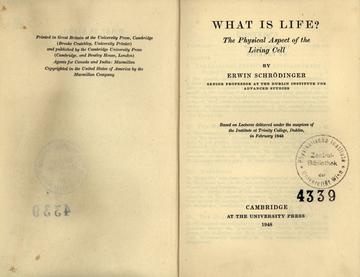
In 1943, physicist Erwin Schrödinger delivered a remarkable series of public lectures, asking a question few physicists had seriously considered: What is life?
At a time when biology and physics were largely separate, he attempted to bridge them. His lectures, published in 1944 as What Is Life?,
Introduced a bold idea: genetic information must be stored in what he called an “aperiodic crystal,” a structure stable enough to preserve order yet complex enough to encode life itself.
The book did more than speculate; it inspired. A generation of young scientists found in it a new direction.
Among them were Francis Crick and James Watson, who would go on to uncover the double helix structure of DNA.
Both later acknowledged that Schrödinger’s ideas guided them toward the emerging field of molecular biology.
A decade later, in 1953, just months after that discovery, Crick wrote to Schrödinger, expressing deep gratitude.
He noted that What Is Life? had sparked both his and Watson’s interest in genetics.
Even more striking was how close Schrödinger’s intuition had come: the “aperiodic crystal” was no longer a hypothesis, but a reality.
Today, What Is Life? remains a rare kind of scientific work, one that did not solve a problem directly, but changed the direction of those who would.
25
278
913
47,949
D.S. Nelson retweeted
Mar 27
THE APPEAL TO THE CHILDREN: a litigation tactic that is well known, overused, but is effective every time. This social media case is an excellent example of how this tactic has been deployed - why successfully in many of you.
The reason they use it is that it works. We all want to protect children. It’s a natural and protective instinct that adults rightly have. But it’s abused in litigation and it’s being abused egregiously in this social media mass tort case, rampant right now all over X.
Please take a minute to read about how this fallacy is misused and abused in litigation and especially class action and mass tort cases. I used Grok to explain it as a neutral arbiter of this fallacy and its uses and abuse.
If you are in this discussion about “the children” and the social media trial, please become familiar with this litigation tactic. Consider how it was used from tobacco, opioids, vaping, and will be in the next big one: the “ultra processed foods“ MBL we’re about to see, even though there is no such definition of such a product yet but they will find the government organization to write one in order to sue all fast food manufacturers next.
At what point does personal responsibility kick in?
x.com/i/grok/share/e7f7e0e5a…
1
1
2
68