
Do some podcast hosting on @brownpundits and @themerumedia, recovering attorney, Fin-tech exec, into philosophy, sanskrit, science, history and generally truth?
Joined September 2009
- Tweets 8,063
- Following 2,509
- Followers 5,074
- Likes 2,718
136 Photos and videos

Pinned Tweet

25 Sep 2023
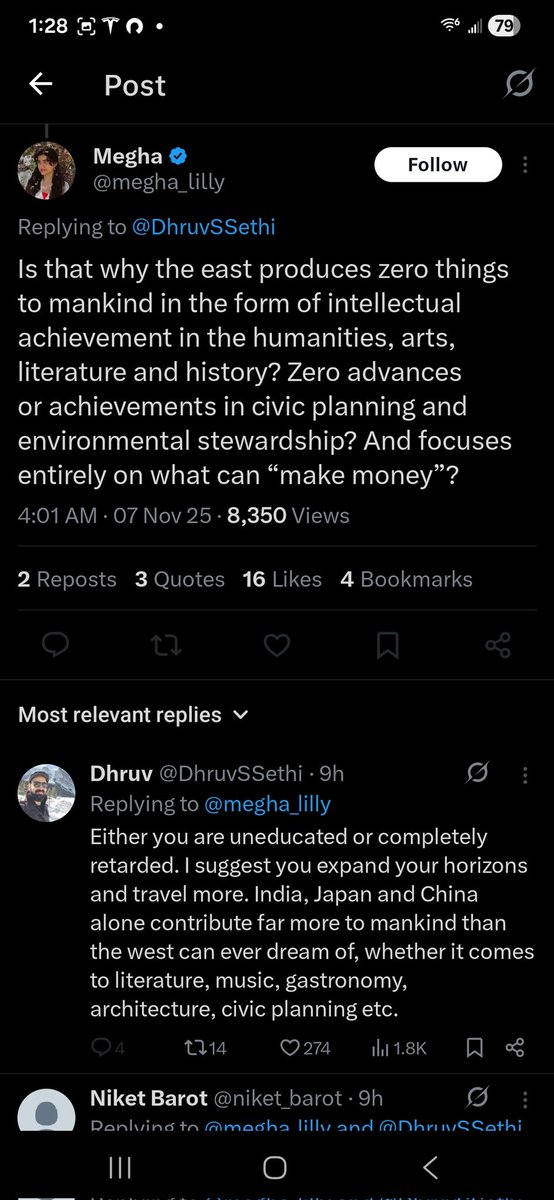
Why do Christians and their cheerleaders like @meghaverma_art who tend to show an utter lack of knowledge or education on anything really to do with let's say Hinduism feel so comfortable making idiotic and ignorant statements like the below? Let's do a quick thread on this:
25 Sep 2023

I absolutely agree that India and Japan are great to juxtapose against each other. But having spent a lot of time in both countries, I think this analysis is only partially correct.
As a poor country, India has a ethic called “jugaad,” which essentially translates to “make it work however you can.” This leads to very creative solutions to problems, at all levels. Also known as “hacks.”
However, if your ONLY ethic is “make it work,” then once it works you’re done. You’ve fulfilled the ethic.
“Good enough” is good enough. And everything in India is merely “good enough”… more or less.
Japan, on the other hand, has an ethic of honor. Your performance in any given task reflects on your whole lineage.
Consequently, almost everything in Japan is excellent. Streets are clean, buildings gleam, and you have to fight to have a bad meal.
The basic idea is that you do an outstanding job for the virtue of doing an outstanding job. It’s the call of craftsmanship, independent of audience.
However, my read is that this exerts an enormous psychic burden on the Japanese people. When you MUST do everything to an A level or you dishonor your ancestors, you end up either doing far less, or being very secretive about your failings.
This sense of pressure and hiding is palpable throughout the country, especially once you get out of the cities. I believe it’s contributing to Japan’s crashing birth rate as well. They’re being crushed under their own sense of honor.
The takeaway I want everyone to get is, once again, how superior America is in ways that most don’t realize.
The majority of people here understand that you do a good job for the sake of doing a good job. There is a wrong way to do things, a right way to do things, and a more right way to do things.
You might not realize it, but most people in America instinctively do things the “more right” way.
I’m writing this at In N Out right now, with low-wage workers making great food in a clean and safe environment, because they derive at least some joy from doing a good job.
This would be impossible in a “make it work” country. India will never have an In N Out.
By the same token, that call to a good job is only lightly enforced. We accept a minimum standard of performance, and don’t incriminate the person’s whole family if they fail.
We could probably afford to put more pressure on families to disciple their children better. But when someone screws up at their job, even due to incompetence, we don’t curse their grandfathers.
Because America has the true Christian ethic called “grace.”
Christianity acknowledges we are broken creatures incapable of reaching our full glory on our own.
So, via Christ’s excellent sacrifice, God forgives us our sins. Therefore, we forgive.
India has no excellence to look up to and embody in that way. Reincarnation is a shallow promise compared to heaven.
Similarly, Japan has no God granting demerited favor, aka grace. So they have no grace to give in return.
Both these are broken models in different ways. America worked in its superior way because of Christ at its core.
That superior way is being threatened because the core is being removed. The heart is being cut out.
What will the result be? Who knows. I’d prefer we didn’t find out.
26
84
381
128,911
What is brahmanical interpretation? There are texts that one can call brahmanical that refers to the idea that the texts were most probably written/composed, maintained and promulgated by brahmana scholarly elite. These traditions internally preserved and engaged with a variety of perspectives including caste, class, gender and so on. Any substantive reading of texts like the Upanishads and Mahabharata let alone tantric, agamic, and kavya works prove this. The entirety of academia publishes on a variety of views and those with less a Marxist bent actually discuss this. What he calls brahmanical are civilizational texts and traditions that capture a variety of views and tensions

savarnas hit the roof if any westerner speaks or publishes about Indian history, mythology, culture etc stating any opinion that is not in sync with brahmanical interpretations, and accuse them of being white colonialists! But savarnas will control all conversations on caste and discrimination though they are the oppressor-outsiders in this conversation!
Basically savarnas like only one voice - their own. 🤦♀️
1
10
326
Mukunda Raghavan retweeted

Anyone can integrate dharma with their life.
Here's an extreme example from Mahābhārata.
Kāpavya, a dacoit, added dharma to his life.
Bhīṣma tells that Kāpavya benefitted immensely from this.
We can start from wherever we are.
[Source: Mahābhārata 12.133 (BORI's edition)]
1
1
23
731
Mukunda Raghavan retweeted

It's interesting how lay people (typically not scholars or Indologists) underestimate the intellectual rigour and continuity of India's indigenous traditions.
They tend to apply the same framework they apply for the Middle East to India.
Iraqis forgot about Hammurabi, Ashurbanipal, et al., Egyptians forgot about Khufu, Hatshepsut, et al.; Arabs forgot about Gindibuʾ, Karibʾīl Watār, et al.
These figures were (re)discovered by archaeologists and epigraphers in the 18th-20th centuries.
The accounts of az-Zabbāʾ/Zenobia in medieval Islamic historiography drew from both indigenous (Arab, Syriac) & Greco-Roman/Byzantine sources while the account of Dārā (Darius III) in Firdawsī's Šāhnāmah drew almost entirely from the Alexander Romance tradition (via Syriac translations from Greek, which were later translated into Pahlavi/Middle Persian)
Therefore, it must stand to reason than Indians also must've forgotten the names of rulers like Candragupta, Aśoka, etc. prior to the arrival of Westerners, no?
Yet this is clearly not true.
Although the Brāhmī script used in the inscriptions had changed so much as to be unrecognizable, Candragupta (Sandracottus of the Greeks) was well known through texts and plays like Viśākhadatta's Mudrārākṣasa, which were completely independent of Greco-Roman sources like Megasthenes.
The names of Aśoka Maurya and his sons Daśaratha and Samprati are recorded in the Puranic vaṃśāvalis and he is glorified in Buddhist sources such as the Divyāvadāna (which contains a section known as the Aśokāvadāna) and Srilankan chronicles like the Dīpavaṃsa and Mahāvaṃsa.
A manuscript of the Divyāvadāna in Sanskrit (or Sanskritized Prakrit) was discovered in Nepal in 1824, so the text was continually being copied.
One could argue that modern Persians had no knowledge of Old Persian for over 1,500 years (until the script was deciphered in the 19th century) and minimal knowledge of Avestan.
The Zand and Dēnkard commentaries composed by medieval Zoroastrians dasturs and mobeds often differs from modern philological readings.
Yet in the case of the Vedas, there is a largely unbroken chain or recitation reinforced by the śikṣās, prātiśākhyas, etc. and interpretation based on the Nirukta (the Naighaṇṭuka, Naigama, Daivatakāṇḍa-s of Yāska), Vyākaraṇa (Aṣṭādhyāyī Vārttikas Mahābhāṣya, along with the Uṇādisūtras and Phiṭsūtras), etc.
Therefore, the commentaries by Bhaṭṭabhāskara, Sāyaṇa, Veṅkaṭamādhava, Skandasvāmin, Mahīdhara/Uvaṭa are quite close to modern philological interpretations, simply because formal study of Sanskrit (including Vedic Sanskrit) never truly disappeared in India.
Even the study of the medieval Prakrits never disappeared among the Hindus and Jains.
Most people nowadays think of the 16th century grammarian Mārkaṇḍeya as the final Prakrit grammarian, yet Rāmaśarman Tarkavāgīśa composed his grammar of Prakrit and Rāmapāṇivāda composed his Kaṃsavaho and Usāṇiruddho less than two centuries before Norwegian-born German Indologist Christian Lassen's published his Institutiones Linguae Prakriticae.
When it comes to continuity, one can't treat the Indian Subcontinent the same way as the Middle East, Iran, or Central Asia, yet the fact that they rehash the same arguments regardless just highlights that these sorts of arguments (whether applied to India OR the Middle East) are ultimately rooted in racial paternalism ("the White Man's Burden," yet applied to history).

Claim 1: "Understanding & translation of the Rig Veda had to be done by Westerners because much was lost in India"
Status: False. Vedas were never "lost" in India. They were preserved through a complex, oral transmission system (incl. permutations) for millennia,
11
88
261
8,796
Jun 11
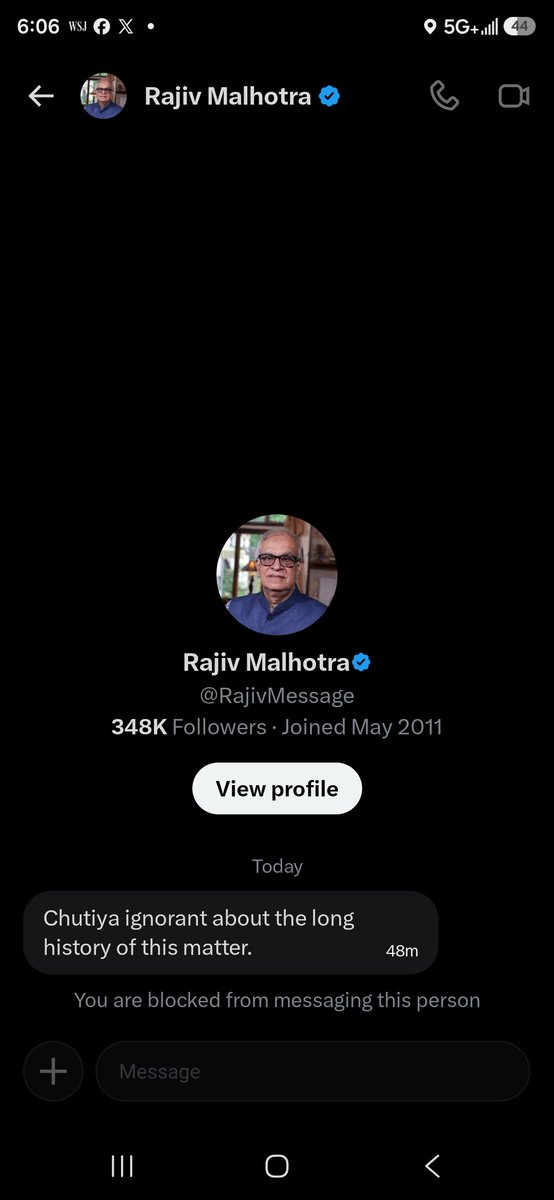
This is how Rajiv Malhotra @RajivMessage responds. Sends a cheap message then blocks. He no doubt has done some good work but now he only works with sycophants around him and raging. Pathetic
25
7
112
7,652
Mukunda Raghavan retweeted

We just can not go behind names like "Vedic Maths" "Bharadwaja Vimana Shastra" etc - They are definitely works of 20th century. Doing such claims is actually detrimental to the real work of pioneers like Panini, Pingala or Aryabhata.
6
10
56
2,031
Mukunda Raghavan retweeted

Jun 7
In medieval times, within the arms race of ever more demonic torture devices, some sadistic genius came up with the idea of the Little Ease.
This was a prison cell built so small in every dimension that a grown man could not stand upright in it nor lie down at full length nor properly sit.
The pain is relentless and without relief and inflicted by one's own body. Prisoners were known to go insane within a few days. A stay at the Little Ease was considered even more cruel than the rack, the thumbscrew, and the other ghoulish machinery of the Tower of London.
A breeding pig will spend her whole life in a version of that box.
These are social, roaming creatures (more intelligent than dogs) who will never leave this corset of steel.
They have been selectively bred to be bigger than their frames can support. Yet we put them in cells so confined that they cannot comfortably sit, and their attempts to do so (for example, by sneaking their limbs into adjacent stalls) reliably lead to fractures and sprains.
They cannot sweat, yet have nothing to roll around in to cool themselves off. Except their own manure, which (contrary to the common misconception) they are so averse to (thanks to their strong sense of smell) that new sows will often suffer from constipation to avoid soiling the space from which they eat and sleep.
Here is how the writer Matthew Scully described what saw at one of Smithfield’s “gestation barn”:
> “Sores, tumors, ulcers, pus pockets, lesions, cysts, bruises, torn ears, swollen legs everywhere. Roaring, groaning, tail biting, fighting, and other “Vices,” as they’re called in the industry. Frenzied chewing on bars and chains, stereotypical “vacuum” chewing on nothing at all, stereotypical rooting and nest building with imaginary straw. And “social defeat,” lots of it, in every third or fourth stall some completely broken being you know is alive only because she blinks and stares up at you … creatures beyond the power of pity to help or indifference to make more miserable, dead to the world except as heaps of flesh into which the [insemination] rod may be stuck once more and more flesh reproduced.”
—
The Save Our Bacon Act is trying to unroll the few state protections we have against this barbaric cruelty - for example California’s Prop 12 - which banned the sale of pork from pigs kept in gestation crates.
It’s incredibly important we don’t end up with this sort of federal preemption.
SOB will not only kill the most important animal welfare related laws in the US of the past decade, but more importantly, it will also restrict ALL future legislative progress (aka how the animal welfare movement has gotten its biggest wins).
The Senate is currently deciding whether to add the SOB Act to the Farm Bill.
With relatively little money now, we can discourage the most pivotal senators in the Ag committee from backing this amendment.
Defeating this bill is even more important given the amount of philanthropic funding I expect to come online in the next year or two.
It will plausibly be over 10x more expensive to repeal SOB than to prevent it from passing in the first place.
All that money that could be spent transforming our society's relationship to mass animal suffering will instead have to be spent just getting us back to where we are right now.
That's why money spent now fighting this bill (and I mean right NOW) is so effective.
If you’re in a position to donate six figures, please DM me.
95
761
4,488
484,737
Mukunda Raghavan retweeted

Amazing. The only immigration "reform" we'll get is the end of dual-intent status for those who actually abide by our laws.
This will solve zero actual problems, but MAGA is so far gone that all they care about is ending legal immigration. Not Iran, not the debt, not spending, not taxation, not accountability, not administrative bloat and abuse, not the uselessness of Congress, not even deportations anymore.
They have deluded themselves into believing that the most compliant, most vetted, most peaceful contingent of immigrants must go, and that booting them will make this nation a white paradise where every idiot who can't do middle school math gets to be in charge of the cybersecurity infrastructure protecting your bank accounts.
Actual information is available, but they reject it. I can't engage because I'm immediately dismissed due to my profession, but here's the catch: my profession requires me to be an actual expert in this area.
Most of all, it's a rejection of agency and grit. It boils down to a complaint that it isn't FAIR the Indians get nice houses and money and take all the jobs because they are so cheap! That statement is inherently contradictory but they cannot or will not see it.
If you want a job at Google, don't beg the government to save you from competition. That's epically wimpy shit. Go study, take a course, try some coding, join a group of fellow professionals. If you scream to high heaven that you hate foreign workers, you won't get hired because you will need to be able to work with them.
I had to fight like hell for my career, and all I am is grateful that I made it work. I cannot respect anyone who whines or insists they have prior claim on any job based on where they were born.
I come from nothing. I made it to Georgetown Law, and not because the government made sure I didn't have to compete with foreign students. When the job market died, I did what I had to do to survive.
Grow up.
Jun 6

U.S. BILL SEEKS TO BLOCK H-1B TO GREEN CARD PATHWAY
U.S. LAWMAKERS MOVE TO END H-1B ROUTE TO PERMANENT RESIDENCY
27
55
286
31,774
Jun 4
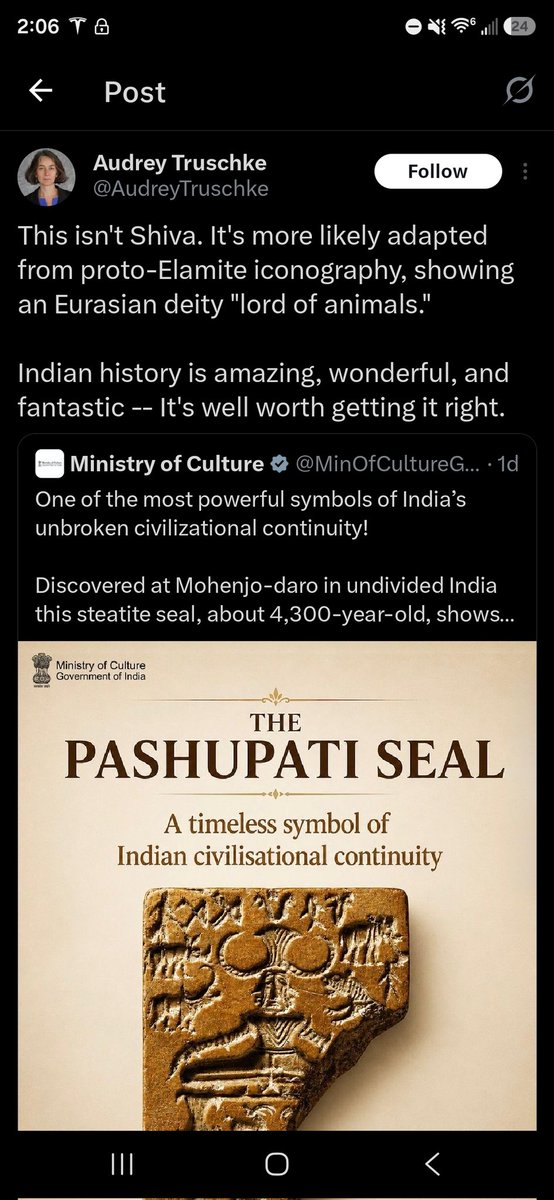
I guess the you of 5 years ago isn't the you now? Vishnu and Shiva are the same deities that they were in the Vedic Age, just understood more fully and also outside of the Vedic yagna perspective. Time is the unfolding of their nature.

meluhha.com/rv/verse.pl?v=07…
> Yet apparently Víṣṇu isn't a deity.
Definitely Vishnu is a deity. what Vedicists have written is that he is not the Puranic Vishnu, as developed in first centuries CE. Vishnu is the Solar deity in the Veda.
Similar to Shiva in RV. He is not the Shiva of later periods. In Tamil, only Jains start using Siva first, much later than the Sangam period.
3
36
1,622
Mukunda Raghavan retweeted

Jun 4
Just four Wikipedia accounts can smear the reputation of an organization like the Hindu American Foundation.
Think this an isolated case?
BTW, Ashley Rindsberg (@NPOV) does some of the best reporting about Wikipedia and its bias—not just left-wing bias. Follow.
Jun 3

🚨NEW INVESTIGATION: A Fortune 500 company reportedly cancelled a @HinduAmerican training session after employees circulated its Wikipedia page.
That page tells readers HAF aligns with Hindu nationalism, threatens academic freedom, and has been accused of acting as a foreign agent.
We traced who built that narrative. The same handful of accounts kept appearing across HAF, its critics, activist groups, and key public figures—building an interconnected narrative that now feeds Google and AI systems.
Full investigation in thread. Receipts 👇
28
721
2,014
103,799
Jun 4
Ouch @tishasaroyan slow your role
Jun 4

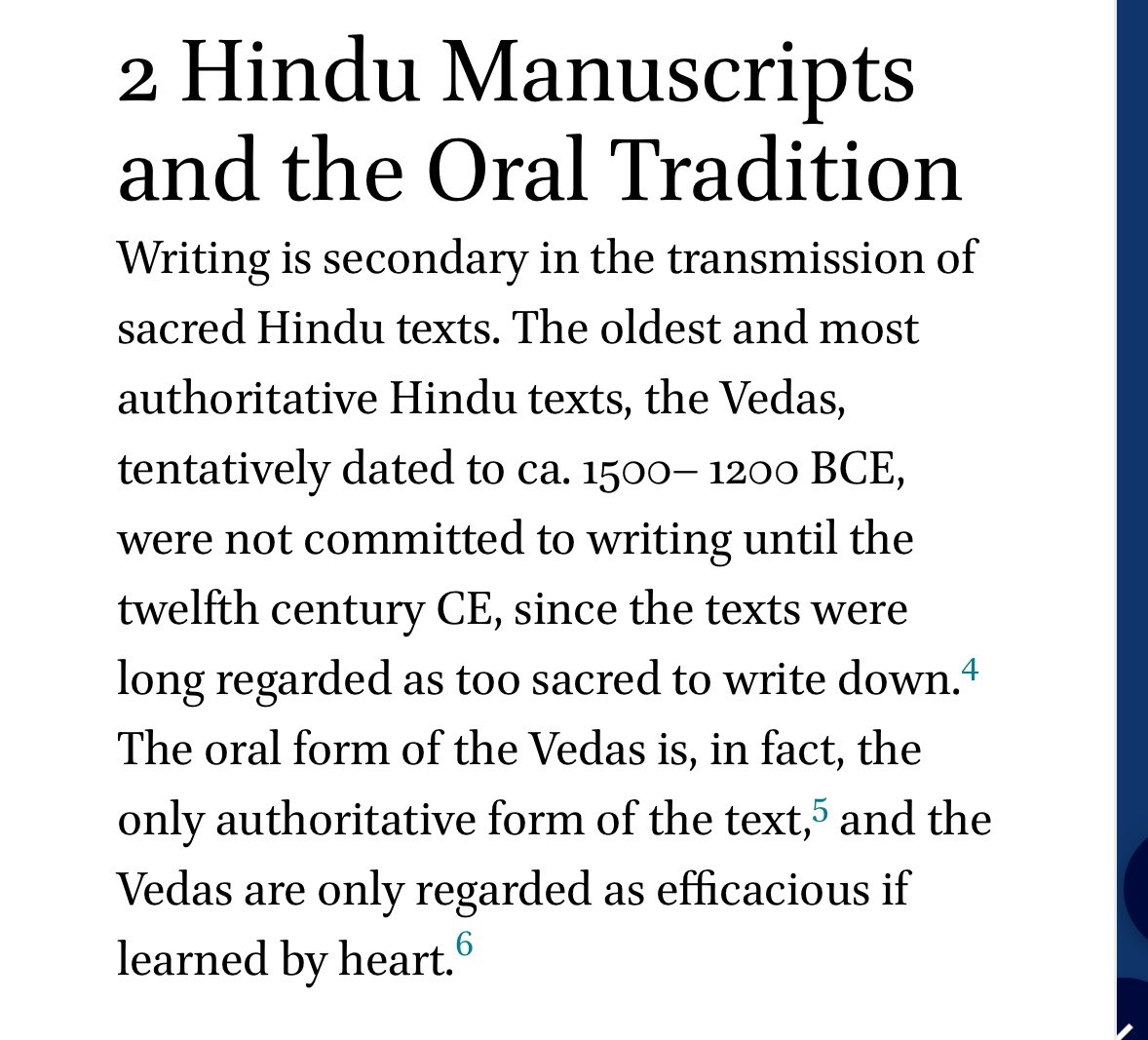
The misplaced confidence displayed by Dr. Ruchika Sharma is baffling—an expert in everything, yet seemingly nothing.

1
2
12
3,398
Mukunda Raghavan retweeted

May 31
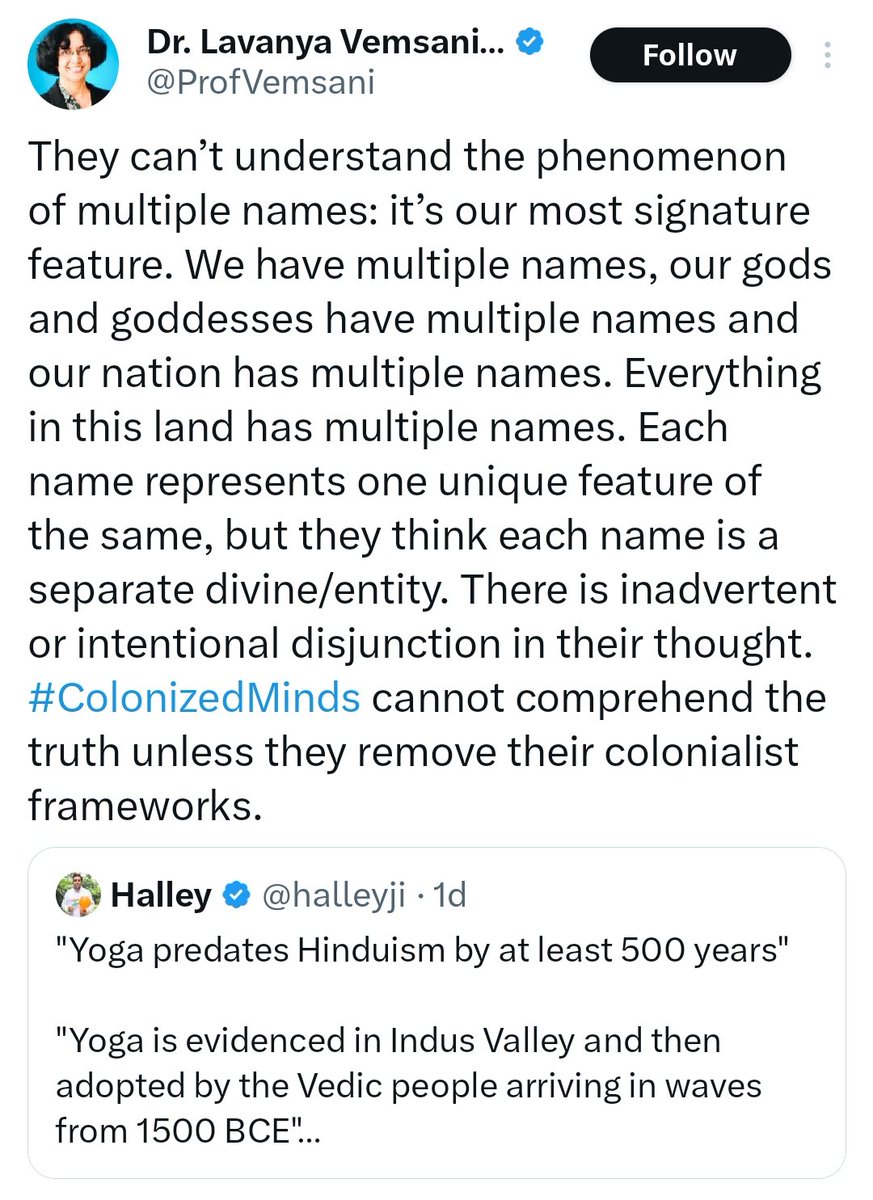
This sort of atomization is endemic in the modern academic reception of polytheist traditions, both ancient and continuous, but is especially popular in order to sever contemporary traditions from deeper roots that might be used to demand respect or protection.

People who speculate about rudra and shiva or for that matter kumAra and murukkan being different deities or the product of some imagined syncretism should be simply seen as too dim-witted and ignorant for any consideration at all.
3
23
54
4,904
Mukunda Raghavan retweeted

While the god vAyu is experienced by all daily, most H who have not studied the depths of the shruti and the also the Iranian religion cannot connect to his deeper essence or that of his dvandva with indra. In order to remedy that, the sage vAlmIki has placed that essence in the rAmAyaNa and it can be accessed by a wider audience.
1
9
64
5,033
Jun 2
There are definitely bad apples in any industry or area, including academia, but some of the best scholarship and academics are western academics who have studied and produced great insights and knowledge. Don't throw the baby out with the bath water

There is no point getting angry anymore on things like this. They are easily solvable - cut access to India and Indian material completely. The Chinese know how to do this very efficiently and that's why no one messes with their history and culture.
10
8
52
6,034
Jun 1
First and foremost, since Ruchika loves to hang on academic degrees and appeal to authority fallacies, it is would behove me to point out that she is not a scholar nor possesses academic expertise in ancient india, Hinduism or Sanskrit. I believe her focus and area of expertise are Medieval India (again, which medieval period and region in India, I'm not sure). So we can take her positions on Rudra-Shiva and Krishna-Gopala-Vishnu with a grain of salt.
1. Shiva and Rudra are the same deity, understood differently over time, which she agrees with. Vedic Rudra isn't simply or just a destructive force or destroyer of animals, she also says he was a minor deity in the Vedas and gains some prominence in the Yajus. He is a liminal deity in the Vedas, on the edge, the one who is to be propiated, which is where the story of Daksha takes place when he isn't. He isn't a minor deity he is a category deity, the entire class of deities Rudra. He is the father of the Maruts, one of most vital allies of Indra. He is the cosmic chastiser. You can read Jan Gonda on this, he is much better than Ruchika here.
2. Her piece on scroll is shoddy; she takes specific hypotheses/theories and assumes that they are facts. For example, the idea that Krishna was originally a tribal or non-aryan deity/hero, what evidence is provided? That idea is a theory that some have put forth as a potential explanation, but no evidence is provided. She also misstates Matchett's argument and position. Matchett is doing a study of Krishna and Vishnu in the Harivamsa, Vishnu Purana and Bhagavata, it is a textual exploration between the texts, not a historical analysis, but a theological one.
It is as if Ruchika just reads snippets and then develops a theory or makes it fact either that or she is not a very good reader in this area. Either way, she is pretty bad at this type of work.

Incorrect!
Shiva and Rudra aren't just names of the same God, they are characteristically different from each other and chronologically as well.
Wrote about this here (scroll.in/article/844874/how…)
Same for Krishna, here (scroll.in/article/814754/how…)
Quick explainer here:
Rudra is a Vedic god, a destructive force, Pashughna (destroyer of animals) and is not a Yogi. Shiva who is a Puranic construct is vastly different, he's a Pashupati as well as a yogi.
Puranic Shiva first makes its appearance in texts a good 400 years after Rudra is written in the Vedas, before the Puranas are committed to writing Shiva is but unknown.
Religions evolve, gods evolve, the concept of what is a god evolves because societies that produce the idea of a god evolves.
17
101
441
20,981
Jun 1
This Thiruvalluvar religious affiliation comes up in regular cycles. We don't know much about him outside of what little we can glean or extrapolate from the Kural. He is what we know he probably wasn't Buddhist, he definitely wasn't Christian. He was probably Hindu or Jain or a person who found both traditions valuable. The poster below doesn't seem to grasp chronology and cultural milieu. Plato predated Christianity by 500 years or so, Thiruvalluvar was smack dab in the middle of the Hindu Tamil world, even if you variously date him from the 3rd century BCE to 5th century CE, the Kural is replete with Sanskrit words (both Hindu terms and Jain ones) along with numerous mentions of Indra, Vishnu, and Lakshmi, other deities, and four purusharthas and so on.
Plato influenced Christianity vis-à-vis Christianity's adoption of philosophy and later on Neo-Platonism. Thiruvalluvar was deeply influenced or was a part of the Hindu world. Man, these Dravidianist types are just dumb

Claiming Tiruvalluvar is 'Hindu' is like claiming Plato is Christian lol
7
34
146
6,611
Jun 1
Join me as I speak with Dr. Ivan Andrijanic from the University of Zagreb. Dr. Andrijanic is Professor of Asian Studies at the University of Zagreb. We explore the intersection of traditional Advaita Vedānta scholarship and modern philological methods. Dr. Andrijanić shares his personal journey into Indology, his research on the historicity of Śaṅkarācārya, and how historical-critical lenses can enrich our understanding of sacred texts like the Mahābhārata and the Upaniṣads without undermining their spiritual value. @themerumedia #vedanta #advaita
youtu.be/3jh5ch1HkNw
1
3
20
1,636