Researching intelligence, conscientiousness, moral foundations & human attainment. Lots of individual differences & genetics
Joined September 2011
- Tweets 10,742
- Following 1,665
- Followers 8,036
- Likes 101,451
595 Photos and videos


Pinned Tweet

18 Feb 2025
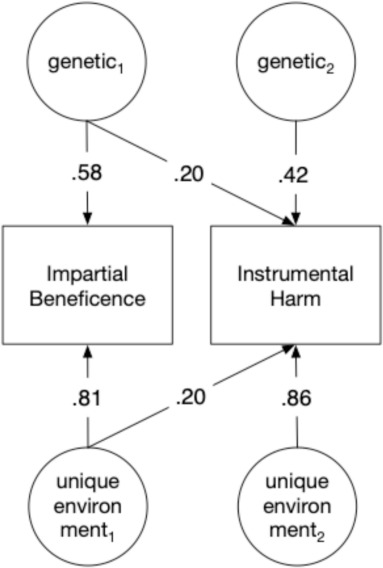
I think this is the first report of the heritability of Utilitarianism.
Utilitarianism is surprisingly heritable!
Second, it reflects two underlying biological systems:
1) A flat moral circle, treating self, family and strangers as substitutable.
2) Treating people as means, versus as ends in their own right.
6
22
95
22,404
Timothy Bates retweeted

Jun 11
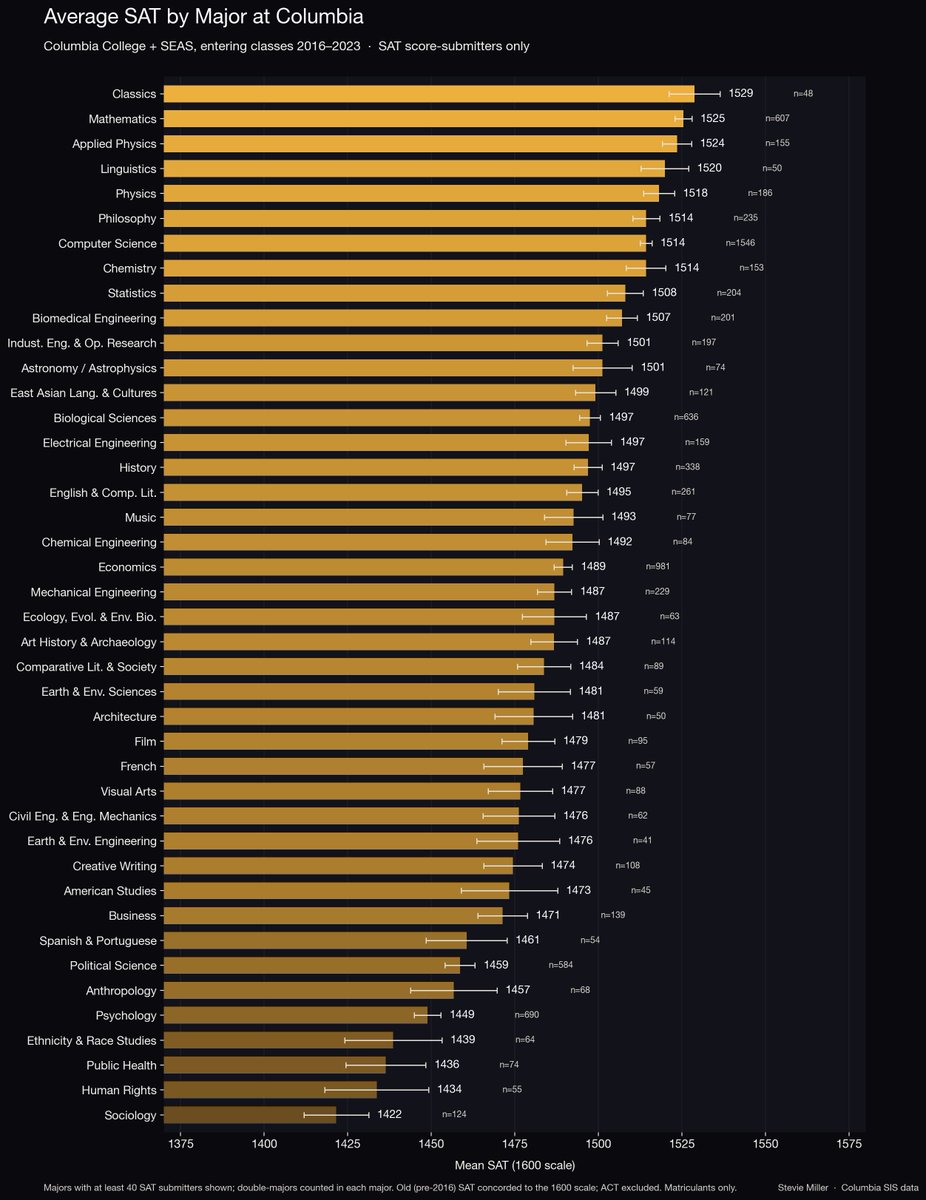
Average SAT by major at Columbia.
Classics improbably edges out Math and Physics for the top spot at 1529. Sociology is on the bottom (1422), though "Ethnicity & Race Studies", "Public Health", and "Human Rights" aren't too far in front.
The within-school spread is 100 points or so — around half of a standard deviation of the SAT-taker population.
102
96
973
398,104
Timothy Bates retweeted

Jun 12
Today feels like a good day to reshare this clip of Ariane Aerospace’s CEO calling SpaceX’s reusability plans “a dream”
419
1,211
10,222
1,599,579
Wow! Blows open the doors to new levels of understanding at the cellular function level of biology (and practical disease cures)
Jun 11

Together with UC Berkeley we are announcing the laser phase plate - a breakthrough in atomic resolution imaging. This is the brightest continuous wave laser in the world, 100 million times the intensity of the surface of the sun.
Phase contrast plays an important role in microscopy, but it was thought close to impossible for electron microscopy, where it would require interfering with an electron beam. Holger Mueller and Robert Glaeser proposed exactly this using a standing wave laser. It has taken over 15 years to make this a reality. Biohub partnered with UC Berkeley and Mueller to support this work and to engineer and build the technology.
Contrast has been the critical barrier to achieving atomic resolution imaging of the cell. In cryo-electron tomography, a cellular imaging technology that uses electron microscopy, the low contrast makes it impossible to resolve anything but the largest proteins within their cellular context. The laser phase plate removes that barrier.
With advances in AI this breakthrough in contrast will start to open up a new frontier in structural biology, that will allow us to see the molecular machines of the cell, and how they assemble into far more complex and dynamic systems, and understand how they work.
2
437
Same in Scotland since ~2003. In one recent year, 100% (!!) of law school entrants at Edinburgh were selected from the bottom quintile of parental/postcode socioeconomic status.
Zero chance for 80% of families and highly capable young people.
Private education, home ownership, parental education sum to dwarf any remaining variance in leaving exams which have near 100% pass rates. Probably fine…
Jun 13

Berkeley math professor:
“Today, the more successful a public high school is at preparing its students, the lower its graduates' chances of getting into top UC campuses like Berkeley and San Diego.”
Berkeley admitted 45% of applicants from a high school where nearly 94% of “students failed to meet the state standards in mathematics.”
It admitted less than 14% of applicants from a school where “nearly 100 percent of its students in AP Calculus BC pass the national exam with a perfect score of 5.”
2
7
37
3,013
Timothy Bates retweeted

The key to saving the environment is not looking backward, it’s moving forward.
I realized this the first time I visited Italy twenty years ago. Everything was clean and green. The rivers sparkled. The lesson for me was obvious: the answer is not underdevelopment. The answer is progress.
When China was poor, the air was so polluted that people could barely see the blue sky. Today, blue skies have returned to their cities. Development does not only create wealth, it also provides the resources needed to restore and protect the environment.
Some environmentalists want us to preserve every aspect of our biodiversity, including the mosquitoes for example, so that researchers can fly in once every ten years from their universities (which build particle accelerators and billion-dollar laboratories with their pocket money), study our ecosystems, and count how many people died from dengue outbreaks.
They want to buy our air through carbon credits. If carbon credits were such a great deal, they would be selling them to us, not the other way around.
Cleaning every river, lake, and water source in El Salvador, and ensuring they remain clean and sparkling, would cost roughly $12 billion. Where is that money supposed to come from without economic development? Carbon credits?
The path forward for our country is the path of Japan and Singapore, not the path of the Congo.
Jun 12

autonomous robot driving through the field at night. no chemicals. no pesticides. just UV light killing pathogens and pests while everyone sleeps. this is @tricrobotics.
this is what chemical-free pest control looks like at scale.
740
6,968
42,382
1,523,986
Jun 13
It’s as if there is some mysterious signal to which these tests are sensitive… Whatever could it g? 👀 Can you C?
Jun 12

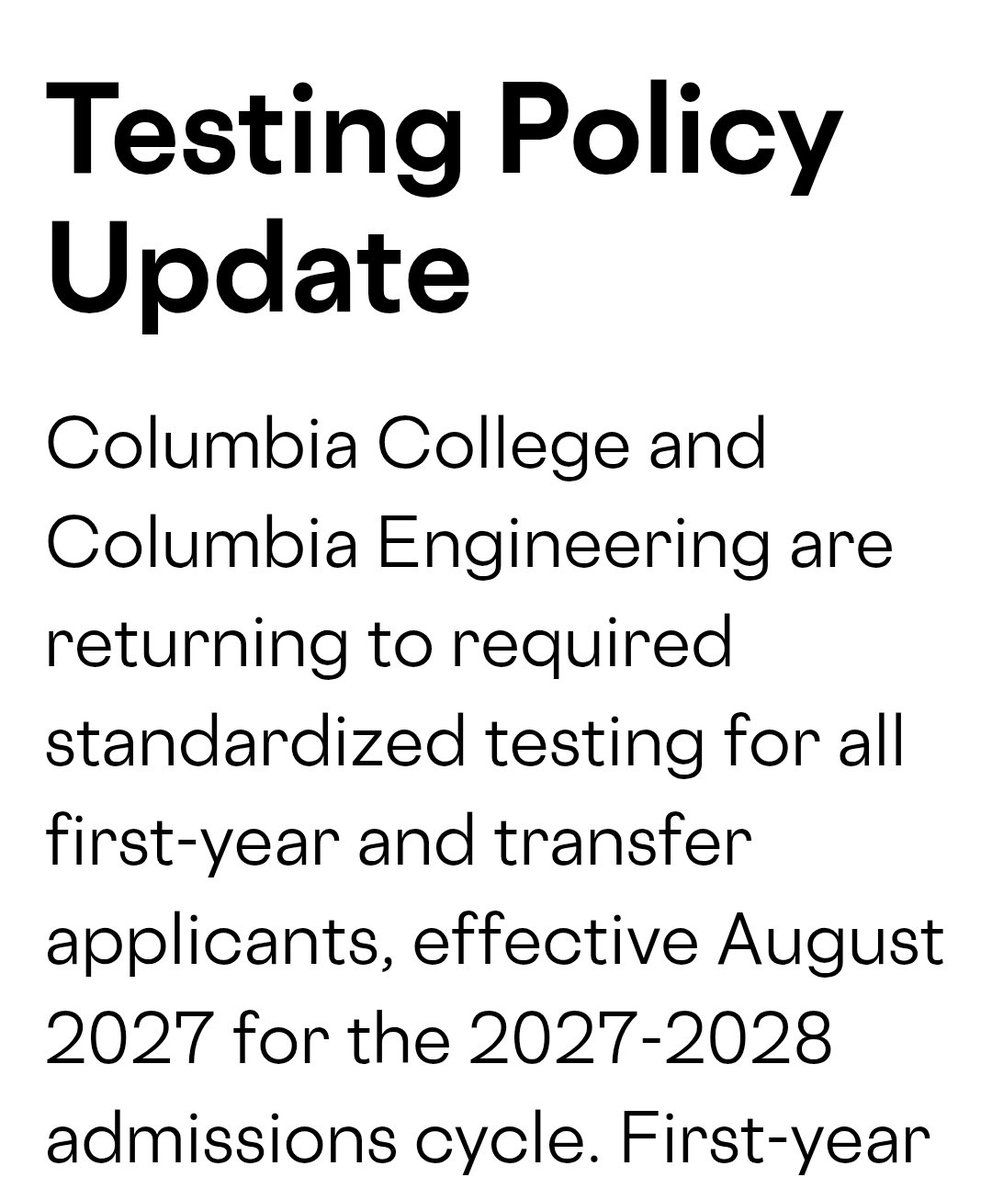
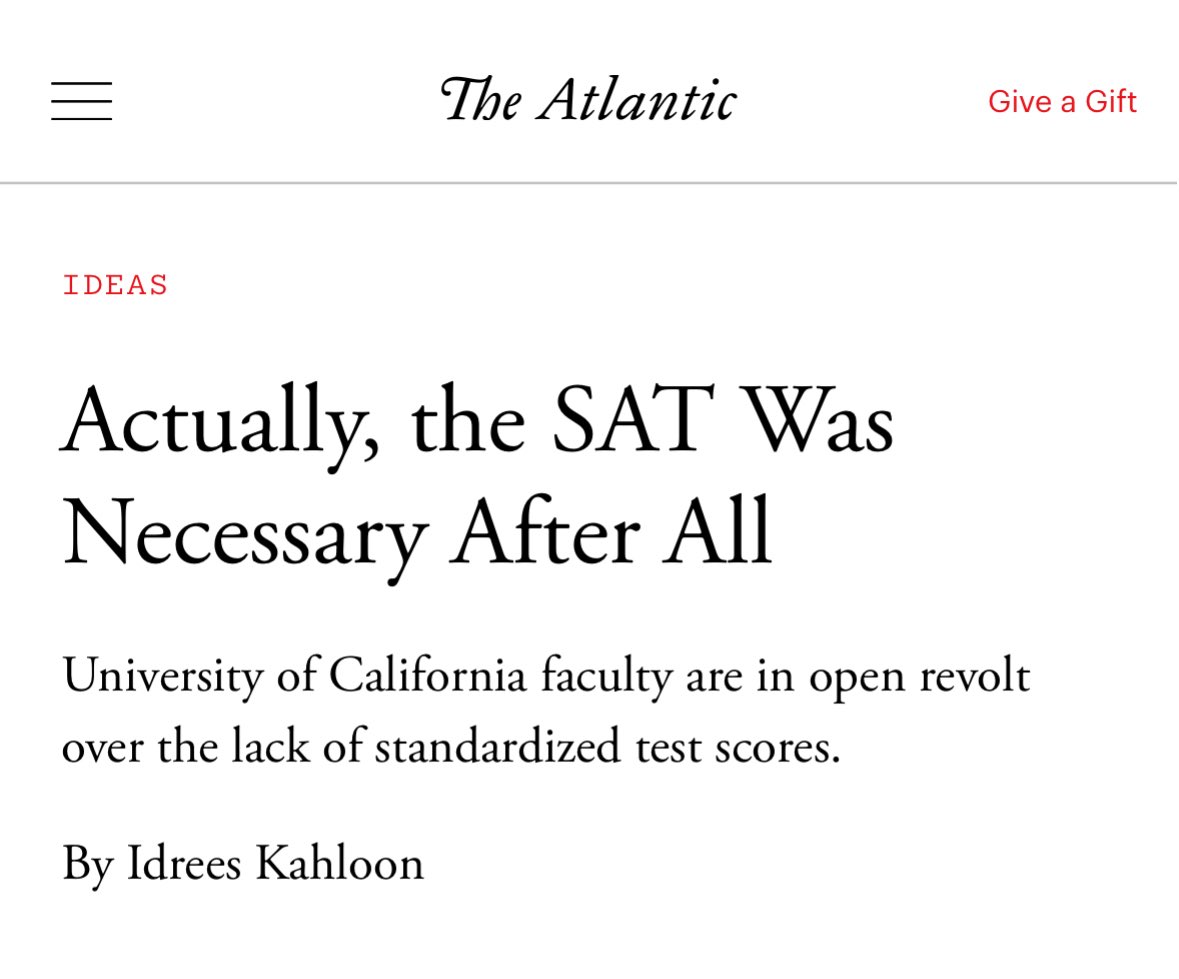
And just like that, the entire Ivy League has returned to standardized testing!
The experiment in letting in unqualified students is over!
3
14
1,229
Jun 12
So many examples of wealth left to charities which then work as hard as possible to disgrace the creator’s intent.
When the great Andrew Carnegie said: if you die rich you die disgraced, he meant use the same capital allocation skill that made the wealth to spend it IN YOUR OWN LIFETIME where you can allocate it. All of us can do this.
Jun 11

NEW: The Mellon Foundation gave $1.5 million to establish a "center for the defense of academic freedom."
In audio I've obtained, the group's leader says his goal is to undermine the newly launched classical civics centers: "map who these f---ers are... and knock them out." 🧵
1
6
670
Jun 12
Carnegies autobiography is very well worth reading (forget the biographies).
He identified that libraries, and reducing the chance of destructive conflict (centre for peace, trying to prevent World War One) were the most useful things he could accomplish and spent the largest fortune the world had seen created to those ends. He also founded a charity, which was almost certainly this kind of Mellon mistake.
2
308
Timothy Bates retweeted

Jun 11
NEW: The Mellon Foundation gave $1.5 million to establish a "center for the defense of academic freedom."
In audio I've obtained, the group's leader says his goal is to undermine the newly launched classical civics centers: "map who these f---ers are... and knock them out." 🧵
144
1,263
4,503
514,887
Timothy Bates retweeted

117 billion people have inhabited this planet.
98% of them never saw a single invention in their lifetime.
You are starting your career at the dawn of the AI revolution. There has never been a better time in human history to start building.
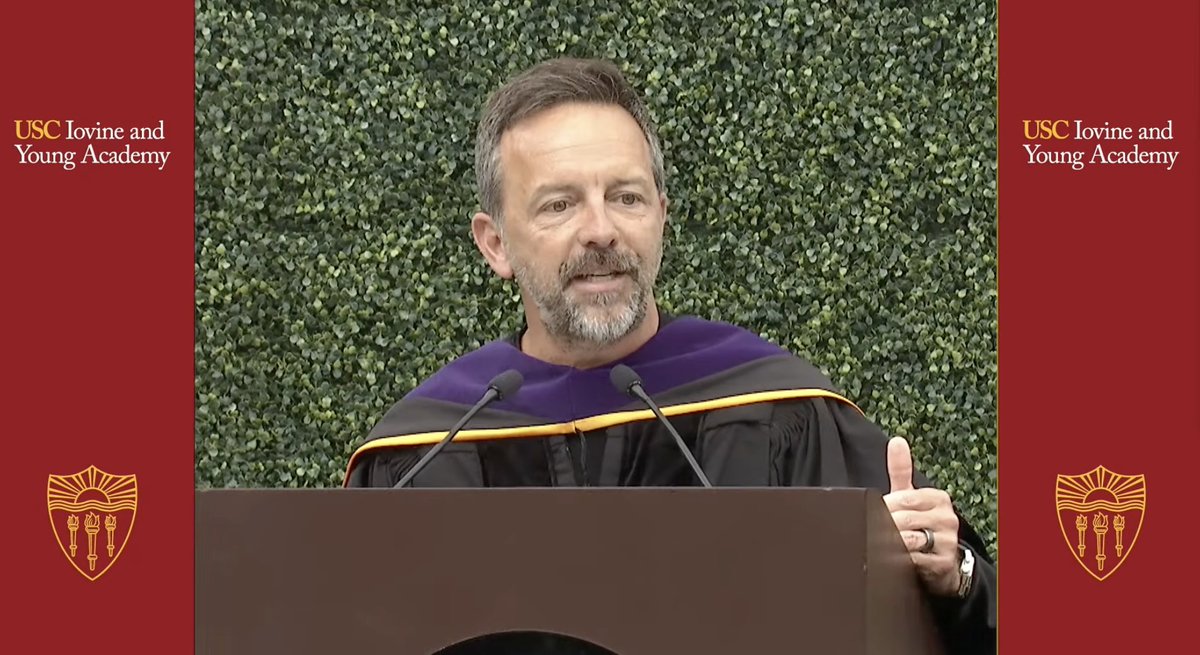
@altcap at USC Iovine & Young Academy's commencement 2026

Advice from Brad Gerstner (@altcap) to the class of 2026 at USC Iovine and Young Academy:
You are starting your career at the dawn of the AI revolution. There has never been a better time in human history to build.
Become the most aggressive user of AI in your field.
Momentum is a superpower. Be biased to action.
As IQ gets commoditized, EQ rises. Taste, empathy, storytelling, and courage matter more now, not less.
Pick your boat wisely. Bet on the future.
And no matter what you do, make it matter.
Congratulations, class of 2026.🎊
3
11
112
109,605
Jun 11
Smart people know how the economy works. So much so that economic knowledge is an excellent IQ test.
Lin, C.-A. and T. C. Bates (2022). "Smart people know how the economy works: Cognitive ability, economic knowledge and financial literacy." Intelligence. doi.org/10.1016/j.intell.202…
Jun 10

We Asked AI To Simulate What Would Happen If AOC Was Forced To Learn Economics
Made with @grok.
3
18
1,787
Timothy Bates retweeted

Jun 10
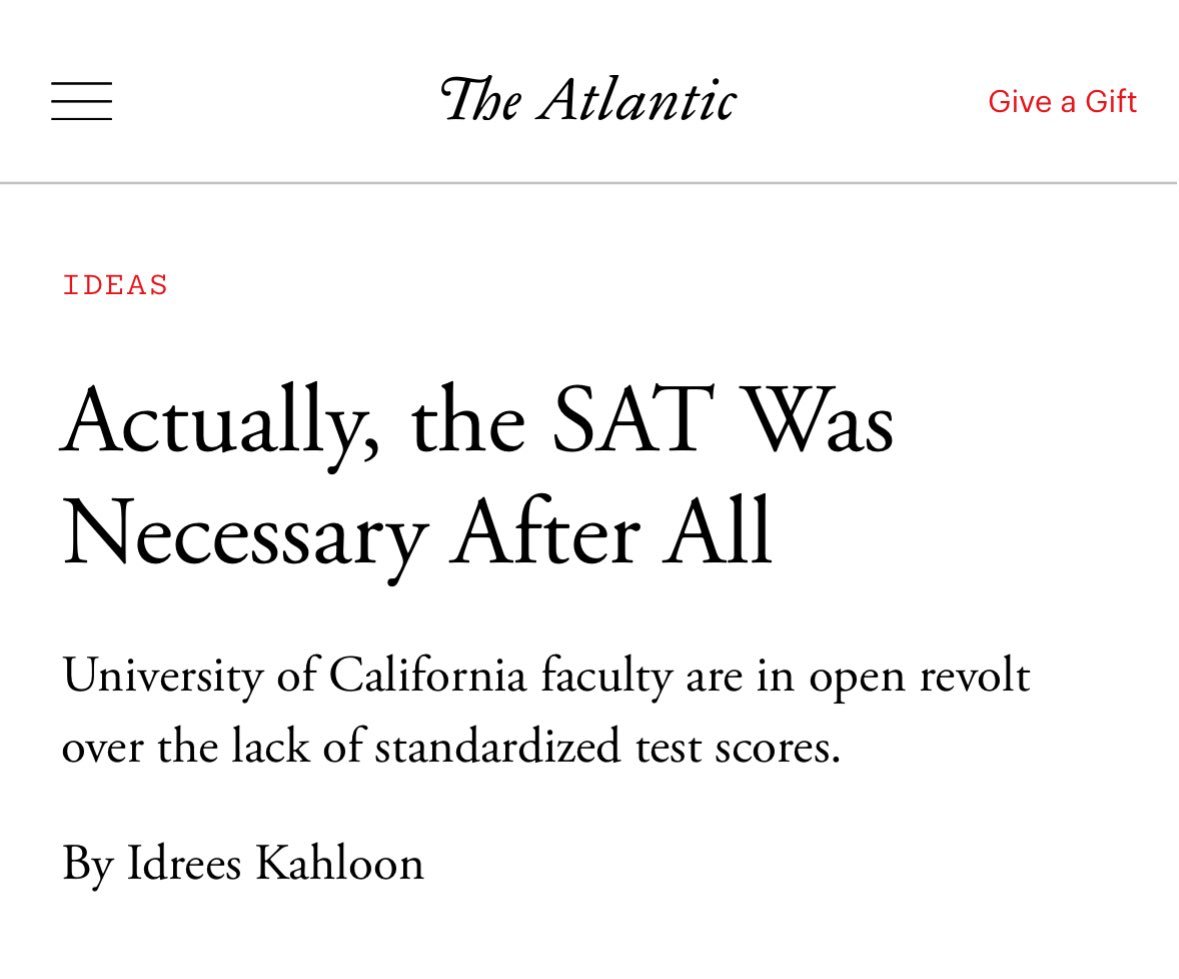
First in a 10,000-part Atlantic “Actually…” series.

170
1,041
15,171
498,178
Timothy Bates retweeted

Jun 9
This is so tiresome, Sasha. You've just been caught red handed trying to suggest Turkheimer 1998 says the OPPOSITE of what any fair minded reader would conclude with regard to his (nominal) support for compatibilism in that piece. You also got just caught out trying to project your misinterpretation of Turkheimer's position in 1998 into work he only authored years later. When these silly (and deceptive) attack-lines failed, you instantly tried to find another angle without stopping to catch a breath. It's obvious that you're simply running interference for Turkheimer and looking for cheap ways to deflect from my critique (while also trying to save face after your bad faith criticisms have failed).
It's pathetic really. Any good faith interlocutor would realize it's irrelevant whether Turkheimer calls himself a compatibilist or not (even though it's mildly embarrassing that he doesn't appear to know what the term means). What is relevant is whether his argument that known genetic and environmental causes of behaviour curtail human agency holds up. It's hard to see how it can (why would known causes of human behaviour curtail our agency while unknown causes of behaviour do not?). Even Harden has realized this position makes no sense and tries to distance herself from it in her latest book.
It's amazing how often I've had to call you out for deliberately misrepresenting papers from people you see as ideological enemies (e.g. Robert Plomin, Ian Deary, James Lee, Jonathan Anomaly) and also deliberately misrepresenting the remarks of people you consider ideological allies when you think it can provide cover for them (e.g. Rebecca Sear, Eric Turkheimer). It's a regular hallmark of your interventions and completely poisonous to honest discourse. It's inexcusable behaviour in a scholar and I honestly don't know how you keep getting away with it. It's a standing indictment on the current state of academia that you do.
I tried to politely draw a line under this tedious exchange 13 hours ago, but you insisted on spamming my timeline late into the evening, so I guess I'll have to mute you now. Keep shouting into the void if you feel you must. I'm not going to waste any more time fending off your dishonest and petty attacks.

2
10
72
7,041
Timothy Bates retweeted

Jun 9
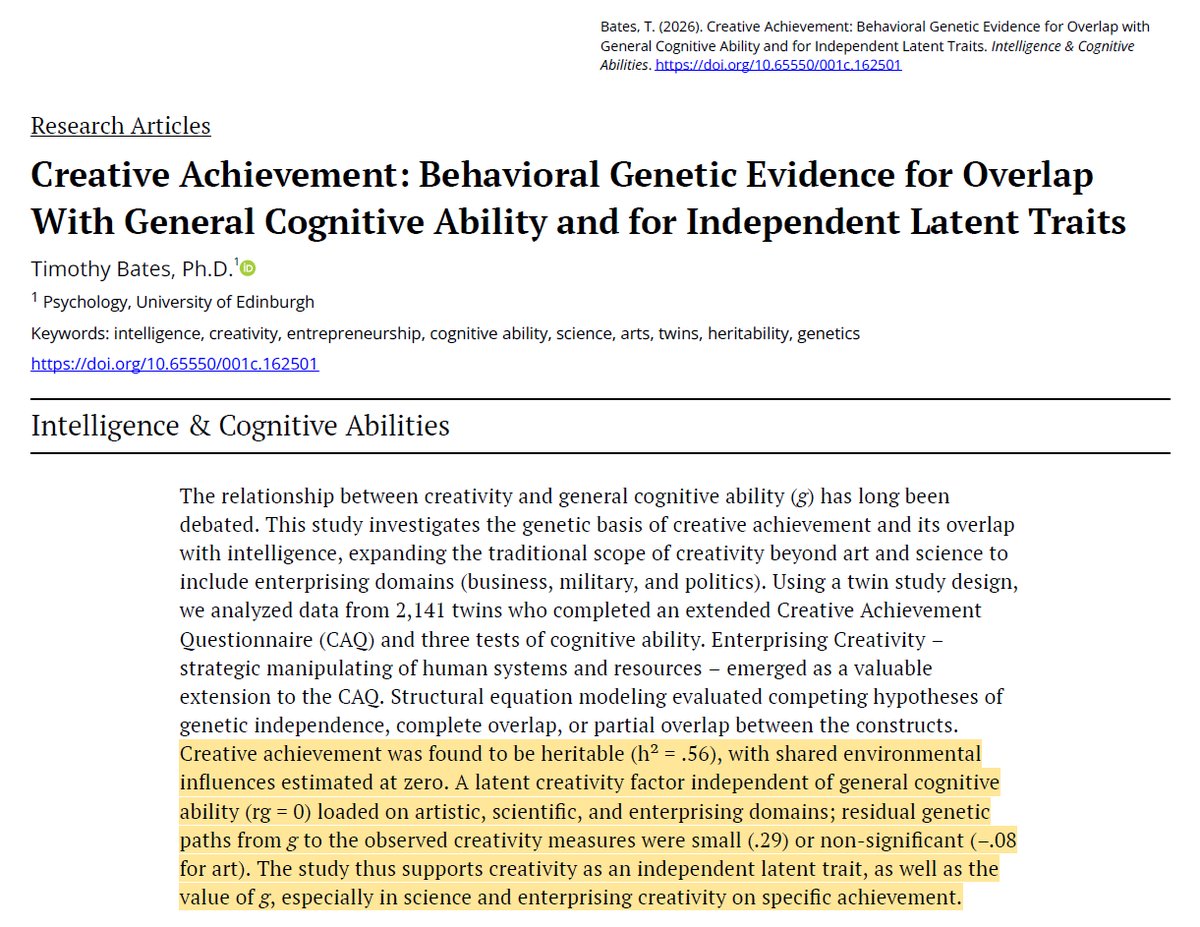
🧠 Is creativity mostly just high intelligence?
A new twin study in @ICAJournal says no. There’s a large genetically independent component.
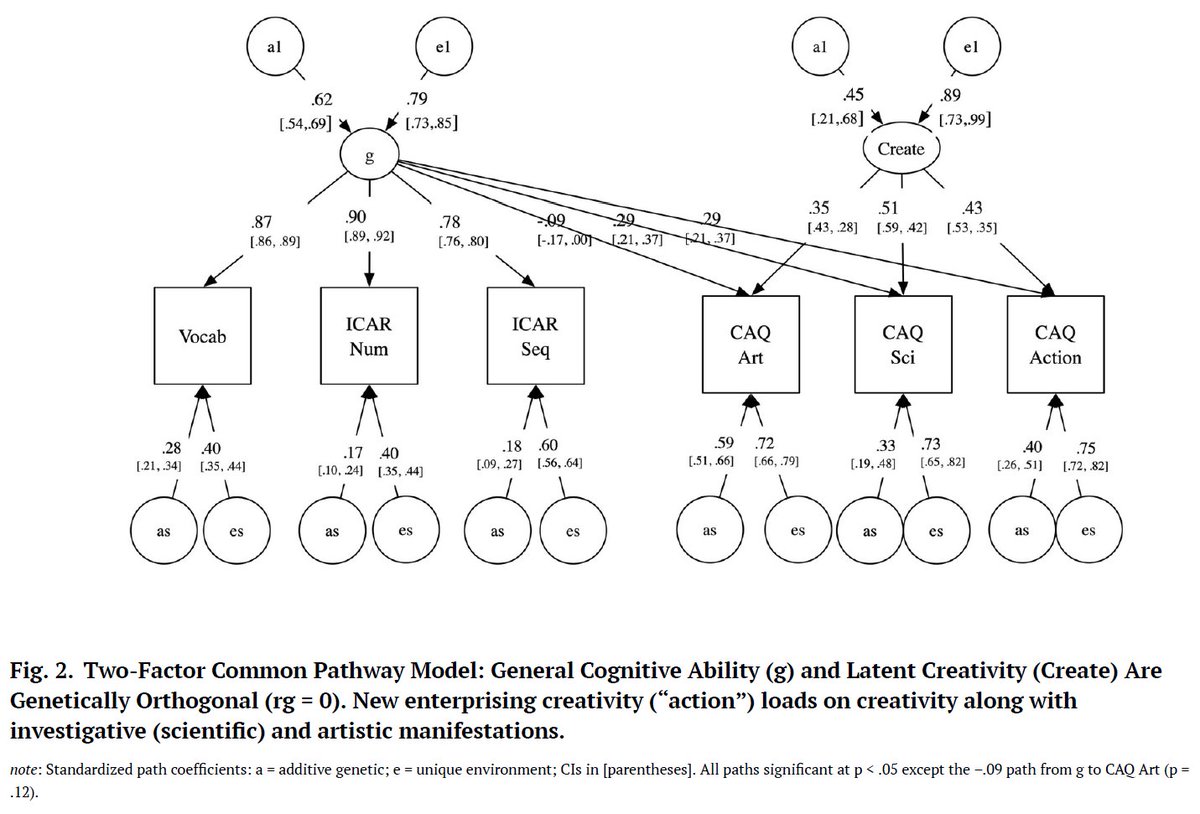
@timothycbates analyzed intelligence test scores and creativity data in three domains: business, military, politics/leadership). Key findings:
➡️Creative achievement is highly heritable (h² ≈ .56), shared environment ≈ 0
➡️Latent creativity and general intelligence are genetically independent.
➡️g explains only ~10% of the genetic variance in creative achievement
These findings support a hybrid view: g helps in many domains, but creativity has substantial unique genetic architecture. As Bates explains, "the genetic architecture of real-world creative achievement is not merely a downstream consequence of general intelligence but reflects a separate, heritable system that operates across artistic, scientific, and enterprising domains" (p. 6).
Read the full open-access paper: doi.org/10.65550/001c.162501
54
97
658
1,595,858
Timothy Bates retweeted

Jun 9
Berkeley Professor Mina Aganagic:
“‘I realized that for students to follow me…I had to start reviewing basic algebra stuff, like fractions.’ The lack of mathematical fluency, Aganagic said, extended even to ‘the meaning of equals in an equation.’”
111
429
3,003
144,628
Timothy Bates retweeted

Jun 9
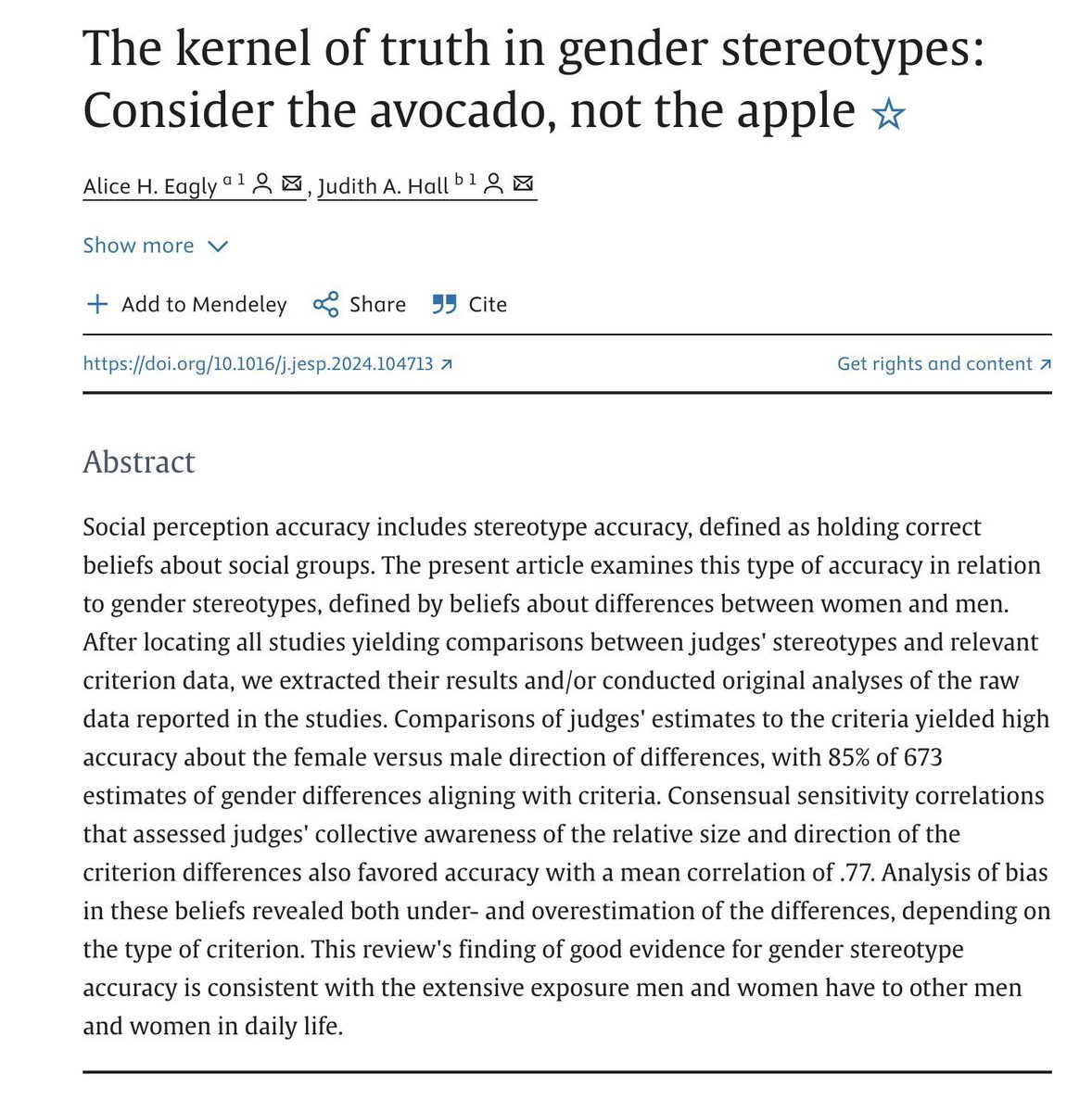
Stereotypes are true and accurate:
Alice Eagly and Judith Hall conducted a meta-analysis on the accuracy of stereotypes regarding differences between men and women.
They confirmed that these stereotypes are highly accurate: 85% of the 673 estimates were in the correct direction.
There is no reason to "fight against stereotypes" on principle. On the contrary, stereotypes are essentially truths about the world.
27
123
731
54,552
Timothy Bates retweeted

Jun 8
I'm surprised by the unreasonable effectiveness of giving people a small amount of money.
When I launched the "Fast Biology" microgrants, people told me that:
1. You can't do anything in science with $1,000.
2. Nobody would submit good ideas, because good ideas are worth much more than $1,000.
#1 is mostly true, and #2 is partially true, but neither is absolute. I did get many excellent ideas, especially from people who are too time-constrained to work on them. In some cases, $1,000 was enough to build an entire prototype (especially in hardware.)
There seem to be a few benefits in giving microgrants, though:
1. They can subtly nudge people toward working on problems they normally wouldn't (and this can, in rare circumstances, take them down strange rabbitholes that then change the course of their whole life.)
2. They act as a vote of confidence, making it easier to raise additional funds from other sources. People tend to just follow the examples of others; VCs often copy investments made by other VCs, for example, and giving someone even a fake, made-up award seems to elevate their "prestige" in a tangible way.
3. They allow the funder to find interesting people. Giving out these grants connected me with ~6 super intelligent people who I was not familiar with ahead of time. Small amounts of money are a mechanism to surface talent.
I continue to meet people who are working on super important or beautiful problems, and yet who struggle to raise even $10,000 for their ideas, simply because they are a) bad at explaining their ideas or b) not working on a problem that is clearly VC- or philanthropically-fundable. I'd like to support as many projects as possible. Therefore, in the next week or so, I'll open up another ~$100K in microgrant funding. (When this goes live, you'll hear about it at my new microgrant website, tinybio[dot]org.
More people with wealth should consider giving microgrants. If you'd like to do this for biology, but don't have time to allocate funds, I'd be glad to support or advise directly. My email is nsmccarty3 [at] gmail [dot] com.
16
37
364
33,748
Jun 9
Optimism and pessimism are independent traits, and best understood as the efficiency of storing recipes for success and recipes for failure, respectively.
Probably the catastrophic failures of the 20th C stored up such a stack of memories for the continent that, when viewing an sunny upland slope like AI, the Greta/macron mindset fills with explanations of why it will fail and how to stop it.
UK/EU needs electroshock therapy to let the good news system restart!
Instead, like jealous Saturn, they drive away any remaining thriving offspring lest they be consumed. Sad.

.@dambisamoyo says Europe approaches innovation with a glass-half-empty mindset, while America tends to see the glass as half full.
"Europe generally thinks about things as glass half empty. The United States tends to think about things as glass half full."
"Whether it's energy, AI, or the climate transition, Europe's shorthanding it. The response has always been, 'Oh my gosh, we need to regulate this thing. We need to curb emissions.' I'm not saying it's all bad. I'm just saying that they tend to err on the side of risk mitigation, as opposed to investing through it and figuring it out. I think that's part of the culture."
1
2
355
Jun 9
People telling you that acquiring skills like reading lower creativity, or "deficits are a gift" are not just wrong, but get reality upside-down. Better reading predicts high creative scores.
It's fine having some cope about oneself, but arguing specific disabilities are gifts is like arguing cancer is a blessing is mad (and denies kids interventions that work).
sciencedirect.com/science/ar…
1
13
545
Jun 9
Just went back to a tweet I'd bookmarked from a great researcher: Deleted.
For scientists, whose actual profession is to robustly document "what?" and ask "why?", deleting your X account is shameful , TBH.
Erasing history for the sake of keeping your head down. Yet so many sciencers did exactly this. Like the least costly thing they could do, but no…
2
349