
Old school cypherpunk believer. Director, Canton Network Ecosystem at Digital Asset
Joined November 2025
- Tweets 136
- Following 28
- Followers 225
- Likes 831
Photos and videos
Pinned Tweet

Feb 12
If you were absolutely committed to:
- Bringing the global financial system onchain, linking all existing institutions into an interoperable network accessible to anyone
- Adding a fully decentralized crypto ecosystem inside that network, with atomic composability among traditional and crypto assets
- Allowing anyone in the world to personally own a piece of that network, with self-custody of that ownership stake
- Preserving privacy for everyone
What would you build?
If your understanding of Canton doesn’t fit this picture, let’s dig deeper.
2
2
12
790
Wayne Collier retweeted

Jun 15
Fed research paper argues that digital money (stablecoins, MMFs, tokenized deposits) can be "fragile" even when perfectly backed, due to the properties of the chain. The core argument is that the rails can cause a "run on the bank."
@CantonNetwork prevents this risk
Jun 2

New #FEDSPaper: The Fragility of Perfectly Safe Digital Money: federalreserve.gov/econres/f… #EconTwitter
2
6
25
1,523

Great summary of Canton by @bc1pxxx at Five North.

2
184
Wayne Collier retweeted

Apr 28
It is easier to do a series of micro hard forks, in comparison to one big one. But, the incentive for successful blockchains is to squeeze all the changes into one big hard fork, since the politics of activation is the difficult part.
1
2
5
1,191
Wayne Collier retweeted

Apr 16
We need to build a cultural movement.
This is how @CantonNetwork hits escape velocity. 👇
@CantonFdn $cc
19
19
116
28,353
Apr 14
Slowly realizing the original vision...
Apr 14

In 1994 Nick Szabo invented smart contracts.
We were told Ethereum delivered that vision.
I read the 1996 paper. They built the opposite.
@CantonNetwork made it a reality. Here's how. 👇
@CantonFdn $CC
2
1
8
456
Wayne Collier retweeted
Apr 10
My top 10 projects on @CantonNetwork.
The video ran long (12 min) but I wanted to give these projects the respect and time they deserved.
Also, if you're watching you should follow. Enjoy.
@CantonFdn $cc
26
29
141
6,733

Wayne Collier retweeted

Apr 7
If I permit myself one bearish EthCC review tweet, it’s that the EF and ethCC leadership are very misguided on Ethereum (the Computer)’s decentralisation. Behind closed doors they are again trying to rush through issuance caps, and think Eth’s Nakamoto coefficient is the wrong measure of decentralisation. They care more about “hard money” and their tax bills than Ethereum being incorruptible.
I think they misunderstand why Ethereum is valuable, as well as the purpose of stake and issuance:
You can make a blockchain with tiny issuance, but unless it’s decentralised no one will value it. You can change economic policy to favour the 0.4% of solo stakers, but they don’t control fork choice. You can claim $X billion dollars are enough economic security to prevent the manipulation of finality, but censoring what you attest to isn’t slashable so that doesn’t matter in practice despite mattering in theory.
Where I mostly agree with them is that any change of economics needs massive legitimacy, and I think lean Ethereum is a legitimate reason to rethink economics to ensure block building proving is meaningfully decentralised. I think we agree that social slashing is not a realistic enough threat right now. I think we also (mostly) agree that a Nakamoto of 5 is far too low for the world computer (even if some dispute it being the most important measure). I think we also collectively believe that everyone with opinions on issuance are being genuine and mean the best for Ethereum, but are likely ‘feeling different parts of the elephant’.
Constructive next steps are publishing credible data on the cost to operate stake, Ethereum’s Nakamoto coefficient, the gini index of its withdrawal credentials, R&D on EIPs that mitigate centralisation pressures, analysis of Ethereum’s principal agent problem in staking, and how we might 10x Ethereum’s decentralisation in a post-quantum future.
A centralised Ethereum is the ultimate financial panopticon, is worse than the status quo, and is something I worry deeply about bringing into the world. I think the majority of Eth people agree and want to prevent that future. If so, we need to bring CROPS to the consensus layer, and not allow absolute power to corrupt absolutely; by no means an easy feat, but one I think we have rough consensus on vying for. Obol will remain steadfast on the front lines of this battle.
3
2
27
2,226
Wayne Collier retweeted

Apr 7
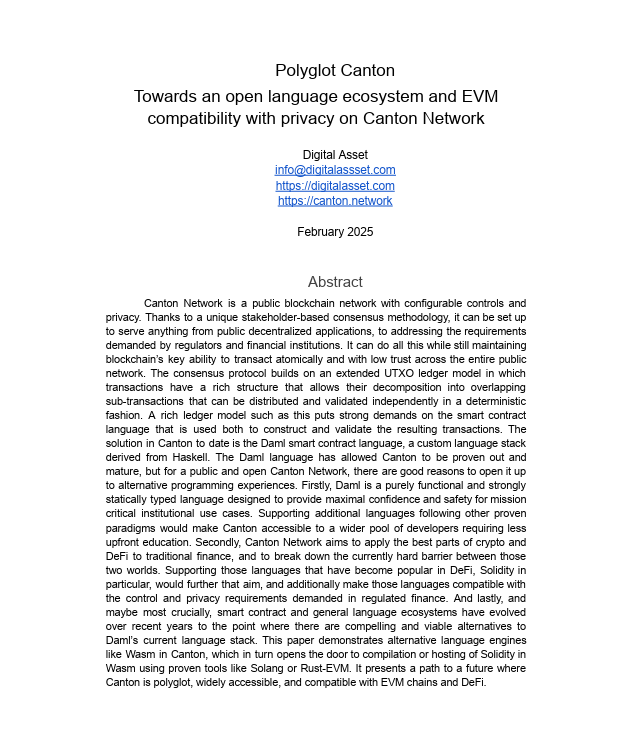
Canton's Polyglot Vision – From Whitepaper to Reality (and Why It Matters)
1/ Most blockchains lock you into one language and one virtual machine.
Canton is different. Last year, @DigitalAsset published the Polyglot Canton Whitepaper, a blueprint for a truly multi-language, multi-VM network that keeps Canton's superpowers: privacy, atomic composability, and institutional-grade controls.
Today, that vision is no longer theory. It's shipping with @ZenithFdn.
Let me break it down simply.
2/ What “Polyglot” Actually Means Here
Canton separates two things that are usually glued together on other chains:
1. The ledger model (extended UTXO sub-transaction privacy)
2. The execution interpreter (the engine that actually runs your smart-contract code)
This clean split lets Canton support multiple languages and VMs at the same time, Daml, Rust (via SVM), Solidity (via EVM), and more, while everything still composes atomically in one transaction.
Quote from the paper: “The more cleanly the ledger model is separated from the language interpreter, the easier it is to support additional languages and virtual machines.”
That’s the entire unlock.
3/ Why This Matters (The Real-World Problem It Solves)
Solidity devs (90% of DeFi TVL) have never been able to bring their code to a privacy-first, regulated network.
Rust devs (Solana ecosystem, high-performance apps) had no clean path to Canton’s institutional rails.
Institutions want atomic DvP, collateral mobility, and not just tokenized RWAs, but mobilized RWAs, and, with all of that, they also need the confidentiality, control, and reliability that public chains have yet to provide at scale.
Polyglot Canton gives everyone the best of both worlds: familiar languages Canton’s privacy and atomicity.
4/ How It’s Coming to Life with @ZenithFdn
We are the team turning the whitepaper into production code. We have built Canton’s canonical EVM and SVM execution layer, the exact polyglot extension the paper called for.
a. Full EVM compatibility → Solidity contracts run with zero changes.
b. SVM/Rust support is roadmapped → high-performance, memory-safe contracts.
c. Atomic cross-VM composability → a Solidity contract can call a Daml contract (or Rust contract) in a single private transaction.
d. Privacy preserved at every step via Canton’s sub-transaction views.
Zenith is already a Tier-1 Super Validator and the official EVM/SVM application layer. What the whitepaper described in theory, we are delivering in practice.
5/ What This Means for @CantonNetwork
(The Big Implications)
→ Developer explosion: Hundreds of thousands of existing Solidity and Rust devs can now build on Canton without learning Daml first.
→ DeFi meets real finance: Privacy-preserving versions of Aave, Uniswap-style logic, and distributed RWAs can run alongside institutional workflows.
→ Massive RWA and payments pipelines: Deals already in flight (tokenization stacks, stablecoin flows, collateral mobility) can now use battle-tested EVM code while gaining Canton’s regulatory superpowers.
→ Network effects on hyperdrive: One unified ledger where public innovation and private control coexist = no more “pick a side” between crypto and institutions.
The whitepaper said: “A future where Canton is polyglot, widely accessible, and compatible with EVM chains and DeFi.”
That future is arriving in 2026.
6/ Bottom line:
Canton was never meant to be “just another smart-contract chain.”
It was built to be the unified venue where every type of developer and every type of capital can meet privately and atomically. This is a true "network of networks," aka the global synchronizer.
@ZenithFdn is making that vision real, one VM at a time.
If you’re a Solidity dev, Rust dev, or institutional builder who thought “Canton is Daml-only,” it’s time to take another look.
The polyglot era of Canton is on its way.
What will you unlock?
(And yes, the full whitepaper is excellent reading: canton.network/hubfs/Canton%…)
Zth.
12
18
73
8,531
Wayne Collier retweeted
Apr 5
The first time I met @wesarn_real, he told me, "We're going to Trojan horse the banks onto crypto." A week later, I was on a plane to NYC to start DA.
Never loved "Trojan horse" because we're helping TradFi, not harming them. But we've definitely been Mr. Miyagiing TradFi into adopting crypto-native properties, one wax-on at a time. We'll get there eventually.
3
5
26
2,891
Wayne Collier retweeted
Mar 30
No, aggregate properties of private assets, such as total supply cap, cannot be verified by every user on Canton yet. If this is the main criticism of Canton, I wholeheartedly accept it!
All of the claims people are throwing on X about Canton not being decentralized, not being cryptographically verifiable, and requiring complete trust in institutions are red herrings. Your observation is the only correct critique of Canton I've seen yet.
I agree that publicly proving aggregate amounts is a desired property and that all transparent chains have it. zkSync Prividiums also have it, under the assumption that the entire ZKP stack works as advertised. Canton does not (yet) have this property.
Now that we've distilled it to the core property that Canton lacks, we can talk about why the importance of it is completely overblown, and why this hasn't been a concern in practice for any users:
(1) Many privacy assets on Canton have decentralized BFT issuers. You're not trusting any single institution; you're trusting a BFT consensus. A single honest Validator can report and cryptographically prove dishonest behavior.
(2) For asset-backed tokens, Canton has the same trust model as transparent public chains. You ALREADY rely completely on an independent auditor to review that the aggregate amount on-chain equals the off-chain amount. Those same auditors cryptographically and independently audit the on-chain amount in Canton. We're already trusting stablecoin providers their auditors to maintain the on- vs off- chain reserves, so the trust model on Canton is exactly the same! But Canton makes it much better - we're moving to a world where tokenized US Treasuries are on-chain, so the auditor gets cryptographic independent verification of the peg. If anything, Canton is the ONLY blockchain bringing on-chain cryptographic verifiability of RWA reserves! Repo transactions on Canton are the only repo transactions in the world where there's distributed cryptographic verification that your asset is fully backed!
(3) For fully dematerialized assets, the registrar is legally allowed to change the aggregate amount. The important thing is that it's auditable by the issuer, not that it's publicly auditable. If DTCC tells you that Tesla has 3.3b shares outstanding, even if you could verify that aggregate number on-chain, can you independently verify that that's the correct amount? Only Tesla can say whether that number is correct so they're the only voice that matters from a trust-model perspective.
All that said, I agree that publicly proving aggregate properties is a nice-to-have. But it's never been desirable enough to justify the trade-off of adding significant complexity to the software stack. Running a Canton Validator in a TEE would be dead simple and give you that property (with different trust assumptions), yet in practice, no one seems to think it's important enough to justify even that modest investment. This is actually one area where retrofitting ZKPs on top of Canton would not be very hard!
By relaxing this single requirement, Canton has been able to add many other security properties.
x.com/DejaRu22/status/192990…

View every decision as a trade-off. Because it is. Saying no to something is saying yes to something else. Saying yes to something is saying no to something else. Basic, yet most are not even capable of embodying a level of lucidity that clearly evaluates choices under this lens.
3
6
27
13,201
Mar 30
For anyone who wants to master the facts on decentralization in Canton, here's a good place to start. Canton allows decentralized, untrusted operators, and the Canton ecosystem has already applied all these methods in various applications and subnets:
docs.digitalasset.com/operat…

Canton’s “Trusted Operators” Are the Real Single Point of Failure
“Canton is not a blockchain, and it's NOT a semantic difference.
This materially limits their ability to protect transacting parties, which is the entire reason the blockchain technology exists.”
- Alex Gluchowski (@gluk64)
Canton warns that complex systems like ZK carry inevitable bugs that could spread undetected. Yet their own network rests on a handful of trusted synchronization domain operators and participant nodes whose keys and behavior control data segregation and state ordering.
If those operators are compromised, by insider action, credential theft, or sophisticated attacks, manipulated transactions and opaque UTXO chains can propagate silently across domains with no independent mathematical check to detect or halt them.
There is no external verifier, no redundancy layer, and no structural containment when a domain fails. Regulators and institutions are asked to accept this as “enterprise-grade” while Canton lectures others on systemic risk.
The irony is sharp: the very complexity they fear in cryptography is replaced by human and operational trust assumptions that history has shown fail far more often and with less warning.
In the end, zero-knowledge proofs offer what Canton cannot: cryptographic finality that stands independent of any operator’s honesty. ZK turns verification into mathematics, provably correct computations that anyone can check without seeing the private data. Bugs become detectable and containable through redundancy and open scrutiny, not hidden behind promises of “trusted” parties. This is why ZK infrastructure redefines safety in tokenized finance: it replaces fragile human trust with unforgeable truth.

3
12
699
Mar 30
I'll take a moment for the Canton-native cypherpunks out there.
At least as I have worked on / dreamed about it, cypherpunk never meant "rejecting Traditional Finance". It meant being able to move freely in and out of tradfi, and across alternate financial realities.
For me, cypherpunk means:
- Privacy above all. Cypherpunk means using ZK where it's ready and applicable, and simple cryptography for everything else. Having no option but exposing all of my data is a bridge too far.
- Individual control, meaning self-custody. The level of self-custody available in Canton today is beyond what most could imagine when cypherpunk got started, and it's only going to get better.
- Asymmetry. Asymmetry means different parts of the network function differently from each other, and that means power in one part of the network can't scale to take over the entire network. Not even massive wealth or government force can dominate.
- Decentralization. Decentralization means many centers of power. Asymmetric decentralization means those centers of power can be radically different from each other, mutually independent, and impenetrable. Asymmetric decentralization is where Canton shines.
By contrast, symmetric decentralization (Bitcoin, Ethereum L1) copies everything, and works the same way everywhere. That's fine for resilience, but it sacrifices local control. When two mining operators control the majority of Bitcoin, I'm uncomfortable. Isn't concentrated power the inevitable tendency of collectivism?
- Composable interoperability. If I can't move freely into and out of TradFi, I'm walking away from the vast majority of the world's wealth and liquidity. Why would I do that? I want full control of all my finances, not part. Canton gives me a path there. And if I can have full control over my own actions, that means institutions also get full control over their own actions. And if we do business, we mutually agree on the terms. I don't see any contradiction there. I can increase my own rights and control over my own destiny without taking rights or control away from others--except from those whose only value comes from controlling me.
There's no rift here between me and @ShaulKfir, by the way. Shaul's reacting to the recent co-opting of 'cypherpunk' to mean 'counter-cultural'. Cypherpunk really just means private, asymmetric, and decentralized. It means having too many centers of power for 'counter-cultural' to signify anything at all. You do you.
Mar 30

Fundamentally, the core assumption of tradfi, is that people can’t be trusted with their own money or finances.
It’s inherently paternalistic and I reject it entirely.
Those that don’t reject that premise will always be enslaved.
Canton is great tech for slaves.
1
1
10
792
Mar 20
I agree with @YuvalRooz; thanks for a thoughtful article.
Markets need data!
So, what's next on Canton?
Publicly verified data is valuable, and so is private data. So you'll see an entire data economy emerge on Canton. You'll see individuals and institutions agree to sell appropriately aggregated data. You'll see explorers report on assets and subnets where all the data is public all the time. You'll see pools of attestors validate data sources and generate consensus public data feeds. We might even see some validator pools use ZKPs for the data they publish.
Canton is enabling a full range of data sources, from public and permissionless to fully private. No one is going to mandate what you have to share or what you have to hide: each app, each pool of validators, and each set of counterparties can decide what data they value, and whether or not to share it.
And the market will decide whose data to trade on, and whose to ignore.
3
3
38
1,353
Wayne Collier retweeted

Mar 16
What if we brought $CC burn to private subnets? :shock:
Mar 16

Great points in this thread. Canton has high burn on the Global Synchronizer today, and it's also true that there's a lot of traffic going through the private synchronizers that doesn't burn $CC yet.
The private subnets want to link to each other, and they'll do that over the Global Synchronizer (public layer). That interop will burn $CC.
You'll see the volume of these transactions among private subnets scale up on the public rails throughout the year. The transactions will remain private, but they'll burn $CC to use the gSync as their interop / transit layer.
34
24
134
22,974
Wayne Collier retweeted

Mar 11
Missed @Wesarn_real LIVE from the Empire State with @TheRollupCo?
Eric breaks down how Canton was designed to move beyond the private vs public chain tradeoff, and discusses the network’s tokenomics and governance structure.
Catch the replay.
x.com/i/broadcasts/1qKDzPvoP…
2
15
53
3,102