
part-time yapper; janitor @mementoresearch; prev @pendle_fi SWE
Joined October 2021
- Tweets 30,225
- Following 2,180
- Followers 9,063
- Likes 71,109
1,924 Photos and videos
Pinned Tweet

Jun 12
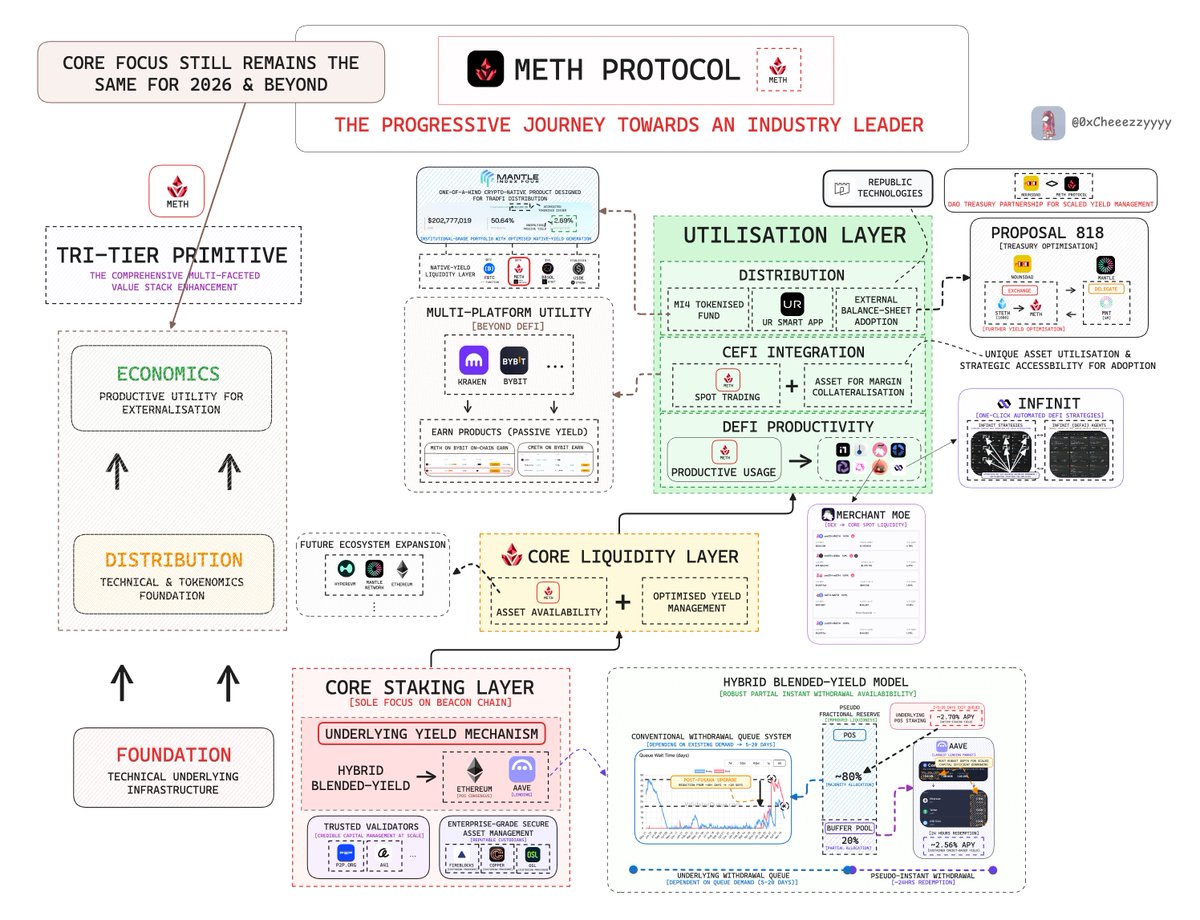
1/ Crypto adoption is entering a new phase.
For years, digital assets were largely viewed as experimental, speculative, or institutionally inaccessible.
But that narrative has changed meaningfully. BTC and particularly ETH, are increasingly being integrated into the product suites of major financial platforms, treasury companies, funds, and institutional trading venues.
As $ETH adoption deepens, the next question becomes less about whether institutions want ETH exposure, and more about how they should manage it.
Holding $ETH passively gives investors exposure to its long-term upside. But ETH is also a productive asset via PoS yield. For treasuries, funds, and sophisticated users, this creates an obvious opportunity: ETH should not simply sit idle.
The challenge is that native staking is not always operationally simple.
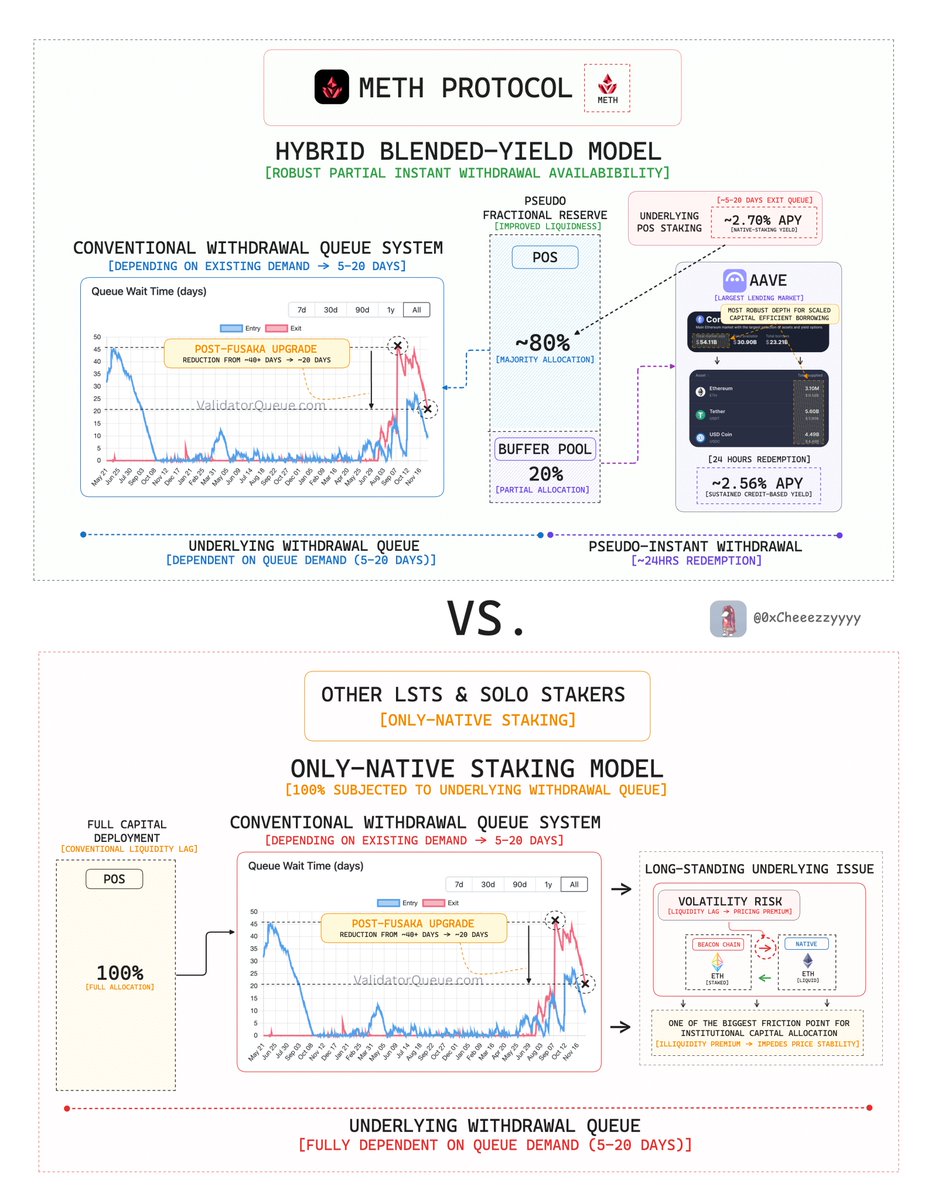
The rabbit hole goes deep → Validator management, withdrawal queues, liquidity constraints, custody requirements & exchange collateral limitations all create friction.
This is esp. true for institutions, where operational resilience, risk management, and liquidity access matter as much as headline yield.
This is where liquid staking becomes increasingly important.
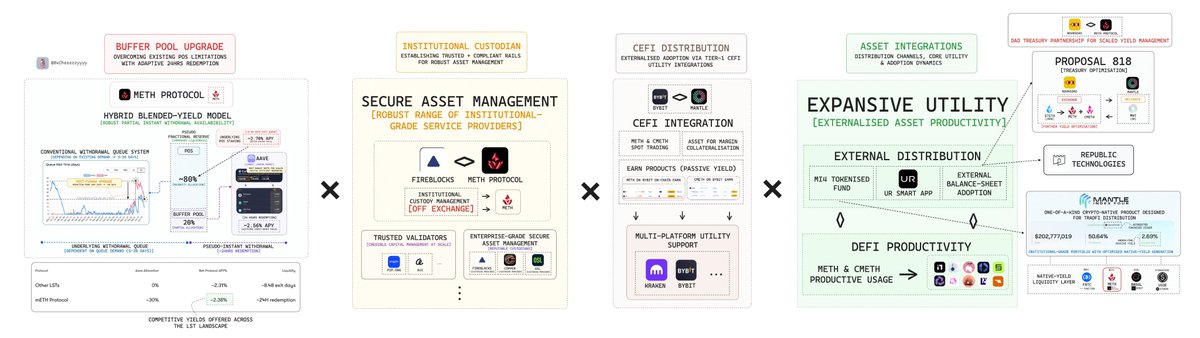
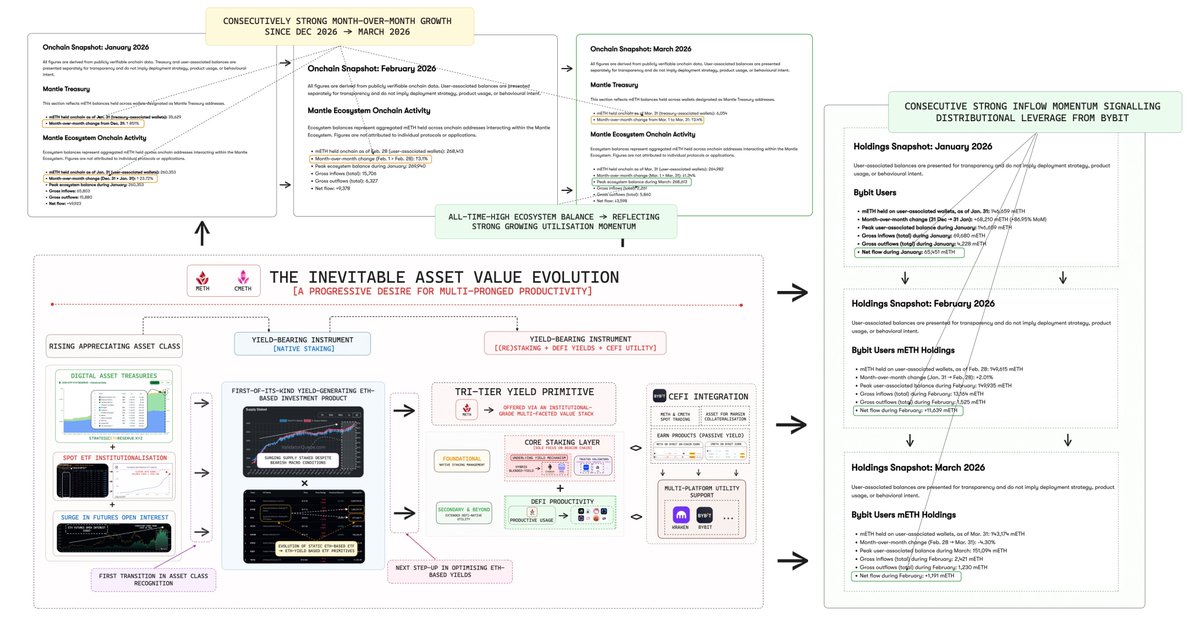
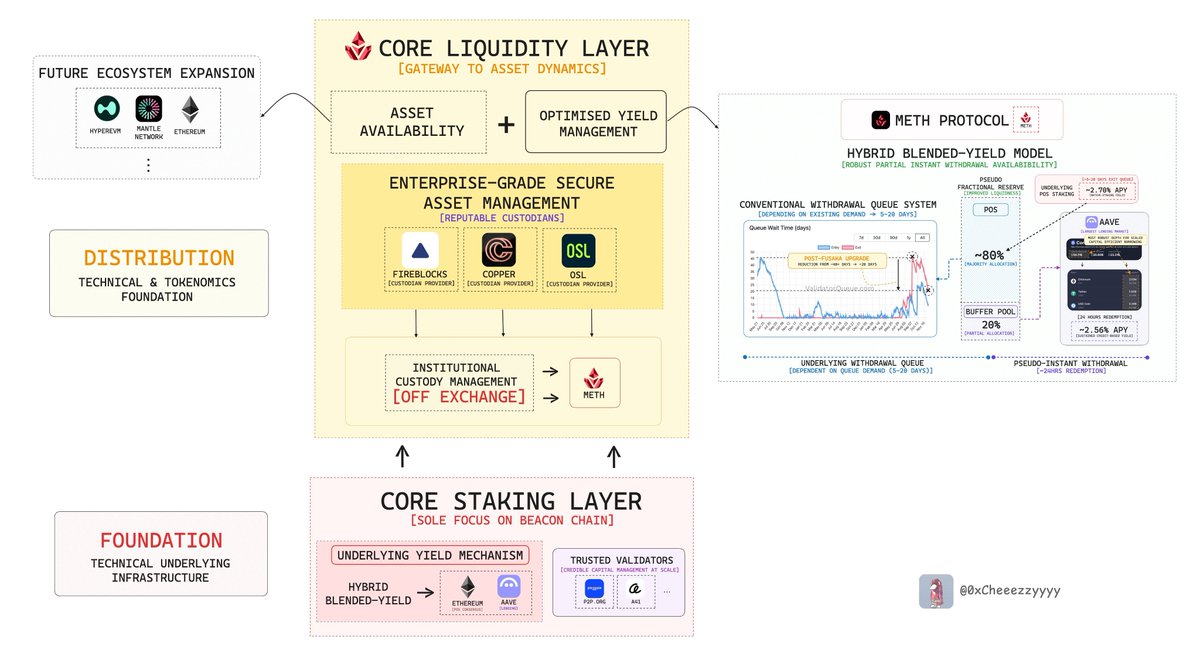
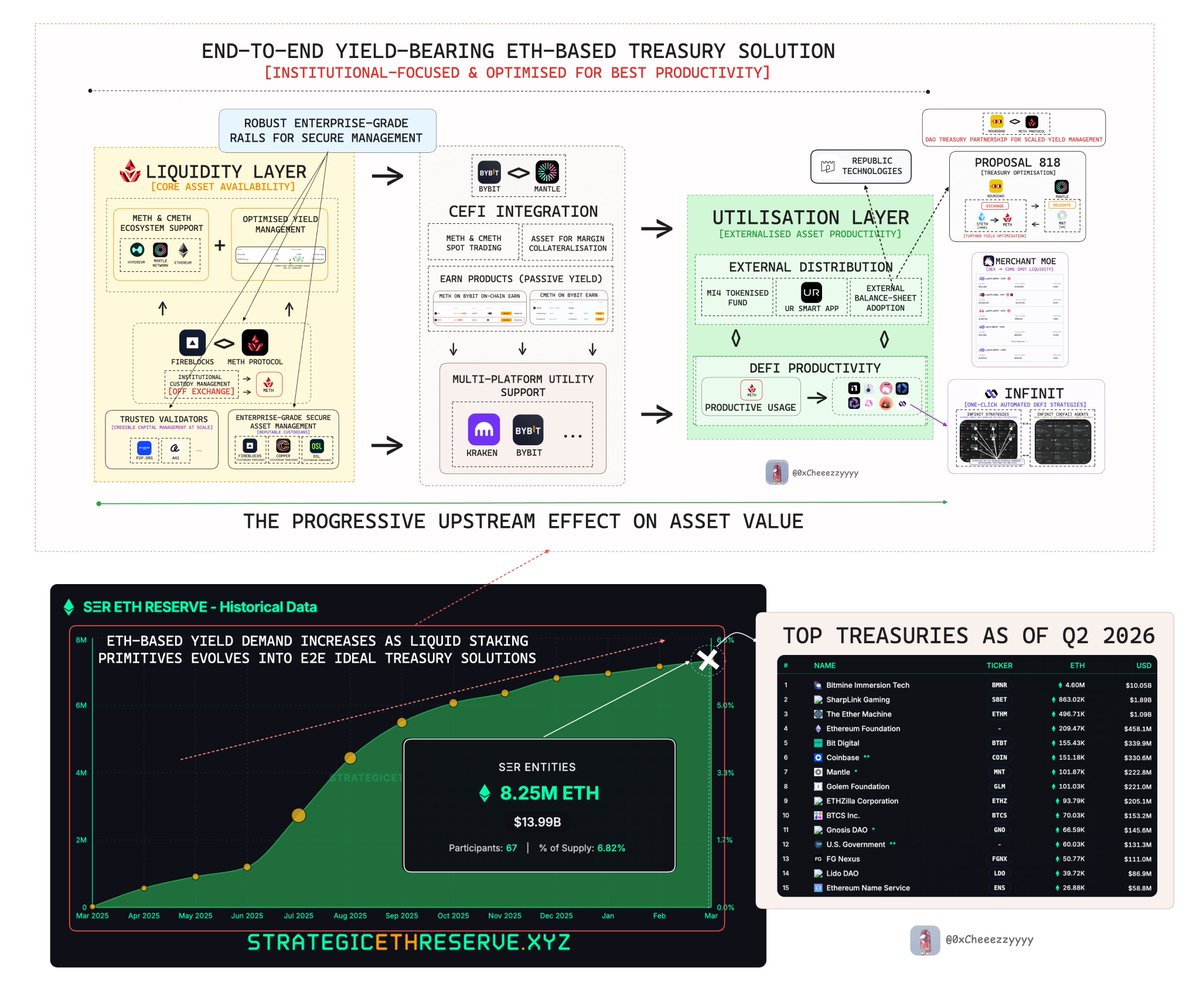
And in 2026, @mETHProtocol $mETH is positioning itself as one of the key yield layers for ETH 🧵
Jun 11

ETH staking is moving beyond yield alone.
“The next phase is about stronger security, deeper liquidity, and better distribution.” - @Defi_Maestro
Read more below on how mETH Protocol is building for 2026.

35
17
81
4,241
Cheeezzyyyy retweeted

Jun 10
14
14
143
27,492
Cheeezzyyyy retweeted

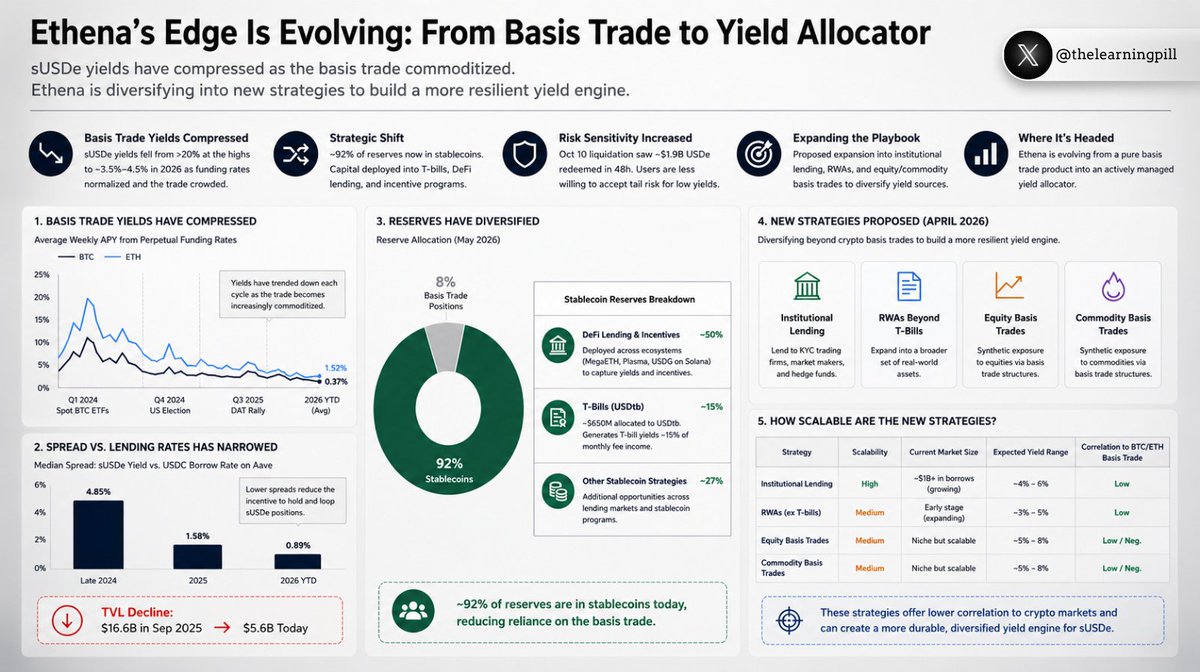
At the beginning, @ethena launched as one trade in a wrapper: short the perp, hold the spot, pass the basis to users. When funding ran hot, sUSDe paid north of 20%.
That trade is now crowded and commoditised.
Basis trade → drying up
Institutional lending → ~5%, uncorrelated
AAA CLOs → credit-driven, near-zero crypto correlation
So @ethena rebuilt itself into something else entirely = an actively managed yield desk
Yet, none of the new strategies will recreate the 20% era. They all converge near 5%, roughly where USDC on Aave already sits.
Which is exactly why the @coinbase partnership is a valuable pillar.
A diversified yield desk only works if it has somewhere to sell. Coinbase already routes ~63.5% of USD deposits on Morpho Base, around $2.3B, and Ethena gives those users one product that holds lending, RWAs, and basis trades at once instead of forcing them to pick.
Even modest penetration of Coinbase's stablecoin base would move deposits meaningfully.
The more interesting second-order effect is on $ENA itself.
Morpho has consistently traded at a premium to Aave because the market prices in the value of Coinbase distribution.
If Ethena becomes a core yield product inside Coinbase's stablecoin stack, the same premium logic could begin to apply to ENA, though that is a possibility the market may price in over time, not a guarantee.

22
6
70
4,699
Cheeezzyyyy retweeted
7 GUD READS 📚 (Edition No. 93)
A chain trading 94% below its high while five asset managers quietly pick it.
A token that erased 17.6% of its own supply with real revenue.
A robot that does nothing useful and still has a waitlist.
Catch up on the moments you've missed👇

23
7
51
1,671
Cheeezzyyyy retweeted

20h
In crypto, attention is shifting beyond tokens to the market structures, liquidity layers, and financial products that drive adoption and value creation.
Most of the alpha reads on the timeline this week circled around capital structures and AI agents.
Here’s a compilation of my top 10 articles of the week.
—
@StarPlatinum_ explains that the biggest risk to @Strategy is not its Bitcoin holdings, but the capital market structure that enables its accumulation strategy.
While investors focus on its 845,000 $BTC treasury, the real engine is investor confidence, equity premiums, convertible debt, and preferred shares funding continued purchases.
The main concern is, Strategy has transformed $BTC into a leveraged financial machine, tying its success more to capital markets and confidence rather than $BTC itself.
x.com/starplatinum_/status/2…
—
@0xfishylosopher argues tokenized startups could give the public access to the high-growth phase of private companies that stays private until late-stage IPOs.
The trend is being driven by rising demand for pre-IPO exposure, the growth of tokenized RWAs and perpetual markets, and frustration with crypto tokens capturing less value than venture equity.
The bigger idea is to reinvent the IPO through tokenized startup exposure, creating more liquid and globally accessible markets for venture-scale assets.
x.com/0xfishylosopher/status…
—
Bear markets do not create new problems, but expose weaknesses that were hidden during periods of growth.
Using @HyperliquidX as a case study, @netrovertHQ highlights how PMF, community ownership, transparency, platform-driven growth, and diversified revenue sources can create more resilience than incentive-driven models.
Long-term survival in crypto depends on building products with genuine demand, aligned communities, and sustainable business fundamentals.
x.com/netroverthq/status/206…
—
According to @Tanaka_L2, the rapid growth of RWA perps is creating a new competitive battleground among perp DEXs, driven by rising demand for commodities, equities, and pre-IPO assets.
Platforms are pursuing different strategies, and CEXs are also increasing their presence in the sector.
As projects race to become the leading venue for onchain RWA trading, success will likely depend on liquidity, UX, and the ability to scale across multiple asset classes.
x.com/tanaka_l2/status/20628…
—
@0xCheeezzyyyy says the next evolution of liquid staking is not about maximizing yield, but maximizing capital efficiency by reducing the time costs of staking.
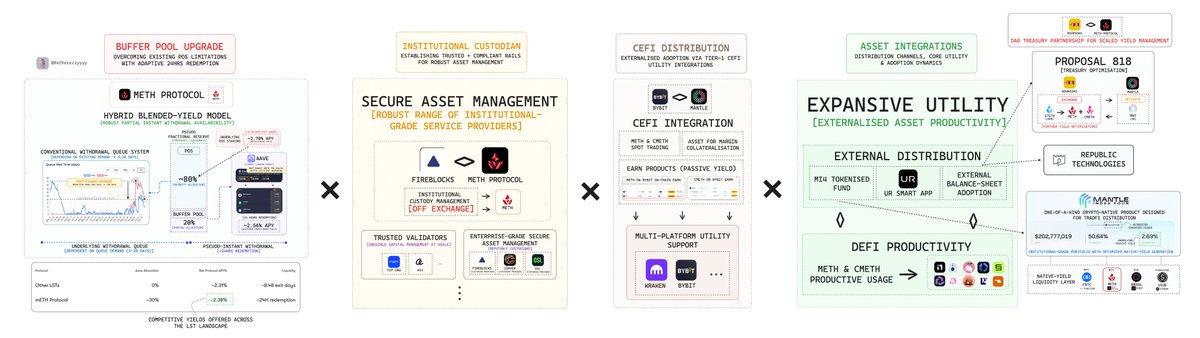
Using @mETHProtocol as an example, he highlights how its hybrid blended-yield model combines staking rewards with faster liquidity access, so capital stays efficient.
Institutions increasingly value assets that balance yield, liquidity, and operational flexibility, making capital efficiency a key differentiator for liquid staking protocols.
x.com/0xcheeezzyyyy/status/2…
—
@0xCodez argues that AI coding is shifting from manual prompting to “loop engineering,” where devs design automated systems that assign, execute, verify, and iterate tasks for coding agents.
Using a structure of automations, state tracking, verification gates, and sub-agents, these loops turn agents into self-running workflows rather than one-off tools.
Real leverage now comes from building systems that manage work for AI, not just writing better prompts for it.
x.com/0xcodez/status/2064374…
—
Most people never learn “research”, but learn to imitate researchers without developing the underlying skill.
@itsreallyvivek says proper research involves choosing your own problems, expanding beyond surface-level information, writing down thoughts, and tightly looping experiments with proper tooling and failure analysis.
Good research is a compounding system, where better questions, faster feedback loops, and honest tracking of mistakes matter most.
x.com/itsreallyvivek/status/…
—
@neil_xbt explains the “loops” debate in AI coding isn’t about replacing prompt engineering, but shifting devs toward building systems that manage agents autonomously.
Instead of manually prompting, developers build loops that assign tasks, verify outputs, manage state, and coordinate multiple agents over time.
The real advantage isn’t the loop itself, but the reusable skills, workflows, and knowledge embedded in it.
x.com/neil_xbt/status/206524…
—
@AnatoliKopadze explains AI agents are a spectrum of systems built around models with tools, memory, and autonomous execution loops.
As agents gain the ability to use tools, retain context, and pursue goals without constant input, they evolve from chat interfaces into workflows capable of research, coding, content creation, and task management.
The real value of agents isn’t the model itself, but the surrounding infrastructure, including memory, tooling, and automation.
x.com/anatolikopadze/status/…
—
@VibeMarketer_ argues that the key to reliable AI agents is not better prompting, but better harnesses such as the workflows, tools, skills, feedback loops, and safeguards surrounding the model.
As AI systems move beyond simple chats into real-world tasks, reliability comes from structured processes that help agents execute, verify, and improve their work with minimal human intervention.
While models generate outputs, harnesses make those outputs consistently useful and repeatable.
x.com/vibemarketer_/status/2…
—
That’s all for this week. Stick around for more alpha articles next week.


51
2
93
4,984


Cheeezzyyyy retweeted

Jun 12
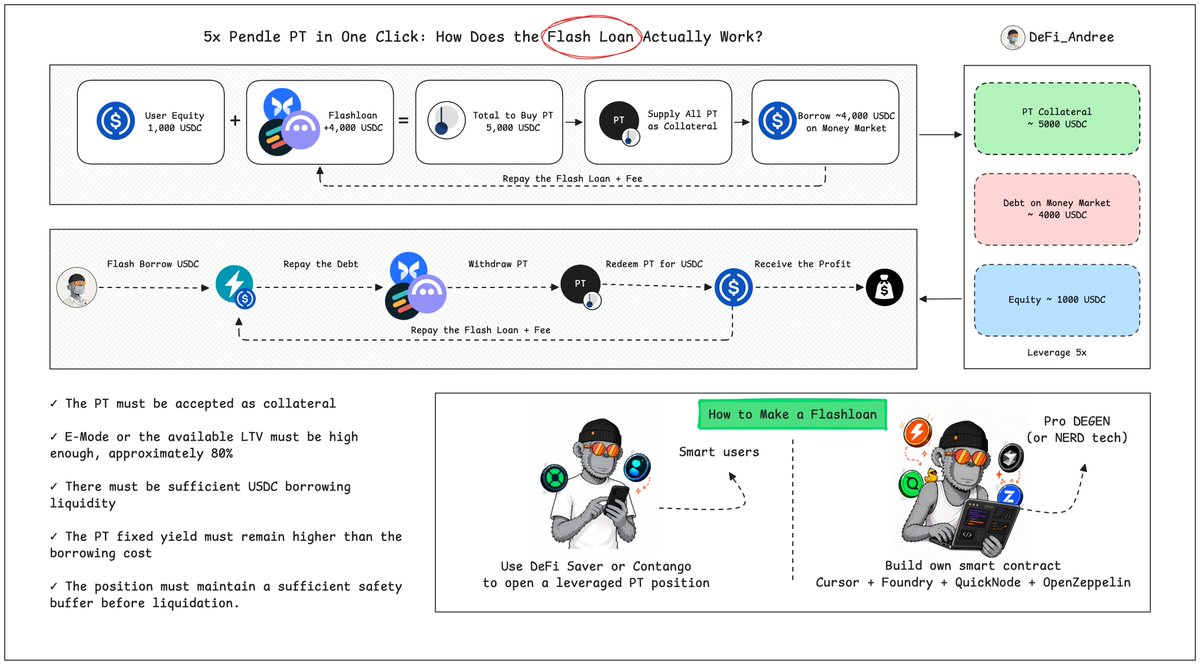
Open a 5x Leveraged Pendle PT Position On 1-click Using a Flash Loan
Normally, to leverage a Pendle PT position, users have to loop through the same process multiple times:
Buy PT → supply PT to Money market → borrow USDC → buy more PT → supply again → repeat
Depending on the LTV, reaching close to 5x leverage can require up to 20 loops, making the process time-consuming and expensive
A flash loan compresses the entire process into a single transaction.
----------
Example: Using 1,000 USDC to open a nearly 5x PT position
Assume the user has 1,000 USDC in real capital
• User contributes 1,000 USDC in equity
• The router flash-borrows 4,000 USDC
• The total 5,000 USDC is used to buy PT through Pendle
• All of the PT is supplied to Aave as collateral
• User borrows ~ 4,000 USDC from @Aave, @Morpho, @eulerfinance,...
• The borrowed USDC is used to repay the flash loan and its fee
⤷ Everything happens within a single transaction. If any step fails, the entire transaction reverts. Once completed, the user has a nearly 5x leveraged position with only 1,000 USDC in equity
The flash loan provides temporary liquidity, allowing the user to purchase the full PT position upfront
A long-term debt position is then created on Aave to repay the flash loan
How to close the position:
Flash-borrow USDC → repay the debt on Aave → withdraw the PT collateral → redeem or sell the PT through @pendle_fi → repay the flash loan and fee → receive the remaining assets
⤷ The user does not need to prepare the full amount of USDC required to repay the debt before withdrawing the PT collateral
----------
For no-code users:
@DeFiSaver or @Contango_xyz users only need to select the PT asset, debt asset, and target leverage. The platform automatically packages the entire flow into a single transaction
For Technical Nerds, Pro Degens, and Developers can building their own smart contracts:
> @cursor_ai: Write, debug, and improve the code
> @QuickNode: Provide the RPC infrastructure
> @OpenZeppelin: Provide smart contract libraries and security components
> Foundry: Compile, test, and fork the mainnet environment
----------
Requirements for a 5x position to work
• The PT asset must be accepted as collateral
• E-Mode or the available LTV must be high enough ~ 80% for 5x leverage
• Aave must have sufficient USDC borrowing liquidity
• The PT fixed yield must be higher than the USDC borrowing APR
• The position must maintain a sufficient buffer before liquidation
• Flash-loan fees, swap fees, slippage, gas, and other costs must all be included in the calculation
➥ This is how DeFi turns a complex looping strategy into an almost one-click experience.
ALT Open a 5x Leveraged Pendle PT Position On 1-click Using a Flash Loan
27
20
89
6,239

If you claim to be an opportunist, you must be lying if you pass this up.
$15,000 USDC on the table for you.
Four ways to win:
Auto trading, strategy sharing, subscribing, and participating.
GMX Masters early signups are now open. Link below.
15th Jun - 12th Jul.
13
10
47
5,431
Cheeezzyyyy retweeted

Jun 11
5
4
16
1,169
Cheeezzyyyy retweeted
Jun 12
1/ Crypto adoption is entering a new phase.
For years, digital assets were largely viewed as experimental, speculative, or institutionally inaccessible.
But that narrative has changed meaningfully. BTC and particularly ETH, are increasingly being integrated into the product suites of major financial platforms, treasury companies, funds, and institutional trading venues.
As $ETH adoption deepens, the next question becomes less about whether institutions want ETH exposure, and more about how they should manage it.
Holding $ETH passively gives investors exposure to its long-term upside. But ETH is also a productive asset via PoS yield. For treasuries, funds, and sophisticated users, this creates an obvious opportunity: ETH should not simply sit idle.
The challenge is that native staking is not always operationally simple.
The rabbit hole goes deep → Validator management, withdrawal queues, liquidity constraints, custody requirements & exchange collateral limitations all create friction.
This is esp. true for institutions, where operational resilience, risk management, and liquidity access matter as much as headline yield.
This is where liquid staking becomes increasingly important.
And in 2026, @mETHProtocol $mETH is positioning itself as one of the key yield layers for ETH 🧵
Jun 11
ETH staking is moving beyond yield alone.
“The next phase is about stronger security, deeper liquidity, and better distribution.” - @Defi_Maestro
Read more below on how mETH Protocol is building for 2026.
35
17
81
4,241
Cheeezzyyyy retweeted

Jun 12
Let's take a brief trip down memory lane my dear anon...
It is May 2021...
After utterly surging to unprecedented high's- on the back of defi summer, the Covid money-printing insanity, and animal spirits of obscene proportions- Bitcoin has suddenly and inexplicably CRASHED by 50%, and many popular alts have dropped by 90% or more :/
Sentiments have been gutted...
Half the TL has been liquidated...
Everyone fears that the bull market is over and they have missed their chance at generational wealth...
And the idea that we could bounce back is the last thing anyone is contemplating...
I remember this point vividly.
As of then, I was not yet full-time crypto.
I still owned my previous business at that point (a digital marketing/performance lead-gen agency) and was ostensibly focused on it full-time, but had become utterly obsessed with defi, and had been geeking out on it all day every day as hard as I possibly could.
Every available moment was spent combing through CT, reading docs, exploring new projects, and watching defi-focused videos from fascinating characters like 'Taiki Maeda' and 'Noah Seidman' and 'The Calculator Guy' :)
And I had stumbled upon something called 'Olympus DAO' that I found utterly fascinating...
And was also curious about this new chain 'Avalanche' I had been hearing about, and some of the projects being built on it like 'Trader Joe'...
And... *IF* I had doubled down then- and kept going down the rabbit hole- I would have made obscene amounts of money- as this was before $OHM had started mooning and before Avax season had begun.
But instead, the crash in May spooked me- and I decided to give up on my silly little crypto infatuation, and go back to digital marketing full-time :)
We all know what happened next though...
Crypto mooned again, $OHM 1000x'd, and Avax season (Trader Joe, TIME, etc) printed millionaires -
- And I ended up jumping into crypto full-time anyway in November of 2021 after fomo'ing back in :)
I bring all of this up, however, because @protocol_fx today reminds me of the above dynamics.
Max pain on the TL.
Max bearishness.
Everyone giving up on crypto.
And a small group of builders shipping like crazy and catalyzing all sorts of excitement despite it.
- While overall defi TVL is down 30% since April 1st, @protocol_fx TVL has 3x'd since then
- While countless other teams are shutting down operations, @protocol_fx ix expanding into new areas and announcing all sorts of new partnerships
- While sentiments languish across the space, @protocol_fx is getting ready to unleash an entirely new defi primitive via @FX100Perp
And, while I'm not claiming we are necessarily set for the same kind of H2 2021 market spike we saw then...
I do think its worth noting just how infinitesimally small our market currently is in comparison to the global economy and other asset classes, and the opportunity this represents...
In this vein...
Crypto has been DEMOLISHED since last October.
$BTC is no longer a top 10 global asset.
Our beloved $ETH has become a punchline.
All of crypto is barely above $2T in market cap.
And there are multiple individual stocks bigger than our entire industry.
While this is painful in the short term, it presents an unprecedented opportunity due to the IMMENSE amount of room there is go to upward from here.
And if we do, I think @protocol_fx is going to ride that wave more effectively than any other project I can think of.
They are actually shipping the proverbial 'Future of France' as thoroughly as any team in defi if you look at all the areas they are currently building in...
They embody the spirit of decentralization and permissionlessness as well as any team I'm aware of...
They have an absolutely spotless track record vis a vis security...
And they are at the forefront of THREE extremely important narratives:
1) Stablecoins
2) Leveraged trading
3) Privacy
Not to mention their continued efforts to cement $fxUSD as the #1 stablecoin for the AI economy (more on that in thread!)...
So yeah... below I will present a bunch of info and updates via links to other tweets and threads and videos on all of the above...
And I highly recommend checking them out...
Do not make my mistake from 2021 and give up and check out just because price action is currently bleak, because crypto can turn around faster than any of us can imagine...
As always, I own a ton of $FXN and am insanely bullish on it and also work with the team - so I am bias (and will flip the goofy 'partnership' tag on this), but I really believe the arc these dudes are gonna go on will be legendary 💪
Here's to defi lads, and here's to utterly massive success stories within it 🫡🇫🇷




16
14
57
4,430

Cheeezzyyyy retweeted

Jun 12
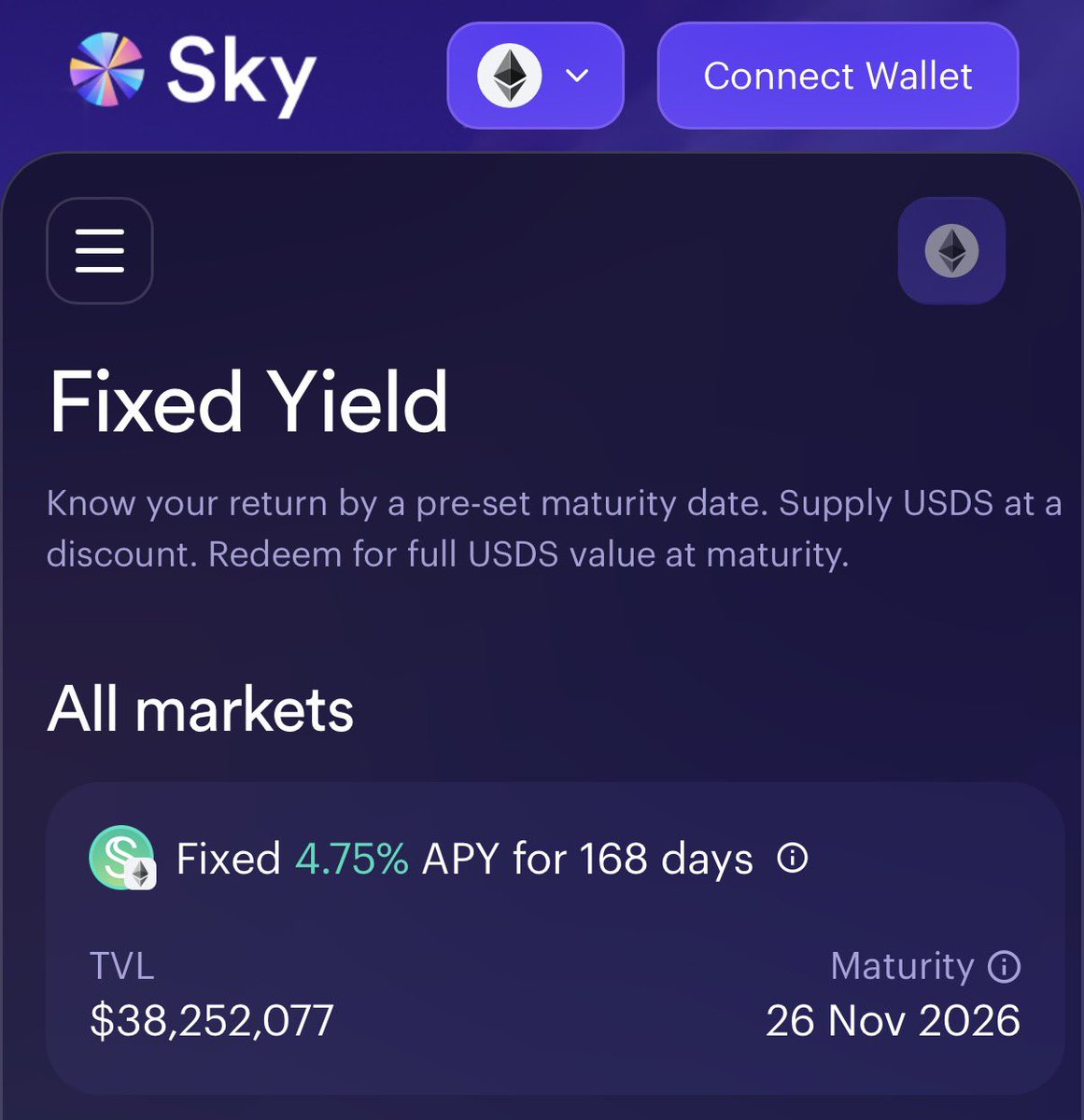
Fixed yield is now natively embedded into DeFi’s largest savings product
@SkyMoney took a major step forward integrating native Fixed Yield directly inside app for sUSDS the yield-bearing stablecoin with over $6.1 billion in TVL.
Users can now simply select the Fixed tab to lock in ~4.85% APY fixed (maturity: Nov 26, 2026), which is higher than the current variable Sky Savings Rate (SSR) of ~3.6%.
Powered by @pendle_fi with $30k USDS weekly incentives for YT holders until maturity. It’s proof that institutional-grade fixed yield is becoming a native feature in top stablecoin ecosystems.
> Sky’s mass users get easy access to fixed income without complex PT/YT learning curves
> Pendle acts as powerful fixed-rate infrastructure
> Win-win for the ecosystem: Sky brings distribution & capital, Pendle brings the tech, users win with better options
Sky Savings Rate has long been a bluechip yield source.
With seamless Fixed Yield embedded, DeFi savings are becoming more mature, flexible, and predictable than ever.

Jun 10

Sky has integrated Fixed Yield natively, powered by Pendle.
Users can now lock Sky Savings Rate to a fixed maturity at 4.75% APY, against a 3.60% variable rate, directly within the @SkyMoney app.
This integration embeds Pendle’s infrastructure inside the product surface of one of DeFi’s largest stablecoin protocols, extending Pendle from a standalone venue to a fixed-income layer that other protocols can integrate to expand their own offerings 🤝
30
2
45
3,365
Cheeezzyyyy retweeted

Jun 12
Over the past year, several large institutions have expanded their presence in DeFi.
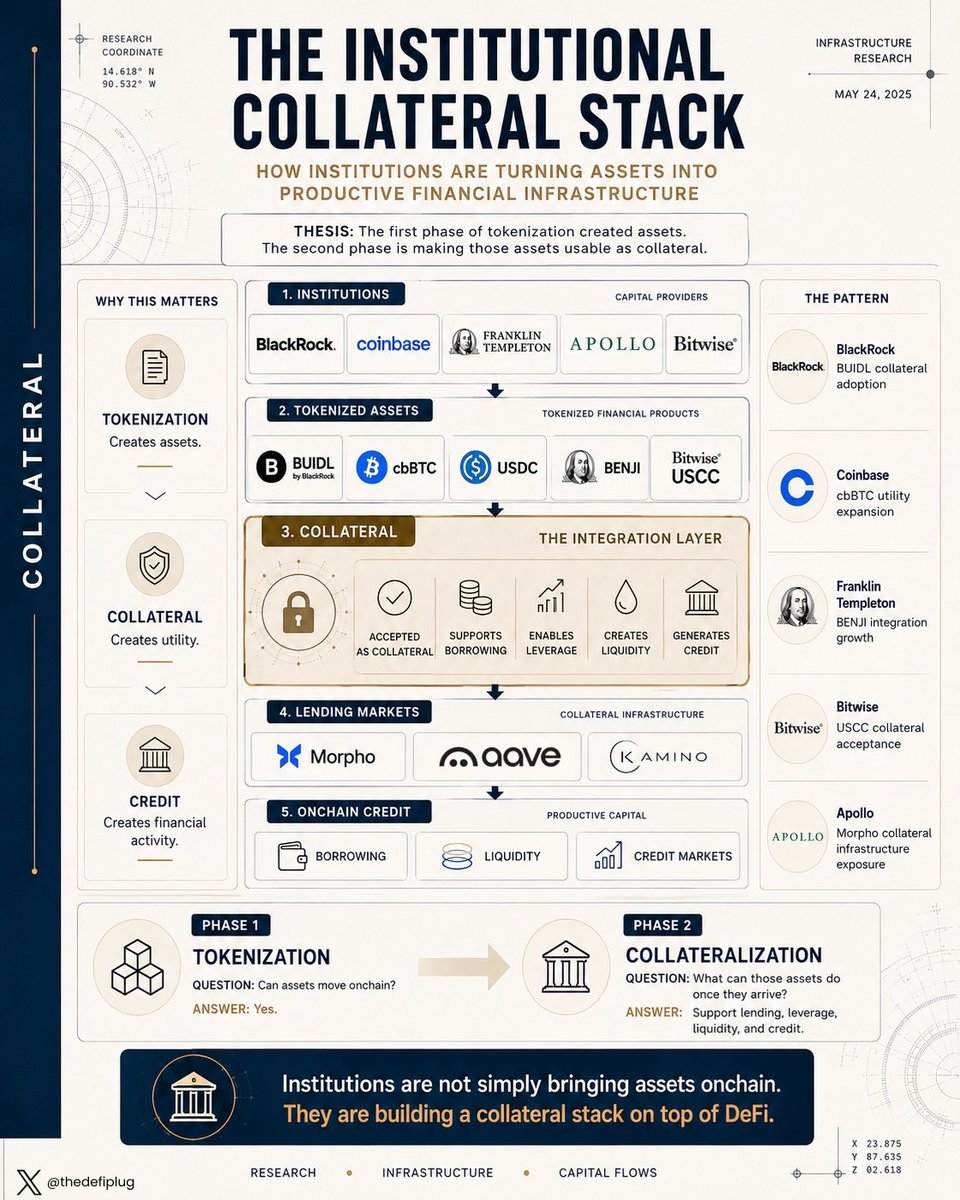
@BlackRock launched BUIDL. @Coinbase expanded cbBTC and USDC integrations. @FTI_US expanded BENJI’s onchain reach. @apolloglobal and @Morpho announced a strategic partnership that includes up to 90 million MORPHO tokens vesting over 48 months.
At first glance, these look like separate initiatives.
The common thread is easy to miss.
The easiest way to interpret these developments is through adoption.
Institutions are entering DeFi.
The more important question is integration.
How are institutions choosing to participate once they arrive?
A pattern is starting to emerge.
Institutions are not entering DeFi by becoming crypto-native.
They are entering by making their assets usable as collateral.
That distinction matters because financial systems are built around collateral, not assets.
The first phase of tokenization focused on issuance.
Can Treasuries be tokenized?
Can institutional funds exist on public blockchains?
Can private credit move onchain?
The answer is increasingly yes.
The more important question now is:
What can those assets do once they arrive?
Several developments point in the same direction:
➤ Apollo: Strategic partnership with Morpho involving up to 90 million MORPHO tokens over 48 months
➤ BlackRock: BUIDL accepted as collateral across lending venues
➤ Coinbase: Expanding cbBTC and USDC integrations
➤ Franklin Templeton: Expanding BENJI’s utility across public blockchains
➤ Bitwise: USCC fund tokens accepted as collateral across Morpho, Aave, and Kamino
Different firms.
Different products.
Same objective.
Make institutional assets usable inside DeFi.
This is why the Apollo-Morpho relationship stands out.
The market tends to view it as a token investment.
It is better viewed as exposure to collateral infrastructure.
Morpho provides modular lending infrastructure that allows credit markets to be built around specific collateral assets.
The opportunity is not tokenization itself.
The opportunity is collateralized credit.
BlackRock’s BUIDL illustrates the same shift.
The interesting development is not that BUIDL exists.
It is that BUIDL can now secure loans and participate in lending markets.
Once an asset can support borrowing, leverage, and liquidity, it stops behaving like a passive investment product.
It becomes infrastructure.
The same logic applies to cbBTC.
The value is not issuance alone.
The value comes from expanding where Bitcoin can be deployed productively.
The market still underestimates this distinction.
Most tokenization discussions focus on assets.
Financial systems focus on collateral.
An institutional asset sitting in a wallet creates limited value.
An institutional asset that can secure credit and circulate through lending markets becomes significantly more useful.
That is why collateral integrations may ultimately matter more than token issuance.
The first phase of tokenization created assets.
The second phase is turning those assets into productive financial infrastructure.
Viewed through that lens, the Apollo-Morpho relationship is important not because Apollo is simply buying a token.
It is important because it signals institutional interest in the infrastructure layer that makes collateral productive.
The easiest interpretation is that institutions are entering DeFi.
The more useful interpretation is that they are building a collateral stack on top of it.
54
17
95
6,545
Jun 12
1/ Crypto adoption is entering a new phase.
For years, digital assets were largely viewed as experimental, speculative, or institutionally inaccessible.
But that narrative has changed meaningfully. BTC and particularly ETH, are increasingly being integrated into the product suites of major financial platforms, treasury companies, funds, and institutional trading venues.
As $ETH adoption deepens, the next question becomes less about whether institutions want ETH exposure, and more about how they should manage it.
Holding $ETH passively gives investors exposure to its long-term upside. But ETH is also a productive asset via PoS yield. For treasuries, funds, and sophisticated users, this creates an obvious opportunity: ETH should not simply sit idle.
The challenge is that native staking is not always operationally simple.
The rabbit hole goes deep → Validator management, withdrawal queues, liquidity constraints, custody requirements & exchange collateral limitations all create friction.
This is esp. true for institutions, where operational resilience, risk management, and liquidity access matter as much as headline yield.
This is where liquid staking becomes increasingly important.
And in 2026, @mETHProtocol $mETH is positioning itself as one of the key yield layers for ETH 🧵
Jun 11
ETH staking is moving beyond yield alone.
“The next phase is about stronger security, deeper liquidity, and better distribution.” - @Defi_Maestro
Read more below on how mETH Protocol is building for 2026.
35
17
81
4,241
Jun 12
7/ That's all from me, thanks for reading my yap
Liquid Staking is def. here to stay & grow, and $mETH is primed to lead the forefront of the next wave of adoption imo.
If you'd found this insightful, feel free to share & show some support👇
x.com/0xCheeezzyyyy/status/2…
Jun 12

1/ Crypto adoption is entering a new phase.
For years, digital assets were largely viewed as experimental, speculative, or institutionally inaccessible.
But that narrative has changed meaningfully. BTC and particularly ETH, are increasingly being integrated into the product suites of major financial platforms, treasury companies, funds, and institutional trading venues.
As $ETH adoption deepens, the next question becomes less about whether institutions want ETH exposure, and more about how they should manage it.
Holding $ETH passively gives investors exposure to its long-term upside. But ETH is also a productive asset via PoS yield. For treasuries, funds, and sophisticated users, this creates an obvious opportunity: ETH should not simply sit idle.
The challenge is that native staking is not always operationally simple.
The rabbit hole goes deep → Validator management, withdrawal queues, liquidity constraints, custody requirements & exchange collateral limitations all create friction.
This is esp. true for institutions, where operational resilience, risk management, and liquidity access matter as much as headline yield.
This is where liquid staking becomes increasingly important.
And in 2026, @mETHProtocol $mETH is positioning itself as one of the key yield layers for ETH 🧵
1
10
159
Jun 12
lastly, tagging frens chads & $mETH enjoyoors who might be interested in this thread:
@MantleIntern_
@DeFi_Andree
@andrewmoh
@0xgilllee
@0x99Gohan
@MeshClans
@crypto_linn
@MahoneDeFi
@_thespacebyte
@Eli5defi
@thelearningpill
@Jonasoeth
@MahoneDeFi
@DeFiVoyager_X
@rektdiomedes
@febarce_DeFi
@CeruonINJ
@YashasEdu
@BUNT10
@kenodnb
@Haylesdefi
@St1t3h
@LokieGLD
1
12
222