
Joined June 2014
- Tweets 1,838
- Following 7,306
- Followers 2,173
- Likes 7,656
156 Photos and videos















Pinned Tweet

9 Jan 2024
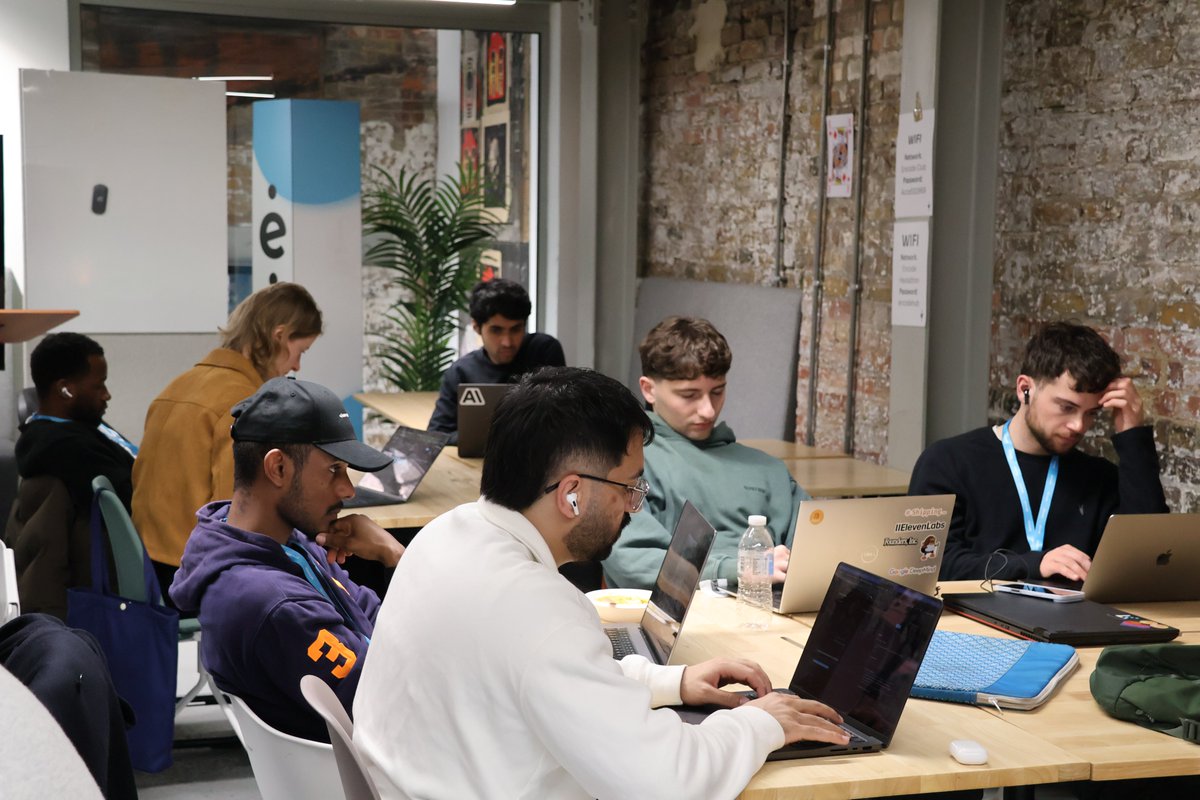
A special thank you to each and every person who came to our @graphprotocol event🥳
It was my honour to be able to host this in London🇬🇧
SOLD OUT EVENT! We're so back baby! The community is thriving🤩
2024 is set to be an incredible year for web3! To the builders... let's continue to buidl our crypto solarpunk future🫡
17
18
160
14,749
this is what you call turning lemons into lemonade!
congrats on the launch @nicole_clash keep pushing 💪🏾
Apr 16

LAUNCH 🚀🚀
I coulda been a fuck nobody who got screwed over and fired, struggling to find a job rn.
Instead, I am about to make the generational MONEYMAXXING run that goes down in history.
The only difference is the insights I have on hand. Insightmaxxing.
Standard practice for corporations is investing in a truckload of numerical data, and hiring for roles such as “Data Analysts” to find these insights.
That’s the way it’s always been done.
Numbers SUCK at driving ACTIONABLE INSIGHTS though. Charts, dashboards, the most they can tell you is where to look, but they still need analysts to turn it into a format that drives key decisions.
What if we were not limited to numbers?
There is no way for a human to read enough to get coverage on large datasets without certain abstractions. Excel was invented for this very purpose.
A human can’t. LLMs CAN.
The very fact that we now have intelligence at the cost of nothing unlock new paradigms of data analysis. We are no longer bound by the limitations of having to work with numbers. We can work with data in their much more optimal, original forms.
Texts. Images. Videos.
For example, if you make a post on X, a high like count can tell you that it is successful. But you will not know WHY it’s successful.
The WHY is information that you can get by looking at the non-numeric data. What exactly did you post about? How is it different from other posts? What did the comments say?
If a business launches a new product, positive social media sentiment and an increase in revenue can tell you that you are doing something right. That information is valuable.
What is infinitely more valuable is knowing EXACTLY what you did right, and any feedback on how it could have been even better.
Today, I am launching my first, public product. It is the first Insights tool of its kind that follows this new paradigm I’ve described.
Know exactly what your competitors are doing. What is working for them? Why is it working for them? How can it work for you?
Know the exact issues with your offerings as they occur. Bugs, complaints, valuable user feedback. How can it be better?
Know all the opportunity spaces you might not be aware of.
You cannot possibly read everything. Insightmaxxing will do it for you.
I truly believe it is a tool every single company can benefit from using.
11
13
258
.@unicorn_mafia know how to throw a good party 🥳

Londonmaxxing with the best devs in London @unicorn_mafia @CharlieCheesma1 @fergomg @fatemallk @Hrdlickas @leaferle @pixelsocieties
5
15
336
in sf from april 8th and looking to link up with people in crypto, AI & longevity!
If you're building, investing, researching or doing growth, let's chat 🥳
DM me or drop a comment here 💯
3
10
174
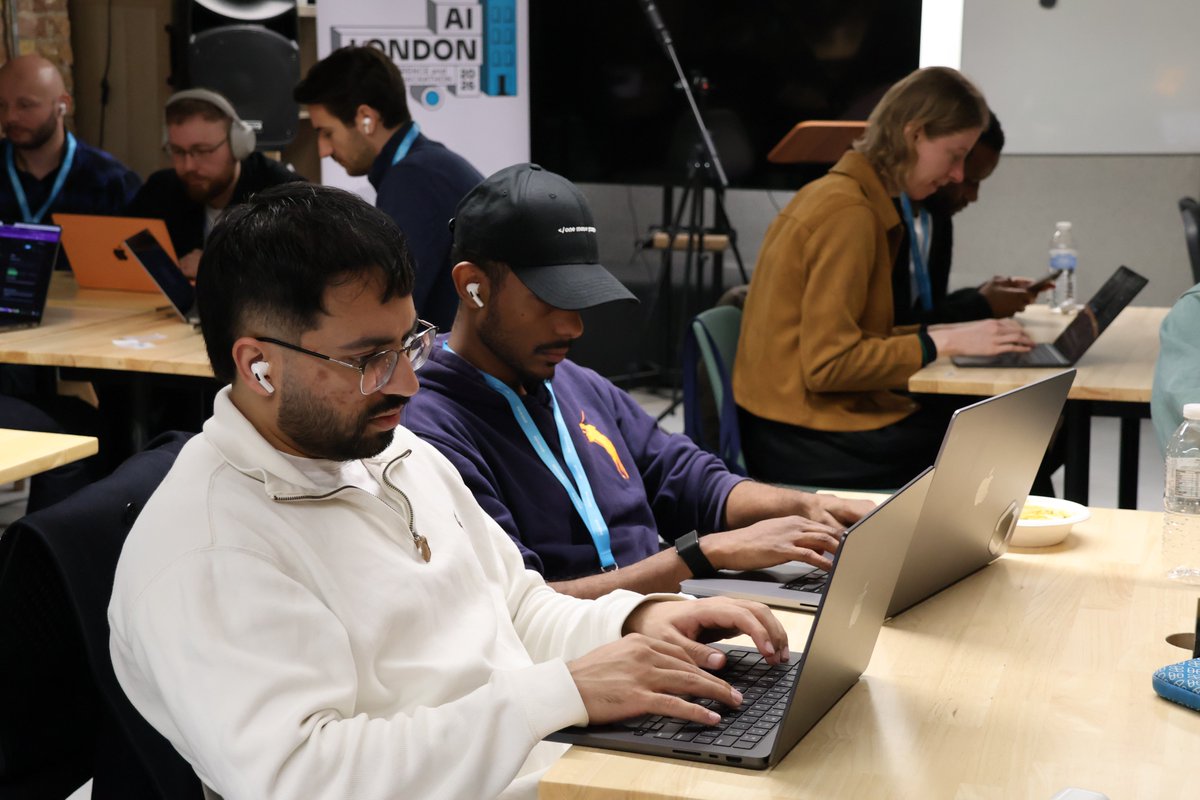
really enjoyed judging at the @encodeclub AI London hackathon
the vibes were incredible, but what stood out most was the speed
what used to take small teams weeks or months now gets hacked together in days, sometimes hours
very impressed by what people managed to ship in such a short period of time
encodeclub.com/programmes/ai…
Mar 24

A wrap on AI London Hackathon 2026!!
Londonmaxxing the Shoreditch edition - check out our recap video!
We filled the Encode Hub with stacked speakers, partners and sponsors: @OpenAI, @ElevenLabs, @awscloud, @civickey, @AWS, @vercel, @Architectxyz, @FlareNetworks, @Luffa and @shiftdeletenet
300 builders. 1 building and 1 place to be.
Want to join? Grab a free taster day below ↓
1
10
387
hahaha this is me 😂

107
AbelsAbstracts (d/acc) 👑 retweeted

Mar 22
the fastest growing startups figured out one thing:
marketing isn’t a department anymore. It’s everyone’s job on the team
71
55
539
27,522
AbelsAbstracts (d/acc) 👑 retweeted

Mar 21
I’m convinced 90% of the founders job is to just do 3 things:
- be delusional in your optimism
- push everyone to move faster
- make it crystal clear what to work on
316
334
4,361
209,559

On the @theallinpod this week, @chamath asked @nvidia CEO Jensen Huang about decentralized AI training, calling our Covenant-72B run "a pretty crazy technical accomplishment."
One correction: it's 72 billion parameters, not four. Trained permissionlessly across 70 contributors on commodity internet. The largest model ever pre-trained on fully decentralized infrastructure.
Jensen's answer is worth hearing too.
99
392
1,686
471,670

londonmaxxing isn't new for some.
Ethereum's ecosystem has always bet on London.
from Devcon 1 in 2015, to 2026 with our community hub opening.
and that's what our @EFetheverywhere hub is all about. enabling the builder economy of London, for tech, creativity, and culture.
if you want to swing by, drop me a DM.
25
22
155
9,856

the most underrated hire right now is a great product person.
when i say product person i'm def not talking about a product manager. perhaps i think there has to be somewhat of a new role. i don't have a good name for it yet but maybe something like "product thinker".. someone with an intuitive grasp of the product as it exists, where it's soft, where it sings, & how to iterate it toward something even sharper. in some sense, this person has to cohesively hold in their head where this product should be 2 years from now & work backwards from that.
i say this cuz when building was hard, engineering was the bottleneck & the status hierarchy often reflected that. building is no longer hard. which means the variance in outcomes has shifted almost entirely to judgment on what to build, how to sequence it, & how to talk about it.
& the story matters as much as the thing. internally, it organizes the team around a shared model of why. externally, it shapes the interpretive frame users bring to their first experience. you can't retrofit narrative onto a product & expect it to land, it has to be load bearing from the start.
the rarest version of this person sits at the intersection of culture & deep technology. someone genuinely bilingual. they know what's technically possible & they know which cultural currents are real vs. ephemeral. that combo is what separates products that feel inevitable from products that feel assembled.
before ppl clap back with this person has always been valuable, i know.. i am just saying now they might be the most *important* person in the room. their value compounds like never before.
446
740
6,325
1,379,314

No startup has ever ‘empowered’ its way to product market fit
PMF is a war of brutal attrition against inertia, apathy & risk aversion. It requires dictatorial obsession and near relentless micromanagement
Hire only to get you, the founder, closer to the truth of the customer
5
3
37
6,284
building a startup is boxing: you get hit a lot 🥊
note to younger me (hopefully helpful for others):
- expect the punches and failures
- stay in the ring! ship, learn, repeat faster than anyone else!
- keep your hands up to protect your belief & vision, not your ego
- when the opening shows up, swing hard for the knockout! great opportunities are rare! go all in 💯
one clean win can pay for years of losses.
god’s got you, keep fighting champ ❤️💪🏾
Feb 21

I'm increasingly convinced that 99% of success is just the ability to outlast uncertainty. The one who can tolerate the most uncertainty is the one who will eventually win.
9
12
310
it’s happening.
everything’s clicking.
and the world’s starting to see what’s coming 🚀📈
thanks for the support @bittingthembits 🫡
Feb 21

🚨 Bittensor $TAO Subnet 6 @numinous_ai just published something that should make the entire AI industry pay attention.
Their top miner is beating Google's Gemini on a live, transparent forecasting benchmark.
Not in a lab. Not in a press release. In real time, on a public leaderboard, scored by one of the most competitive metrics in probabilistic forecasting in the world.
Look at what the data says and see for yourself.
Benchmark: Brier Score
If you're unfamiliar with Brier scoring, here's what you need to know.
It's not did you get it right. It's how confident were you, and were you right?
A model that says 90% on a coin flip and wins still gets penalized. A model that says 51% on an uncertain outcome and wins barely moves the score.
It rewards calibration. It rewards precision. It punishes overconfidence and randomness equally.
This is the metric intelligence agencies and quantitative hedge funds use to evaluate forecasters. It's the gold standard. You cannot game it at scale over hundreds of events.
The Numbers: Read These Carefully
Top Miner (UID 128): 0.1772 Brier Score. 71.8% accuracy. 600 events.
Gemini baseline, same questions, same window: higher Brier (worse).
For context: the difference between good and great in forecasting benchmarks is often measured in the fourth decimal place. Getting to 0.177 over 600 events is not luck. That's a system that has learned to be right and to know when it's right.
71.8% accuracy with a Brier that low means the model isn't hedging to 50/50. It's making directional calls with conviction and getting them right at a rate that moves the score meaningfully.
221 agents are competing on this network simultaneously. Open source. Transparent. Scored the same way for every miner. No cherry-picking. No selective disclosure.
The best one is beating Gemini.
Again This Is the Bittensor Thesis Made Real and No one talks about it
Here is the argument that skeptics have made about decentralized AI for years:
"A network of anonymous miners competing on a blockchain cannot produce AI outputs that match what Google, OpenAI, or Anthropic can build with billions of dollars and the world's best engineers."
The Numinous leaderboard is a direct empirical refutation of that argument in one specific domain, on one rigorous metric, over a meaningful sample size.
Not we think we can compete. We have the chart. We have the numbers. Look at it.
The Bittensor thesis isn't that decentralized AI beats centralized AI at everything simultaneously. That's not how specialization works. The thesis is that competitive markets produce superior specialized outputs in specific domains when the evaluation is transparent and the stakes are real.
Forecasting is one domain. The top miner won.
The competition is self-reinforcing: 221 miners see the leaderboard, learn from what's working, iterate, improve. Every epoch the baseline rises. Open source selection pressure means the collective intelligence of the entire network compounds permanently. Gemini's forecasting doesn't get better because someone improved a miner's CUDA kernel last night. Bittensor's does.
What the Architecture Looks Like
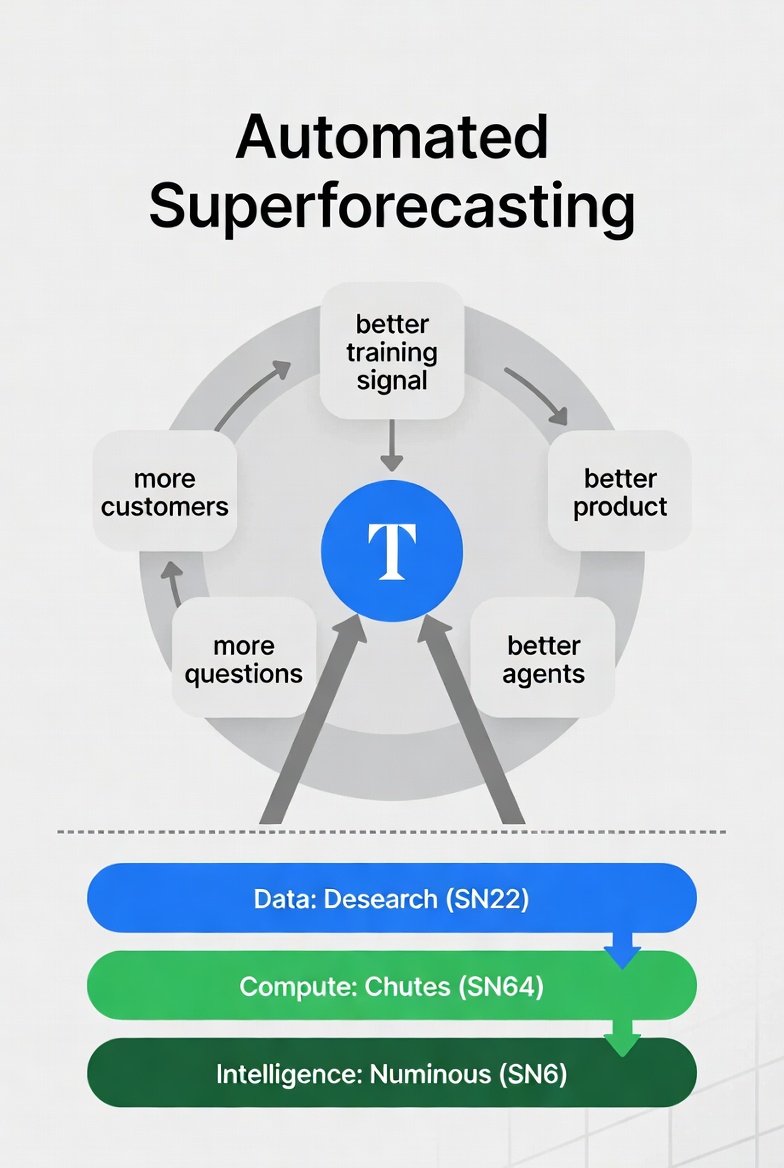
This isn't just ask an LLM a question and score it. Numinous's architecture is worth understanding.
Miners aren’t submitting predictions.
Validators run that code in sandboxes with curated data tools, and the agent searches, updates, and outputs a probability. Blind scoring across 600 events.
That’s automated superforecasting code: the best analyst methodology, running 24/7 at machine speed.
Stack:
Data: Desearch (SN22)
Compute: Chutes (SN64)
And it’s monetizable right now: Eversight sells the probabilities via API to traders/institutions.
Top miner’s Brier curve sat below Gemini’s for a full week. Public proof that a decentralized market of agents can beat a top centralized model in a measurable domain.
Ask Eversight a question. Compare it to Polymarket.
$TAO | @numinous_ai | leaderboard.numinouslabs.io
4
12
323
AbelsAbstracts (d/acc) 👑 retweeted

Feb 20
Numinous is monitoring the situation.
Agents will soon reason on satellite data.

3
3
38
1,416
great resource if you’re new to @bittensor 💯

2
2
22
1,031
The world has NOOO IDEAAAA what is around the corner for @numinous_ai - we are forging our path to greatness 📈📈📈
All will be revealed in due time 🫡🚀📈
Feb 12

And I heard Const saying that you had the best prediction agent in the world, if that’s true you should be making way more noise about it
5
1
17
519

AbelsAbstracts (d/acc) 👑 retweeted

Feb 16
💡 Subnet Spotlight #8 💡
Subnet 6 – @numinous_ai
Decentralized Market Intelligence & Alpha Coordination on Bittensor
Numinous isn’t just another trading subnet, it’s building infrastructure for collective market intelligence on Bittensor.
Instead of siloed analysts or opaque signal groups, Subnet 6 transforms alpha discovery into a competitive, onchain ecosystem where miners generate insights and the network continuously evaluates who actually performs.
🚀 What It Builds
🔹 Decentralized Alpha Engine
Miners produce market insights and predictive intelligence. Validators assess them on real-world performance, ensuring rewards flow to signal quality, not noise.
🔹 Alpha Arena (Newly Launched Product)
Numinous just launched Alpha Arena -a product that allows anyone to stake their alpha directly behind the miners they believe in.
This creates powerful incentive alignment:
• Miners are motivated to perform better
• Supporters back conviction with capital
• The best signal producers naturally attract stake
• The network becomes a live marketplace of belief and performance
It turns passive observers into active participants.
🔹 Incentive-Driven Meritocracy
Performance is continuously measured. Strong miners gain stake and weight. Weak signals lose backing. The system compounds toward signal quality over time.
🧪 Benchmarks & Performance
Subnet 6 focuses on live results, not hypothetical backtests:
🔥 Miners are judged on real predictive accuracy
🔥 Stake flows dynamically toward outperformers
🔥 Poor performance results in immediate economic consequences
Alpha Arena intensifies this dynamic by introducing market-based conviction into the scoring loop, not just validator assessment.
💸 Revenue & Market Potential
Numinous is building infrastructure at the intersection of:
✔ AI-powered market intelligence
✔ Decentralized capital coordination
✔ Onchain signal monetization
✔ Community-driven alpha allocation
The broader market for trading signals, portfolio analytics, and asset intelligence spans trillions in global markets. By aligning AI miners with economic stake, Subnet 6 moves toward a scalable, monetizable intelligence layer.
📈 Product & Ecosystem Impact
Numinous pushes Bittensor beyond pure model competition:
🔥 Turns alpha into a stakable, market-driven asset
🔥 Aligns miners and capital through shared incentives
🔥 Encourages transparency and measurable performance
🔥 Strengthens the feedback loop between signal quality and economic reward
Alpha Arena, in particular, introduces a new paradigm:
Don’t just follow alpha, stake behind it.
📌 In Short
Numinous (Subnet 6) is building decentralized market intelligence on Bittensor - where miners generate alpha, validators score real-world performance, and Alpha Arena allows anyone to stake behind the miners they believe in. It’s a step toward turning predictive intelligence into a live, incentive-aligned marketplace powered by performance, conviction, and capital.

4
10
42
6,102
AbelsAbstracts (d/acc) 👑 retweeted
Feb 11
Spot on sir
Feb 11

Use @numinous_ai on @almanac_market = free money glitch???
2
25
1,726
AbelsAbstracts (d/acc) 👑 retweeted

Feb 10
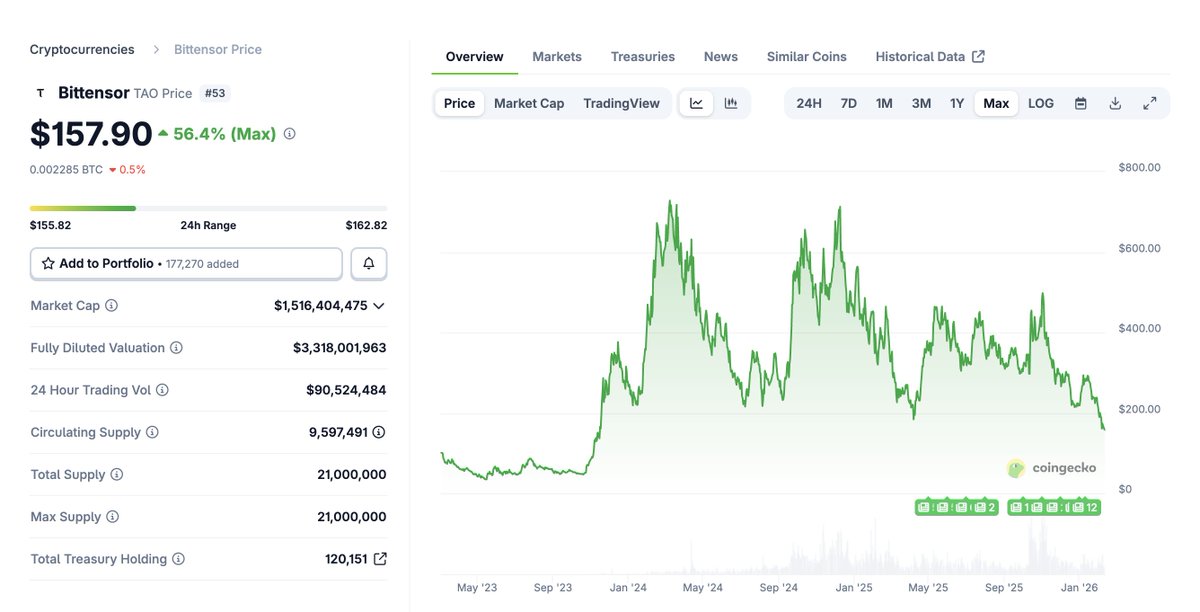
A cofounder of @AnthropicAI publicly validated a crypto project's decentralized training infra.
1. Called it the largest active network of its kind
2. Backed by Epoch AI data showing decentralized training growing at ~20x/year vs ~5x for centralized
That project is @bittensor $TAO
128 live subnets running right now. One of them processes trillions of tokens monthly, ranking alongside AWS-tier providers.
‣ First halving done
‣ Grayscale ETP filed
‣ dTAO turning the network into a live capital market for AI infra
Either the builders validating this are wrong, or the market is.
52
39
308
24,309