Research group at the University of Edinburgh using genome editing and targeted protein degradation to study genetic disease and therapy
Joined December 2013
- Tweets 870
- Following 365
- Followers 729
- Likes 1,305
34 Photos and videos




Pinned Tweet
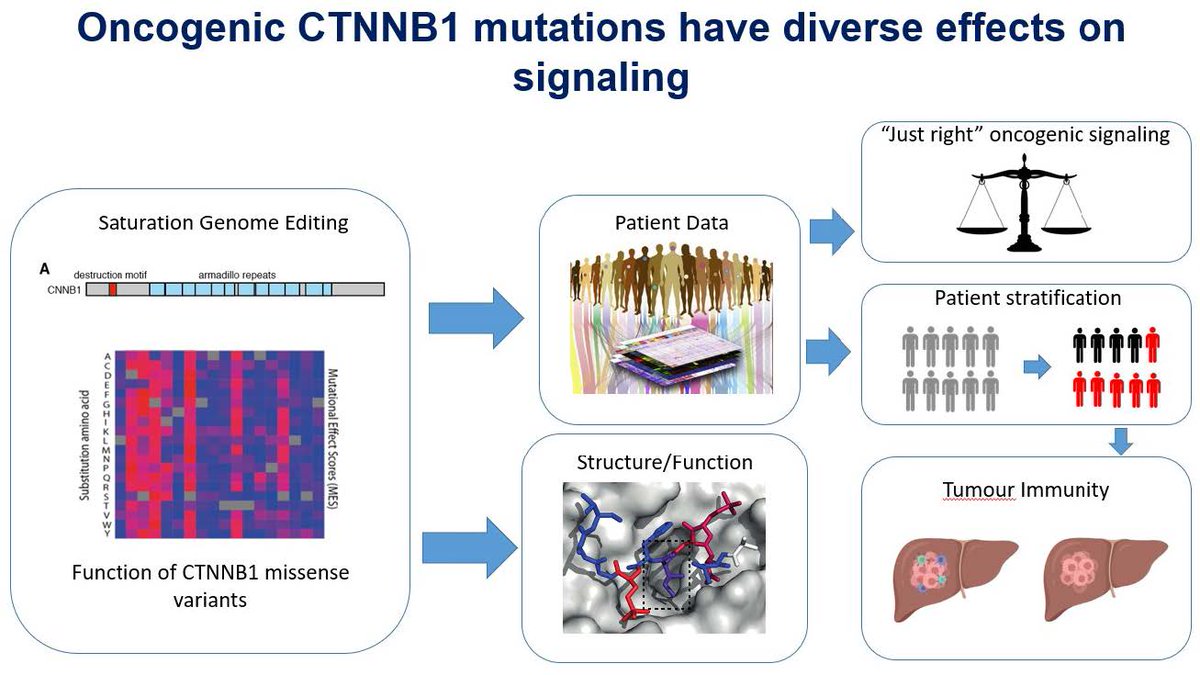
Today in @NatureGenet, we report a saturation genome editing study that systematically dissects the degron of β-Catenin: one of the most frequently mutated regions of the cancer genome. Collab with @kiddevonline and @DeryaDOzdemir, among many others
rdcu.be/e1Tvk
1
12
55
6,191

Apr 20
🔬 New lab preprint: How does the mode of oncogene activation shape PROTAC efficacy?
Led by Evelina Gudauskaite, we ask whether stabilising mutations vs transcriptional upregulation have distinct consequences for targeted protein degradation.
biorxiv.org/content/10.64898….
1
1
2
120
Apr 20
Using a controlled cellular system (dTAG TetOn3G), we found:
✅ Stabilising mutations don’t limit PROTAC action—degradation resets protein levels to the same baseline.
❌ Increased transcription raises target protein levels both pre‑ and post‑treatment.
1
43
Apr 20
This reveals a synthesis‑dependent ceiling on degradation, with implications for:
• interpreting preclinical degrader data
• resistance mechanisms
• genotype‑guided therapy design
20

Beautiful new UK Wnt paper out now in @NatureGenet by Peter Hohenstein @AndrewWoodLab and Derya Ozdemir @UniLeidenNews @EdinburghUni @kocuniversity characterising the molecular/functional impact of numerous CTNNB1 mutational variants in human cancer.
nature.com/articles/s41588-0…
2
6
333

Nature research paper: Hepatic zonation determines tumorigenic potential of mutant β-catenin
go.nature.com/4nZHB4h
11
58
17,209
Andrew Wood retweeted

18 Nov 2025
Major new direction in the @stark_lab: hacking human cell biology with pathogen effectors (eORFs) - amazing collaboration with @mike_tilapia lab. Huge congrats to first authors Tomas & He & all co-authors! Check out the pre-print on @biorxivpreprint biorxiv.org/content/10.1101/…
17
79
12,933
Andrew Wood retweeted

2 Nov 2025
1/ Happy to share important work done with my co-author Andrew Khalil in the labs of Rudolf Jaenisch @WhiteheadInst @MITBiology @MIT and Dave Mooney @Harvard @wyssinstitute trying to assess and fix the major problem of transgene silencing in human ESC/iPSC based work
5
30
171
87,148
Andrew Wood retweeted

20 Sep 2025
The big one is finally out!! In this paper, we set out to provide insight into the fundamental question;
How do the individual cells from complex tissues regulate their proteomes?
Brief summary of our findings 👇
biorxiv.org/content/10.1101/…
6
39
199
41,425
26 Aug 2025
Our manuscript characterising tissue-specific consequences of tagged protein fusions in CRISPR-engineered mice is now online @PLOSGenetics. journals.plos.org/plosgeneti…. Thanks again to all coauthors, reviewers and editors for a smooth publication process.
20 Jun 2025

Happy to share our latest work and first manuscript from the Degron Tagging Cluster @MRCMouseNetwork. If you work with protein tags, particularly in tissue biology models, this should be of interest.
biorxiv.org/content/10.1101/…
1
2
9
587
26 Aug 2025
Nice write up on the @MRCMouseNetwork website, highlighting the awesome work of first author Gillian Taylor, is available here: nmgn.mrc.ukri.org/news/under…
1
2
423
Andrew Wood retweeted

21 Jun 2025
Know it before you tag it!! 🏷️🧬
20 Jun 2025
Happy to share our latest work and first manuscript from the Degron Tagging Cluster @MRCMouseNetwork. If you work with protein tags, particularly in tissue biology models, this should be of interest.
biorxiv.org/content/10.1101/…
1
3
316
20 Jun 2025
Happy to share our latest work and first manuscript from the Degron Tagging Cluster @MRCMouseNetwork. If you work with protein tags, particularly in tissue biology models, this should be of interest.
biorxiv.org/content/10.1101/…
1
1
5
1,100
20 Jun 2025
By surveying a series of CRISPR-engineered mice, we found that tags often change protein expression in some tissues but have little effect, or even opposite effects, in others. Why?
1
2
93
20 Jun 2025
We characterise two underlying mechanisms with opposing effects on protein stability and explain their tissue-specificity, providing a rational basis for improved experimental design. Congrats to 1st author Gillian Taylor and all who contributed. Feedback welcome!
1
84
Andrew Wood retweeted

9 Oct 2024
🚨We are recruiting🚨. We have a @UKRI_News funded position available @mrc_hgu for a Research Assistant working on Polycystic Liver Disease with @scott_wad_dell
& @Mill_lab ! If you are interested in #organoids, #singlecell and disease modelling then apply! job: 11386 & link👇
1
12
12
5,596
Andrew Wood retweeted

19 Oct 2023
Excited to share my PhD work, out now in @ScienceMagazine ! What governs successful lysosomal degradation of membrane proteins mediated by extracellular degraders? Can we improve degradation efficacy? science.org/doi/10.1126/scie…🧵(1/n)
13
77
560
142,050
Andrew Wood retweeted

20 Sep 2024
Thrilled to share that, together with my colleagues @UoDCeTPD and collaborators @Boehringer, we report @ScienceMagazine the breakthrough discovery and characterization of a small-molecule that degrades most oncogenic mutant forms of KRAS. 1/8 science.org/doi/10.1126/scie…
15
86
363
45,525