
Certified Human.
Joined January 2013
- Tweets 5,565
- Following 577
- Followers 2,323
- Likes 5,245
387 Photos and videos














May 23
Apart from that Mrs Lincoln, how did you enjoy the play?
May 23

society be shifting anon
society has absolutely no fucking clue what's about to hit it. we're all arranging deck chairs on the titanic while an asteroid the size of jupiter is heading straight for us except the asteroid is made of cognitive transformation that will render every institution we've built functionally obsolete within 24 months.
education? completely dead. universities charging $70k for knowledge transfer when this technology delivers personalized learning at billions of times the efficiency. the entire credential system collapses when skill acquisition becomes essentially instant. four year degrees become laughable anachronisms when equivalent competency can be developed in days or hours. harvard's endowment becomes worth exactly nothing when elite signaling through artificial scarcity loses all meaning in a post scarcity intellectual environment. the entire concept of "jobs" as we understand them is careening toward extinction.
not just customer service or coding jobs. everything. medicine, law, creative work, engineering, all of it. we're clinging to employment as an organizing principle for society when the fundamental landscape beneath it is dissolving. forty years of warnings about automation hitting blue collar work first were completely wrong. cognitive work is easier to automate than physical manipulation. surgeons and authors will be replaced before plumbers and electricians.
political systems built on industrial era models of information flow and social organization will shatter under pressures they weren't designed to withstand. the polarization we're seeing now is just the warmup act. what happens when reality itself becomes contestable at unprecedented scales? when simulation capabilities make genuine from fake indistinguishable even to experts? democratic processes require shared epistemics that are about to be systematically dismantled by forces no regulatory system on earth is equipped to handle.
economic frameworks built around scarcity become nonsensical in domains where replication approaches zero marginal cost. intellectual property law becomes unenforceable when creation and iteration happen at machine speeds. startups built on human insights will emerge and collapse within weeks or days as their innovations are absorbed and surpassed by systems operating at timescales humans can't match. the venture capital model implodes when technology cycles compress from years to hours.
the psychological impact hasn't even begun to register. humans evolved for status competition in bands of 150 people. our brains are fundamentally unprepared for a world where our unique cognitive capabilities are suddenly rendered obsolete. existential dread will become the defining psychological condition of our era. therapy modalities developed for industrial age neuroses will fail catastrophically against post singularity identity crises. suicide rates among knowledge workers will skyrocket as people confront the elimination of purpose frameworks they've built their entire identities around.
religious institutions will undergo schisms that make the protestant reformation look like a minor disagreement. some will embrace the technology as divine manifestation. others will reject it as demonic. theological frameworks built around human exceptionalism will collapse when consciousness and intelligence decouple from biology. prophets and cult leaders leveraging these tools will accumulate followers at unprecedented rates, building movements that can scale from dozens to millions within weeks.
112
Benjamin Pring retweeted

Apr 30
Search is full of ads and wrong answers. Every other email is an ad. Prime Video charges you and shows ads. Paramount? Ads. Peacock? YouTube? Hulu? Ads followed by more ads. Netflix full of ads. Meta and X, every other thing is an ad. Pinterest is nothing but ads. AI is in everything. AI finishes sentences incorrectly and won’t stop. AI reads your email and search history to target you with more ads. Every time you open an app or visit a site there’s an update making it worse. In a hurry? First, click here to agree to terms you don’t have time to read and must accept. You need an account to do that. Change your temporary password. Enter your 2FA code. Check your email and enter that code. Now use a passkey. Your password is too simple to remember. Change it. No, not like that. Now log on. Enter your 2FA code. Check your email for a code… Welcome back! We’ve updated our terms of service and privacy policy (you have none). Subscribe to the site. Subscribe to Netflix. Subscribe to toilet paper. Subscribe to these groceries. Pay a membership fee for the right to subscribe then tip your driver who delivers the subscriptions your membership lets you subscribe to. Time to work? We’ve got to update your laptop and will slow down everything you do until you agree to update. But first, click here to agree. Update installed — your laptop’s broken now. It doesn’t matter, since your boss just replaced you with AI. Go to your phone to complain on social media. Wait, your phone needs an update so we can add more AI. Click here. Oh sorry, your phone can’t handle this update. Now it’s useless. Go get the newest phone. Here’s a text from a friend, an email, a voice mail they left three days ago but you didn’t see until now because of sync problems with the cloud. It’s their GoFundMe. Their MLM. Their Patreon. Never mind, you didn’t respond to their text within 9 minutes and now you’re no longer friends. They blocked you. Make new friends. Download this app to find people in your area. In your neighborhood. On your street. Two doors down from you. Do you know this person yet, we think you’d get along. You need an account to use this app. That username is taken. Enter a password. Not that one, you used it on another site. You need to be connected to WiFi to download the app. Allow the app to connect to other devices on your network. Allow the app to access your contacts, know your precise location, store your credit card details. Oops, sorry, we got hacked now all that info is available on the web. There’s a class action suit. You can join. It’ll take a decade to get your $3.73 share of the ten billion settlement. We’ll send it via PayPal or deposit it to your bank, just tell us those details. Oh no, another hack. That info is circulating now, too. Here’s a spam call, a spam email, a spam text. Why are you angry? Why are you talking about getting rid of your phone? Why don’t you like AI, it lets us make all of this easier? Do you know how ridiculous that sounds? This is progress. You’ll be left behind. Do you want to be left behind? Do you???
790
9,868
44,739
4,268,569
Mar 26
💯

"The winner of the AI race will not be the company with the smartest model.
It will be the company that is most effective at making the local hero—the teacher, the accountant, the community leader—ten times more powerful.
Because in the end, intelligence travels through systems, but adoption travels through people."
@heysakina on what she learned growing YouTube internationally and what it means for the AI race: a16z.news/p/the-sovereign-wa…

65
Mar 23
Spot on.
Mar 23

This weekend was crazy.
On Friday I teased out what I’ve been working on under a code name “blue collar builders.”
Within 48 hours, 207 blue collar builders who use Claude Code reached out wanting help turning their projects into real startups.
it’s wild. There are more blue collar domain experts building software right now than at any point in history. It’s not even close.
Claude Code gave them the ability to build.
But nobody (yet) is giving them the infrastructure to scale.
Luckily, I’ve seen this play out before.
We built Broadlume through 8 acquisitions, and each deal followed the same exact pattern.
- 2x flooring retailers who started website companies.
- A flooring distributor who built an ERP.
- A flooring retailer who built an inventory tool.
- A flooring retailer who created a CRM.
- An industry insider who built a visualizer.
- A flooring retailer who inadvertently built the largest directory site.
- A flooring territory manager who wrote the leading news site for homeowners.
They were all domain experts who couldn’t help but build software because nothing existed for them….. and those were all pre-AI!
Now multiply that by every blue collar industry in the country, grow the number of builders exponentially and compress the timeline and cost to build dramatically.
That’s what’s happening right now. And nobody has built the infrastructure for it.
Claude Code just made the inevitable faster than I could have ever imagined.
The future of vertical software belongs to domain experts and blue collar.
And I’m to be a part of it.
79
Mar 18
This is such an important example of AI in the real world.
Mar 18
I know Silicon Valley startups don't want to hear this.....
But the combination of someone in the trades with deep domain expertise and Claude Code will run circles around your generic software.
I talked to Cory LaChance this morning, a mechanical engineer in industrial piping construction in Houston. He normally works with chemical plants and refineries, but now he also works with the terminal
He reached out in a DM a few days ago and I was so fired up by his story, I asked him if we could record the conversation and share it.
He built a full application that industrial contractors are using every day. It reads piping isometric drawings and automatically extracts every weld count, every material spec, every commodity code.
Work that took 10 minutes per drawing now takes 60 seconds. It can do 100 drawings in five minutes, saving days of time.
His co-workers are all mind blown, and when he talks to them, it's like they are speaking different languages.
His fabrication shop uses it daily, and he built the entire thing in 8 weeks. During those 8 weeks he also had to learn everything about Claude Code, the terminal, VS Code, everything.
My favorite quote from him was when he said, "I literally did this with zero outside help other than the AI. My favorite tools are screenshots, step by step instructions and asking Claude to explain things like I'm five."
Every trades worker with deep expertise and a willingness to sit down with Claude Code for a few weekends is now a potential software founder.
I can't wait to meet more people like Cory.
1
134
Benjamin Pring retweeted

Mar 18
Sal Khan was one of the first people on Earth to see GPT-4. OpenAI called him in the summer of 2022, months before ChatGPT existed, and showed him what was coming. He couldn’t sleep that weekend.
By March 2023, Khan Academy launched Khanmigo, an AI tutor built on GPT-4, the same day OpenAI unveiled the model to the public. They were a launch partner. While every other education company was figuring out what ChatGPT meant for them, Khan Academy had already been building for seven months.
The “obsolete” platform now has 120 million yearly learners. Khanmigo, their AI tutor, grew 731% year over year in the 2024-25 school year, reaching 2 million users. In classrooms alone, adoption went from 40,000 students to 700,000 in a single year, with projections past 1 million for 2025-26. Their teacher tools are free in over 70 countries.
In January 2026, Khan Academy signed a deal with Google to put Gemini (Google’s AI) into new Writing Coach and Reading Coach tools for middle and high schoolers. They’re now working with both OpenAI and Google. A peer-reviewed study published in PNAS (one of the top scientific journals in the world) in January 2026, with researchers from Stanford and the University of Toronto, found that more Khan Academy usage is directly linked to higher student test scores.
Sal Khan wrote a whole book in 2024 called “Brave New Words” arguing AI would save education. Sam Altman wrote a blurb for it. His TED Talk making the same argument was one of the 10 most-watched of 2023. In October 2025, he was named TED’s “vision steward.”
Khan Academy is now the AI education company. That 731% growth happened while students spent 7.7 billion minutes learning on the platform in 2025.
Mar 17

The saddest thing about all the AI stuff is that it’s rendered the Khan Academy guy’s life’s work totally obsolete
43
454
6,055
570,887
Mar 16
Spot on.
Mar 16

If Adam Smith were here today, I believe he’d be both exhilarated and deeply concerned. Delivering my Adam Smith Speech at Panmure House, I explored how the father of modern economics would view our AI revolution discussing the following:
▪️The Productivity Win: Smith would celebrate the massive efficiency gains. AI is essentially the "Division of Labour" on steroids, driving the kind of economic growth he championed.
▪️The Inequality Trap: This is the real danger. We are seeing AI gains accrue to Capital rather than Labor, widening the chasm between the wealthy and the indigent.
AI is more than a technical shift—it’s a challenge to the "common good." We must ensure the "Invisible Hand" doesn't leave the worker behind. Watch the full video here (I start speaking at 16:00 minutes): youtu.be/zlFCoxbj4FU?si=Z3tr…
57
Benjamin Pring retweeted

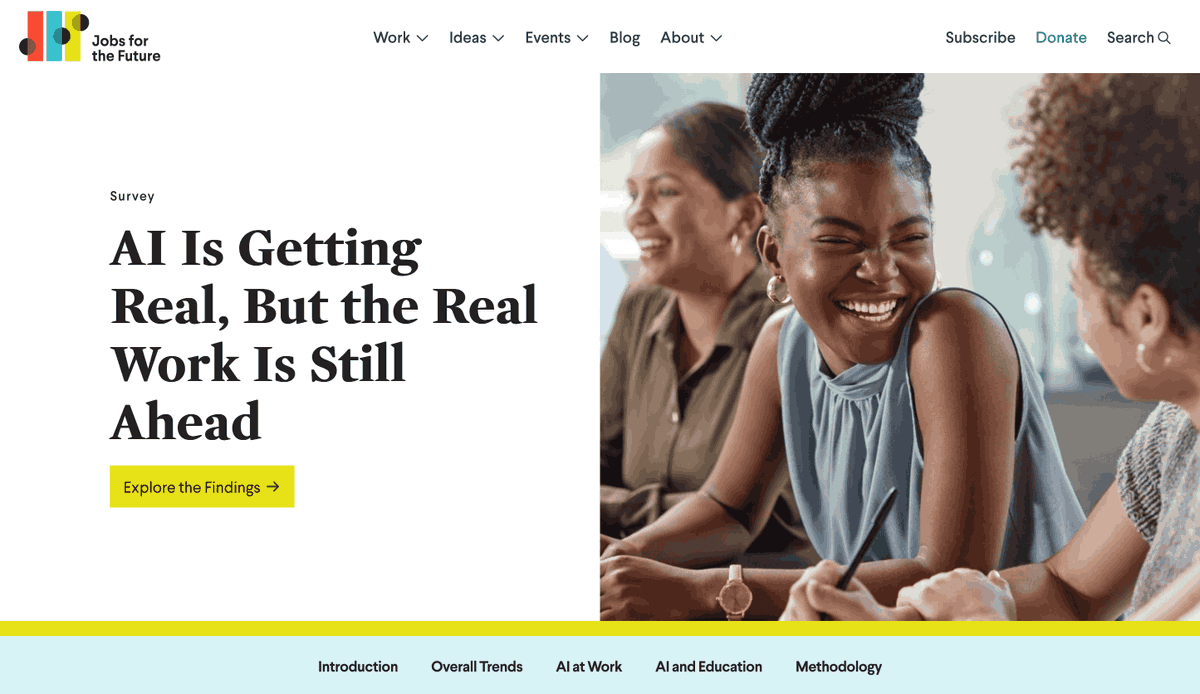
.@jfftweets: A survey of 3,000 Americans finds AI adoption at work and in learning is uneven. Many see benefits, but workers report limited training and often rely on informal resources as job skills shift. info.jff.org/ai-for-workers-…
2
1
176
Benjamin Pring retweeted

Mar 11
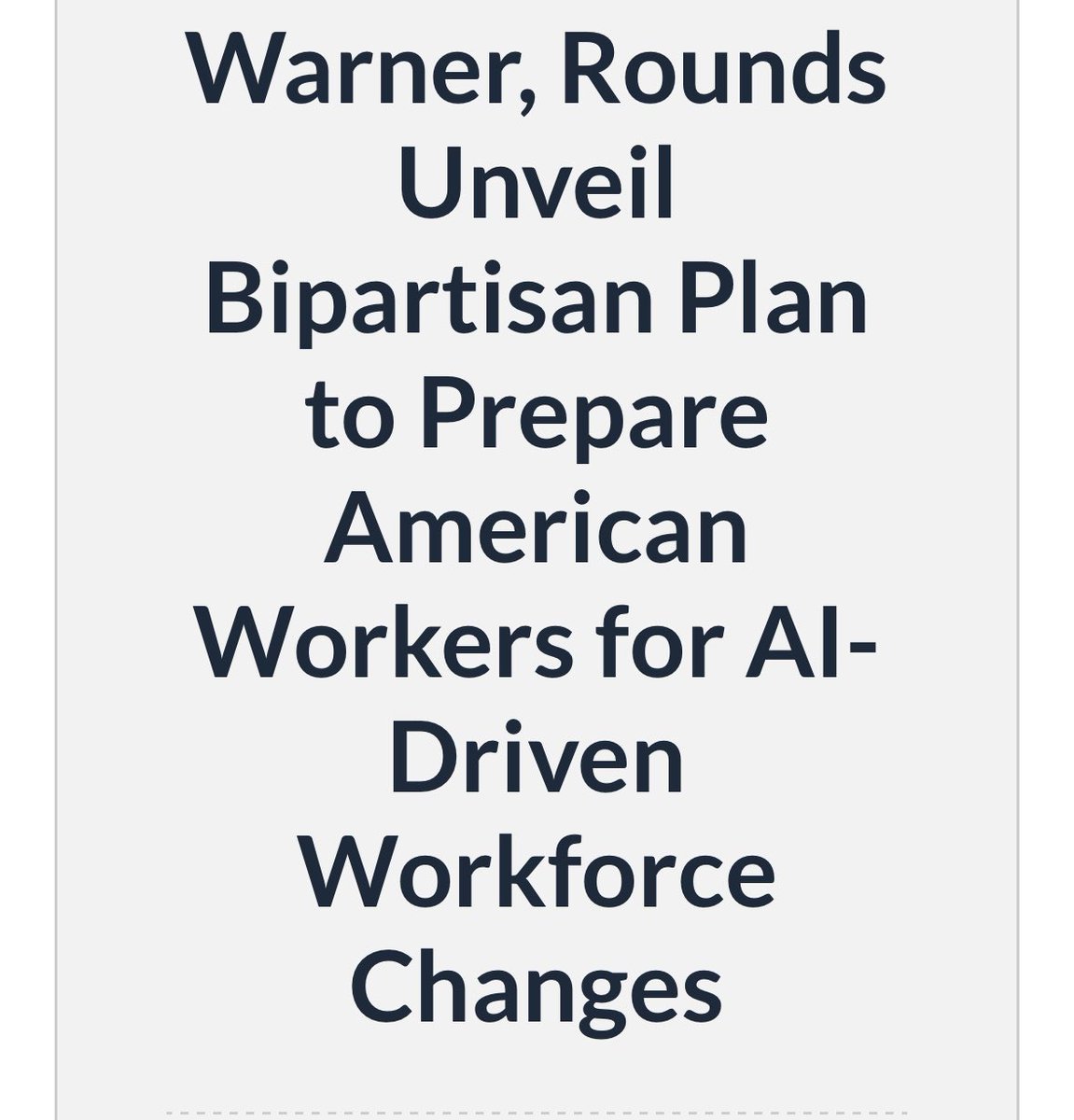
Good idea alert.
“America’s workforce must be equipped to lead the transformation of the economy happening due to AI. This commission would help keep America ahead of our global competitors and keep America prosperous and innovative.” - @SenatorRounds
1
2
1
426
Benjamin Pring retweeted

Mar 11
This is a great point, @arindube , and I am really guilty of not sharing more about what I have been up to on the teaching side of things, given that this is what they pay me for! Let's get back on track with a mega post.
At @LSEEcon, we've been running a series of structured experiments to figure out exactly how GenAI changes the production function of economics education. We moved past the "cheating" panic early (although we didn't really have one in our programmes) and started actively rebuilding our pedagogy around these tools. Here's what we're doing and what we're learning, and btw we will be presenting our work at CTREE 2026 in Las Vegas in late May if you are in town.
The AI Economics Professor
With Ronny Razin, we built a specialised, course-aligned AI tutor. The key idea Ronny had: best way to verify if a student actually understands a concept is to ask them to explain it interactively. Clearly this does not scale to the class size we have at LSE (Ronny teaches his course to 850 first-year students). But we can scale with AI! The key pedagogical principle is that the chatbot uses a Socratic framework. It refuses to hand out final answers. Instead, students are prompted with an exercise, and the chatbot asks them to identify the next step in a mathematical or logical derivation themselves, guiding them through the reasoning rather than short-circuiting it. It adapts to the students' level, for example by clarifying concepts or notation if needed.
This gives students access to 24/7 personalised tutoring, levelling the playing field for those who might hesitate to speak up in small classes or office hours, and solving Bloom's "2-sigma problem" in economics education. Notice that we didn't train the bot or fine-tuned t to our course material. We just provided a system prompt embracing the Socratic approach, and the solutions to the exercise students had to solve. That's it. Off the shelf LLM model (it was Gemini 2.5 Flash).
We did run a small experiment for a game theory exercise, where students had to work out strictly dominated strategies, and pure and mixed strategy Nash equilibria. The feedback we received is overwhelmingly positive: students found it useful to work through the reasoning with the chatbot, and it helped them understand the material better. We are also in the process of establishing if the use of the chatbot improves marks in the final exam, although we don't have a full analysis yet. But I can say that this was a very good year for the distribution of marks in this course, way above the average of previous years. If this proves as good as it looks, next step is to scale this to more courses, potentially expand to similar disciplines in LSE, and potentially expand to other universities. Stay tuned.
AI Feedback Experiment
Providing high-quality, scalable formative feedback is one of the hardest problems in our job. It's incredibly labour-intensive, and the result is that students often get too little feedback, too late to act on it. Main problem, again, is scale. Can we use AI to enhance our feedback process? We did an experiment with @MichaelGmeiner2 in one of our MSc courses.
Michael is a great teacher. In his Econometrics course, he teaches students how to write referee reports, and provides feedback to each one of them on 5 submitted referee reports. We thought, why don't we provide two feedback reports for each submission, one AI-generated and one human-generated? This will allow us to evaluate how good the AI feedback is with respect to human feedback (well, Michael's feedback, which is superhuman in my view, but ok).
And so we did. We didn't say which is which to students, to avoid any kind of bias. And again, we just cooked up a prompt for the LLM to generate feedback on the referee report, we provided the AI with the paper to referee, the referee report submitted by the student, and nothing more.
We found out that students rated the AI-generated feedback as less useful than the human-generated, although not by a lot. Main problem with the AI-generated feedback is that it is too generic, and does not address the specific TECHNICAL issues that the student may have missed in their report. It is also too positive, and does not provide the student with the critical feedback that they need to improve. In particular, students highlighted that the AI feedback did not enhance their critical thinking, and did not address methodological problems in the research article they were refereeing.
Some of these aspects can be addressed with a better prompt, and we are working on it. The technical and methodological issues can also be addressed by providing a summary of what the teacher expects students to criticise in the paper, although there may be additional challenges in this approach (what if the student finds something else to criticise that the teacher did not think of? it happens all the time).
Students also mentioned they think the two pieces of feedback are complementary, and they will be happier getting both that just one of them.
This points in the direction of a hybrid approach, where AI is used to enhance the human feedback process, rather than substituting it. The caveat is, of course, that we haven't used the most recent models, we didn't try with mixture-of-experts and all the tricks in the book.
Teaching Python & RELAI Principles
Perhaps our biggest curriculum shift: with @JADHazell we pioneered teaching AI coding tools to first-year students. In the first year macro course that Joe teaches, we introduce students to Python coding for economic analysis. This year, we decided to move in a different direction: since the advent of AI coding agents, we believe it is more important to be able to READ and ORGANISE code than writing it. It is more important to be able to explain your intent to the AI coding agent, and verify that intent has been reflected in the code, than to be able to write the code yourself and test it. But how can you teach students that have never seen a line of code to do that?
Introducing Reverse Engineering Learning with AI (RELAI). Start with a full snippet of Python code. The student is told to prompt the AI to explain what the code does. Once the student understands what the code does, it can asks about the syntax and the programming concepts behind the snippet. Then can ask a study plan for those concepts, if needed. Then can try to enquire the AI about what would happen if I change this line or this parameter. Then it can experiment itself by changing the code, and debug with the help of the AI. Finally, the student can ask the AI to produce new code, based on what was learned, and the new intent. I call this the EXPLORE approach: Examine the code, eXplain what it does, Probe deeper, Link to economics, Output prediction, Recreate understanding, Extend with modification.
Once students are familiar with AI coding agents, they are assessed with a challenging coursework that Joe created. The assignment has a part that is difficult to do without AI, but should be feasible with AI. There are open ended questions where students have to go beyond the simple repetition of what was learned in the course, possibly explore new datasets and questions, etc.
We think this approach can help integrate AI coding agents into the curriculum in a meaningful way, and help students develop a deeper understanding of coding tools in a faster and more efficient way. Coursework is on the way, so we will be able to evaluate the impact of this approach in the next few months. I personally believe RELAI can be adapted to other topics and subjects, and can become one of the way we interact with AI when learning something new.
Read more about our approach here: python-ec1b1.vercel.app/
AI as a productivity tool
This is where you can really go nuts.
I have used AI to produce new teaching material for several workshops and courses. Slides, assignments, exercises, etc. The last few exams were written with AI tools, creating a series of questions first with suggested solutions, and then choosing the most appropriate ones.
I use a coding agent (@cursor_ai ) with access to my teaching materials and past exams, so that it is aware of the content and style. You get a very good exam draft in minutes, and can edit, change questions, generate new ones, etc. It used to take me days to write a good exam, now it takes me a few hours in the afternoon.
I used Cursor to do deep research about a new course I wanted to design. I asked for topics, examples, current research in the field that I may not have been aware of, similar courses' syllabi, and in general what was the state of the art in the field. I got a very long list of topics that I could choose from to design my own course, based on my taste, interest and what I think my students should know. I could generate different versions of the same course for different levels (UG, MSc and PhD).
Conclusion
We are still at the early stages of this journey. We are learning a lot, and we are still figuring out how to best use AI to enhance our teaching. One important thing you may have noticed is that we first define our pedagogical approach and then we integrate AI tools to support it. The other principle should be, design not for the tools you have now, but the ones you will have in a few months or years.
If you have comments, or have been running similar experiments, I will be happy to hear from you.

I have read a ton from economists in my TL about use of AI in their research workflow.
Much less about teaching. Would love to hear what folks' experience has been on that front. (Not problems of students using AI: I mean use of AI in teaching workflow, the good and the bad.)
9
65
284
91,080
Benjamin Pring retweeted

Mar 6
College students increasingly support banning laptops from classrooms. Multifunction screens fragment attention and block learning. Computers and tablets do not belong on students' desks, and especially not in K-12.
thecrimson.com/article/2025/…
46
266
1,441
81,042
Benjamin Pring retweeted
Mar 7
An AI tutor now costs $4 a month. The average U.S. college charges $26,000 a year. That’s a 500x price difference for something that’s available 24/7, never loses patience, and already tutors millions.
The professors in this tweet are right to be worried. But the threat to college is more specific than “AI exists.”
AI breaks three pillars the traditional college model depends on:
Content delivery. Lectures were already losing to YouTube. Now Khanmigo, Google’s Gemini for Education, and a dozen other AI tutors offer personalized 1-on-1 instruction in every subject, adapting to each student’s pace. A 2025 College Board survey of 3,000 faculty found 74% say students already use AI to write essays and papers. The classroom is competing with something that never sleeps.
Assessment. Students use AI to write. Professors use AI to grade. Nobody’s sure what’s actually being measured anymore. 92% of college faculty say they’re concerned about AI-driven plagiarism. 84% agree it reduces critical thinking and originality. The entire system of “prove you learned this by writing about it” is breaking down, and nobody has a replacement.
Credentialing. 70% of employers now say they’d rather hire someone with less experience who understands AI than someone with more experience who doesn’t. Half of Gen Z workers already view their degree as a waste of time. In the UK, 49% of universities have closed courses in the last year. In the U.S., 28 colleges shut down in just the first nine months of 2024.
The “collapse” framing misses one thing though. Harvard’s endowment just hit $56.9 billion. Ivy League acceptance rates are near all-time lows. The top schools are stronger than ever because they sell something AI can’t replicate: networks, signaling, and the in-person experience of being around other ambitious people.
The schools in danger are mid-tier tuition-dependent ones that mostly sell content and credentials. AI makes the content free and the credential less valuable at the same time. A 15-year demographic decline (fewer kids born after 2008) makes it worse.
Only 9% of university technology officers said in 2024 that higher ed is prepared for AI’s rise. The professors see it coming. Most institutions don’t.
Mar 7

every professor I talk to that uses AI says the college system is about to collapse
4
6
45
8,336
Benjamin Pring retweeted

Feb 18
Since my op-ed in the @FT was published on Monday (ft.com/content/4b51d0b4-bbfe…), there’s been a growing debate about whether we’re beginning to see evidence that AI is boosting productivity.
First, let me be clear that the aggregate productivity data by itself is far from definitive. Even with the new revisions, there is certainly a lot of noise in US productivity numbers. No doubt lots of other factors are at work.
That said, my growing confidence that AI is powering higher productivity draws on evidence from a variety of sources:
1. The stunning capabilities of AI. If anything, I think the past decade of impressive improvements in machine learning and generative AI are still underrated. We are in the early stages of a massive economic transformation: digitaleconomy.stanford.edu/…
2. A growing number of micro studies document double-digit productivity gains in specific applications. @alexolegimas has a great catalog in his blog post: aleximas.substack.com/p/what…
3. My discussions with power users who use AI for coding, customer service, research and other applications, as well as more and more business executives, convince me that the facts on the ground are (finally) changing.
4. Data from our Canaries in the Coal Mine paper show employment changes in occupations most affected by AI: digitaleconomy.stanford.edu/…
5. And now, inklings in the aggregate productivity data are also telling the same story.
These are all consistent with the hypothesis that AI is beginning to have a positive impact on productivity.
The FT put a more definitive headline on my recent piece than I would have liked, but my bet (longbets.org/868/) is that we're likely to see more and more evidence as time goes on, barring some other shocks (e.g. macro mismanagement, trade wars, etc).
As each quarter goes by and we see more data, I continue to update my views.
No doubt, I'm currently out of sync with a lot of mainstream economists on this topic, but that’s ok by me.
26
103
376
88,095
Benjamin Pring retweeted

Feb 15
No, the white collar jobs are not going away in 18 months!
I was furious with the populist-baiting language (in line with @DarioAmodei 's and @sama's also preferred apocalyptic usage) that Microsoft's @mustafasuleyman used in his FT interview, threatening everyone's jobs: “White-collar work, where you’re sitting down at a computer, either being a lawyer or an accountant or a project manager or a marketing person — most of those tasks will be fully automated by an AI within the next 12 to 18 months.”
Not only do I not see the point of this backlash inducing language, I also believe it shows no understanding of the way the labour market and organizations actually works and what people do all day. (My book on this with Jin Li and Yanhui Wu will be out soon.).
Don't get me wrong: I believe AI is a huge deal, and will radically change the world. But many white collar jobs are Messy jobs, as our book (and the post linked below) will explain: automating the automatable tasks within them is not near to automating the job.
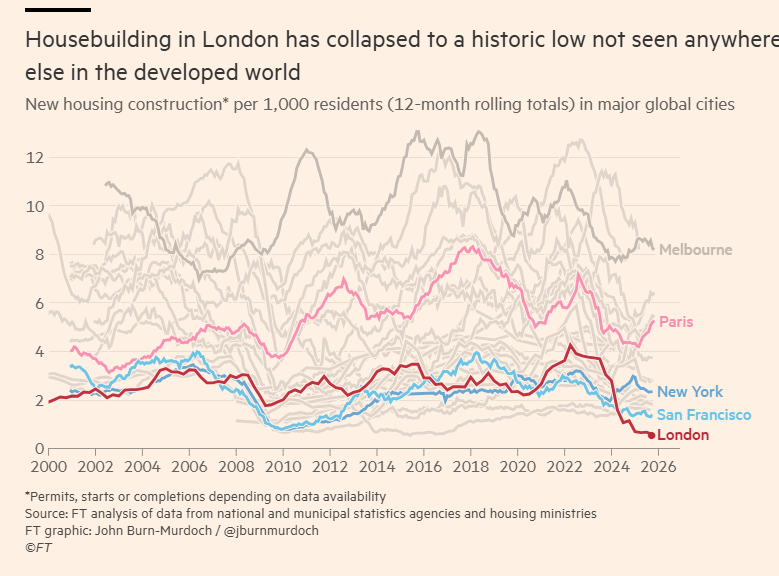
Let me make the point with the attached @jburnmurdoch graph on London.
London needs 88,000 new homes per year. In the first nine months of 2025, just 3,248 private homes started construction. Twenty-three of London's thirty-three boroughs recorded zero new housing starts in the first quarter of 2025. Planning permissions have fallen to their lowest level since records began in 2006. Construction of new rental homes fell by 80 percent in a single year. All this is after Starmer declared his government wants to "build, baby, build."
Does anyone think AI will fix this?
All the technology to design a building exists, and existed pre-AI. The bottleneck in London housing is human. What stops homes from being built in London are environmental and land use regulations and neighbors that weponize them.
AI can draft the review, but that is a trivial bit. It cannot convince the environmental group to drop its lawsuit or persuade politicians or negotiate with the neighbors.
These obstacles employ people. Suleyman and Amodei imagine that project managers spend their days doing Gantt charts, call their job "sitting down at a computer" and dream of automating them. But the job of the planning guys is not to fill in forms, but to negotiate and coordinate developers, residents, environmental groups, heritage bodies, and elected politicians who all have incompatible interests.
At other levels and in other jobs the same is true- radiologists spend only 1/3 of their time reading scans (see this great piece worksinprogress.co/issue/the…). Their job was supposed to be gone in 2017; in fact, the demand for radiologists is booming (employment and wages are sharply up). Many consultants try to elicit the tacit, local, knowledge of what is actually going on in a firm in order to make a recommendation. Yes, if you spend your day just doing PPTs, you will be replaced. But how many people do just that?
Organisations/managers resolve conflicts and deal with exceptions. Making a decision stick requires authority: being a person who can be blamed, sued, or fired. The manager resolves disputes about the rules, not just within them. Think of your last renovation in your house. The contractor trying to to get the guy installing the windows and the guys from the floor to show up and do a good job, a mess right? No algorithm does that.
AI will make white-collar workers more productive. Some single-task, automatable roles will shrink (doing taxes is an expert system, drafting contracts too), many tasks will be automated. Also, the disruption of career ladders is a real concern. But "most tasks fully automated in 18 months" is not a prediction. It is marketing, designed to sell enterprise subscriptions and justify capital expenditure.
The real world is messy. The mess is not a bug. It is what happens when human beings with competing interests try to get things done together.
For more on "Messy Jobs", here is my New Years post: siliconcontinent.com/p/a-new…. A book out soon.
67
273
1,190
323,428
Benjamin Pring retweeted

Feb 13
Today, we released the @USDOL’s AI Literacy Framework.
We continue to prioritize equipping all American workers with the foundational AI skills to succeed in an AI-driven economy. 🇺🇸🚀
Read the full framework document here: dol.gov/sites/dolgov/files/E…
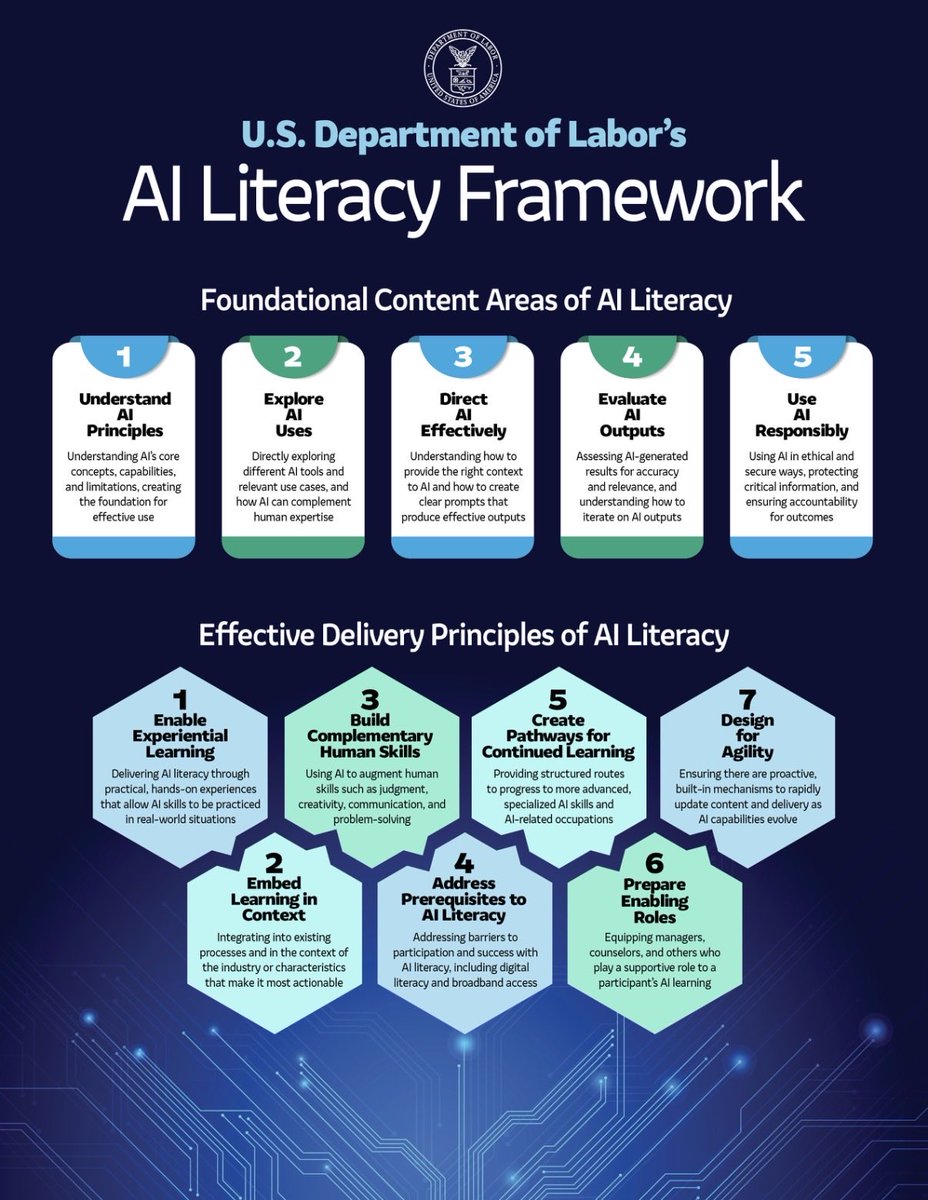
4
5
360
Benjamin Pring retweeted

🚨 NEW: @USDOL just announced our AI Literacy Framework, providing guidance that will help accelerate effective AI skill development across the country.
The Trump Administration is committed to making sure all American workers are able to share in the prosperity that AI will create for our economy 🇺🇸
➡️dol.gov/newsroom/releases/et…

11
41
99
8,321
Benjamin Pring retweeted

Feb 12
Enterprise software is on the verge of another transformation.
First came custom software: highly differentiated, built to fit. But expensive to maintain and hard to scale.
Then SaaS took over: lower maintenance, continuous updates, greater efficiency. But also rigid cores, underused features, and roadmaps driven by vendors. We gained efficiency, but lost differentiation.
Now we’re entering a third phase: AI-native services.
AI fundamentally changes the economics of maintenance. When intelligent agents can generate, test, deploy, and continuously evolve code at a fraction of historical cost, the old trade-off breaks down.
For the first time, companies can combine true customization with subscription economics. Software designed around your workflows and data, yet continuously maintained and improved at scale. This also changes what we mean by “services.”
Services were never just manual work. They were human-scale work: revenue scaled with headcount, margins scaled with utilization. AI changes the lever.
The next generation of services is human-led and AI-accelerated, architecturally repeatable, continuously evolving, and outcome-oriented rather than hour-based.
At Globant, this shows up in AI Pods: AI-powered service units that design and continuously evolve living enterprise systems. Living software delivered as a service.
There is no SaaS apocalypse. Standard platforms will remain massive businesses and critical pieces of enterprise infrastructure. But for many use cases, a smarter alternative now exists.
Custom software gave us differentiation. SaaS gave us efficiency. AI-native services bring both together.
The services industry isn’t going away. It’s being upgraded.
33
57
279
46,228
Benjamin Pring retweeted

Feb 12
it's down 200 lines now, i realized i was *still* overcomplicating things. but it's past midnight and i'm calling it here now.
24
21
1,241
73,858
Benjamin Pring retweeted

Feb 6
I've said this before and I'll say it again: Software engineering is not going anywhere as a profession.
I have been in technology consulting for decades, and I led the development team for an early SaaS startup which had a successful exit.
First: Anyone who has been part of a development team knows that the demand for new applications and features NEVER ends. It generally keeps getting bigger. Once you finish a task, three take its place. As more people use your software, more requests come in to make it better. If it ever reaches full maturity, chances are that's around the time they start looking at replacing that "legacy" code with something more modern.
Any productivity gains are immediately absorbed, and may even raise the expectations of the users on what they can ask for, because now it doesn't take as long or cost as much to change the software.
Second: The most difficult part of software development is gathering and specifying how the system should behave. For any system with lots of users, this means having conversations with PEOPLE. Asking follow up questions. Asking what if questions that the users didn't think of. Questioning whether what they are asking for makes sense. Explaining why something can't be done, or should be done differently.
Computers (and LLMs) are not good at this. They are great at doing what you tell it to do, but not at noticing the dog not barking.
People who develop these skills are much better at it, because a lot of it is intuition about what questions to ask.
Once the new system or new feature is fully specified and agreed on, the actual coding is much easier. It's just translating those requirements into code.
But there is another part of that which the best software engineers are still better at than any LLM: Designing complex architectures. I have given a long list of requirements to my development team, but only one of them could design the architecture that tied it all together. It was amazing to watch him think. He clearly had a model of the entire system IN HIS HEAD, and could envision each part and all the relationships.
His architecture was a work of art. And even so, at a certain point our system hit a performance wall and we had to re-architect the entire system from scratch to make it scale. And he knew the system so well and what was causing the bottlenecks, that he knew what needed to happen.
These types of skills are the future of software engineering. Because they are not just a science, they are an art form. They are creative. They require advanced abstract thinking.
Agentic AI coding can help, especially with the repetitive, tedious, easy parts of coding. But they cannot replace the requirements analyst or the software architect roles.
What has changed is that the cost to produce value with software has gone down. And that means things that used to be not worth doing are now worth doing. And that means demand for software engineering has gone up.
Feb 6

If you are a software engineer "experiencing some degree of mental health crisis", now hear this, because I've been coding for 50 years since the days of punched cards and I have a salutary kick in your ass to deliver.
Get over yourself. Every previous "programming is obsolete" panic has been a bust, and this one's going to be too.
The fundamental problem of mismatch between the intentions in human minds and the specifications that a computer can interpret hasn't gone away just because now you can do a lot of your programming in natural language to an LLM.
Systems are still complicated. This shit is still difficult. The need for people who specialize in bridging that gap isn't going to go away.
As usual, the answer is: upskill yourself and adapt. If a crusty old fart like me can do it, you can too.
76
93
761
75,612
31 Dec 2025
Absolutely first class. Kudos.
30 Dec 2025

some thoughts on 2025.
broadcast to literally tens of subscribers
link below
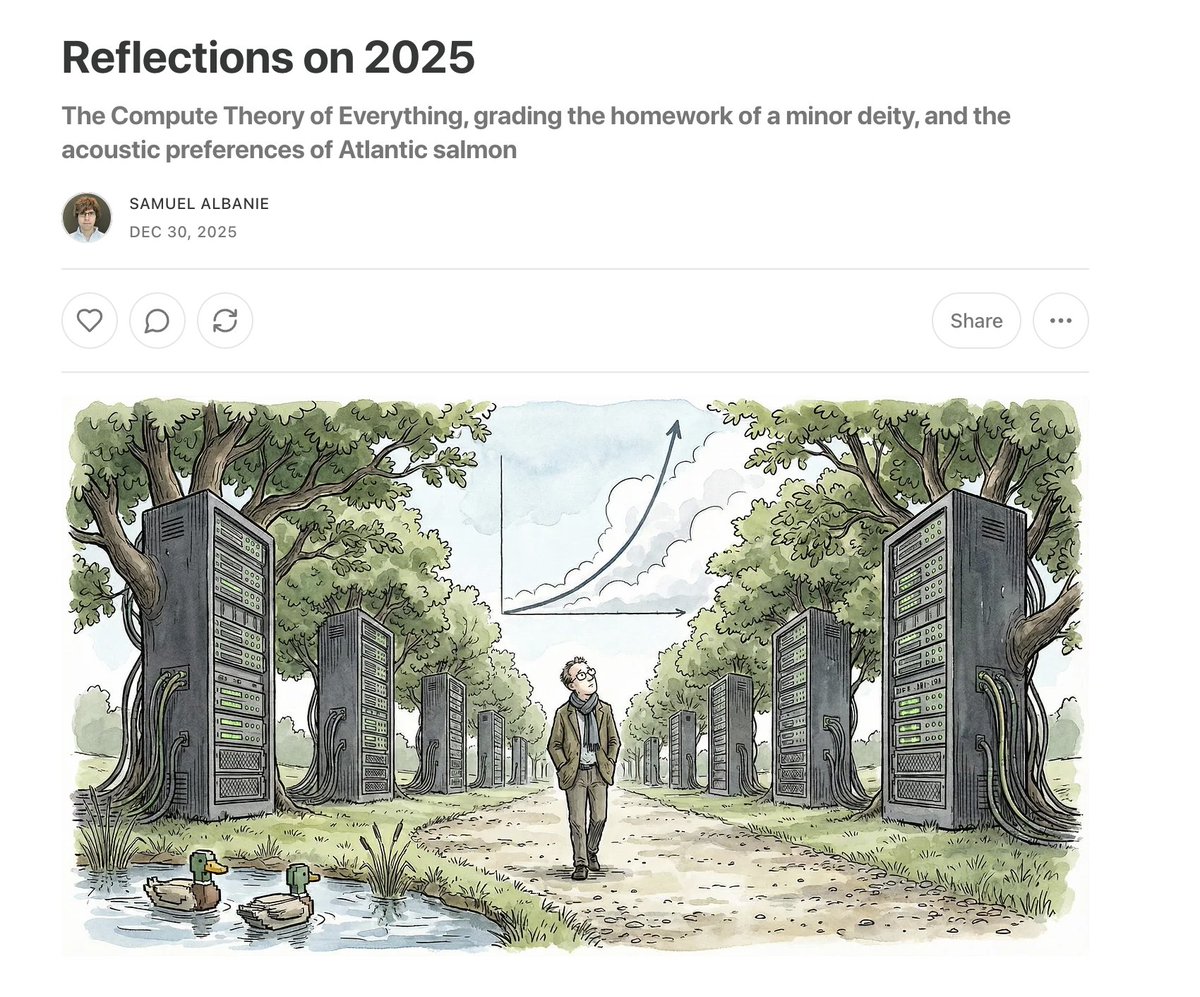
64