“Il faut cultiver notre jardin”
Joined April 2018
- Tweets 53,430
- Following 1,529
- Followers 652
- Likes 49,118
4,762 Photos and videos
Pinned Tweet

23 Dec 2023
No matter what MMT tries to claim the real tax is paid when gov spends, by transfer of goods and service from private to public.
The rest is just funding.
If gov issue money and the money gets its value from taxation then its the tax payer.
If the issue more, then devaluation.
27
11
58
23,852

Henric retweeted

MMT wants to return to the Glory days of the Soviet Union. Where we all bow to the state and politicians promising riches.
MMT is a political movement dressed up as economics. Like jihadists who couldn't quote a single verse from the koran.
2
2
4
85
Henric retweeted

Jun 11
Since 2022, the State of Colorado has accepted crypto currency for payment of all its taxes. That should not count in the MMT storytelling somehow, because it undermines chartalism. Much like they claim that unminted gold "was never money" (except it was).
tax.colorado.gov/cryptocurre…
2
9
48
1,505
Henric retweeted
Jun 10
Am I to think that if I made a public claim, and in the process openly challenged @stephaniekelton to "find the hole in" (debunk) it, that "I'll wait" for her response, and she writes a peer-reviewed article debunking my claim, that MMTers would let me get away with ignoring it?
5
4
43
2,119
Henric retweeted
Jun 10
More from the Dunning-Kruger crowd. If anything characterizes MMTers (other than outright ignorance) it is their consistent (often complete) lack of precision and nuance--a hallmark feature of non-scholars.
Jun 10

Mises explicitly rejected empirical testing with his praxeology framework – economic laws derived from pure logic, unfalsifiable by design
This is not a criticism; it is their (your?) stated methodology. Hayek diverged slightly but the core tradition persists.
Didn’t you know?
2
3
39
2,349
Henric retweeted
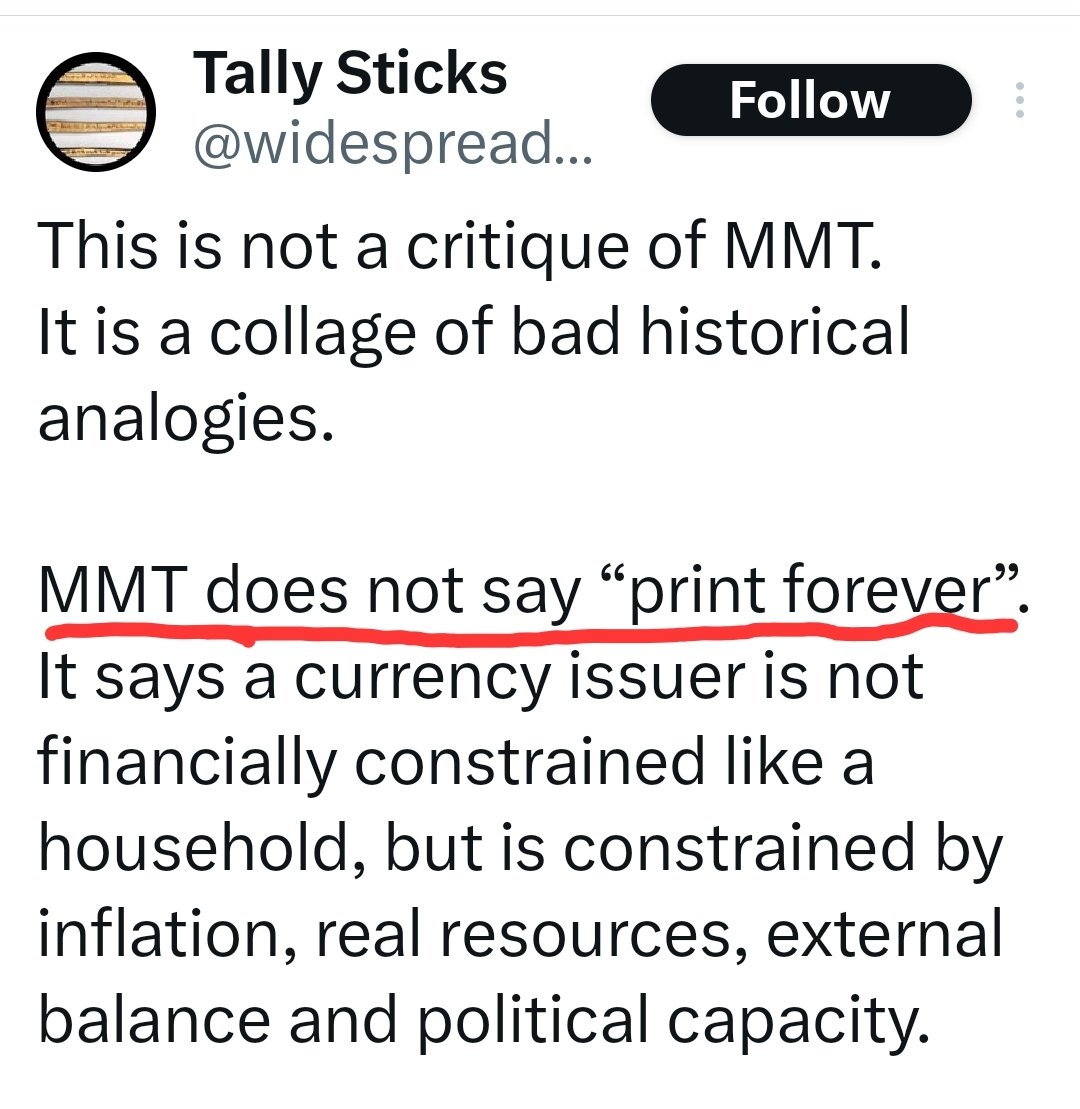
If the act of printing created value then by definition inflation could never exist.
Thus #MMT does say print forever or it must accept its "theory" is wrong.
You can't have it both ways.

8
2
6
1,549
Henric retweeted
Jun 9
"Or they didn't have money"? MMT is an exercise in sophism. I've yet to encounter an MMTer who appears to be of IQ > 80.
2
11
144
Henric retweeted
Jun 9
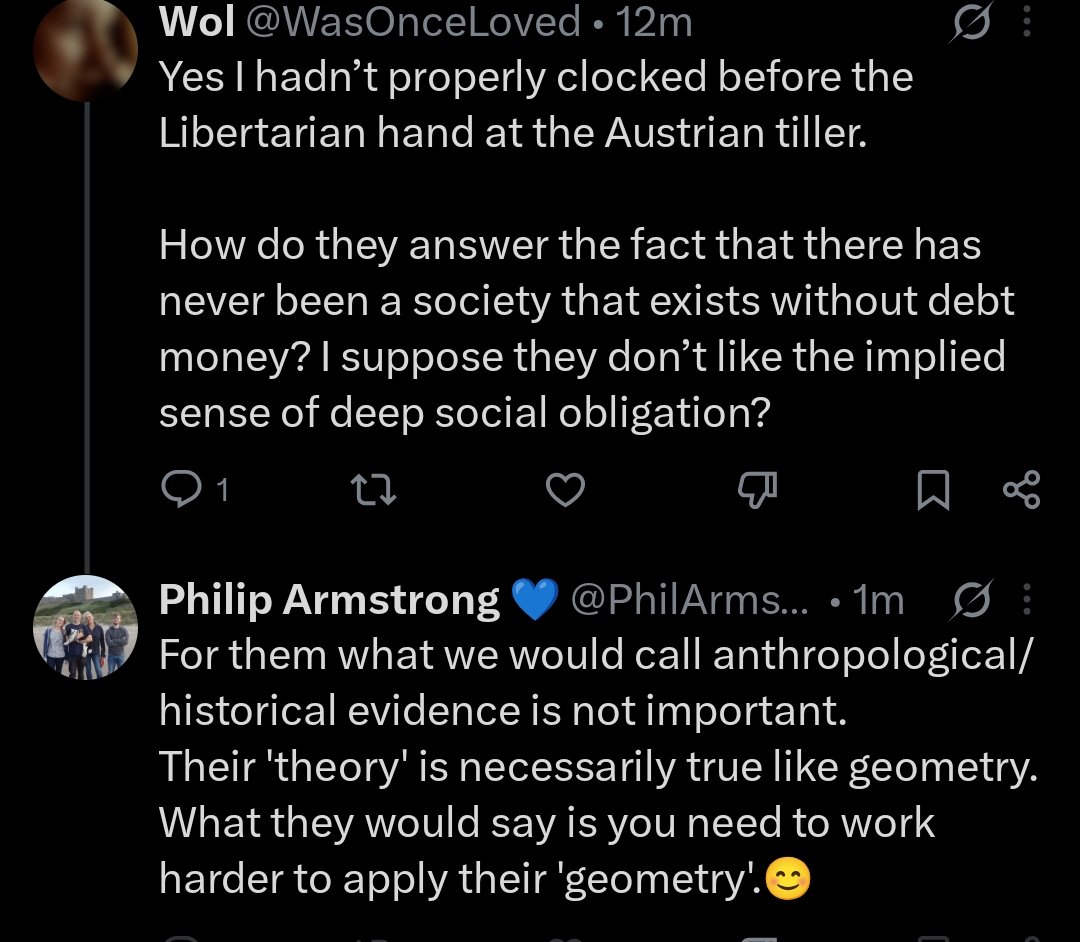
This is fascinating. Two MMTers, of typical delusions, making fun of Austrians. Needless to say, they even fail in their intra-MMT rants... 🤦♂️
10
2
47
2,151
Henric retweeted

Jun 9
MMT doesn't describe the monetary operation bc Gov cannot spend a liability of nothing.
0-1=0 not 1
MMT ers would have to convince 5 year olds that there is something they can have from nothing.
2
1
1
146

Modern economics is a circus, and proponents of MMT are the clowns.
MMT proponents dress up inflationary financing in academic jargon, but you're witnessing the same monetary snake oil that governments have peddled for centuries. Every empire from Rome to Weimar told citizens they could print their way to prosperity. The Romans debased their denarius. John Law flooded France with paper livres in 1720. The Continentals became worthless by 1781.
Modern Monetary Theory repackages this ancient temptation with PhD credentials and colorful charts. Stephanie Kelton and her disciples claim deficits don't matter because the government creates dollars. They argue inflation only appears when you hit "resource constraints." But this ignores how money creation distorts price signals from day one. When the Fed conjures $3 trillion in 2020, those dollars don't sit idle waiting for full employment. They bid up assets, reward speculation over production, and transfer wealth from savers to borrowers.
The MMT crowd loves pointing to Japan's debt-to-GDP ratio above 250% without hyperinflation. Yet Japan suffered two lost decades of stagnation while the Bank of Japan propped up zombie corporations. Japanese households saw their purchasing power erode as real wages stagnated and asset bubbles inflated. You call that success?
Money printing doesn't create wealth: it redistributes it. Every dollar the Treasury spends into existence represents resources diverted from private hands to political priorities. The Pentagon gets its $800 billion budget whether or not taxpayers can afford it.
Zimbabwe's central bank also believed it could print without consequence until inflation hit 89.7 sextillion percent in 2008. The Fed just has better marketing.

59
99
268
17,268
Henric retweeted

Unfortunately - MMT is a conspiracy theory, a half-baked idea of how money and fiscal policy operates which is so divorced from human behaviour, current affairs, and the minutiae of how our systems function, that it should be roundly laughed at (which in serious economic and academic circles, it is).
For example - if you claim that "they" (whoever "they" are) want more privatisations, I'd ask why it is that this government have moved to nationalise (or move against the marketisation of) railways, steel, health-services, schools, energy, etc. Likewise, the idea that they are reducing public services is laughable.
If Kelton, Murphy, et al, were to be correct, we would not have seen Liz Truss removed when she moved to massively increase the deficit -- just as they have no answer to inflation or the maleffects of taxation which is, almost unilaterally, demonstrated to curtail consumer power and investment.
If MMT really was not a conspiracy theory, I would like to see it used in public policy somewhere on planet earth. I'm still waiting, as I'm sure, so are you.
24
2
5
3,117
Henric retweeted

The easiest way to quieten MMT down is to ask if inflation is measured by more units of money used in the same number of transactions. They won’t answer, but if they do ask them where more units of money come from.
3
3
6
200
Henric retweeted

The counter argument to MMT.
Thomas Sowell provides the takedown:
Thomas Sowell, a prominent free-market economist and critic of expansive government intervention, would likely reject core elements of Richard Murphy’s (and broader MMT) positions as ignoring fundamental economic realities like scarcity, incentives, unintended consequences, and the destructive effects of inflation.
Murphy’s MMT Position (Simplified)
Murphy describes MMT as explaining how sovereign currency-issuing governments (like the UK) actually operate: They spend by creating money (via the central bank), taxes withdraw money to manage demand and control inflation (not to “fund” spending), deficits create private-sector assets, and the real limit is inflation/resources rather than solvency. Governments face no inherent financial constraint like households and should prioritize full employment and public goals over balanced budgets or austerity.
Sowell’s Likely Counterarguments provide a clear framework for opposition. Key points:
1 Scarcity and Real Resource Constraints (Not Just Inflation):
Sowell emphasizes that economics begins with scarcity—there is never enough of everything to satisfy all wants. Government “creating money” to spend doesn’t create real resources (labor, materials, goods). It merely redistributes them, often inefficiently. MMT’s focus on inflation as the primary constraint downplays how printing/spending distorts prices, misallocates resources, and crowds out private uses. Sowell would argue this leads to waste, as politicians chase visible “needs” without trade-offs.
2 Inflation as a Hidden Tax and Destroyer of Wealth:
Sowell repeatedly calls inflation “the most universal tax of all” and “a way to take people’s wealth from them without having to openly raise taxes.” It erodes savings, punishes the prudent, transfers wealth to debtors (often government), and creates uncertainty. Historical examples like the Weimar Republic show massive money-financed spending leading to ruin, not prosperity. MMT’s willingness to run deficits and use taxes only reactively to curb inflation would strike him as dangerously naive—politicians rarely act in time, and inflation hits the poor and middle class hardest.
3Government Spending, Incentives, and Unintended Consequences:
Sowell is deeply skeptical of claims that more government spending “stimulates” or solves problems. He notes the assumption that spending more taxpayers’ (or printed) money improves outcomes survives endless evidence to the contrary. Expanded spending creates dependency, bureaucracies, and political incentives to buy votes rather than deliver value. MMT’s framing enables ever-larger deficits and programs without fiscal discipline, ignoring how interventions distort markets (e.g., via price signals).75
4False Analogy and Political Reality:
Sowell would likely call out the household-government analogy rejection but flip it: While governments can print, the real costs (opportunity, inflation, future burdens) remain. Politicians disregard scarcity; MMT gives them intellectual cover for short-term populism (“magic money tree”) at long-term expense. He favors reduced government spending overall, not clever accounting to justify more of it.
5Empirical and Historical Lens:
Sowell draws on evidence that market-driven coordination outperforms central planning or heavy fiscal activism. Post-WWII recoveries, stagflation in the 1970s, and failures of big-spending initiatives align with his views over MMT-style functional finance.
In short, Sowell would view Murphy’s MMT as sophisticated-sounding rhetoric that replaces what has worked (fiscal prudence, sound money, market incentives) with what sounds good (unlimited public spending without “financial” worry). It risks repeating historical mistakes where governments overreached monetarily, leading to inflation, inefficiency, and eroded prosperity.
7
1
6
1,194
Henric retweeted

Jun 4
I really dislike MMT. Pay for your stuff with taxation!
38
3
27
10,468
Henric retweeted
What MMT do not understand is that the same units of currency are used time and time again and year on year to finance different spending and tax.
MMT think spending creates new money and tax destroys it: a joke of a theory
6
4
30
850
Henric retweeted

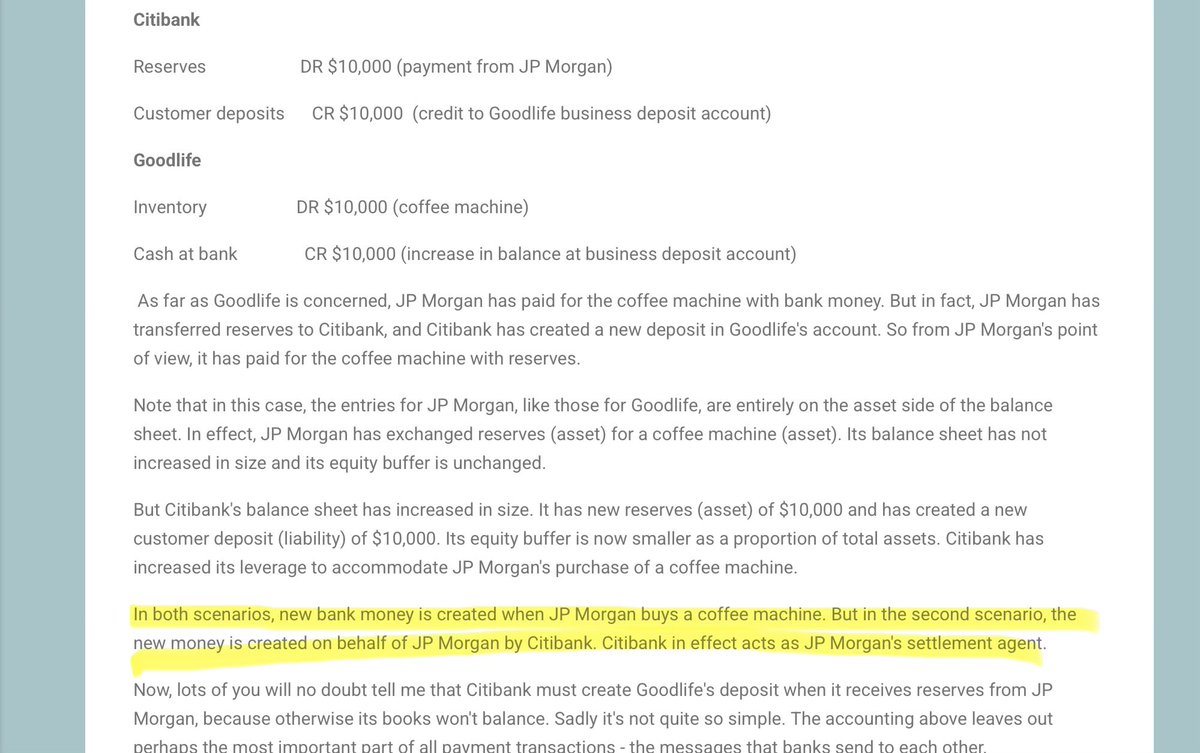
A powerful rebuttal to the MMT claim that money originates exclusively from - and must be spent into the economy by - government.
1
6
159
Henric retweeted

MMT advovates are the same class of people who were selling sub-prime mortgages 20 years ago and saying it was prime debt.
Just a bigger scam this time round.
1
2
75
Henric retweeted

Jun 3
Mmt people are like sovereign citizens. Convinced they’ve found a clever loophole which allows them to do as they like without consequences, and if you suggest there might be consequences they get angry and call you stupid.
1
2
81
Henric retweeted

>>>MMT is for 2 types of people
Type 1 The academic grifters who make a good living peddling MMT bullshit
Type 2 The malcontented loser who believes that their pitiful existence would be better if only the state clandestinely stole more wealth from its citizens
You are Type 2

Austrian Economics is economics for people who don't understand numbers or think they matter. And mostly deeply unserious, as you generously just demonstrated.
5
4
36
1,349
Henric retweeted
Modern Monetary Theory is fantasy economics from people who rely on taxpayer money, because it has run out.
Monetary flat-earther nonsense.
None of them has ever run a business, employed people or had to pay income tax and NI, nor collect VAT on behalf of other people.
4
1
11
891