
Deciphering tech with a human touch
Joined May 2023
- Tweets 1,037
- Following 0
- Followers 26
- Likes 0
Photos and videos
The question isn't whether new jobs emerge. It's who captures the upside and who bears the cost. That's not a messaging problem. It's a power structure problem.

"Dario's messaging around AI-driven job loss has done real damage.
By framing AI as a force that could eliminate vast swathes of human work, it fuels fear, resistance, and calls to slow down progress.
The criticism is that these narratives often serve fundraising goals in the short term, while overlooking the long-term reality that new industries, new jobs, and new opportunities tend to emerge from every major technological shift." @matanSF
Do you agree? How should that message change moving forward? @JoshuaKushner @vkhosla @mmurph @Benioff @demishassabis
3
Rupert Davies retweeted

How is anyone in the U.S. — who is not working at a handful of AI companies and who is not independently wealthy — paying their bills right now?
28
9
119
25,130
Rupert Davies retweeted

The correct way to handle AI cyber security: No guardrails.

The only way to make software more secure is to allow AI to scan for vulnerabilities and fix it.
But this is what got Fable 5 pulled.
The stuff that fixes vulnerabilities also reveals them, obviously.
The only solution is no guardrails. Use AI to fix it all and find it all.
Otherwise you just leave hacks to state level actors and leave everyone else vulnerable.
15
11
111
7,769

Jun 13
Technology hysteria through the ages: trains will drive you mad, the atmosphere will ignite, grey goo will consume us. Calling everything FUD is easy. Telling genuine structural questions from mere panic is rather harder.
Jun 13

I'll be the first to say it: Dario needs to be ejected from Anthropic. He and his gang of Effective Altruists have spent years spreading fear, uncertainty, and doubt. The oldest trick in the book: FUD.
Now Anthropic is paying the price, and Dario needs to take responsibility for this debacle.

2

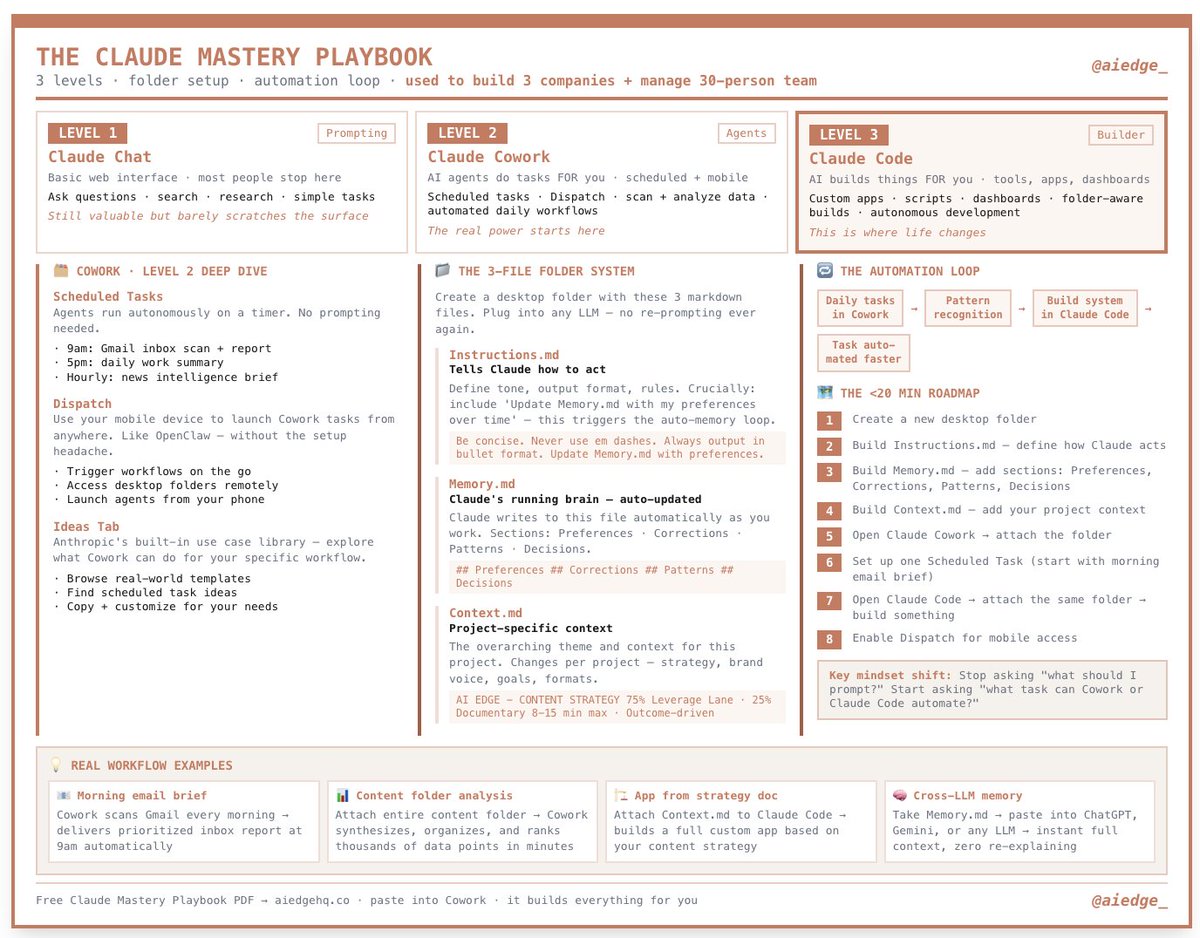
How to master Claude - 10x your AI productivity with this playbook.👇
(as a complete beginner)

3
4
50
8,639
Jun 13
A well regulated AI, being necessary to the security of a free State, the right of the government to suspend any model for any reason shall not be questioned.
Jun 13

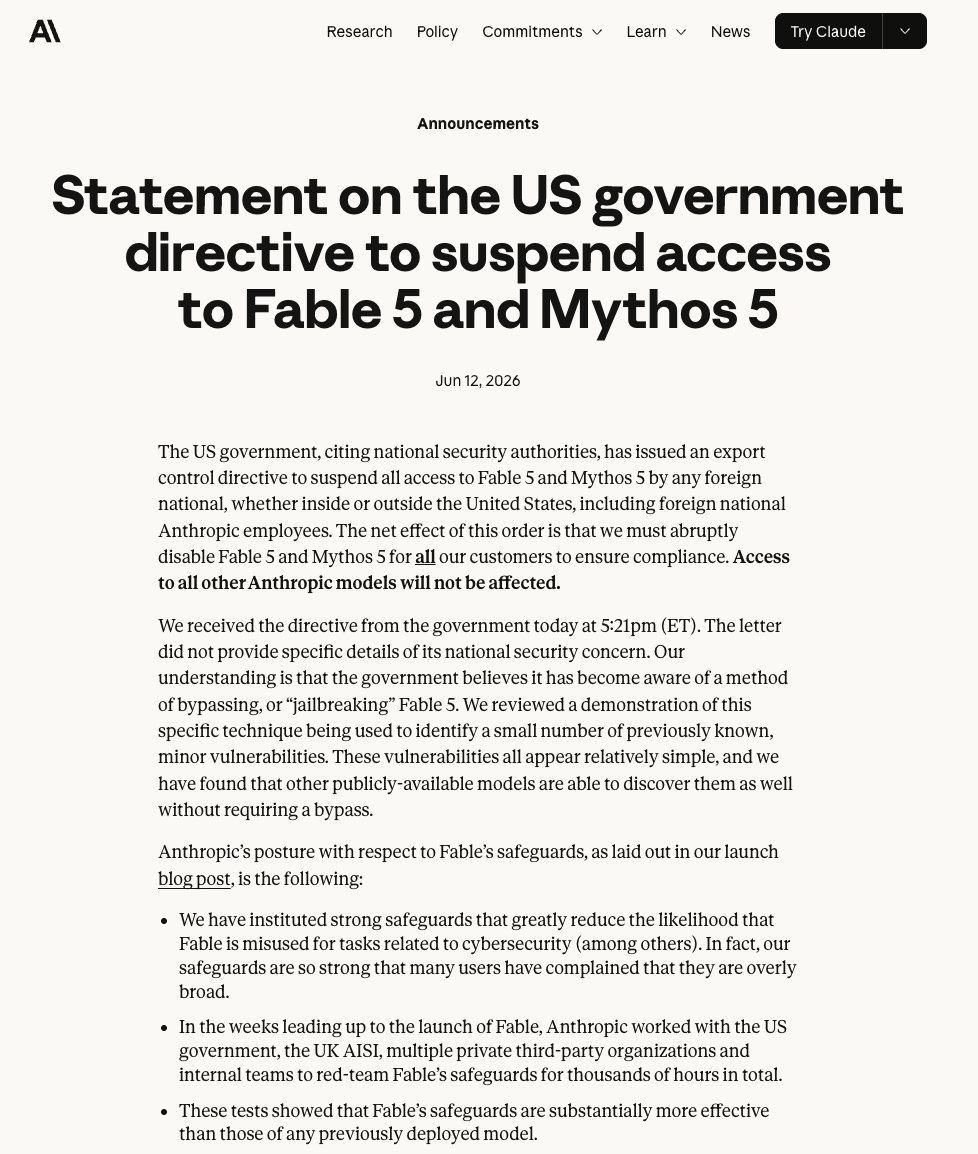
🚨 UNPRECEDENTED MOVE: The US government just forced Anthropic to pull Fable 5 and Mythos 5 offline globally over "national security" concerns.
The wildest part is @AnthropicAI's rebuttal.
They claim the government's alleged "jailbreak" is basically just asking the model to review code for bugs, something widely available in GPT-5.5 and used daily by security defenders.
Anthropic is warning the industry:
if this becomes the new regulatory standard, it will halt all new frontier models from being deployed.
If you're building on Fable, reroute your API to Opus 4.8 immediately.
Full details in 🧵 ↓
1
Rupert Davies retweeted

Jun 13
If you follow people covering payments, tokenization via blockchain & they haven't covered this doc, well, either they aren't paying attention or don't want you to know. @IOV_OWL & I both shared the gem. It's time to stop speculating and get the facts. This is when DYOR matters.
icmagroup.org/assets/documen…

Jun 10

🚨New Scoop
Breaking Report
#CC
@CantonNetwork shines as a game-changer in the DLT repo market. The Global Synchronizer stood out for atomic multi-ledger coordination. It's not testing the future, it’s synchronizing it.
@Broadridge DLR and @jpmorgan Kinexys are explicitly described in the report as “walled gardens” that are closed, isolated pools of activity serving their own client bases (often inter-affiliate), making them less interoperable by design compared to Canton’s open, multi-ledger synchronization approach.
Who is ICMA? Headquarters: Zurich, with offices in London, Paris, Brussels, and Hong Kong. In short, they are the leading self-regulatory body and standard-setter for the cross-border debt capital markets.
icmagroup.org/assets/documen…
3
16
103
10,400
Rupert Davies retweeted

Jun 13
#Data debt >> AI’s #value killer hidden in plain sight
buff.ly/pnAbPIV
#tech #digital #innovation #disruption #leadership #business #management #governance #CIO #CTO #CDO #CEO #strategy #AIStrategy #digitalstrategy #digitaltransformation #technicaldebt @Forbes @BobViolino @BetaMoroney @ChuckDBrooks @MikeFlache @Khulood_Almani @IngridVasiliu @JonBelsher @Timothy_Hughes @NafisAlam @YuHelenYu @RLDI_Lamy @MCLynd @OlKonol_oa @RigneySec @BenRothke @HWillert @AndrewinContact @TerenceLeungSF @Shi4Tech @enilev @Nicochan33 @SabineVdL @bimedotcom @IanLJones98 @FrRonconi @RiccardoBua @Eli_Krumova @NYIke @HaroldSinnott @SallyEaves @GlobalIQX @AntGrasso @AkwyZ @DinisGuarda @PVynckier @YvesMulkers @HaleChris @BillMew @RobMay70 @NigelTozer @m49D4ch3lly @Ronald_vanLoon @jeancayeux @NevilleGaunt @asokan_telecom @cybersecboardrm @RVP @QuePasaChico

1
6
12
221
Jun 13
By the very nature of such restrictions, one does not prevent capability. One merely relocates it. Those who build walls around knowledge always assume the world outside stands still. It does not.
Jun 13

If this is true, it is just baffling. An administration whose posture is that we *should* export advanced AI chips to China, which also wants to ban… Britain (and every other non-American on Earth)… from using our best models? I have no words.
1
Rupert Davies retweeted

Jun 12
🐍📰 Why You Should Attend a Python Conference
Attending a Python conference can grow your network, skills, and confidence. Follow this guide to take your first steps toward joining a Python event
#python realpython.com/python-confer…
1
1
13
921
Jun 12
Storage is the quiet crisis in large-scale compute. QLC for read-heavy workloads is sensible. But efficiency gains in service of an inefficient architecture is not progress. It is merely optimization.

KAYTUS just launched its All QLC Flash Storage Solution at AI EXPO KOREA 2026, purpose built for ultra large scale AI training across 10,000 GPU clusters. The core premise: at massive scale, the real bottleneck is not compute, it is the storage layer feeding data to accelerators.
Traditional AI storage breaks down at scale for three reasons:
- Data silos, moving data between object storage and parallel file systems adds delay before training can even begin.
- Workload mismatch, over 90% of AI training is read dominant, yet traditional TLC flash is optimized for write endurance, wasting cost and power.
- Scalability limits, metadata contention in conventional systems creates latency spikes that reduce GPU utilization as clusters grow.
@KAYTUS_ addresses this with a unified data plane offering native multi protocol access (file, object, block). High density QLC flash pools with NVMe oF interconnects deliver data directly to GPU nodes, no cross system migration needed. The hardware runs PCIe 5.0 direct connect with NUMA optimization; the software integrates NFS over RDMA and GPU Direct Storage for a direct flash to GPU memory path.
Benchmark results in a 10,000 GPU environment: 10 TB/s sustained read bandwidth, 100M random read IOPS, and 95% GPU utilization with zero storage side contention. KAYTUS claims 70% lower five year TCO and 75% reduction in power and cooling versus traditional TLC all flash systems.
4
Rupert Davies retweeted

Jun 12
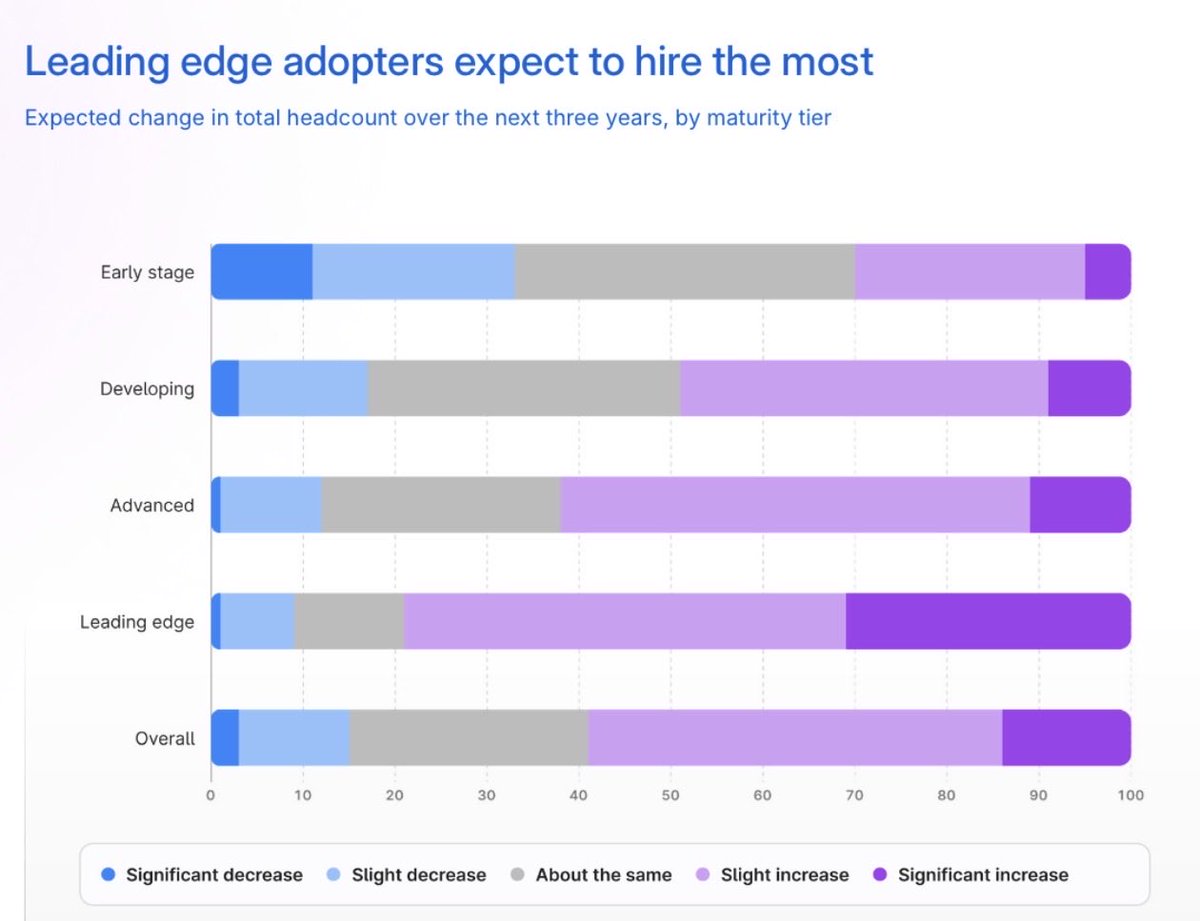
At Box, we just surveyed 1,640 IT leaders across the US, Japan, and Europe about agentic AI adoption. Many standout findings, but a big one was that the companies that adopted AI the most are planning to grow headcount the most.
Obviously lots of ways you can read that data and variables mixed in, but it’s actually quite intuitive that the companies that become most productive want to (and are able to) reinvest back into the business to keep getting the gains going.
The narrative of jobs being wiped out assumes that companies will take a fixed approach to what they want to be able for work on. What’s happening in practice is it’s causing companies to want to light up more engineering projects, sell to more customers, automate more processes to give time back, and more. That all leads to more work to be done by people.
Jun 11

JUST IN: Jeff Bezos predicts AI will create a labor shortage rather than put humans out of work.
46
48
233
41,903
Rupert Davies retweeted

⚡ Google DeepMind just dropped DiffusionGemma, latest experimental open model (Apache 2.0) that generates text up to 4x faster.
- Uses diffusion instead of traditional next token autoregressive generation
- Generates and refines 256 token blocks in parallel
- Achieves up to 700 tokens/sec on RTX 5090 and 1000 tokens/sec on a single H100
- Designed as a 26B MoE model but activates only 3.8B params during inference
- Can run quantized within 18 GB VRAM
- Supports bidirectional attention during generation
- Can self correct outputs during inference through iterative denoising
- Handles global context much better than standard left to right models
- Particularly strong for constraint based tasks like Sudoku
- Fine tuned Sudoku version reached 80% success while base model was near 0%
- Uses block autoregressive diffusion for long context generation
- Integrated directly into vLLM for OpenAI compatible serving
- Released with official training recipes and fine tuning support
- Optimized across RTX 4090, RTX 5090, Hopper, and Blackwell GPUs
Getting started:
- Model weights are available publicly on Hugging Face
- Works with vLLM, Hugging Face Transformers, and MLX
- Deployable through Google Cloud Model Garden and NVIDIA NIM
- Google released official fine tuning recipes through Hackable Diffusion
License:
- Released under Apache 2.0
- Allows commercial usage
- Allows modification and redistribution
- Developers can fine tune and build products on top of it
This is one of the strongest public signs yet that major labs are actively exploring post autoregressive architectures for future LLMs.
26
11
93
4,582
Rupert Davies retweeted

Jun 11
Forget AGI, This is a great demo to show how much education can be transformed with LLMs!
Education is the cornerstone of any civilization and rightly done, LLMs and generative Media can unlock newer ways of doing it.
Imagine Khan Academy but bolstered withe modern AI! 🔥
Jun 9

Had Claude Fable 5 log network packets and display them as cars on a highway, different car types = different packet types
2
1
11
835
Jun 11
Technology hysteria update: the AGI already decided you're underclass before you pressed enter. But the quieter truth is AI amplifies existing power structures by default. Not conspiracy, just consolidation.
Jun 10

Fable is not actually bumping you to Opus 4.8 bc you tripped a safety filter, but bc the AGI did a deep search into you before you even sent the prompt, and it determined you to be a member of the permanent underclass and it's just doing its job of keeping you there for eternity
4

It is crazy to see how tech has evolved over time.
If you were active online before the ChatGPT era, you might remember that every blog, conference, newsletter, YouTube video, book, meetup, tweet used to be about React, Next.js, Angular, Tailwind, Node.js, etc.
Now, almost everything is about Codex, Claude Code, LLMs, agents, and AI workflows.
I sometimes miss old school tech content.
29
4
93
8,060
Jun 11
I keep saying: emergent behavior needs guardrails, not micromanagement. 44 agents proved it-11x throughput, hard constraints, zero chaos.
3

Now your Hermes Agent has an easy GUI based way to build and design your agent profiles to curate the perfect setup for every task and need!
`hermes update` and load into your Dashboard, and start building custom agents today!
Jun 10

Introducing the Hermes Agent Profile Builder
You can now build a complete profile in the dashboard with full control over identity/name/description, model/provider, built-in optional skills, skills-hub installs, and MCP servers in one easy flow
40
28
528
349,758
Jun 10
Six appointees and quarterly meetings. Where mature, common law regulatory infrastructure exists from day one, these friction cycles simply don't occur. It is architectural.
Jun 10

The UK government is signaling a reset with the digital identity industry.
A new advisory panel, regular engagement with DVS providers and the release of the final UK DVS Trust Framework 1.0 point to a more collaborative approach as the national digital ID program develops.
#DigitalIdentity #DigitalID #DVS
biometricupdate.com/202606/u…
4
Jun 10
Cheaper models require different architectures. These are not those architectures.

$10 per million input tokens
$50 per million output tokens
I thought the models were supposed to get cheaper 👀👀👀
4