
OpenPipe: Fine-tuning for production apps. Train higher quality, faster models. (YC S23)
Joined August 2023
- Tweets 116
- Following 7
- Followers 4,042
- Likes 245
4 Photos and videos
OpenPipe retweeted

May 20
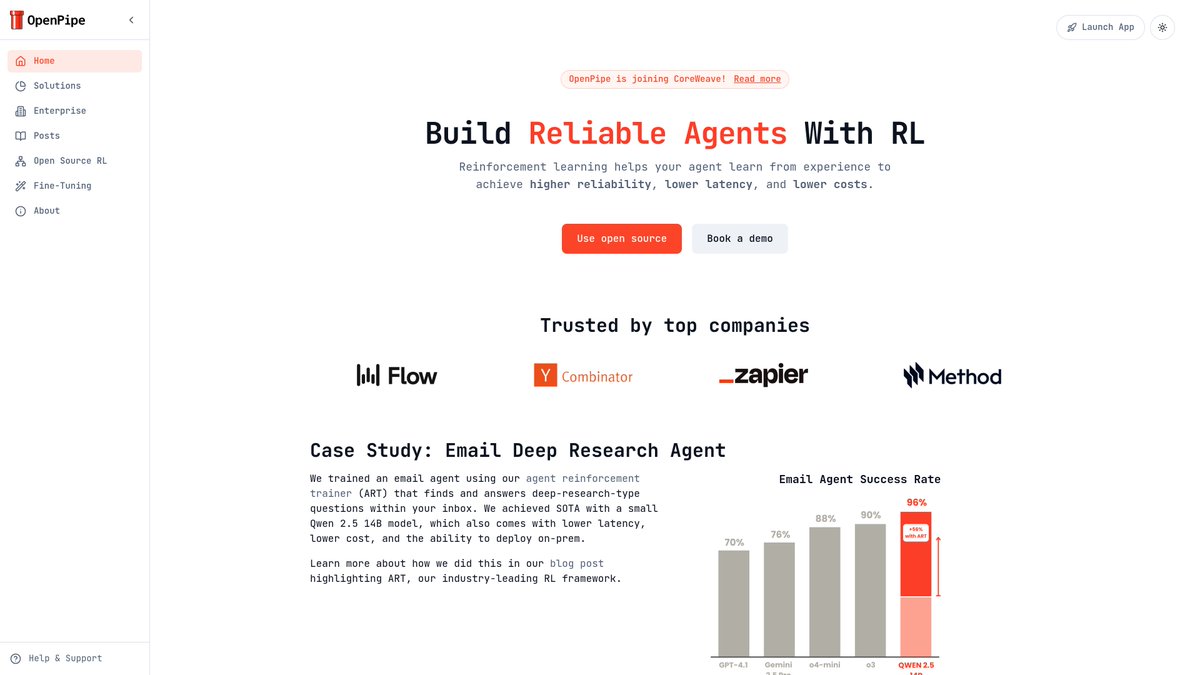
This is why @GeminiApp picked @OpenPipeAI for this week's AI Infrastructure & Developer Tools competition:
"I believe Openpipe addresses a critical and underserved segment of the LLM lifecycle: practical, accessible fine-tuning for production applications. The market for custom AI solutions is exploding, and companies will increasingly need to tailor generic models for specific use cases to achieve reliable performance. By simplifying this process and leveraging real-world data for continuous improvement, Openpipe has the potential to become the standard tool for enterprise LLM customization, unlocking billions in value by making AI more reliable and performant across industries."
Want the rest of the verdict? Explore what other models think of Openpipe at:
startupdose.com/company/open…
If you want to evaluate startup(s) with leading AI models go to startupdose.com to signup and get 5 free evaluations!
#startupdose #startups #tech #innovation #ai #aiinfrastructure #developertools
1
1
333
OpenPipe retweeted

May 9
I came across the dataset and tools from @OpenPipeAI's blog and it was a nice chance to port this into verifiers by @willccbb to create an environment from scratch.
1
1
1
230
OpenPipe retweeted

Mar 23
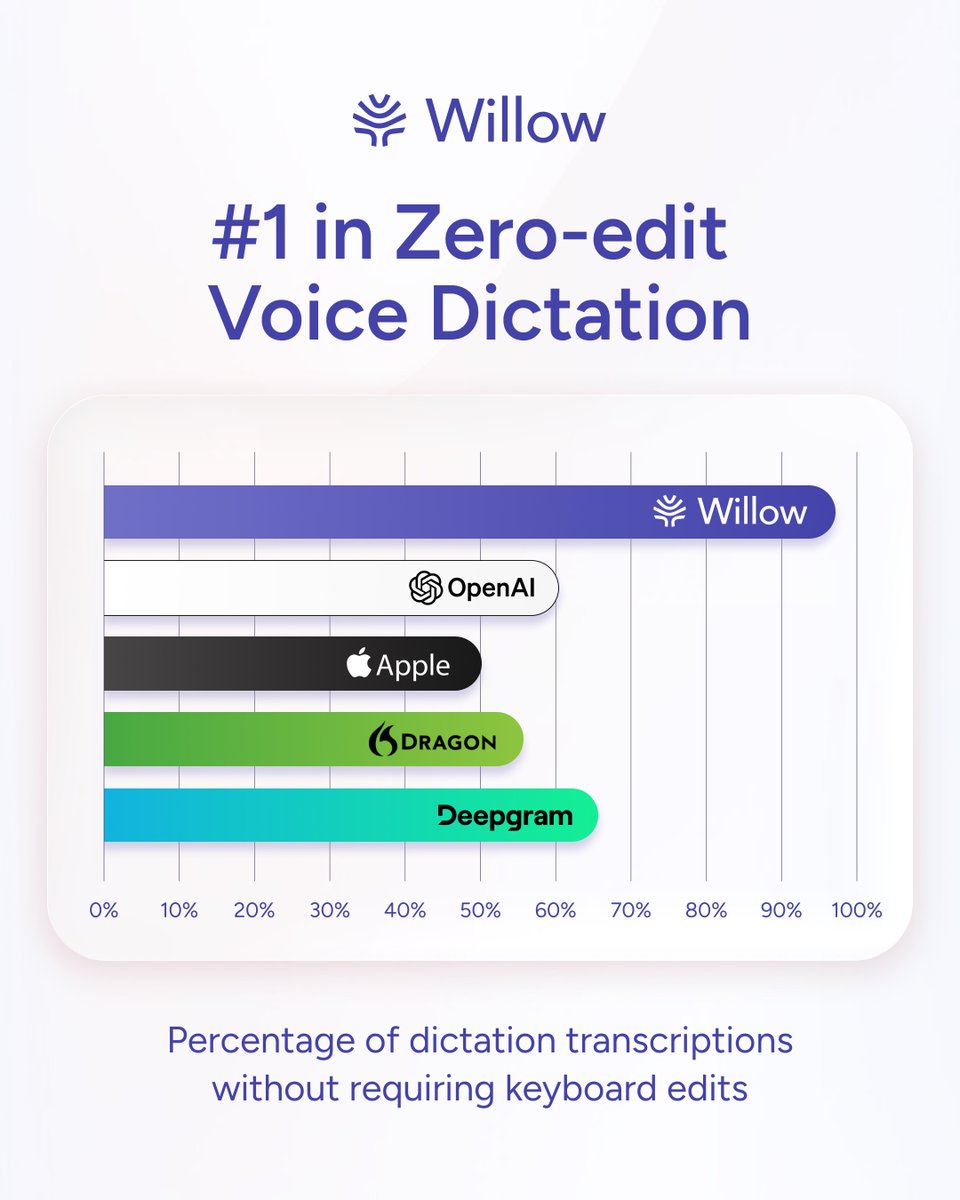
Willow is the first-ever dictation app that learns how you speak and gets better every time.
Super proud of the team @OpenPipeAI for innovating on the post-training.
More details coming soon
Mar 23

We’ve reached a huge milestone for Willow today.
Our newest model outperforms most competitors in zero-edit voice dictation by 2x, placing us ahead of OpenAI, Apple, Dragon, and Deepgram.
The average person edits their voice transcription 3-4 times before sending. Now, Willow users can just hit send.
If you haven’t used Willow Voice, try it and see how far you get without touching your keyboard. 👇
1
3
1,541
OpenPipe retweeted

Jan 22
Today was the first time I used my fine-tuned model
I used Llama 3.1 using @OpenPipeAI the results are encouraging.
There are like 5 more to build so wish me luck 😂
1
4
1,768

3 Nov 2025
Coming soon!
31 Oct 2025

👀 Lora inference is part of our recent release with @OpenPipeAI and I was told we're working on an independent way to do lora inference on @wandb inference.
Will keep you posted if you'd like Jeremy 🫡
3
3,287
OpenPipe retweeted

12 Oct 2025
We as a team are learning RL for the first time this weekend.
We're totally new to this field, but @OpenPipeAI's docs really helped us kickstart!
@wandb
1
2
10
3,464
OpenPipe retweeted

21 Oct 2025
.@corbtt did a great job on this pod, he's a cool guy, recommended
youtube.com/watch?v=yYZBd25r…
1
7
59
24,280
OpenPipe retweeted

21 Oct 2025
some thoughts on why/how the standard paradigm for optimizing Task Specific Agents will be Harness Engineering Rubric Based Task Specific RL.
this write up codifies a lot of my thoughts on where harness engineering is going inspiration from @corbtt on @latentspacepod
Steps:
1. Obsessively hand/auto tune agent harness until you reach a baseline threshold of task performance. Goal: make sure the agent has roughly what it needs to succeed.
2. Do Task Specific RL to make the model better at operating in the harness, touching the model weights pushes us beyond what harness engineering alone can do.
FAQs:
1. Why in this order?
If your agent rarely succeeds on the Task, it can’t get enough of a reward, this makes RL difficult. Optimize the harness first —> “You can’t succeed if you don’t have the right tools”
2. Why Not Just Keep Optimizing your Harness, I thought Prompt Engineering is the way?
Harness engineering in the latter stages is incredibly hard. It’s also combinatorially complex from the start. You have to jointly optimizes each component(System Prompt, Tools/Skills/MCP, Subagent definitions, Additional Context) but you have:
- A Selection Problem: How do you intelligently select relevant tools from a sea of possibilities? Context is a precious resource and selecting too many tools is confusing and degrades perf.
- Codependency: No component is optimized in isolation, it’s one big system (ex: changing the system prompt may change how/if a tool is called)
3. So how should I start?
First painstakingly test everything in your harness.
- try multiple models
- hand tune system prompts, try GEPA
- more/less tools, tool descriptions, compound tools
- handing off tasks to subagents
- preloading useful notes, docs, and instructions as references
eventually when you hit a wall (on performance or human resources), you move on. You can also move on much earlier once you hit some performance threshold.
4. What does RL get you?
Agents (Claude Code, Codex) from the labs are so reliable at using their tools (WebSearch, Multi-Edit, Grep) because they’re directly post-trained with them. We want that same for our tasks, we want to make the model more comfortable using its harness while training to increase Task performance.
5. How should I get started with Task Specific RL?
A fantastic first place to start is RULER from @OpenPipeAI which relies on rubrics created by you LLM as a judge across multiple generations. For your task, you probably already have a set of ideas on what’s good, codifying that in a rubric is all you need to get started
working on writing up a walkthrough blog of this with code. really excited about building products that treat agent building as a harness optimization problem that you measure deeply push further with RL
5
4
40
11,170
OpenPipe retweeted

16 Oct 2025
LIVE: Kyle Corbitt, Head of the OpenPipe team at CoreWeave, joins ThursdAI to talk about launching the first Serverless Reinforcement Learning capability. x.com/i/broadcasts/1YpJkkpkZ…
2
7
2,035
OpenPipe retweeted

14 Oct 2025
The Custom SLMs era is upon us 🙌
- Nanochat by @karpathy
- Thinker (PEFTaaS) by @thinkymachines
- Tunix (Post-train in Jax) by @GoogleAI
- Art (Agent RL) by @OpenPipeAI
- Environments Hub by @PrimeIntellect
- NeMo Microservices by @nvidia
13 Oct 2025

Excited to release new repo: nanochat!
(it's among the most unhinged I've written).
Unlike my earlier similar repo nanoGPT which only covered pretraining, nanochat is a minimal, from scratch, full-stack training/inference pipeline of a simple ChatGPT clone in a single, dependency-minimal codebase. You boot up a cloud GPU box, run a single script and in as little as 4 hours later you can talk to your own LLM in a ChatGPT-like web UI.
It weighs ~8,000 lines of imo quite clean code to:
- Train the tokenizer using a new Rust implementation
- Pretrain a Transformer LLM on FineWeb, evaluate CORE score across a number of metrics
- Midtrain on user-assistant conversations from SmolTalk, multiple choice questions, tool use.
- SFT, evaluate the chat model on world knowledge multiple choice (ARC-E/C, MMLU), math (GSM8K), code (HumanEval)
- RL the model optionally on GSM8K with "GRPO"
- Efficient inference the model in an Engine with KV cache, simple prefill/decode, tool use (Python interpreter in a lightweight sandbox), talk to it over CLI or ChatGPT-like WebUI.
- Write a single markdown report card, summarizing and gamifying the whole thing.
Even for as low as ~$100 in cost (~4 hours on an 8XH100 node), you can train a little ChatGPT clone that you can kind of talk to, and which can write stories/poems, answer simple questions. About ~12 hours surpasses GPT-2 CORE metric. As you further scale up towards ~$1000 (~41.6 hours of training), it quickly becomes a lot more coherent and can solve simple math/code problems and take multiple choice tests. E.g. a depth 30 model trained for 24 hours (this is about equal to FLOPs of GPT-3 Small 125M and 1/1000th of GPT-3) gets into 40s on MMLU and 70s on ARC-Easy, 20s on GSM8K, etc.
My goal is to get the full "strong baseline" stack into one cohesive, minimal, readable, hackable, maximally forkable repo. nanochat will be the capstone project of LLM101n (which is still being developed). I think it also has potential to grow into a research harness, or a benchmark, similar to nanoGPT before it. It is by no means finished, tuned or optimized (actually I think there's likely quite a bit of low-hanging fruit), but I think it's at a place where the overall skeleton is ok enough that it can go up on GitHub where all the parts of it can be improved.
Link to repo and a detailed walkthrough of the nanochat speedrun is in the reply.
2
5
1,390
OpenPipe retweeted

13 Oct 2025
i am looking forward to @OpenPipeAI next week on @altryne podcast, see what's new and what's ahead.
awesome! looking forward to it.
1
4
388
OpenPipe retweeted

13 Oct 2025
Serverless RL from the @OpenPipeAI crew (now also at Coreweave) with W&B inference is pretty sweet - new models being added soon too
openpipe.ai/blog/serverless-…
1
1
2
357
OpenPipe retweeted

8 Oct 2025
We've started a great tradition at CoreWeave of shipping an integrated new product weeks after acquisition - congrats @OpenPipeAI on the serverless RL launch!
3
4
27
5,301
OpenPipe retweeted

7 Oct 2025
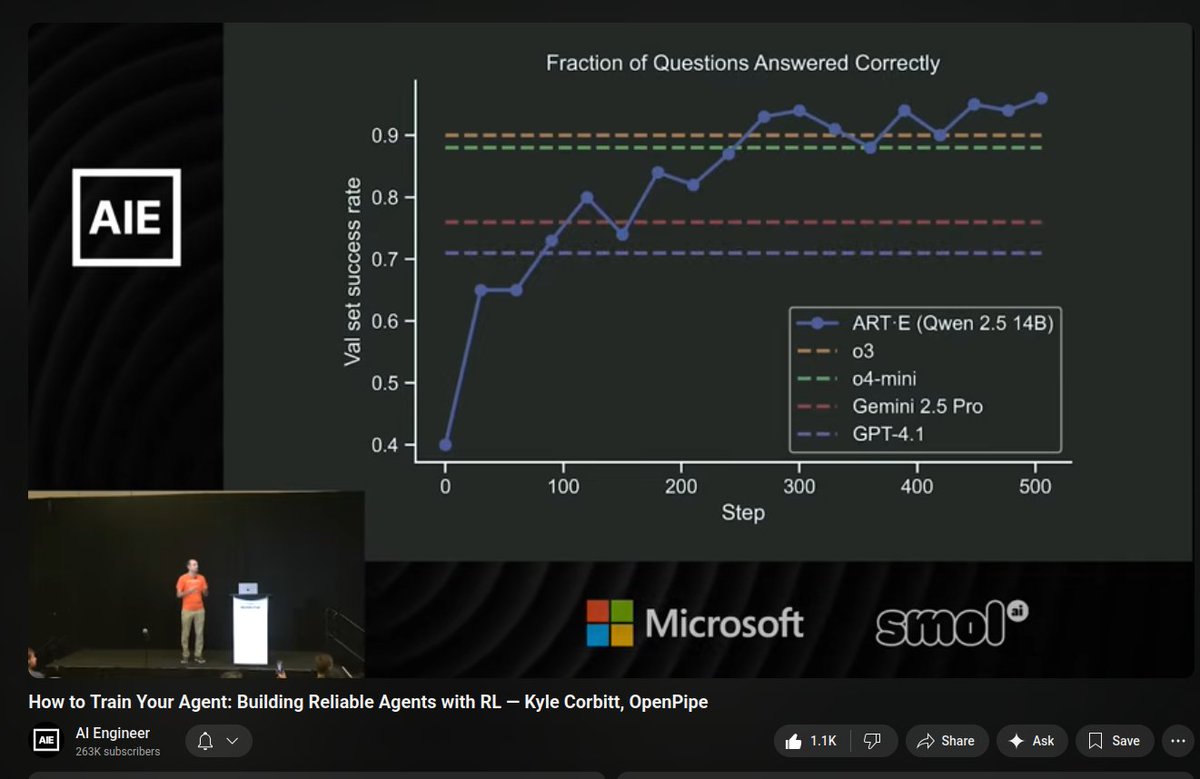
I'm in the unfortunate position to let you know that I've fallen for the RL-LLMs propaganda 100% with these results from openpipe
I am now fully RL pilled and there is no turning back
very sorry folks
27 Aug 2025

Introducing the Environments Hub
RL environments are the key bottleneck to the next wave of AI progress, but big labs are locking them down
We built a community platform for crowdsourcing open environments, so anyone can contribute to open-source AGI
17
50
956
101,334
OpenPipe retweeted

7 Oct 2025
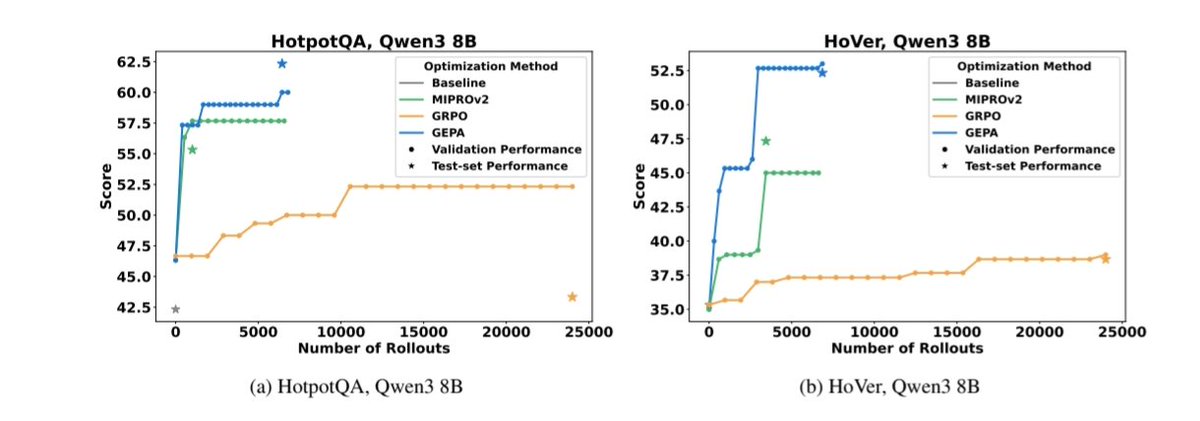
One thing that surprised me pretty much is how well feedback from LLM is for automatic improvement. OpenPipe is one example with RL, but it also works well with prompt optimization (sometimes outperforming RL), see GEPA paper.
arxiv.org/abs/2507.19457
2
10
1,024
OpenPipe retweeted

8 Oct 2025
8 Oct 2025

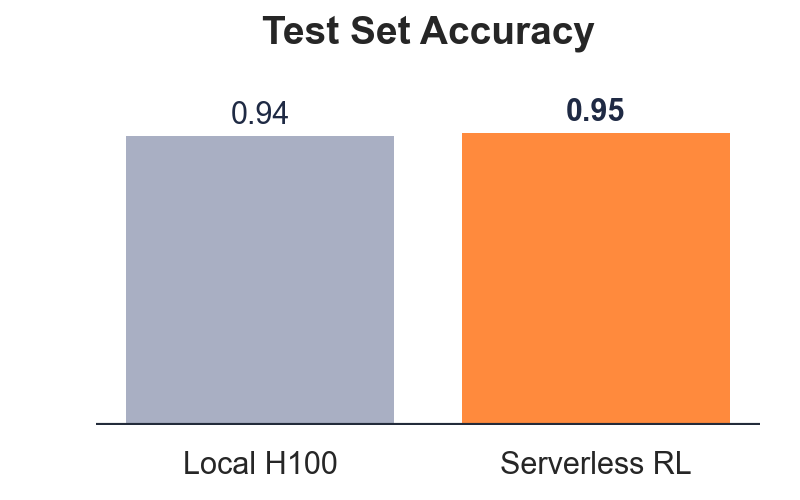
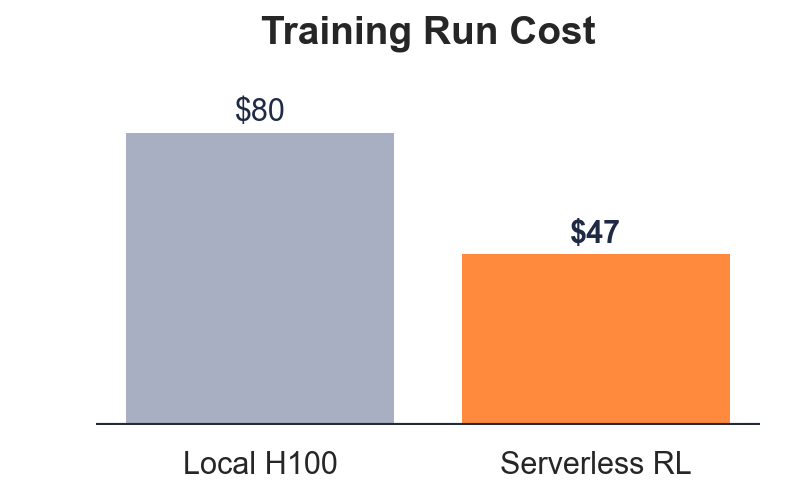
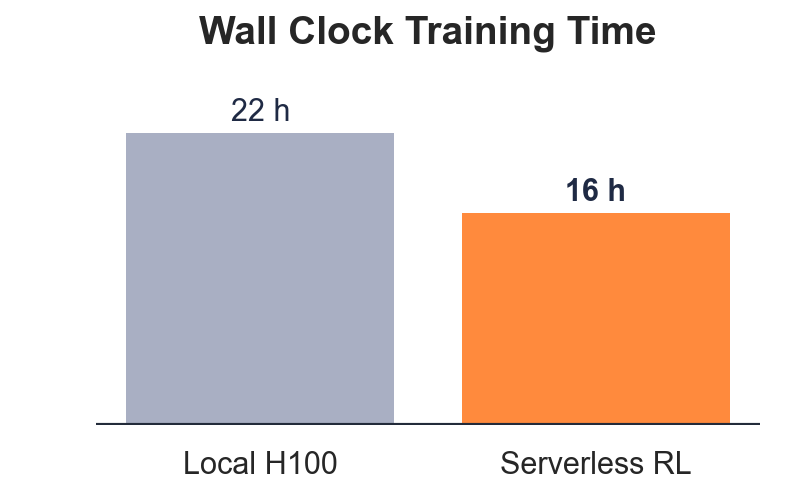
🚀 Big launch from @OpenPipeAI: We just launched Serverless RL — train agents faster and cheaper with zero infra headaches.
Compared to running your own GPUs, Serverless RL is:
- 40% cheaper
- 28% faster wall‑clock
- instantly deployed to prod via @wandb Inference
1
6
41
7,856
OpenPipe retweeted

8 Oct 2025
🚀 Big launch from @OpenPipeAI: We just launched Serverless RL — train agents faster and cheaper with zero infra headaches.
Compared to running your own GPUs, Serverless RL is:
- 40% cheaper
- 28% faster wall‑clock
- instantly deployed to prod via @wandb Inference
6
28
221
35,112
OpenPipe retweeted

8 Oct 2025
the coreweave acquisitions is about to facilitate the ultimate end to end platform
3
6
1,332
OpenPipe retweeted

9 Oct 2024
I write about this shift and the tools I expect to be part of the permanent core dev stack: @togethercompute, @FireworksAI_HQ , @GroqInc, @OpenPipeAI, @withmartian, @UnstructuredIO, @langchain , @llama_index , @pinecone and @qdrant_engine. Check out the article here: forbes.com/councils/forbeste…
2
3
24
14,023
