
COO & Co-Founder at MinuteBox. Corporate legal compliance at scale.
Joined April 2007
- Tweets 2,045
- Following 2,047
- Followers 969
- Likes 1,298
136 Photos and videos












Jun 13
Anthropic in(advertently) pulling off the greatest marketing campaign of all time.
Jun 13

The US government, citing national security authorities, has issued an export control directive to suspend all access to Fable 5 and Mythos 5 by any foreign national, whether inside or outside the United States, including foreign national Anthropic employees.
The net effect of this order is that we must abruptly disable Fable 5 and Mythos 5 for all our customers to ensure compliance.
Access to all other Claude models is not affected.
We apologize for this disruption to our customers. We believe this is a misunderstanding and are working to restore access as soon as possible.
Read our full statement: anthropic.com/news/fable-myt…
54
Steven Pulver retweeted

Jun 12
The OTPP turned a $300M bet on the $SPCX IPO into ~$16B CAD – roughly $33.5K per each of it's 346K teachers.
Thousands more Canadians are along for the ride through their RRSPs, TFSAs, & retail investment.
Like Elon or not, a rising tide lifts all boats. Canadian boats too. 🇨🇦
Jun 11

Opinion: SpaceX IPO makes Elon Musk the first trillionaire. Here’s how to properly hate him theglobeandmail.com/business…
14
39
375
27,613
Jun 4
We’re on a boat! Huge kudos to the @GoodlawyerInc team for organizing and to our other partners and friends that made this event possible!
30
Steven Pulver retweeted

Jun 3
think about how many people’s lives this impacted. how many more entrepreneurs there are.
congrats @tobi
Jun 2

Shopify launched to the public 20 years ago today
2
2
43
1,882
Steven Pulver retweeted

Jun 2
People should be asking why Costco is entering this space in the first place.
Jun 1

some thoughts on kirkland building its own harvey
1) kirkland is spending $500m over four years in order to build its own internal ai legal tools; kirkland intends to spend $100m this year
2) i suspect that kirkland is doing this because they have told themselves that they have valuable data and because they want to appear differentiated
3) i think the first issue is that kirkland probably does not have differentiated data from other elite law firms; at least, not at the level a harvey would absorb
4) all the elite firms probably have similar internal workflow data and so long as some of them defect, that is enough to commoditize the data kirkland wants to use for its platform
5) and, to the extent that they do have different internal workflows, harvey and legora will end up representing a better version of them and this will put kirkland at a disadvantage
6) moreover, companies like kirkland will have difficulty building their internal legal platforms because they do not have experience with software development
7) and, there are both cultural and structural issues with them managing software developers, like they cannot give non-lawyers equity in the firm due to regulation
8) so, i think firms like kirkland are better off using tools like harvey and legora and then looking to focus on where their value really is now: client relationships, local knowledge (litigation, regulation) and legal r&d (novel structures, etc...)
9) anyway, this seems to me like a phenomenon that ai creates across a lot of industries, where firms that were previously vertically integrated become unbundled due to ai because part of the intelligence gets moved to the labs or otherwise gets commoditized
10) and so, a new set of companies are created whose job it is in order to provide services complementary to the labs: forward deployed like harvey and legora and data providers like mercor, surge and handshake
90
98
5,219
1,440,395
Steven Pulver retweeted
May 31
If @harvey and @WeAreLegora pivot to become law firms like Carta has, the only rational moves for law firms will be to:
1. immediately dump both products. law firms cannot feed the mouths that kill them when there are viable open source alternatives like @willchen500's MikeOSS or commercial tools like MinuteBox AI, which will never compete with firms
2. choose tools that fully support BYOK/AI. it's astounding that firms are willingly paying 10x markup on inference today or use tools that don't provide complete model-routing transparency
3. form a strategy around local, on-device inference. local models are incredibly good today. cost is a big consideration but there are competitive reasons too, especially with the frontier providers entering the legal domain alongside the big legaltech incumbents.
May 31

Harvey and Legora are probably thinking of pivoting to law firms. Or at least acquiring an “AI native” law firm subsidiary like Carta.
It’s the only way that they can provide a narrative for how they will survive, now that:
1) Biglaw firms are building their own AI application layer/fine tuning models; and
2) OpenAI and Anthropic are going after their customers and they don’t have a differentiated product.
But the moment they do so, they will enrage all of their customers who all have opt out clauses embedded in their contracts, thereby triggering an immediate ARR collapse.
Truly a difficult dilemma.
6
3
43
5,917
May 29
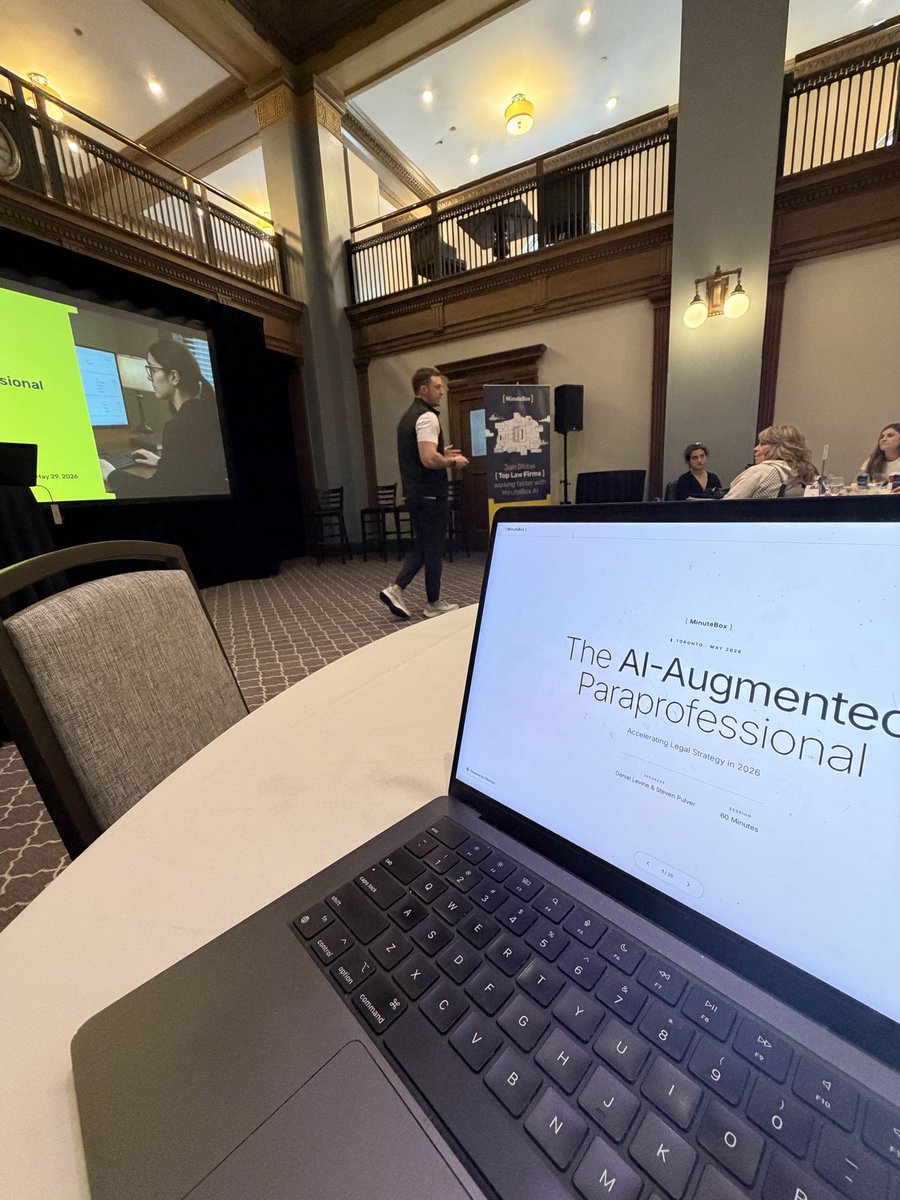
The AI-Augmented Paraprofessional.
Presenting now with @daniellevine to a packed room full of legal professionals.
The wild thing is that our presentation is unrecognizable from even 18 months ago, let alone a month ago. Time and tech flies!
59
May 25
This 👇
May 25

Lawyers, your biggest barrier to AI isn't AI. It's that your data lives in 6 places. Dropbox. Drive. Email. Hard drive. A spreadsheet only one person can find. Fix that first.
68
May 24
Yes. This is exactly right.
May 24

I predict an "AI is reportedly pushing Latham & rival big law firms to rethink the billable hour, as clients are "questioning the value" of their rates/advice" headline in the next couple months
1
2
315
May 21
What is your WHY? The law clerk who knows why the filing matters will always have more work than the one who just knows how to file it.
AI closed that gap faster than anyone expected.
What's the "why" in your practice that you'd put on the line?
36
May 14
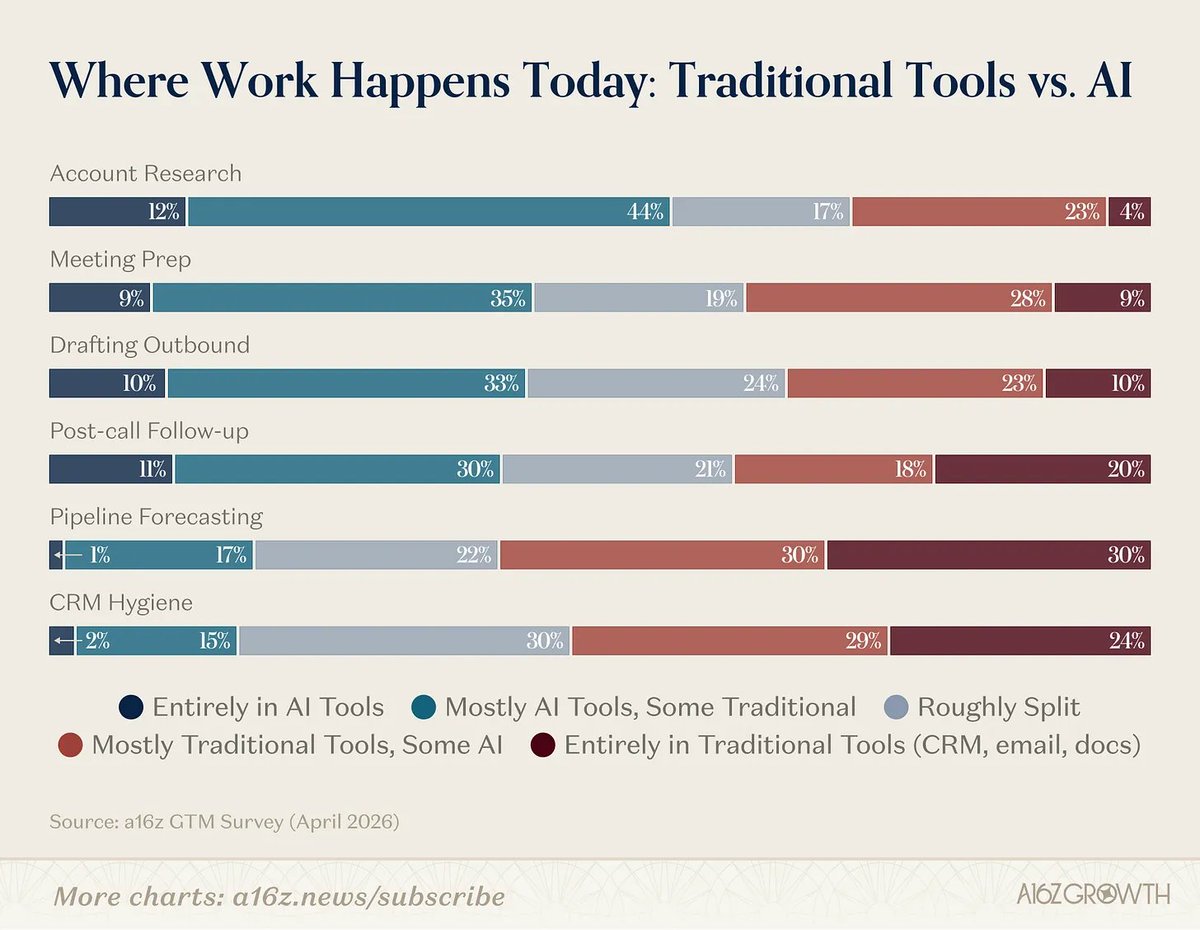
The minute book had been a "System of Record" for 150 years.
Our team has obsessed over modern solutions to this for close to a decade. AI unlocks the intelligence and reasoning layer on top of it all in really incredible ways.
The last week, I have been speaking with dozens of law clerks and legal ops folks who are consistent in their comments that "change is all happening faster than we ever expected."
Couldn't agree more. Buckle up!

From "System of Record" to "System of Intelligence"
In the next decade, you want to own the system of intelligence that pulls from the system of record, becomes the user’s one-stop shop for gaining context and taking action, and turns the SoR into something that’s primarily consumed at the API layer.
The reasoning layer that sits above the database is where a new generation of companies is being built, and it’s where the majority of the next decade’s enterprise value of GTM software will end up.
Full piece from a16z's Gio Ahern, Steph Zhang, and Alex Immerman: a16z.news/p/from-system-of-r…
90
May 13
Yep. Critically important especially at scale.
May 13

This is exactly right. Lawyers, clerks and paralegals need to see the diff to trust the output on top of their precedents.
1
95
May 12
"Exploring AI" is not a strategy.
It's a posture.
The firms pulling ahead are done exploring. They found one problem, solved it, and built from there (and they will do it again and again).
#LegalAI #LegalTech
1
2
55
May 11
Most legal AI is built to go faster. Speed isn't the only bottleneck.
The pattern is consistent: the tools that get the most attention are the ones that make existing work faster. Summarize this document. Draft this clause. Review this contract in 30 seconds instead of 30 minutes. All real. All useful.
But the problem is one level deeper. The actual problem is context. The institutional memory of what happened to an entity. What decisions were made and who authorized them. What's outstanding, what's been missed, what the exposure is if this goes to a transaction tomorrow. A tool that reads documents faster doesn't help if nobody knows what happened in 2019.
The AI that actually changes legal work isn't the one that summarizes faster, it's the one that knows the history. The one that can tell you the entity was incorporated in Alberta in 2019, that there's an outstanding annual return, that the director list hasn't been updated since the last financing. Not because a human went looking. Because that's what it's there for.
Context is the differentiator.
The next time you're evaluating a legal AI tool, ask it what happened to your entity in 2021. If it can't answer, you haven't solved the bottleneck. You've just moved faster toward it.
#LegalTech #LegalAI
3
3
187
May 11
Every generation of legal professionals thought their tools were the last revolution. "What else could top this?" they'd say.
The scribe hand-copied every document. Irreplaceable until Gutenberg made them obsolete in a generation. The typewriter was the gold standard of legal production until the word processor arrived and felt, briefly, like alien technology. Then it became table stakes. Then nobody remembered working without it.
We're living through the same thing right now. The difference is speed. AI isn't arriving slowly.
McLuhan said every tool is an extension of the human. The hammer extends the fist. The wheel extends the foot. The question worth asking about any AI tool isn't "what can it do?", it's "what part of you does it extend?" Most legal AI is built to extend speed. Speed is useful. But speed has never been the only bottleneck in corporate practice.
The profession has survived every tool revolution not by resisting, but by understanding what the tool actually was. The scribes who thrived after Gutenberg weren't the ones who kept hand-copying. They were the ones who figured out what hand-copying had actually been for and found the work that still required it.
The question for every legal professional right now isn't whether to use AI. It's whether you understand what it extends and whether you're the one deciding.
What's the part of your work that no tool has managed to replace yet?
1
56
May 8
Am I hallucinating or does this sound like a great product?


1
71
May 3
Have been thinking about this a lot. The spreadsheet moment for the legal profession, almost 50 years after accountants modernized their pen.
A bright future ahead for the legal profession and those that have a part in it.
May 3

Lawyers, don’t panic…
“In 1979, VisiCalc, the first electronic spreadsheet, was released for the Apple II. It could do in minutes what previously took teams of accountants days. There were predictions of mass unemployment for bookkeepers. Instead, the number of accountants quadrupled over the next 40 years. “The spreadsheet didn’t replace the accountant,” Eldar Maksymov writes. “It unleashed latent demand for financial intelligence that had been there all along, waiting for costs to fall far enough to be satisfied.”
2
88
Apr 29
Autobuild is amazingly cool. We’ve been working with @dboskovic and team for years, and I have to say that Obvious is super impressive!!!
Apr 29

we were spending too much time "carrying water" between agents
- here's a spec build it
- address the pr comments
- fix the failing CI
so we made an agent for overseeing the SDLC e2e (Autobuild)
we invited 10 startups to use it last week in SF (NYC next week!)
what it does:
- plans out entire feature builds across dozens of PRs
- oversees the coding agents as they work
- babysits PRs and addresses human and agentic review
- conducts security, performance, and architectural reviews
- QAs the work and records videos of the outcomes
- monitors logs for issues after staging release
- collects ux feedback from humans and address them
- indexes all the concepts in your codebase
- automatically writes updates to your team about what shipped
- knows the current rollout state of features
- maintains running sandboxes with a full dev env
- dogfoods features before reporting success
- engages with you in slack as it builds
- automatically fixes reported issues
- nags you for PR reviews when needed
- optimizes your CI so it's not shit (big bottleneck for velocity)
we're planning on making this the most insane building experience for established companies with a focus on quality/safety and human collaboration while accelerating velocity by 1-2 orders of magnitude
if you want to join us in NYC next week (Thur/Fri - May 7/8) or future workshops lmk - we're onboarding up to 50 companies at a time by helping you ship 12 weeks of roadmap in 2 days - a sort of reset on baseline velocity
no cost to attend beyond the inference you burn (you'll build a lot so not for the faint of heart)
1
111
15 Oct 2024
Woot woot! Chat with your minute books, corporate data, compliance reports, and even our embedded textbooks!
15 Oct 2024

🧵 Say Hello to Second Chair AI by MinuteBox!
1/ Introducing Second Chair AI — the new way to manage your legal entity data! This AI-powered tool offers a conversational interface to simplify compliance and corporate governance. 💬
1
4
321