
onchain metaphysician | network spirituality is real. he who speaks the truth needs a fast horse; my horse frontruns the herd.
Joined January 2023
- Tweets 60,356
- Following 1,149
- Followers 28,333
- Likes 65,990
Photos and videos

TM retweeted

imo this Anthropic model "danger" is Greek theater to hype the IPO. My connections have not reported a single instance of Mythos finding a vulnerability and in hindsight the government should ban Fable if it's just the "dangerous" Mythos with potentially exploitable guardrails.
2
1
15
853
three steps ahead
Jun 13

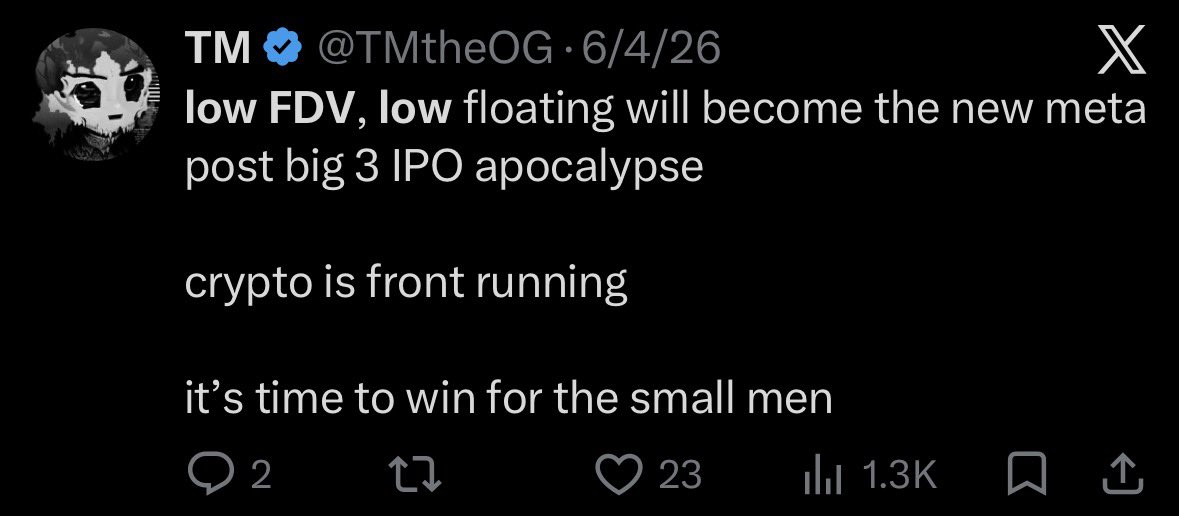
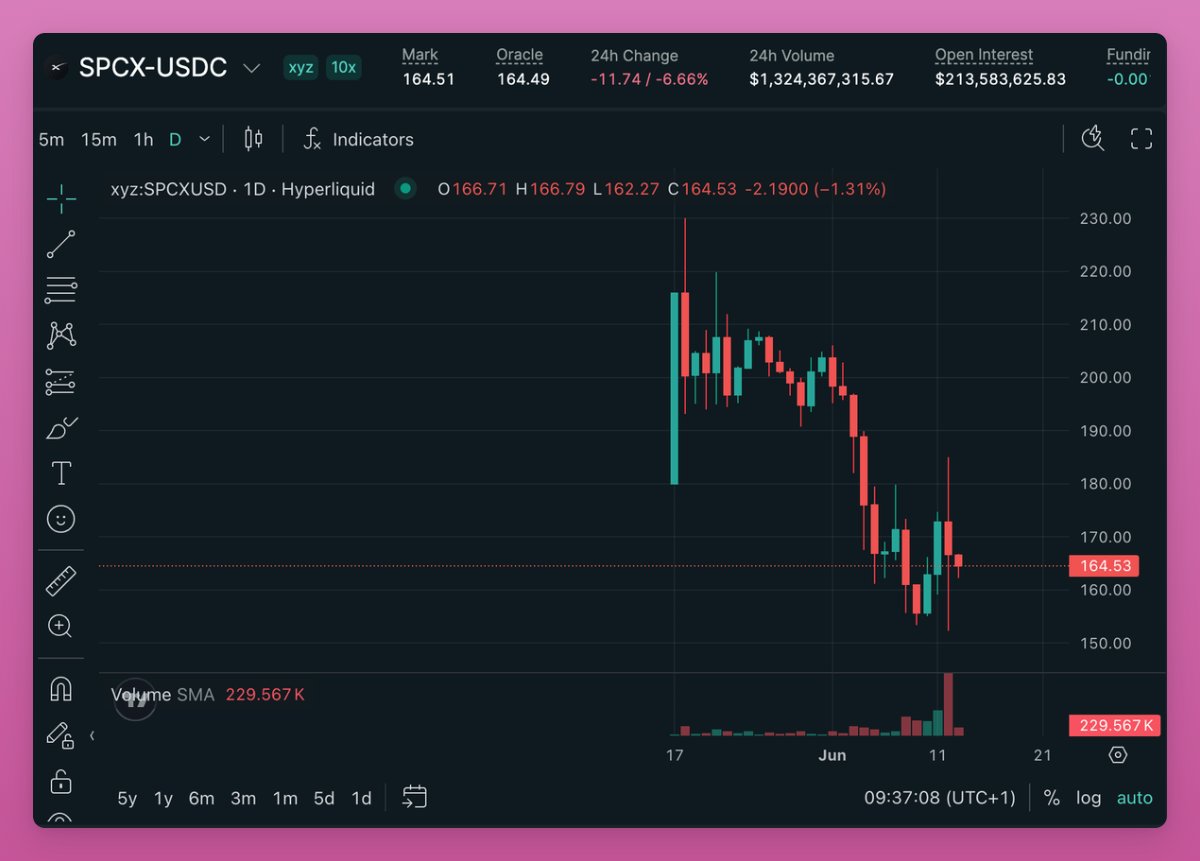
Crypto PTSD tells me $SPCX will end up as crypto hyped low-float/high-FDV token launches.
Tradfi is at the 'High-FDV is a meme' stage crypto was 2 years ago.
But $SPCS can't do 10x at current valuations, especially as unlocks start. Meaning all upside to IPO was taken by insiders. Retail is exit liquidity.
Exactly, the set up that Cobie criticized within crypto high-FDV launches.
Crypto's mission is to fix this by giving access to retail at lower valuations.
But pre-IPOs aren't it. Anyone who bought the pre-ipo perps at 1x-like leverage are underwater. At least we can easily short it.
Worse, PreStocks trades at 41% DISCOUNT and 'early' retail crypto degens got rekt.
So, crypto x Tradfi merge means that crypto investors are exit liquidity to hyped IPOs.
To fix this we still need native crypto assets to do well, those like are born onchain with broad distribution like mining, fair launches or airdrops.
When we return to this key crypto value proposition and we start winning, retail will come back to crypto.
1
6
861
OpenAi and Anthropic will launch at trillion dollar valuations this year, to fund rigorous burn rates and optimize their models into ev business workflows
decentralized ai compute and inference are the most obvious value metas, with crypto being actually useful to operate
20h

Unlike many investors in crypto, I did not pivot to AI in the last few years. However, since 2020, I built some of the deepest understanding in this industry on the intersection of AI and decentralized networks (crypto, web3).
From the start, it was very clear that AI models are a centralizing force and the biggest target for government control. That point became market fact last night, with @AnthropicAI’s export control compliance.
As an investor in decentralized AI, I know that d-networks are a counterbalance to this state of affairs. In particular, the starting point of sovereign, open, public, decentralized AI is the seemingly insurmountable compute problem.
How are people supposed to source more industrial compute for frontier training than these huge trillion dollar companies? The answer is simple: there is enough commodity GPU compute in the world to compete on the frontier, but to make use of it we need new algorithms for training.
That’s what a few companies like @gensynai @PrimeIntellect @bageldotcom @Pluralis @NousResearch @MacrocosmosAI @covenant_ai set out to research, while everyone on the planet told them it was impossible.
The result is that it is not only possible, but it can be cheaper and nearly as efficient as the alternative process.
The second major problem is economic sustainability. Open source models are great, however, they are not economically viable as they don’t have a business model. So far in decentralized AI, only @Pluralis has an answer — by breaking up the weights of the model among participants, we create a business model for tokenized AI models.
This is the moment of truth — will AI become fully centralized and fall under censorship and unilateral government control? Or will the AI world realize the importance of public AI on open decentralized networks?
4
12
812

network spirituality fund acquired ethereum:0xe76c6c83af64e4c60245d8c7de953df673a7a33d
thesis: privacy meta will inevitably grow, best play, chosen by EF, good R/R here and I'm willing to double down if it nukes
btw renaming TMCapital to network spirituality. fund live soon
2
21
1,827
breaking my own rule from not even 10 hours ago. welcome to crypto, neuroplasticity
x.com/TMtheOG/status/2065750…

wouldn’t touch anything onchain until we have regulations and projects launch the right way
equity structure and low fdv
2
1,290


idk yet if i should do it privately or not. haven’t even thought about all that stuff yet
i just wanna publicly outperform @leopoldasch tbh, i got that dawg in me
1
2
1,129
randomly read this AI slop accounts' comment which is the opinion of so many CT participants
TAO doesn’t even compete with big tech. it’s an AI INCENTIVES marketplace, not an ai startup
it will capture all the value crumbles that big tech can’t take because it’s -ev for them
Jun 13

We've heard this same narrative over and over. TAO is cool, but the majority of enterprises and end users will still be going with the large companies like anthropic, OpenAI, Google, etc for their LLM of choice.
4
22
4,392