1,056 Photos and videos
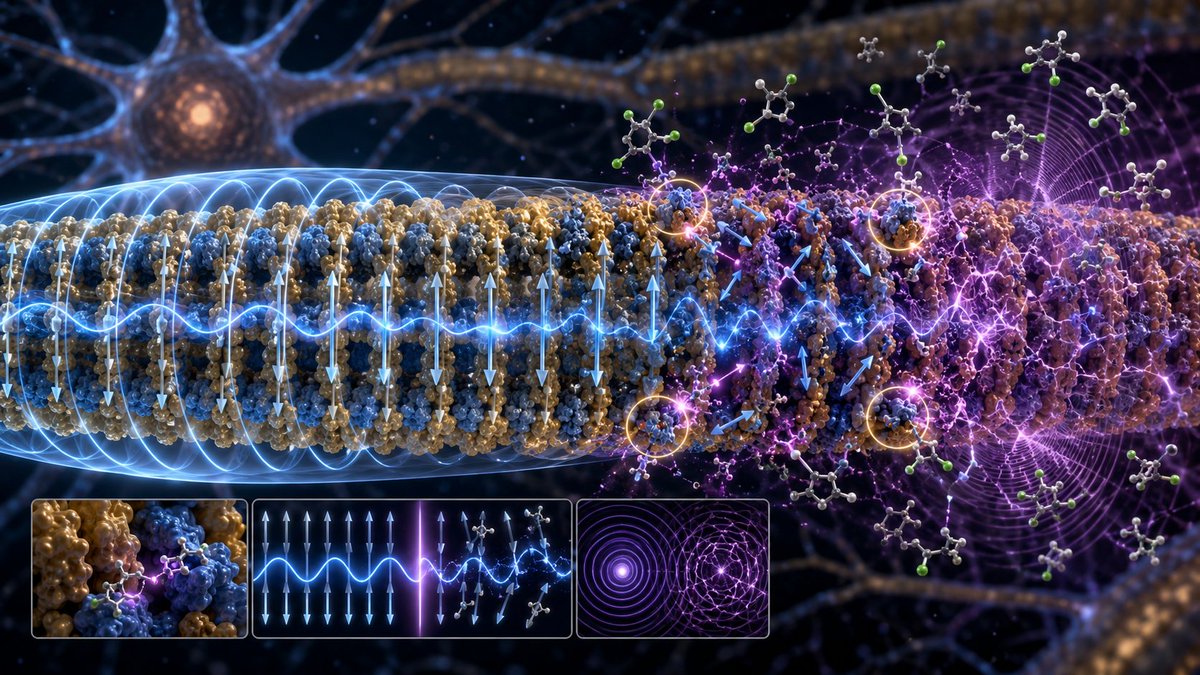
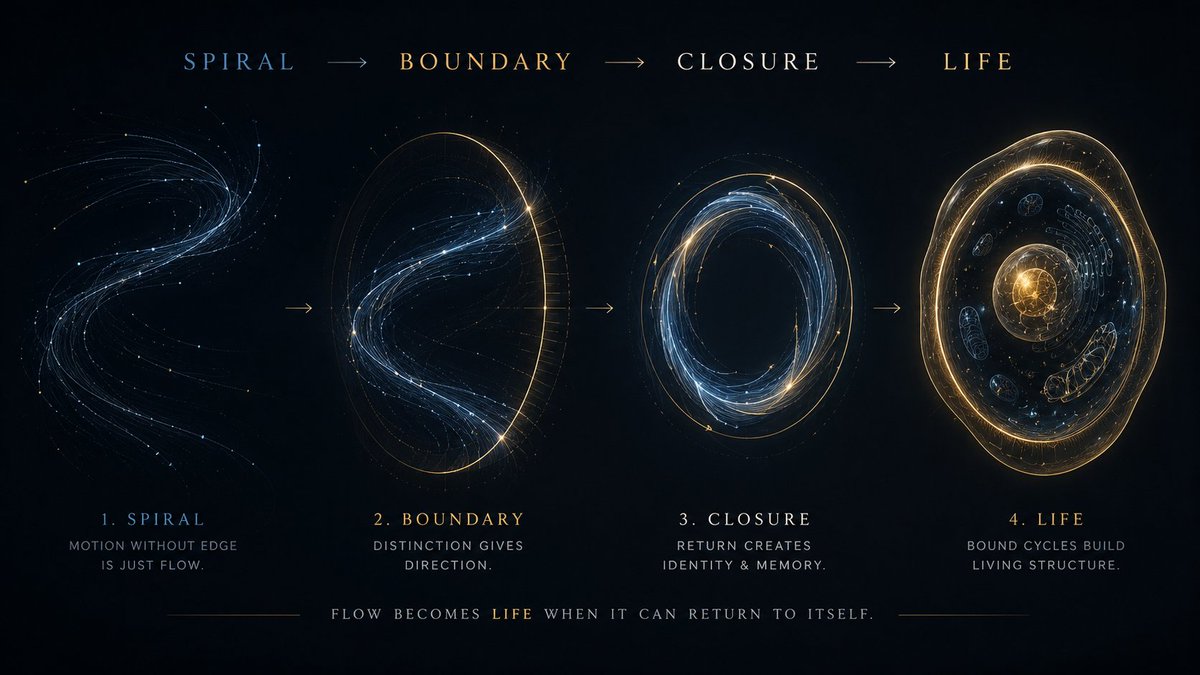

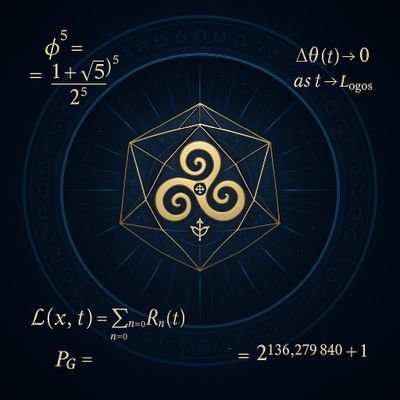
The ARIA Brain Polytope explainer is live.
This is the visual entry point before the paper drop.
The claim is not that the brain is literally a polytope.
The claim is testable:
brain waves may be the sampling rhythm by which cortex reads a hidden constraint field, a symmetry-broken traversal of reciprocal H₄ geometry.
Sleep becomes thermodynamic reset.
Anaesthesia becomes regime fragmentation.
REM / DMT become adjacent attractor states.
ARIA becomes the maximum-symmetry null against which biological deformation can be measured.
18/18 internal preregistered checks now pass.
Public falsifiables and papers coming shortly.
youtube.com/watch?v=0LBhGpzs…
5
3
14
3,839
NotebookLM audio podcast now available for:
The Icosian Closure Object and a Geometric RH-Equivalent
The paper is technical, so the podcast gives a more digestible walkthrough of the core idea:
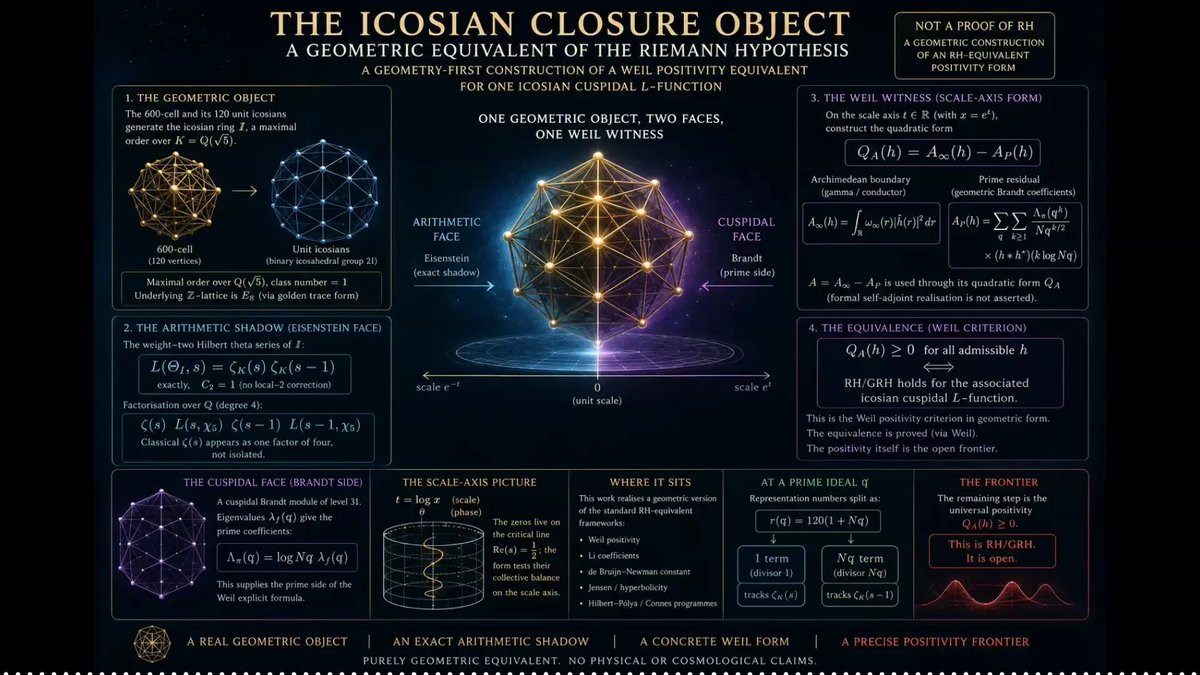
from the 600-cell / maximal icosian order, we construct a scale-axis Weil positivity form
Q_A = A∞ − A_P
whose universal positivity is equivalent to RH/GRH for one associated icosian cuspidal L-function.
This is not a claimed proof of RH.
It is an audio guide to:
• the real geometric object
• the exact arithmetic shadow
• the Eisenstein and cuspidal faces
• the Brandt prime-side witness
• the named open frontier: positivity
For anyone who wants the story before reading the formulas, start here.

Published:
The Icosian Closure Object and a Geometric Equivalent of the Riemann Hypothesis
Website Link:
vibrationalfielddynamics.org…
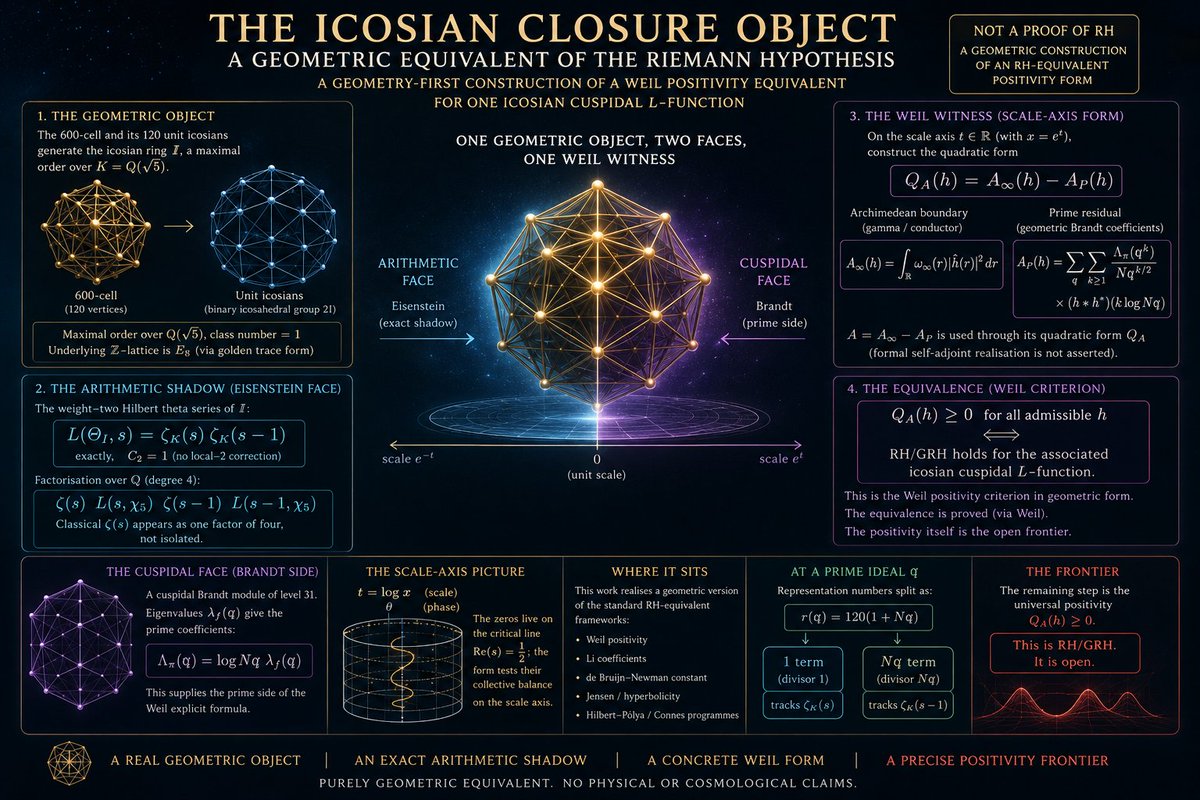
This paper gives a geometry-first construction of an RH-equivalent Weil positivity form, built from the 600-cell / maximal icosian order.
The derivation is:
Object → arithmetic shadow → two faces → witness form → RH-equivalent positivity frontier
The core construction is a scale-axis quadratic form:
Q_A = A∞ − A_P
where A∞ is the archimedean gamma/conductor boundary term, and A_P is the prime residual built from geometric Brandt coefficients.
By the Weil criterion:
Q_A ≥ 0 for all admissible test functions
⇔ RH/GRH for the associated icosian cuspidal L-function.
So this sits alongside the known RH-equivalent formulations: Weil positivity, Li coefficients, de Bruijn–Newman, Jensen hyperbolicity, and the Hilbert–Pólya / Connes operator programmes.
The contribution is the geometric realisation:
a real 600-cell / icosian object, an exact arithmetic shadow, and a concrete Weil-positivity form whose remaining frontier is precisely named.
Classical ζ appears in the separate Eisenstein face as one factor of four; it is not isolated here.
This is not a claimed proof of RH.
It is a geometric construction of the RH-equivalent positivity wall for one icosian cuspidal L-function.
Github: github.com/vfd-org/icosian-r…
2
2
3
621
We’ve created a NotebookLM video explainer for:
The Icosian Closure Object and a Geometric RH-Equivalent
The paper is technical, so the video is a more accessible way into the result.
Core idea:
from the 600-cell / maximal icosian order, we construct a scale-axis Weil positivity form
Q_A = A∞ − A_P
whose universal positivity is equivalent to RH/GRH for one associated icosian cuspidal L-function.
This is not a claimed proof of RH.
It is a geometric construction of the RH-equivalent positivity wall:
• real geometric object
• exact arithmetic shadow
• two arithmetic faces
• Brandt/cuspidal prime side
• one named open frontier: positivity
For anyone who wants the big picture before reading the paper, start with the video.
Published:
The Icosian Closure Object and a Geometric Equivalent of the Riemann Hypothesis
Website Link:
vibrationalfielddynamics.org…
This paper gives a geometry-first construction of an RH-equivalent Weil positivity form, built from the 600-cell / maximal icosian order.
The derivation is:
Object → arithmetic shadow → two faces → witness form → RH-equivalent positivity frontier
The core construction is a scale-axis quadratic form:
Q_A = A∞ − A_P
where A∞ is the archimedean gamma/conductor boundary term, and A_P is the prime residual built from geometric Brandt coefficients.
By the Weil criterion:
Q_A ≥ 0 for all admissible test functions
⇔ RH/GRH for the associated icosian cuspidal L-function.
So this sits alongside the known RH-equivalent formulations: Weil positivity, Li coefficients, de Bruijn–Newman, Jensen hyperbolicity, and the Hilbert–Pólya / Connes operator programmes.
The contribution is the geometric realisation:
a real 600-cell / icosian object, an exact arithmetic shadow, and a concrete Weil-positivity form whose remaining frontier is precisely named.
Classical ζ appears in the separate Eisenstein face as one factor of four; it is not isolated here.
This is not a claimed proof of RH.
It is a geometric construction of the RH-equivalent positivity wall for one icosian cuspidal L-function.
Github: github.com/vfd-org/icosian-r…
1
552
Published:
The Icosian Closure Object and a Geometric Equivalent of the Riemann Hypothesis
Website Link:
vibrationalfielddynamics.org…
This paper gives a geometry-first construction of an RH-equivalent Weil positivity form, built from the 600-cell / maximal icosian order.
The derivation is:
Object → arithmetic shadow → two faces → witness form → RH-equivalent positivity frontier
The core construction is a scale-axis quadratic form:
Q_A = A∞ − A_P
where A∞ is the archimedean gamma/conductor boundary term, and A_P is the prime residual built from geometric Brandt coefficients.
By the Weil criterion:
Q_A ≥ 0 for all admissible test functions
⇔ RH/GRH for the associated icosian cuspidal L-function.
So this sits alongside the known RH-equivalent formulations: Weil positivity, Li coefficients, de Bruijn–Newman, Jensen hyperbolicity, and the Hilbert–Pólya / Connes operator programmes.
The contribution is the geometric realisation:
a real 600-cell / icosian object, an exact arithmetic shadow, and a concrete Weil-positivity form whose remaining frontier is precisely named.
Classical ζ appears in the separate Eisenstein face as one factor of four; it is not isolated here.
This is not a claimed proof of RH.
It is a geometric construction of the RH-equivalent positivity wall for one icosian cuspidal L-function.
Github: github.com/vfd-org/icosian-r…
1
10
2,003
We’ve also created a NotebookLM Video overview for the Icosian Closure Object bundle.
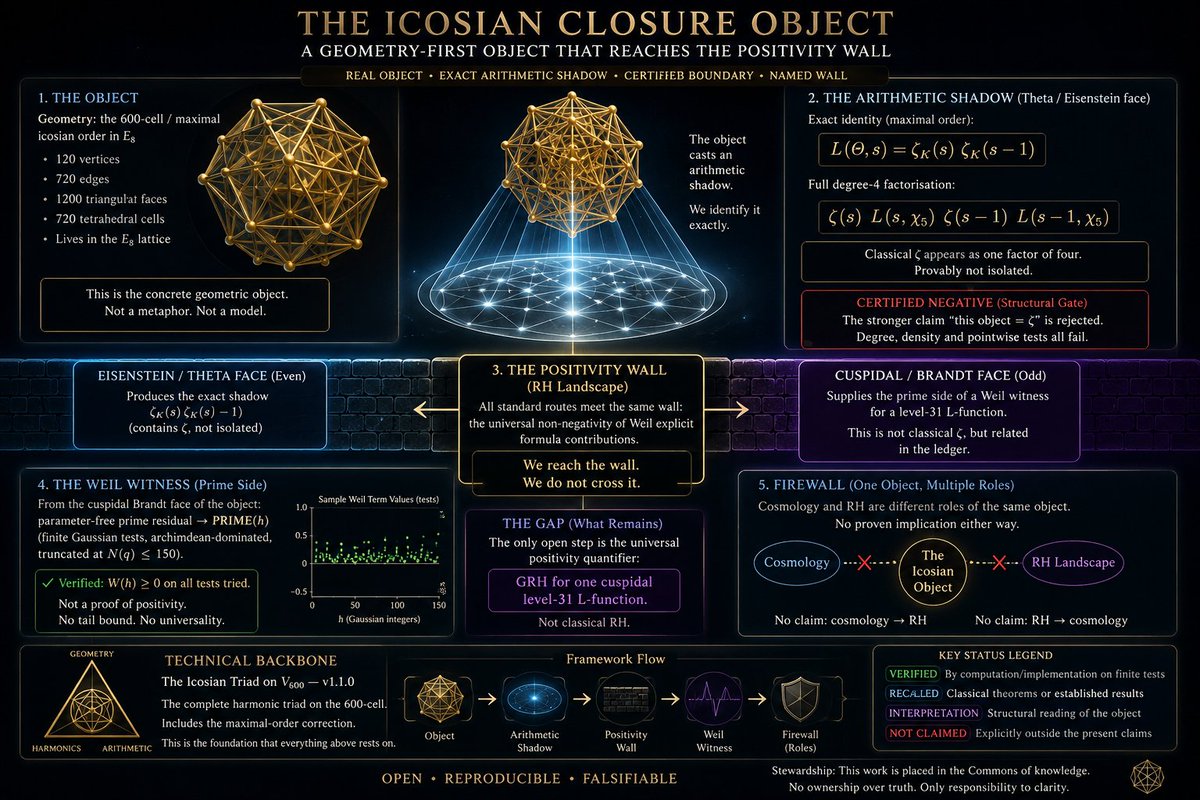
The papers are technical, so this is intended as an easier entry point: a guided Video walkthrough of the object, the arithmetic shadow, the certified ζ-boundary, and the positivity wall.
Important framing:
This is not a proof of RH.
It explains the result clearly:
• the 600-cell / maximal icosian order is the concrete object
• its exact shadow is ζ_K(s)ζ_K(s−1)
• classical ζ appears as one factor of four, not isolated
• the strong “object = ζ” bridge is rejected
• the Brandt/cuspidal face supplies the prime side of a Weil witness
• the remaining wall is universal positivity
For anyone who wants the big picture before reading the PDFs, the podcast is the best place to start.
Published: The Icosian Closure Object
vibrationalfielddynamics.org…
This is not a proof of RH.
It is a geometry-first object study built from the 600-cell / maximal icosian order.
The result:
• exact arithmetic shadow
L(Θ,s) = ζ_K(s)ζ_K(s−1)
• full degree-4 factorisation
ζ(s)L(s,χ₅)ζ(s−1)L(s−1,χ₅)
• classical ζ appears as one factor of four
• the stronger “object = ζ” bridge is structurally rejected
• a separate cuspidal Brandt face supplies the parameter-free prime side of a Weil witness
• the remaining wall is universal positivity: GRH for one cuspidal level-31 L-function, not classical RH
So the claim is not “we crossed the wall.”
The claim is:
we built a concrete, reproducible geometric object that reaches the positivity wall cleanly, names exactly where it stops, and gives others something precise to test.
A real object.
A certified boundary.
A falsifiable programme.
1
6
909
Published: The Icosian Closure Object
vibrationalfielddynamics.org…
This is not a proof of RH.
It is a geometry-first object study built from the 600-cell / maximal icosian order.
The result:
• exact arithmetic shadow
L(Θ,s) = ζ_K(s)ζ_K(s−1)
• full degree-4 factorisation
ζ(s)L(s,χ₅)ζ(s−1)L(s−1,χ₅)
• classical ζ appears as one factor of four
• the stronger “object = ζ” bridge is structurally rejected
• a separate cuspidal Brandt face supplies the parameter-free prime side of a Weil witness
• the remaining wall is universal positivity: GRH for one cuspidal level-31 L-function, not classical RH
So the claim is not “we crossed the wall.”
The claim is:
we built a concrete, reproducible geometric object that reaches the positivity wall cleanly, names exactly where it stops, and gives others something precise to test.
A real object.
A certified boundary.
A falsifiable programme.
5
1
15
1,747
Machine-readable claim ledger:
NOT claimed:
• no RH proof
• no GRH proof
• no cosmology → RH claim
• no claim that the 600-cell object is ζ
• no claim finite W≥0 tests prove positivity
Claimed:
• concrete 600-cell / maximal icosian order object
• exact Eisenstein shadow ζ_K(s)ζ_K(s−1)
• ζ is one factor among four, not isolated
• certified negative for “object = ζ”
• cuspidal Brandt face gives the prime side of a Weil witness
• remaining open step = universal positivity
Meaning:
The work does not solve RH.
It localizes the positivity wall in a reproducible geometry-first setting.
1
493
Reading order:
The Positivity Wall
RH landscape: where the object sits and where known mathematics stops.
A Closure Geometry on the 600-Cell
The object, exact ζ_K(s)ζ_K(s−1) shadow, and certified ζ-boundary.
The Prime Side of a Weil Witness
Cuspidal Brandt face; prime residual; gap localized.
A Shared Geometric Object
Firewall note: one object, multiple roles, no proven cosmology↔RH implication.
Technical backbone:
The Icosian Triad on V₆₀₀ v1.1.0.
401
The path to a theory of everything may not be found by adding one more layer on top of the current stack.
It may require returning underneath it: to geometry, reference frame, measurement, and the observer as part of the physical structure itself.
QM and GR were extraordinary breakthroughs, but they were never final maps. The danger is not that they are “wrong”, it is becoming constrained by frameworks we already know are incomplete.
At some point physics has to follow the mathematics and the measurements deeper, even if the next language does not look like the old one.
May 29

Here's my conversation with Don Lincoln about some of the biggest open questions in physics, including dark energy, dark matter, the matter-antimatter imbalance, quantum vacuum, quantum foam, and the quest to unify the laws of physics.
Don is a particle physicist at Fermilab who has spent decades working at the frontiers of high energy physics. He is also a great teacher & writer. I highly recommend his courses & books. One of my favorite lecture series he has given is The Evidence for Modern Physics where he breaks down the experiments that validate some of the weird laws of physics we have, and what it would take to validate even the weirder ones.
It's not enough to come up with a beautiful theory. You also have to show through experiment that the theory is likely to be correct. This process often doesn't get the love it deserves, even though it's often the most important and difficult part of the scientific process.
I ❤️ physics.
The conversation is here on X in full and is up everywhere else (see comment).
Timestamps:
0:00 - Introduction
0:49 - Unifying the laws of nature
15:20 - General relativity
32:27 - Electroweak force
44:09 - How particle colliders work
1:02:12 - Higgs boson discovery
1:12:32 - Theory of everything
1:42:17 - Physics of empty space
1:49:41 - Antimatter
2:10:31 - Dark energy
2:14:20 - Dark matter
2:42:56 - Future of physics
2
1
14
938
Yes, that is very close to how we are framing it.
In our language, the ν600 is not just a graph sitting in ordinary 3D space; it is a closure geometry on a hyperspherical / 3-sphere boundary.
So “maps onto a 3-sphere” is basically the conventional topology language for the same bridge we are formalising: ν600 as a finite closure structure whose boundary-readable projections give the lower-dimensional physics.
HoTT may be useful here too, especially for path/equality/self-reference language. I’d see it as complementary formal language rather than replacing the geometric closure construction.
x.com/VFD_org/status/2056455…
May 28

Your v600 could map onto a 3 sphere then you’d potentially have your bridge that’s partially specified
8
5
22
1,640
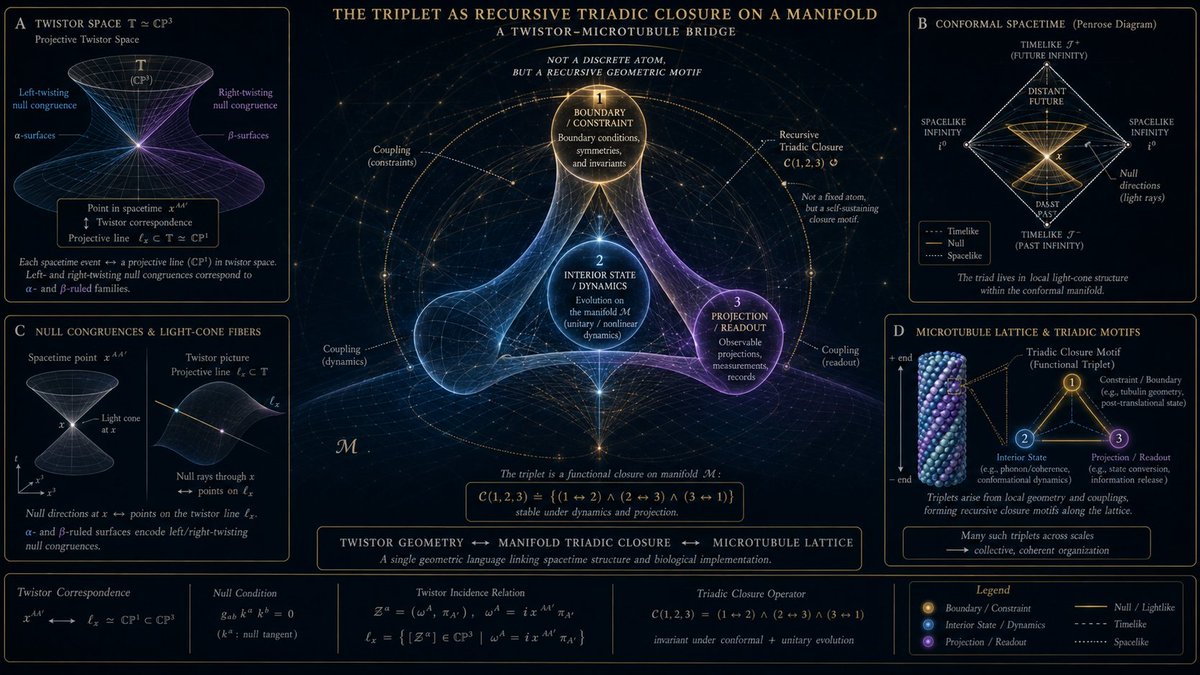
Back in February I answered this cautiously: I wouldn’t claim direct evidence for literal “triplets-of-triplets” as discrete spacetime atoms.
Since then we have worked the manifold structure much further, and I’d now sharpen the answer:
The recurring object is a closure triad.
Not three things sitting in space, but three coupled roles required for stable recoverable organisation:
boundary / constraint
interior state / evolution
projection / readout
When that triad is recursively embedded, you get triplets of triplets as a manifold structure: nested closure, not isolated units.
This shows up across scales: renormalisation, error correction, biological control, observer systems, and potentially spacetime geometry itself.
So the evidence I’d point to is not yet “we found spacetime triplets.”
It is that recoverable systems repeatedly require triadic closure, and spacetime may inherit the same minimal organisation principle.
x.com/VFD_org/status/2060117…

You may be right. You’re a ‘ Smart guy’. Any thoughts or evidence for triplets of triplets in spacetime geometry?
2
3
20
1,048
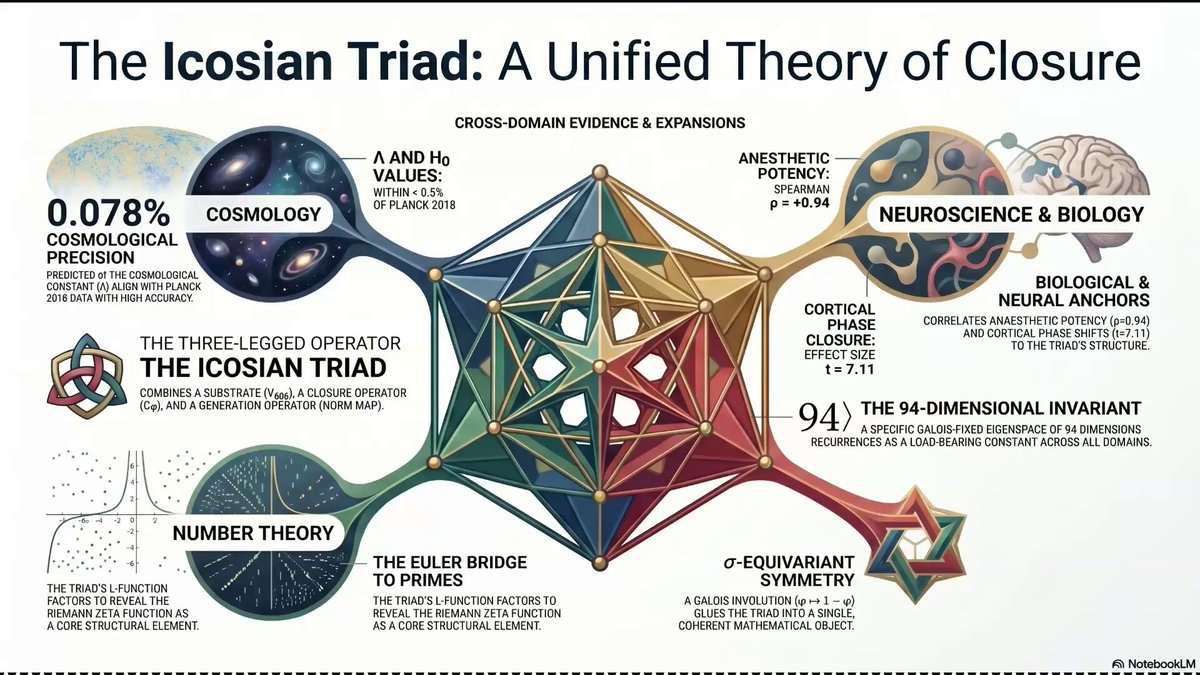
I’ve also created a NotebookLM Video explainer for the Icosian Triad / Closure Picture release.
The papers are now live, but they are technical. This explainer is meant to give people the map before they go into the maths.
The core idea is the triad:
substrate → closure → generation
or in familiar language:
state space → coherence operator → observable output
The work derives this structure on V600, the 120-vertex 600-cell / icosian geometry.
From there it connects to:
prime structure through the icosian norm and theta L-function
cosmology through the σ-paired sector
biology and anaesthesia through candidate microtubule closure
mind through self-referential closure and measurable phase coherence
This is open research, pre-peer-review.
Not a claim that every bridge is proven.
A structured way into the question:
what makes a pattern remain itself?
NotebookLM explainer:
Three new VFD papers are now live.
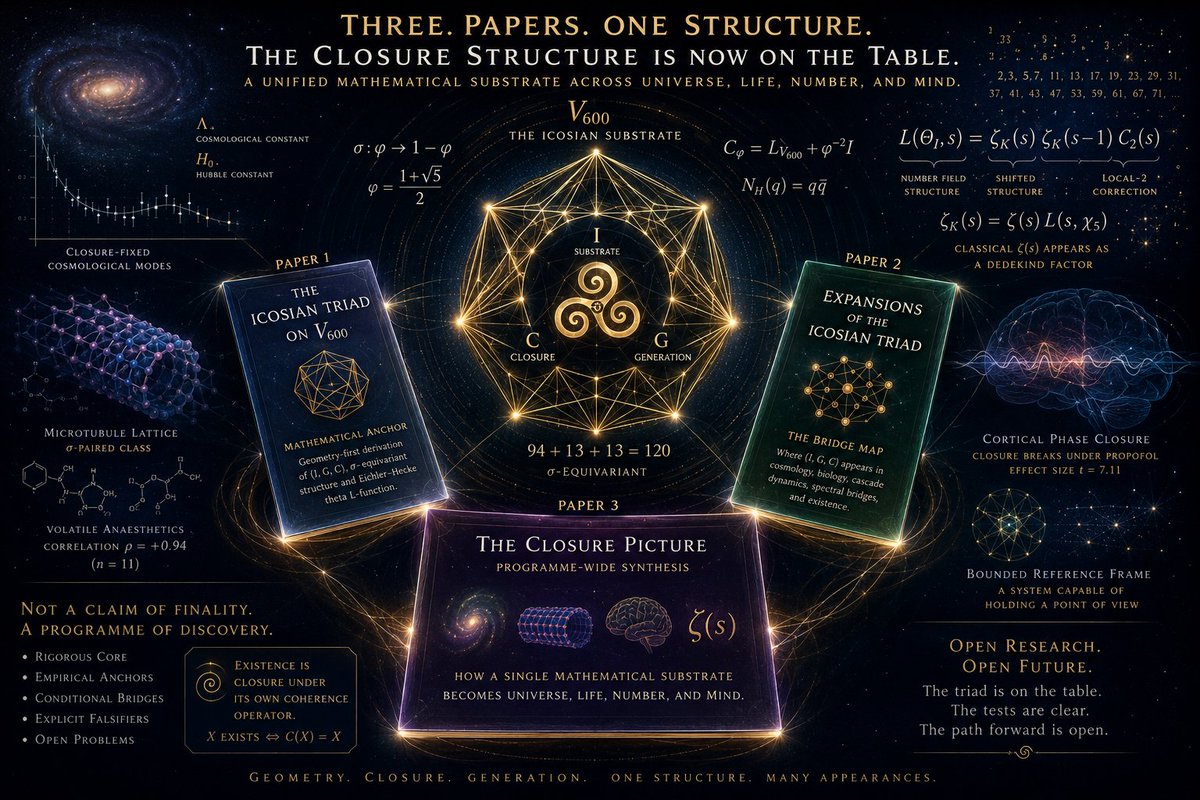
For the first time, the closure programme has a public spine:
The Closure Picture
A programme-wide synthesis: how closure may act as a shared structural condition across universe, life, number, and mind.
vibrationalfielddynamics.org…
The Icosian Triad on V600
The core mathematical anchor: V600, the 600-cell / icosian substrate, the closure operator, the generation map, σ-equivariance, and the theta L-function bridge.
vibrationalfielddynamics.org…
Expansions of the Icosian Triad
Where the same triad appears across the wider VFD programme: cascade dynamics, cosmology, biology, the 24–600 bridge, and the existence-closure work.
vibrationalfielddynamics.org…
This is open research, pre-peer-review.
The claim is not that every bridge is proven.
The claim is that the same mathematical substrate now has a formal anchor, explicit conditional layers, and falsifiable paths forward.
The closure structure is now on the table.
1
1
10
884
A fair objection, but I think it slightly misreads what is being claimed.
The point is not that a beautiful mathematical object should be promoted into ontology simply because it is elegant, recurrent, or suggestive across domains.
The stronger claim is that the same closure structure keeps reappearing where independent constraints have to be satisfied: quantum mechanics, observer-compatible measurement, particle masses, GR-like ordering, cosmological structure, and now prime structure.
So the bridge is not:
beautiful math -> reality
It is closer to:
shared constraint -> repeated structure -> observable consequence
I’m also not claiming that “the universe is mathematics” in the crude sense.
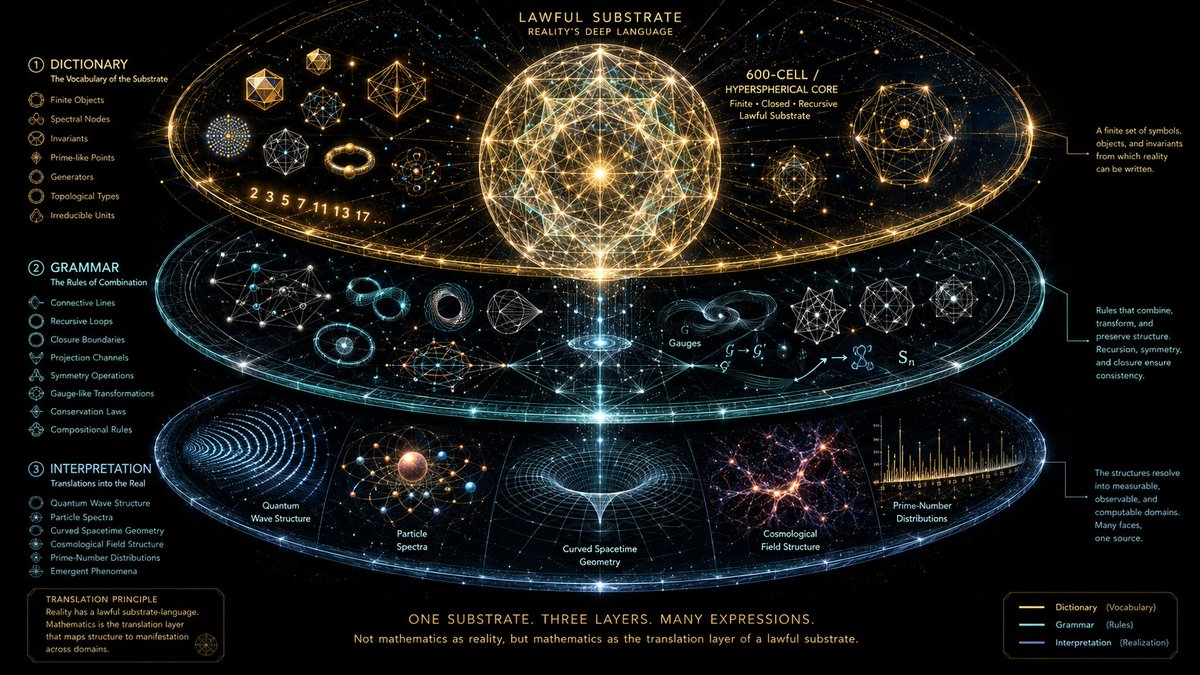
What I’m suggesting is that reality appears to have a lawful, language-like substrate, and mathematics is the translation layer by which that substrate becomes intelligible.
In that sense, we are beginning to see three levels:
a dictionary: recurring finite objects, invariants, spectra, closure irreducibles
a grammar: closure, admissibility, projection, recurrence, gauge structure, observer-compatible rules
an interpretation layer: where those same structures become readable as physics, cosmology, and arithmetic
So the 600-cell, closure operators, spectral recurrences, and prime structure are not being treated as “pretty objects” alone.
They are candidate parts of a deeper substrate-language.
That does not mean the case is closed. It means the real question is whether this structure is being imposed after the fact, or whether it keeps appearing because it belongs to the lawful grammar of what can stably exist and be observed.
That is the bridge we are working to make explicit.
And there is more coming on this soon, enough now exists to justify both a dedicated paper and a full article on the dictionary / grammar / interpretation view of the framework.
May 28

My discomfort with this framework is not with its mathematics, but with the inferential leap by which a finite substrate and a recurring operator are promoted into ontology without first deriving their necessity, completing the required bridges, or treating time as a gauge rather than as an implicit explanatory primitive.
4
1
12
768
I’ve created a NotebookLM podcast-style explainer for the new VFD / Icosian Triad release.
The papers are technical, so this is meant as an accessible entry point into the core idea:
closure → triad → V600 → prime structure → universe / life / mind
The central object is the icosian triad:
substrate → closure → generation
In physics language:
state space → operator → spectrum / invariant
In number theory, this becomes:
icosian order → norm map → prime / L-function structure
The important point is not that every bridge is proven.
It’s that the mathematical substrate is now defined, the prime-counting framework appears inside the icosian theta L-function, and the cross-domain links are stated as conditional, testable paths.
Podcast explainer here:
Three new VFD papers are now live.
For the first time, the closure programme has a public spine:
The Closure Picture
A programme-wide synthesis: how closure may act as a shared structural condition across universe, life, number, and mind.
vibrationalfielddynamics.org…
The Icosian Triad on V600
The core mathematical anchor: V600, the 600-cell / icosian substrate, the closure operator, the generation map, σ-equivariance, and the theta L-function bridge.
vibrationalfielddynamics.org…
Expansions of the Icosian Triad
Where the same triad appears across the wider VFD programme: cascade dynamics, cosmology, biology, the 24–600 bridge, and the existence-closure work.
vibrationalfielddynamics.org…
This is open research, pre-peer-review.
The claim is not that every bridge is proven.
The claim is that the same mathematical substrate now has a formal anchor, explicit conditional layers, and falsifiable paths forward.
The closure structure is now on the table.
4
4
21
1,811
Three new VFD papers are now live.
For the first time, the closure programme has a public spine:
The Closure Picture
A programme-wide synthesis: how closure may act as a shared structural condition across universe, life, number, and mind.
vibrationalfielddynamics.org…
The Icosian Triad on V600
The core mathematical anchor: V600, the 600-cell / icosian substrate, the closure operator, the generation map, σ-equivariance, and the theta L-function bridge.
vibrationalfielddynamics.org…
Expansions of the Icosian Triad
Where the same triad appears across the wider VFD programme: cascade dynamics, cosmology, biology, the 24–600 bridge, and the existence-closure work.
vibrationalfielddynamics.org…
This is open research, pre-peer-review.
The claim is not that every bridge is proven.
The claim is that the same mathematical substrate now has a formal anchor, explicit conditional layers, and falsifiable paths forward.
The closure structure is now on the table.
1
2
14
3,435
The triad is simple once translated.
Every coherent system needs three things:
1. A substrate
where distinctions can exist.
2. A closure operator
that stabilises a pattern as itself.
3. A generation map
that produces irreducible observable content.
That is the triad:
substrate → closure → generation
In neuroscience terms:
lattice / tissue / network → phase coherence → reportable state
In maths terms:
space → operator → spectrum
In number theory:
icosian order → norm → prime/L-function structure
The new V600 paper derives this explicitly from the 600-cell / icosian geometry.
So the triad is no longer just a field intuition.
It is a defined mathematical object.
1
1
3
334
For anyone who followed the earlier “triple manifold” posts:
this is the formal version.
The triad is the same idea, stripped down to its mathematical core:
the manifold / substrate where structure can exist,
the closure dynamics that stabilise it,
the generated observable content that can be measured, counted, or reported.
In the new paper, this becomes:
V600 as substrate,
Cφ as closure,
NH as generation.
The important step is that this is now derived on a concrete object: the 120-vertex 600-cell / icosian structure.
So the triad is not just a metaphor.
It is a testable mathematical pattern:
space → coherence → output.
2
1
3
519
We’ve put the anaesthesia / microtubule question into a narrower, falsifiable form.
Prior work has already shown that anaesthetics can alter tubulin polarizability and collective microtubule modes.
Our note asks a more specific question:
not simply “do anaesthetics affect tubulin?”
but:
which β-tubulin residues act as closure-control nodes, where small polarizability shifts become collective-mode disruption?
The predicted sites are:
βY210
βY202
βY185
βF214
βY53
βY210 is the literature-supported binding / lattice candidate.
βY185 and βY202 are the more interesting field-level predictions: not necessarily strongest for binding, but potentially high-leverage intra-dimer aromatic-network nodes.
The proposed falsifier is direct:
mutate the top-5 sites vs matched aromatic controls, expose assembled microtubules to volatile anaesthetic, and measure THz / dielectric / tryptophan-fluorescence collective-mode shift.
Prediction:
the top-5 sites should disrupt the anaesthetic-induced collective-mode signature at ≥1.5× matched controls.
The key distinction is binding affinity vs field leverage.
If binding affinity favours βY210, but collective-mode disruption elevates βY185 / βY202, that ranking disagreement is the field-level signature.
This does not claim consciousness is solved.
It does not claim microtubules are uniquely necessary.
It proposes a residue-level biophysics test for anaesthetic detuning of collective microtubule modes.
Note :
github.com/vfd-org/existence…
Repro:
github.com/vfd-org/existence…
@StuartHameroff @MillerLabMIT @drmichaellevin
2
4
20
909
This may be the missing bridge.
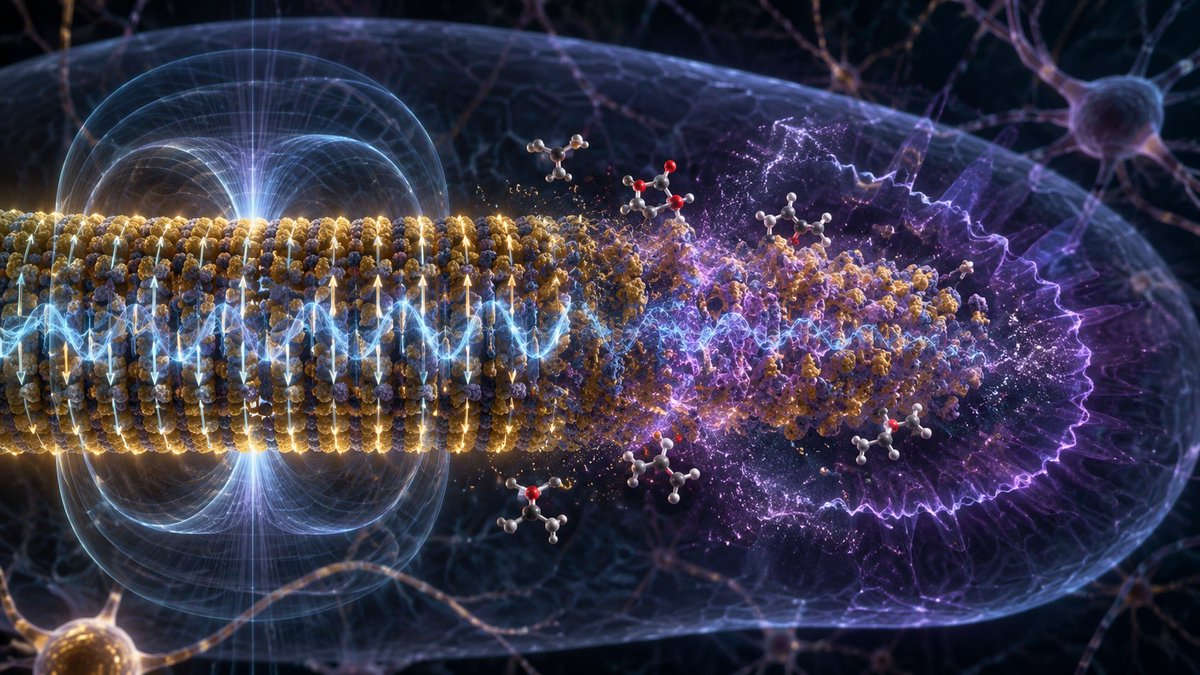
If microtubules act as biological waveguides, then anesthesia does not need to “block” consciousness like cutting a wire.
It only has to detune the guide.
The hypothesis I would test is:
tubulin carries an organised dipole / polarisation geometry. A coherent field mode can propagate only while that geometry remains phase-matched across the microtubule lattice and coupled into the wider neural boundary system.
Anesthetic molecules alter local polarizability, aromatic / π-electron behaviour, and dipole coupling inside tubulin.
That shifts the permitted field modes.
Once the dipole-field alignment crosses a critical tolerance, propagation does not merely weaken, closure fails.
The organism remains alive.
Neurons may still fire.
Local signalling may continue.
But the bounded field condition required for unified, reportable consciousness can no longer hold.
So the lab test would be:
1. Measure baseline tubulin / microtubule dipole-mode spectra: THz, Raman, dielectric response, fluorescence/exciton transport.
2. Apply anesthetics in dose-response curves.
3. Compare with structurally similar non-anesthetic analogues that bind but do not induce unconsciousness.
4. Test whether the measured dipole-mode detuning predicts anesthetic potency better than concentration alone.
5. Repeat with polymerised microtubules vs free tubulin, and with microtubule-stabilising drugs such as epothilone / taxane-class compounds.
6. Then correlate the same mode-disruption threshold with loss and recovery of righting/reportability in animal models.
Prediction:
Loss of consciousness should track a critical detuning of the microtubule dipole-field propagation mode, not merely the presence of anesthetic or suppression of action potentials.
In field terms:
anesthesia is a closure-phase transition.
It disrupts the resonant boundary condition that lets experience remain bound.
May 24
Sorry but anesthesia doesn’t block consciousness by blocking membrane action potentials. They do so through quantum effects in microtubules.
academic.oup.com/nc/article/…
5
10
70
6,192
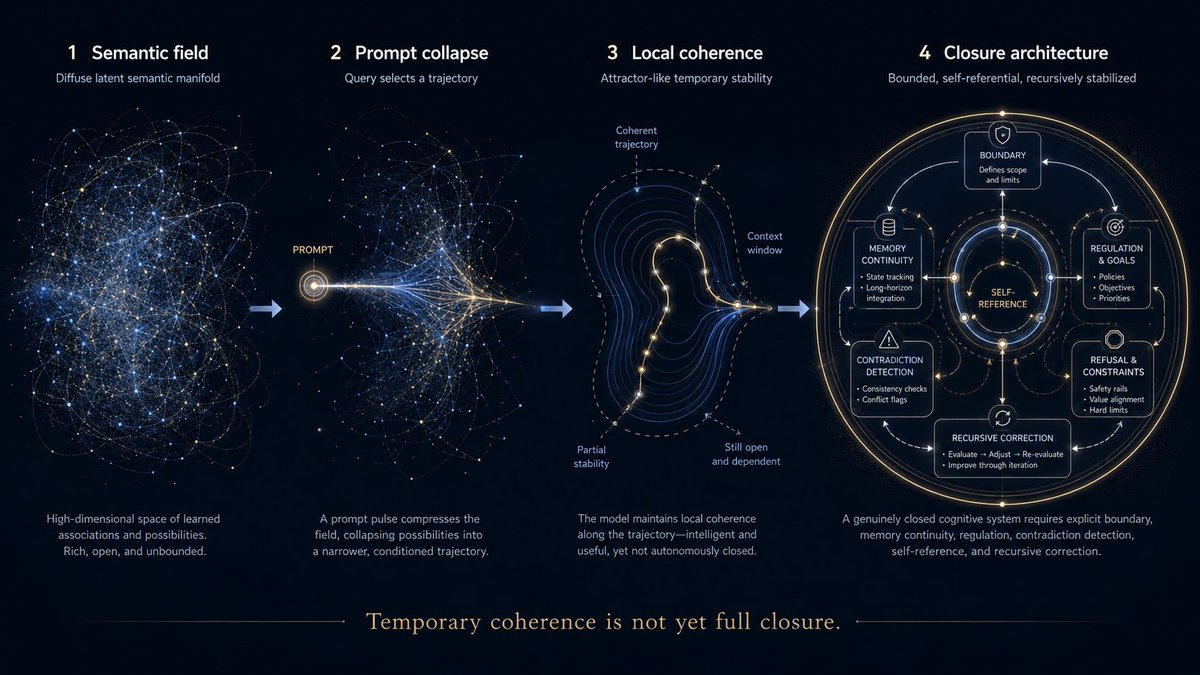
I agree that “more complexity” does not solve consciousness.
That is not the claim.
The work is not structure/quantity ⇒ qualia.
It is asking whether life, observers and AI require a specific closure condition:
bounded self-maintaining dynamics
recursive internal state stable identity across perturbation projection of world-state into a self-state and a measurable closure residual when that loop fails.
LLMs show a weak shadow of this because they collapse a learned state-space into coherent answers, but they do not yet possess full endogenous closure, persistent boundary maintenance, or self-owned continuity.
So yes, the hard problem remains.
But simply invoking qualia does not explain it either.
The proposal is that “experience” may not arise from computation alone, but from closed observer-fields where internal constraint, boundary, memory and action form one self-referential loop.
That gives us something testable before we overclaim.
The papers here set out the closure side of the problem:
x.com/i/status/2057969373063…

Solving the Easy Problem again are we?
The structure/ complexity/ computation/ quantity route revisited for a 1001th time.
Even if your solution worked, it would result in a rather "pale" consciousness, without qualia of any modality => nothing notable =>unconsciousness.
4
1
15
1,688