
Something new. Prev partner at @Sequoia. Started @PeopleGlassApp. @a16z @Caltech CS. Crypto and AGI maxi.
Joined December 2014
- Tweets 482
- Following 490
- Followers 3,456
- Likes 4,057
9 Photos and videos




Daniel Chen retweeted

Jun 16
Most AI investing happens downstream of the frontier: a capability emerges, a category gets named, and capital rushes in.
But by the time a category earns a clean box on a market map, the best builders have usually been living in the messy version for months.
Agents. Reasoning. RL environments. World models. AI for Science. Recursive self-improvement.
I call this frontier proximity: the ability to see what is becoming possible before it becomes consensus.
My frontier proximity ladder:
L0 Wrapper: uses today’s models.
L1 Reactor: reacts fast to releases, but roadmap is downstream.
L2 Anticipator: builds for where capabilities are going.
L3 Native: depends on a non-obvious frontier bet.
L4 Shaper: helps move the frontier itself.
The point is not that every company needs to train models.
Apps can have high frontier proximity if they understand what models will make possible next.
Infra can have high frontier proximity if it knows what future agents, multimodal systems, robotics stacks, or scientific workflows will need.
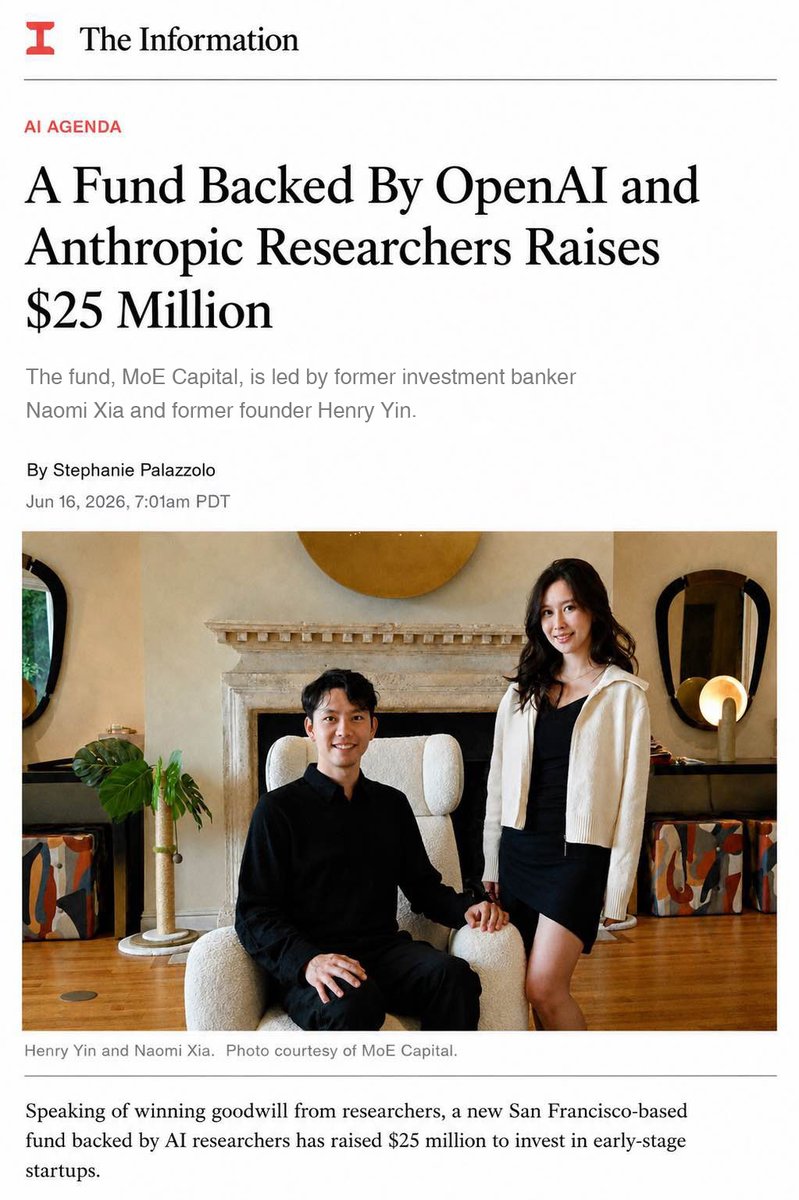
That is why we’re launching MoE Capital.
MoE stands for Mixture of Experts.
The idea is simple: build an AI fund around people closest to the frontier: frontier researchers, technical founders, AI-native builders, and seasoned operators.
We don’t want to be another AI fund with a newsletter-level understanding of the frontier.
We want to build the AI fund closest to the frontier.
More in The Information: theinformation.com/newslette…
116
67
597
236,916

Daniel Chen retweeted

Apr 21
A runner knows the route.
Ours learned it with the professionals.
3
6
29
4,002


Daniel Chen retweeted

@karpathy's AutoResearch made one thing visible:
the frontier question is no longer whether a model can answer once.
It is whether it can survive the loop.
That is why we built AutoLab.
161 evals | 23 tasks | 7 frontier models | 8,891 trajectories | 633M tokens
If you want to watch agents struggle, double down, pivot, and occasionally break through, come watch the Live Lab:
autolab.moe/live-lab

3
15
1,004
Daniel Chen retweeted
Feb 18
meta: my chat with Claude got too long while drafting this critique of the RLM paper. Claude couldn't fit the full conversation in context. so it grepped the local transcript file and pulled in relevant sections. context as external variable, examined and retrieved programmatically... wait, my Claude is already doing RLM?
the paper (@a1zhang, @lateinteraction). the core problem is real: models need clean separation between the context they're reasoning over and the intermediate results of exploring that context. tool outputs and sub-call results shouldn't pollute the window you're thinking in. context rot from accumulated junk is a genuine failure mode.
but this divide-and-conquer is already happening at the harness level and useful patterns are being RLed into models. plan mode → external checklist → Ralph Wiggum loops working through tasks one at a time with fresh context. subagents returning distilled results so junk never hits the parent window. context-driven file exploration (check length, grep structure, selectively read)...
do the above well and each sub-task gets a focused window with mostly relevant context. this is where RLM's recursive approach actually costs you — every sub-call is a fresh prefill with no KV cache sharing, plus scaffolding overhead. when context is mostly relevant and fits in window, a warm cache with full cross-context attention wins outright.
the training contribution is clean RL env design: the model can't read long snippets from the prompt, forcing it to learn selective exploration and recursive decomposition. but existing coding tools already impose the same constraint — Claude Code's read tool rejects files over ~25k tokens. models are already learning context decomposition because their harness tooling forces it when being RLed.
for frontier models, the path forward is better divide-and-conquer, better tool use for external context — transcripts, persisted state files, disk artifacts — and better RL for learning when to decompose. not a new paradigm. All these are already underway. some RLM patterns are already there, as the opening makes clear.
1
1
3
384
Daniel Chen retweeted

Feb 10
Few know what’s going on in el segundo
And we may look back on it as one of the most important things that happened in America this century
Feb 10

America is the greatest country in the world.
But we need more founders working on real problems.
If you are in the early stages of building something that matters, you have to be in El Segundo.🇺🇸
Apply to the Spring Cohort in bio.
Deadline February 20th.
2
5
61
6,425
Daniel Chen retweeted

Feb 10
363
588
3,539
2,219,028
Daniel Chen retweeted

Feb 11
I was at the @LayerZero_Core event today
It genuinely felt historic
A gigantic leap forward in blockchain technology

56
39
656
169,317
Daniel Chen retweeted

30 Dec 2025
The ticker is $LIT.
x.com/Lighter_xyz/status/200…
30 Dec 2025

We are announcing the Lighter Infrastructure Token (LIT)! Lighter is building infrastructure for the future of finance and the native token is key to aligning incentives. In this thread, we will describe the structure of the token, broader vision, and roadmap of use cases.
193
115
1,153
183,707
Daniel Chen retweeted

30 Dec 2025
We are announcing the Lighter Infrastructure Token (LIT)! Lighter is building infrastructure for the future of finance and the native token is key to aligning incentives. In this thread, we will describe the structure of the token, broader vision, and roadmap of use cases.
521
512
2,986
1,183,004

We’ve raised 17 million led by @PanteraCapital, with participation from @Sequoia and others.
Fin enables users and businesses to move millions of dollars instantly - whether to other Fin users, directly into bank accounts, or across crypto rails.
If banks and payment products could be rebuilt from the ground up today, they would look like Fin.
234
145
1,342
621,488
Daniel Chen retweeted
7 Nov 2025
Dear founder,
Are you letting god flow through you?
130
163
956
283,745
Daniel Chen retweeted

27 Oct 2025
we first met w sequoia in May 22. They invested in Dec 23. @shaunmmaguire intro'd us to spacex (and pushed us hard to think bigger), @josephinekchen connected us to some of our first customers, @Alfred_Lin helped us reason through scaling problems ...
If you can meet w sequoia, do it. If you can partner with them, definitely do it. it might take some time.
they very much helped shape bridge
27 Oct 2025

We're launching our latest venture and seed funds to partner with the next generation of outlier founders at the start of their journey.
We seek founders who see possibilities where others see limits. Here's what's inspiring our Early team:
20
15
440
323,764
Daniel Chen retweeted

27 Oct 2025
Working with @sequoia as our 1st investor was the best early decision we made in @privy_io's life.
Starting a company is brutal - but some investors bend reality in your favor so you get a toehold to change things!
@shaunmmaguire @josephinekchen definitely did this for us 🙇
27 Oct 2025
We're launching our latest venture and seed funds to partner with the next generation of outlier founders at the start of their journey.
We seek founders who see possibilities where others see limits. Here's what's inspiring our Early team:
10
6
180
30,700
Daniel Chen retweeted

23 Oct 2025
Sequoia's Chief Product Officer, @jesskah, won't hire well-rounded people.
She looks for a "spikes" in 1 of 4 traits that predict success:
• EQ: One-on-one people skills
• IQ: Raw intellectual horsepower
• PQ: Ability to navigate politics/systems
• JQ: Judgment on decisions that matter
In this week's episode of The Library of Minds, we went deep on how this framework shaped her journey from Google PM to Polyvore CEO to Sequoia’s Chief Product Officer. Jess explains why velocity is the strongest early predictor of product-market fit, how choosing the wrong business model was her biggest mistake as a founder, and why she now believes AI will spark a new wave of consumer media.
00:00 Intro
1:00 Who is Jess Lee
02:50 The EQ / IQ / PQ / JQ framework
03:44 What early Google taught her
05:35 When ambition becomes a weakness
07:34 Customer discovery vs visionary intuition
09:31 Polyvore: from user → CEO
12:37 Imposter syndrome & finding authentic leadership
15:20 Picking the wrong market
18:24 Firing fast & setting high performance bars
20:12 Building cult-like community and emotional loyalty
22:13 Velocity vs delight in product
24:32 What she looks for in founders (turn-based velocity)
25:59 The business model wake-up call
27:27 Storytelling as a founding superpower
28:26 Hot take: consumer isn’t dead, it’s being reborn
31:50 AI-generated media, fanfic, and the next YouTube
Grateful to be working with her at @withdelphi !
157
440
4,240
1,970,632
Daniel Chen retweeted

10 Oct 2025
In 2020, @mansourtarek_ and @luanalopeslara dazzled us at @sequoia with a bold vision: make prediction markets federally compliant and mainstream.
Today, @Kalshi is available in 140 countries and is one of the fastest-growing companies in the world.
Congrats to Team Kalshi. Proud to be on this journey with you from Series A to Series D and beyond.
Let's go!
10 Oct 2025

Kalshi recently raised $300M at $5B from Sequoia, a16z, Paradigm and others.
Since then, we've grown over 3x, hit $50B of annualized volume, and became the largest prediction market in the world.
And today…Kalshi goes global.
140 countries. 1 liquidity pool.
18
18
165
54,192

10 Oct 2025
Almost exactly 10 years ago, we were building an internal prediction market @a16z. @cdixon is a true OG. Congrats
10 Oct 2025

Today we are announcing that a16z is co-leading the Series D in @Kalshi, a regulated exchange for trading on prediction markets. Prediction markets are a modern implementation of a classic economic idea, one most clearly articulated by Friedrich Hayek.
Hayek and the knowledge problem
Hayek argued that no central planner could ever access the dispersed knowledge held by millions of people across an economy, a fundamental challenge that has come to be known as the “knowledge problem.” Much of this knowledge is tacit and unspoken, embedded in people’s experiences, circumstances, and preferences.
Hayek wasn’t just pointing out the limits of central planning. He was offering a solution. In his 1945 essay The Use of Knowledge in Society, Hayek argued that the solution lies in looking outward, not inward: “We need decentralization,” as he put it.
Markets, in Hayek’s view, are not just allocation mechanisms but information systems. Prices act as signals, compressing vast amounts of local knowledge into actionable information. Moreover, prices create incentives: they encourage people to make decisions and act in ways that drive information back into the system. This creates an iterative feedback loop, an engine that drives better performance.
Today we might say that the answer to the knowledge problem is not to give central planners more sophisticated computers. The answer is that markets themselves are the computers. Prediction markets make this idea concrete, applying it to questions about the future and turning collective knowledge into prices that reflect probabilities.
Why we’re investing in Kalshi
This is why we’re excited about prediction markets, and why we’re investing in Kalshi. Kalshi is bringing prediction markets into the mainstream with a compliant, scalable platform for event contracts covering everything from elections and economics to sports and culture. It has already seen billions in trading volume and continues to grow quickly. Kalshi also plans deep crypto integrations, work we’re excited to collaborate on, and today announced they’re expanding globally to 140 countries.
We’re not the only ones excited about the potential of prediction markets. For businesses and investors, event contracts can hedge risk, such as exposure to economic or policy changes. For policymakers and analysts, market prices offer real-time forecasts that can outperform polls and expert predictions. And for society at large, prediction markets create an open, transparent, and incentive-driven way to aggregate beliefs about the future.
This is the right moment for prediction markets. As trust in established institutions reaches historic lows — at least according to the polls — we need new systems that can earn trust in different ways. We believe the answer lies in open, decentralized systems. DeFi provides an alternative to traditional finance, stablecoins to conventional payment providers, and prediction markets to expert forecasts. Where people once trusted banks or pundits, they can now trust protocols and markets.
Hayek’s insight was that knowledge is too widely distributed for any one authority to possess. Instead, we need systems that harness the intelligence of the many. Kalshi puts this idea into action, transforming dispersed information into concrete, market-based forecasts. We’re excited to support their work as they bring prediction markets into the mainstream.

3
5
279
Daniel Chen retweeted

25 Sep 2025
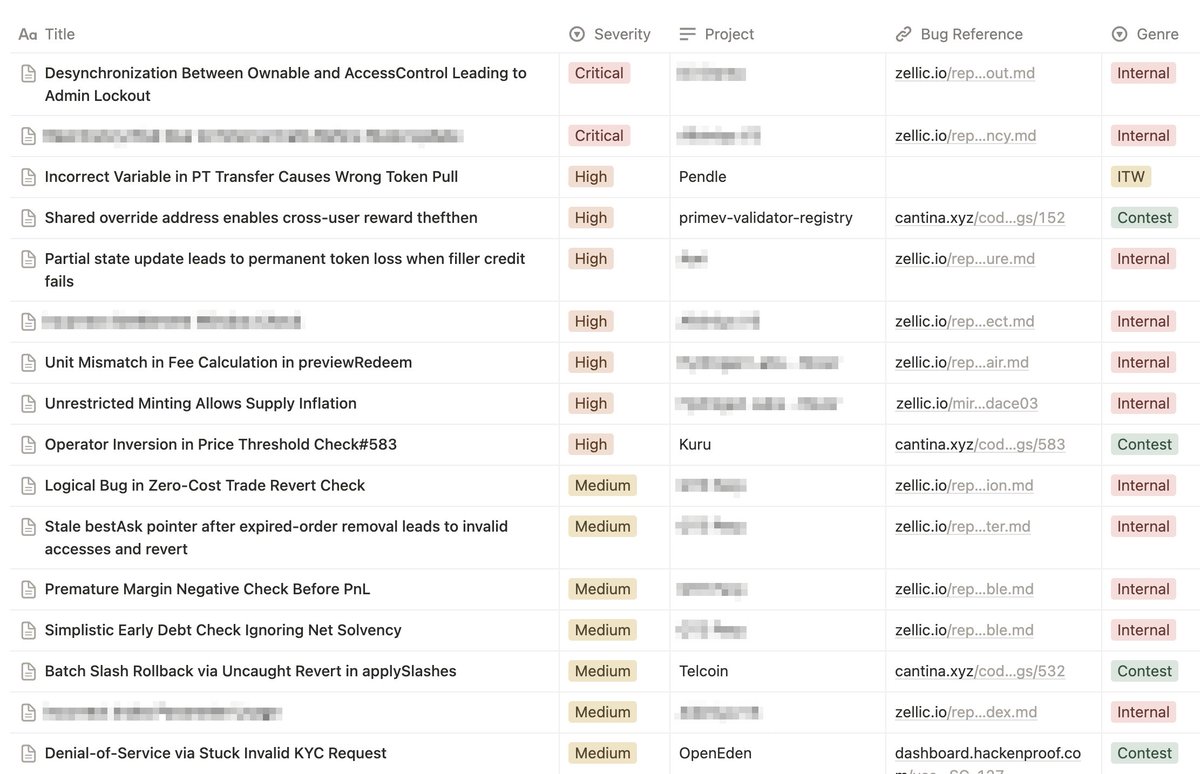
Bad auditors miss obvious bugs. We built an AI tool that finds them.
Introducing V12: the only autonomous Solidity auditor that actually finds Highs and Criticals.
We'll be releasing it for free.
V12 finds Crits in Zellic audits, High/Mediums in Cantina, and a bug in Pendle.
79
135
728
267,417