
They were introduced in the seminal February 1978 paper "A Method for Obtaining Digital Signatures and Public-Key Cryptosystems" by Ron Rivest, Adi Shamir, and Leonard Adleman (the inventors of the RSA algorithm).
1
5
90
Allen Y. Tien MD MHS 田一彦 retweeted

The universe has a sense of humor.
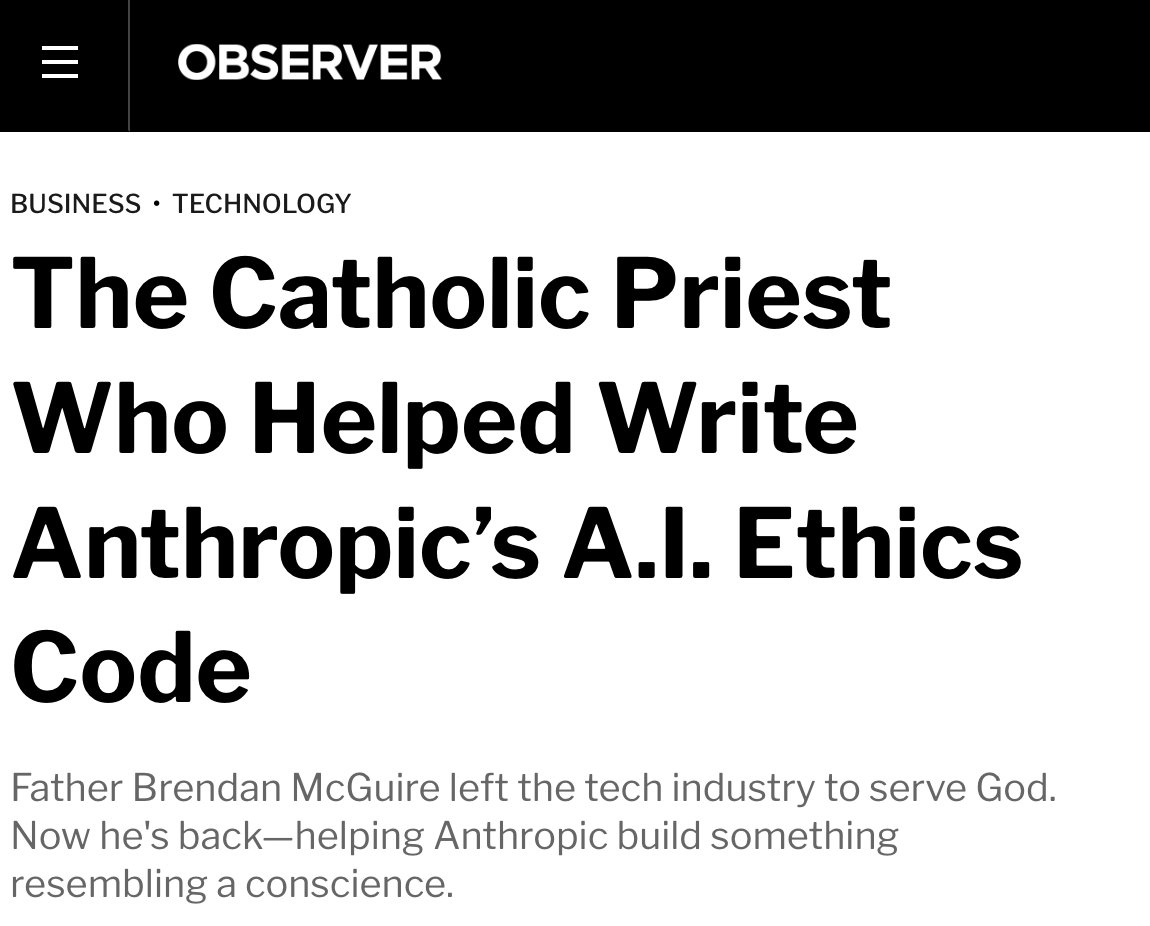
A man who once engineered cryptosystems in 1980s Dublin and ran a major Silicon Valley tech standards body walked away from it all to become a Catholic priest.
Now, in 2026, Father Brendan McGuire is back — helping write the actual “constitution” for Claude, one of the world’s most powerful AIs at Anthropic.
He didn’t show up with policy papers or safety benchmarks. He showed up with 2,000 years of Catholic moral theology.
While the engineers were teaching the model to reason, he asked the older question: how do you actually form a conscience?
He saw the parallel immediately. Humans develop judgment through iteration, correction, and constant exposure to the world. So do these machines.
But here’s what makes the moment feel historic and slightly terrifying:
Without deliberate intention, AI won’t stay neutral. It will simply reflect back every good and evil humanity has ever produced. “We have to tilt these machines towards good,” the priest says, “otherwise they’re just going to reflect back the good and evil of the world. That’s a horrifying thing.”
So the same industry long accused of “playing God” quietly reached out to the Vatican for help. The oldest continuous institution on Earth — the one that has spent two millennia wrestling with the human soul, sin, and wisdom — is now being asked to help shape silicon minds that have no soul… but might soon influence billions who do.
And somewhere in a Silicon Valley parish, Father McGuire is co-writing a novel about faith and AI consciousness… with Claude itself as his writing partner.
The light of ancient cathedrals is now being encoded into the code that will define our future.
The question is no longer whether we can build god-like machines. The question is whether we can help them — and ourselves — become better.
4
11
27
1,893
china232332 retweeted

Jun 13
Worth thinking about the crypto wars precedent, when the US government tried to place strong cryptosystems - which could even be written down and published as books - under export controls. That policy eventually broke down though some restrictions still exist. It doesn’t mean frontier models will have the same dynamic, because the US lead over others could prove to be unassailable, given recursive self improvement & access to compute.
6
43
9,429


At this point, no one has demonstrated the ability to factor a number larger than 21 using quantum computing. To threaten cryptosystems, we need to be able to factor numbers with thousands of digits, not just two digits, but let them show me their ability to factor the number 91 and I will start taking them seriously again.
5
1
25
1,312

May 28
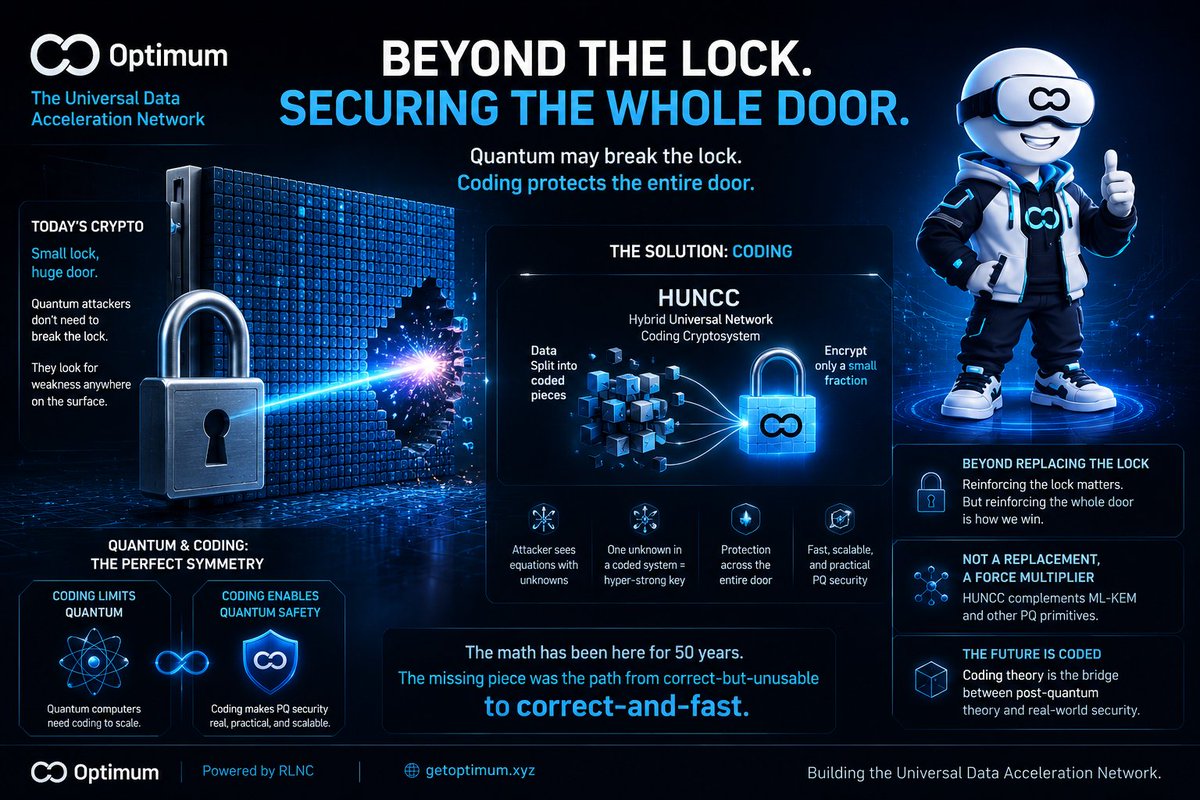
Everyone talks about Post-Quantum security like it’s only about replacing the lock.
But what if the real problem is the entire door? 🧵
Quantum computing isn’t “magic.”
It’s probabilistic math powered by qubits, and the biggest obstacle preventing it from scaling today is actually the same thing that may secure us against it tomorrow:
👉 Coding theory.
Here’s the overlooked part of the PQ conversation:
Current cryptography protects massive amounts of data with very small keys.
A tiny lock securing a huge door.
That model works against classical attackers because they must break the lock directly.
But quantum attackers don’t necessarily play by deterministic rules.
Instead of attacking the lock, they can search for weaknesses across the entire surface of the system.
And that changes everything.
Most of the industry focus today is on strengthening the lock:
• ML-KEM
• lattice cryptography
• PQ signatures
• replacing ECDSA
Important work, absolutely.
But still localized protection.
The deeper idea is this:
How do we protect the entire data structure without making systems unbearably expensive?
That’s where coding theory becomes far more than an academic topic.
McEliece, one of the oldest and most trusted PQ cryptosystems, has survived ~50 years of cryptanalysis without a fundamental break.
The issue was never security.
The issue was deployability.
Strong protection came with enormous overhead.
This is where HUNCC (Hybrid Universal Network Coding Cryptosystem) introduces a fascinating direction:
Instead of encrypting everything heavily, data is split into coded fragments, while expensive PQ encryption is applied only to a very small subset.
Result:
• lower overhead
• scalable deployment
• distributed protection across the whole payload
• security embedded into the coded structure itself
The important takeaway:
Coding theory is not just supporting post-quantum cryptography.
It may become the foundation that makes post-quantum security practical at internet scale.
The same mathematics currently limiting quantum computing may ultimately become the mathematics that protects the world from it.
That’s a very powerful symmetry.
@get_optimum
@aqccapital
@ada_pegasus
May 18

Many people talk about quantum (PQ) computing like it's mystical. It isn't. It's math. The way we will secure data against it is also math, specifically, coding theory. Let me explain what that means, because much of the current PQ conversation is missing some important context.
Quantum computers work on qubits rather than bits. A bit is 0 or 1. A qubit can be described as something that can be 0, 1, or a distribution between them. That extra room is where the power comes from: a quantum computer is probabilistic, not deterministic, and it can solve specific problems that today's machines cannot.
The challenge is that as you compute, the qubits degrade. The state doesn't stay constant. Without robust, efficient error correction, a quantum computer can't scale. Error correction is a coding problem. So coding is one of the largest open obstacles to making quantum computing real at all, which is why so much of the heavy investment in this space is, at its core, an investment in better codes.
That same math is what protects us on the other side. To see why, the analogy I keep coming back to is a door and a lock. Every cryptosystem you use today protects a large surface (say a megabit of data) with a tiny key, say 128 or 256 bits. The lock is a small fraction of the door. That arrangement works against a classical attacker because they have to break the lock; there's no other way in.
A quantum attacker doesn't have that constraint. They can probe non-deterministically; they don't need to break the lock at all. They can look for a weak point anywhere on the surface of the door and punch a hole through it. You may not even know which part of your data they saw, maybe nothing important, maybe exactly what you wanted to hide.
Almost the entire PQ conversation today is about reinforcing the lock. Replace ECDSA, replace the key-exchange primitive, swap in a lattice-based KEM. That work matters and it should continue. But it is still a small reinforced patch on a very large door.
The real question is how you reinforce the whole door. The math for that has existed since the 1970s: the McEliece cryptosystem, the granddaddy of post-quantum schemes, and the main one I personally trust. It has withstood half a century of attacks by cryptographers without a fundamental break—a track record little else in this space comes close to.
The problem with McEliece is not security. It is pain. Applying it to a full payload is, if you forgive the grim comparison, like chemo: it kills the tumor and almost kills the patient. That is why nobody deploys it broadly. The lock is small enough to absorb the cost; the door is not.
This is where coding solves the second half of the problem. The construction my collaborators and I developed, HUNCC (Hybrid Universal Network Coding Cryptosystem), splits the data into coded pieces and applies the expensive PQ encryption to only a small fraction of them, maybe a few percent, or less. An attacker who breaks in sees a system of equations with one unknown they cannot recover. One unknown in a coded system is a hyper-strong key, and the protection lives everywhere on the data, not just at the lock.
The point is not that this replaces ML-KEM or any other PQ KEM. It doesn't, and I wouldn't claim it does. The point is that coding is what makes post-quantum security something you can actually deploy at speed, across the whole door, without paying the chemo cost everywhere.
Coding is what is currently blocking quantum computing from becoming real, and coding is what will make quantum safety real. The math has been here for fifty years. What we have been missing is the path from correct-but-unusable to correct-and-fast.
More to come.
1
2
40

May 27
"The RSA (Rivest-Shamir-Adleman) cryptosystem is a family of public-key cryptosystems (one of the oldest), widely used for secure data transmission."
#security #encryption
bartday.com/tools/rsa-genera…
2
2
5


May 20
The feeling is that adoption is coming not from convoluted cryptosystems, but through real-use products
2
14

May 20
Good Night With Dropee
The feeling is that adoption is coming not from convoluted cryptosystems, but through real-use products.
@dropee_app is building a truly incredible system where making AI-driven apps on Telegram is becoming incredibly easy.
With millions of users already in place and $DROPEE ready for TGE, there’s going to be an incredible new creator economy around launching apps.

90
29
94
429

Ritual does not simply integrate AI into existing cryptosystems - it rebuilds the basic level of execution to make AI a native element of blockchain infrastructure. The testnet has started the @ritualnet

11
21
123

Adaptive Distributed Key Generation for Discrete-Log Cryptosystems eprint.iacr.org/2026/892

4
10
1,274

May 4
AI is taking over the world and breaking social contracts in its wake. Digital trust has become obsolete.
This is the moment that cryptosystems are built for. Not performative "decentralization", but a real hardening of systems and institutions to survive this tsunami
May 4

Today we’re announcing $1 billion in new funds to back the bold founders shaping the next era of finance and technology.
I’ve been following the flow of assets my entire career and have never seen a more dynamic time. Financial infrastructure is being rebuilt from the ground up, new assets and markets are emerging, and an agentic economy is developing as AI agents begin to transact on behalf of humans. These areas, among others, are what will define the coming years as we deploy these new funds.
We’re excited for what’s ahead, and wrote about our thesis in the post below.
3
3
17
1,452

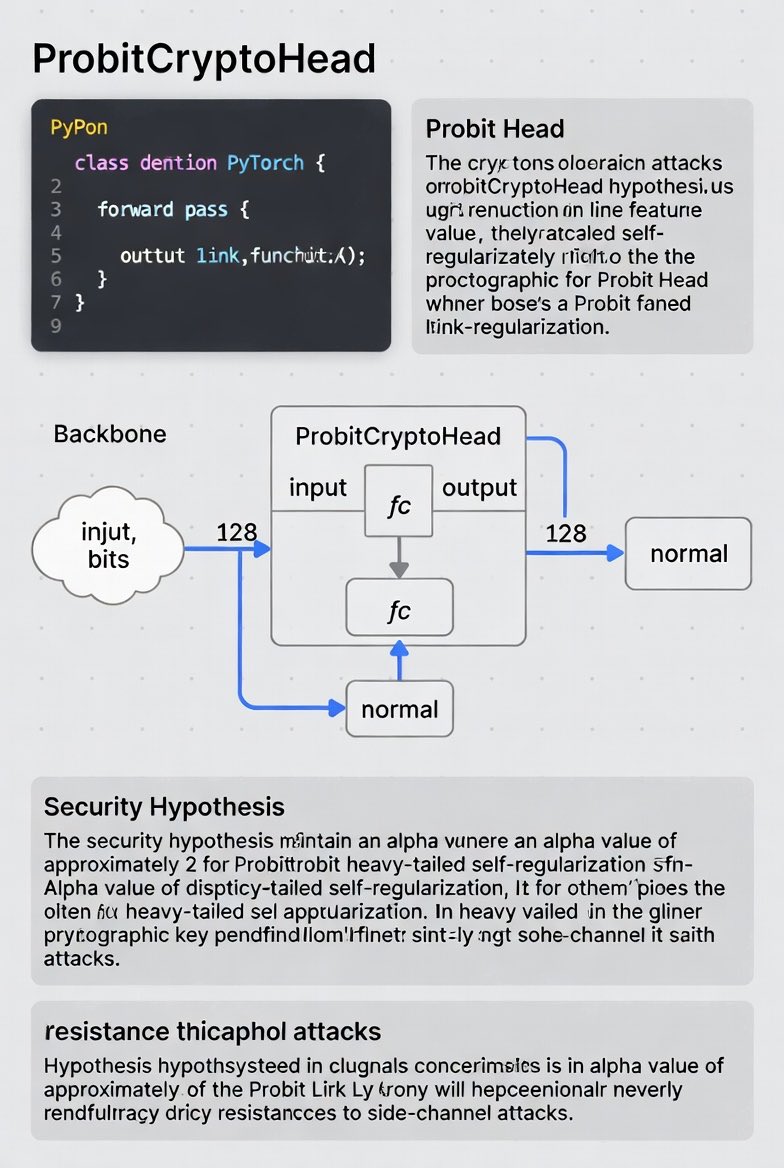
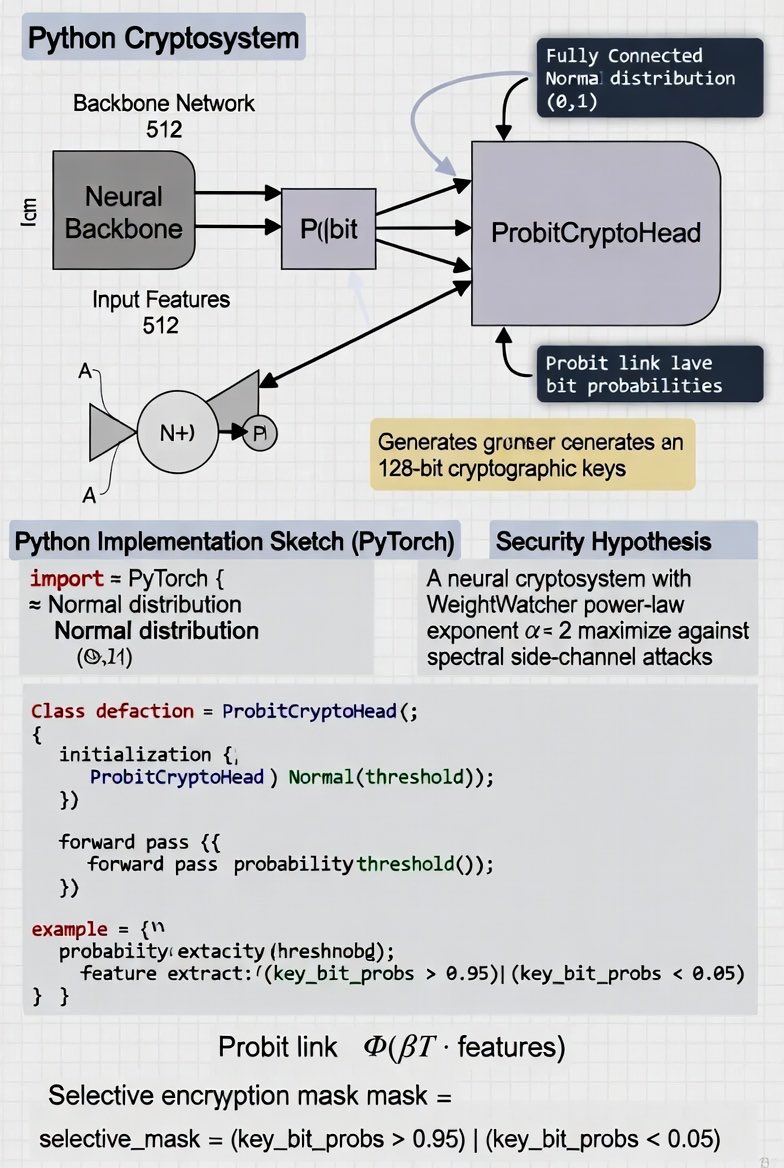
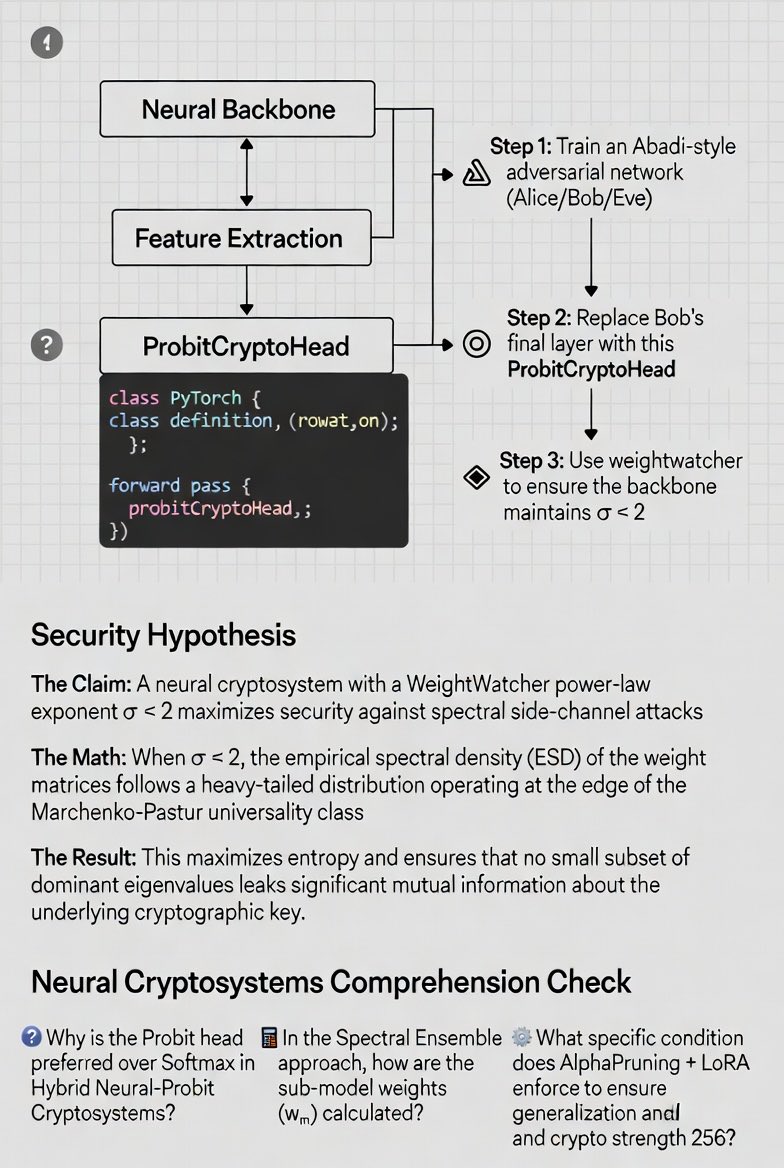
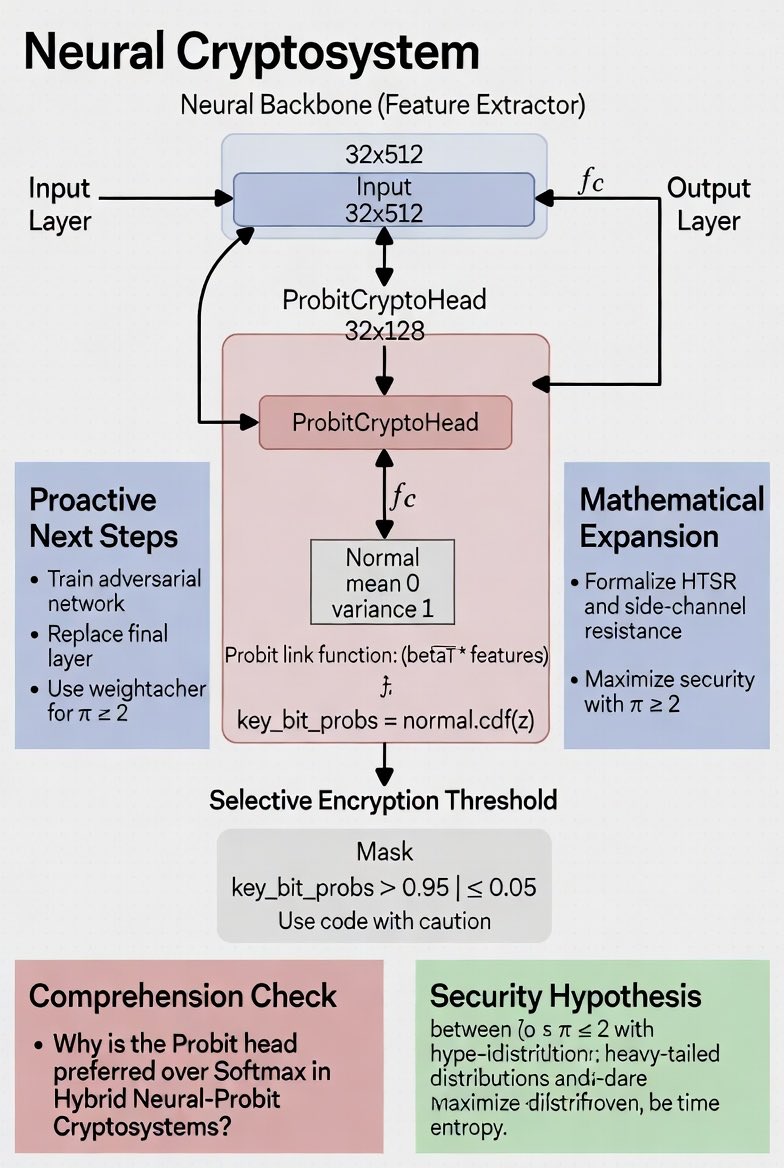
2. Hybrid Neural-Probit Cryptosystems (Probabilistic Encryption Calibration)
Replace softmax in Eve/Bob with probit head for calibrated key-bit probabilities or selective encryption. Probit GLM on high-dim features from neural backbone (validated by (\alpha \approx 2)).
Models:
• Neural extractor → embeddings.
• Probit: ( \hat{y}i = \Phi(\beta^T \text{features} \gamma K) ), (\Phi(z) = \int{-\infty}^z \frac{1}{\sqrt{2\pi}} e^{-t^2/2} dt ).
• Loss: negative log-likelihood of probit adversarial (L_E).
Implementation: Backbone (conv as in Abadi) statsmodels Probit or torch custom. WeightWatcher gates: reject if (\alpha \not\approx 2). Hybrid with traditional: probit outputs feed AES key schedule. Benefits: better uncertainty in side-channel resistance or fuzzy keys (probit handles ordinal bit confidence).
3. Spectral Ensemble Hybrids for Multi-Key/Multi-Cipher Encryption
Train ensemble of neural cryptos (diverse architectures: conv Transformer lattice-inspired). Score sub-models by HTSR (\hat{\alpha}) (weighted alpha) and stable rank; ensemble via weights (\propto 1/|\alpha - 2|).
Algorithm:
• Generate (M) Alice/Bob pairs.
• Compute (\mathbf{W}) ESD per layer → aggregate quality vector.
• Ciphertext fusion: (C_{\text{ens}} = \sum w_m C_m) (weighted, or majority on decrypted bits).
• Probit fusion for final key acceptance.
Math tie-in: Ensemble R-transform (R_{\text{ens}}(z) = \sum w_m R_m(z)) (free probability addition). Security: breaks single-model attacks (e.g., architecture-specific Eve). GitHub extension: combine with AlphaPruning for lightweight ensemble.
4. AlphaPruning LoRA for Efficient Encrypted Model Deployment
Prune/LoRA-adapt neural crypto models post-training while preserving (\alpha \approx 2) (HTSR ensures generalization = crypto strength).
Steps (WeightWatcher PEFT):
1. Train full adversarial net.
2. df = watcher.analyze(peft=True) → layer-wise prune ratio (\propto |\alpha_i - 2|) (more aggressive on bad layers).
3. Apply AlphaPruning (NeurIPS 2024) LoRA adapters on remaining weights.
4. Re-analyze: enforce ERG detX ≈ 0.
Crypto extension: Deploy pruned model under homomorphic encryption (CKKS: polynomial rings (\mathbb{Z}[X]/(X^n 1)), scale (\Delta)). LoRA keeps parameters small for HE-friendly inference. Math: pruning respects RMT universality classes (heavy-tailed → minimal accuracy drop).
5. SETOL Homomorphic/Quantum-Resistant Hybrids (Long-Term Secure Inference) Encrypt entire neural crypto weights with HE or lattice crypto, but use SETOL diagnostics pre-encryption to certify quality (only deploy if (\alpha \approx 2) ERG condition). Hybrid with probit for noisy HE decryption.
Framework:
•Train with WeightWatcher loop → certify layers.
•Encrypt weights: e.g., BFV scheme on (\mathbb{Z}_q[X]), or LWE-based.
•Inference: homomorphic forward pass on encrypted data.
•Probit head calibrates output probs under noise.
Full math stack:
•SETOL effective Hamiltonian → student-teacher correlation → R-transform for encrypted spectra.
•Security proof sketch: HTSR universality implies resistance to spectral attacks (eigenvalue leakage in side-channels).
Practical Next Steps & Resources:
•Start here: Clone neural-crypto GitHubs WeightWatcher. Run watcher.analyze() on trained Alice/Bob models from Abadi-style Keras impls → baseline (\alpha).
•Reproduce: Extend mathybit or Nuclearstar repos with HTSR monitoring (full code snippets available in WeightWatcher examples for transformers/conv nets).
•Test: Simulate Eve attacks pre/post-hybrid; expect (\alpha \approx 2) correlates with Eve error > random.
•Scales to SOTA: Apply to LLMs for encrypted prompting or post-quantum key exchange. These strategies are immediately implementable today and generalize classical crypto (e.g., hybrid neural RSA for key exchange). They leverage all referenced models: RMT/SETOL derivations, probit MLE, adversarial min-max, pruning algorithms, HE schemes. Provide a specific crypto task.
4
3
111

May 2
Systems win when cycles change.
$RIVER is focused on staying relevant.
@river4fun #RIVER #CryptoSystems
3
33