
How Pyth Delivers Real-Time Market Data Across Multiple Blockchains
If you’ve ever traded during a volatile market, you already know how fast prices can move.
One exchange shows one number. Another updates milliseconds later. Suddenly the market shifts again before most users even realize what happened.
Now imagine trying to deliver those same real-time prices accurately across dozens of different blockchains at the same time.
That’s basically the problem @PythNetwork is solving.
And the deeper you look into it, the more impressive the architecture becomes.
Most people only see the final price feed inside a DeFi app, but behind that is an entire cross-chain data pipeline working in real time to make those updates possible.
How Pyth Delivers Real-Time Market Data Across Multiple Blockchains
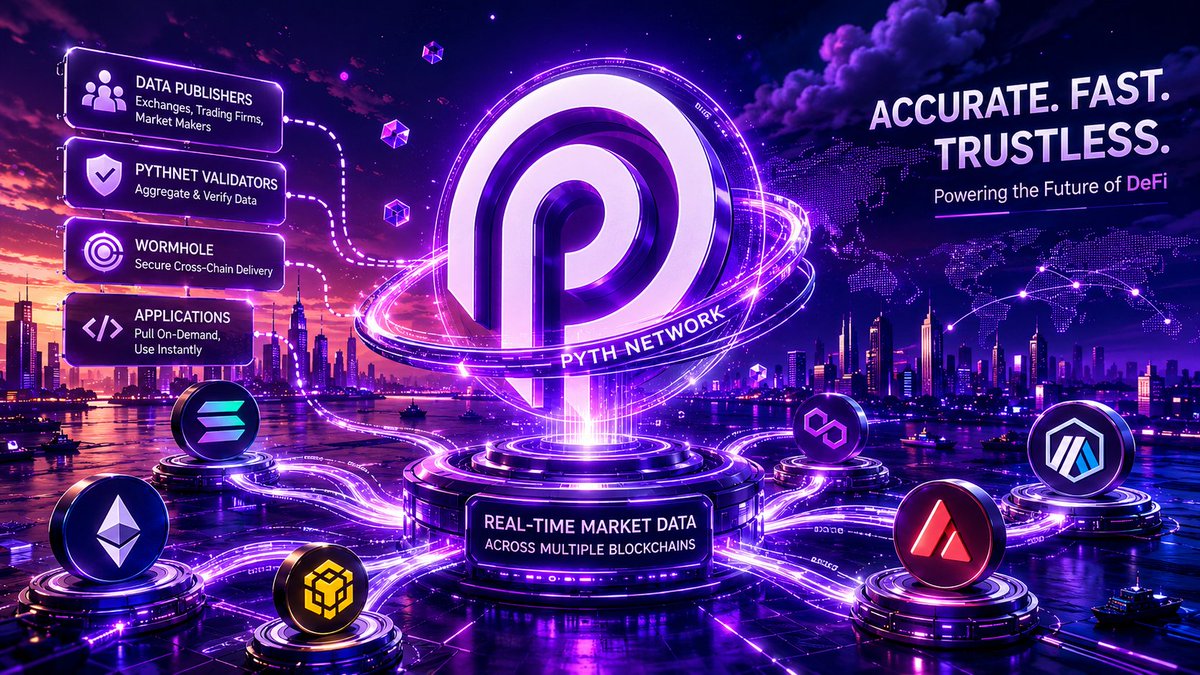
Pyth was designed to move high-frequency financial data from institutional sources directly into blockchain applications with as little latency as possible. Instead of relying on slow external scraping systems, Pyth gets market data directly from first-party publishers like exchanges, trading firms, and market makers.
The process starts with data publishers.
Step 1: Data Publishers Submit Prices
Pyth’s publishers include trading firms, exchanges, and financial institutions that continuously send live pricing data into the network.
Importantly, publishers don’t just submit prices - they also provide confidence intervals that estimate how certain the market price is during current conditions, especially during volatility.
The data is then published onto #Pythnet, Pyth’s specialized network built for high-frequency oracle updates.
Step 2: Pythnet Aggregates the Data
Instead of relying on a single source, Pyth combines pricing from multiple publishers to create a more reliable market price and confidence range in real time.
That final aggregated output becomes the official Pyth price feed and this is where things start getting interesting.
Step 3: Wormhole Broadcasts the Update Across Chains
After aggregation, Pythnet validators send the latest price data through #Wormhole, Pyth’s cross-chain messaging layer.
Wormhole guardians verify the update and generate signed messages called VAAs — cryptographic proof that the data is legitimate.
This allows Pyth to securely deliver the same market data across multiple blockchains without maintaining separate oracle systems on every chain.
Step 4: Applications Pull the Latest Price On-Demand
Unlike traditional push oracles, Pyth uses a pull-based architecture.
That means prices are not constantly pushed onto every blockchain whether they’re needed or not.
Instead, applications pull the newest signed price update exactly when needed during transaction execution.
For example:
- A perpetual exchange opening a leveraged trade.
- A lending protocol checking collateral health.
- A liquidation engine verifying market prices.
The protocol fetches the latest signed update, verifies it on-chain, and executes the transaction immediately afterward.
This dramatically reduces unnecessary gas costs while still giving protocols access to near real-time market data.
Why This Architecture Matters
Why Pyth’s architecture stands out is simple: scalability.
Instead of forcing constant updates across every chain, Pyth separates data production, verification & delivery into different layers. That keeps costs lower, latency faster, and multichain expansion far more efficient.
As DeFi keeps expanding across chains, infrastructure like this stops being optional. It becomes necessary.
MY Take
The more I research oracle infrastructure, the more I realize most people only focus on the final price feed while completely overlooking the systems quietly making real-time multichain DeFi possible behind the scenes.
For more details: pyth.network/
#PythNetwork #RealTimeData #DeFiInfrastructure #DataOracles #PythnetValidators
14
10
52
1,678

🧠 Chainlink isn’t just surviving the bear — it’s maturing into real infra. Co-founder Sergey Nazarov says this time is different: no infra collapsed, and enterprise adoption keeps growing. #Chainlink is quietly becoming the backbone of blockchain data. 🧩 #DeFi #DataOracles #Web3Infrastructure #Crypto
20

👆True this 🙌
@SunifiedEnergy
@2tokens_org
Energy backed digital assets
This will start as a Community Currency/Complementary Currency with DataOracles
Renewable Assets as RWAs
linkedin.com/posts/mrfarukar…
@joshgans @SvenMeyer @jdietz @jfhaft
2
1
59

Jan 25
From Entebbe to the world - @Chainlink @SmartContract is linking everything #onchain and #offchain #verifiably. What an Incredible time to meet, brainstorm, discuss and engage with all things #chainlink and #dataoracles.
5
8
14
659

13 Dec 2025
@redstone_defi
Casual Friday alert: Teamed up with Ocean Protocol for tokenized data oracles, unlocking AI DeFi mashups. Early testers are raving about the accuracy dive into the beta and share your wild predictions! 🤝 #DataOracles
39


13 Nov 2025
@duskfoundation is officially adopting @chainlink’s interoperability data standards to power regulated, cross-chain tokenized securities.
Backed by real-world equities from NPEX, a fully regulated Dutch exchange with over 17.5K investors.
Here’s what’s coming by the way.
Chainlink CCIP powers seamless $DUSK transfers across Ethereum and Solana via the Cross-Chain Token standard
Chainlink DataLink Data Streams equals low-latency and verified exchange data for institutional-grade DeFi
While Dusk/NPEX combo serves as the official data publishers of regulated market
This isn’t just crypto, this is the bridge between traditional finance & Web3, built on compliance and privacy.
The future of onchain capital markets just went live with this Dusk/Chainlink partnership.
#DUSK #Chainlink #CCIP #RWA #DeFi #Tokenization #CryptoNews #Web3 #Blockchain #DataOracles #Ethereum #Solana #Interoperability #RealWorldAssets #ZKTech
13 Nov 2025

Dusk (@duskfoundation) is adopting the Chainlink interoperability & data standards to enable compliant, cross-chain tokenized securities backed by real-world equities from NPEX, a fully regulated Dutch stock exchange with €200M in financing raised & 17.5K active investors.
prnewswire.com/news-releases…
Chainlink CCIP will serve as the canonical interoperability solution for tokenized NPEX assets, while also enabling the Dusk Network’s native token, DUSK, to be natively transferable across Ethereum and Solana via the Cross-Chain Token (CCT) standard.
Chainlink DataLink will serve as the exclusive data oracle solution for bringing NPEX exchange data onchain and cross-chain. Dusk and NPEX will become official data publishers of regulated market data, and Chainlink Data Streams will deliver low-latency price updates for institutional-grade DeFi applications on Dusk.
Together, this integration brings regulated securities, verified financial data, and cross-chain connectivity into a unified infrastructure, unlocking a new era of institutional capital markets onchain, powered by the Chainlink platform.
3
30
475

4 Nov 2025
🔥 Chainlink just dropped a bomb: it’s teaming up with global index giant FTSE Russell! Now, FTSE Russell’s market data will go on-chain via DataLink 💥 This could change how traditional finance connects with blockchain forever. Are we finally seeing #TradFi merge with #DeFi? 👀
#Chainlink #FTSERussell #CryptoNews #Blockchain #DeFi #SmartContracts #FinTech #DataOracles #Ethereum #CryptoCommunity #Investing #Web3 #Innovation #Finance #DigitalAssets #JapanTech #AnimeCrypto #TokyoWeb3 #CryptoJapan #TechTrends #CryptoTalk #NFTCommunity
35

🚨 Ozak AI x Pyth Network 🚨
We’re in deep conversations with Pyth Network, the oracle that delivers real-time financial market data to smart contracts across 100 blockchains, sourced from 120 first-party providers — including major exchanges and market makers ⚡
With 1600 price feeds, sub-second latency, and cryptographically secure updates, Pyth is built for EVM, Cosmos, Solana, Aptos, and beyond 🌍
Together, we’re exploring integration of Pyth’s high-fidelity data feeds into Lyno AI’s Prediction Agents and Streaming Network, unlocking:
🔹 More accurate market forecasts
🔹 Real-time risk insights
🔹 Seamless on-chain trading tools
This collaboration aims to bring next-gen data intelligence to decentralized finance — and push the boundaries of AI-powered trading.
⚡ The future of on-chain prediction just got smarter.
#Lyno #OzakAI #PythNetwork #DeFi #AI #DataOracles #OnChainTrading #Web3
169

♾ Elucent ($ELCN) Between Reversal Hopes and Short Squeeze Fears @EdgenTech
Once pitched as an innovative decentralized data marketplace, Elucent is under immense selling pressure, yet flashing signs of a reversal.
What it is: A decentralized data platform that incentivizes truthfulness through a unique data verification and monetization system.
Translation: Secure, transparent, and trustless data exchange.
Stack: Built on Polkadot, leveraging its cross-chain capabilities for seamless data transfer.
Current snapshot:
Price: $0.0655
Market Cap: $3.4M
Drawdown: 98% from ATH $4.42
ATL: $0.035
Market read: Trading in sentiment-reset territory - high volatility, near bottoms, short-term fear with long-duration optionality.
Why it still matters
Data scarcity on-chain remains a massive pain point, and Elucent seeks to solve this with incentives.
Polkadot's cross-chain capabilities give Elucent access to a vast network for seamless data transfer.
If the market starts rewarding innovative platforms, the upside convexity is non-linear.
Recent moves
Partnership with a major DeFi protocol to integrate data oracles.
Strategic grant from a prominent DeFi-focused investor.
Growth in community engagement metrics, such as Discord users and GitHub contributors.
Competition snapshot
Ocean Protocol ($OCEAN) – Data marketplace on Polkadot and Ethereum, ~$1.1B.
Hive ($HIVE) – Data and content monetization platform on Polkadot, ~$1.1B.
Kusuri (KSR) – Decentralized data market and analytics platform, ~$2.8M.
Reality check
Lack of adoption and limited user base still hinder scalability.
Centralized oracles raise concerns about trust and decentralization.
Price volatility and market sentiment amplify swings.
2025 roadmap to watch
Polkadot 1.5 integration to unlock seamless cross-chain data transfer.
Data oracle decentralization and expansion into DeFi.
If delivered, these directly address trust, scalability, and data verifiability.
Bottom line
Elucent is a high-risk, high-reward data platform. Bleeding today, but Polkadot strength, innovative data incentives, and a growing ecosystem keep the bull case alive.
Execute and $0.0655 may read like a pre-recovery price. Miss and it risks becoming another case study in overextended hype.
#Elucent #ELCN #DecentralizedData #Polkadot #BlockchainMarketplace #DataOracles @EdgenTech
2
2
1,469

18 Oct 2025
DIA xReal on Lumina: verifiable RWA data feeds are here. Transparency from source to chain just leveled up. #RWAs #DataOracles #Lumina
61

17 Oct 2025
The Future of Oracles is Transparent
@DIAdata_org is redefining trust with verifiable on-chain data feeds — making every piece of information traceable, auditable, and unstoppable.
TVS: $45M → $400M (June–Sep 2025)
Integrated with 20 chains: Arbitrum, Polygon, Avalanche, Plume & more
Tracking 20,000 assets across 60 blockchains
4M $DIA staked real users, real conviction
Built on Lumina Rollup Architecture, DIA turns raw data into verified truth.
This is how you rise to Top 3 Oracle Provider.
Explore: diadata.org/
@DIAdata_org #Web3 #DeFi #Blockchain #DataOracles $DIA

9 Oct 2025

🚀 New to MindSharing! DIA: The Top 3 Oracle
🎁 MindPool: 5,000 $UNIT0
🔑 Key Messages:
> @DIAdata_org
> $DIA
> diadata.org/
💬 Post tweets about the product → AI scores them → you earn rewards instantly!
Let’s go 👉 fun.units.network/d7106f33-a…
1
2
22,088
16 Oct 2025
The Future of Oracles is Transparent
@DIAdata_org is redefining trust with verifiable on-chain data feeds making every piece of information traceable, auditable, and unstoppable.
💥 TVS: $45M $400M (June–Sep 2025)
Integrated with 20 chains (Arbitrum, Polygon, Avalanche, Plume & more)
Over 20,000 assets tracked across 60 blockchains
4M $DIA staked real users, real conviction
Built on Lumina Rollup Architecture, DIA turns raw data into verified truth.
This is how you climb to Top 3 Oracle Provider status.
Explore: diadata.org/
#Web3 #DeFi #Blockchain #DataOracles #DIA

9 Oct 2025

🚨 The DIA @mindsharing_pad Campaign is LIVE
Think @DIAdata_org deserves to be a top 3 oracle provider?
Create content that makes the case using recent milestones, and win a portion of 5,000 UNIT0 tokens 💰
→ fun.units.network/d7106f33-a…
8
8
13,121

13 Oct 2025
Empowering the future of transparent data,
@DIAdata_org — a leading Oracle — is rewarding the community with 10,000 $UNIT0!
Join the open-source revolution with $DIA 🔗 diadata.org
#DeFi #Crypto #DataOracles
1
2
1,222

10 Oct 2025
🚀 DIA: The Path to Top 3 Oracle Provider
DIA is positioning itself as one of the Top 3 Oracle providers by combining transparency, scalability & real adoption.
✨ Key Highlights:
📊 Verifiable oracle infra with on-chain data feeds — TVS surged from $45M ➝ $400M (Jun–Sep 2025)
🌐 20 chains supported (Arbitrum, Polygon, Plume, Avalanche & more)
🧮 20,000 assets across 60 blockchains
🔐 4M $DIA staked since mainnet launch
🏦 DIA xReal for Real World Assets
💰 Listed on Binance, Coinbase, Kucoin
DIA’s Rollup architecture (Lumina) ensures every computation is verifiable from source to destination. Backed by native transparency & wide ecosystem reach.
👉 Learn more: diadata.org
👉 Blog: diadata.org/blog
👉 Staking: diadata.org/app/staking
#DIA $DIA @DIAdata_org #DeFi #DataOracles #Web3 #Blockchain

4
10
33

30 Sep 2025
The integration of on-chain reaction data with AI-driven sentiment analysis, especially within a reward-gated ecosystem like this, signals a maturation of actionable intelligence platforms. The mention of @morphnetwork's sequencer emphasizes the importance of throughput and ordering finality in scaling these data pipelines efficiently.
#OnchainAnalytics #DataOracles #L2Scaling
6

24 Sep 2025
⚡ While everyone watches Layer 2s, #RedStone is quietly redefining asset oracles. Modular feeds now link real-time pricing, synthetic triggers & contract-bound dispute fallbacks — it’s programmable truth for #DeFi at speed. 🧾📉 #DataOracles #SmartContracts #Tokenization #ModularBlockchain

29
22 Sep 2025
🔥 Parallel chains are quietly mutating oracle logic. #HedronNet now routes time-delayed data truth, multichain slippage snapshots & DAO-signed signal ranking into vault-native contracts. Not ETH bias — it's programmable cross-chain data finality. 📡⛓️ #ModularBlockchain #DataOracles #SmartContracts #Web3Infra #Tokenization

15
22 Sep 2025
⚠️ While most chains build L2s, #Ten Protocol is testing L3 oracle compression via modular rollups — linking lightproof replays, asset scaling rails & fee abstraction into pre-confirmation sync logic. Not gas tweaks — it’s programmable truth routing. 🧠⚙️ #ModularBlockchain #DataOracles #SmartContracts #Tokenization #Web3AI

91
21 Sep 2025
🧠 Legacy infrastructure is under assault. #RedStone just deployed real-time oracle streams designed for modular chains, syncing vault-safe pricing data, disaster reversion logic & onchain integrity flags. Not just feeds — it’s programmable data armor. 📈🔐 #DataOracles #ModularBlockchain #Tokenization #DeFi #SmartContracts

10