
9 Aug 2025
Nanodesigner: Resolving the Complex-CDR Interdependency with Iterative Refinement @jcheminf
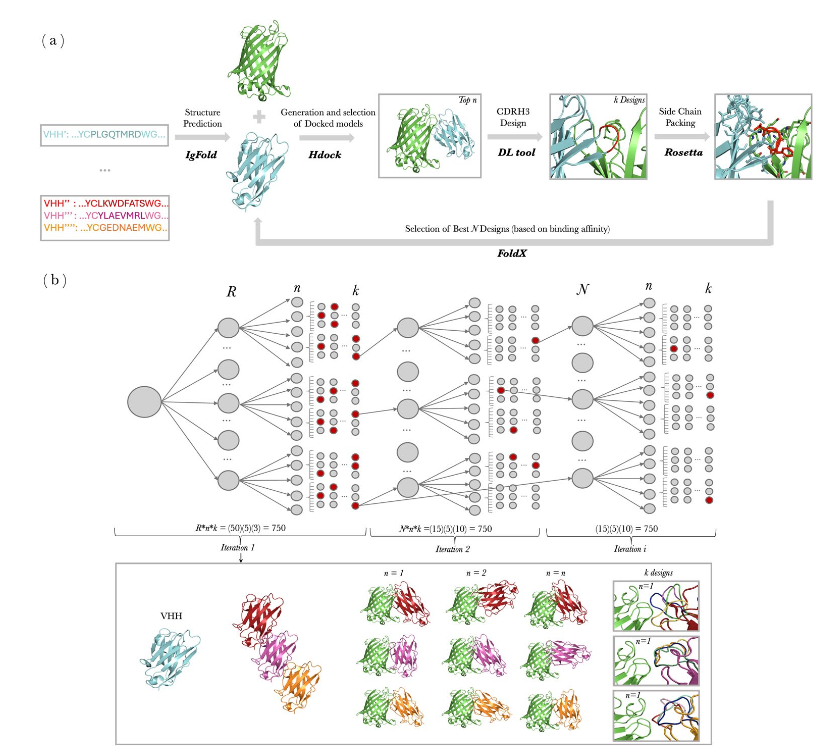
1. A novel tool, NanoDesigner, has been introduced for the design and optimization of nanobodies using generative AI. This method tackles the complex interdependency between the structure of the complementarity-determining regions (CDRs) and the docking of nanobodies to antigens through an iterative refinement process based on the expectation maximization (EM) algorithm.
2. NanoDesigner integrates multiple key stages—structure prediction, docking, CDR generation, and side-chain packing—into a cohesive iterative framework. This approach significantly enhances the success rate of de novo nanobody designs by continuously refining docking and CDR predictions, effectively doubling the success rate compared to traditional linear workflows.
3. The study demonstrates that NanoDesigner outperforms existing methods in terms of binding affinity and structural accuracy. It achieves higher success rates in both optimization and de novo design scenarios, with notable improvements in binding energy and reduced steric clashes. This is attributed to the algorithm’s ability to explore a wider range of CDRH3 conformations and sequences.
4. NanoDesigner is designed to handle the unique challenges of nanobody design, which differ from conventional antibodies. By focusing on the highly variable CDRH3 region, the tool can efficiently explore the most diverse and functionally critical part of the paratope. This targeted approach leads to more effective binding and higher overall design quality.
5. The modular architecture of NanoDesigner allows for seamless integration of emerging techniques in structure prediction, docking, and CDR generation. This flexibility ensures that the tool can be continuously improved as new methods become available, while maintaining reproducibility and comparability with state-of-the-art approaches.
6. As a proof of concept, NanoDesigner was applied to three distinct antigens—mNeonGreen, KRAS, and HER2—with significant results. The tool showed consistent improvements in binding affinity, especially when optimizing the CDRH3 region alone, highlighting its potential for both optimization of existing nanobodies and de novo design for novel antigens.
7. The code for NanoDesigner is freely available, allowing researchers to reproduce and build upon this innovative work. This open-access approach promotes further advancements in nanobody design and optimization, potentially leading to new therapeutic applications.
💻Code: github.com/bio-ontology-rese…
📜Paper: jcheminf.biomedcentral.com/a…
#NanoDesigner #GenerativeAI #NanobodyDesign #AntibodyOptimization #ComputationalBiology #IterativeRefinement #EMAlgorithm
10
58
4,713

24 Dec 2022
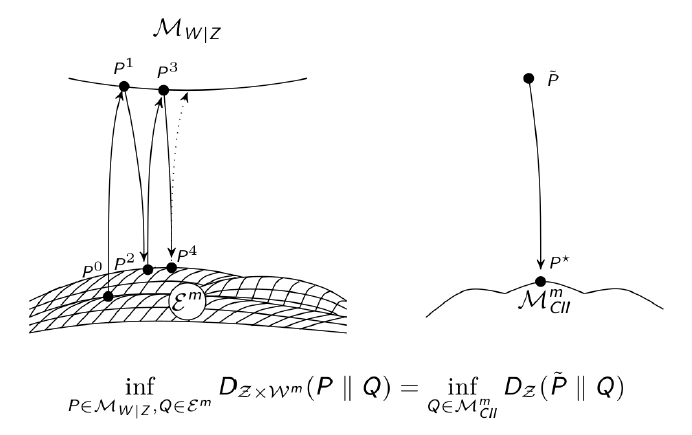
#情報幾何
🔓フリーダウンロード公開中 #期間限定 (12/31迄)
#日野英逸 #赤穂昭太郎 #村田昇 著 「EMアルゴリズムと関連する反復アルゴリズムの幾何学」
#EMAlgorithm #BregmanDivergence #RobustStatistics #HalfACenturyOfInformationGeometry
link.springer.com/article/10…
16
38
7,819

26 Jul 2021
☄️Free to download from Springer until 30 September.
"Geometry of Arimoto algorithm" by Shoji Toyota (豊田祥史) @SokendaiU
#informationgeometry #Channelcapacity #Emalgorithm #情報幾何
Download now:
link.springer.com/article/10…
2
4

28 Mar 2021
Expectation-maximization (EM) algorithm is practised to find the maximum likelihood estimates (MLE) or maximum a posteriori (MAP) estimate of parameters in latent variable models, explaining the basics of #EMalgorithm.
analyticssteps.com/blogs/exp…
2
4

19 Oct 2020
#mdpientropy "Complexity as Causal Information Integration" mdpi.com/1099-4300/22/10/110…
#complexity
#integratedinformation
#causality
#conditionalindependence
#emAlgorithm
1
6

16 Jan 2020
That's some great piece of research 😁👩💻👋
#InteractiveSoftwareSystems #UserTraces #UsageStyles #PopulationApproach to #UbicompSystemDesign #HCI #TemporalAnalytics
#EMalgorithm
#MarkovModels #ProbabilisticModelChecking
@m_j_chalmers @MorrisonAJ
@S4programme @EPSRC
16 Jan 2020

📢 Our Prof Muffy Calder @UofGSciEng will give this term's #StracheyLectureInComputerScience @CompSciOxford on 3 March 2020 titled ➡️ "#FormalMethods Reinvented: now with users, data, and inference"
Details: cs.ox.ac.uk/seminars/2323.ht…
@S4programme @GlasgowCS
@FormalMtds
3
4

29 Oct 2019
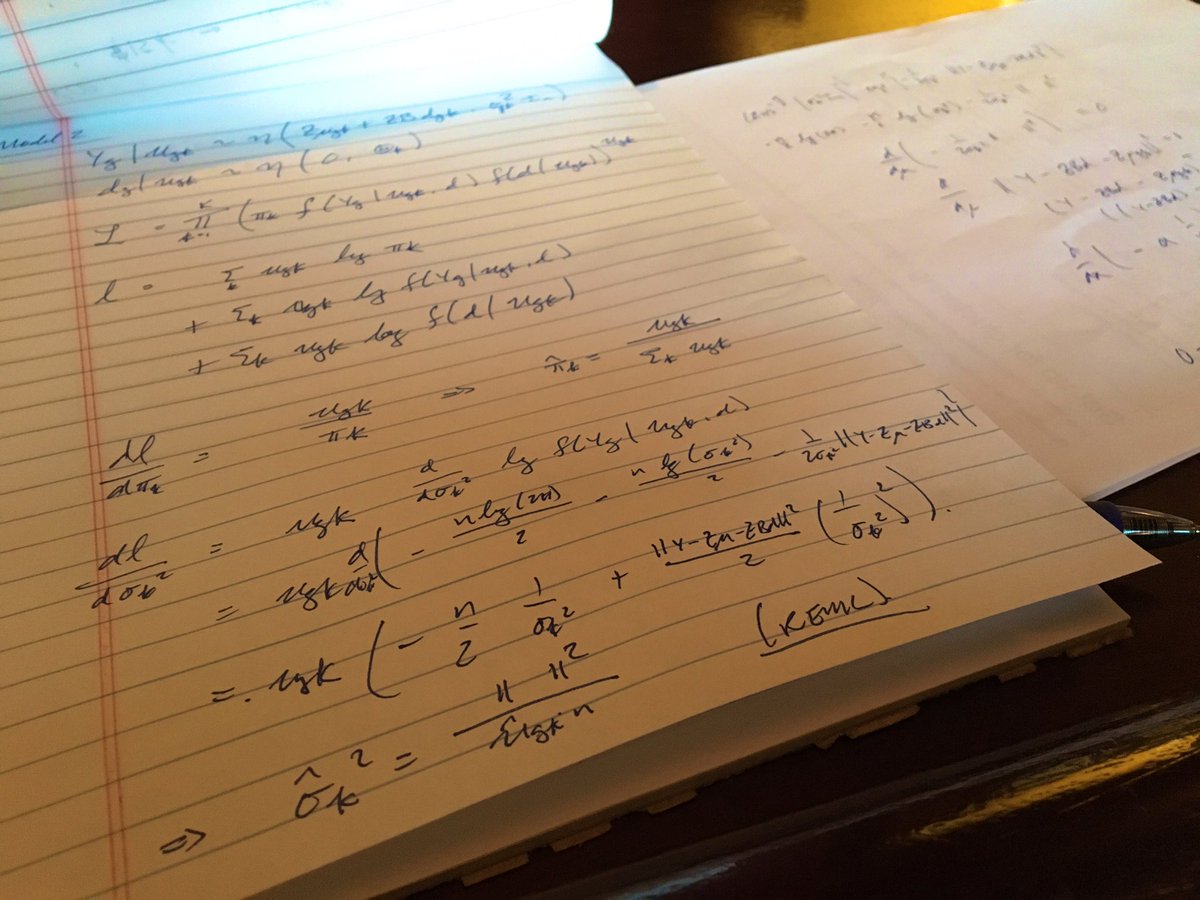
Some tough days require a little calculus. (Thinking about clonal evolution in my #SingleCell expt.) #EMalgorithm #compbio #mixturemodel #phylogenetics #doyourmathinpen
3

4 Aug 2018
@sirajraval Today I implemented GMM and EM algo from scratch in Python taking your code as a reference. Link to my @github is here
github.com/urvishp80/100Days…
Would love to hear thoughts of peoples on #GaussianMixtureModels nd #EMAlgorithm. #100DaysOfMLCode #MachineLearning #AI
1
2
9

1 Mar 2016
#DailyUpdate, 29 Feb 2016: covering #winnow, #COLT, #GenerativeModels & #EMalgorithm in @kstate_CIS 732 #MachineLearning. #EM #DataScience
1

4 Feb 2016
EMalgorithm凄い!抱いて!ってなってたのに勾配法を無理やりMCMCで実行することがメインに書かれてると俺の感動はなんだったんだってなる