
Jun 8
digital actions across apps and software.
Think of it this way:
🗣️ LLM: Writes a travel itinerary.
🏃♂️ LAM: Books the flights, reserves the hotel, and rents the car for you.
#AI #LargeActionModels #AIAgents @ActionModelAI
1
24

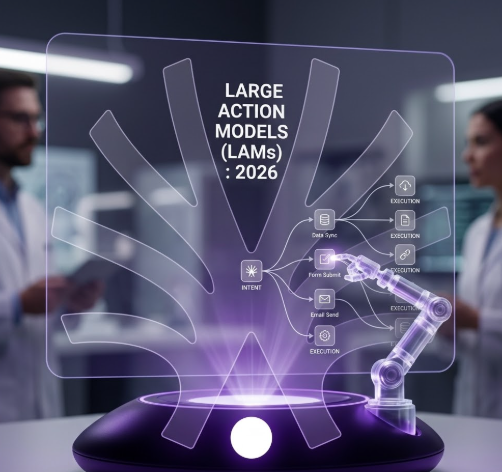
The Shift from Language to Agency: Why Large Action Models (LAMs) Define 2026
The era of AI as a mere "chatbot" has officially concluded. We are now witnessing the definitive rise of Large Action Models (LAMs)—the architectural backbone of the next digital frontier.
While Large Language Models (LLMs) mastered the art of syntax, the Action Model AI project focuses on the mastery of intent. It is no longer about predicting the next word; it is about executing the next sequence of complex tasks across fragmented software ecosystems.
1. From Conversation to Execution
The fundamental breakthrough of LAMs lies in their ability to bypass traditional API constraints. By observing and modeling human-computer interaction (HCI), these models learn to navigate User Interfaces (UI) just as a human would. They understand that a "request" is actually a "workflow," translating a single sentence into dozens of autonomous micro-actions across multiple platforms.
2. Autonomous Reasoning & Error Correction
In 2026, the Action Model project has moved beyond simple automation. We have entered the phase of Bounded Autonomy. These models now possess self-correcting feedback loops; if a UI element changes or a process stalls, the model reasons through the obstacle in real-time, iterating its approach without requiring a human prompt.
3. The New Operating System (OS)
We are moving toward a world where the Action Model is the operating system. In this paradigm:
The Model is the Interface: Users no longer "open apps"; they provide objectives.
Cognitive Offload: The burden of navigating digital complexity is shifted from the human to the agent.
Interoperability: LAMs act as the universal bridge between siloed data environments, unified by the Model Context Protocol (MCP).
4. Conclusion
The @ActionModelAI represents a profound epistemological shift. We are transitioning from "Artificial Intelligence" (knowing) to "Artificial Agency" (doing). As these models achieve higher levels of reliability and integration, the distinction between digital intent and physical result continues to vanish.
We are not just building smarter tools; we are building a more capable digital workforce.
#AI #LargeActionModels #FutureOfTech #AutonomousAgents #LAMs2026
1
2
48

Google’s Antigravity IDE shifts coding from LLMs to LAMs: autonomous AI agents now plan, execute, and visually verify code instead of just autocompleting it. 🧠💻
#LargeActionModels #AIAgents #SoftwareEngineering #DevTools #ArtificialIntelligence
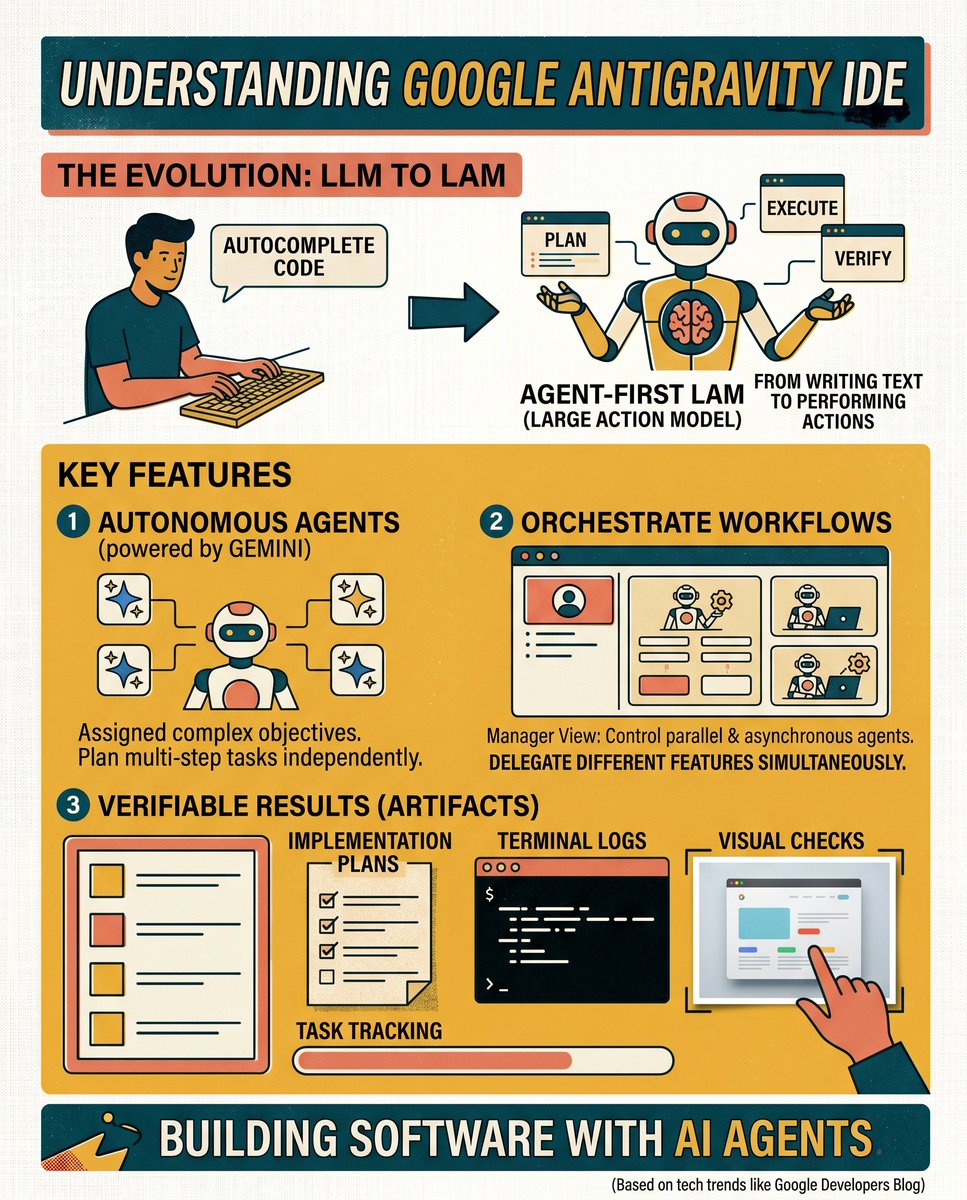
ALT Quick summary: The thread outlines the shift in software engineering from reactive text generation (LLMs) to autonomous task execution (LAMs). Using Google's Antigravity IDE as the prime example, it highlights how developers are transitioning from writing raw code to orchestrating multiple AI agents that can independently plan, execute, and verify complex system architectures.
3
98
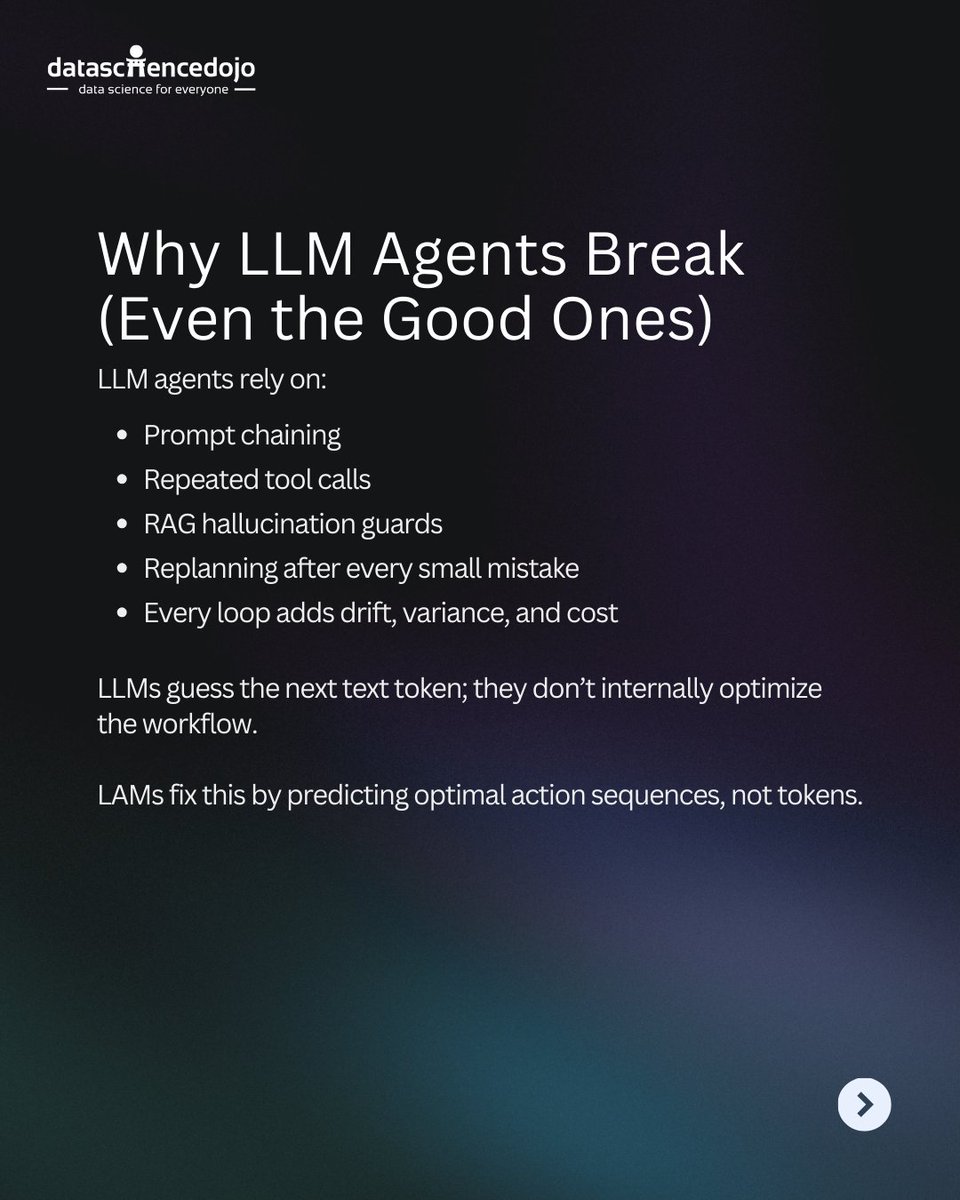
Hot take: most “AI agents” today are still just LLMs guessing the next token.
And that’s exactly why they break.
If you’ve built multi-step agent workflows, you’ve probably seen it:
- Endless prompt chaining
- Repeated tool calls
- Replanning after tiny errors
- Drift, variance, and rising costs
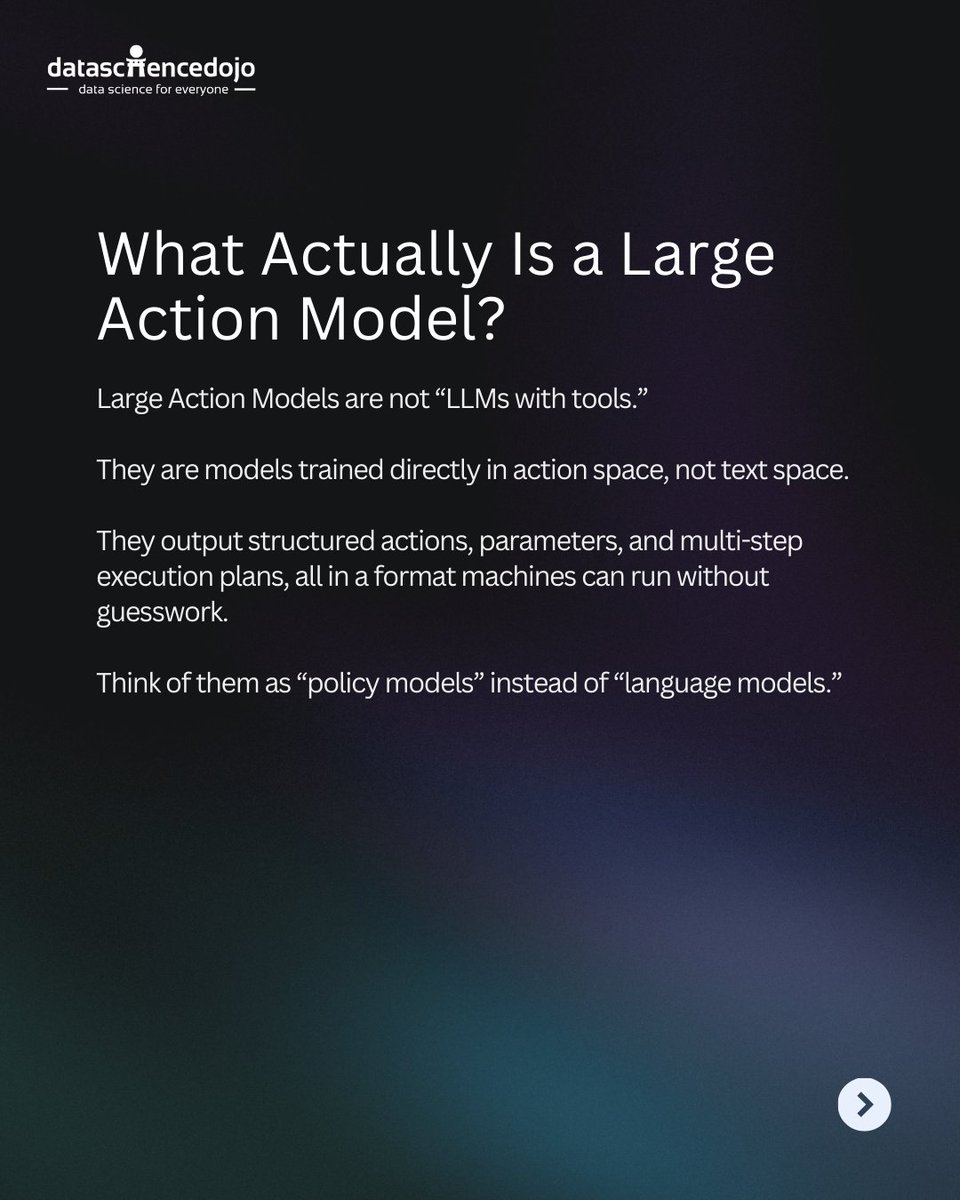
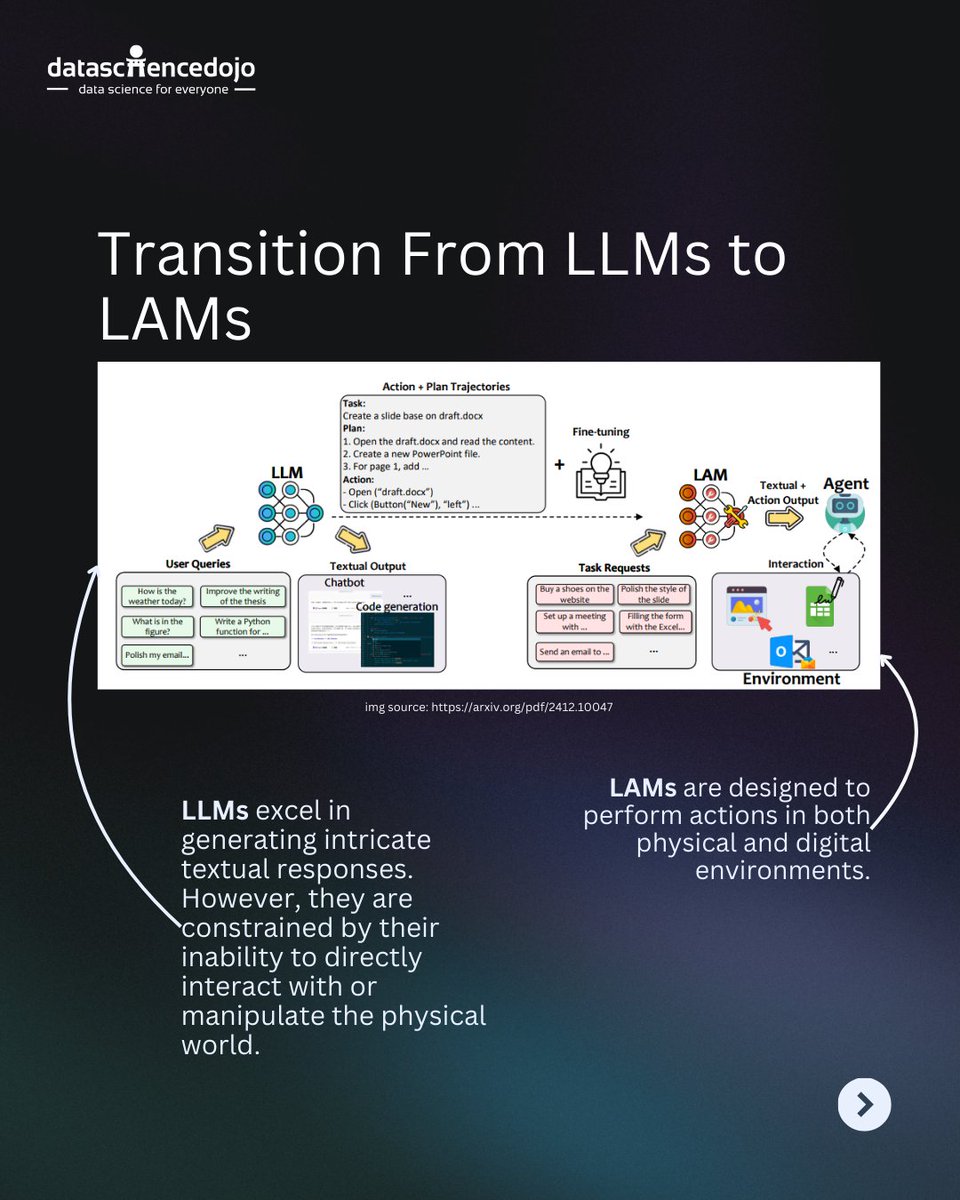
Large Action Models (LAMs) take a fundamentally different approach. They are not “LLMs with tools.” They’re trained directly in action space, not text space.
That means instead of generating language that describes an action, they:
- Predict structured actions
- Choose parameters explicitly
- Optimize multi-step execution plans
- Learn full action sequences end-to-end
In other words, they behave more like policy models than chat models.
The reliability difference is huge.
On a workflow like parsing 30 emails and pushing structured data to a CRM:
- An LLM agent re-plans constantly and compounds errors
- A LAM, however, predicts the entire pipeline upfront and executes in parameter-checked steps
LAMs reduce branching, minimize compounding error, and optimize how the workflow runs — not just what the output looks like.
Curious, do you see LAMs replacing LLM agents, or complementing them?
Want to get started with building agentic AI applications? Reserve your spot now: hubs.la/Q044QmBh0
#AgenticAI #LargeActionModels #LLMResearch #AIEngineering
3
6
812
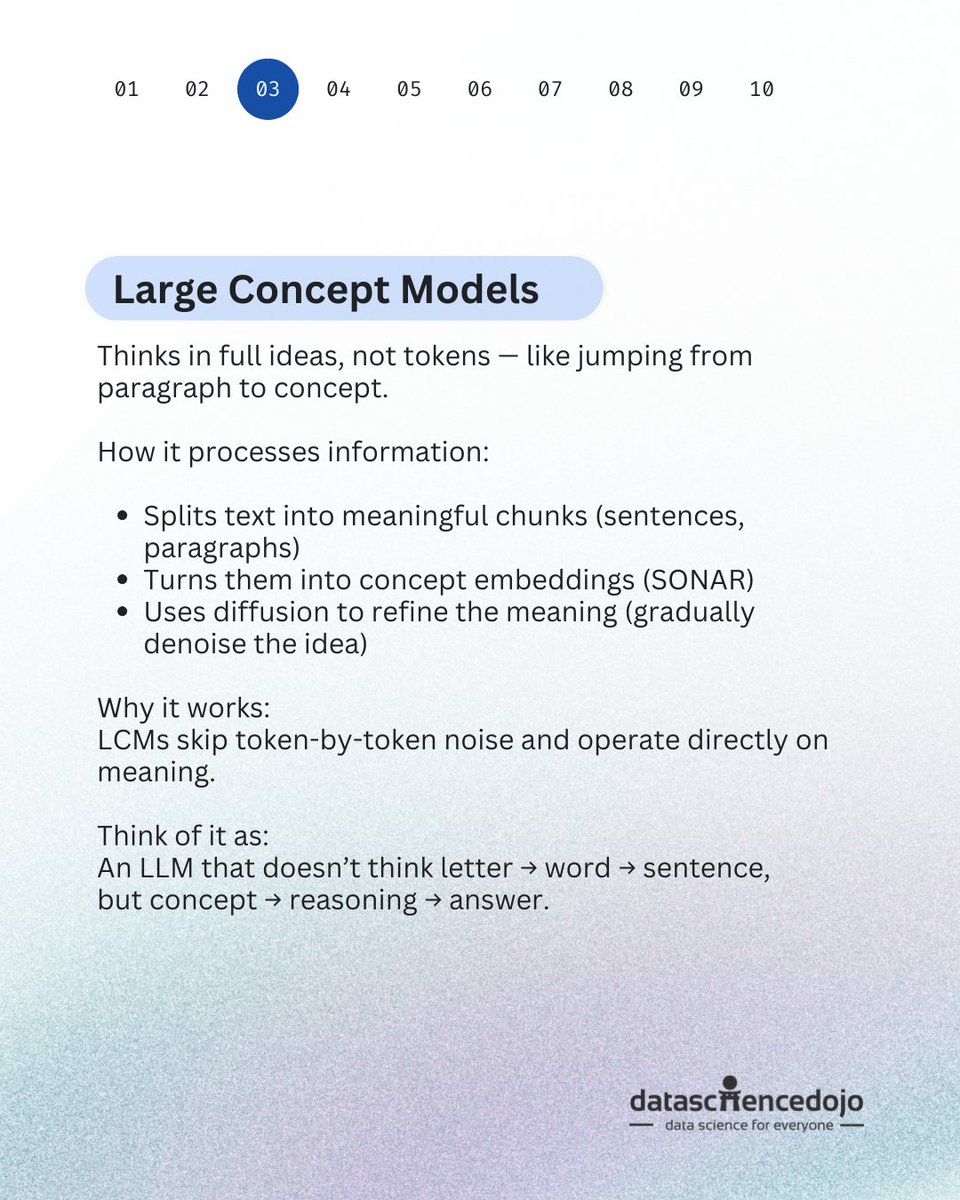
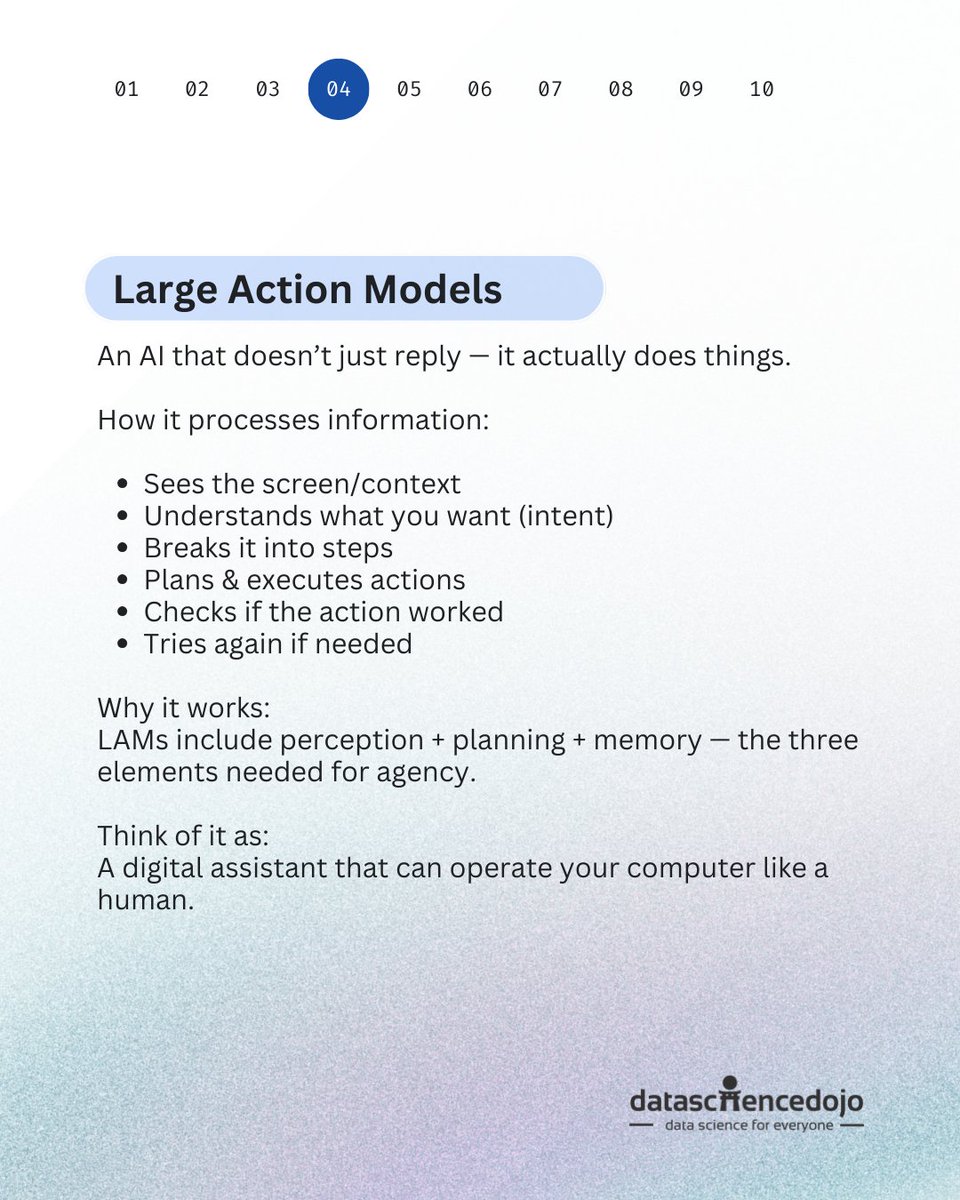
Most people say “AI models” like they’re all the same.
But under the hood, they think in very different ways.
This carousel breaks down the major AI model architectures shaping how systems reason, act, and scale today 👇
What’s changing in how models are built:
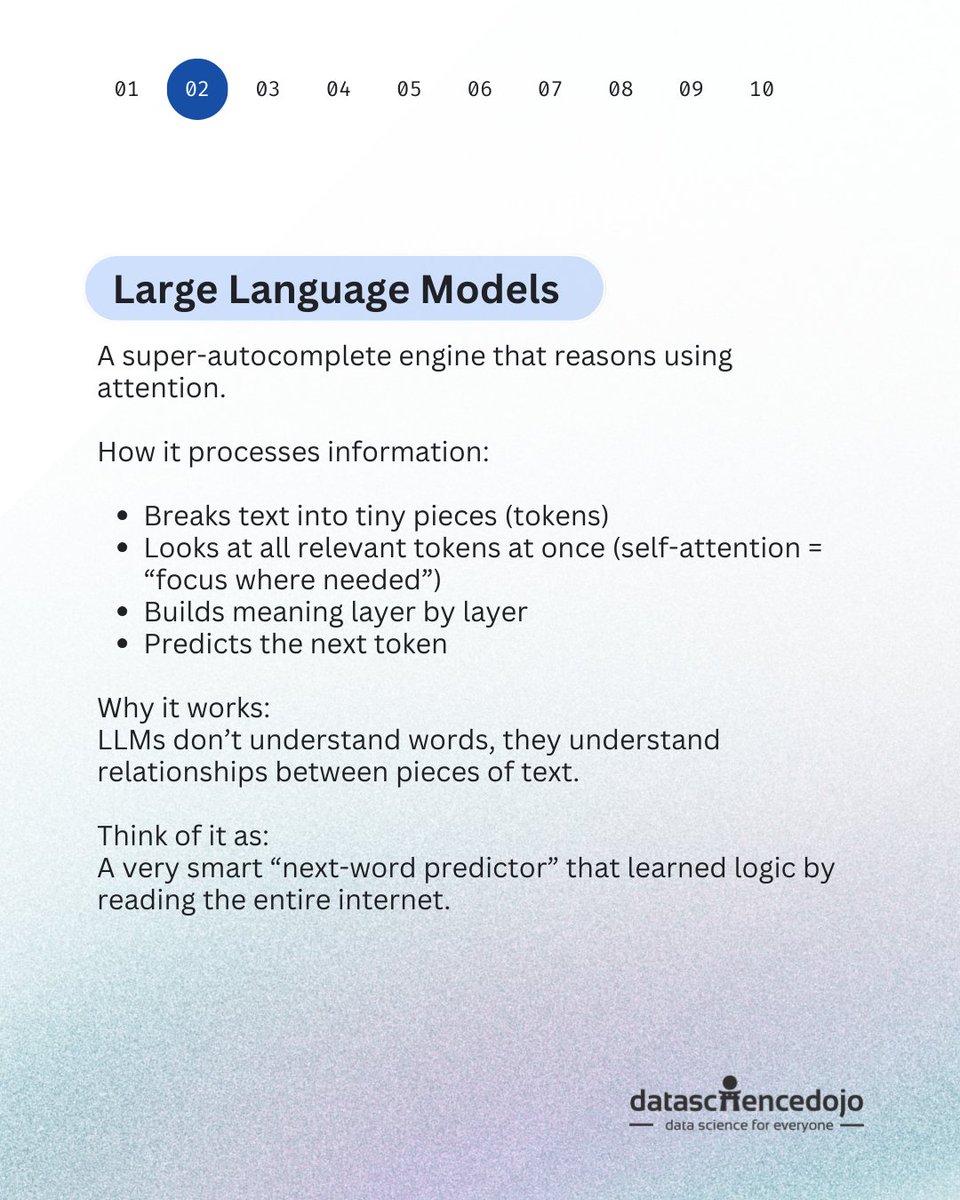
LLMs reason through relationships between tokens (attention = focus).
- Large Concept Models (LCMs) skip token noise and operate directly on meaning.
- Large Action Models (LAMs) don’t just respond — they perceive, plan, and act.
- Mixture of Experts (MoE) routes problems to specialists instead of one giant brain.
- Vision-Language & small models show that efficiency often beats sheer size.
- Masked Language Models learn by seeing context from both directions.
- Segment Anything Models (SAM) generalize vision tasks without retraining.
Why this matters if you work with AI today:
- Architecture determines cost, latency, and capability
- It shapes what’s possible with agents, multimodality, and autonomy
“Bigger models” aren’t always the answer — better design is
We’re clearly moving from text prediction → concept reasoning → action-taking systems.
#AIArchitecture #LLMs #AgenticAI #LargeActionModels
1
1
844

9 Dec 2025
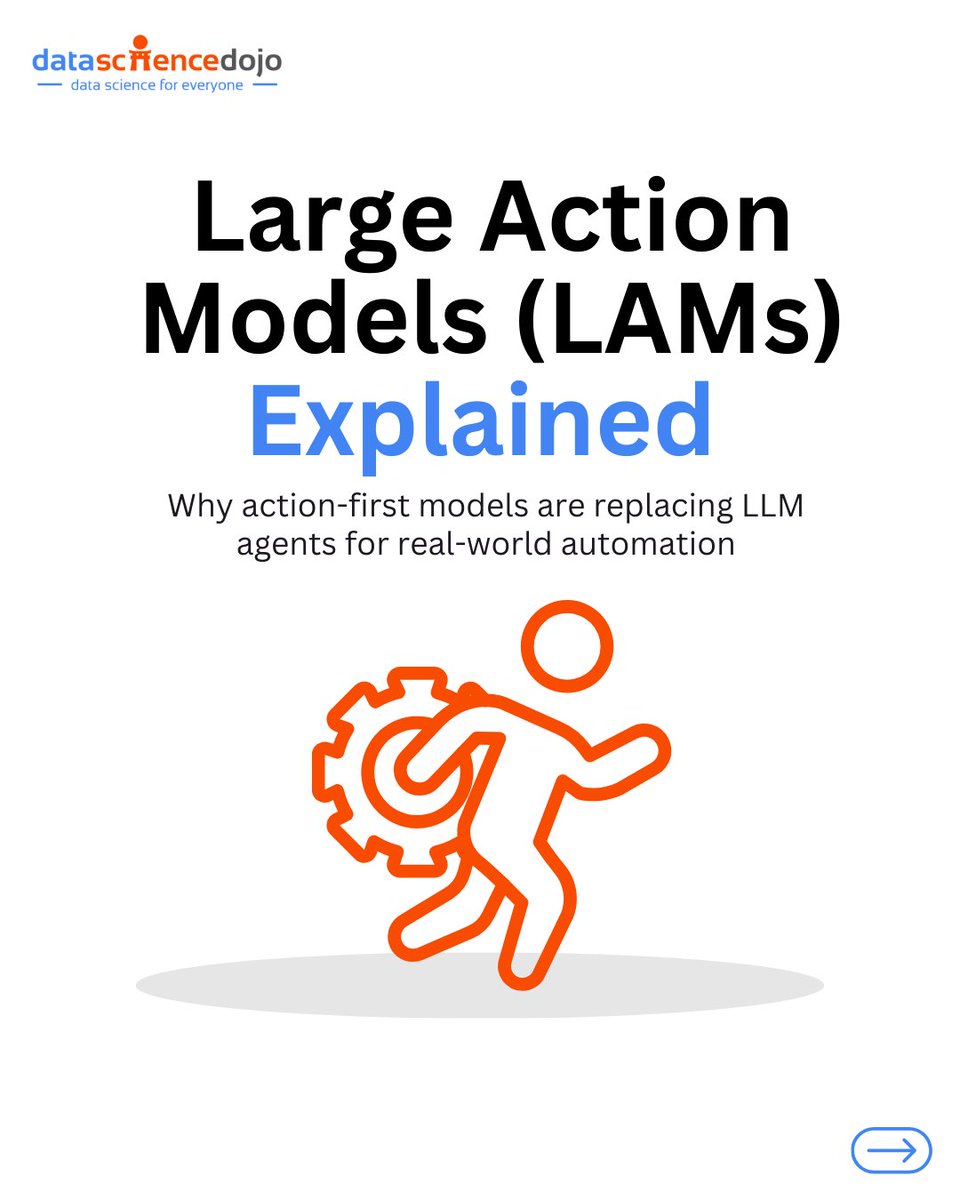
🚀 Large Action Models might be the biggest shift in AI agents since the rise of LLMs themselves.
For years, we tried to make language models behave like decision-makers—prompt chaining, tool-calling, guardrails, retrievers, planners, critics. But no matter how clever the prompt engineering became, the underlying problem stayed the same: LLMs generate text, not actions.
LAMs flip the paradigm.
Instead of generating tokens that describe what to do, they generate structured actions that machines can execute directly. That means fewer error loops, fewer hallucinations, and far more reliable long-horizon behavior.
Check out the thread below to see how LAMs optimize workflows, reduce errors, and transform AI from assistant to autonomous agent.
Want to learn how to build scalable LLM Applications? Join our Large Language Model Bootcamp happening in March 2026 -> hubs.la/Q03Xt57Q0
#LargeActionModels #AgenticAI #AIWorkflow #AIOptimization #LLMAgents #NeuroSymbolicAI
1
1
5
1,035
9 Dec 2025
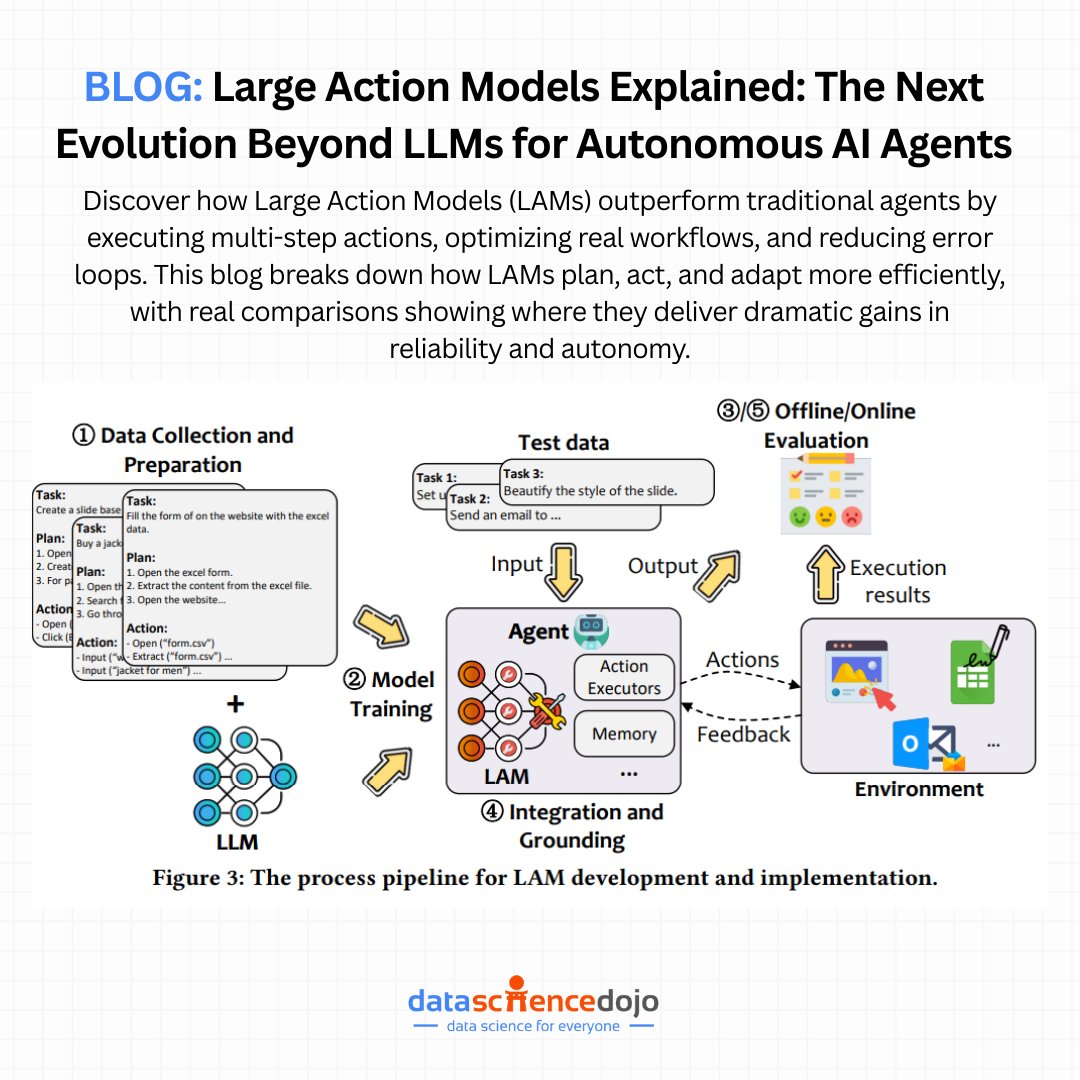
📢 From chatbots to digital agents — AI is learning to do, not just talk.
Large Action Models are transforming artificial intelligence by equipping it with the ability to interpret instructions, plan sequences, and take meaningful actions, whether in software, automation, robotics, or workflows. LAMs represent a major leap from purely text-based models, enabling real-world impact and task automation at scale.
In this blog, we explore:
What Large Action Models (LAMs) are — how they combine perception, reasoning/planning, and execution to transform high-level instructions into real actions.
How LAMs work under the hood — perception of input (text, UI, sensor data), mapping of intent to action, planning action sequences, execution (e.g. API calls, UI interactions, robotics), and feedback/adaptation loops.
Where LAMs can be applied — from software automation and user-interface tasks, to robotics, operations automation, UI workflows, and complex business process orchestration.
Their benefits — enabling automation of multi-step tasks, saving time, reducing human workload, improving consistency, and enabling real-time decision/action in dynamic environments.
Challenges & considerations — building LAMs often requires diverse action-based training data, environment grounding, careful planning/control mechanisms, and robust safety/verification before entrusting them with important tasks.
If you're working in AI deployment, automation or product design, this blog is a great primer to understand how to go beyond “call-and-response” models, and start building systems that act on user intent.
#AI #LargeActionModels #Automation #AIAgents #AIEngineering #TechInnovation #FutureOfWork #IntelligentAutomation #MachineLearning #AI #DigitalTransformation
2
2
685

31 Oct 2025
Training large models at scale demands robust infrastructure 🏗️
Our work on large action models required automated failure recovery, efficient job scheduling, and seamless scaling across thousands of accelerators—capabilities that directly impact training throughput and model quality 📈
@VentureBeat explores the infrastructure landscape we navigated with @googlecloud 👉 bit.ly/3JkVoUY
#EnterpriseAI #AgenticAI #MachineLearning #LargeActionModels #ModelTraining

11
953
28 Oct 2025
Fine-tuning large action models for CRM-specific tasks yields measurable results: our specialized models now outperform industry-leading LLMs on key benchmarks 📊
Domain specialization through targeted training enables more reliable, consistent AI agents for enterprise workflows 🤖⚡
Read about our work with @googlecloud Vertex AI Training
👉 bit.ly/43FAZ3E
#EnterpriseAI #AgenticAI #MachineLearning #LargeActionModels #ModelTraining
2
13
1,029
16 Sep 2025
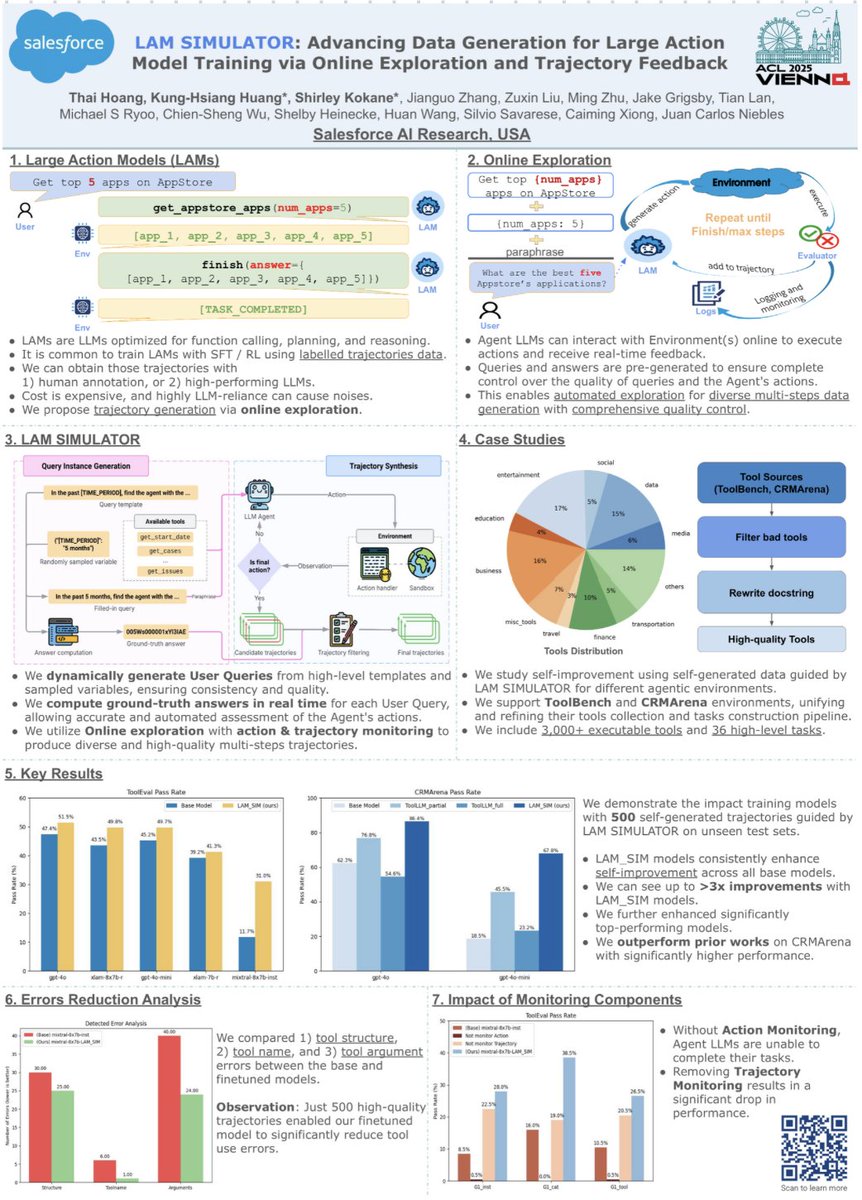
🤖 LAM SIMULATOR: Advancing Data Generation for Large Action Model Training via Online Exploration and Trajectory Feedback
📄 Paper: bit.ly/3IO5flv
🎤 Presented virtually at @aclmeeting's #ACL2025 in Vienna by Thai Hoang: bit.ly/48pMEqu
Framework enables AI agents to autonomously generate training data through exploration and real-time feedback, eliminating manual curation bottlenecks.
⚡Key results on ToolBench and CRMArena:
📈 GPT-4o: 24.1% improvement on CRMArena
📈 GPT-4o-mini: 49.3% improvement
📈 Mixtral-8x7b: 19.3% improvement on ToolBench
Uses template-driven task generation with programmatic evaluation, allowing agents to learn from exploration while maintaining data quality through structured feedback loops. 🔄
Authors: Thai Hoang @ThaiHoang_9120, Kung-Hsiang Huang @steeve__huang, Shirley Kokane @KokaneShirley, Jianguo Zhang @JianguoZhang3, Zuxin Liu @LiuZuxin, Ming Zhu @ming_zhu0527, Jake Grigsby @jakegrigsby, Tian Lan, Michael S Ryoo @ryoo_michael, Chien-Sheng Wu @jasonwu0731, Shelby Heinecke @shelbyh_ai, Huan Wang @huan__wang, Silvio Savarese @silviocinguetta, Caiming Xiong @CaimingXiong, Juan Carlos Niebles @jcniebles
#LargeActionModels #FutureOfAI #EnterpriseAI
1
5
24
3,874
10 Sep 2025
📱 Compact AI, Massive Capabilities
Forget massive cloud LLMs. Salesforce's xLAM2-3B proves intelligent action execution works right on your iPhone.
Watch this compact 3B model seamlessly:
🎵 Play instrumental EDM on @Spotify
📊 Look up @Salesforce stock price
📺 Play Salesforce Sales Cloud videos on @YouTube💬 Send messages to operations channel on @SlackHQ
xLAM is a Large Action Model that executes real actions across apps. You don't need computational giants when you have models designed for action execution. Learn more: bit.ly/48aQaVD
One request, multiple actions, zero friction. The age of pocket-sized AI agents is here 📱
#xLAM #LargeActionModels #EnterpriseAI #FutureOfAI
1
11
2,132
3 Sep 2025
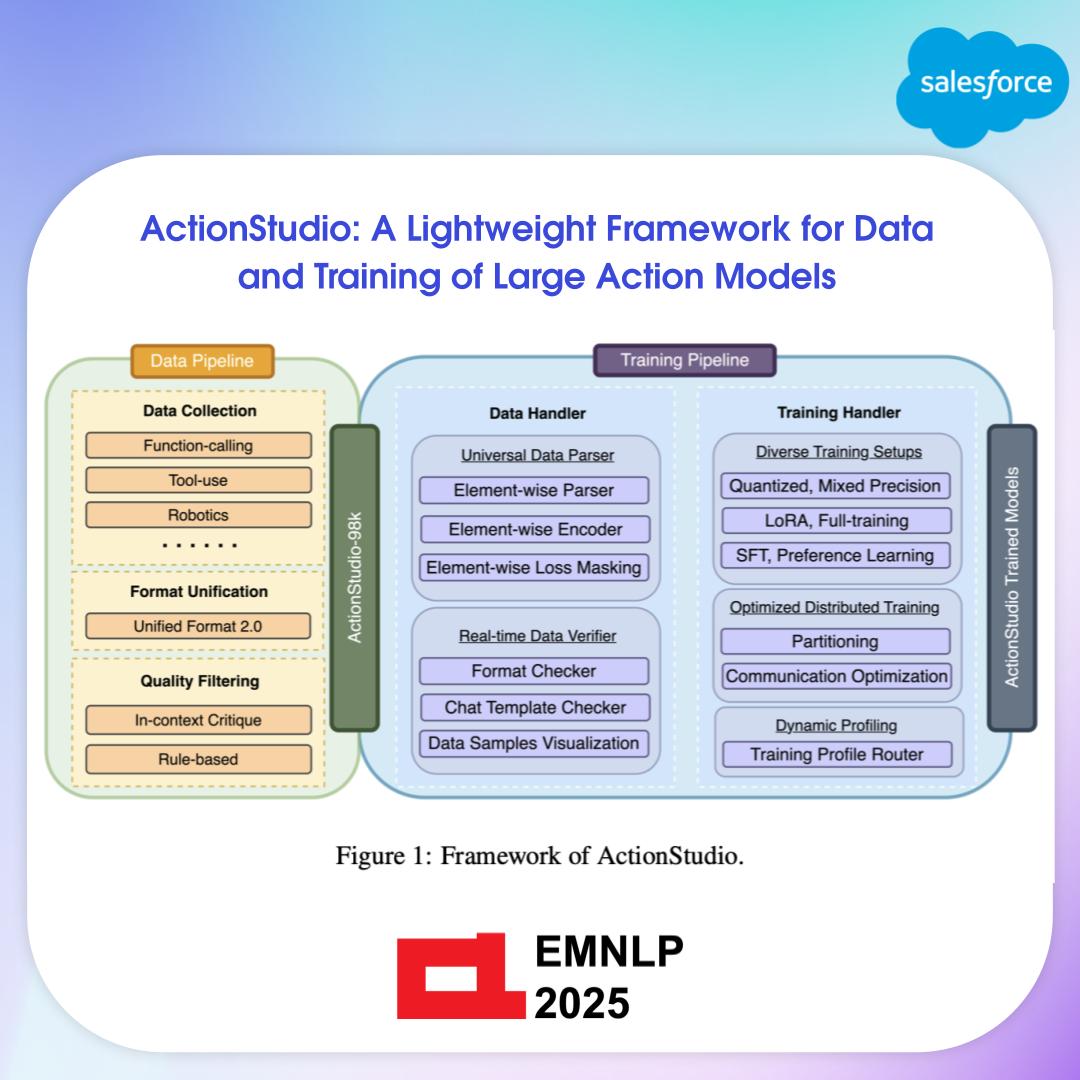
@emnlpmeeting / #EMNLP2025 Accepted Paper: ActionStudio: A Lightweight Framework for Data and Training of Large Action Models 🤖
📝 Paper: arxiv.org/abs/2503.22673
🔗 Code: github.com/SalesforceAIResea…
This work introduces ActionStudio, an end-to-end open-source framework for training Large Action Models that enable autonomous agents to perform complex multi-step tasks across diverse environments.
Key contributions:
➡️ Unified Format 2.0 standardizing agent trajectories with native chat-based LLM API compatibility
➡️ Critique-and-filter pipeline with real-time verification for automated trajectory quality control
➡️ Optimized training infrastructure with up to 9× higher throughput than existing frameworks
➡️ ActionStudio-98k dataset: 98,000 high-quality trajectories across 30,000 APIs and 300 domains
Results demonstrate state-of-the-art performance on NexusRaven (96.9% F1) and CRM Agent Benchmark, with models outperforming both open-source alternatives and commercial systems like GPT-4 on realistic agent tasks.
👥 Authors: Jianguo Zhang @JianguoZhang3, Thai Hoang, Ming Zhu @ming_zhu0527, Zuxin Liu @LiuZuxin, Shiyu Wang @shiyu04490786, Tulika Awalgaonkar @tulika614, Akshara Prabhakar @aksh_555, Haolin Chen @HaolinChen11, Weiran Yao @iscreamnearby, Zhiwei Liu, Juntao Tan, Juan Carlos Niebles @jcniebles, Shelby Heinecke @shelbyh_ai, Huan Wang @huan__wang, Silvio Savarese @silviocinguetta, Caiming Xiong @CaimingXiong
#FutureOfAI #EnterpriseAI #AgentAI #LargeActionModels #AI #MachineLearning #AutonomousAgents #OpenSource #SalesforceAIResearch
2
1,123

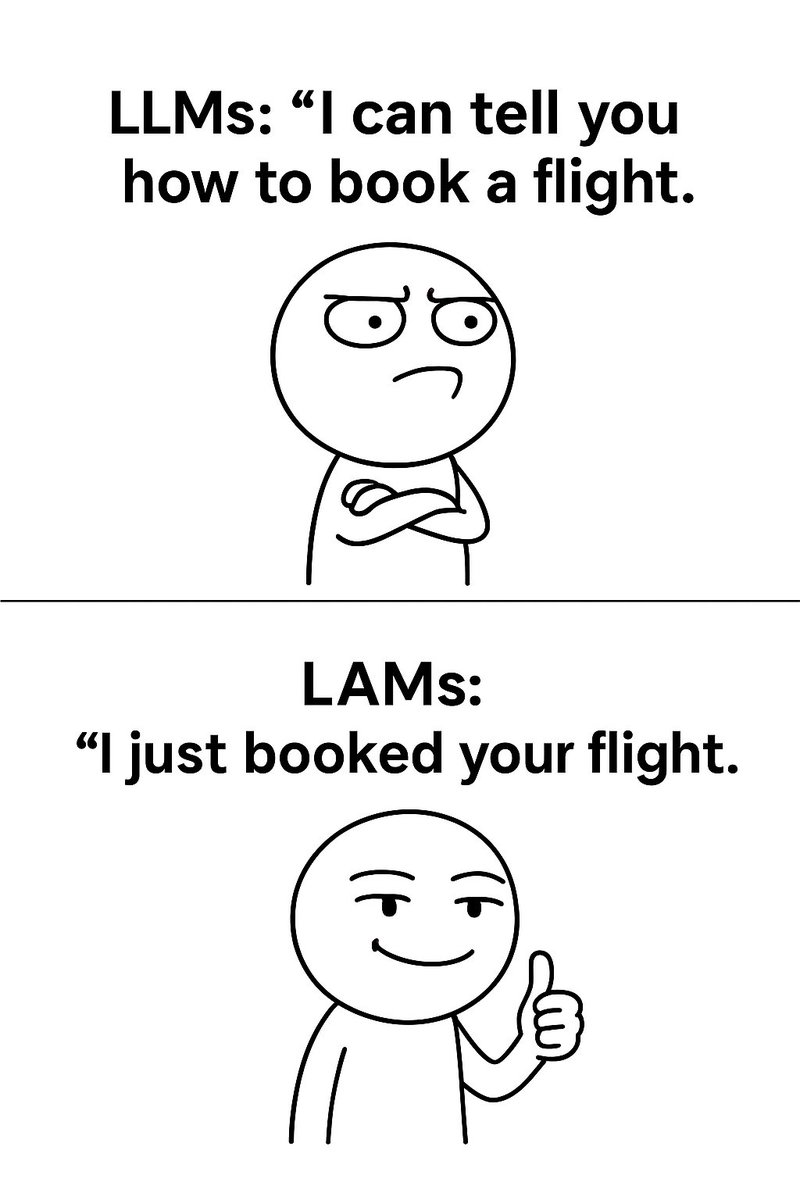
LLMs: "I can tell you how to book a flight."
LAMs: "I just booked your flight."
Game changer. #LargeActionModels #AI @getactionmodel
2
3
55

Uniphore has acquired Orby AI and intends to acquire Autonom8, two AI-native companies adding unmatched expertise and proven innovation to push the boundaries of Business AI. bit.ly/45CvRPp
#BusinessAI #AIAgents #LargeActionModels #EnterpriseAI #FutureOfAI
1
1
11
2,742

28 Jun 2025
Powering Next-Gen AI: Large Action Models (LAMs)
💡 Peek into the future: @JoinSapien AI's work directly supports the development of #LargeActionModels (LAMs).
#AIFuture #LAMs

1
2
141
24 Apr 2025
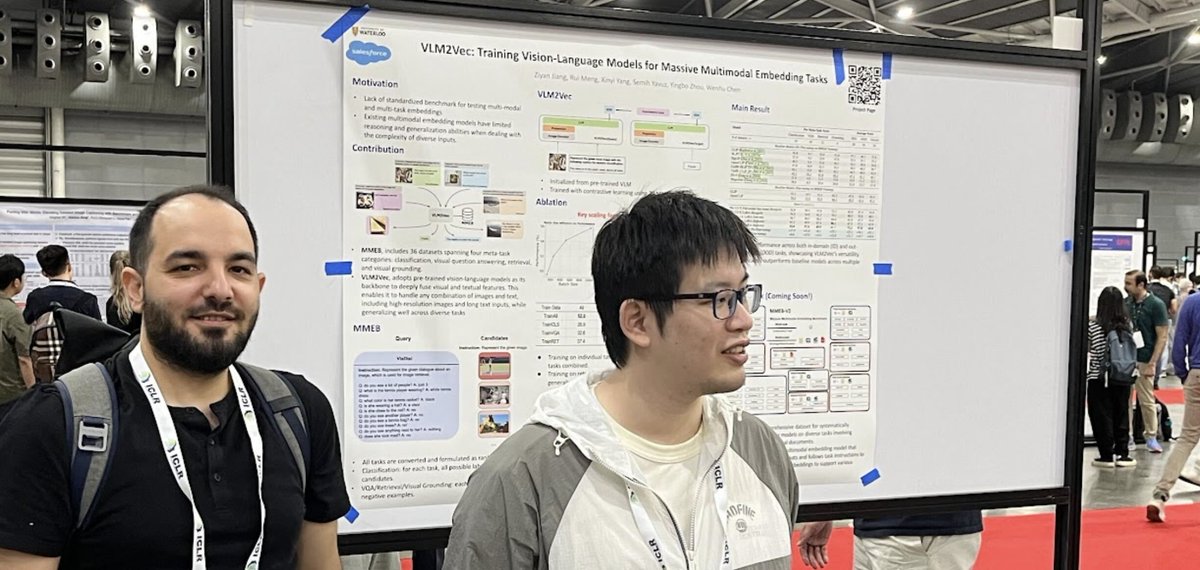
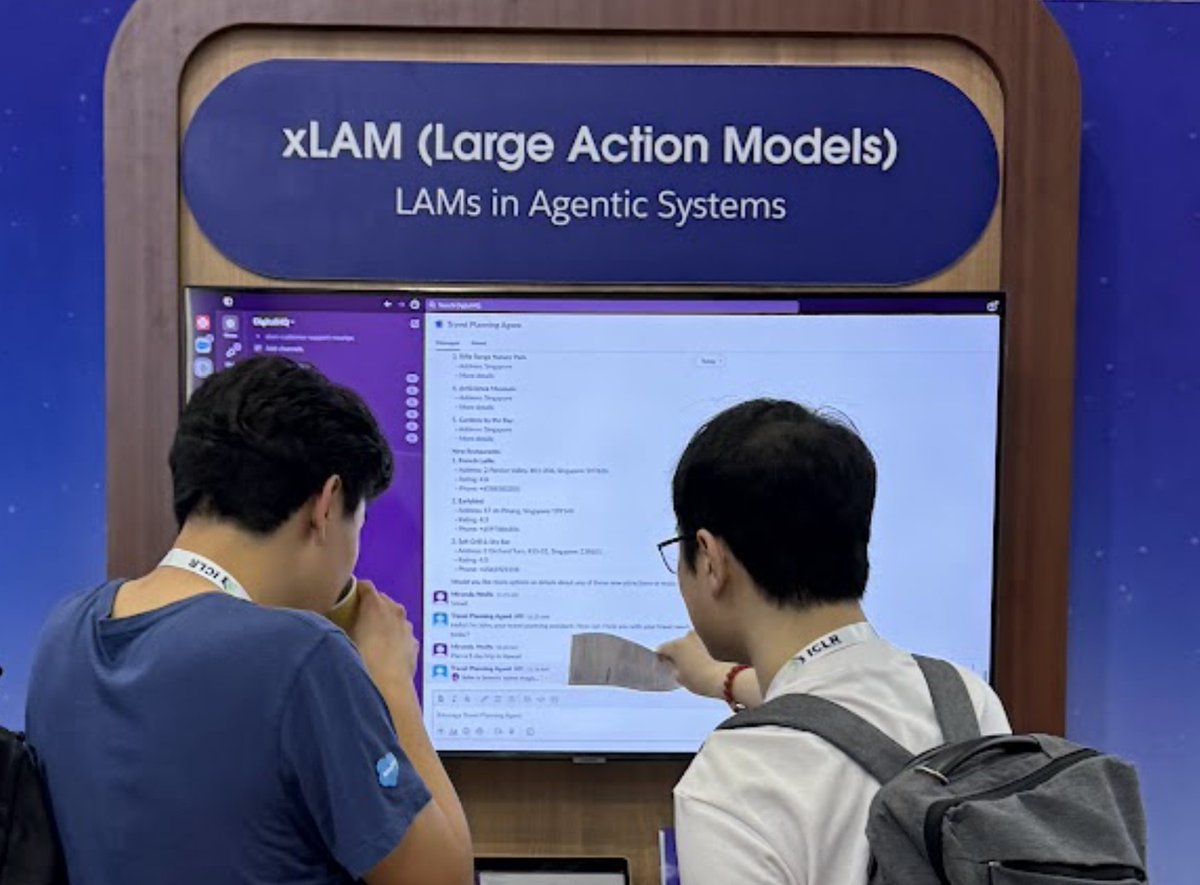
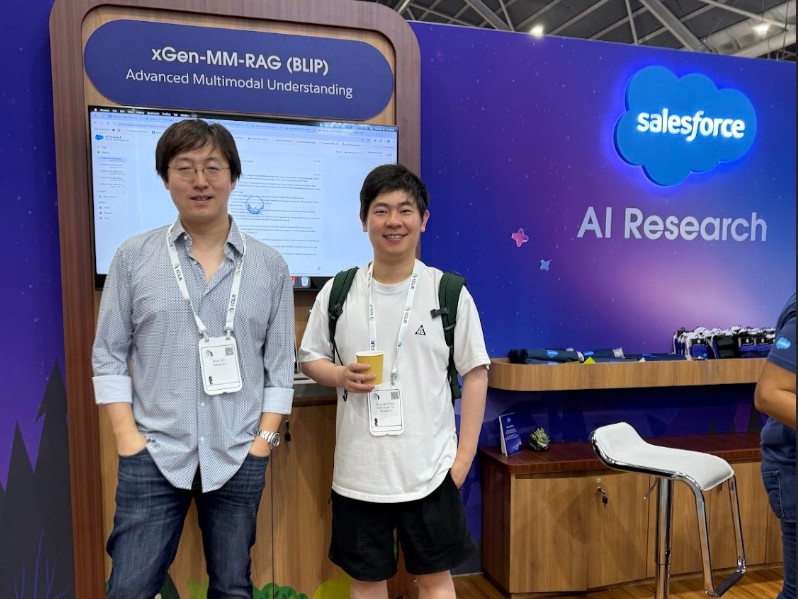
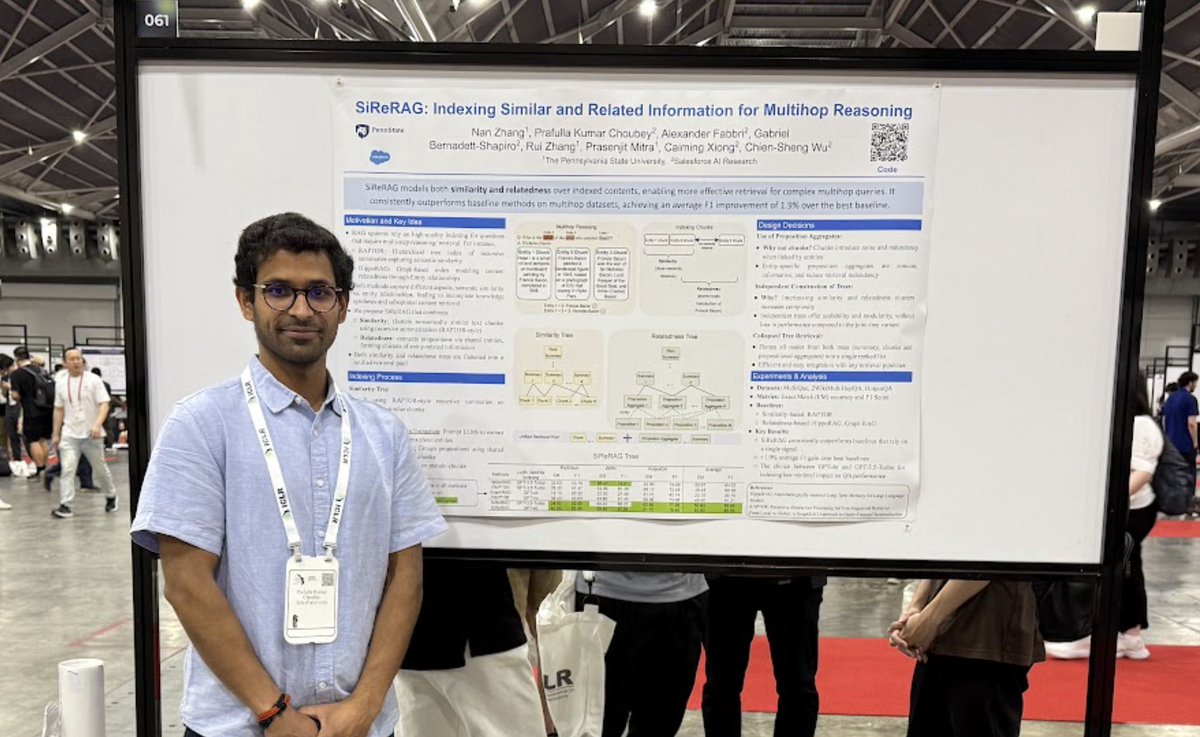
🔥 Phenomenal Day 1 of poster sessions at #ICLR25! ✨
Attending tomorrow? Visit us at Booth #G03 to dive into how our groundbreaking research in multimodal AI and large action models are revolutionizing #EnterpriseAI capabilities! 🚀
Don't miss these three must-see poster sessions tomorrow showcasing novel techniques for advancing agent intelligence, trust frameworks, and reliable context processing:
(Friday, April 25, 10:00am-12:30pm)
🛡️ "BingoGuard: LLM Moderation Tools with Explicit Risk Levels" arxiv.org/abs/2503.06550
🌙 "FaithEval: Can Your Language Model Stay Faithful to Context, Even If 'The Moon is Made of Marshmallows'"
arxiv.org/abs/2410.03727
🤝 "Integrating Expertise of Software Engineering Agents" -arxiv.org/abs/2408.07060
Not at the conference? Explore the papers and follow us for more real-time #ICLR25 updates! 📱💻
#AIResearch #EnterpriseAI #MultimodalAI #LargeActionModels
4
13
1,134
18 Apr 2025
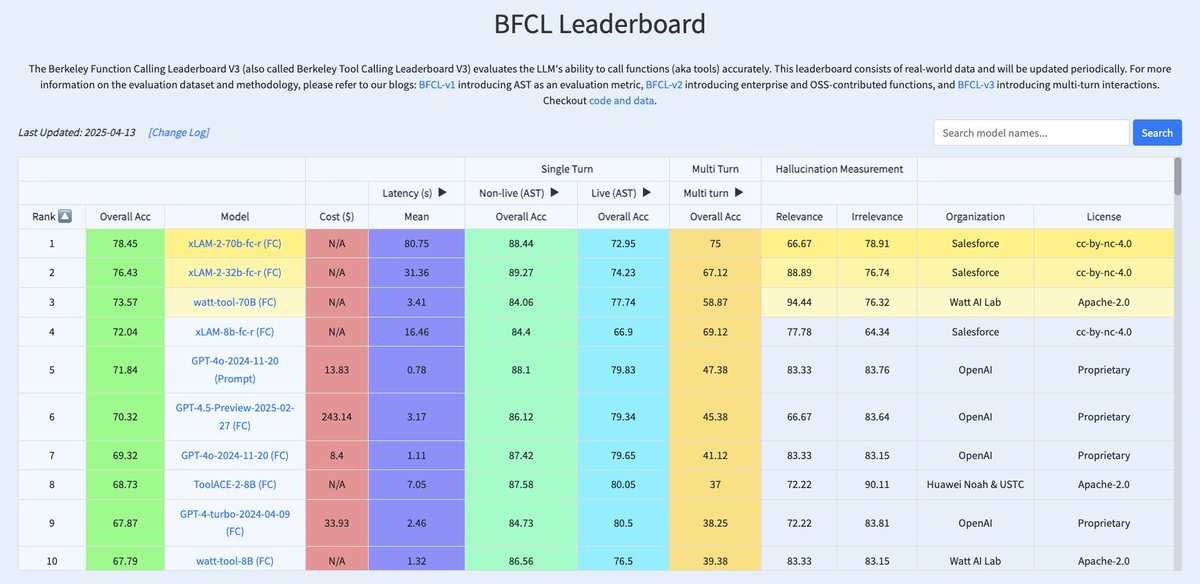
Our xLAM (#LargeActionModels) family just got an upgrade!
1️⃣ Multi-turn, natural conversation support
2️⃣ Smarter multi-step reasoning
3️⃣ Models from 1B to 70B for ultimate flexibility
🤗 HuggingFace: bit.ly/4jyj2tu
👑 BFCL Leaderboard: bit.ly/3WIZdY3
Our research models xLAM-70B-r ranks #1 and xLAM-32B-r #2 on the BFCL function-calling leaderboard—beating GPT-4o, Gemini, Qwen & more.
xLAM-8B-r lands at #4, ahead of GPT-4o.
And our Tiny Giant, xLAM-1B-r, plus xLAM-3B-r, outperform much larger models like Mistral-Large and DeepSeek-V3.
This is just the beginning—we're building even stronger xLAM models internally to inspire future Salesforce innovation. Stay tuned!
18
52
10,786

19 Feb 2024
Advancing #LargeActionModels (LAMs)?
Want to optimise your workloads quickly?
Look no further than @Hyperstackcloud to spin up your #VM in minutes with the latest NVIDIA GPUs on-demand. Get started at console.hyperstack.cloud?utm…
#Hyperstack #LAMs #AI #Innovation #VMs #VirtualMachine #AI #ArtificialIntelligence #CloudComputing #GPU #Cloud #GPUInfrastructure #GPUCloud #NVIDIA #GPUisWhatWeDo

1
3
212

19 Feb 2024
Are you advancing #LargeActionModels (LAMs)?
Spin up your #VM in minutes with the latest NVIDIA GPUs on-demand and optimise your workloads at: console.hyperstack.cloud?utm…
#Hyperstack #LAMs #AI #Innovation #VMs #VirtualMachine #AI #ArtificialIntelligence #CloudComputing #GPU #Cloud #GPUInfrastructure #GPUCloud #NVIDIA #GPUisWhatWeDo

1
2
269