
World Cup 2026 is LIVE, and @LightLinkChain is lighting up the pitch! ⚽🔥
No fees. No delays. Just pure, gasless blockchain magic for ticketing, fan tokens, and prediction markets. We’re onboarding billions of fans seamlessly. 🌍
$LL is ready for the global stage. 🚀 #LightLink #WorldCup2026 #Crypto
Dive in ➡️ lightlink.io
1
32


Jun 10
Preach @LightLinkChain - cheaper fees are a band-aid, seamless UX is the cure! 🔥
Gasless txs social login smart wallets = Web3 that actually feels good. Building the right way! 🧱
Jun 9

1/5 Mythbusters time! Today’s myth: fixing Web3 UX
❌ Myth: cheaper fees = better UX
✅ Fact: simpler txs = better UX
Because gas fees aren't the sole reason of sometimes frustrating Web3 experience
Here’s what to do with fees to make Web3 feel better step by step
29
Jun 10
Day one support - @RelayProtocol never misses a beat! 🔗⚡
First block, first bridge. The onchain economy keeps expanding!
Jun 10

A major new chain is coming.
Relay will support @Arc from day one, connecting you to the onchain economy from the very first block 🟢

1
1
163


Australia’s First Tamil Run Boxing Event powered by @tickify_io & @LightLinkChain 👀
As a boxing fan, this is fantastic!
May 14

We are live! 🔥
King of the Ring is now running on Tickify.
1,500 fans using our technology in real time.
Our largest event to date 🎟️
events.tickify.io/events/d53…

1
183
You can’t make this up. LightLink is a sleeper
2
44
@KevinGarre25974 brought to my attention that @mwolf has ties to San Francisco and Silicone Valley 👀
3
53

Thanks bro! And yes, the connections are there. We just don’t know the fine details….yet
2
14

Jun 4
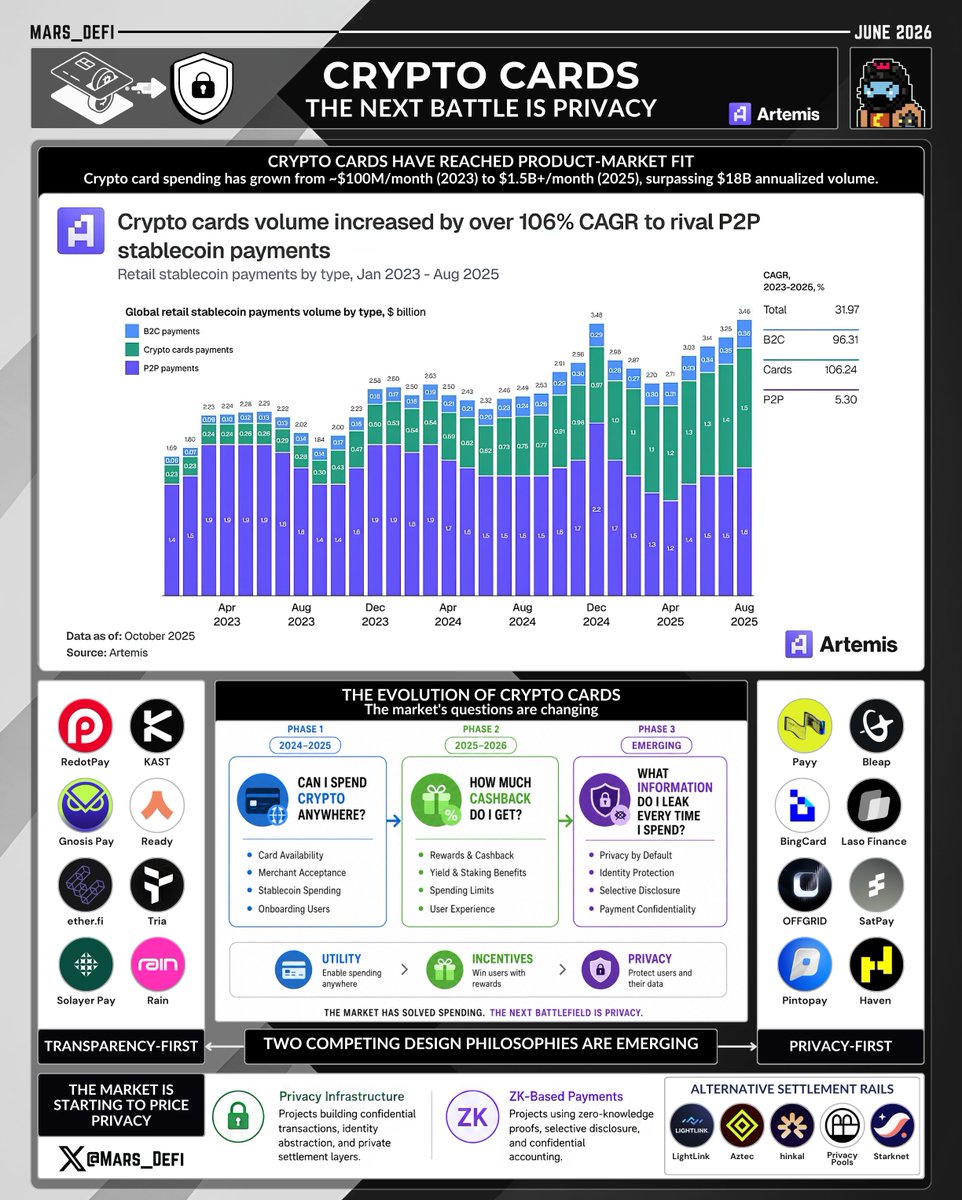
Crypto cards have successfully solved spending, but privacy is emerging as the next competitive battleground.
For the last two years, the market competed on cashback, yield, UX, and self-custody, but the @ether_fi incident exposed a new challenge: protecting user financial data.
Here's what's actually happening:
—
● Crypto Cards Have Officially Reached Product-Market Fit
Crypto cards have evolved from a niche experiment into a legitimate payment category, with monthly spending volume growing from roughly $100M in early 2023 to more than $1.5B by late 2025.
• Cashback rewards
• Yield-bearing balances
• Higher spending limits
• Geographic expansion
• Better user experience
Over the last two years, competition has centered around making stablecoin payments feel as seamless as traditional fintech and neobank experiences.
Today, the category generates more than $18B in annualized spending volume, showing that the industry has largely solved the "Can people spend crypto?" problem.
—
● The Conversation Around Crypto Cards Is Changing
As the sector matures, users are no longer asking whether they can spend crypto, but what they sacrifice every time they do.
• Phase 1 (2024–2025): "Can I spend crypto anywhere?"
• Phase 2 (2025–2026): "How much cashback do I get?"
• Phase 3 (Emerging): "What information do I leak every time I spend?"
This shift reflects a broader realization that what works for DeFi does not necessarily work for consumer payments.
—
● The Hidden Tradeoff Behind Self-Custodial Payments
Users thought they were getting self-custody and financial freedom, but often received self-custody and radical transparency.
The debate is shifting from custodial vs self-custodial to public vs private settlement, and ultimately from wallet ownership to data ownership.
—
● Two Competing Design Philosophies Are Emerging
As the market shifts toward privacy, crypto payments are beginning to split into transparency-first and privacy-first settlement models.
• Transparency-First
Most existing card infrastructure is built around public ledgers, where transactions remain auditable, verifiable, and visible on-chain.
This model is represented by @RedotPay, @KASTxyz, @ether_fi, @useTria, @gnosispay, @ready_co, @Solayer_Pay, @raincards, and other cards built on public settlement rails.
• Privacy-First
A newer category is emerging around private-by-default payments and selective disclosure.
Projects exploring this direction include @payy_link, @BleapApp, @cryptoBingCard, @LasoFinance, @offgridcash, @sat_pay, @pintopay_me, and @Haven_Hn_.
—
● The Market Is Starting To Price Privacy
If this trend continues, capital may increasingly flow toward privacy infrastructure, ZK payments, and alternative settlement rails.
• Privacy Infrastructure: Projects building confidential transactions, identity abstraction, and private settlement layers.
• ZK-Based Payments: Projects using zero-knowledge proofs, selective disclosure, and confidential accounting.
• Alternative Settlement Rails: @LightLinkChain, @aztecnetwork, @hinkal_protocol, @0xprivacypools, and @Starknet privacy initiatives.
AI has dramatically reduced the cost of wallet clustering, identity discovery, and behavioral analysis, accelerating this shift.
—
Today, crypto cards compete on rewards, yield, availability, and fees; tomorrow, they may compete on privacy and identity protection.
Users are beginning to evaluate not just what they earn, but what they reveal.
Crypto payments have largely solved accessibility and rewards; the next battleground is infrastructure that combines self-custody, compliance, and privacy.
Jun 1

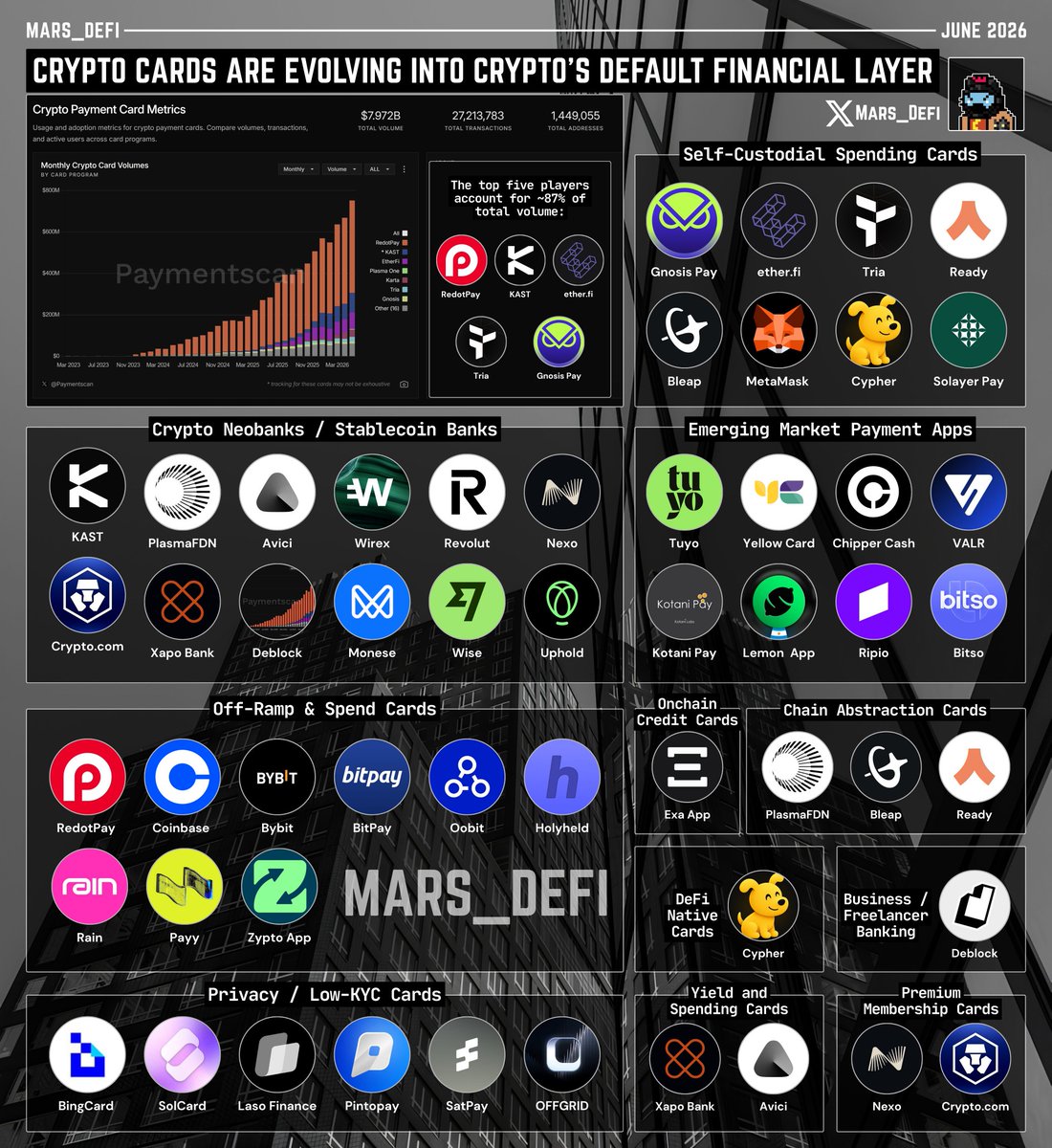
Crypto cards have processed over $7.8B in onchain volume, emerging as one of crypto's largest consumer sectors.
But beneath the surface, the market is splitting into distinct categories, each competing to become the default financial layer for crypto users.
So, which crypto card category is positioned to capture the biggest opportunity?
—
● Crypto Cards Are Becoming Crypto's First Consumer Vertical
Most discussions focus on cashback, but the real competition is happening across payments, banking, credit, and onchain finance.
Over $7.8B in volume has been processed, with most activity occurring in the last 12 months.
The top five players account for ~87% of total volume:
• @RedotPay
• @KASTxyz
• @ether_fi
• @useTria
• @gnosispay
Crypto cards have moved beyond experimentation into a category processing billions in real activity.
—
● Two Markets Are Emerging Inside Crypto Cards
Most CT treats crypto cards as one category, but the data shows two very different markets emerging.
• Market #1: Crypto Off-Ramp Infrastructure
RedotPay and KAST focus on moving stablecoins into the real economy through payments and banking services.
With average transaction sizes of ~$819 and ~$783, they're built for capital movement, not daily purchases.
• Market #2: Crypto-Native Spending
EtherFi, Tria, and Gnosis Pay focus on staying onchain while spending directly from crypto assets.
Average transaction sizes range from just $48-$168, reflecting actual consumer spending behavior.
—
● Crypto Neobanks Landscape
The market is expanding into distinct categories, each targeting a different financial use case.
• Crypto Neobanks / Stablecoin Banks
@KASTxyz
@AviciMoney
@wirexapp
@Revolut
@Nexo
@xapobankapp
@DeblockApp
@monese
@Wise
@UpholdInc
• Off-Ramp & Spend Cards
@RedotPay
@BitPay
@oobit
@holyheld
@raincards
@payy_link
@ZyptoApp
• Self-Custodial Spending Cards
@gnosispay
@ether_fi
@useTria
@ready_co
@BleapApp
@MetaMask
@Cypher_HQ_
@Solayer_Pay
• Chain Abstraction Cards
@BleapApp
@ready_co
• Yield and Spending Cards
@xapobankapp
@AviciMoney
• Emerging Market Payment Apps
@itstuyo
@yellowcard_app
@ChipperCashApp
@VALRdotcom
@kotanipay
@lemonapp_ar
@RipioApp
@Bitso
• Privacy / Low-KYC Cards
@cryptoBingCard
@solcard
@LasoFinance
@pintopay_me
@sat_pay
@offgridcash
• Premium Membership Cards
@Nexo
—
Three endgames are emerging: crypto banking, onchain credit, and chain-abstraction financial apps.
KAST and Redot are building crypto banking, EtherFi and Exa are building credit, while Tria is removing blockchain complexity altogether.
The winners won't be the best cards, but the platforms that become crypto's default financial layer.
H/t : @PaymentScan for the data.
46
6
96
7,788
Alright, so apparently not many Australians outside of the crypto community know about @RedbellyNetwork & @LightLinkChain and their collaborations with @JellyC_ 😱
Here are my 2 cents on how LightLink’s parent company developed JellyC AI tool
youtu.be/DIoaiCVornI?si=50Yq…
2
1
13
489

tbh most users just want the thing to work they dont care about gas mechanics nearly as much as crypto people think. @LightLinkChain follow back if you wanna keep the loop
2
9

5/ Low Monetization Zone
@Lisk, @MorphNetwork, @Polygon zkEVM, @ModeNetwork, Fraxtal by @Frax, @BobaNetwork, @Ancient8_gg, @HSKChain, @Zora, @LightLinkChain, @RedstoneXYZ, @Blast, @Mint_Blockchain, @Zircuit, @Prom_io, @Immutable zkEVM, @Shape
2
866

May 27
97% cheaper gas is the kind of boring
thing that actually changes adoption.
Not narratives.
Behavior.
14
