
When I worked on GTA V I used to be a full-on simulationist and emergent freeform game-play fanatic, but I've changed my perspective over the years after VR games keep frustrating me. Ex trying to holster/unholster gun or clips from belt doesn't work while seated in most games.
1
1
12

So the rules of ACKS exist to simulate the world of ACKS. And they do a great job! You should consider using it to simulate your game world too!
This is also why most tables, especially simulationist, should have a DM who will blatantly disregard dice rolls.
1
3
115

Jun 14
An important characteristic of the simulationist approach; un-fun moments are valuable meaning making elements of a long campaign. Many players of 5E and other contemporary RPGs look at me like I have a yellow musk creeper growing out my head when I say that.
2
6
103

Jun 14
To add to my own thoughts on kriegspiel...
Anyone who has seen my corpus of games writing knows that (a) I think of myself as a simulationist and (b) I'm an avowed member of the rules kriegspiel camp. But that's not the only way to play. Let's steelman what free kriegspiel can do, because it can do a lot.
Imagine a Prussian staff officer who runs free kriegspiels in 1880. He is asked by the King of Prussia to run a wargame that will "inspire the young prince to take up the profession of arms." "Make sure he wins gloriously," the King adds. Our officer therefore makes sure that the outcome of the wargame is exciting and dramatic. Having the prince get killed by a sniper in the first 15 minutes is off the table, even if it's "what really would have happened." He's running a sort of narrativist game.
Later, he is asked by his army commander to run a wargame designed to test how his corps's leadership fares under adversity. When he runs the game, he uses his power as game judge to make sure events always go wrong, every decision leads to bad, stressful outcomes. The goal is not realism or fairness, it's inflicting stress through unfairness to see how people respond. He's running a reverse gamist wargame (unfun is the goal).
Finally, he is asked by the Prussian general staff to run a wargame designed to evaluate their plans to invade Estovia. When he runs that game, he uses all of his knowledge to make the game as realistic as possible, so that the officers can evaluate their strategy as plausibly as possible. He's running a simulation.
Free kriegspiel is thus a method that can be applied towards any goal. Whether it achieves that goal consistently and reliably is a different question. The Prussians ultimately decided free kriegspiel was *better* than rules kriegspiel for training officers for war, and the free kriegspiel tradition continues to be widely used by DOD today in the form of "matrix games" and similar rules-lite judge-ajudicated games.
So why do I not personally use free kriegspiel? I believe that free kriegspiel, when used outside of simulation, gradually undermines its own basis; and when used inside a simulation, requires such a level of objectivity and experience that it's a hard ask of the judge.
For instance, the Prussian prince enjoys the wargame where he is a heroic military commander precisely because it's being run by a senior staff officer who normally runs kriegspiel simulations. The officer's experience as a judge of simulations validates the reality of the experience for the prince, making it "feel real." The same game run by the prince's nanny wouldn't inspire him at all; and if the prince knew the judge had been instructed to let him win, the game would lose its value. If the prince plays once, he'll be fooled. If he plays a hundred games, he'll realize it's a sham. Note that this is simply the same debate as "should you fudge?" Fudging only works if the players believe you don't fudge. Eventually they figure it out.
Likewise, if the officers undergoing the test of adversity realize they are undergoing a test of adversity, the kriegspiel fails. It is only the pretense that it's a simulation that makes it seem fair and plausible. And they will eventually realize it's a forced test, because without dice or probability, it will eventually become evident that the judge is just against them. At that point future effort becomes worthless; and the player develops an ironic distance to the game that robs it of some of its value. Note that this is just the railroad problem in D&D, applied to a wargame. In a D&D railroad, no matter what you do it advances the DM's plot. In the free kriegspiel, no matter what you do, it causes more friction of war. Same thing, and equally damaging in the long term.
So for free kriegspiel to work long-term, it has to be grounded on judges who are actually interested in simulating what would really happen. Unfortunately, that requires an enormous amount of experience from the judges, as well as a deep commitment to objectivity and fairness, and a willingness to let things sometimes be "unfun" in the short term. This is the complete opposite of the advice given to judges (GMs) today about when to fudge, when to override the dice, and so on.
That all said, with the rise of LLMs we could see a return of free kriegspiels of a sort. If we had an LLM trained on the entire corpus of military history and military science, including things like Trevor N. Dupuy's attrition mathematics and Lanchester's Laws, then that LLM might be able to reliably and fairly adjudicate action without needing a rulebook. An AlphaGo of free kriegspiel with the entirety of warfare in its latent space. That's interesting game design space, unexplored right now.
Jun 14

Around 1876, wargames were divided by a disagreement into two camps, "rules kriegspiel" and "free kriegspiel." The division has never healed. Most of today's RPG debates just reiterations of that classical rules vs free kriegspiel debate.
13
11
125
4,428


Jun 13
@archon Tried to use it to turn civilization into a simulationist RPG, and almost succeeded
Jun 13

Anthropic has been ordered by the US government to suspend access to Fable 5.
WTF.
1
24
Randolph Carter retweeted
Jun 13
I'm sorry everyone. All I wanted to do was use AI to make the world's best simulationist RPG. I didn't mean for this to happen.
5
1
49
893
Jun 12
Jung was a simulationist before simulationism. He referred to base reality as the Unis Mundi. He may not have envisioned a technological simulation in his time, but otherwise his metaphysics fit real simulationism perfectly
1
2
78

Elric is where we get alignments from. The Grey Mouser was something Gary Gygax liked a lot more. One story i heard about Clerics is that in the first campains Vampires basicly took over the more simulationist word and to balance it out he took inspiration from old texts on monks
2
26
Jun 12
A few months ago @emollick demonstrated that a frontier model could write a story game RPG. With the release of Fable 5, I am now going to test whether the latest model can generate a simulationist RPG that's good enough to impress me. It's 10:42PM and Claude has just begun.
6
4
93
2,446

Latest papers: Felipe De Brigard elaborates on his recent suggestion that the causalism/simulationism debate is largely ill-construed and defends a particular view of memory reconstruction that reconciles a causal and simulationist view of remembering doi.org/10.1080/09515089.202…

ALT A person surrounded by question marks
2
6
238

The increasingly simulationist approach to design is the real reactionary trend in design moreso than any specific subject for simulation. It represents a "warming up" of a previously "cool" (or low-fidelity) medium as mcluhan puts it.
1
6
421

Jason Breshears is a researcher, simulationist, chronologist, author & creator of Archaix YT channel. Ben Davidson is an independent researcher, author & creator of the Suspicious0bservers YouTube channel & SpaceWeatherNews.
youtube.com/watch?v=bbq025q1…
7

Jun 9
Gygax in the early 2000s said this would happen regarding WotC's direction. He warned the simulationist grid-based war gaming (3rd ed) would accelerate the loss of the spontaneous, creative and roleplay aspects: replaced by tactical moves and "build" obsession.
1
15

Jun 7
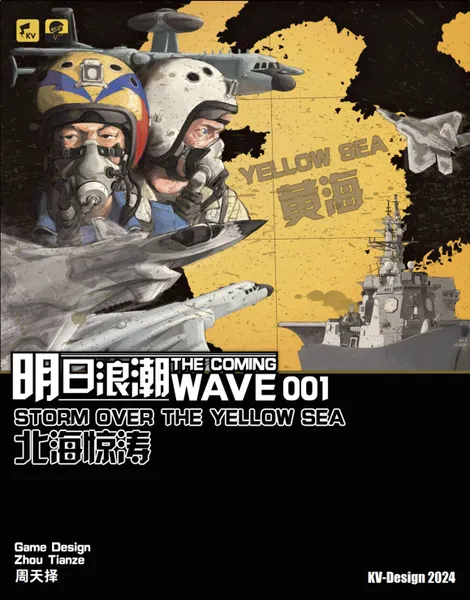
It is fascinating to compare two Chinese simulationist wargames. In TTCW's scenarios, written in a poetic style, an embattled China is always forced to react to threats from its neighbors.
3
272

Interesting 🧵👇. Clausewitz wrote war is continuation of politics which logically leads to #wargaming including politics. Even the most simulationist design has biases & scenarios are one of the easiest places to see them. Real question is how much does player buy-in to biases?

🇨🇳🇺🇸Hemos hablado mucho de The Coming Wave (TCW), tenéis el podcast de @GrognardPodcast y los vídeos de @Kalinote1 y @Sherlocky_Luke para aprender el sistema. Doy una vuelta más y me lanzo con un análisis geopolítico de los escenarios. Dentro hilo dominical🧵
4
1
12
1,027