
1/7 -
Businesses no longer want rigid software.
They want apps that adapt, evolve, and scale quickly.
That’s why Composable Apps are trending.
#ComposableApps
1
1
21

19 Jul 2025
✨ Anoma isn't just building tech. It's building how we coordinate.
Forget sending transactions.
@anoma lets you express your intent —
“I want to swap,” “I want to pay,” “I want to coordinate with others.”
Then boom — the system figures it out. Across chains. Privately. Automatically. 🧠💥
No chain lock-in. 🚫⛓️
No complex UX. 😵
No privacy trade-offs. 🕵️♂️💬
Just clean, chain-agnostic coordination — built with privacy by default and designed for real people, not just protocols. 🙋♀️🙋♂️
This isn’t about another Layer 1.
It’s a whole new way to think about #Web3 . 💡
More intuitive, more human, more free. ✨👐
Anoma is turning the Web3 OS dream into something real.
And honestly? It’s the most exciting thing I’ve seen in a while. 😍🔥
#Anoma #IntentCentric #Web3OS #ChainAgnostic #PrivacyByDefault #ComposableApps #CoordinationLayer #FutureOfWeb3 #BuildDifferent #SNAPS @cookiedotfun
7
6
109

18 Jul 2025
“Some chase hype. Some chase clout. One just holds the space for all to grow.” 🌐🫂
#Holochain #P2P #DistributedWeb #dApps #DecentralizedFuture #HoloDev #HolochainDev #AgentCentric #PostBlockchain #Web3Builders #RustLang #OpenSource #ComposableApps #CryptoDadEnergy #HoloLove
13
3
14
757

18 Jul 2025
🧠 Rethinking Web3 with Anoma: Building a World Where Intent is the Interface
✅ The Problem with Web3 Today
Despite all the innovation, Web3 still suffers from serious user and developer experience problems.
• Users must understand chains, bridges, wallets, gas, slippage, tokens, L2s, and MEV to perform even basic actions.
• Developers must choose between fragmented chains, duplicate logic, complex interoperability, and low composability.
• Infrastructure is visible everywhere. Every transaction reminds users that they are operating within a blockchain.
• Applications are not privacy-preserving by default, creating a contradiction between decentralization and data sovereignty.
Web3 isn’t broken because of lack of effort — it’s broken because we’ve been optimizing for transactions, not for intentions.
✅ What Is Anoma?
Instead of writing a transaction that executes something directly, users simply declare what they want — their intent. The network then handles:
• Discovering matching intents
• Resolving conditions (e.g., price, time, multi-party logic)
• Ensuring privacy through zero-knowledge proofs
• Finalizing outcomes without revealing unnecessary data
Anoma hides the plumbing and exposes only what matters: goals, conditions, and trust boundaries.
✅ Intents: The New Atomic Unit of Decentralized Apps
In traditional systems, users submit transactions. In Anoma, they submit intents — declarations of what they want to do under certain constraints.
Example intents:
• “Swap 10 DAI for ETH only if the rate is better than 0.00032”
• “Send funds to address X if three of my multisig members approve”
• “Match with another DAO seeking to merge treasuries under governance Y”
• “Reveal my identity only if this DAO is privacy-compliant”
These are expressive, conditional, and programmable — enabling complex coordination without central intermediaries.
✅ A Composable, Chain-Agnostic Developer Environment
With Anoma, developers don’t build apps for a specific chain. They build intention-aware logic using Juvix — a privacy-preserving, type-safe, and functional language purpose-built for the intent architecture.
• No per-chain contracts — build once, deploy across all intents
• Built-in support for zero-knowledge proofs
• Composable settlement logic
• Privacy and identity control as native features
• Interoperability with Ethereum, Cosmos, and other ecosystems
Applications become intent-centric programs that can interact across chains with no hardcoded routing, no bridges, and no cross-chain spaghetti.
✅ Solvers, Not Smart Contracts
Instead of having all application logic inside contracts, Anoma uses solvers — off-chain agents that match, fulfill, and settle user intents in a privacy-preserving way.
• Solvers search for matchable intents (e.g., “Alice wants to swap ETH for DAI”, “Bob wants the reverse”)
• They bundle these into transactions and submit zero-knowledge proofs for correctness
• The network validates proofs without learning who the parties are or what was exchanged
This shifts power away from protocols and toward users — enabling expressive dApps with no trusted coordination points.
✅ Data Sovereignty and Privacy by Design
Privacy in Web3 is often an afterthought. On Anoma, it’s foundational.
• All intent matching is done via zero-knowledge execution
• Users choose which metadata, identity claims, or resources to expose
• No unnecessary leakage: you reveal only what’s logically required for your intent to be matched
• Supports advanced patterns like shielded pools, anonymous credentials, and ephemeral IDs
Your data, your terms — always.
✅ Real-World Applications of Anoma
What can you build with Anoma? Pretty much anything that involves coordination with conditions.
• Auctions: “Only bid if the price is under 10k and this DAO is winning”
• Crowdfunding: “I’ll contribute if 100 others do”
• DAOs: “Let’s merge treasuries only if we agree on new governance rules”
• Identity: “I’ll prove I’m over 18 without revealing who I am”
• Escrow: “Transfer only after I receive the product”
• Governance: “Vote anonymously, but verifiably, within a group”
• Private marketplaces, decentralized insurance, prediction markets, and more
Anoma is not a vertical protocol — it’s a horizontal coordination layer.
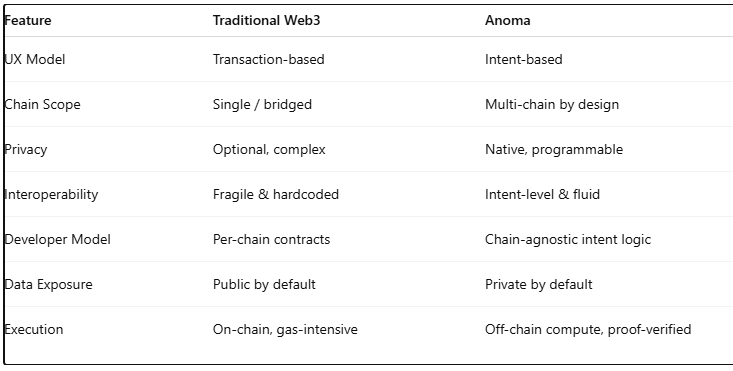
✅ Anoma vs. Traditional Web3 Infrastructure
✅ Why Anoma Is Different
Anoma is not competing with Ethereum, Solana, or Cosmos — it’s complementing them by abstracting away their differences.
• You don’t build on Anoma — you build through it.
• You don’t manage accounts or chains — you manage desires and constraints.
• You don’t rely on oracles — you trust provable computation.
• You don’t sacrifice privacy for composability — you get both.
✅ The Future: Intention is the Interface
We are entering a new phase of decentralized systems:
• From passive chains → to active coordination networks
• From static contracts → to dynamic, matchable programs
• From siloed ecosystems → to interoperable intent webs
• From surveillance defaults → to privacy-first architectures
Anoma is not a better blockchain — it’s a better abstraction.
It lets us stop programming machines and start expressing human intent.
✅ Learn More & Get Involved
• 🌍 Website: anoma.net
• 📚 Documentation: docs.anoma.net
• 💬 Discord: discord.gg/anoma
• 🧠 Whitepaper: anoma.net/whitepaper.pdf
#Anoma
#Web3
#IntentBased
#PrivacyByDesign
#ZKProofs
#Multichain
#ComposableApps
#Juvix
#Web3Developer
#CryptoUX
#ZeroKnowledge
#AnomaOS
#BuildWithIntents
#DecentralizedFuture
#BlockchainInfrastructure
2
3
38
17 Jul 2025
🚨 You’re Still Sleeping on Anoma? Let Me Put You On…
So I’ve been digging deep into this project called @anoma lately…
And honestly? It’s not “just another blockchain.” It’s something way bigger. 🧠⚡
Anoma isn’t trying to be the chain. It’s building a whole coordination layer.
That means: you don’t build “on Anoma” — you build through it. 👀
You define what you want (your intent), and it figures out how to get it done. Across chains. Privately. Automatically.
Swap tokens? Done.
Split payments in a DAO? Easy.
Coordinate with strangers, anonymously and securely? Yup. 🤝💥
And the best part? Your app logic isn’t tied to any one chain. It can run anywhere. 🧩
This is what “composable” was supposed to mean.
This is what “interoperability” was supposed to feel like.
No more Frankenstein multi-chain hacks. Just pure coordination flow. 💫
Privacy? Built in.
UX? Simplified.
Dev experience? Actually sane. 😮💨
It’s like they redesigned Web3 from scratch — for humans.
If you’re building in Web3 and not looking at Anoma yet...
You might already be behind. 😬
#Anoma #Web3Future #ComposableApps #IntentCentric #ChainAgnostic #CoordinationLayer #PrivacyByDefault #Web3OS #BuildDifferent #FOMO 🧠🚀✨

4
6
102
15 Jul 2025
🌐 Beyond Chains: How @anoma Enables Chain-Agnostic Applications
Let’s be honest — most dApps today are stuck.
Stuck on one chain. One ecosystem. One way of doing things. 🧱🔒
And if you want to expand? Rebuild. Migrate. Cry. 😩
But here’s where @anoma flips the game. 🎮
It’s not just another chain — it’s a coordination layer where logic lives above the chain layer.
Write your app logic once... and run it anywhere. Literally. 🔁🌍
With its intent-centric architecture, your app simply defines what it wants to do — swap, vote, coordinate —
and Anoma figures out how, where, and with whom it should happen. 🧠⚙️
💥 No more chain lock-in
💥 No more duplicated smart contracts
💥 Just clean, portable, modular logic
This means devs can stop being infrastructure babysitters 👶🛠️
...and start building apps that scale across ecosystems like it’s no big deal. 🚀
It’s like going from a walled garden 🌳
to an open field of possibility 🌾
— and your app can roam free.
One intent. Many chains. Limitless coordination.
This is how Web3 should feel.
So tell me — what would you build if your app could live anywhere?
#Anoma #ChainAgnostic #IntentCentric #CoordinationLayer #FutureOfWeb3 #ComposableApps #KAITO #KaitoAI @KaitoAI ✨🔗💭

14
15
174

27 Jun 2025
1/
New to @anoma? Don’t worry — you don’t need to be a dev to explore the future.
Here’s a simple step-by-step guide to interact, test, and build with Anoma, whether you’re a user, builder, or just Web3 curious 👇
2/
🌱 Step 1: Understand What Anoma Is
Anoma is not a typical L1 or rollup.
It’s an intent-centric protocol — meaning, you declare what you want (intent), and Anoma handles the rest.
Think of it like:
“I want to swap token A on chain X for token B on chain Y” — and it just happens.
3/
🧪 Step 2: Try out Namada (Anoma’s sibling)
Before Anoma mainnet, the best way to experience the tech is via [@namada], the privacy-preserving L1 built on similar tech.
→ Visit app.namada.net
→ Join testnets
→ Shield and transfer tokens privately
→ Use your wallet to send intents!
4/
🔧 Step 3: Use the Anoma CLI or App Dev Kit (for builders)
→ Install Anoma CLI from anoma.net/docs
→ Try sending test intents using the SDK
→ Experiment with the intent gossip network — no need to specify routes, just describe what you want
5/
🛠 Step 4: Build Apps With the Dev Stack
Anoma provides:
→ Juvix (a safe, expressive smart contract language)
→ Taiga (a zero-knowledge proving system)
→ Composable privacy primitives
If you’re a dev: build intent-centric apps with built-in privacy and multi-chain coordination.
6/
🎯 Use Cases You Can Explore
✅ Private swaps across chains
✅ Multi-party bartering (ex: 3 people trade without a central DEX)
✅ DAO coordination with privacy
✅ Multi-chain NFT transfers
✅ Private voting
It’s not DeFi. It’s reFi — reflexive finance.
7/
📢 Step 5: Join the Ecosystem
→ Follow @anoma for updates
→ Join the Anoma Discord: discord.gg/anoma
→ Contribute to testnets and governance
→ Watch for community bounties and early access
8/
🌀 TL;DR: How to Interact
Try Namada for private transfers
Use Anoma CLI to test intents
Explore dev stack (Juvix, Taiga)
Join community contribute
Stay early — this is pre-mainnet
9/
Anoma isn’t here to scale a single chain.
It’s here to dissolve the boundaries between them.
No more choosing ecosystems.
No more custom bridges.
Just you, your intent — and the world answering.
#Anoma #Web3OS #IntentDriven #Privacy #ComposableApps #BuildAppsNotChains
3
1
4
41

9 May 2025
See you in the next episode.
Follow @DojimaNetwork
⚡
#Omnichain #Web3 #CrossChain #Interoperability #Dojima #RealTimeSettlement #DeFiInfra #ComposableApps
10
27
2,298

6 Mar 2024
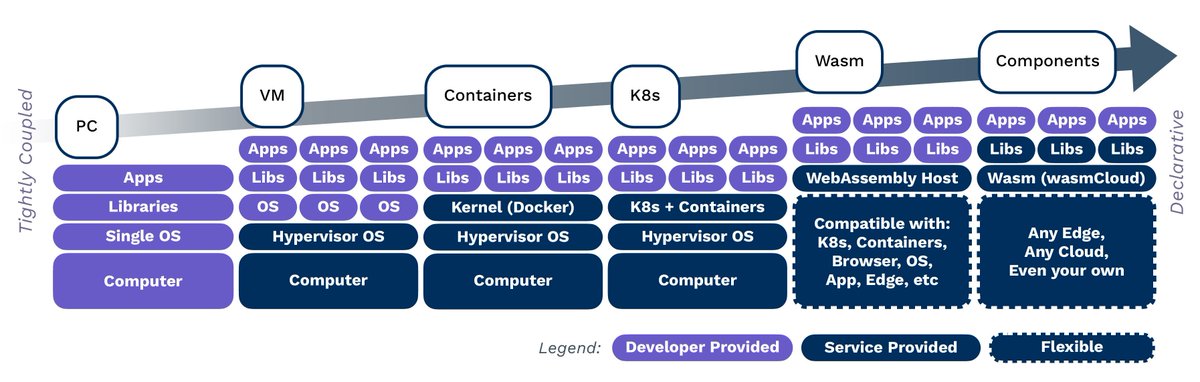
Interesting convo about The Great Decoupling with @Hectaman @Cosmonic. He explained to me why 'Components are the new Container'. Seems like: next stop, #ComposableApps. #wasmcloud #webassembly #composable
1
3
11
746

10 Aug 2023
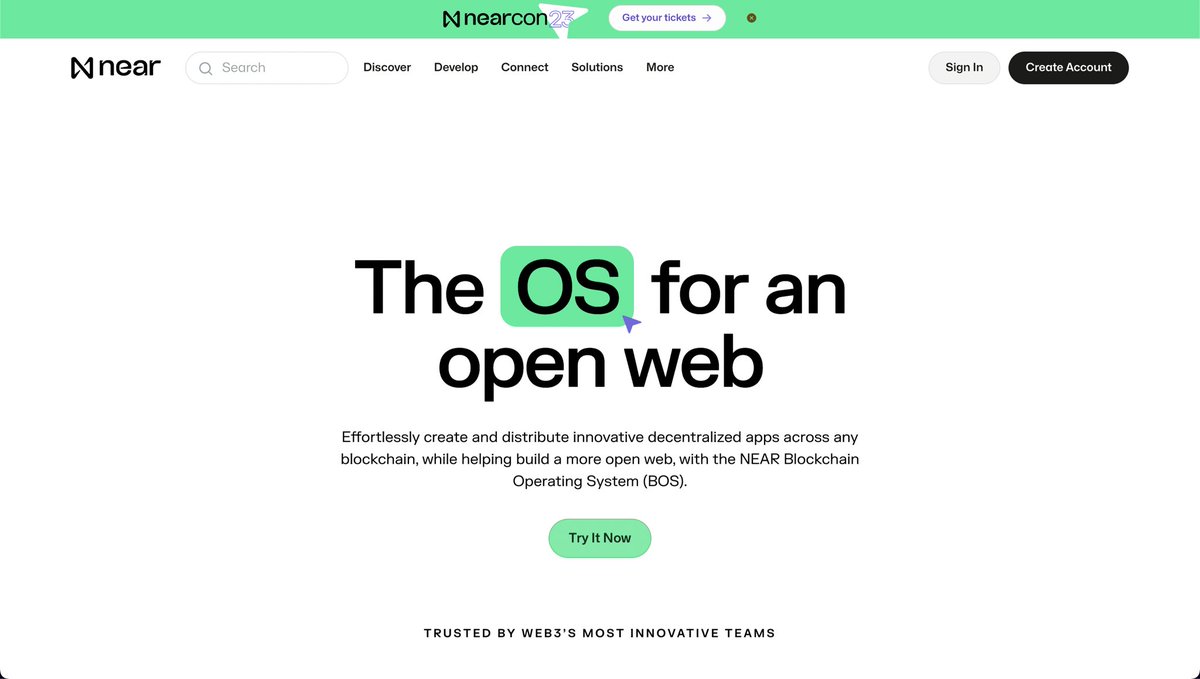
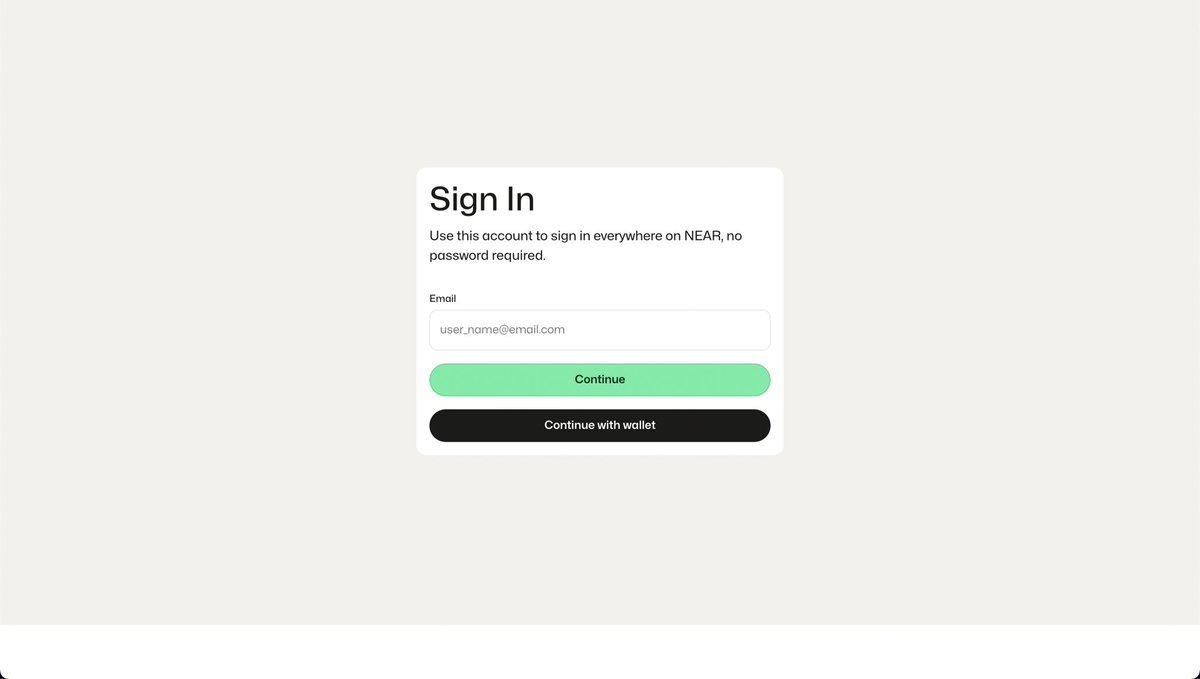
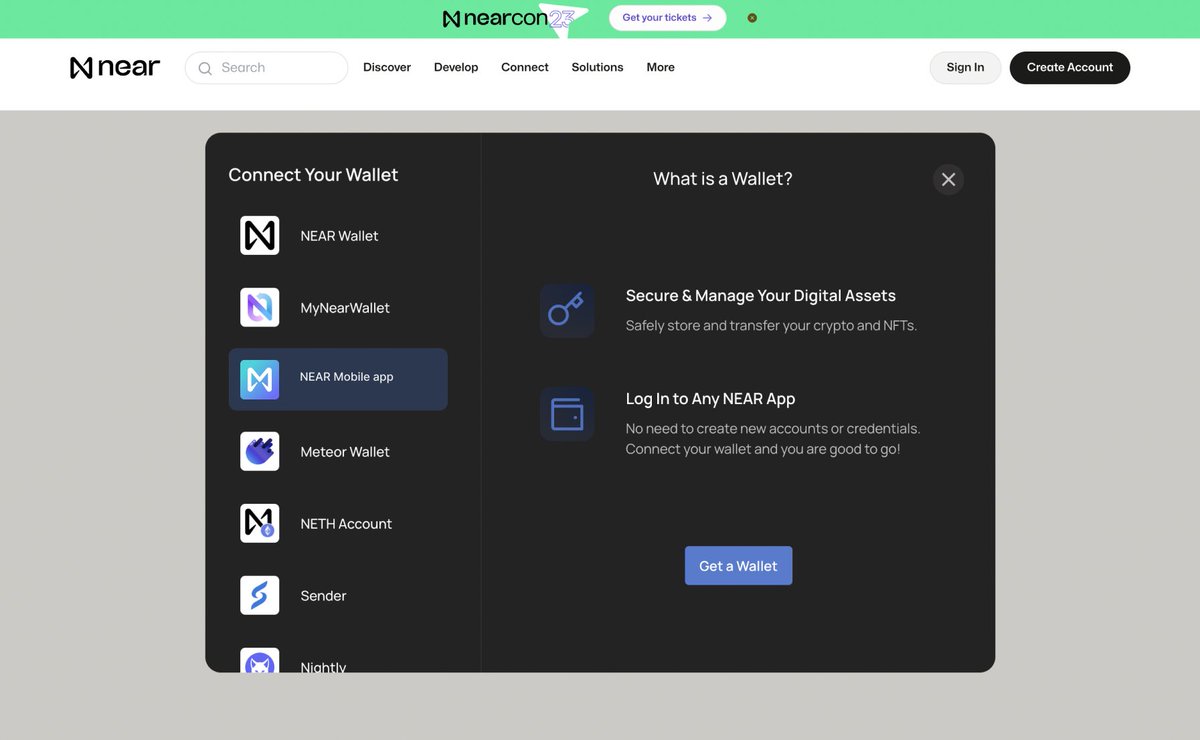
📱⚡🚀 @NEARMobile_app @NEARProtocol's BOS 🔜
🌐🔗 Unlock seamless access to all NEAR-based applications from within your pocket. 📲💼 #NEAR #BOS
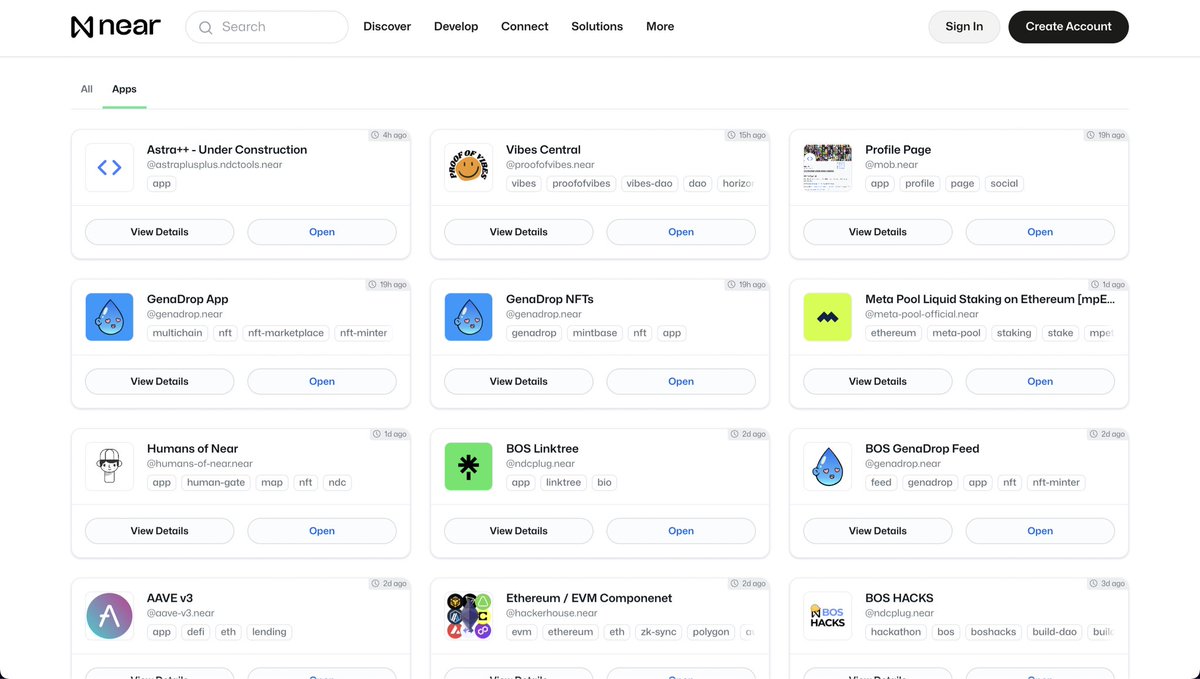
🔑 Embrace BOS's power: it's not just a development environment, it's a decentralized social network too! Deploy & discover apps effortlessly 🚀🌍 #Web3
🔄 Get ready to remix and reuse! BOS fosters composability, letting developers create in lightweight ways. New smart contract front-ends on mainnet? Done in less than 10 minutes. ⏱️🎉 🤯#ComposableApps
🌐 BOS plays well with all chains! Chain-agnostic makes it a go-to solution for devs working with diverse blockchains. 🌎✌️🕊
🔮 BOS stands strong on three pillars:
1️⃣ Components: Tiny, mighty web3 apps stored on-chain, like building blocks for innovation.
2️⃣ Blockchains: Storage for code, assets, and data, with NEAR's cheap HTML/CSS/JS storage.
3️⃣ Gateways: Unlock the decentralized frontends with specially designed virtual machines, connecting you to apps on Ethereum, L2s, and our beloved NEAR. 🚪🔌 #BOSMagic
🔗 Want examples? near.org, bos.gg, near.social 🌟🌐 #ExploreBOS
Ready to reshape the way you interact with the NEAR ecosystem? 🌌🚀 Embrace BOS 🔓🔥 #NEARisTheBOS
ALT #NEARProtocol
1
4
25
865

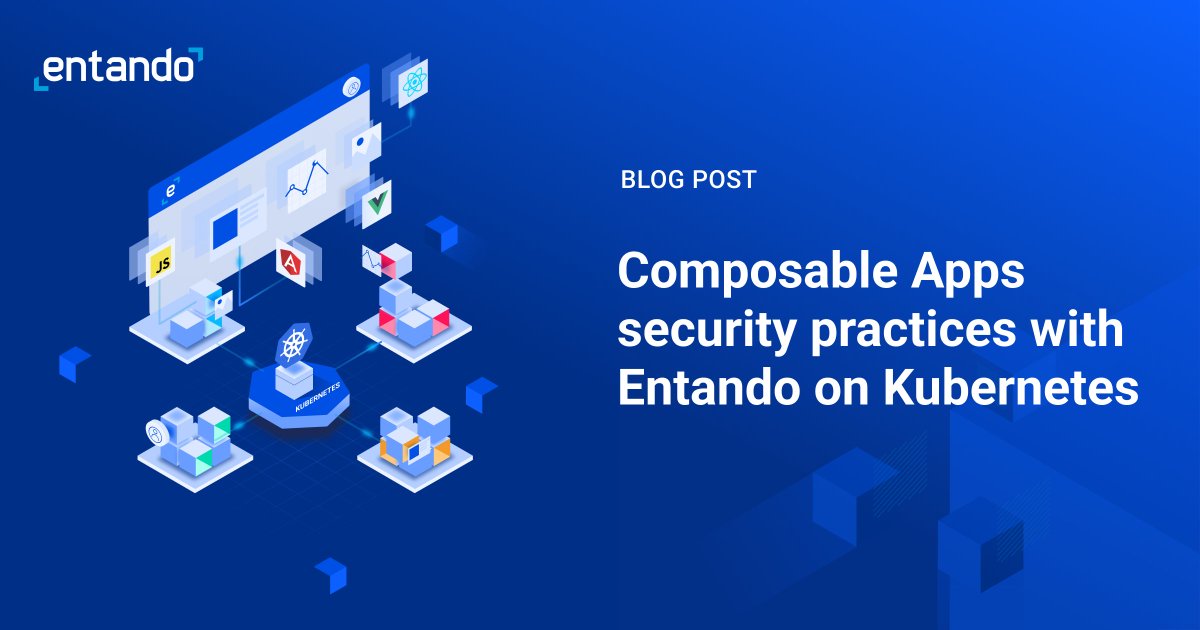
Building #composableapps requires a clear understanding of how security and reliability are managed.
To learn more about this topic, check out this Entando blog post featuring Ippon Technologies USA expert Lucas Ward: bit.ly/3lgGvXM
#kubernetes #cloudnative #ACP
2
2
75

4 Feb 2023
The future is already here! #ArcBlock is bringing DID, AI, composable apps, and dapps together, but not enough people have discovered us yet. Unlock the future and join us today! #blockchain #DID #AI #dapps #composableapps
6
24
59
3,372

18 Oct 2022
New #DigitalTransformation list, ready to be followed.
x.com/i/lists/14900128505842…
#DataFabric
#ComposableApps
#CyberSecurityMonth
#Hyperautomation
3
5

1 Jun 2022
OmniDeq delivers continuous, non-stop modernization, which leads to uninterrupted governance.
Know more: bit.ly/3MYgWn2
#DigitalFirstGovernance #ModernizeWhileYouMigrate #ComposableApps #ContinousModernization
3
5
31 May 2022
We deliver automated modernization while migrating your apps. Know more about #OmniDeq's secure and continuous Modernization.
bit.ly/3MYgWn2
#DigitalFirstGovernance #ModernizeWhileYouMigrate #ComposableApps #ContinousModernization

4
30 May 2022
Automation is not a one-time process. Find how #OmniDeq enables not just rapid but continuous and enduring #Modernization.
bit.ly/3MYgWn2
#DigitalFirstGovernance #ModernizeWhileYouMigrate #ComposableApps #ContinousModernization
4
5
20 May 2022
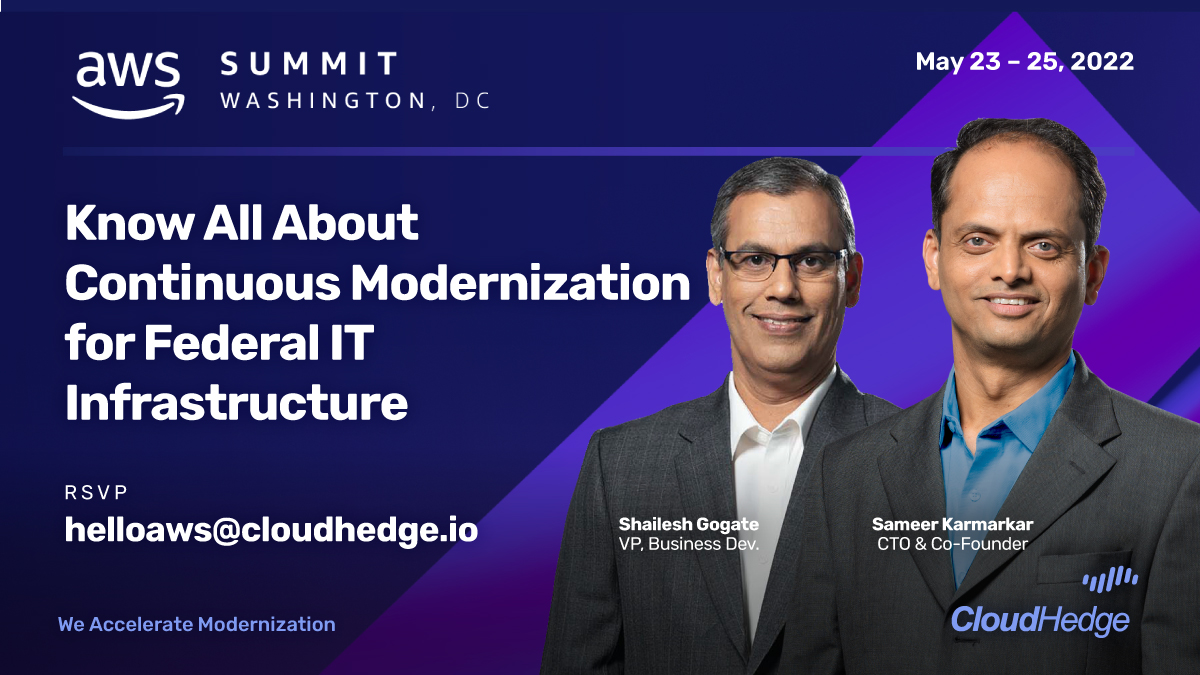
Next, we are at @awscloud Summit, Washington DC. Join in to meet our Modernizers @sgogate and @samkya in person to discuss how we provide Continuous Modernization for better governance.
#AWS #Summit #WashingtonDC #DigitalFirstGovernance #ComposableApps #Modernization
3
4
12 May 2022
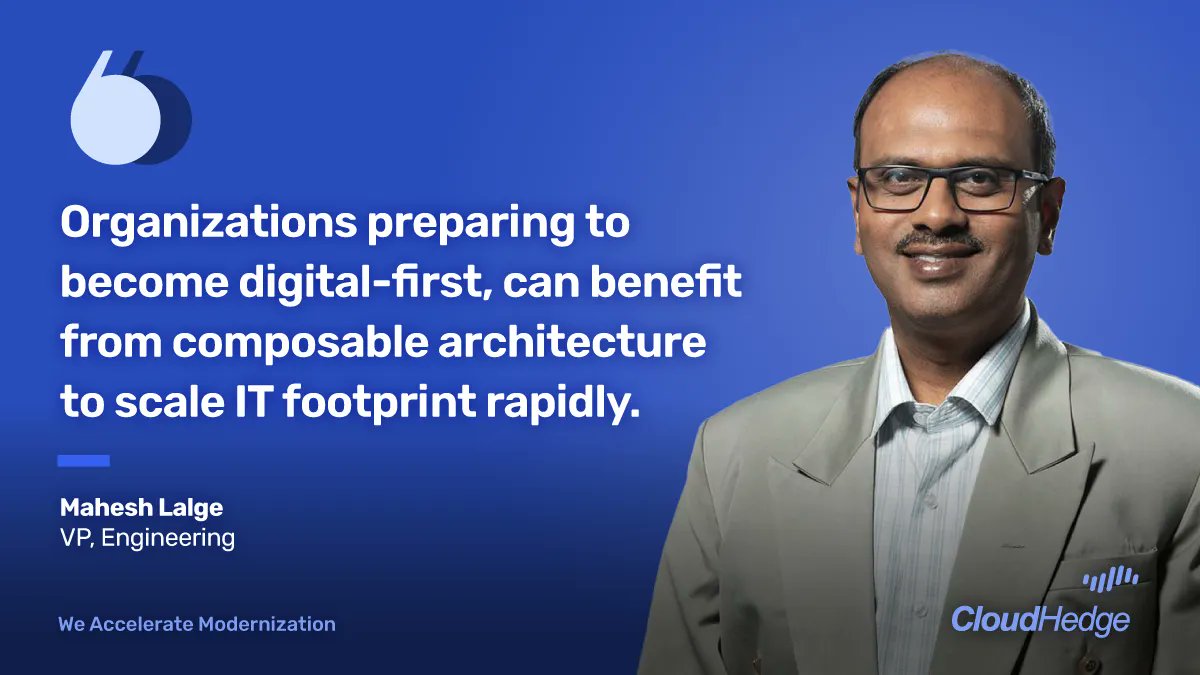
Composable architecture provides the tools to build the future, allowing organizations to innovate and transform the services they offer to customers.
@maheshlalge
#AWS #Summit #WashingtonDC #DigitalFirstGovernance #ComposableApps #Modernization
2
8

7 Apr 2022
@cisco showing up 💪 with API integrations across @Webex @meraki @CiscoIoT @CiscoSecure and @CiscoNetworking all with a mission to deliver a unified #hybridwork Architecture from #composableapps #distributedcloud
7 Apr 2022

It's time to transform #HybridWork! Meet the all-new Smart Workspaces from @Cisco, powered by best-in-class technologies to deliver a better employee experience.
🎉 Learn more in the blog: bit.ly/3KiEOjN
#HybridWorkers #BackToWork
5