
Jun 12
(2) Multi-Agent Path Planning & Explainable AI
- Multi-agent path planning using learning and optimal transport
- Explainability and interpretability techniques for DeepFleet Foundation Models
amazon.jobs/en/jobs/3117815/…
1
192

🚨🤖 أمازون توسع استخدام الذكاء الاصطناعي داخل مستودعاتها
📦 الهدف تسريع عمليات الشحن والتخزين وخفض التكاليف التشغيلية
🟢 الشركة نشرت أكثر من مليون نظام آلي داخل شبكة التوزيع
🟢 نظام DeepFleet AI ساهم في تحسين حركة المعدات بنسبة 10%
🟢 أستثمرت أكثر من 10 مليارات يورو للتطوير
60

Jun 10
$AMZN --- $AMZN delivered blowout Q1 2026 results: AWS sales surged 28% YoY to $37.6 billion, the fastest growth in 15 quarters. Amazon Bedrock processed more tokens in Q1 2026 than in all prior years combined, with customer spending jumping 170% quarter-over-quarter.
In early June 2026, Amazon officially launched Proteus, its next-gen generative AI-powered warehouse robot, and deployed DeepFleet, a foundational large model, to orchestrate logistics. This cut robot travel time across the fulfillment network by 10%, sharply optimizing fulfillment costs.
$AMZN also signed a multi-billion-dollar fiber-optic deal with Corning in early June 2026, laying critical hardware groundwork for massive AI data center expansion. Meanwhile, its ongoing big bet on AI startup Anthropic has yielded massive paper gains and tight ecosystem integration.
1. Valuation Re-Rating: From Low-Margin E-Commerce to High-Profit Tech Giant
Amazon has long been seen as a capital-intensive, low-margin retail player. Today, three high-margin segments—AWS, advertising, and digital subscriptions—keep gaining revenue share. In Q1 2026, AWS alone generated $14.2 billion in operating income (nearly 60% of the total). This shift has lifted overall gross margins and free cash flow potential, driving a P/E and P/CF re-rating.
2.Full-Stack AI Monetization
Unlike firms stuck at the “application layer concept” stage, Amazon monetizes AI end-to-end:
Infrastructure (Compute): Over $20 billion annual run rate from in-house AI chips (Trainium, Graviton).
Platform (Models & Access): Amazon Bedrock acts as an “AI app store” for the enterprise era.
Applications: AI upgrades power retail recommendations, the enterprise assistant Kiro, logistics routing, and precision ad targeting.
3. Local Retail & Global Fulfillment: Back to Alpha Returns
After years of regional network restructuring, Amazon’s North American retail segment has matured. In 2026, Amazon fulfilled over 1 billion units with same-day or next-day delivery. This formidable moat drives sticky FBA reliance among third-party sellers. Even amid antitrust scrutiny and fuel cost volatility, core Stores unit growth hit 15%—a post-pandemic high.
9
701

Jun 10
$AMZN One of the most underrated growth drivers at Amazon is robotics.
While investors focus on AI models, cloud computing, and advertising, Amazon is quietly building what could become one of the largest AI-powered logistics networks in the world.
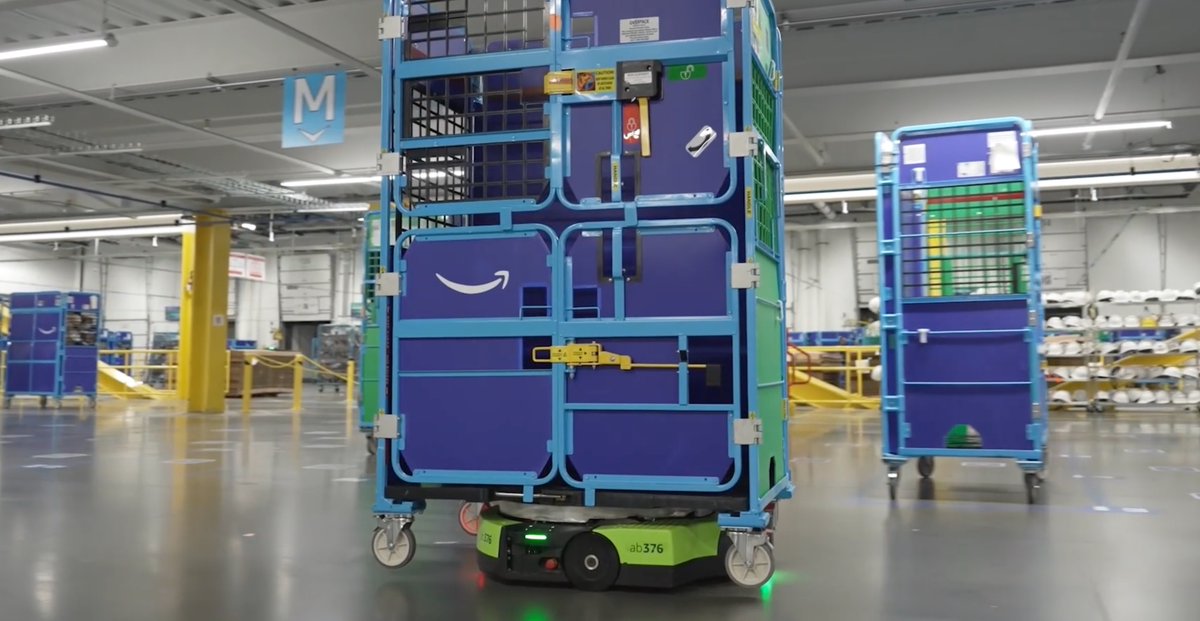
The company is rolling out systems like Proteus, Amazon's autonomous warehouse robot, alongside DeepFleet, an AI platform designed to coordinate and optimize the movement of robots across fulfillment centers.
Every second saved inside a warehouse translates directly into lower fulfillment costs, faster delivery times, and potentially higher operating margins.
What's particularly interesting is that DeepFleet improves as it processes more data. The more robots Amazon deploys, the smarter the system becomes. Management believes this will unlock deeper efficiencies, allow more products to be stored closer to customers, and further improve delivery speed.
This is exactly the type of flywheel Amazon has mastered for decades.
The key question now is whether these investments start showing up in the numbers. If automation can reduce unit costs while volumes continue growing, margins could expand much faster than many investors currently expect.
Robotics may end up driving the next wave of operating leverage.
55

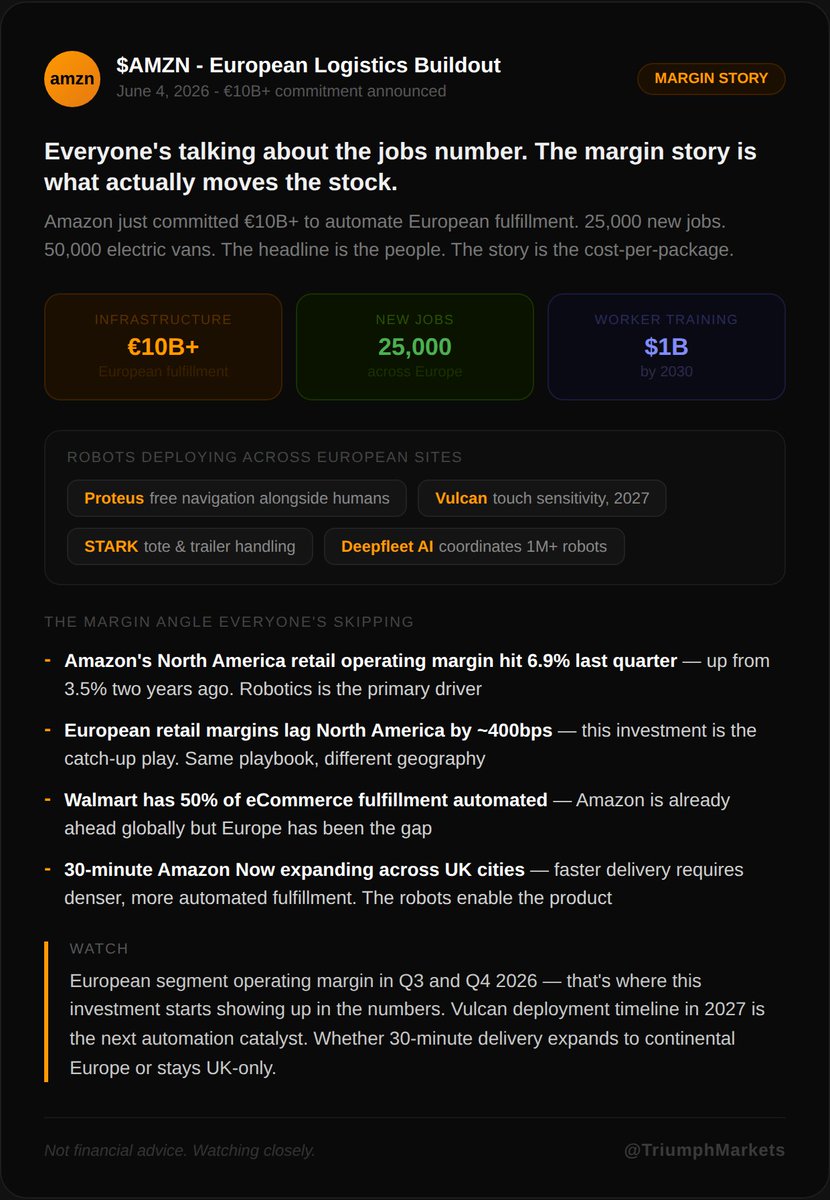
$AMZN just committed €10B to automate European fulfillment. Everyone's talking about the 25,000 jobs. The margin story is what actually moves the stock.
Amazon's North America retail operating margin hit 6.9% last quarter. Two years ago it was 3.5%. Robotics is the primary driver - Proteus, STARK, Deepfleet AI coordinating over 1 million robots across fulfillment centers.
European retail margins still lag North America by ~400bps. This investment is the catch-up play. Same playbook, different geography.
The robots deploying across European sites:
• Proteus - free navigation alongside humans, no safety cages
• Vulcan - touch sensitivity for handling fragile items, coming 2027
• STARK - tote and trailer unloading, historically the most labor-intensive step
• 50,000 electric vans globally on top of all of this
The $1B worker retraining commitment by 2030 is the political cover that comes with deploying robots at scale across five countries. Worth noting - not worth overstating.
Look out for the European segment operating margin in Q3 and Q4. That's where this investment starts showing up in the numbers.
5
9
114


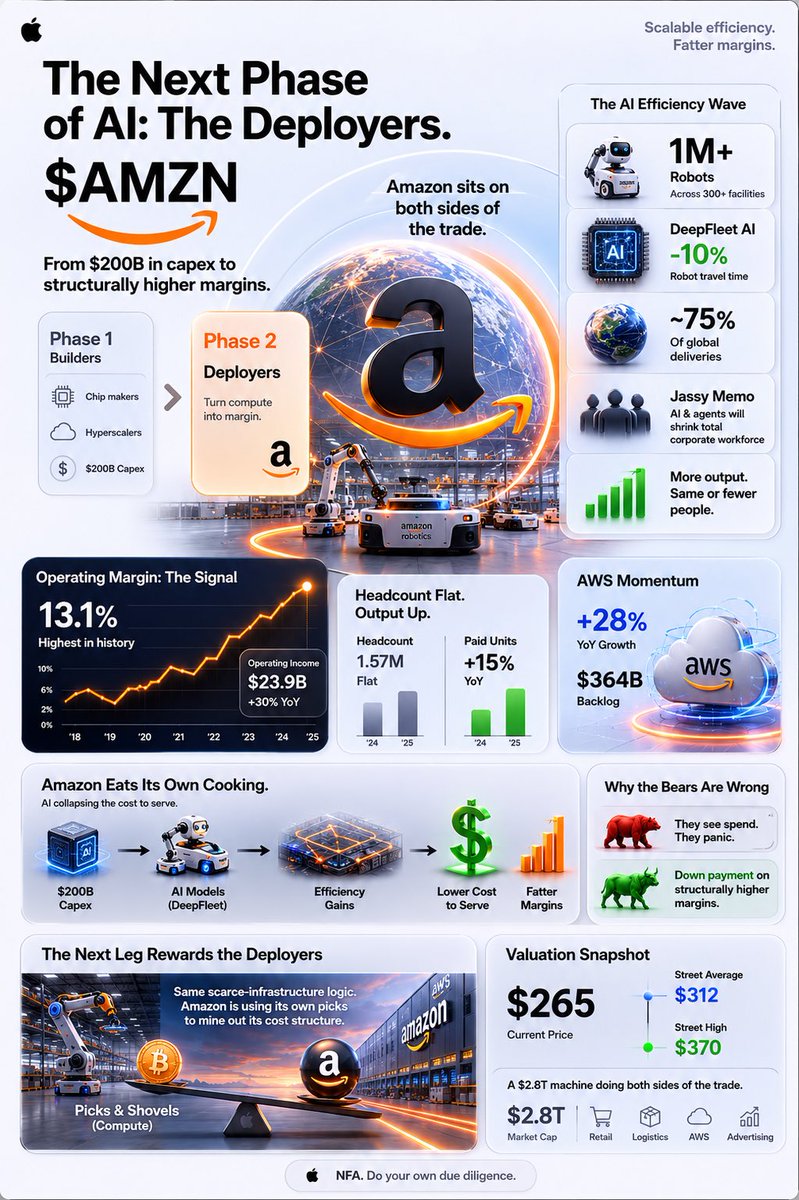
Most people are still trading the first phase of AI, the one that paid the builders, the chip makers and the hyperscalers writing $200B capex checks. @ChrisCamillo woke me up to next phase, the companies that take all that compute and turn it on their own cost structure to print fatter margins, and $AMZN is the cleanest example on the board because it sits on both sides of that trade.
Quick shout-out here to Chris Camillo, who has been hammering this exact point on the @TheICHpodcast. He turned it into an eight-figure Amazon trade as part of his best three-month run in 18 years, and while everyone else was scared of the $200B capex, he called it too little and framed Amazon as the prime beneficiary of what he calls the AI efficiency wave. That framing is the whole thesis, so credit where it is due.
That efficiency wave shows up everywhere inside the business. Amazon now runs more than 1 million robots across 300-plus facilities, which makes it the largest operator of mobile robotics on earth, and last year it rolled out a generative AI model called DeepFleet that coordinates the entire fleet and cut robot travel time by about 10%. Across a network that already touches roughly three quarters of global deliveries, a 10% gain compounds into serious cost-to-serve savings that drop straight to the bottom line.
The labor side tells the same story. Jassy has told employees in writing that generative AI and AI agents will shrink the total corporate workforce over the coming years, and he is putting AI into what he calls virtually every corner of the company. You can already see it in the numbers, since headcount held flat at 1.57 million while paid units grew 15%, the fastest pace since the covid era. That is the entire bull case for AI adopters in one line, more output from the same or fewer people.
This is why I keep pointing people back to operating margin instead of the capex headline. Amazon just printed a 13.1% operating margin, the highest in its history, with operating income up 30% to $23.9B, even while spending $200B to build. The bears see the spend and panic, but the same AI that the capex is funding is quietly collapsing the cost of running the largest logistics operation in the world. AWS gets all the attention, and it earns some of it growing 28% with a $364B backlog, but the under-priced story is Amazon eating its own cooking.
So the market is still pricing the capex as a wound, when it is actually the down payment on structurally higher margins across retail, logistics, and advertising. The next leg of this cycle rewards the deployers as much as the sellers, and Amazon is the rare name doing both at once. Same scarce-infrastructure logic that pulls me toward Bitcoin, except here a $2.8T machine is using its own picks and shovels to mine out its cost structure. The stock sits near $265 against a Street average target around $312 and a high of $370.
NFA. Do your own due diligence.
1
2
300

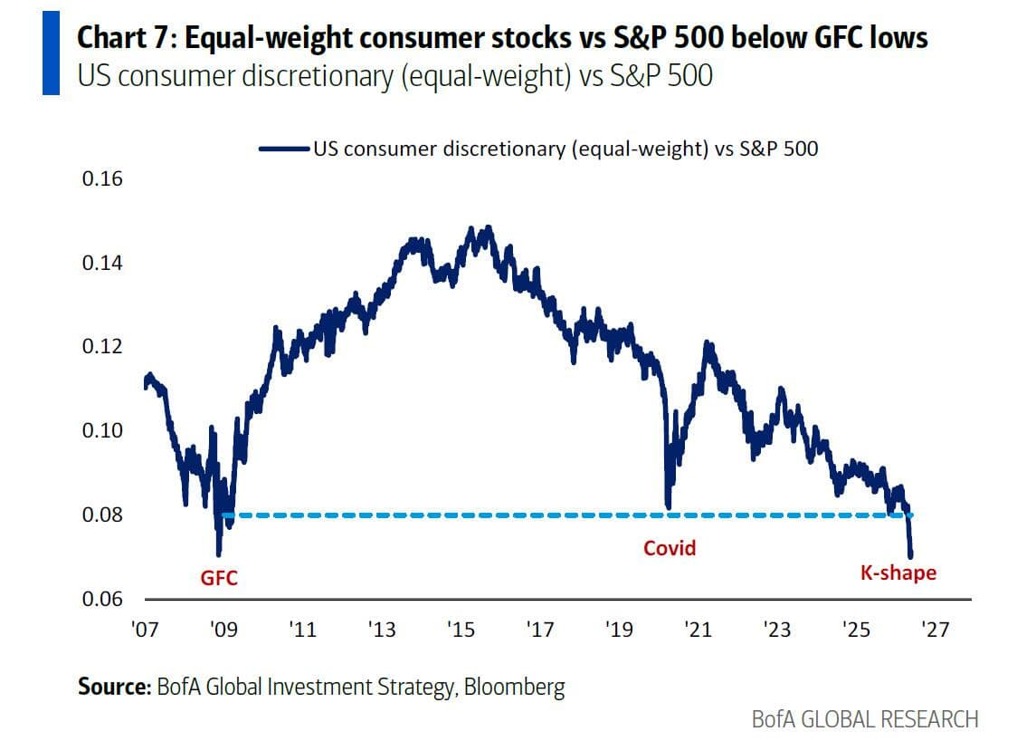
Important chart from BofA Global Investment Strategy.
US consumer discretionary equal-weight vs S&P at 20-year low. Below GFC and Covid troughs.‼️
My consumer exposure is $AMZN, sized specifically for three engines the aggregate chart doesn’t measure:
1.AWS - cloud infrastructure demand, B2B not consumer
2.Ads - 30% growth, retail margins masking the print machine
3.Robotics - 1M robots deployed, DeepFleet AI, Fauna and Rivr acquisitions. The largest physical AI deployment in the world
The retail business is the volume engine. The profit and the moat sit elsewhere.

US consumer stocks are extremely weak:
The equal-weighted US consumer discretionary index relative to the S&P 500 is down to 0.07, the lowest in at least 20 years.
Since 2021, this ratio has fallen -42%, dropping below both the 2020 and 2008 lows.
Over this period, the S&P 500 has surged 60%, outperforming the equal-weighted US consumer discretionary index by 10x, which has increased just 6%.
Meanwhile, US Consumer Sentiment fell another -5.0 points in May after falling -3.5 points in April, to 44.8, an all-time low.
By comparison, the S&P 500 is up 17% since March 30th and closed on Friday just 0.5% below its all-time high.
The stock market is thriving, but the average American consumer is not.
10
17
2,861

May 12
feels like amazon's ASCS announcement got relatively little attention in VC world because it's "just" fulfillment / logistics
UPS and fedex fell off 10% but VC was quiet
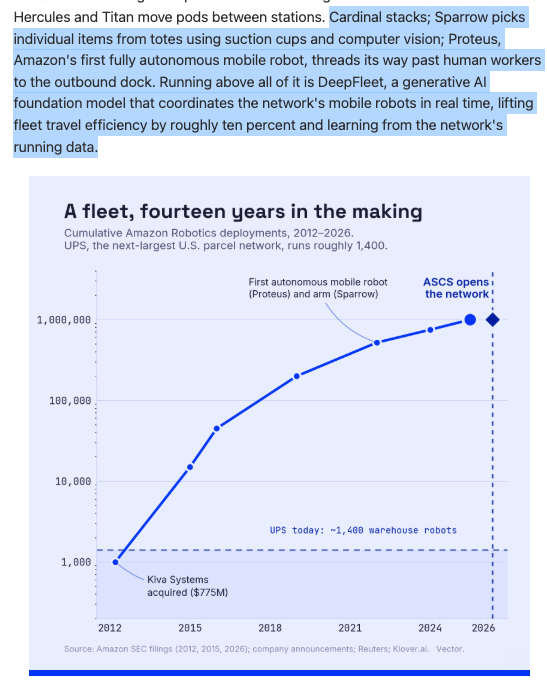
good reminder that amazon 10x'd their deployed robot count to 1 million ('19 to '26), and announced both Proteus and DeepFleet in the past 2 years. and now they're selling a second physical infra stack in parallel to AWS
if they used the word 'robot' in their announcement the reaction would have been very different. maybe that comes later
May 5

Amazon Supply Chain Services—our freight, distribution, fulfillment, and parcel shipping network—can now be used by any business.
Was built over nearly three decades to move, store, and deliver products across land, air, and sea. All one network, so no need to piece together different providers at every stage. Same reliability and speed our customers rely on.
P&G, 3M, Lands' End, and American Eagle already on board. Gonna help a lot of businesses move faster, save money, and simplify things. aboutamazon.com/news/retail/…
7
898


Apr 5
The AI robotics market is projected to hit $375.8 billion by 2035.
That's a 17.33% compound annual growth rate over the next decade.
But here's what the projection misses:
The revolution already happened.
Most people just didn't notice.
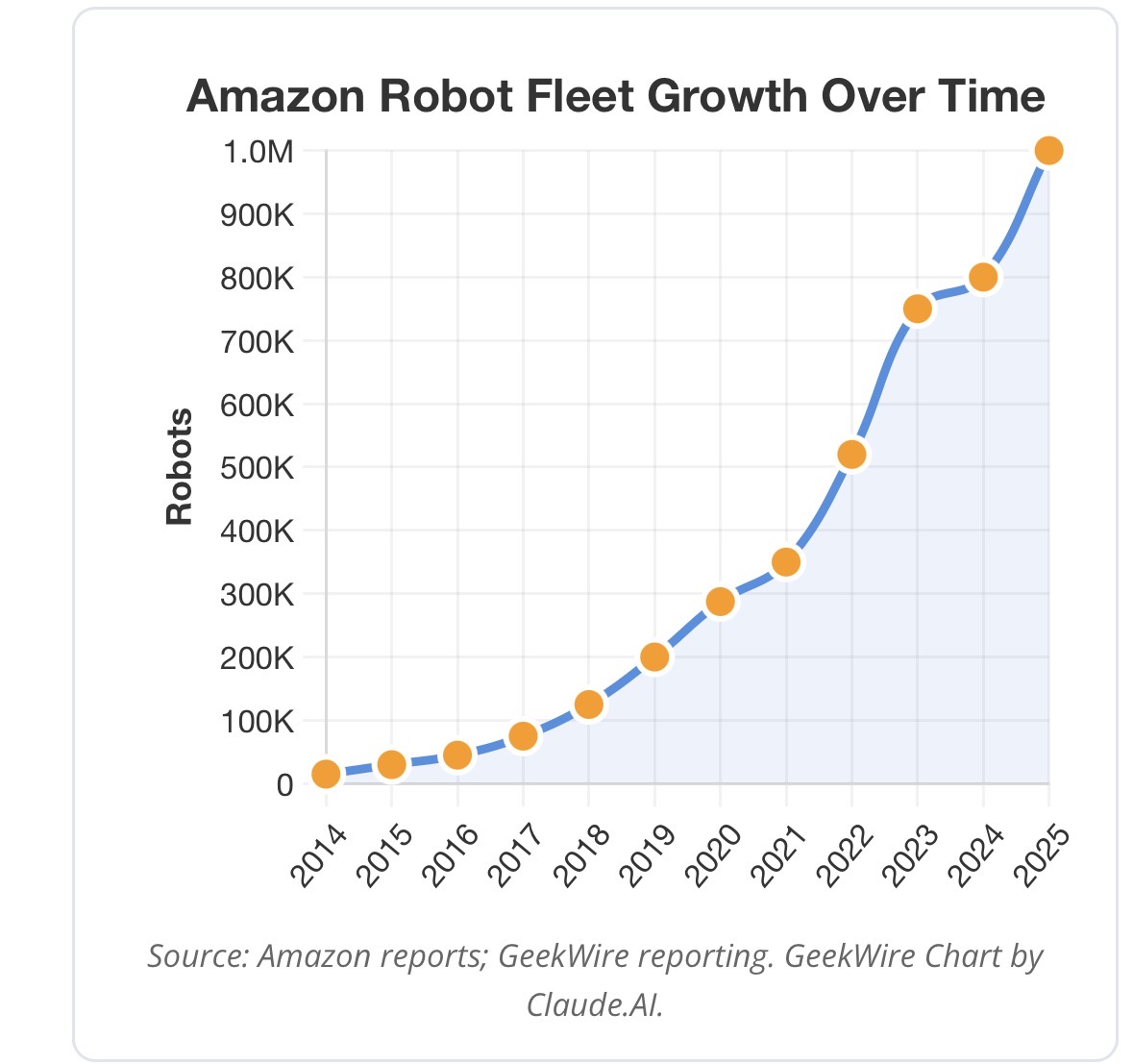
Amazon deployed 1 million robots across its warehouses last year.
Not in 2035.
Not "coming soon."
Last year. July 2025.
1 million functioning AI robots moving packages, sorting inventory, and optimizing routes across 300 fulfillment centers globally.
For context: That's more robots than the population of San Francisco working 24/7 shifts without breaks, sick days, or turnover.
And 75% of Amazon's global deliveries are now touched by a robot at some point in the supply chain.
The market grew from $64.8 billion in 2024 to a projected $375.8 billion by 2035 because companies like Amazon proved the model works at scale.
Not in theory. In practice.
Amazon's newest facility in Shreveport, Louisiana spans 3 million square feet across five floors.
The Sequoia system inside holds 30 million items.
Thousands of robots coordinate in real-time using an AI model called DeepFleet that reduced robot travel time by 10%.
Once a package enters the system, human hands barely touch it again.
The facility employs 25% fewer workers than it would without automation.
By next year, that number drops to 50%.
Amazon plans to replicate this design across 40 facilities by 2027, generating $12.6 billion in cost savings.
Here's the math that matters:
Amazon expects to avoid hiring 600,000 people over the next few years because robots can do the work.
The company already employs 1.6 million people globally.
That's a third of their potential workforce replaced by machines that work two 10-hour shifts daily, never call in sick, and get more efficient with every package they touch.
The Wall Street Journal reported that Amazon averaged 670 employees per facility in 2025.
The lowest in 16 years.
At the same time, packages handled per employee jumped from 175 in 2016 to 3,870 in 2025.
That's a 22x productivity increase driven entirely by robots doing work humans used to do.
The $375 billion projection isn't about the future.
It's about what's already scaling right now across manufacturing, logistics, healthcare, and agriculture.
Amazon started with 1,000 robots in 2013 after acquiring Kiva Systems for $775 million.
Twelve years later: 1 million robots generating billions in savings.
The technology works.
The economics work.
The only question left is how fast it spreads to every warehouse, factory, and farm on Earth.
Bookmark this.
The AI robotics market isn't "projected" to change the world by 2035.
It's already changing it.
You're just not inside the warehouses to see it happening.
8
32
88
7,132

Mar 26
$AMZN is one of only 2 Mag 7 names I hold.
One is $TSLA, which I think becomes the largest company in the world.
The other is $AMZN, which I recently added in my FHSA and honestly… I get more bullish on it every day.
A lot of people are focused on $AMZN margins “still being too low” or the AI capex spend being too heavy right now.
But I think that misses the bigger picture.
Amazon did 716.9B of revenue in 2025 and 77.7B of net income, which puts net margin at about 10.8%. AWS alone grew to $128.7B in revenue last year, while AWS backlog reached $244B, up 40% YoY. On top of that, Andy Jassy recently said AI could help AWS reach as much as $600B in annual sales by 2036. That is an absurd runway for a business already operating at scale.
And that is just the obvious part.
What I think the market is still underestimating is robotics.
$AMZN has now deployed 1 million robots across its operations. Its new Vulcan robot can already handle roughly 75% of the items in Amazon’s fulfillment network, and Sequoia helps identify and store inventory up to 75% faster. They also launched a generative AI model, DeepFleet, to improve robot travel efficiency by another 10%. This is not some far-off sci-fi concept anymore. It is already happening inside the business today.
So yes, right now the margin debate is all about heavy spending.
But what happens when AWS keeps compounding, advertising keeps scaling, and robotics starts removing more labor, time, and friction from the fulfillment network?
That is when today’s “low margin” business starts looking very different.
If Amazon can push net margins from around 10% today to something materially higher over the next decade, the earnings power here becomes massive. And when a company with this kind of revenue base expands margins, the valuation rerates hard. That’s the part I do not think is fully priced in yet.
The market is punishing $AMZN for spending.
I think in 5-10 years we may look back and realize they were simply building the next leg of the moat.
I don’t own enough $AMZN.
1
4
550

Mar 20
I regularly do deep dives into interesting topics. Follow along → @anishmoonka
Attaching all links, if you'd like to dive deeper →
1. WSJ report via Bloomberg (original breaking story): bloomberg.com/news/articles/…
2. Investing.com (fund structure details, "manufacturing transformation vehicle," Prometheus connection): in.investing.com/news/econom…
3. Amazon deploys 1 millionth robot, launches DeepFleet AI model: aboutamazon.com/news/operati…
4. TechCrunch on Bezos co-CEO of Project Prometheus ($6.2B, first operational role since Amazon): techcrunch.com/2025/11/17/je…
5. Bezos and OpenAI invest in Physical Intelligence ($400M, universal robot brain): cnbc.com/2024/11/04/jeff-bez…
6. Skild AI raises $1.4B with Bezos, SoftBank, Nvidia ($14B valuation): businesswire.com/news/home/2…
7. NAM manufacturing data ($2.95T sector, 9.5% GDP, 12.6M workers): nam.org/mfgdata/facts-about-…
8. TechCrunch on Travis Kalanick launching Atoms (robotics, factory automation, 8 years stealth): techcrunch.com/2026/03/13/tr…
6
5,063

Mar 16
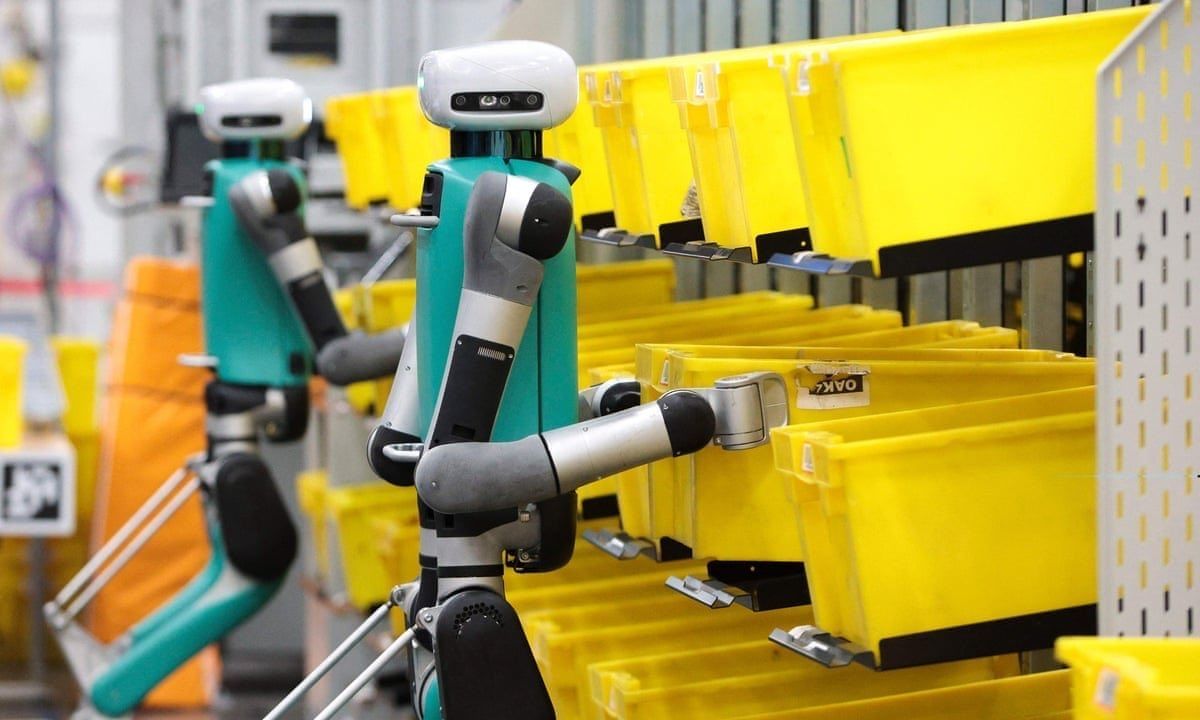
Amazon’s robots are about to outnumber its human workforce.
1 million robots. 1.56 million employees. The gap is closing fast.
Since 2012 they’ve been building their AI capabilities with DeepFleet coordinating their entire system
It’s been said Amazon’s internal goal is to replace 600,000 jobs by 2033 and automate 75% of operations.
One Louisiana warehouse already runs with 25% fewer people, estimating half the workforce by next year.
40 more sites will get the same treatment by 2027 and this is just Amazon’s own network.
The next move is selling this infrastructure to the rest of the world, every warehouse, every industry.
Once Amazon cracks something at scale, everyone copies it. That’s always how it’s worked.
The robots aren’t coming for jobs. They’re already here.

3
28

Mar 15
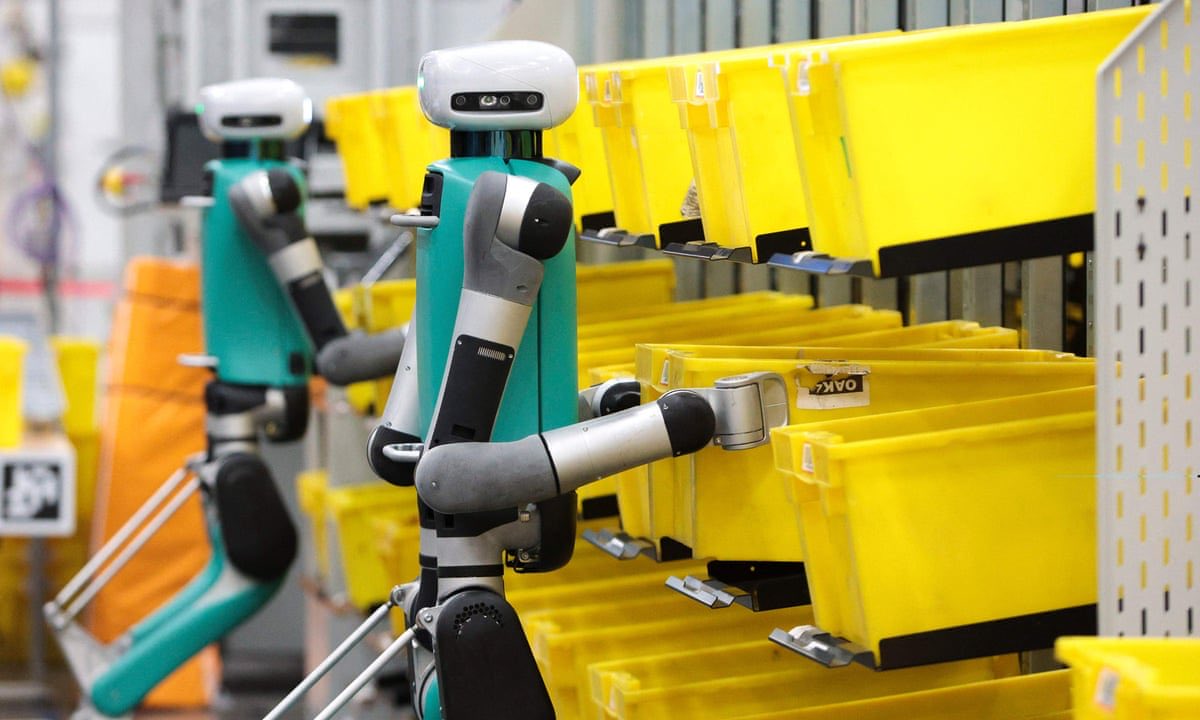
Amazon’s robots are about to outnumber its human workforce.
1 million robots. 1.56 million employees. The gap is closing fast.
Since 2012 they’ve been building their AI capabilities with DeepFleet coordinating their entire system
It’s been said Amazon’s internal goal is to replace 600,000 jobs by 2033 and automate 75% of operations.
One Louisiana warehouse already runs with 25% fewer people, estimating half the workforce by next year.
40 more sites will get the same treatment by 2027 and this is just Amazon’s own network.
The next move is selling this infrastructure to the rest of the world, every warehouse, every industry.
Once Amazon cracks something at scale, everyone copies it. That’s always how it’s worked.
The robots aren’t coming for jobs. They’re already here.

33
4
58
2,630

Mar 6
Spot on. $AMZN has officially evolved into a robotics powerhouse that just happens to ship packages.
Their private fleet is now nearly double the size of the entire U.S. industrial robot stock.
They also launched DeepFleet, a generative AI foundation model that coordinates the entire fleet like an intelligent traffic system.
1
3
49


AI-Driven Autonomy: Amplifying Human Oversight in Robotic Fleets.
It’s widely believed that human operators are the primary bottleneck in robotic systems. In reality, the true constraint often lies in how effectively AI models enable robots to operate autonomously while seamlessly integrating human oversight.
The Real Constraint:
Without advanced AI handling perception, prediction, and decision-making, a single teleoperator is typically limited to controlling one robot at a time. Scaling human involvement becomes inefficient, costly, and error-prone as complexity grows.
Recent frameworks like FleetDAgger show how interactive learning can scale human supervision across fleets, enabling continual policy improvement from remote interventions.
PrismaX AI’s Innovative System:
@PrismaXai models act as a powerful intermediary, translating operator inputs into sophisticated autonomous actions.
By mastering perception, contextual reasoning, and low-level control predictions, leveraging vision-language-action (VLA) models similar to those powering adaptive machines in complex environments, these models allow one operator to oversee an entire fleet.
The system continuously learns from human guidance, environmental cues, and real-time robot states, improving autonomy over time, much like Amazon's DeepFleet AI, which coordinates massive robot fleets for 10% better travel efficiency.
Key Mechanisms & Benefits
➜. Amplified Human Capacity: Operators supervise multiple robots simultaneously without cognitive overload, creating a hybrid human-AI-robot model that enhances reliability in critical sectors.
➜. Superior Data Collection: Autonomous operations generate rich, structured datasets, accelerating model training and creating virtuous feedback loops, as seen in foundation models enabling generalist robots across industries.
➜. Operational Efficiency: Reduced cognitive strain boosts throughput, lowers errors, and enables scalable deployments, with frameworks like FORMIGA showing faster task completion through adaptive human-robot collaboration.
Long-Term Implications:
Beyond task automation, AI models unify the robotic ecosystem. They make supervision scalable, enrich data pipelines, and build resilient fleets capable of handling diverse real-world challenges, paving the way for physical AI in industrial operations.
True value emerges from actions, not ideas. Autonomy doesn’t replace humans, it elevates them, turning oversight into a force multiplier and forging lasting operational strength.

3
10
117

Jan 19
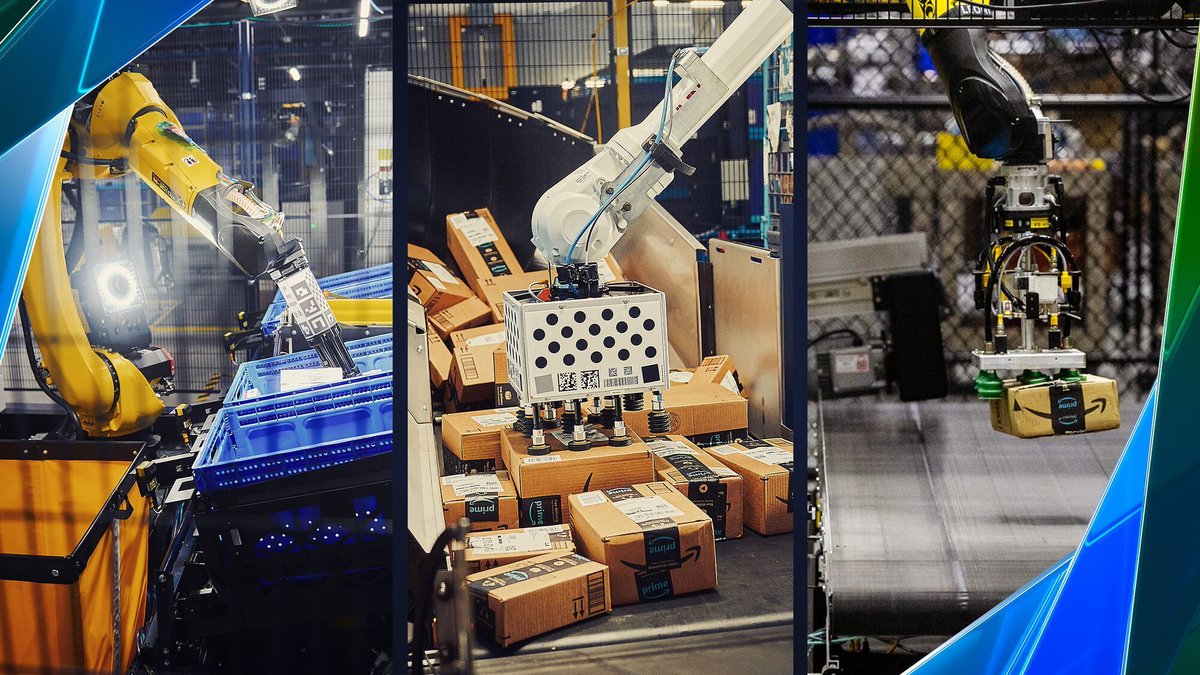
$AMZN Amazon now uses over 1 million robots in its warehouses and logistics network, and that number is still growing. These robots move shelves, sort packages, and help pick and pack items so humans walk less, handle fewer repetitive tasks, and process more orders per hour.
This automation makes each warehouse more efficient by speeding up how quickly items are found, moved, and shipped, and by cutting errors and congestion inside the buildings. With AI systems like DeepFleet coordinating robot traffic, Amazon says robot travel time is about 10% faster, which lets the same buildings and staff handle more volume at lower cost per package.
Lower labor hours per package, better space use, and fewer mistakes all reduce unit costs, which supports higher operating margins in the retail and logistics segments over time. Analysts estimate that this kind of automation already adds roughly a percentage point or more to operating margin and could save Amazon billions of dollars a year as it scales across an enormous revenue base.
Simply amazing.
1
21
2,011