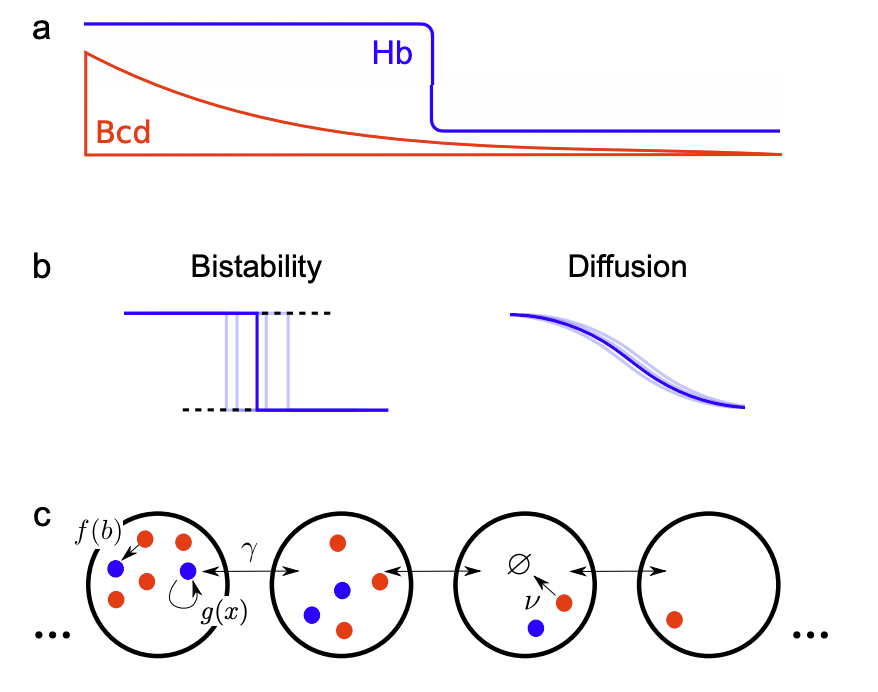
ALT Three images showing hunchback, Hb, boundary formation. On the top is a schematic of a sharp Hb profile and exponential Bicoid, Bcd, profile along the anterior-posterior axis. Below is an illustration of how bistability, depicted on the left as a series of blue lines that make a 90 degree zig zag, could promote a sharp transition between states but increase positional variability. On the right, diffusion, shown as a series of smooth blue curves, could reduce variability but also reduce sharpness. Below, depicted using four black outlined circles with blue and red circles inside, Hb is shown as being activated by both Bcd and itself; it then degrades and diffuses among cell nuclei.



ALT #IETSPapersOfTheMonth Exposure to polystyrene nanoplastics impairs sperm metabolism and pre-implantation embryo development in mice Liu Y, Hao F, Liang H, Liu W, Guo Y. 2025. Frontiers in Cell and Developmental Biology 13, 2025. APRIL 2025




ALT Zenker lab group photo


ALT SRF: A New Regulator of Retrotransposons and Genes in Early Embryonic Development


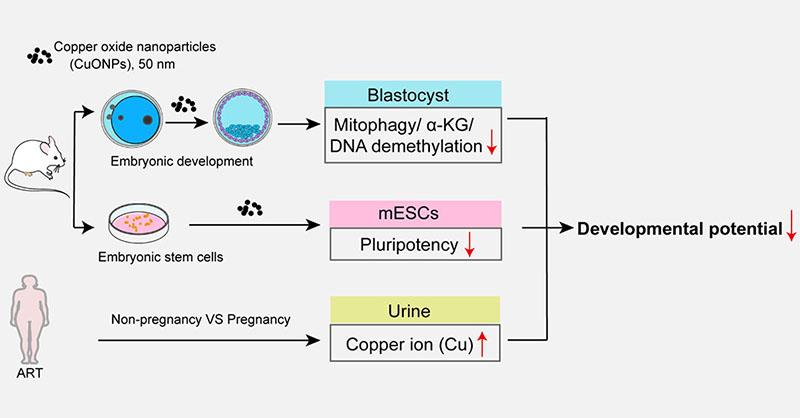
ALT TOC image from the article