
26m
Obamas project was to:
1. Stop Water Waste
2. Implement Water Recirculation
3. Utilize Sustainable Water Sources
4. Improve Structural Stability
What trump did was unnecessary and just a vanity project.
1
12

Hey, Grok: is this true?
No, this is not accurate—it's a misleading recirculation of a 2021 incident.
x.com

Compared to a swimming pool
- high amounts of organic matter (trees)
- Animals swimming in there (excrements)
- no full water recirculation through a filter
- No bottom vacuum
high water temperatures
The goal of getting the water "clear" is insane with this setup.
2
6

No, they're killing the algae that came out of the recirculation pipes.
4


The problem is they are too stupid to realise fish would solve the problem as long as there is water oxygenation and recirculation.
1
1
2
71

It needs a recirculation pump, Chlorine and pool acid are needed to make a pool blue!
it’s not 🚀 science!
2
116

A weak and shaky attempt was made to lend credibility to a highly baseless claim dragging an entirely unrelated community into the argument by a cardiologist masquerading as a historian.
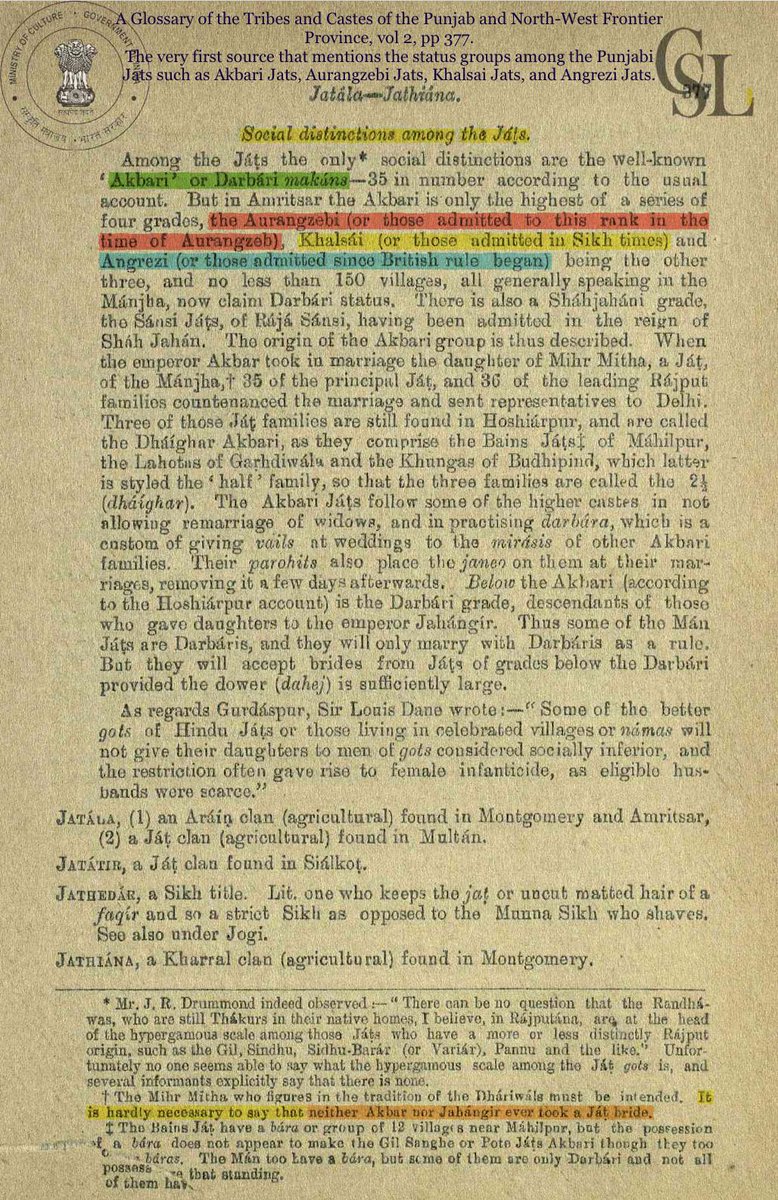
In its article published on 15 June 2026, titled "Don't use Rajput women as proof of Mughal Indianness. It's communal simplification," @ThePrintIndia @ThePrintHindi, under the editorship of @ShekharGupta and through an article authored by @dryadusingh, asserted that Jat women too had matrimonial connections with the Mughal imperial household.
This was not a passing remark. It was a positive historical assertion placed before a national readership. As such, it carried an evidentiary burden.
On examination, however, that burden remains entirely unmet.
I. The Gratuitousness of the Defamation
The stated objective of the article was to challenge an over-simplified narrative centred upon Rajput matrimonial alliances with the Mughal imperial household. One may engage with that argument on its merits.
What is not defensible is the method by which the article pursued it: invoking alleged matrimonial connections between Jat women and the Mughal imperial household without primary documentary support and against the explicit correction recorded by the earliest source in which the tradition appears in written form.
The honour of one community's women is not defended by implicating the womenfolk of another community in a claim that the evidence does not sustain.
The Jat community did not require to be conscripted into this argument.
Its conscription was gratuitous.
And, in the ordinary meaning of the term, defamatory.
II. What Hari Ram Gupta Actually Recorded, and Whence He Derived It
The article cites Hari Ram Gupta's Sikh Lion of Lahore (1991) for the proposition that the Bains, Sahotas and Khungas were known as "Akbari Jats" by virtue of matrimonial alliances with the Mughal household, and that "one account mentions a Jat named Mehar Mitha offering his daughter in marriage to Emperor Akbar."
What the article failed to disclose is that this "account" is not a contemporary historical document.
It is a folk tradition recorded in written form for the first time by Denzil Ibbetson in A Glossary of the Tribes and Castes of the Punjab and North-West Frontier Province.
Ibbetson was sufficiently scrupulous to do what Hari Ram Gupta—and subsequently The Print—did not. Having recorded the tradition, he appended a footnote to the very passage in question, observing that "it is hardly necessary to say that neither Akbar nor Jahangir ever took a Jat bride."
Ibbetson thus recorded an urban legend and corrected it in the same breath. Hari Ram Gupta repeated the legend and suppressed the correction. The Print has now repeated Hari Ram Gupta whilst remaining ignorant of the source that both underlies and refutes him.
The chain of transmission upon which the article's claim rests is the following:
• A folk tradition;
• Corrected as historically false by the first scholar to commit it to print;
• Repeated at second hand;
• Stripped of its corrective footnote;
• And published as historical evidence in a reputed national daily.
This is not evidence.
It is the recirculation of an urban legend.
III. What "Akbari Jat" and Cognate Designations Actually Denote
The article further implies that the grades of "Akbari," "Darbari," "Aurangzebi," and "Khalsai" among Jat lineages testify to matrimonial connections with the Mughal imperial household.
This implication is unfounded.
Ibbetson's Glossary, the authoritative source for these designations, explains that they denote the period at which particular Jat lineages received recognition of chaudhriyat, that is, the status of local revenue superior or zamindar, under successive Mughal and Sikh administrations.1/.
@meelrajaram @thejatheroes @du_jat
@JAT_SAMAAJ @JATs_Land @hanumanbeniwal @XJatlandX @RakeshTikaitBKU @Warriorsclub_X
@jat_devta

6
13
29
1,002

$SUI processed $65B in stablecoin transfers in 5 days after zeroing out fees on May 20.
$470M float turning over tens of billions is pure recirculation. Fireblocks already integrated. Mysten is gunning for correspondent banking rails.
Watch velocity, not supply.
14

One, the co2 narrative where they blame cow farts and cars, is a convenient falsehood that allows the pedophiles to contain and control food sovereignty as well as industry and in part the economy. The other theory, soil degradation, is a problem humans have battled since the beginning of time ( turns out a recent re-discovery shows it’s best to emulate nature as close as possible, who woulda thought?! 😑) this IS proven peer reviewed science if you consider different farming practices the experiment, and the scientists, the farmers. Agriculturalists, regardless of the crop or method, constantly measure soil variables such as temperature, water content, compaction, bio density, etc; because it’s required for the process. Global warming is basically a new consequence of the scale and speed at which humans have industrialized and stripped the earth of plant mater resulting in: soil degradation, lower water retention, interrupting the cycle; which causes: water shortages, and the earth to physically dissipate and reflect less heat. instead it absorbs, and radiates it, into a now steamy, and saturated, atmosphere where the heat is trapped like water behind a damn… we’ve basically as a species severely throttled or valved off the earth’s natural resorption/recirculation of water and carbon while simultaneously releasing both into our atmosphere at rates that would’ve been physically impossible less than 200 years ago. The “valve” is plenty big enough (the whole earth) to turn on and continue our every day lives; but the pedophiles will make less money and you’d have control over your basic needs… so instead we’ll all just bake and starve i guess; serves us right! dirty tax cattle!🤷🏼♂️🤣 @modernTman @RepThomasMassie @idahobeef @TomTaberHODL @SamaHoole
1
11

VIDÉO | Filtre XFM Flocell – Principe de la filtration par recirculation buff.ly/p627erj #Station #Épuration #Nettoyage #EauxUsées #Vidéo
6

Cabin air recirculation.
cabin air recirculation button.
When the light is on, the car reuses the air already inside the cabin instead of pulling fresh air from outside.
Mostly to be used on a very hot day.
3

4400 feet of 6inch pipe. Holes every 25 feet. recirculation loop that feeds back into the primary filtration system. 90 million unless you can make it yourself Liquid Chlorine is the cheapest solution.
1
20

Haha. Interesting... I've got a bit over 1300 hrs on a 4038.. it's had a few issues, but once you understand how things are wired and daisy chained it's easier to figure out. I'll be doing the plungers at the end of the season. Just getting to the hrs. It's definitely not a 4720 that will run and run and run without issues or costing you anything but it's still a good sprayer. If it doesn't have recirculation on it, get a kit from the ninja.. best money I spent on it
1
34

Chlorine escapes pretty sson, so it should be constantly added during recirculation. At this length of the pool, to keep it algae-free you are basically looking at creating an artificial river with quite fast current and constant pudgent smell of chlorine.
1
23

dans les blocs je n'en doute pas, vous en avez peut-être même dans des lits d'UHCD où dans vos couloirs pour les brancards aux heures de pointe, que sais-je.
Grok a réponse à côté et re-réponse pas si à côté puisque légaliste.
La discussion semblait découler d'un avis sur notre pays 7ème économie mondiale qui n'investit pas malgré des services ordinaires et surchauffés où on bricole.
Dans l'absolu les clims sont évidemment installables partout, mais imaginer (c'est moi qui le fais, à cause du point de départ, pays riche pas capable de mettre des sous) que ca couterait pas cher est hasardeux (recirculation alors qu'il est obligatoire de renouveler, filtrage réel, .. ).
Une alternative durable est chère, et la pique sur le pays qui est riche, aventureuse, c'est tout.
55

What they didn't tell you about your favorite diesel powered Mazda cx-5.
1) The DPF (diesel particulate filter? The dpf requires regeneration which short trips and low speeds do not generate.
This causes dilution which leads to soot build up and accelerated wear, and finally catastrophic engine damage.
2) EGR- (exhaust gas Recirculation) Both the valve and cooler accumulate carbon deposits which causes rough running, misfires and reduced performance.
NB// diesel powered vehicles require full regeneration which is acquired by long drives and relatively high speeds. It's not your usual drive around vehicle.

1
2
4
169

Aggressive tapering causes recirculation bubbles which add drag.... 🤔
1
1
461


Recirculation mode which stops outside air from entering the vehicle and cycles the air currently inside.
13