
CEO @mattermost, collaborative workflow for critical infrastructure. Ex-Microsoft, Trilogy. #YC S'12
Joined September 2009
- Tweets 2,108
- Following 904
- Followers 1,777
- Likes 1,816
181 Photos and videos






Ian Tien retweeted
Telegram founder Pavel Durov on what separates A Players from B Players
“I can recall a few instances in my career where firing an engineer actually resulted in an increase in productivity,” Telegram founder Pavel Durov begins.
He gives an example of two Android engineers building an app that are having a hard time hitting deadlines:
“You think, ‘I probably have to hire a third engineer.’ But then you notice that one of [the engineers] is really weird — falling behind schedule, complaining, not assuming responsibility — and you ask, ‘What if I just fired this person?’ Then you fire this person, and in a few weeks you realize you never needed a third engineer. The problem was this guy who created more issues and problems than he solved. It’s so counterintuitive because in developing tech projects, you tend to think that you just throw more people into something and things get solved miraculously.”
Pavel continues:
“The other thing that people don’t realize is how demotivating working with a B Player is. Everyone can tell if the other engineer they’re working with is really competent. If the person is asking the wrong questions and they keep lagging behind, at a certain point if you’re an A Player, you get get this dissatisfaction and feeling that you are not able to realize your full potential and accomplish what you’re really meant to accomplish because of this person working next to you (or pretending to work next to you).”
Pavel reflects on what it is exactly that separates these B Players from A Players:
“In some cases it’s not because the person is lazy . . . It’s not about experience. More often it’s about natural ability and persistence. In 90% of cases, it’s just the inability to focus on one task for an extended period of time. Not everybody has this ability. So for people who do have this ability, it’s an insult to work alongside someone who is distracted and cannot go deep in the projects that they’re responsible for.”
Source: @lexfridman (Sep 2025)
17
64
561
58,420
Ian Tien retweeted

May 27
Today we're highlighting insights from our CEO, @iantien, as he breaks down what AI transformation really means for organizations operating in high‑stakes, security‑first environments.
As AI reshapes how teams coordinate, decide, and execute, Ian underscores why secure, self‑hosted, and sovereign collaboration is becoming essential infrastructure for defense, government, and regulated industries. His perspective focuses on practical, mission‑aligned AI adoption, strengthening operational agility while maintaining full control over sensitive data.
#AITransformation #SecureCollaboration #MissionCritical #SovereignAI #OpenSource #DefenseTech #GovTech #DigitalModernization #OperationalResilience
1
155

Everyone thinks "do things that don't scale" is about building relationships with early users.
Yes AND it's about generating mistakes at maximum density.
When you're doing everything manually (onboarding, support, delivery) you hit errors every hour. Each error teaches you something the dashboard never will.
The manual work IS the learning. Automate too early and you freeze your ignorance in code (and now markdown).
104
127
1,411
76,697
There is a transition here for people across the workforce: the working world needs fewer measurers and more builders
More revenue means there will be more activity and more building, and in the shorter term less measuring
May 21

Cloudflare CEO Prince on how AI changes who gets laid off first:
Two weeks ago I laid off more than 20% of my workforce. I didn’t do it because Cloudflare is struggling. We posted record revenue growth, have strong free cash flow and are adding an unprecedented number of customers around the world. I did it because business is changing, and to win the future, Cloudflare needs to change with it.
We haven’t found another example in U.S. business history of a public company growing at more than 30% that laid off more than 20% of its workforce. Yet what we did is likely going to become the norm over the next year. This is a story about artificial intelligence, but executives and commentators are misunderstanding how it will disrupt business and who will be affected.
AI isn’t coming for builders or sellers, but it is coming for measurers. Tireless, independent, efficient and available, AI systems can now measure an organization with a level of objective detail and precision that was previously impossible even for the best employees.
For Cloudflare, internal audit previously picked a handful of business risk areas to scrutinize each quarter. Now we’re moving to a system in which every business risk is audited continuously. We’re closing our books faster. We’re making fewer mistakes and catching the ones we do more reliably. And, as CEO, I’ve never had better tools to measure exactly how the business is performing, including identifying our rising stars.
The vast majority of those we laid off last week were measurers. We cut middle managers across the organization because AI allows us to have more direct reports per manager while still measuring and mentoring our teams effectively.
We consolidated our operations functions into a single group that can support teams across the business, using AI to gain specific expertise when needed. We significantly reduced our marketing team, which, like in most companies, was teeming with measurers. Across our finance team, we found opportunities to consolidate and automate.
We received almost a million applicants for 1,111 paid internships this summer. The interns we hired are extremely qualified and AI-native. They’re all builders or sellers, and we expect that the majority will get full-time offers.
81
79
836
326,226
Ian Tien retweeted

May 1
Mark Cuban just told a conference that one of his Shark Tank companies is saving $50,000 a month with an AI agent that takes pictures of boxes.
RebelCheese ships vegan cheese around the world. UPS and DHL bill on a stack of variables: dimensional weight, zone, fuel surcharge, residential delivery, address correction. About five percent of those invoices come back wrong. Almost always in the carrier's favor.
The agent does four things. Photographs the box at packout. Reads the dimensions. Pulls the published rate. Reads the carrier invoice. If the numbers don't match, it files the credit request before the 30-day dispute window closes.
That last step is the whole game. UPS and FedEx require disputes inside 30 days. A small business shipping a few hundred boxes a week never had time to find errors AND file claims AND fight the rejection AND refile. The math on hiring someone to do it never penciled.
So an entire industry got built to catch the overcharges. Sifted, 71lbs, Reveel, ICC. They charge 15-30% contingency on whatever they recover. Reveel's own data says 75% of parcel credits owed by UPS and FedEx go unclaimed every year. About $1.25 billion sitting on the table.
RebelCheese just clawed back their share for the cost of running an LLM.
Notice what kind of work this agent does. Not creative. Not strategic. It photographs, reads, compares, files. The first wave of agentic AI is winning on tasks where the labor cost was the only thing keeping a structural overcharge alive.
Carrier billing. Hotel folios. Insurance EOBs. Cloud invoice reconciliation. Payroll deductions. Telecom contracts. Every one of these has a 3-7% leak that exists because the audit cost exceeded the recovery.
The complexity was the moat. The complexity is now the input.
32
99
787
115,199
Ian Tien retweeted

Apr 23
.@iantien and @lisamartinmedia join @NPetallides to discuss $GOOGL and the AI stack, including the latest partnership and product announcements from its cloud event, such as eighth-generation TPUs, and where the next wave of enterprise value could be generated.
For more market news, tune in at: SchwabNetwork.com/?CID=SM:Tw…
4
3
13
1,722

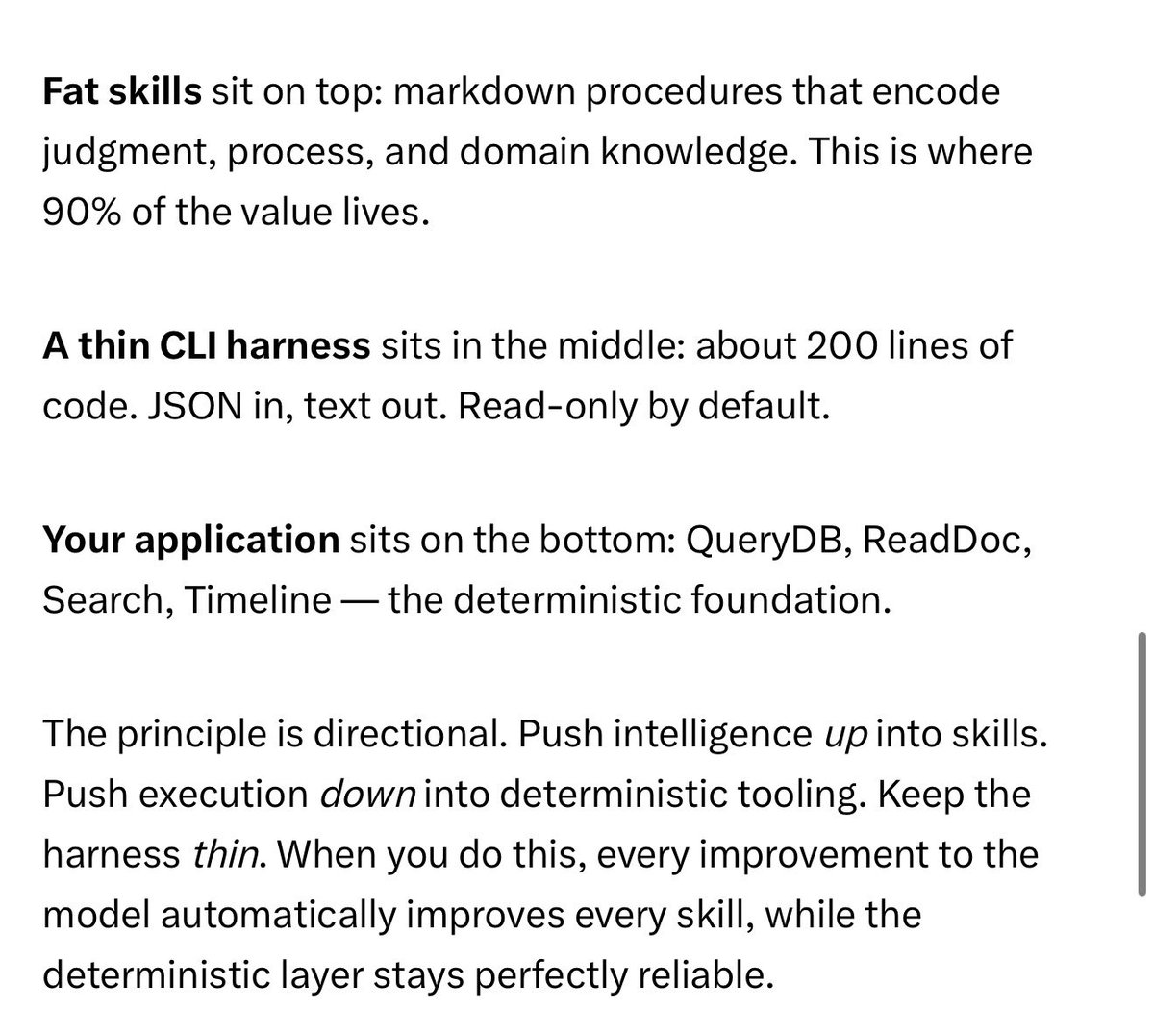
This is the simplest distillation of what I have learned about agentic engineering this year
Push smart fuzzy operations humans do into markdown skills. Fat skills.
Push must-be-perfect deterministic operations into code. Fat code.
The harness? Keep it thin.
104
211
2,755
220,221
Look I've been telling you too
54
50
789
266,983
Ian Tien retweeted

Mar 31
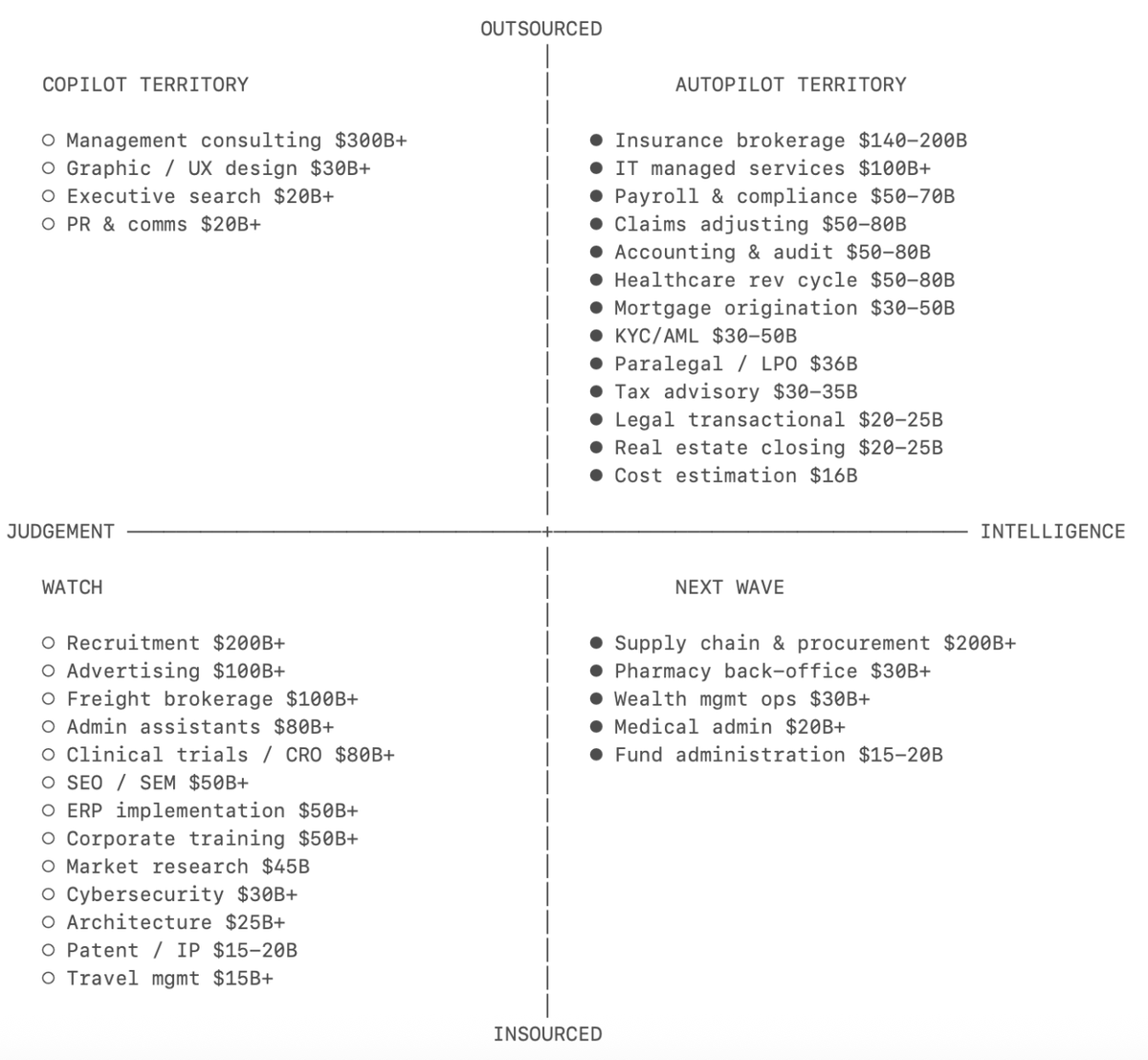
sequoia put out a blog post called "services is the new software"
look at this map of over $1T in services being replaced by AI agents
269
498
4,228
625,822
Ian Tien retweeted

Mar 13
Our cracked team just used Software Factory to rebuild and replace Jira in a little more than a month.
We first spent 3.5 weeks planning. This is Software Factory’s superpower.
It allowed our lead PM, Designer and Architect to thoughtfully describe and detail exactly what they wanted. Software Factory then did the heavy lifting in filling in the blanks and allowing our senior tech folks to sharpen the direction of what they wanted.
Then in 2.5 weeks 2.5 junior devs built a replacement.
This will launch as an updated Planner module inside of Software Factory on Tuesday.
It’s beautiful, clean and super useful.
Try it here: 8090.ai
255
82
1,417
1,068,114
Ian Tien retweeted

Mar 10
Airbnb founder Brian Chesky on how to design an amazing user experience
“How do you make something for a million people? I don’t know where to start. But if you pick one person, study them, and take their journey, you can actually build something really personal. You can design something and keep iterating until they love it. Don’t stop improving it until that person loves it, and you’re not allowed to move to the second person until the first person loves it. Then you get the second person and keep iterating until they love it. And so on.”
As Brian argues, designing the perfect experience for one person is a much easier place to start than trying to design something for a million people. You can figure out how to scale it later.
“If you can design something really amazing using the hand-crafted part of your brain, then you can reverse-engineer how to industrialize this millions of times over. And what happens is people love your product and they tell everyone else about your product.”
When people truly love your service, they become your marketing department. But counterintuitively, the biggest and best products seem to mostly get started by solving a very specific problem for a very specific user.
Video source: @StanfordGSB (2023)
17
30
303
28,816
Ian Tien retweeted

Mar 6
Last week, @Flexport released an AI agent that can audit bills from shippers and truckers against the actual logs to ensure its customers are invoiced correctly.
The product was just an idea 3 days before.
"We probably pivoted 30% to 40% of our engineers now just to building agents," founder Ryan Petersen (@typesfast) says.
"There's way less planning than there used to be at Flexport in the roadmap. It used to be a one year strategic plan. Now you're like, ‘Alright, let's go see if you can make this work, come back to me two days later.' And it works, because of AI.”
Catch the full interview on The Upstarts Podcast:
YouTube: youtube.com/watch?v=1JamC0Wv…
Apple: podcasts.apple.com/us/podcas…
Spotify: open.spotify.com/episode/1S1…
23
40
541
121,909
Ian Tien retweeted
Mar 5
The PM skill that matters in 2026 is taste at speed. Boris Cherny just showed everyone what that looks like.
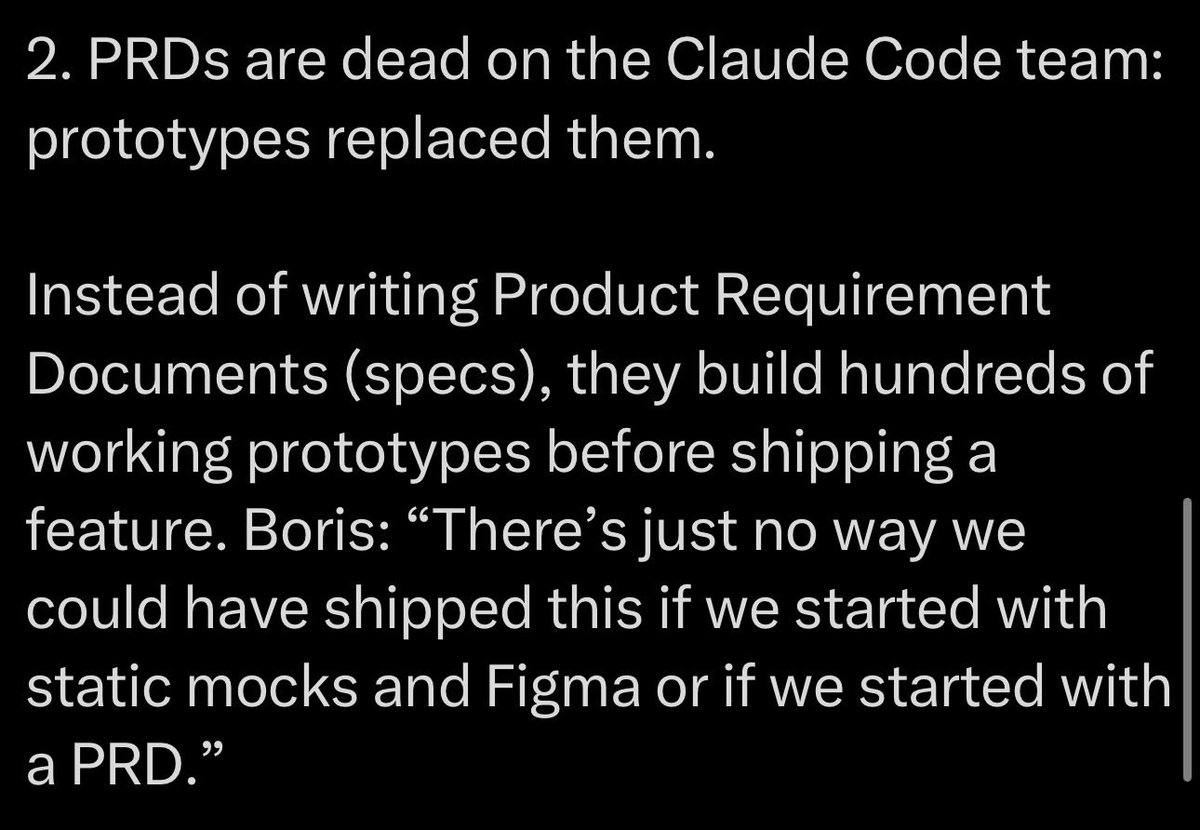
His Claude Code team at Anthropic doesn’t write PRDs. They build hundreds of working prototypes before shipping a single feature. Boris personally ships 20-30 PRs a day running 5 parallel Claude instances. They built Cowork, a full product for non-engineers, in about 10 days.
Everyone in the replies is debating whether PRDs should die. Wrong conversation. The real question is what happens to the PM who can’t evaluate 15 prototypes and pick the 3 worth shipping.
Because here’s what changes when building costs near zero: the bottleneck moves from “can we build it” to “should we ship it.” PRDs existed because building was expensive and you needed sign-off before committing resources. When a prototype takes 45 minutes instead of 6 weeks, nobody needs a document to authorize exploration. They need someone who can look at working software and say “this one, not that one” in real time.
On the Claude Code team, PMs code. Data scientists code. User researchers code. Boris said productivity per engineer grew 70% even as Anthropic tripled in headcount. The coordination cost of translating specs into code disappears when everyone can build. And that changes what a PM is actually good for.
Boris said it himself: “There’s just no way we could have shipped this if we started with static mocks and Figma or if we started with a PRD.” The old process would have spent more calendar time documenting Cowork than his team spent building it.
This is the Claude Code team today. It will be most fast-moving teams within 18 months. The PMs who thrive will be the ones reviewing prototypes at 9am, killing 80% of them by noon, and shipping the survivors by end of week. Pattern matching across user research, technical feasibility, and business model simultaneously while staring at working software.
The PMs who struggle will be the ones still writing 15-page specs for features that could be prototyped, tested, and validated before the doc hits its first review cycle. Taste at speed is the new moat.

you must internalize this ASAP:
- less handoffs, decide fast
- faster exploration
- encourage to throw away code/tokens
- learn by building, de risk with code
- pick leads that can own design, eng and product
33
36
441
99,506
Before AI, the newest version of enterprise software only lasted 6-9 months before competitors caught up, the market moved forward, and leaders had to innovate in driving more value for customers.
Moreover, leaders had to constantly compete against their current and previous offerings—the same way iPhone 17’s biggest competitor is iPhone 16 and “good enough”
With AI, the innovation and obsolescence cycles will be faster, and there may be more competitors, including customers themselves.
Leaders need to fully embrace AI (in a responsible and effective way). They need to understand there will be more competition, and turn the dial up on the speed and precision of delivering value—not super different than riding other innovation and obsolescence waves: Smartphone, Internet, and PC.
34
Ian Tien retweeted

Mar 3
The force multiplier of the agent harness right now is crazy. The industry has landed on some architectural consistency, but there are still so many different variants of how to attack this. Maybe this gets bitter lessened out of existence, but for now it’s a huge lever.

48
59
637
222,082
I was on a plane yesterday vibe coding and the 20 something engineer sitting next to me asked me what I was doing. He had heard about these tools but don’t use them.
I was blown away. These tools are like the holy grail for engineers! It’s Feb 2026 and you haven’t tried it yet?
Feb 20

Head of Claude Code @bcherny says Claude Code now writes 100% of his code, no manual edits since November, up from 20% in February and 30% in May.
216
54
1,371
531,601
Ian Tien retweeted
Feb 12
Is on-premise the new cloud?
I’m beginning to think yes.
It’s the only way for companies to not blow themselves up and have some semblance of capability in an AI world…
415
120
2,366
793,948
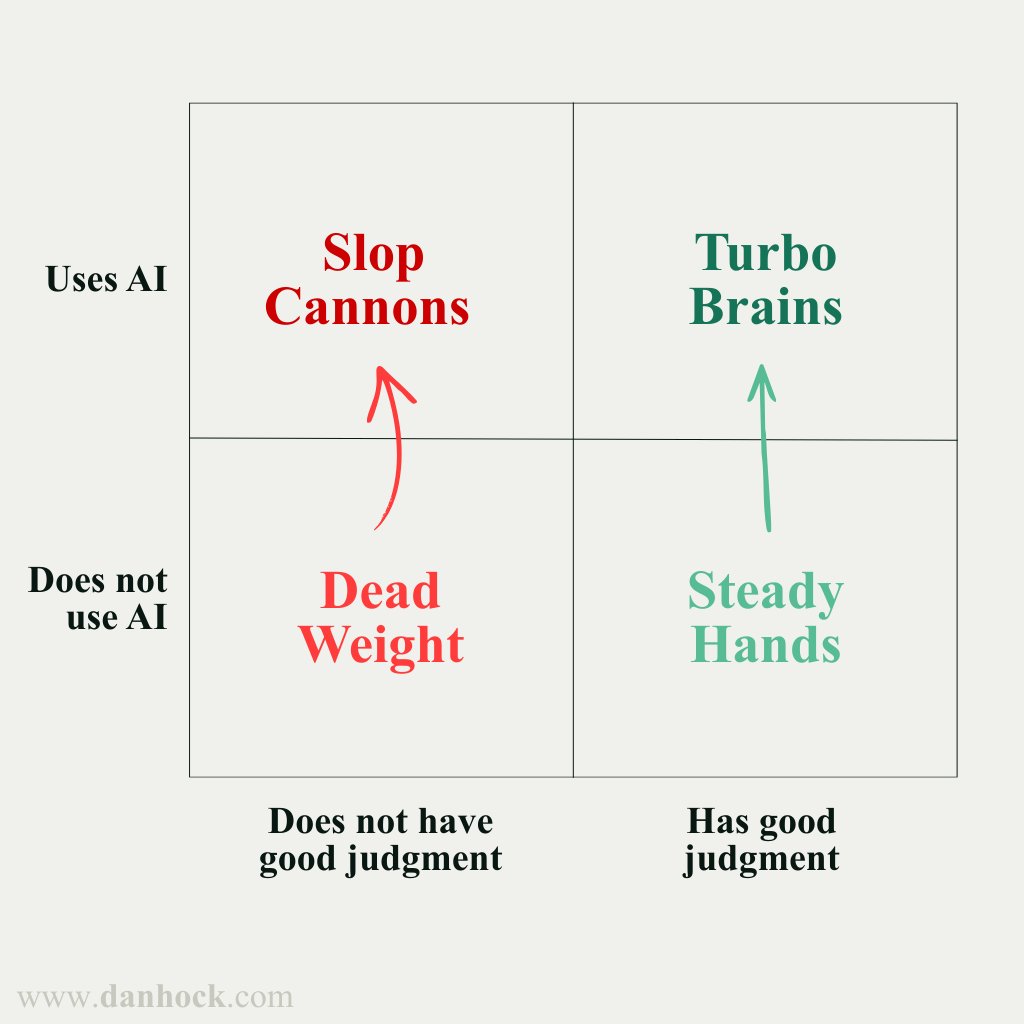
Useful four quadrants
Feb 11

Four types of people at every company now
yes, people get 10x better when the go from bottom right to top right
but also, people get 10x worse when they go from bottom left to top left
14
12
267
59,078
Ian Tien retweeted

Jan 12
8,689
46,027
301,041
187,117,619