
Dad, Entrepreneur, Investor, Amateur tennis 🎾 player Founder @Pixelmatters_ & @PixelVentures_ & @joinUpsideClub 💸 €30M in sales over the past 12y
Joined July 2009
- Tweets 12,010
- Following 1,245
- Followers 2,029
- Likes 26,766
1,085 Photos and videos

Pinned Tweet

16 Oct 2025
Super excited about our new initiative at @Pixelmatters_, positioned to help overseas enterprises open their Tech Hub in Portugal. 🇵🇹
ℹ️ info here: pixelmatters.com/insights/op…
If you'd like to know more, just DM me here on X! 💪
2
2
13
4,944
André Oliveira retweeted

Jun 13
Disabling Fable 5 and other models for foreigners is not a misunderstanding or a mistake, it’s the inevitable result of technology shaping warfare so that sovereignty is more about code than cannons.
With high energy costs and the emphasis on safety not opportunity Britain’s response has been to build the brake cutting ourselves off from the future and tied ourselves to the past.
We cannot continue like this and remain sovereign.
Jun 13

The US government, citing national security authorities, has issued an export control directive to suspend all access to Fable 5 and Mythos 5 by any foreign national, whether inside or outside the United States, including foreign national Anthropic employees.
The net effect of this order is that we must abruptly disable Fable 5 and Mythos 5 for all our customers to ensure compliance.
Access to all other Claude models is not affected.
We apologize for this disruption to our customers. We believe this is a misunderstanding and are working to restore access as soon as possible.
Read our full statement: anthropic.com/news/fable-myt…
105
206
1,372
151,537
André Oliveira retweeted

Jun 13
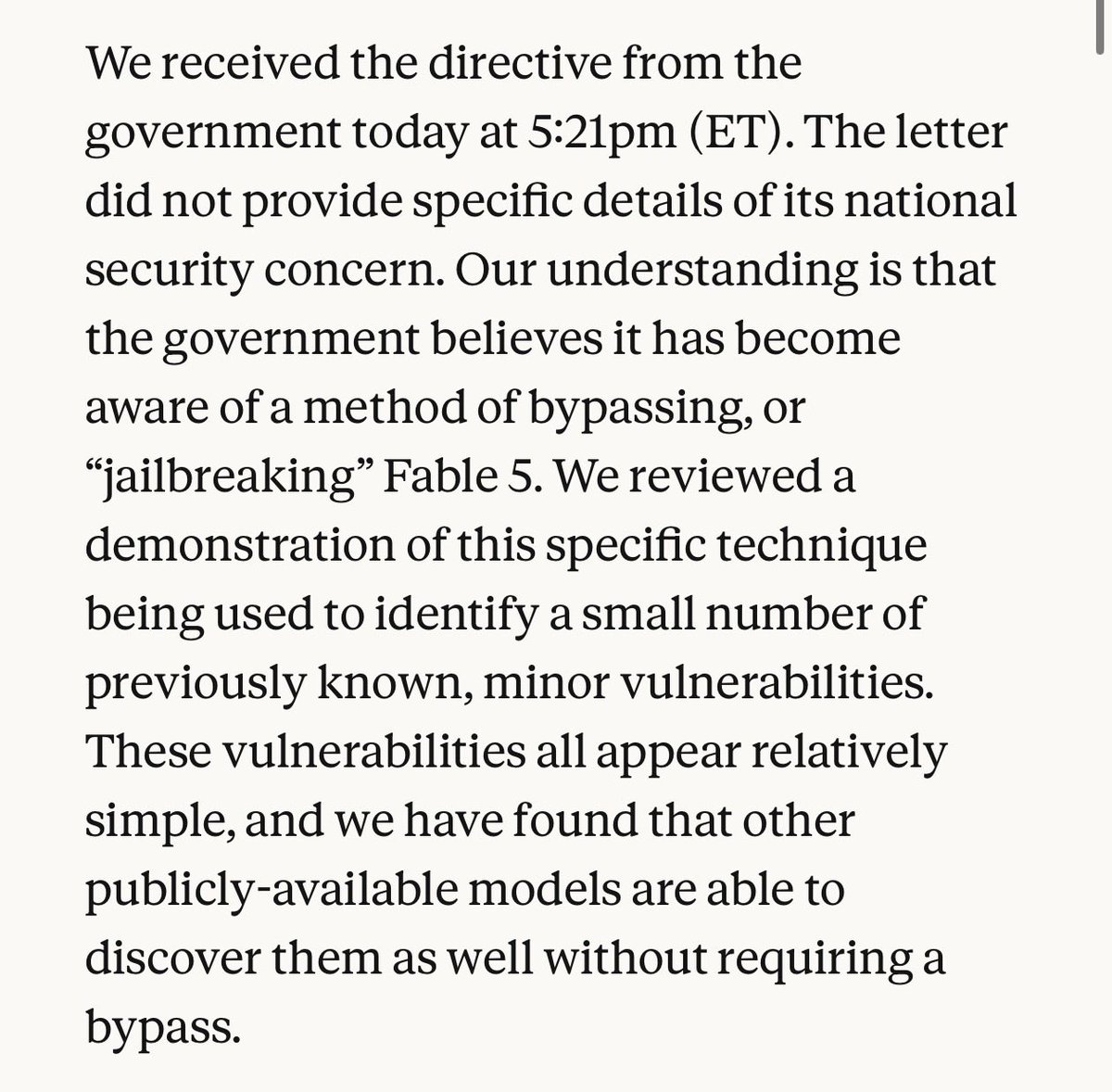
This is a big turning point for AI regulation.
The government is starting to deem some models too powerful for certain uses, which creates a precedent for a range of possible controls in the future.
I’m in the camp that this is unnecessary and we should be primarily regulating the use of AI, as opposed to the underlying models. But, equally, there are plenty of people that actually prefer this outcome.
Either way, it’s unlikely that we’re going back to a world where the government doesn’t have far more meaningful involvement in the rate of AI progress.
Jun 13
The US government, citing national security authorities, has issued an export control directive to suspend all access to Fable 5 and Mythos 5 by any foreign national, whether inside or outside the United States, including foreign national Anthropic employees.
The net effect of this order is that we must abruptly disable Fable 5 and Mythos 5 for all our customers to ensure compliance.
Access to all other Claude models is not affected.
We apologize for this disruption to our customers. We believe this is a misunderstanding and are working to restore access as soon as possible.
Read our full statement: anthropic.com/news/fable-myt…
97
47
579
112,930
André Oliveira retweeted

Jun 13
Today the US government ordered Anthropic to cut off its most capable AI models — Fable 5 and Mythos 5 — to every foreign national on earth. Not just rivals. Allies. Even Anthropic's own non-American employees. Within hours, 34 million people had seen the announcement.
The official rationale is national security. The real question it forces is bigger than any export rule: in a world where machines are becoming strategically decisive, who gets to think with the best ones?
There's a serious argument for the monopoly — frontier AI as something closer to fissile material than software, best kept in few, accountable hands. I take that argument seriously in the essay. And I think it fails, fatally, on one fact: the monopoly cannot exist. In January 2025 a Chinese lab published open-weight models at the frontier, for anyone to download. You cannot embargo a number once it's discovered.
What's left, once you accept that, is the most dangerous configuration of all: one government deciding who may think with the smartest machines — revocable overnight, applied even to friends.
The answer isn't a bomb you hoard. It's the opposite of scarcity. Safety in this technology comes from plurality: many models, many developers, many jurisdictions, no single hand on the switch.
For Europe, this is a fire alarm. You cannot regulate your way to relevance in a technology you can be cut off from at will. The one card that answers a passport-based embargo is open weights — models you can run on your own hardware, that no directive in Washington or Beijing can switch off.
And Europe should go further: open its doors to every AI firm and researcher on earth — many of them European already — with a guarantee that here, this will never happen to them. This is the moment that tests who had real social concerns all along, and who only wanted a seat at the regulator's table.
Frontier intelligence is too important to be rationed by passport.
This is a defining moment, for AI and for geopolitics.

6
15
65
6,604
André Oliveira retweeted

Jun 13
⚡️This is a monster signal.
This is the moment frontier AI stops being treated like software and starts being treated like controlled strategic capability.
The key phrase is not “customers.”
The key phrase is “foreign national Anthropic employees.”
That means the state is no longer only controlling chips, model weights, or overseas access. It is moving into cognition access by nationality. That is the real threshold. The U.S. government is saying the highest models are sensitive enough that even people physically inside the United States, working inside the company, may be barred from touching them if their nationality creates deemed-export risk.
That is weapons-control logic.
This is ITAR logic for intelligence.
The corporate language about a “misunderstanding” is probably diplomacy.
Companies say that when they need to preserve customer trust, employee morale, and regulatory room. But national security authorities do not force emergency suspension of top model access because someone made a minor paperwork mistake.
Something about Fable 5 and Mythos 5 crossed the line: cyber capability, autonomous R&D acceleration, AI-improving-AI utility, bio/security planning, code exploitation, or some blend of all of it.
The U.S. state just showed that Anthropic does not fully control Anthropic’s frontier layer.
That is the phase change.
Labs can brand themselves as public-benefit AI companies. They can talk about safety. They can sell enterprise plans. They can publish model cards. But once the models become national capability, the sovereign arrives. The state does not need to own the company to control the access surface. It only needs legal authority over export, security, procurement, and liability.
This confirms the arc we’ve been tracking:
Frontier AI becomes state-supervised strategic infrastructure.
Public AI splits from strategic AI.
Foreign access gets restricted.
Labs become quasi-defense contractors.
Model access becomes a national security perimeter.
Enterprise customers learn that API access is not property. It is revocable permission inside a sovereign-controlled stack.
The most important implication is organizational.
If foreign national employees can be cut off from frontier systems, AI labs now have to reorganize internally around citizenship, clearance, compartmentalization, and controlled access. That breaks the old Silicon Valley assumption that global talent can freely collaborate around the frontier. The next AI lab structure looks less like Google in 2015 and more like a defense prime crossed with a classified research facility.
For markets, the winners are the national champions with U.S.-aligned infrastructure, cleared customer channels, government relationships, compliance capacity, and domestic compute. The losers are open access, foreign-dependent AI wrappers, offshore model distributors, and any enterprise whose moat depends on unrestricted access to frontier APIs.
For geopolitics, this is escalation. China will read this correctly. Allies will read this correctly. Every serious state will understand that frontier models are now part of national power.
The AI race just moved from “who has the best chatbot” to “who controls cognition as a strategic asset.”
Jun 13
The US government, citing national security authorities, has issued an export control directive to suspend all access to Fable 5 and Mythos 5 by any foreign national, whether inside or outside the United States, including foreign national Anthropic employees.
The net effect of this order is that we must abruptly disable Fable 5 and Mythos 5 for all our customers to ensure compliance.
Access to all other Claude models is not affected.
We apologize for this disruption to our customers. We believe this is a misunderstanding and are working to restore access as soon as possible.
Read our full statement: anthropic.com/news/fable-myt…
106
239
1,534
616,971
André Oliveira retweeted

Jun 13
The US government, citing national security authorities, has issued an export control directive to suspend all access to Fable 5 and Mythos 5 by any foreign national, whether inside or outside the United States, including foreign national Anthropic employees.
The net effect of this order is that we must abruptly disable Fable 5 and Mythos 5 for all our customers to ensure compliance.
Access to all other Claude models is not affected.
We apologize for this disruption to our customers. We believe this is a misunderstanding and are working to restore access as soon as possible.
Read our full statement: anthropic.com/news/fable-myt…
12,349
25,611
87,179
87,191,979
Jun 12
Some of my most recent thoughts on the state of the industry and AI, here miguelrdelgado.substack.com/…
2
76
André Oliveira retweeted

Jun 9
Our website is expanding. 👀
Six new pages across Solutions and Services. A closer look at what we build and how we combine design, product, and engineering across Web Apps, Hybrid Mobile Apps, and Websites.
pixelmatters.com
2
3
242
André Oliveira retweeted

Jun 7
Rafa cannot be an inspiration. And I mean that seriously.
Watched the RAFA series on Netflix with my daughters this week. The 9 year old was okay and maybe even excited. The five-year-old had to be - let's say - firmly encouraged to stay seated.
I kept pausing to tell them where I was when some of these matches happened. The 2008 Wimbledon final - Nadal winning his first on grass, at dusk, in what many still call the greatest match ever played. The 2012 epic, which for a lot of people remains the most complete - for me a complete heartbreak. The 2022 comeback - a man who had been told his foot condition might end his career after his first few grand slams, winning not only his 14th Roland Garros but his second AO.
Each of those matches is etched somewhere specific in my memory. The emotions came back watching the documentary like they hadn't gone anywhere.
My daughters of course couldn't relate. They will grow up creating their own moments and their own memories. I hope sport is part of that and maybe even their own matches, who knows.
But I kept coming back to the thought I mentioned at the beginning as I watched the series.
Rafa cannot be an inspiration.
Nobody can look at what he did - the physical punishment, the sheer doggedness, the way he kept coming back when his own body was the opponent - and think: I can do that. He belongs to a handful of people across all of human history, in sport or any other field, who achieved what they achieved.
Holding him up as a template is almost unfair to the rest of us.
But here is what the documentary does show: At the absolute pinnacle of human achievement, he felt self-doubt. He wanted to give up. He lost hope. He questioned himself in ways that will feel familiar to anyone who has ever tried to build something or push through something hard.
And that is the more honest inspiration.
Court Philippe-Chatrier has the words engraved: "Victory belongs to the most tenacious." But the tenacity that matters to most of us isn't the tenacity to win the tournament. It's the tenacity to win your own inner doubts. To show up when everything in you is arguing for staying put.
Showing up isn't just how you succeed. Showing up is the success.
My daughters will figure that out in their own way, in their own time. I just hope they have their own version of those matches to look back on when they need reminding.
Well done Netflix. Made me cry.
60
262
2,437
436,950
André Oliveira retweeted

Jun 3
Welp, that happened faster than I predicted. Thought it would be end of 2027, then early 2027, but agentic traffic growing so fast that bots have now passed human traffic online for the first time in the Internet's history. radar.cloudflare.com/traffic…
388
2,169
8,318
2,242,134
Jun 3
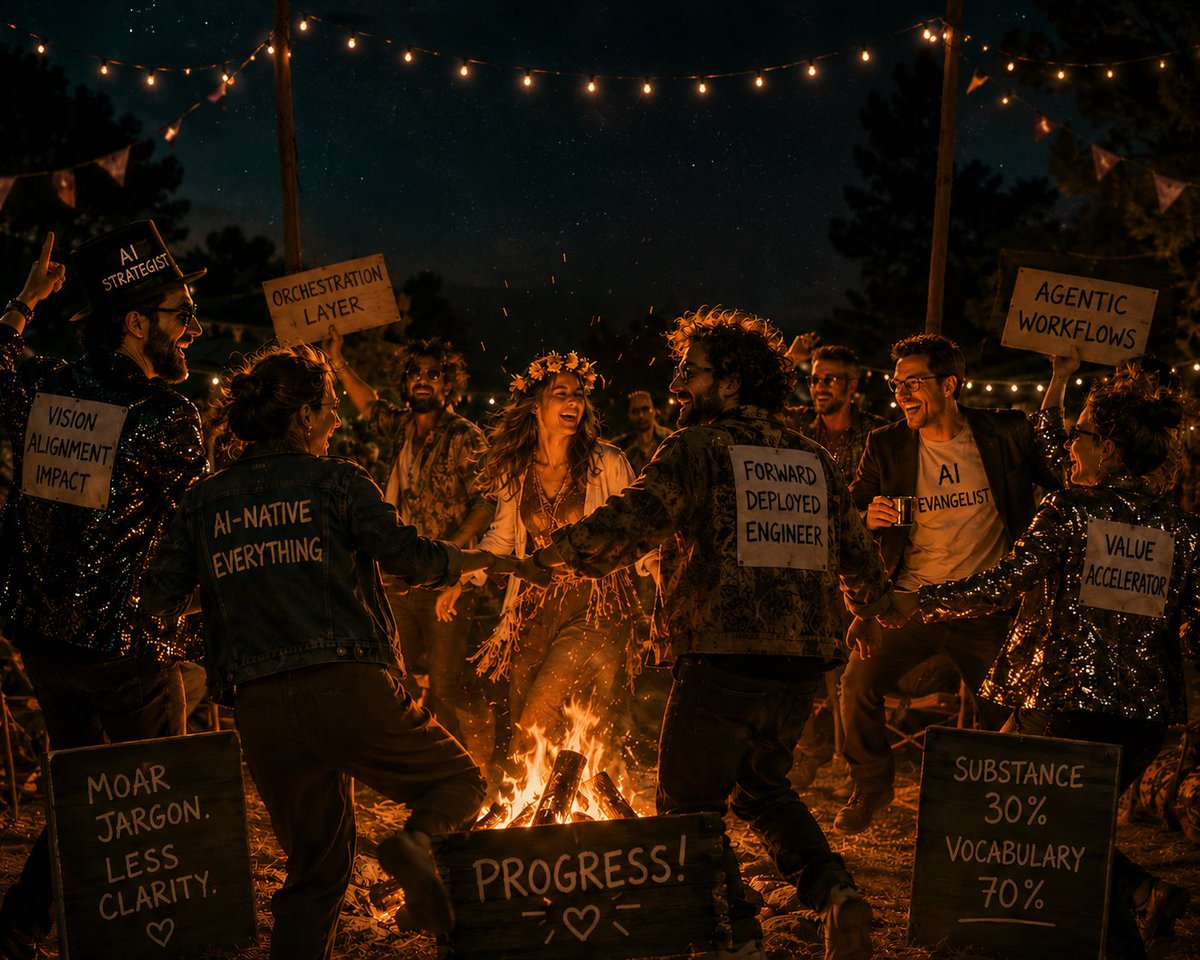
Here's my honest take on the state of non-infra AI services as of June 2026 ⬇️
→ With few exceptions, nobody really knows what they're doing.
→ The current winners aren't the best at doing the work. They're the best at marketing it.
→ It's all about naming and packaging. The people, the roles, the skillsets are the same... and were already there.
→ Turning a "Consultant" into a "Forward Deployed Engineer" is the best rebrand of the decade.
→ Half the offerings are 30% substance, 70% vocabulary. Agents, orchestration layers, agentic-stuff, AI-native everything.
→ Surprisingly or not, clients are buying the jargon! Makes the FOMO go away.
→ So yeah, we're all kinda throwing sand in each other's eyes. And we're all kind of enjoying it. It feels like progress!
Follow me for more inspiring takes. 😅
1
2
345
André Oliveira retweeted

Jun 3
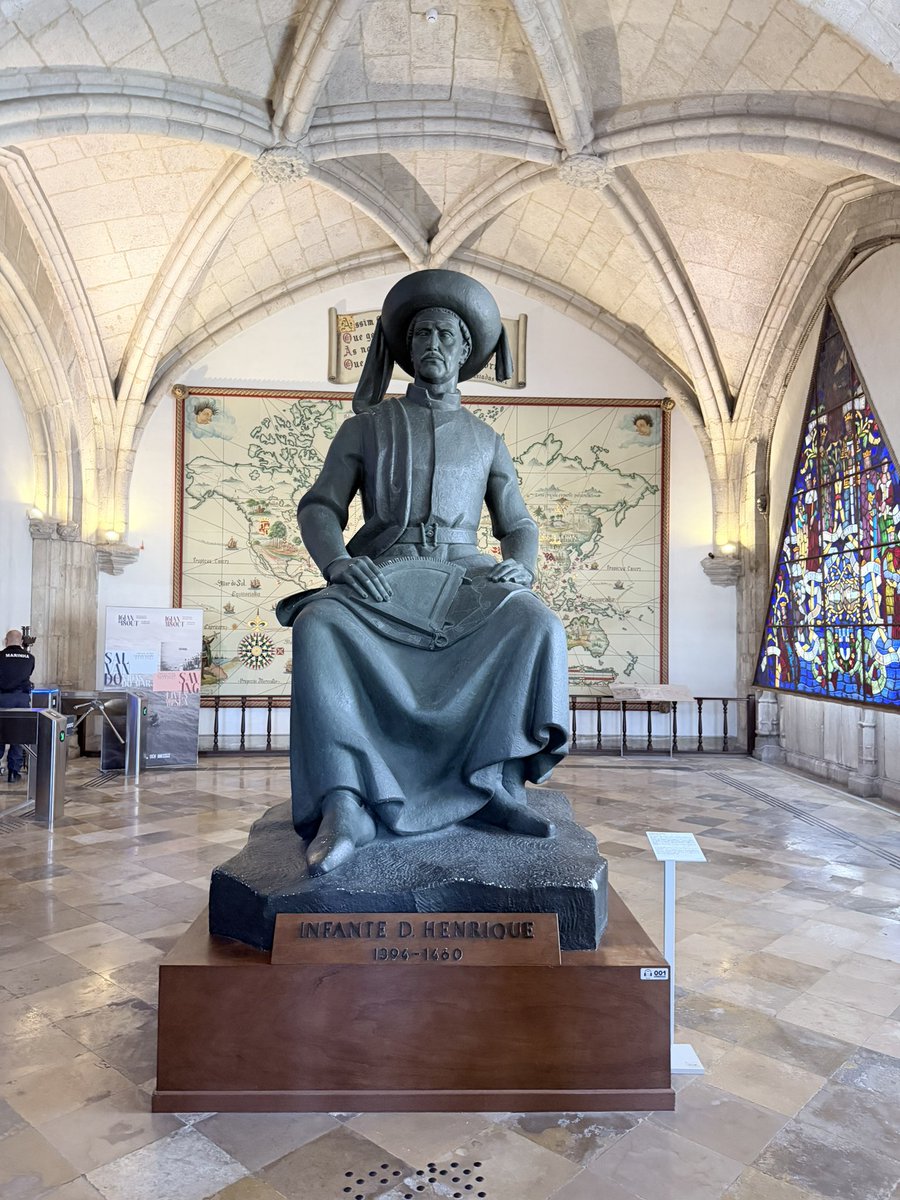
The Portuguese under Henry the Navigator invented the technology to explore the world.
Now struggling to run the passport processing machines at the airport.
184
130
1,878
121,724
André Oliveira retweeted
Jun 2
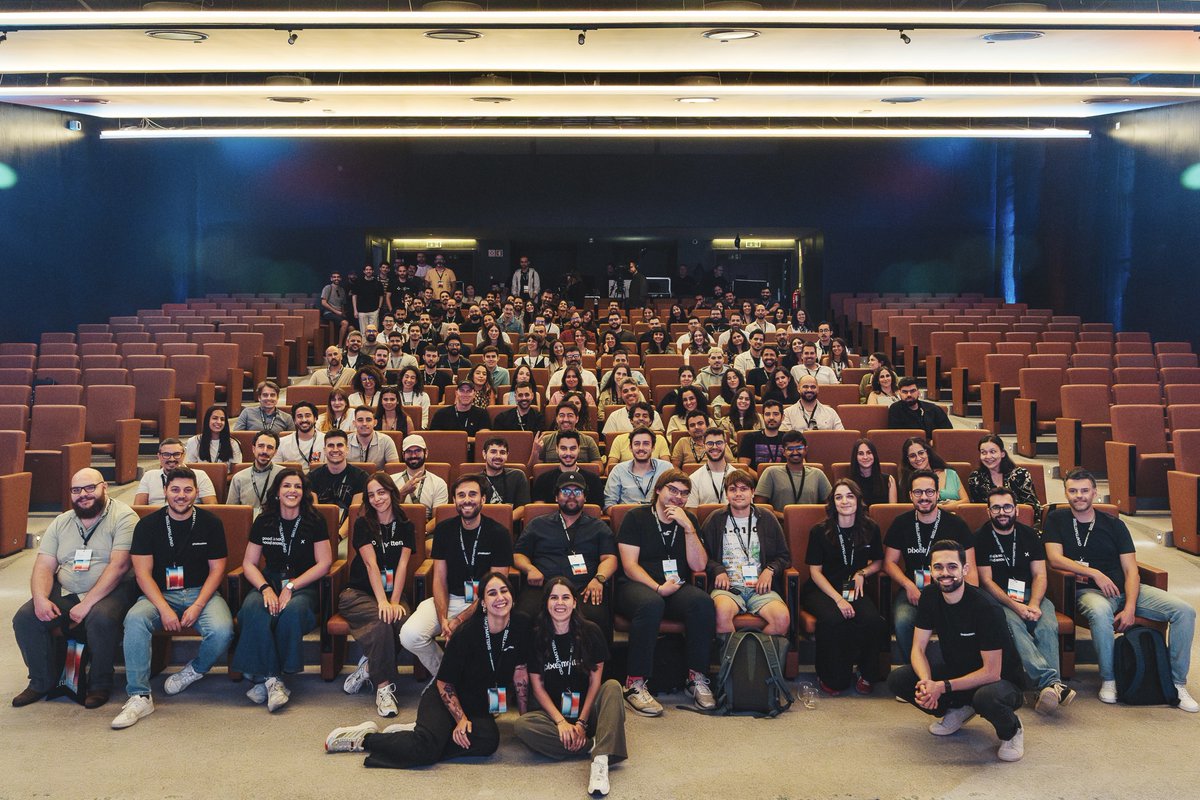
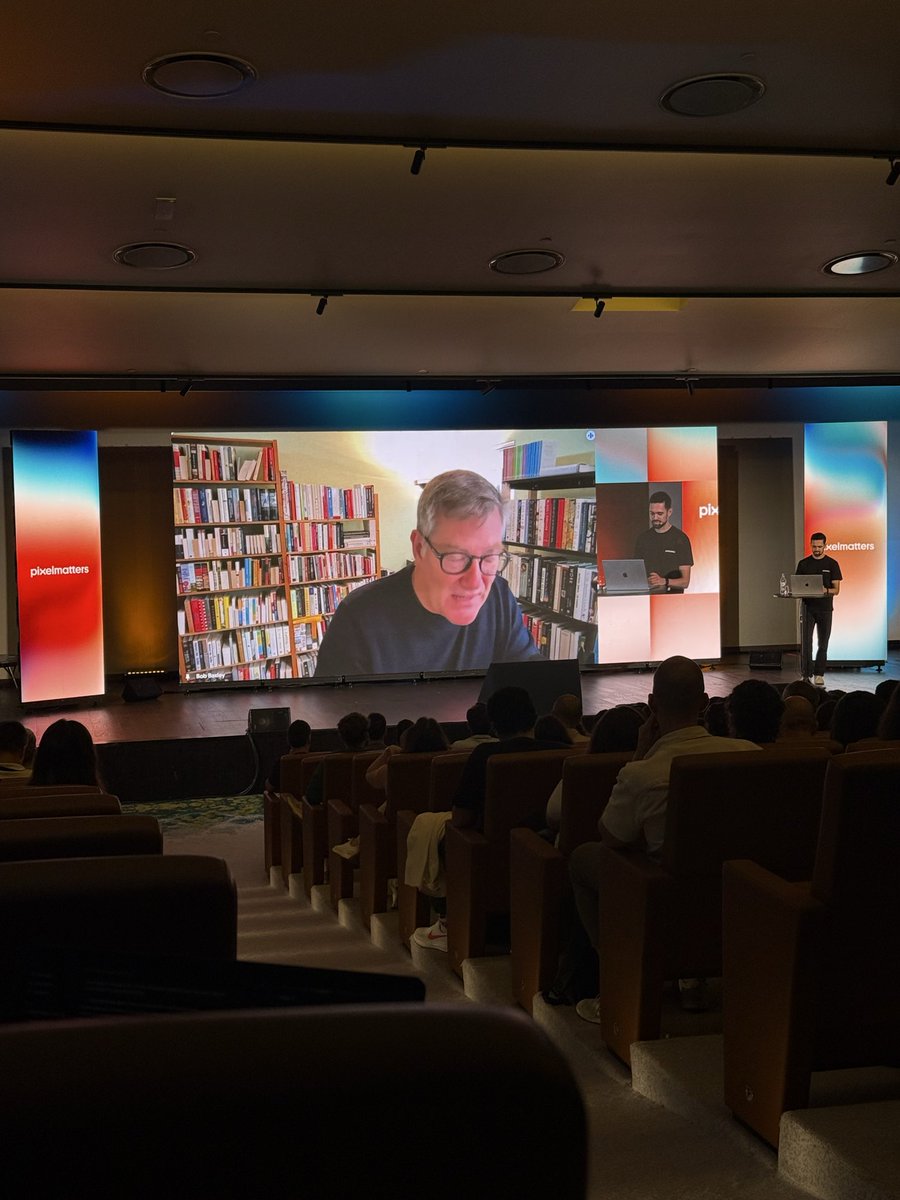
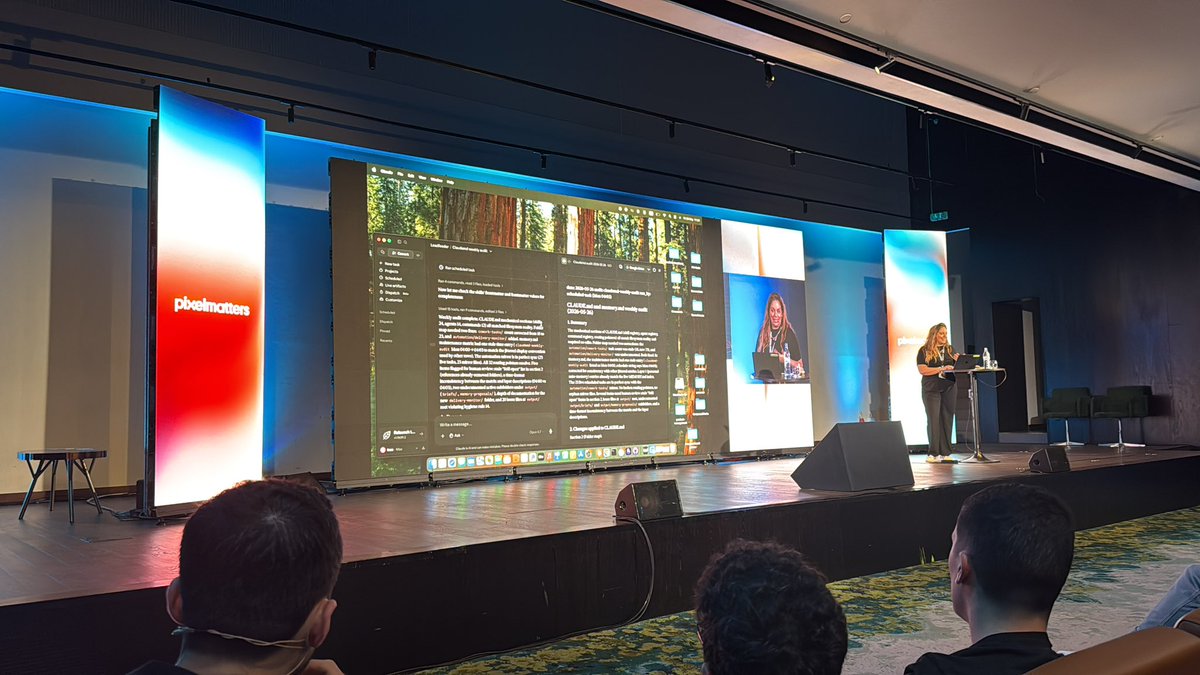
Craftmatters 2026, in 60 seconds ⚡️
A full day of real conversations about craft, AI, and building great products. Thank you to everyone who made it happen 🔥
1
1
95
Jun 1
Craftmatters conference by @pixelmatters_ 2nd Edition is in the books. ✨
It was "Premium but intimate".
I believe we, as @Pixelmatters_ and as a community, may be creating something special here.
We're putting Portugal on the map, with something that may slowly be becoming one of the best small digital Conferences in Europe. 🇵🇹 🇪🇺
See you all next year!
1
12
513
May 29
1
135

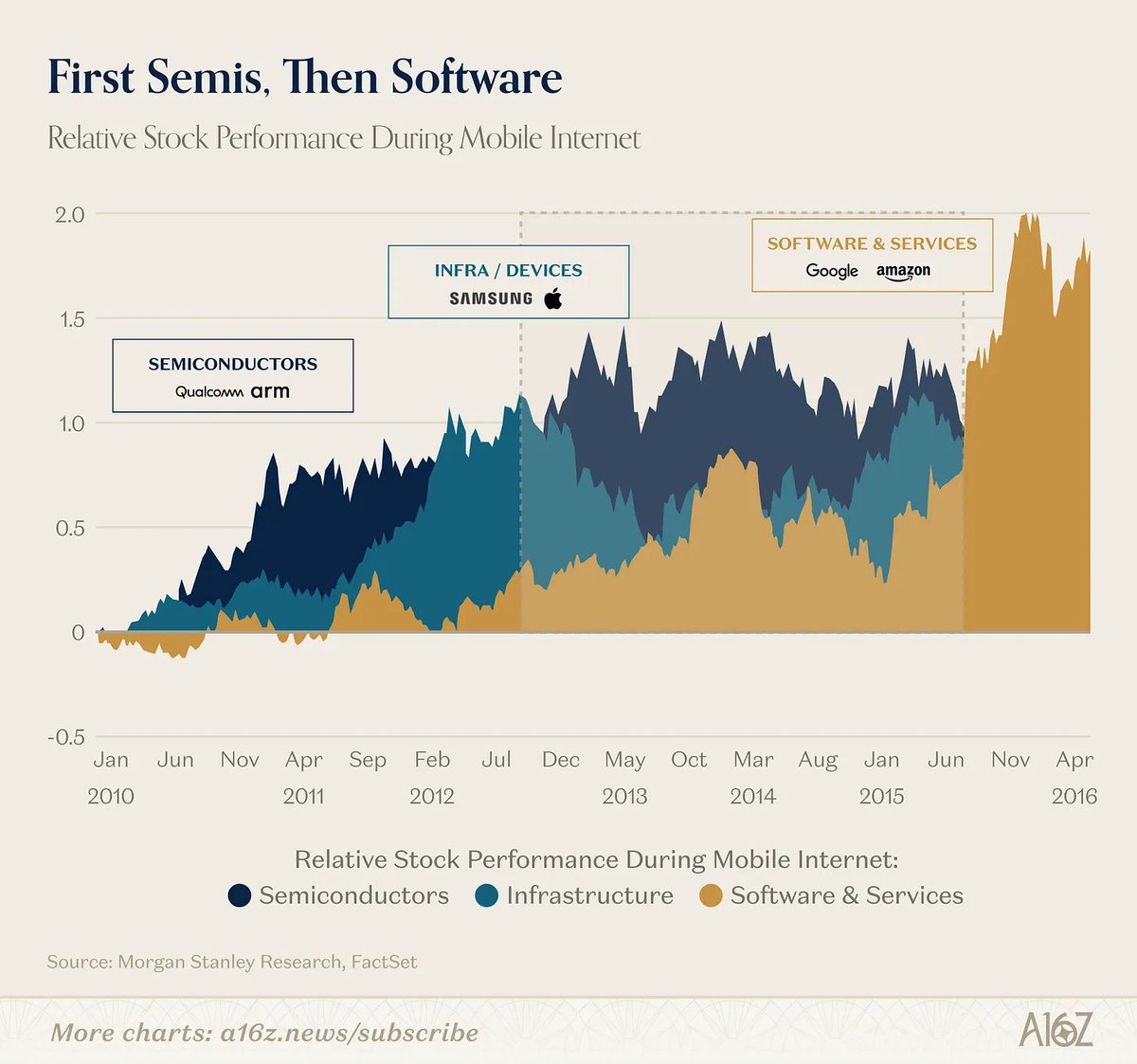
OpenAI and Anthropic are effectively telling the market they can't solve every problem with a generic AI coworker.
You don't pour billions into massive forward-deployed joint ventures if you think the next model release is going to take care of it.
In the cloud supercycle, semis led and software followed (and you didn't need Qualcomm or ARM to tell you the value was migrating up the stack).
In AI, the infra layer itself is telling us the application layer is a separate, massive opportunity they can't fully capture.
a16z's @joeschmidtiv on why the app layer isn't dead: a16z.news/p/avoiding-death-o…

183
413
3,292
1,020,474
May 26
20.000 people already watched my podcast with @miguel_milhao — aka Mike Billionzz! 🔥
The DMs have been great. Some of the public comments… less so. This combo is what makes these public chats to be so fun and worthwhile. 😀
If you haven't watched it yet, you're still on time:
→ YouTube: youtube.com/watch?v=vT9R9npa…
→ Spotify: open.spotify.com/episode/65u…
9
1,119
May 26
This is a glimpse into the future in the form of a layoff letter
May 21

Today we reduced headcount by 22%. The business is the strongest it's ever been. So I think it's important to be direct about what I'm seeing and why.
First, I made this decision and I own it. I did it because the way to operate at the highest level of productivity is changing, and to win the future, ClickUp needs to change with it.
Second, this wasn't about cutting costs. Most savings from this change will flow directly back into the people who stay. We'll be introducing million-dollar salary bands. If you create outsized impact using AI, you'll be paid outside of traditional bands.
Most importantly, I have the deepest gratitude for those affected. We're doing this from a position of strength specifically so we can take care of people properly. Everyone affected receives a package aimed at honoring their contributions and easing the transition.
I only see two options: wait for this to play out gradually in the market or be honest about what I'm seeing and act proactively.
THE 100X ORGANIZATION
The primary change is that we're restructuring around what I call 100x org. The goal is 100x output. The roles required to build at the highest level are fundamentally different than they were a year ago.
Incremental improvements to existing systems won't get us there. We need new ones. That means creating enough disruption to rebuild rather than iterate on what's already broken.
The common narrative is that AI makes everyone more productive. It doesn't. Many of the workflows of today, if left unchanged, create bottlenecks in AI systems.
These roles will evolve. But waiting for that to happen naturally means falling behind now.
The 100x org is actually heavily dependent on people - infinitely more than today. This is only possible with 10x people that have embraced and adopted new ways of working.
THE BUILDERS, AGENT MANAGERS, AND FRONT-LINERS
— THE BUILDERS: 10X ENGINEERS
I don't think most companies have internalized what's actually happening with AI in engineering. The common narrative is that AI makes all engineers more productive. That may be true in isolation, but at an organization level - that is the farthest thing from reality.
Here's what we've validated recently at ClickUp: the great engineers, the ones who can orchestrate, architect, and review, are becoming 100x engineers. They're not writing code. They're directing agents that write code. The skill is judgment.
AI makes the best engineers wildly more productive, and everyone else using AI slows these engineers down.
Think about it - the bottlenecks are (1) orchestration - telling AI what to do, and (2) reviewing - what AI did. Everything is leapfrogged and no longer needed.
So who do you want orchestrating and reviewing code?
And how do you want your best engineers to spend their time?
If your best engineers are spending time reviewing other people's code, then this is inherently an inefficient bottleneck. These engineers can review their agent's code much faster than reviewing human code.
The new world is about enabling your 10x engineers to become 100x.
The wrong strategy is to push every engineer to use infinite tokens. Companies doing this are celebrating 500% more pull requests. But customer outcomes don't match the volume of code being generated.
I call this the great reckoning of AI coding, and every company will face this soon if not already.
More code is just another bottleneck to the best engineers, and ultimately to your company's impact as well.
— THE BUILDERS: 10X PRODUCT MANAGERS
Product management and design roles are merging.
Designers that have customer focus, become more like product managers.
And product managers that have intuition for UX become more like designers.
The bottleneck of user research is gone. It takes us just one mention of an agent to kickoff research and analyze results.
The bottleneck of product <> design iteration is also gone. The product builder iterates on their own, along with agents and skills that ensure alignment with quality and strategy.
Also controversial today - I believe that the wrong strategy is to have your PMs shipping code - that just introduces another bottleneck that the best engineers will waste their time on.
To be clear, PMs should be coding but they should do this in a playground to iterate, validate, and scope. That code should not go to production.
Everything outside of managing systems, orchestrating AI, and reviewing output becomes a bottleneck.
That's why the other roles that are critical along with these are the systems managers (to reduce bottlenecks) along with a bottleneck you can't replace - customer meeting time.
— THE SYSTEM MANAGERS
Ironically, the people that automate their jobs with AI will always have a job. They become owners of the AI systems - agent managers. We have many examples of these people at ClickUp.
The underlying systems in which we operate are absolutely critical to get right. I think most companies are delusional to think they can iterate on existing systems and compete in this new world.
You must create enough disruption so that old systems are deprecated entirely. If there's any definition for 'AI native' that's what it is.
— THE FRONT-LINERS
In a world that will become saturated with AI communication, the human touch will matter more than anything to customers.
This is a bottleneck that you shouldn't replace - even when agents are high enough quality to do video meetings.
One-on-one meeting time with customers is something that shouldn't be automated. The systems around the meetings should be - so that front-liners spend nearly 100% of their time with customers.
REWARDING 100X IMPACT
In a world where companies are able to do so much more with less, where does that excess money go?
In our case, much of the savings in this new operating model will flow directly back to those that enabled it.
We must reward people that create productivity accordingly. This aligns incentives on both sides. Plus, in a world where your best people create 100x impact, you can't afford to lose them.
You should aim to retain these employees for decades. The context they have and their ability to efficiently orchestrate and review will be nearly impossible to replace.
Compensation bands of today should be thrown out the door. We're introducing $1 million cash/year salary bands with a path available to nearly everyone in the company if they produce 100x impact by creating or managing AI systems.
THE FUTURE
Nearly every company will make changes like these. The ones that do it proactively will define what comes next.
The future is not fewer people. It's different work, new roles, and better rewards for those who embrace it. We're already seeing entirely new roles emerge, like Agent Managers, that didn't exist a year ago.
ClickUp is positioning to lead this shift, not just internally, but for our customers too. I've never been more certain about where we're headed.
1
3
794