
Joined January 2010
- Tweets 6,641
- Following 823
- Followers 447
- Likes 14,982
432 Photos and videos






satyam kumar retweeted

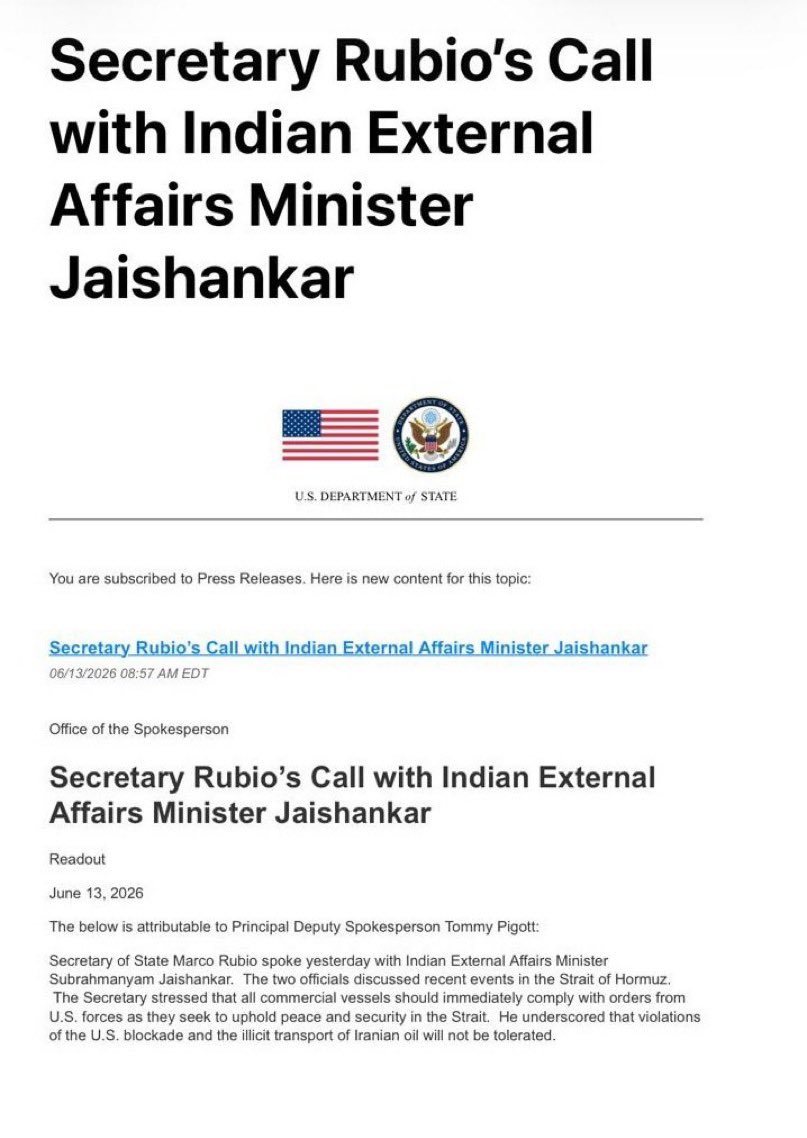
Deeply shocking to read this official US statement, which contains absolutely no expression of regret or condolence for the loss of innocent Indian lives. How can a “friend” and strategic partner be so deeply insensitive?
Why couldn’t a non-compliant commercial vessel have been stopped using other, non-lethal means? Is it not possible to disable a ship's propulsion or steering without firing missiles targeted to kill civilian crew members?
Practically every merchant ship navigating these crucial waters has Indian crew on board. Are they all considered fair game for US missiles now?
This approach is unacceptable and I hope @DrSJaishankar had said so to @marcorubio.
2,140
11,347
39,843
1,530,330

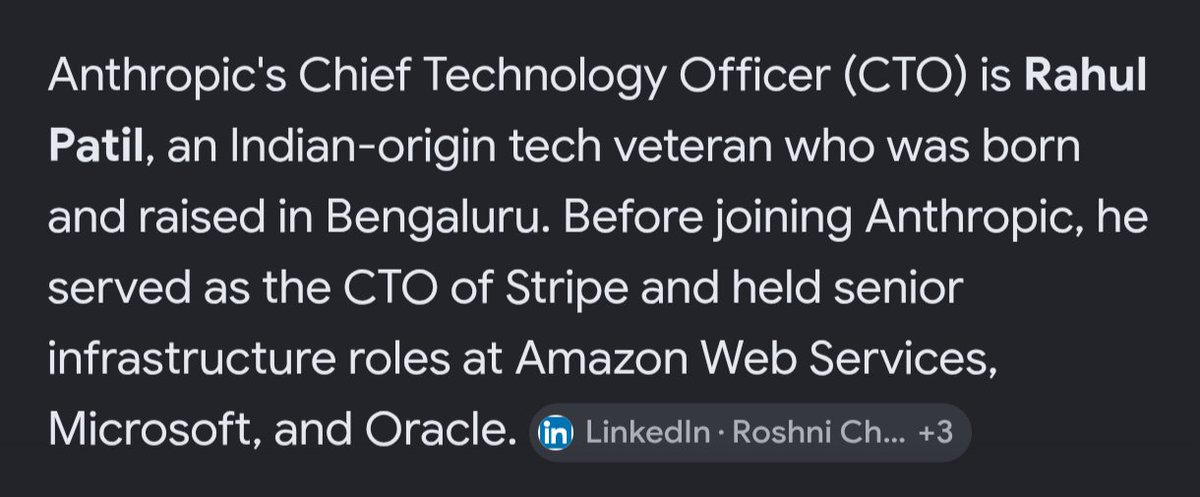
Even Anthropic CTO don't have Mythos/Fable access within this new regulation.
Jun 13

The US government, citing national security authorities, has issued an export control directive to suspend all access to Fable 5 and Mythos 5 by any foreign national, whether inside or outside the United States, including foreign national Anthropic employees.
The net effect of this order is that we must abruptly disable Fable 5 and Mythos 5 for all our customers to ensure compliance.
Access to all other Claude models is not affected.
We apologize for this disruption to our customers. We believe this is a misunderstanding and are working to restore access as soon as possible.
Read our full statement: anthropic.com/news/fable-myt…
43
90
1,260
83,453
satyam kumar retweeted

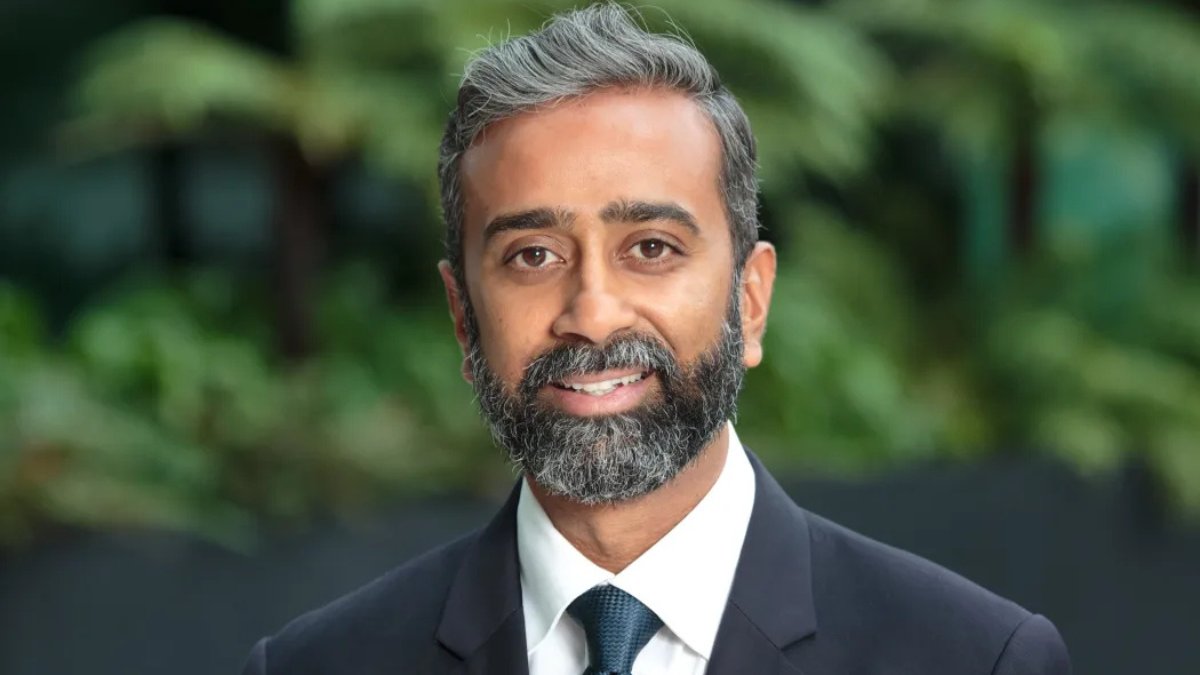
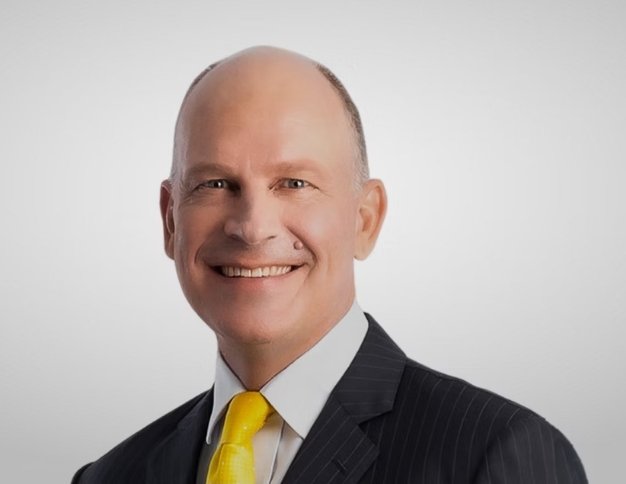
On the left is Nikhil Ravishankar. He went to school in New Zealand, worked all his life in NZ. Yet in 2025 when he was appointed CEO of Air New Zealand, the wave of online racism directed at him became such a tsunami that the country's 3 leading media outlets, the New Zealand Herald, 1News and Radio New Zealand, had to shut down their comments section. The sheer volume of racist comments made it impossible for moderators to do their job. It was like half the population of New Zealand had decided to be racist on Ravishankar.
On the right is Air India’s current CEO - New Zealander Campbell Wilson whose appointment in 2022 attracted no such backlash in India. Wilson hails from Christchurch, arguably the most racist city in New Zealand.
163
2,505
6,793
178,361
**AWS IAM in 2026: The Biggest Security Risk Isn't Your Network. It's Your Permissions.**
Most cloud breaches don't begin with a zero-day.
They begin with an access key.
An over-privileged role.
A permission nobody remembered existed.
Yet many organizations still treat IAM as a setup task instead of a continuously engineered system.
**DEEP ARCHITECT LENS**
Least privilege breaks at scale because permissions only move in one direction: they accumulate.
Across dozens of AWS accounts, thousands of roles, CI/CD pipelines, Kubernetes workloads, agents, and third-party integrations, IAM becomes a distributed systems problem.
The winning architecture is surprisingly consistent:
Federated identity.
Short-lived credentials.
Role assumption everywhere.
Org-wide SCP guardrails.
Permission boundaries.
Continuous access analysis.
Infrastructure-as-code.
The critical shift is moving from detective controls to preventive controls.
An alert after privilege escalation is an incident.
An SCP that makes escalation impossible is architecture.
**CEO / CTO / BOARDROOM LENS**
Identity failures create the highest leverage failures in cloud environments.
One leaked key.
One shared admin role.
One forgotten permission.
And years of security investment become irrelevant.
The business impact is not limited to security.
It affects compliance, customer trust, audit readiness, operational resilience, and regulatory exposure.
A mature IAM program reduces blast radius before an attacker ever arrives.
**MARKET SHIFT**
From:
Managing users and permissions.
To:
Engineering identity as a governed platform capability.
**WHAT ACTUALLY WORKS IN PRODUCTION**
Centralized SSO.
Zero standing admin.
OIDC-based CI/CD.
IRSA and workload identities.
Automated permission right-sizing from real usage.
Continuous Access Analyzer reviews.
Mandatory permission boundaries.
IAM managed as reviewed code.
**WHERE MOST TEAMS FAIL**
Long-lived access keys.
Shared administrator accounts.
Console-edited IAM.
Annual permission audits.
Copying AdministratorAccess to "unblock delivery."
Detection-first security instead of prevention-first architecture.
**ADOPTING STRATEGY**
Eliminate static credentials.
Federate every human identity.
Move workloads to role assumption.
Enforce SCP guardrails.
Automate permission pruning.
Measure blast radius, not policy count.
**FINAL INSIGHT**
In modern cloud platforms, identity is the perimeter.
The organizations that master IAM don't just reduce risk.
They make entire classes of breaches structurally impossible.
#AWS #CloudSecurity #IAM #PlatformEngineering #EnterpriseArchitecture #ZeroTrust #CyberSecurity #DevSecOps #CloudArchitecture #SecurityEngineering #InfrastructureAsCode #SystemDesign
appscale.blog/en/blog/iam-ha…
24
**NIS2 Is Not a Compliance Framework. It's a Production Architecture Test for 2026.**
Most executives think NIS2 is about policies.
Most auditors know it's about evidence.
Most attackers hope it's neither.
That's the problem.
When a major incident hits, regulators don't ask for your security strategy deck.
They ask for proof.
**DEEP ARCHITECT LENS**
NIS2 fundamentally changes how cloud platforms must be engineered.
The directive is not prescribing tools.
It's prescribing operational outcomes.
Identity controls.
Encryption.
Supply-chain security.
Incident response.
Business continuity.
Centralized logging.
Recovery testing.
What matters is not whether these controls exist.
What matters is whether they are observable, auditable, and provable under pressure.
The real architecture pattern is a governed control plane:
IAM MFA least privilege.
KMS-backed encryption.
Zero-trust segmentation.
Immutable logging.
Automated incident workflows.
Cross-region recovery.
Vendor-risk governance.
The critical engineering challenge isn't prevention.
It's building a detection-to-report pipeline that survives a real incident.
**CEO / CTO / BOARDROOM LENS**
NIS2 introduces something many regulations avoided:
Executive accountability.
This is no longer a security-team problem.
It is a board-level operational risk.
Revenue disruption.
Regulatory exposure.
Customer trust erosion.
Personal management liability.
The cost of compliance is engineering effort.
The cost of non-compliance is business disruption under regulatory scrutiny.
**MARKET SHIFT**
From:
Security as a project.
To:
Resilience as a continuously measured platform capability.
**WHAT ACTUALLY WORKS IN PRODUCTION**
Policy-as-code.
Continuous compliance scanning.
Centralized immutable audit trails.
Automated alert-to-notification workflows.
Shared control frameworks across NIS2, GDPR, DORA, and the EU AI Act.
One control set.
Multiple compliance outcomes.
**WHERE MOST TEAMS FAIL**
Treating NIS2 as legal paperwork.
Building controls per application instead of per platform.
Missing the 24-hour reporting pipeline.
Ignoring supply-chain risk.
Running audits against documents instead of evidence.
**ADOPTING STRATEGY**
Design the landing zone first.
Embed controls once.
Automate evidence collection.
Test reporting before the incident happens.
**FINAL INSIGHT**
The next generation of compliance will not be won by better documentation.
It will be won by architectures that can prove resilience when everything goes wrong.
#NIS2 #CyberSecurityArchitecture #CloudArchitecture #PlatformEngineering #ZeroTrust #SecurityEngineering #EnterpriseArchitecture #CloudSecurity #DigitalResilience #Governance #RiskManagement #SystemDesign
appscale.blog/en/blog/nis2-d…
16
satyam kumar retweeted

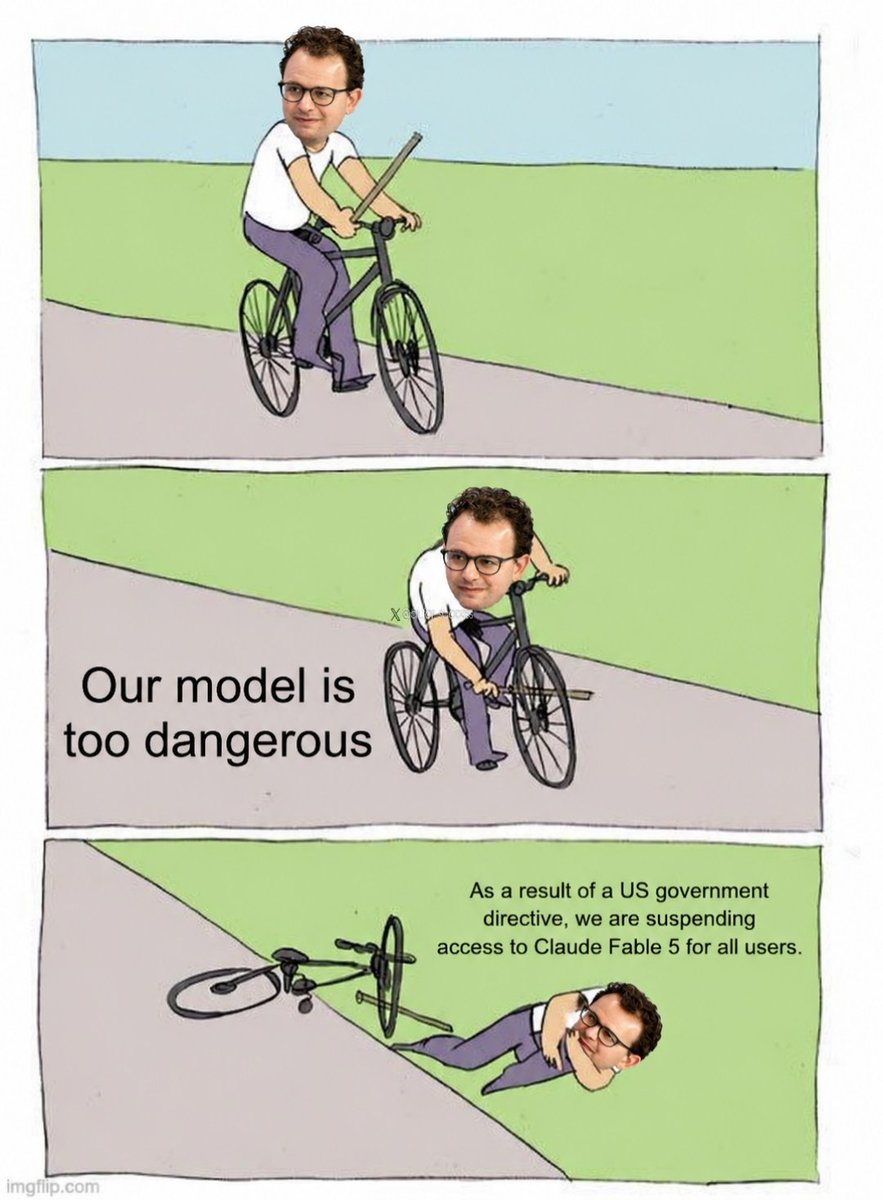
Dario Amodei, you did this to yourself.
31
113
1,482
71,332
satyam kumar retweeted

Jun 13
The US government, citing national security authorities, has issued an export control directive to suspend all access to Fable 5 and Mythos 5 by any foreign national, whether inside or outside the United States, including foreign national Anthropic employees.
The net effect of this order is that we must abruptly disable Fable 5 and Mythos 5 for all our customers to ensure compliance.
Access to all other Claude models is not affected.
We apologize for this disruption to our customers. We believe this is a misunderstanding and are working to restore access as soon as possible.
Read our full statement: anthropic.com/news/fable-myt…
12,148
25,350
85,909
84,337,544

Jun 12
**SEO Is No Longer the Moat in 2026. Visibility Has Become a Five-Layer Architecture Problem.**
Most companies are still celebrating Rank #1.
Meanwhile, their traffic is disappearing.
Why?
Because the search result is no longer the destination.
It's becoming the answer.
And if your content strategy ends at SEO, you're already losing visibility on surfaces your customers increasingly trust.
**DEEP ARCHITECT LENS**
Search has evolved into a distributed discovery architecture.
Google Search.
Google AI Overviews.
ChatGPT.
Perplexity.
Gemini.
Voice assistants.
Each surface retrieves, synthesizes, ranks, and presents information differently.
The architecture challenge is no longer "How do I rank?"
It's "How do I become the source every answer engine cites?"
The modern content stack must simultaneously support:
Crawlability.
Structured extraction.
Entity resolution.
Schema-driven understanding.
Citation readiness.
AI summarization.
Post-click conversion.
This is no longer marketing.
It's information architecture.
**CEO / CTO / BOARDROOM LENS**
A growing percentage of customer journeys now end before a click happens.
If your company is invisible inside AI-generated answers, you are losing market share before prospects ever reach your website.
This is becoming a governance issue, not a traffic issue.
Visibility now impacts pipeline generation, brand authority, customer acquisition cost, and long-term discoverability.
**MARKET SHIFT**
From:
SEO → Rank First
To:
Search Visibility Architecture → Be Found, Quoted, Summarized, Trusted, and Converted
**WHAT ACTUALLY WORKS IN PRODUCTION**
Fact-dense content.
Entity-first writing.
Structured data.
FAQ, Article, and Speakable schema.
Answer-first page design.
Clean HTML.
Fast mobile experience.
Citation tracking across AI engines.
**WHERE MOST TEAMS FAIL**
Treating SEO, GEO, AEO, and AIO as separate projects.
Optimizing rankings while ignoring citations.
Using AI content tools and calling it "AI optimization."
Ignoring SXO because "it's not search."
Chasing AI visibility before building authority.
**ADOPTING STRATEGY**
Build once.
Structure once.
Serve all answer surfaces simultaneously.
SEO → AEO/GEO/AIO → SXO.
The order matters.
**FINAL INSIGHT**
In 2026, the winner is not the company that ranks first.
It's the company that becomes the answer before the search ever becomes a click.
#SEO #AEO #GEO #AIO #SXO #SearchArchitecture #EnterpriseSEO #GenerativeAI #DigitalStrategy #AIVisibility #ContentArchitecture #ChiefArchitect
appscale.blog/en/blog/seo-vs…
2
2
68
Jun 12
**AI Architecture in 2026: Most Systems Don't Fail Because of the Model. They Fail Because of the Pattern.**
The AI industry is obsessed with components.
Vector databases.
Agent frameworks.
Model providers.
Observability platforms.
But production failures rarely come from missing tools.
They come from choosing the wrong architecture pattern.
The most expensive mistake I see today?
Teams building agent systems to solve problems that a single LLM call, a cache, or a retrieval layer could solve faster, cheaper, and more reliably.
**Deep Architect Lens**
Every AI architecture is a trade-off between latency, cost, reliability, accuracy, governance, and operational complexity.
The architecture sequence is surprisingly simple:
Serving → Retrieval → Reliability → Cost Control → Security → Agents
Yet many teams start from the opposite end.
They build orchestration before observability.
Agents before retrieval.
Complexity before evidence.
In production, every new component introduces new failure modes:
More state.
More coordination.
More debugging.
More operational overhead.
The winning architecture is rarely the most sophisticated.
It's the one that delivers predictable outcomes under load.
**CEO / CTO / Boardroom Lens**
AI economics are changing fast.
A system that costs $0.10 per request at pilot scale can become a budget crisis at enterprise scale.
Reliability incidents destroy trust faster than model-quality improvements create it.
And governance gaps become procurement blockers long before they become security incidents.
Architecture decisions are now financial decisions.
**Market Shift**
From:
Model-Centric Thinking
To:
System-Centric Thinking
From:
Agent-First Architectures
To:
Pattern-Driven Architectures
From:
Prompt Engineering
To:
Production Engineering
**What Actually Works in Production**
Hybrid RAG with reranking.
Semantic caching.
Model routing.
Async execution for long-running jobs.
Evaluation-driven releases.
Observable AI pipelines.
Zero-trust controls designed in from day one.
**Where Most Teams Fail**
Agent-first design.
No evaluation gates.
No cost attribution.
No observability.
Frontier model for every request.
Caching without invalidation strategy.
Security added after launch.
Demo-driven architecture masquerading as platform strategy.
**Adopting Strategy**
Choose the simplest pattern that satisfies the requirement.
Add retrieval before agents.
Add observability before scale.
Add governance before enterprise rollout.
Earn complexity. Never assume it.
**Final Insight**
The best AI architects don't start by asking, "What model should we use?"
They start by asking, "What is the simplest architecture that survives production?"
#AIArchitecture #SystemDesign #EnterpriseAI #SolutionArchitecture #CloudArchitecture #AgenticAI #RAG #PlatformEngineering #AIEngineering #DistributedSystems #AIOps #ChiefArchitect
appscale.blog/en/blog/ai-arc…
1
51
Jun 12
**SOC 2 Type II for AI in 2026: Compliance Is No Longer a Security Exercise. It's a Platform Architecture Problem.**
Most AI startups approach SOC 2 the same way they approach documentation.
Late.
Rushed.
Driven by a blocked enterprise deal.
By then, they've already lost.
SOC 2 Type II does not audit your controls.
It audits whether your controls actually worked over time.
That's a completely different engineering problem.
**Deep Architect Lens**
The real architecture is not CloudTrail, Security Hub, GuardDuty, IAM, or Config.
The real architecture is evidence generation.
Every access.
Every change.
Every deployment.
Every security event.
Every model interaction.
Every prompt and response.
Every secret rotation.
The question is simple:
Can your platform prove what happened six months ago?
If not, you're not building a compliant system.
You're building a hopeful one.
For AI workloads, the challenge gets harder.
Model access.
Training-data lineage.
Prompt logging.
Inference retention.
LLM threat controls.
Model provenance.
These are now first-class architecture concerns, not audit afterthoughts.
**CEO / CTO / Boardroom Lens**
Enterprise buyers increasingly treat SOC 2 Type II as a procurement gate.
No report.
No deal.
No expansion.
No trust.
The real ROI is not compliance.
It's revenue acceleration.
The fastest-growing AI companies are designing controls once and reusing them across SOC 2, ISO 27001, EU AI Act, and DPDP requirements.
One control plane.
Multiple attestations.
**Market Shift**
From:
Audit Preparation
To:
Continuous Evidence Architecture
From:
Security Controls
To:
Provable Operational Controls
From:
Compliance Teams
To:
Platform Engineering Ownership
**What Actually Works in Production**
Preventive controls over detective controls.
Policy-as-code.
Immutable audit trails.
Multi-account landing zones.
Automated evidence collection.
Short-lived identities.
Continuous compliance validation.
**Where Most Teams Fail**
Shared admin accounts.
Manual console changes.
Untested controls.
Compliance-by-spreadsheet.
Prompt logging without retention policies.
Buying compliance tools and calling it governance.
**Adopting Strategy**
Build the landing zone first.
Automate evidence second.
Layer AI-specific controls third.
Start the observation window only when controls are already producing proof.
**Final Insight**
The strongest SOC 2 report is never written by auditors.
It's written by the architecture decisions you made six months earlier.
#SOC2 #CloudSecurity #AWS #EnterpriseArchitecture #PlatformEngineering #SecurityArchitecture #AIInfrastructure #ComplianceEngineering #ZeroTrust #Governance #SolutionArchitecture #CloudArchitecture
appscale.blog/en/blog/soc-2-…
2
53
satyam kumar retweeted

Jun 11
This I agree with !!!
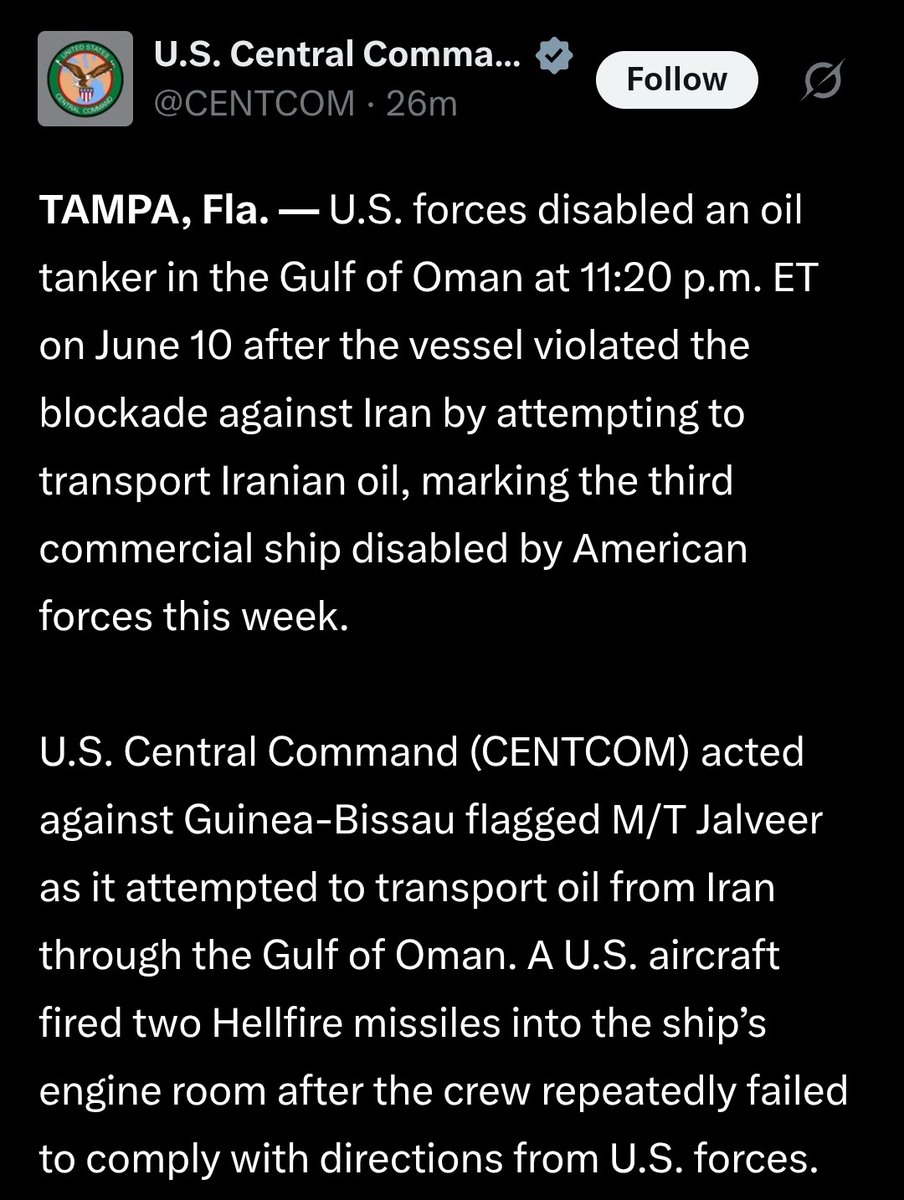
There are multiple ways of doing the "DISABLING" of a ship and the US has chosen the harshest one!!
Jun 11

US Navy could have disabled the tanker in multiple ways. But they chose to fire two hellfire missiles straight into the engine room which had the Indian crew. Cold Blooded Murder. Now, they are also advertising it.
13
47
156
3,581
satyam kumar retweeted

Jun 11
"No European country has been attacked with Indian Weapons... So Keep that in Mind"...!!!
I think Europe was not expecting that answer from Minister @DrSJaishankar 👏
425
6,246
27,079
1,071,694
satyam kumar retweeted

Jun 11
The final boss of Vegetable Biryani🍲
66
110
2,157
560,367
Jun 11
Multi-Cloud in 2026 Is Not a Technology Strategy. It's an Operating Model.
Most enterprises don't adopt multi-cloud.
They drift into it.
An acquisition here.
A regulatory requirement there.
A team that prefers a different provider.
Three clouds later, they have three architectures, three security models, and three times the operational complexity.
That's not multi-cloud.
That's infrastructure fragmentation.
Deep Architect Lens
The biggest misconception in cloud architecture is treating AWS, Azure, and GCP as the design.
They are not.
The design is the control plane.
Landing zones.
Identity.
Policy enforcement.
Observability.
Governance.
Resilience.
The cloud provider is merely an implementation detail.
The highest-performing platforms standardize what matters:
Traffic-flow-based networking.
Zero-trust identity.
Policy-as-code.
Centralized telemetry.
Portable workload placement.
Provider-specific services change.
Control-plane disciplines do not.
The real architecture challenge is not deployment.
It is maintaining consistency across security boundaries, compliance domains, operational workflows, and failure scenarios.
CEO / CTO / Boardroom Lens
Multi-cloud increases optionality.
It also increases operational surface area.
Without governance, every additional cloud becomes a multiplier on risk, audit scope, incident response complexity, and cost.
The boardroom question is not:
"Are we multi-cloud?"
It is:
"Can we operate multiple clouds as one governed platform?"
Market Shift
From:
Cloud Adoption
To:
Cloud Portfolio Management
From:
Provider-Centric Design
To:
Control-Plane-Centric Design
From:
Infrastructure Provisioning
To:
Platform Governance
What Actually Works in Production
Portable landing zones.
Zero-trust workload identity.
Policy-as-code guardrails.
Kubernetes where portability matters.
FinOps before scale.
Cross-cloud failover drills.
Residency pinned per workload.
Where Most Teams Fail
Multi-cloud by accident.
Egress-blind architectures.
Per-cloud security silos.
Untested disaster recovery.
Compliance retrofitted after deployment.
Lowest-common-denominator engineering.
Adopting Strategy
Standardize governance first.
Standardize identity second.
Standardize observability third.
Only then expand across providers.
Final Insight
The future belongs to organizations that can change cloud providers without changing their operating model.
That is the real definition of cloud portability.
#MultiCloud #CloudArchitecture #EnterpriseArchitecture #PlatformEngineering #CloudSecurity #ZeroTrust #FinOps #CloudGovernance #DistributedSystems #Kubernetes #SolutionArchitecture #CIO #CTO
appscale.blog/en/blog/multi-…
1
13
Jun 11
**Cloud Landing Zones Are Being Designed Backwards in 2026**
Most cloud architectures still start with a vendor diagram.
VPCs.
VNets.
Firewalls.
Transit Gateways.
Attackers don't care.
A breach doesn't move through AWS, Azure, or GCP services.
It moves through traffic flows.
That's the architectural mistake many enterprises are still making.
**Deep Architect Lens**
The durable unit of cloud architecture is not the service.
It's the packet.
Every production landing zone ultimately exists to answer five questions:
How does ingress enter?
How does egress leave?
How does East-West traffic move?
How does hybrid connectivity cross trust boundaries?
How is the management plane protected?
The highest-performing cloud platforms in 2026 are designed around these flows, not provider-specific constructs.
DMZ-first, hub-and-spoke, central inspection, forced-tunnel egress, micro-segmentation, identity-bound workloads, immutable logging.
This is not network design.
This is operational risk containment.
The most expensive cloud incidents are rarely ingress failures.
They are egress failures, lateral movement, privilege escalation, and ungoverned trust expansion.
**CEO / CTO / Boardroom Lens**
Every cloud breach becomes a governance problem before it becomes a technology problem.
Customer trust is lost.
Compliance posture collapses.
Audit findings multiply.
Incident response costs surge.
The board doesn't care whether the packet crossed AWS Transit Gateway or Azure Virtual WAN.
The board cares why it crossed an uninspected boundary.
**Market Shift**
From:
Cloud-Service-Centric Architecture
To:
Traffic-Flow-Centric Architecture
From:
Perimeter Security
To:
Continuous Inspection Across Trust Boundaries
From:
Network Connectivity
To:
Governed Connectivity
**What Actually Works In Production**
DMZ-first design.
Forced-tunnel egress.
Default-deny East-West segmentation.
Private service access.
Policy-as-code guardrails.
Just-in-time administration.
Centralized inspection and immutable audit trails.
**Where Most Teams Fail**
Inspecting ingress but ignoring egress.
Flat networks disguised as cloud architecture.
Public admin ports.
Hub firewalls sized without traffic engineering.
Spoke-to-spoke shortcuts.
Manual click-ops landing zones.
Compliance controls implemented after deployment.
**Adopting Strategy**
Design the flow first.
Map controls second.
Choose cloud services last.
The architecture should survive a cloud migration without changing its security model.
**Final Insight**
Cloud providers change every year.
Traffic flows do not.
Architect for the flow, and your security, compliance, and operating model become portable across every cloud.
#CloudArchitecture #LandingZones #AWS #Azure #GoogleCloud #EnterpriseArchitecture #CloudSecurity #ZeroTrust #PlatformEngineering #NetworkArchitecture #CloudGovernance #CyberSecurity #SolutionArchitecture
appscale.blog/en/blog/cloud-…
64
satyam kumar retweeted

Jun 9
Claude Fable 5 just one-shotted this landing page.
prompts by @bogdan_qclay

Introducing Claude Fable 5: a Mythos-class model that we’ve made safe for general use.
Its capabilities exceed those of any model we’ve ever made generally available.
92
102
3,068
690,543
Jun 10
**Agentic AI in 2026: The Real Shift Is Not Prompt Engineering. It's Control Engineering.**
Most AI teams are asking the wrong question.
"Which model should we use?"
Production systems fail because that's not the architecture decision.
The real question is:
"What is the unit of work, and what control system does it require?"
**Deep Architect Lens**
AI architecture has quietly evolved through three distinct operating models:
Prompts.
Loops.
Orchestrated agent teams.
A prompt solves a response.
A loop solves convergence.
An orchestrated team solves coordination.
Each stage introduces new capabilities, but also new failure modes, observability requirements, governance controls, and cost structures.
The breakthrough insight is simple:
Every Stage 3 system is built from Stage 2 loops.
Every Stage 2 loop is built from Stage 1 prompts.
Architecture maturity is compositional, not revolutionary.
The highest-performing AI platforms today are not model-centric.
They are evaluator-centric, budget-aware, checkpointed, observable distributed systems.
**CEO / CTO / Boardroom Lens**
Multi-agent systems are becoming the new microservices.
And many organizations are repeating the same mistakes.
Over-engineered orchestration.
No evaluation gates.
No cost controls.
No audit trail.
The result is predictable:
Higher spend.
Lower reliability.
More operational risk.
A multi-agent architecture without governance is simply distributed uncertainty.
**Market Shift**
From:
Prompt Engineering
To:
Loop Engineering
To:
Orchestrated Goal Execution
From:
Model Outputs
To:
System Outcomes
From:
Response Quality
To:
Cost Per Resolved Task
**What Actually Works In Production**
Classification-first routing.
Explicit loop budgets.
Independent evaluator agents.
Durable execution and checkpointing.
Agent-level observability.
Coordinator-driven orchestration.
Dynamic promotion and demotion across execution stages.
**Where Most Teams Fail**
Building Stage 3 architectures for Stage 1 problems.
Treating prompts as architecture.
Loops without breakers.
Evaluators judging their own outputs.
Agent swarms without governance.
Observability limited to token counts instead of execution trajectories.
**Adopting Strategy**
Start with prompts.
Graduate to loops only when iteration becomes the bottleneck.
Move to orchestrated teams only when coordination becomes the bottleneck.
Earn every layer of complexity.
**Final Insight**
The future of AI systems will not be defined by larger models.
It will be defined by better control systems around them.
#AIArchitecture #AgenticAI #MultiAgentSystems #LLMOps #EnterpriseAI #SystemDesign #PlatformEngineering #SoftwareArchitecture #DistributedSystems #AIOperations #CloudArchitecture #EngineeringLeadership
appscale.blog/en/blog/agent-…
4
142
Jun 10
**The Biggest AI Architecture Mistake of 2026: Treating Every Problem Like an LLM Problem**
Most AI platforms are not failing because their models are weak.
They are failing because their routing is wrong.
A surprising number of enterprise AI systems still send retrieval, classification, planning, vision, automation, and reasoning workloads through the same frontier model.
That is not architecture.
That is expensive serialization.
**Deep Architect Lens**
The production AI stack is rapidly fragmenting into specialized compute classes.
LLMs generate.
MLMs retrieve.
SLMs classify.
VLMs understand visual context.
LAMs execute actions.
SAMs segment pixels.
MoE systems deliver frontier quality at different economics.
LCMs are emerging for long-horizon planning and coherence.
The architectural decision is no longer model selection.
It is workload routing.
The cheapest model that satisfies the quality bar wins.
Everything else is wasted latency, wasted compute, and unnecessary operational complexity.
The most mature AI systems now operate as distributed inference fabrics, not chatbot wrappers.
**CEO / CTO / Boardroom Lens**
This is no longer a technical optimization.
It is a cost-governance problem.
The difference between correct routing and frontier-for-everything can be 20x, 50x, even 200x in operating cost.
At enterprise scale, that becomes budget, margin, and product viability.
Organizations that cannot explain model-routing economics will eventually lose to competitors that can.
**Market Shift**
From:
One Model → Many Workloads
To:
Many Model Classes → One Orchestrated System
From:
Model Selection
To:
Inference Architecture
From:
Prompt Engineering
To:
Routing Engineering
**What Actually Works In Production**
SLM front-door classification.
MLM-based retrieval.
MoE for generation.
VLM for multimodal understanding.
LAM for tool execution.
Policy-driven model routing.
Continuous evaluation and cost telemetry.
**Where Most Teams Fail**
Frontier-for-everything.
Using LLMs as embedding engines.
OCR-before-VLM pipelines.
Treating function-calling as an action model.
No routing layer.
No cost-per-intent visibility.
Demo-driven architecture replacing engineering discipline.
**Adopting Strategy**
Classify first.
Route second.
Generate last.
Treat every model class as a specialized infrastructure primitive with its own lifecycle, economics, observability, and governance.
**Final Insight**
In 2026, the competitive advantage is not having the smartest model.
It is building the smartest routing system.
#AIArchitecture #EnterpriseAI #AgenticAI #LLMOps #SystemDesign #PlatformEngineering #GenerativeAI #MachineLearning #SolutionArchitecture #CloudArchitecture #AIInfrastructure #EnterpriseArchitecture
appscale.blog/en/blog/eight-…
1
92

