
Offering insights into the enterprise technology landscape, empowering tech executives to make better business decisions. Reach us: contact@alltechmagazine.com
Joined April 2021
- Tweets 716
- Following 746
- Followers 1,044
- Likes 46
92 Photos and videos






One statistic from this article stood out:
Teams adopting a contract-first approach reported substantially fewer integration defects and significantly faster delivery cycles.
The reason isn't magic.
Frontend, backend, QA, and product stop working in sequence and start working against the same contract.
Paths.
Schemas.
Fixtures.
Error states.
Validation rules.
Less interpretation.
Less rework.
Less surprise.
That's a platform engineering lesson as much as a frontend one.
#PlatformEngineering #DeveloperExperience #SoftwareArchitecture #DevOps #EngineeringEfficiency

7
Choosing an AI development partner is becoming harder, not easier.
Everyone claims expertise in:
• GenAI
• Agentic AI
• RAG
• Automation
• Computer Vision
Few discussions focus on the questions that actually predict project success:
How is model performance measured?
Who owns deployment?
What happens when data quality changes?
How does the team handle production drift?
This ranking looks at several AI development companies worth evaluating in 2026 and, more importantly, the criteria buyers should use when assessing them.
Worth a read before issuing an RFP: alltechmagazine.com/top-ai-d…
#MachineLearning #MLOps #DataEngineering #EnterpriseArchitecture #AIEngineering
10
Most enterprise AI initiatives fail long before the customer sees the output.
They fail in the layers underneath.
Disconnected data.
Siloed channels.
Inconsistent knowledge repositories.
Poor orchestration.
The visible AI experience is often just a reflection of the operational architecture supporting it.
What stood out in this article is the emphasis on continuity.
The best customer experiences aren't necessarily the most automated.
They're the most connected.
When interaction history, intent signals, and knowledge systems operate through a unified layer, AI becomes an accelerator rather than a source of confusion.
For operations leaders, service architects, and transformation teams, that's a distinction worth paying attention to.
Read more: alltechmagazine.com/how-ai-i…
#OperationalExcellence #ServiceOperations #CustomerJourney #EnterprisePlatforms #IntelligentAutomation #CXOperations #DigitalInfrastructure
10
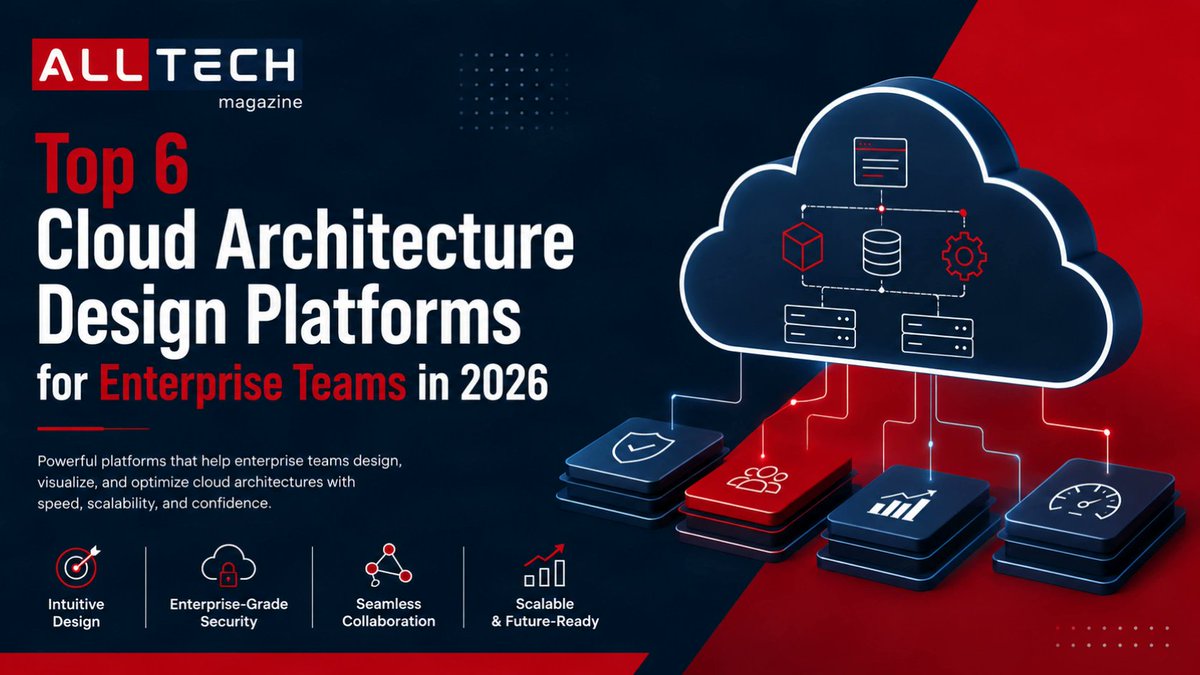
Most cloud transformation projects don't fail because of technology.
They fail because leadership teams can't see how architecture decisions connect to business outcomes.
As enterprise environments become more distributed across AWS, Azure, Google Cloud, SaaS platforms, AI workloads, and legacy systems, architecture is no longer just an IT concern. It's a business capability.
The strongest organizations are moving beyond static diagrams and adopting platforms that provide continuous visibility, governance, dependency intelligence, and modernization planning.
The real question isn't which cloud architecture platform is "best."
It's which platform solves the business problem you're facing right now.
A useful breakdown of six leading platforms helping enterprise teams navigate cloud architecture in 2026.
Worth reviewing for CIOs, CTOs, and transformation leaders managing complex cloud environments.
#CIOInsights #EnterpriseArchitecture #CloudTransformation #DigitalStrategy #TechnologyLeadership #BusinessTechnology #ITGovernance
Read more: alltechmagazine.com/top-6-cl…
ALT Top cloud architecture design platforms
1
15
Four ways contract efforts rot (and how Contract‑First UI fixes them):
❌ Schema theater → validate fixtures in CI
❌ Double sources of truth → import paths, don't duplicate
❌ Choreographed mocks → treat mock/real mismatches as blockers
❌ Soft errors (200 with {success:false}) → make error shapes first‑class
6
"Components are cheap; commitments are expensive." – Adetola Oyebode
When a metric is cited in a regulator's meeting note, you can't unwind it. Contract‑First UI catches those semantic mismatches before production. 40‑60% fewer integration defects proven in real teams.
14
Four ways contract efforts rot (and how Contract‑First UI fixes them):
❌ Schema theater → validate fixtures in CI
❌ Double sources of truth → import paths, don't duplicate
❌ Choreographed mocks → treat mock/real mismatches as blockers
❌ Soft errors (200 with {success:false}) → make error shapes first‑class
#TechDebt #SoftwareQuality #EngineeringExcellence
13
Contract‑First UI artifact stack:
📁 Canonical HTTP paths (no string duplication)
📄 TypeScript request/response types
📐 JSON Schema validation in CI
🧪 Mock fixtures (real edge cases, not fake data)
🖥️ Local mock server (MSW)
Start with one painful slice (pagination, errors, geometry). Prove faster cycle time.
#DevTools #FrontendTips #APIFirst
20
The UI looks finished long before its meaning is stable. That's not a styling problem — it's a contract problem.
The Contract-First UI Model: paths, types, schemas, mocks, and failures before the first render.
Teams using it see 40–60% fewer integration defects.
26
Most AI development companies look impressive on a website.
The real test comes after deployment.
Can they maintain production systems?
Can they explain a failure?
Can they survive a regulator's audit?
Can they hand ownership back to your team?
Those questions eliminate a surprising number of vendors.
We reviewed some of the most talked-about AI development firms heading into 2026 and looked beyond the marketing claims.
The names are interesting.
The evaluation criteria matter even more.
Full ranking and analysis in the article: alltechmagazine.com/top-ai-d…
#EnterpriseAI #AILeadership #DigitalTransformation #CIOInsights #AIStrategy
11
Most discussions about AI focus on replacement.
The more interesting conversation is redesign.
The future of customer experience isn't AI versus humans.
It's AI and humans operating as a unified system.
AI contributes scale, pattern recognition, and speed.
Humans contribute judgment, empathy, trust, and contextual decision-making.
The organizations creating sustainable competitive advantage aren't eliminating people from the experience.
They're redesigning operating models so technology strengthens human capability.
As products become increasingly similar and pricing becomes easier to compare, experience remains one of the last true differentiators.
That's why CX is evolving from a support function into a strategic growth engine.
An excellent systems-level perspective from Artur Ledowski on where enterprise customer experience is heading.
Article link: alltechmagazine.com/how-ai-i…
#ThoughtLeadership #EnterpriseStrategy #FutureOfCustomerExperience #AITransformation #LeadershipInsights #BusinessStrategy #DigitalLeadership
7
The CIO role is changing. New title: Chief Intelligence Orchestrator.
No more just keeping systems running. Now it's about weaving together people, AI, and data across the whole business.
Quick read. Worth your time.
👇cio.com/article/4120232/the-…?
16
All Tech Magazine retweeted
Everyone is talking about AI-powered customer experience.
Few are asking whether AI is actually improving customer outcomes.
According to our latest article authored by Artur Ledowski (Senior Director of Enterprise Growth and Commercial Strategy at TELUS Digital), the biggest CX failures see aren't caused by weak models.
They're caused by fragmented data, disconnected systems, and operating models designed around deflection rather than resolution.
When organizations deploy AI on top of broken customer intelligence, they don't eliminate friction.
They scale it.
The companies creating meaningful differentiation are taking a different approach:
• Unified customer context
• AI-assisted decision making
• Human expertise in high-value moments
• Resolution over deflection
The future of customer experience won't be defined by how much we automate.
It will be defined by how intelligently we connect people, data, and technology.
👉 Read the full article to discover the blueprint for building an outcome-driven AI strategy: alltechmagazine.com/how-ai-i…
#CX #ArtificialIntelligence #CustomerSuccess #DigitalTransformation #DataStrategy
22
23
211
The enterprise AI budget crisis isn't about model licensing—it's about Token Maxing. CIOs are burning through annual budgets in 90 days.
Here is how Agentic AI, Model Context Protocol (MCP), and Usage-Based Pricing (UBP) are forcing a massive shift from traditional B2B SaaS into autonomous systems of execution:
For years, Enterprise Software relied on seat-based pricing. But when Autonomous AI Agents act as the primary users executing multi-step workflows, per-seat licensing collapses.
According to mid-year data, even though Large Language Model (LLM) token costs dropped 80%, total enterprise consumption spiked by 320%. This "AI cost shock" is shifting the industry toward outcome-based FinOps for SaaS.
Look at the recent structural moves. Microsoft Build just launched Agent 365 and Work IQ to embed agentic orchestration directly into core workflows. Meanwhile, Accenture Ventures made a massive strategic investment in AlphaSense to scale agentic workflows for B2B market intelligence. We are moving from "AI-enabled tools" to "AI-native platforms".
The winners of this shift won't just build faster LLM prompts. They will master Workflow Orchestration and strict AI Governance.
Companies must transition from systems of record to systems of execution.
Human-in-the-loop validation remains non-negotiable to prevent agent error cascading.
2
99
Everyone is focused on how quickly AI agents can be built.
The more important question is whether they can be trusted.
As agents gain access to financial systems, HR workflows, and business operations, governance becomes a strategic requirement—not a compliance afterthought.
Speed gets attention.
Trust gets adoption.
That's why announcements around Agent Passport may prove just as significant as the AI tooling itself.
#AITrust #AgenticAI #EnterpriseGovernance #CyberSecurity #ResponsibleAI #EnterpriseTechnology #DigitalTrust
16
Enterprise AI is moving from copilots to coworkers. The challenge now is trust, governance, and scale.
#AgenticAI #EnterpriseAI #AILeadership #FutureOfWork
32
One of the more interesting themes from DevCon is the growing maturity of the agent ecosystem.
MCP integration, A2A interoperability, Agent Passport, Data Cloud, and open standards like skill.markdown point toward a future where enterprise agents are expected to operate across platforms rather than inside isolated environments.
The technology challenge is evolving from "Can we build agents?" to "How do we govern, secure, and orchestrate them at scale?"
That's a much bigger conversation.
#AgenticAI #MCP #EnterpriseArchitecture #AIOperations #PlatformEngineering #Interoperability #FutureOfEnterpriseAI
15