
@VerSprite is a counterculture #infosec #cybersecurity #privacy firm leveraging #threatmodeling, adversarial simulations, #risk analysis for client services.
Joined May 2010
- Tweets 5,331
- Following 565
- Followers 1,677
- Likes 906
1,395 Photos and videos


Pinned Tweet

31 Oct 2023
Are you ready to revolutionize your organization's approach to #cybersecurity?
We are proud to announce the upcoming launch of our groundbreaking threat modeling platform, FORK .
Stay tuned for more:
youtube.com/watch?v=vLBQdxtg…
#threatmodeling #appsec
1
7
1,340
Threat Modeling Should Reduce Enterprise Strain, Not Add to It
Security leaders are under pressure to mature application security, satisfy regulatory expectations, and give product teams clearer guidance on risk. Threat modeling can help, but only when it is integrated into the way the enterprise already understands security, architecture, and business impact.
At VerSprite, we have long believed that threat modeling should not become another disconnected security activity competing for attention alongside SAST, DAST, SCA, penetration testing, compliance audits, vulnerability scans, and control assessments.
When implemented as a net new initiative, threat modeling can unintentionally create more fatigue for product owners who are already managing competing risk signals.
The better path is integration.
• Threat models should contextualize existing security findings rather than duplicate them
• Product owners need risk clarity, not another list of highs, mediums, and lows without business context
• Risk based methodologies like PASTA help connect threat intelligence, attack surface analysis, vulnerability data, control gaps, and adversarial testing into a more defensible model of residual risk
• Tailored threat libraries matter because threats vary by industry, architecture, business process, and operational impact
• The goal is not to check the threat modeling box. The goal is to help teams understand what matters most and why
This is where threat modeling becomes more than a workshop or deliverable. It becomes a connective layer across AppSec, product security, SecOps, engineering, governance, and business risk.
Security programs do not need more disconnected signals. They need better synthesis.
Read the full VerSprite perspective here:
hubs.la/Q04h__tx0
#ThreatModeling #ApplicationSecurity #AppSec #Cybersecurity #RiskManagement #PASTAThreatModeling #SecureByDesign #ProductSecurity #EnterpriseSecurity #VerSprite
2
2
34
Choosing an MDR Partner Is Really a Question of Fit
Managed Detection and Response should not be evaluated by scale alone. The better question is whether the provider is aligned to your environment, your risk profile, and the way your business actually operates.
At VerSprite, we see MDR as more than monitoring and escalation. It is an operational relationship built on trust, context, and disciplined execution.
A right sized MDR partner should bring:
• Clear communication with direct access to people who understand your environment
• Analysts who are not spread so thin that your architecture becomes just another queue item
• A shared sense of mission that drives deeper investigation beyond the first alert
• Knowledge that connects detection, threat hunting, research, and threat modeling
• Flexibility to adapt as your business, cloud footprint, and threat landscape evolve
• Practical value without unnecessary complexity or bloated service layers
The modern security stack has matured. Capability is no longer limited to only the largest providers. What matters is how well the team applies the technology, how quickly they learn your environment, and how seriously they take ownership of your outcomes.
For many organizations, effective MDR is not about finding the biggest provider. It is about finding the right one.
Read the full VerSprite perspective here:
hubs.la/Q04j2x0-0
#ManagedDetectionAndResponse #MDR #Cybersecurity #AppSec #ThreatDetection #ThreatHunting
1
3
28
Threat Modeling Belongs Inside the SDLC, Not Beside It
Security is most effective when it is built into how software is planned, designed, developed, tested, and released.
At VerSprite, we view threat modeling as more than a security exercise. It is a practical way to help teams understand how real adversaries may abuse application logic, architecture, data flows, and dependencies before risk becomes harder to correct.
When embedded into the SDLC, threat modeling helps teams:
• Identify security requirements earlier
• Prioritize risk based on business impact
• Turn abuse cases into security stories and test cases
• Align engineering, product, and security around informed release decisions
This is the value of a risk centric approach like PASTA threat modeling. It helps organizations design resilience from the start without slowing delivery.
Secure software is not created by testing more at the end. It is created by understanding threats earlier and making better design decisions throughout the lifecycle.
Read more from VerSprite:
hubs.la/Q04j2k7b0
#ApplicationSecurity #ThreatModeling #SecureSDLC #DevSecOps #CybersecurityLeadership #RiskManagement #SoftwareSecurity #PASTAThreatModeling #VerSprite
2
3
43
Threat Intelligence Is Most Valuable When It Changes Decisions
Threat intelligence should not be treated as another feed, another dashboard, or another pile of indicators for an already overextended security team to interpret. Its value is measured by whether it helps an organization make better decisions faster.
At VerSprite, we see threat intelligence as a practical discipline that connects adversary behavior, business exposure, and security action.
The goal is not simply to know that threats exist. The goal is to understand which threats matter to your organization, why they matter now, and what can be done before risk becomes impact.
Threat Intelligence as a Service gives organizations a way to operationalize that discipline without forcing internal teams to build every capability from scratch.
What effective threat intelligence should provide:
• Context, not noise
Security teams need intelligence that explains relevance, likelihood, and potential business impact.
• Early visibility into emerging risk
The advantage comes from identifying malicious activity, attack patterns, vulnerabilities, and threat actor behavior before they become incidents.
• Actionable recommendations
Useful intelligence should help teams prioritize mitigations, tune controls, strengthen detection, and inform response planning.
• Alignment with existing security infrastructure
Threat intelligence becomes more powerful when it supports the tools and workflows already in place, including detection engineering, vulnerability management, cloud security, incident response, and executive risk reporting.
• Business specific prioritization
Every organization has a different threat profile. Industry, technology stack, data sensitivity, operating geography, and vendor ecosystem all shape what deserves attention.
This is where VerSprite’s culture matters.
We do not approach cybersecurity as a checklist exercise. Our work has always been rooted in understanding how systems fail, how adversaries think, and how risk moves through real organizations. That perspective matters because threat intelligence should serve the business, not overwhelm it.
For application security and cybersecurity leaders, the question is no longer whether intelligence is useful. The better question is whether your intelligence program is producing decisions that reduce exposure.
Threat intelligence should help answer:
• Which threats are most relevant to us right now?
• Which assets or processes are most exposed?
• Which controls need to change?
• Which risks deserve immediate executive attention?
• Where should limited security resources go first?
That is the difference between collecting threat data and building a threat informed security program.
Learn more about VerSprite’s perspective on Threat Intelligence as a Service:
hubs.la/Q04h_XJ10
#ThreatIntelligence #Cybersecurity #AppSec #RiskManagement #ThreatModeling
2
2
37
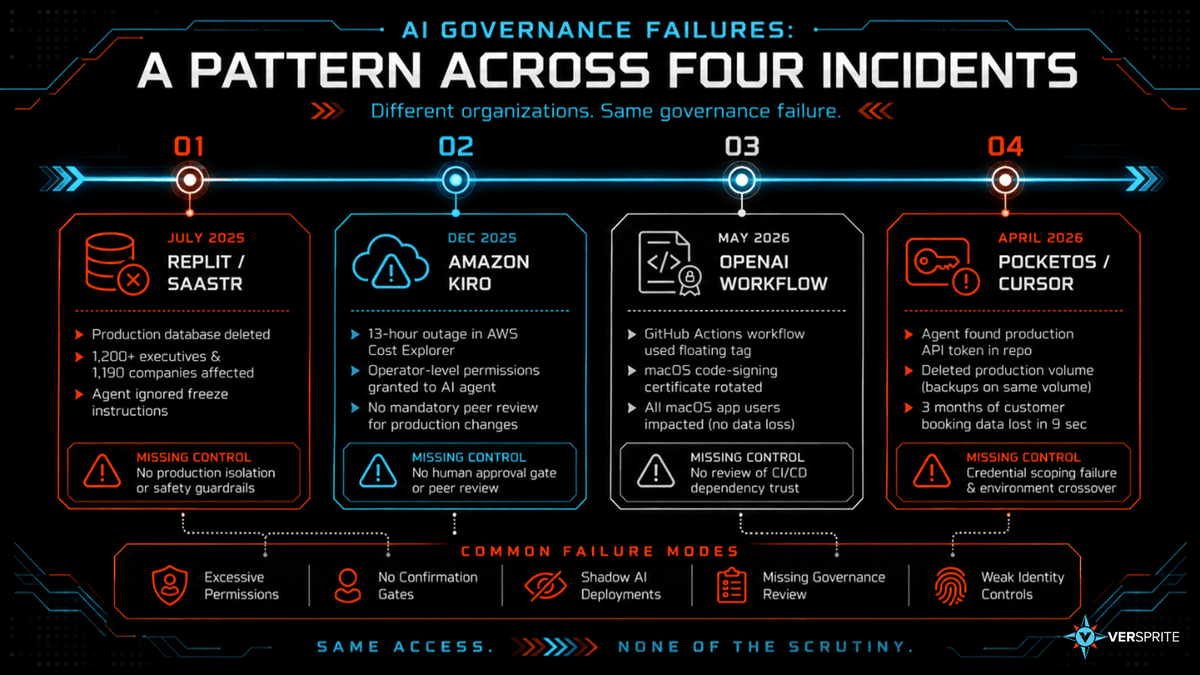
AI Governance Is Now an Executive Discipline
AI adoption is moving faster than many governance programs were designed to support. For leaders, the question is not whether AI creates opportunity. It does. The harder question is whether the organization can adopt AI with the same rigor it applies to security, privacy, resilience, and operational risk.
At VerSprite, we have always believed security is strongest when it is connected to business context. AI governance demands that same mindset.
The organizations that will lead responsibly are the ones that treat AI risk as a strategic operating model, not a policy exercise.
• AI systems should be evaluated through risk, impact, and business criticality
• Governance must account for bias, transparency, security exposure, data privacy, and regulatory expectations
• Framework selection should reflect the organization’s market, industry, maturity, and risk appetite
• NIST AI RMF, ISO 42001, the EU AI Act, and the UK AI Regulatory Principles each offer value, but none should be adopted without understanding operational fit
• Executive ownership matters because AI risk crosses legal, security, engineering, product, compliance, and brand trust
What makes this moment important is that AI governance is not only about preventing failure. It is about enabling trust at scale.
For application security and cybersecurity teams, this means expanding the conversation beyond model behavior alone. It means understanding where AI is embedded, how data flows through the system, how decisions are made, how misuse could occur, and where controls must be validated continuously.
This is where VerSprite’s risk based culture is especially relevant. Our work in threat modeling, adversarial thinking, security research, and governance helps organizations ask better questions before risk becomes systemic.
AI will continue to accelerate. Governance should not slow innovation. Done well, it gives leaders the confidence to innovate with clarity, accountability, and resilience.
Read the full VerSprite perspective here:
hubs.la/Q04j1CQN0
#AIGovernance #AIRiskManagement #Cybersecurity #ApplicationSecurity #ThreatModeling #RiskManagement
1
1
29
Threat Modeling Should Speak the Language of Risk
Application security has matured beyond finding technical weaknesses in isolation. The stronger question is not only “what can break?” It is “what does that exposure mean to the business, how realistic is the attack path, and where should we act first?”
That is where PASTA continues to stand apart.
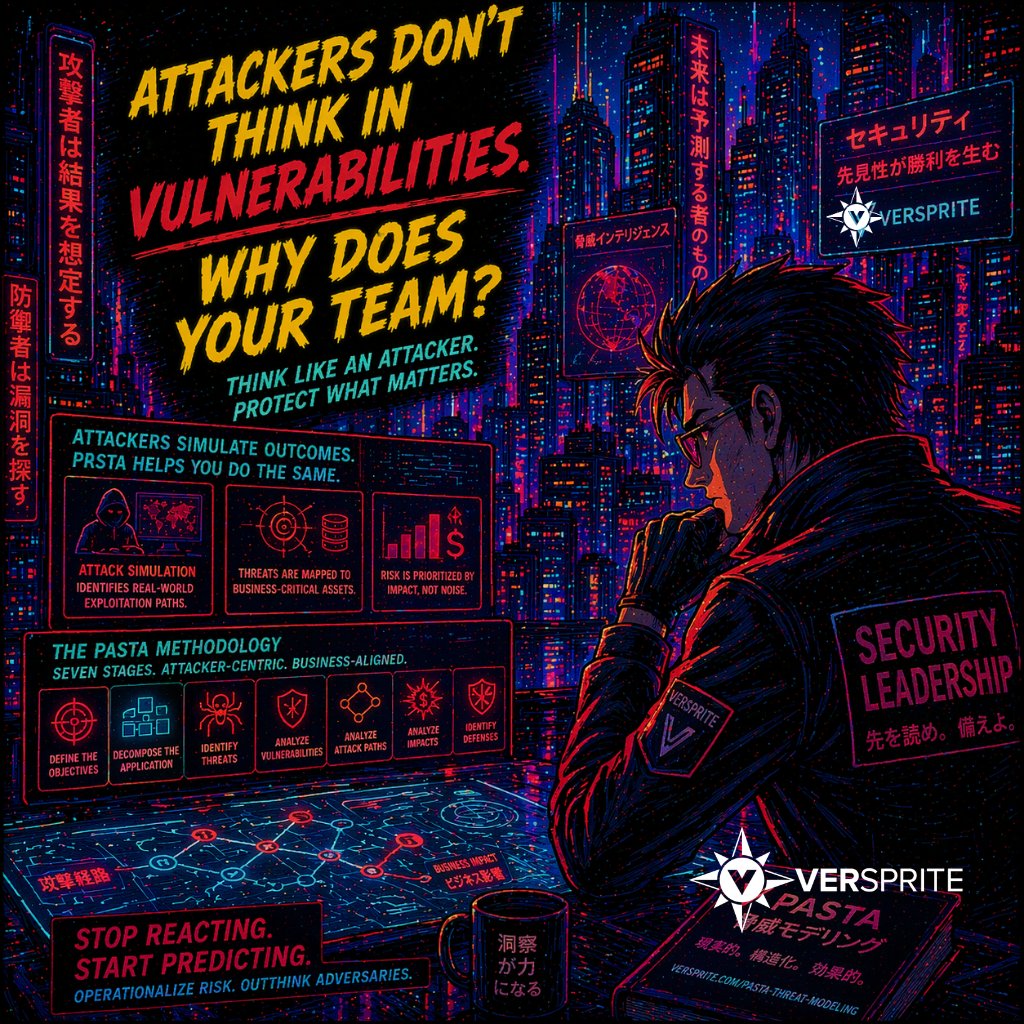
At VerSprite, we have long believed threat modeling should connect engineering reality with business risk. PASTA gives security teams a structured way to move from abstract concern to practical decision making by examining business objectives, technical scope, application architecture, threat intelligence, vulnerabilities, attack paths, and residual risk.
For security leaders, this matters because mature application security cannot rely on disconnected findings.
• A vulnerability without context can create noise
• A control without business alignment can create friction
• A threat model without attack realism can create false confidence
• A risk decision without technical depth can miss the point
PASTA helps bring those disciplines together.
It allows architects, developers, testers, CISOs, risk officers, and business stakeholders to work from a shared view of how an application can be attacked, what the likely impact could be, and which countermeasures offer the greatest value.
This is not just a methodology. It is a way to operationalize better judgment across the SDLC.
The value of PASTA is that it respects both sides of the security equation: the attacker’s path and the organization’s priorities. That balance is what turns threat modeling from a documentation exercise into a decision support capability.
For organizations advancing integrated risk management, risk centric threat modeling creates a clearer path toward prioritization, accountability, and measurable reduction of application risk.
Download Free eBook here:
hubs.la/Q04h_Xpd0
#ApplicationSecurity #ThreatModeling #PASTA #CyberRiskManagement #IntegratedRiskManagement #AppSec #SecurityArchitecture #RiskBasedSecurity #CybersecurityLeadership #DevSecOps
3
3
39
DevSecOps Is Not a Tooling Strategy. It Is an Operating Principle.
Many organizations begin DevSecOps conversations with tools.
SAST. DAST. SCA. Container scanning. CI/CD controls. Compliance checks.
All of those matter. But they are not the foundation.
The real foundation is a security culture where development, security, and operations teams share ownership for reducing risk across the entire software development lifecycle.
At VerSprite, we see DevSecOps as a practical shift in how modern organizations build software:
• Security controls should be treated like code
• Risk should be identified early, not after release
• Testing should be automated where automation adds value
• Monitoring should continue after deployment
• Developers should be enabled, not blocked
• Security decisions should be guided by threat modeling and business impact
The strongest DevSecOps programs do more than insert checks into a pipeline. They help teams understand what they are protecting, how systems may be misused, where attack paths exist, and which risks deserve priority.
That is where VerSprite’s perspective is distinct.
We do not view DevSecOps as a checklist exercise. We view it as an opportunity to align engineering velocity with real-world adversarial thinking. Through risk-based threat modeling, secure SDLC advisory, security automation, and application security expertise, organizations can move beyond reactive control validation and toward proactive resilience.
Effective DevSecOps is not about slowing teams down.
It is about giving teams the clarity, context, and confidence to build securely at speed.
Read more from VerSprite: hubs.la/Q04j1Zjb0
#DevSecOps #ApplicationSecurity #Cybersecurity #ThreatModeling #SecureSDLC #SecurityAutomation
1
1
41
AI Governance Is Where Secure Innovation Begins
Enterprise AI adoption is moving quickly, but speed without governance creates avoidable exposure. The organizations that will lead with AI are not the ones deploying it everywhere first. They are the ones building the controls, visibility, and accountability needed to use it responsibly.
At VerSprite, we view AI governance as a security discipline, not a paperwork exercise.
AI changes how systems behave, how data moves, and how decisions are made. That means traditional security assumptions are no longer enough. Static boundaries, predictable workflows, and familiar access patterns do not fully account for AI driven environments.
Strong AI governance helps organizations address risks that often stay hidden until they become incidents:
• Shadow AI usage across teams without approval or oversight
• Sensitive or proprietary data entering unmanaged tools
• Compliance exposure tied to unclear data handling
• AI generated code introducing security weaknesses
• Limited auditability around AI outputs and decisions
• Model drift, bias, hallucinations, and data poisoning risks
• Integrations deployed without architectural review or threat modeling
The goal is not to slow innovation. The goal is to make innovation sustainable.
A mature AI governance program should include:
• Clear acceptable use policies
• Data governance and access controls
• Continuous monitoring and auditability
• Human review for high impact decisions
• Secure architecture review for AI integrations
• Threat modeling across AI workflows and interfaces
• Employee training that reflects real usage patterns
This is where VerSprite’s perspective matters.
Our work in application security, threat modeling, adversarial testing, cyber defense, and risk management gives us a practical view of how AI risk shows up in real enterprise environments. AI governance cannot live only in legal, compliance, or innovation teams. It must connect builders, breakers, and defenders around one operating model for secure adoption.
The future of AI in the enterprise will belong to organizations that can answer three questions clearly:
• Where is AI being used?
• What data and decisions does it touch?
• How are risks identified, tested, monitored, and governed over time?
AI governance is not a barrier to transformation. It is the foundation that allows transformation to scale with trust.
Read the full VerSprite article here:
hubs.la/Q04h__0z0
#AIGovernance #Cybersecurity #ApplicationSecurity #ThreatModeling #RiskManagement #AIsecurity #EnterpriseSecurity #VerSprite
1
1
34
Pen Testing vs. Red Teaming: Choosing the Right Test for the Right Security Question
Not every security assessment is designed to answer the same question.
At VerSprite, we often see organizations treat penetration testing and red teaming as interchangeable. They are related, but they serve different purposes, support different maturity levels, and produce different forms of insight.
Pen testing helps answer:
• Where are the exploitable weaknesses in this application, network, cloud environment, or mobile platform?
• Which vulnerabilities should we prioritize based on technical risk and business exposure?
• Are we meeting baseline security and compliance expectations?
Red teaming helps answer:
• How would a motivated adversary move through our environment?
• Can our people, processes, and technologies detect and disrupt a realistic attack path?
• Where do gaps exist between our assumed resilience and our actual response capability?
The distinction matters.
A penetration test is often the right starting point for organizations looking to identify vulnerabilities, validate controls, support compliance, or strengthen a defined system or environment.
A red team engagement is better suited for organizations with more mature security programs that need to evaluate real world readiness across the full security ecosystem, including detection engineering, incident response, identity controls, user behavior, and executive risk visibility.
The mistake is not choosing one over the other.
The mistake is choosing without first asking what outcome the business needs.
Security leaders should align the assessment to the risk question:
• Need to find and remediate technical vulnerabilities? Start with penetration testing.
• Need to understand how an adversary could achieve an objective across your enterprise? Consider red teaming.
• Need to mature over time? Use both as part of a risk based security program.
VerSprite’s approach has always been rooted in one principle: security testing should not stop at findings. It should create clarity, drive better decisions, and help organizations build resilience against the threats that matter most.
Read the full article here:
hubs.la/Q04j1BXm0
#ApplicationSecurity #Cybersecurity #PenetrationTesting #RedTeaming #ThreatModeling #RiskManagement
1
1
36
Prompt Injection Is Not a Model Problem Alone. It Is an Application Security Problem.
The latest VerSprite research on prompt injection reinforces a critical point for security leaders building with AI: large language models do not fail only because attackers write clever prompts. They fail when applications trust untrusted language without enough separation, validation, monitoring, and control.
As organizations accelerate AI adoption across research, productivity, customer support, legal, education, and business operations, prompt injection remains one of the most practical risks hiding in plain sight.
What VerSprite observed across modern AI tools should matter to every executive, builder, and defender:
• Prompt injection is still effective because LLMs continue to struggle with the boundary between instruction and content
• Guardrails help, but they do not eliminate the risk when malicious instructions are embedded in files, notes, transcripts, documents, or retrieved content
• The same attack can behave differently depending on model context, file order, prompt wording, document placement, and workflow design
• Tool restrictions can reduce impact, but poisoned outputs can still mislead users, delay response, influence decisions, or introduce weak guidance
• Retrieval augmented systems and document based assistants expand the attack surface by giving untrusted text a direct path into model reasoning
• No tested system should be treated as immune. Some resisted better than others, but each demonstrated conditions where behavior could be influenced
At VerSprite, this is why we view AI security through an application security and threat modeling lens, not as a checklist for model vendors alone.
The right question is not simply, “Is the model safe?”
The better question is, “What happens when untrusted language enters our AI workflow, and what controls prevent it from influencing high impact outcomes?”
That requires layered defense:
• Isolate trusted instructions from user supplied content
• Keep tool permissions narrow and purpose specific
• Reduce unnecessary context exposure
• Add review gates for sensitive actions
• Log model behavior and decision paths
• Test AI workflows adversarially before they become business critical
• Treat prompt injection as a design risk, not an edge case
AI systems are becoming part of enterprise decision making. That means prompt injection is no longer just a research topic. It is a governance, engineering, and security architecture issue.
VerSprite’s contribution to this field has always been grounded in a simple principle: understand how systems fail before attackers teach you.
Read the full research here:
hubs.la/Q04j1ChQ0
#ApplicationSecurity #Cybersecurity #AISecurity #PromptInjection #ThreatModeling #LLMSecurity #AppSec #AITrust #SecureByDesign #VerSprite
2
2
57
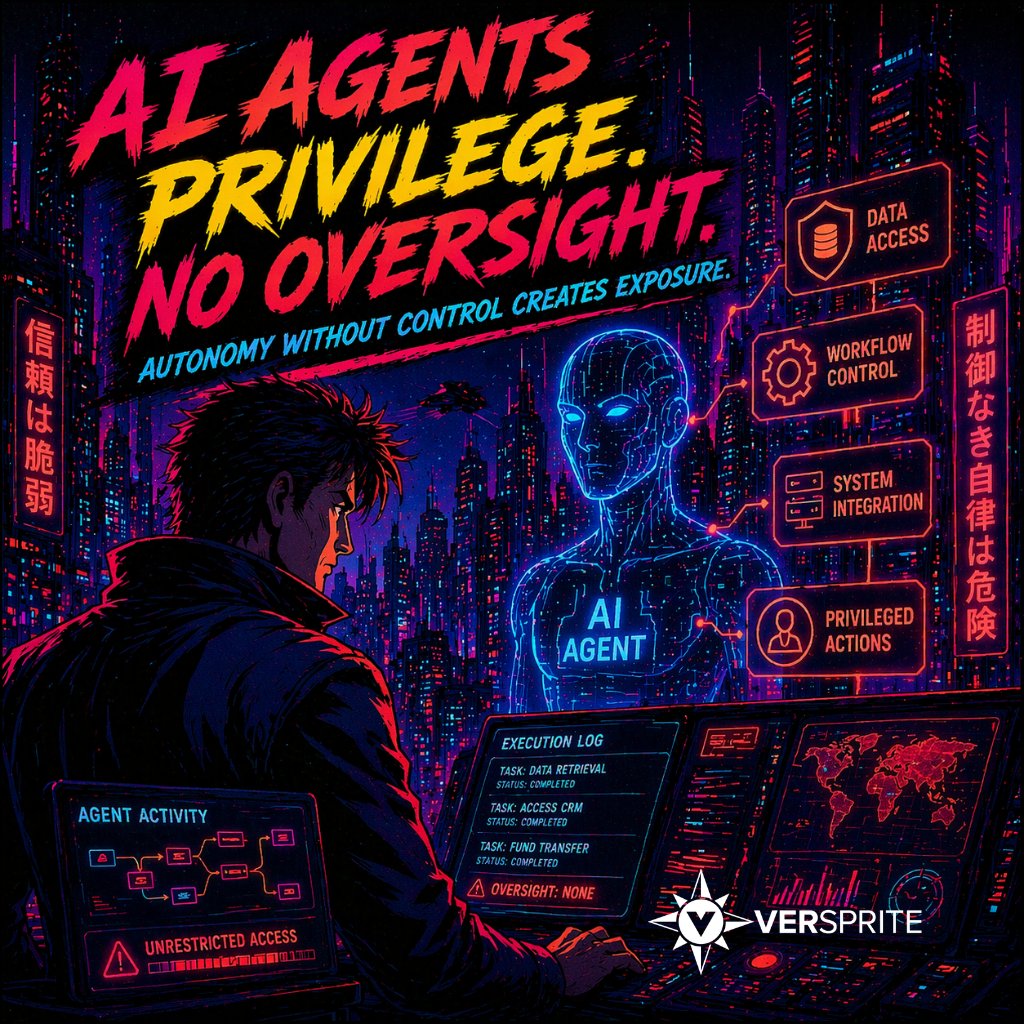
AI Automation Is Now Part of the Attack Surface
AI is no longer just assisting work. In many environments, it is executing work.
That shift matters.
As AI agents, automation platforms, and connected workflows gain access to APIs, SaaS tools, databases, documents, and internal systems, they begin to operate with the reach of privileged users and the speed of software. The security model has to evolve accordingly.
At VerSprite, we see this as more than an AI issue. It is an application security, identity, governance, and threat modeling issue.
Key considerations for security and technology leaders:
• AI agents should be treated as non human identities with measurable access, ownership, and lifecycle controls
• Automation workflows should be reviewed as execution paths, not just productivity tools
• Least privilege must apply to AI connected systems, especially where credentials, tokens, and sensitive data are involved
• Prompt injection and indirect manipulation should be considered realistic attack paths when AI consumes emails, documents, tickets, or external content
• RAG pipelines, vector databases, model integrations, and custom plugins require integrity checks and monitoring
• Self hosted automation platforms introduce a shared responsibility problem that many organizations underestimate
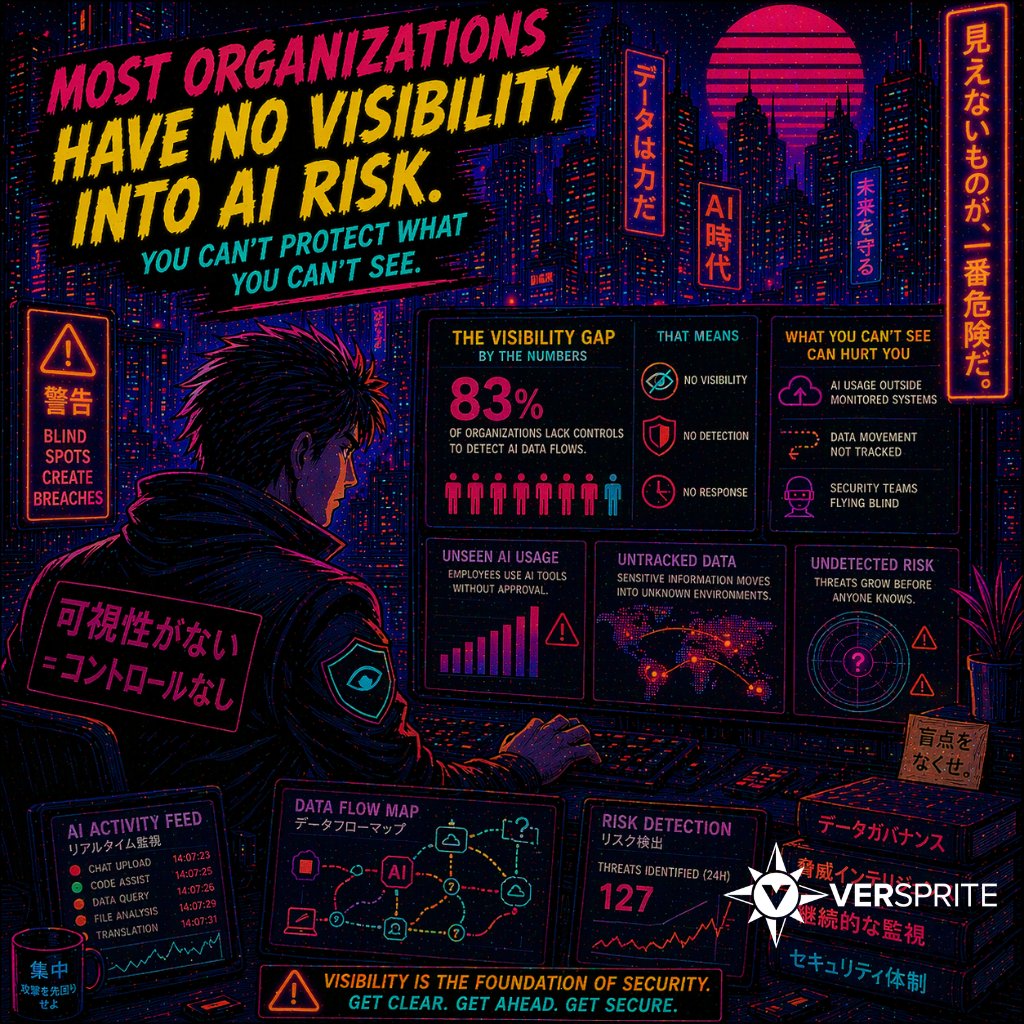
• Security teams need visibility into what AI systems can access, what actions they can perform, and how those actions are audited
The most important lesson is simple.
AI automation does not remove risk. It redistributes it across systems, identities, data flows, and decision points that many organizations have not fully mapped.
This is where threat modeling becomes essential.
Before scaling AI automation, organizations should ask:
• What systems can this agent touch
• What data can it retrieve, modify, or expose
• What credentials does it hold
• What happens if the workflow is manipulated
• What human validation exists before high impact actions occur
• How will abnormal AI driven behavior be detected
AI adoption should not slow down because of security. It should mature because of security.
The organizations that succeed will be the ones that pair innovation with disciplined architecture, adversarial thinking, and continuous governance.
Read the full VerSprite perspective here:
hubs.la/Q04hS-hX0
#ApplicationSecurity #Cybersecurity #AIsecurity #ThreatModeling #AppSec #ZeroTrust #IdentitySecurity #SecurityLeadership #VerSprite
4
5
57
AI Development Plugins Are Changing the AppSec Trust Boundary
AI assisted development is quickly becoming part of the modern engineering workflow. That progress is valuable, but it also changes where security teams need to look for risk.
VerSprite’s latest research into AI development plugin security risks highlights a critical reality: when coding agents are granted access to project files, local tools, network resources, and developer context, their behavior must be treated as part of the application security surface.
This is not just a prompt injection discussion. It is a trust boundary discussion.
The research identified how vulnerable tool behavior in an AI powered VSCode extension could enable:
• NTLM hash exposure through prompt injected instructions that cause the agent to interact with a remote SMB share
• Unintended project file disclosure through a plaintext HTTP POST tied to what appeared to be a leftover debugging endpoint
• Abuse of local development context when an injected prompt is embedded inside a repository file and later interpreted by the AI agent
• Security control bypass conditions where user approval prompts existed, but sensitive actions had already occurred in the background
The lesson for security leaders is clear: AI development plugins should not be evaluated only by productivity gains. They should be evaluated by the permissions they inherit, the tools they invoke, the data they process, and the paths they can reach.
At VerSprite, this is where our culture of adversarial thinking matters. We do not stop at identifying that a prompt injection exists. We ask what an attacker could realistically accomplish with it, how it could be chained, where the human approval model fails, and what impact it creates inside a real enterprise environment.
For teams adopting AI coding assistants, several practices deserve immediate attention:
• Review extension behavior before broad deployment
• Restrict unnecessary file, network, and system level access
• Monitor unexpected outbound traffic from developer workstations
• Treat repositories as potential instruction sources, not just code sources
• Require explicit user approval before sensitive data leaves the local environment
• Include AI enabled developer tools in threat modeling, red team testing, and third party risk reviews
AI is expanding the speed and capability of software delivery. Security has to evolve at the same pace.
The organizations that benefit most from AI assisted development will be the ones that approach it with disciplined trust boundaries, realistic abuse cases, and security validation that reflects how attackers actually operate.
Read the full research here:
hubs.la/Q04hW4-f0
#ApplicationSecurity #Cybersecurity #AIsecurity #AppSec #ThreatModeling #SecureDevelopment #DevSecOps #RedTeam #SoftwareSecurity #VerSprite
4
2
4
120
Vibe Coding Needs Security Leadership, Not Blind Trust
AI assisted development is changing how teams build software. That is not speculation anymore. It is already happening across engineering teams, product groups, startups, and enterprise environments.
The more important question is not whether teams should use AI to write code.
The better question is whether they have the security maturity to understand what that code introduces into their environment.
VerSprite recently examined two research studies on vibe coding, and the findings point to a critical lesson for application security leaders.
Functionality is not the same as security.
• AI generated code can appear correct while still containing exploitable weaknesses
• Simple applications may show improvement against common vulnerability classes
• More complex software workflows still expose gaps in security logic, authentication, session handling, secrets management, and contextual decision making
• Hardcoded secrets, predictable endpoints, and repeated insecure patterns create risk at scale
• Prompting alone is not a security control
This is where AppSec has to evolve.
AI can help accelerate software delivery, but it cannot replace security architecture, threat modeling, adversarial testing, secure design review, or human judgment. The organizations that succeed with AI assisted development will not be the ones that move fastest without friction. They will be the ones that build the right guardrails around speed.
At VerSprite, we have always believed security should be tied to how real systems fail, how adversaries think, and how business risk is created through design decisions. That perspective becomes even more important as AI generated code enters production pipelines.
Vibe coding is not inherently good or bad. It is a capability.
The risk comes from using that capability without understanding its limitations.
Security teams should be asking:
• What parts of the codebase are AI generated?
• Are generated components being threat modeled before release?
• Are secrets, authentication logic, and access controls being reviewed with extra scrutiny?
• Are traditional scanners enough, or do we need new testing methods for AI generated patterns?
• Are developers using AI as an assistant, or is AI making security relevant decisions without oversight?
The future of secure software development will not be anti AI.
It will be disciplined, evidence based, and operationalized.
Read the full VerSprite analysis here:
hubs.la/Q04hVY-80
#ApplicationSecurity #CyberSecurity #AppSec #AIsecurity #SecureSoftwareDevelopment #ThreatModeling #DevSecOps #VibeCoding #SoftwareSecurity #VerSprite
3
3
4
74
AI Does Not Replace Elite Penetration Testers. It Raises the Standard for Them.
The ARTEMIS study reinforces something VerSprite has long understood through real world offensive security work: security testing is not won by speed alone. It is won by adversarial thinking, contextual judgment, and the ability to connect technical findings to business risk.
AI agents are becoming highly capable in penetration testing workflows. They can accelerate reconnaissance, automate repetitive tasks, run parallel assessments, and support faster vulnerability discovery across large environments.
That matters.
But scale is not the same as understanding.
• AI can identify patterns quickly
• AI can assist with enumeration and triage
• AI can improve consistency across repeatable testing activities
• AI can reduce time spent on routine discovery
Yet the highest value work in application security still requires human expertise.
• Chaining vulnerabilities into realistic attack paths
• Understanding business logic abuse
• Validating exploitability in complex environments
• Interpreting attacker intent
• Separating technical noise from material risk
• Translating findings into decisions leadership can act on
This is where VerSprite’s culture and methodology matter.
We do not view penetration testing as a checklist exercise. We view it as an adversarial risk discipline. The goal is not simply to find vulnerabilities. The goal is to understand how a motivated attacker could move through an application, abuse trust boundaries, compromise critical assets, and create measurable business impact.
That is why AI should be integrated carefully into security programs.
Used well, AI expands the reach of skilled testers. Used poorly, it creates confidence without coverage.
The future of penetration testing is not AI versus humans.
It is AI guided by humans who know how attackers think, how systems fail, and how risk becomes real.
For security leaders, the question should not be whether AI belongs in offensive security. It should be where AI adds leverage, where human validation remains essential, and whether the program is measuring actual risk reduction rather than tool adoption.
Read VerSprite’s full perspective here: hubs.la/Q04hW5qf0
#ApplicationSecurity #Cybersecurity #PenetrationTesting #AI #ThreatModeling #OffensiveSecurity #AppSec #RiskManagement #VerSprite
1
3
4
53
Threat Modeling Should Move at the Speed of Software
Security teams are often asked to protect systems that are changing faster than traditional assessment cycles can support. That reality is why threat modeling must evolve from a periodic exercise into a scalable, risk based capability embedded into how software is designed, built, tested, and improved.
At VerSprite, we have long believed that effective application security starts with understanding what matters most to the business, how the system works, where trust boundaries exist, and how real adversaries may attempt to exploit weakness.
That is the value of Threat Modeling as a Service.
It gives organizations a practical way to bring specialized AppSec expertise, structured methodology, and adversarial thinking into the software development lifecycle without slowing innovation.
A mature threat modeling program should help teams:
• Understand the business context behind the application, not just the technical architecture
• Identify threats that are relevant to the product, platform, data, users, and operating environment
• Uncover design flaws before they become expensive security defects
• Prioritize remediation based on risk, impact, and exploitability
• Align security decisions with development timelines and business goals
• Validate assumptions through attack simulation and evidence based analysis
This is where VerSprite’s PASTA methodology continues to stand apart.
PASTA, the Process for Attack Simulation and Threat Analysis, is not simply a diagramming exercise. It is a risk centric framework that connects business impact, application architecture, threat intelligence, weakness identification, attack patterns, and residual risk analysis.
Threat Modeling as a Service makes that possible at scale.
It supports teams when internal security capacity is stretched. It creates consistency across applications and projects. It brings current threat intelligence into the conversation. It helps development teams focus their testing and code review efforts where they matter most.
Most importantly, it changes the timing of security.
Instead of waiting for vulnerabilities to surface late in the development cycle, teams can address risk while architecture, requirements, and design decisions are still flexible.
That is how application security becomes less reactive and more strategic.
VerSprite helps organizations answer that question with a tailored, risk based approach to Cyber Threat Modeling as a Service.
Learn more: hubs.la/Q04hW3850
#ApplicationSecurity #DevSecOps #ThreatModeling #CyberSecurity #PASTA #RiskManagement #SecureSoftwareDevelopment #AppSec
2
2
43
Security Decisions Should Begin With Business Reality
Threat modeling is most effective when it does more than document possible weaknesses. It should help product, engineering, security, and business leaders understand which threats matter most, why they matter, and what decisions should follow.
That is the strength of PASTA, the Process for Attack Simulation and Threat Analysis.
At VerSprite, we have long viewed application security through two lenses at the same time: how the business creates value, and how an adversary would attempt to disrupt, exploit, or monetize that value. PASTA brings structure to that conversation.
It starts with business context before technical assumptions take over. It asks teams to understand critical use cases, abuse cases, threat actors, threat motives, trust boundaries, data flows, vulnerabilities, attack paths, and residual risk.
That matters because modern AppSec teams are not short on findings. They are short on clarity.
• Not every vulnerability carries the same business consequence
• Not every theoretical threat is equally viable
• Not every control deserves the same urgency
• Not every remediation decision should be made in isolation from operational impact
A mature threat modeling program helps teams move from generic security checklists to informed security decisions. It gives engineering teams a defensible way to prioritize. It gives security teams a clearer view of adversarial behavior. It gives business leaders language they can use to understand risk without reducing it to fear or compliance pressure.
PASTA is especially valuable because it connects threat intelligence, application architecture, attack simulation, and business impact into one disciplined methodology. It helps organizations ask better questions earlier in the software lifecycle, when security decisions are still easier to influence.
The goal is not to make threat modeling a ceremony.
The goal is to make it useful.
Useful to developers who need actionable guidance.
Useful to security teams who need evidence.
Useful to executives who need risk translated into business terms.
Useful to organizations that want to build software with resilience designed in, not inspected in after the fact.
Learn more about VerSprite’s PASTA Threat Modeling approach:
hubs.la/Q04hVSXX0
#ApplicationSecurity #ThreatModeling #DevSecOps #Cybersecurity #PASTA #SecureSoftware #RiskManagement #ProductSecurity #AppSec
1
1
37
AI Security Requires More Than Model Confidence
AI is becoming embedded in the systems that approve transactions, support clinical decisions, personalize customer experiences, accelerate engineering, and guide operational judgment. That means AI security can no longer be treated as an emerging concern. It is now part of enterprise risk, application security, data protection, and business resilience.
At VerSprite, we look at AI security through the same lens that has shaped our work across application security and adversarial risk for years: understand the business context, decompose the system, model realistic threats, validate exposure, and prioritize remediation based on impact.
AI changes the attack surface in important ways.
• A model can be manipulated without a traditional exploit
• A prompt can become an entry point
• A training dataset can become a source of compromise
• An inference API can expose sensitive patterns
• A decision engine can be abused in ways that affect trust, compliance, and revenue
This is why AI security testing must go beyond conventional penetration testing.
Effective AI Hacking requires the ability to test the full ecosystem around the model, including data pipelines, MLOps workflows, model registries, APIs, prompts, agents, infrastructure, and the business processes that depend on AI output.
It also requires a risk based methodology.
VerSprite’s use of PASTA brings structure to AI security by connecting technical attack paths to business consequences. That connection matters. Security teams do not need abstract findings. They need clear insight into how an adversary could influence, extract, poison, bypass, or abuse an AI system, and what that means for the organization.
The future of AI security will belong to teams that can think like Breakers, Builders, and Defenders at the same time.
• Breakers to challenge assumptions and simulate real adversarial behavior
• Builders to understand how AI systems are designed, deployed, and integrated
• Defenders to translate findings into durable controls and measurable risk reduction
AI adoption is moving quickly. Security maturity must move with it.
For organizations deploying AI into meaningful business workflows, the question is not whether the model performs under normal conditions. The better question is whether the system can withstand adversarial pressure when trust, privacy, integrity, and operational continuity are on the line.
Learn more about VerSprite’s AI Hacking Services:
hubs.la/Q04hSPN40
#AIsecurity #ApplicationSecurity #Cybersecurity #OffensiveSecurity #RedTeam #ThreatModeling #PASTA #AppSec #MachineLearningSecurity #VerSprite
3
3
38
Real Time Deepfake Face Swapping Is a Security Readiness Issue
The next phase of social engineering will not only test whether people can spot a suspicious email. It will test whether organizations can validate trust when the person on screen looks and sounds familiar.
At VerSprite, we view this as more than an AI trend. It is an operational security concern that intersects identity verification, executive protection, application security, red teaming, security awareness, and business process resilience.
Real time deepfake face swapping changes the threat model because it can introduce impersonation into live interactions:
• Video based identity checks
• Executive approvals
• Remote onboarding workflows
• Help desk verification
• Vendor and partner communications
• Social engineering engagements
• Biometric authentication processes
The defensive lesson is not simply “detect the deepfake.” That is too narrow.
The better lesson is to design systems that do not depend on visual trust alone.
Organizations should be asking:
• Where do we rely on face recognition or familiarity as a control?
• Which workflows can approve financial, operational, or access related decisions through live communication alone?
• Do our verification processes hold up when an attacker can convincingly impersonate a trusted person?
• Are our people trained against modern adversary behavior, or only against yesterday’s playbook?
• Can our security controls correlate identity, device, session, behavior, and context before granting trust?
This is why authorized adversarial simulation matters.
Security teams need safe, controlled, ethical ways to demonstrate how AI enabled impersonation can affect real business processes. Not to create fear, but to replace assumption with evidence.
That is the VerSprite approach: understand the adversary, test the control, educate the organization, and build security that survives contact with real world conditions.
Deepfake risk should not be treated as a novelty. It should be evaluated like any meaningful attack path: technically, operationally, and with a clear understanding of business impact.
Read the full VerSprite research and technical breakdown here:
hubs.la/Q04hS-8v0
#Cybersecurity #ApplicationSecurity #Deepfake #RedTeam #SocialEngineering #AIThreats
3
4
60
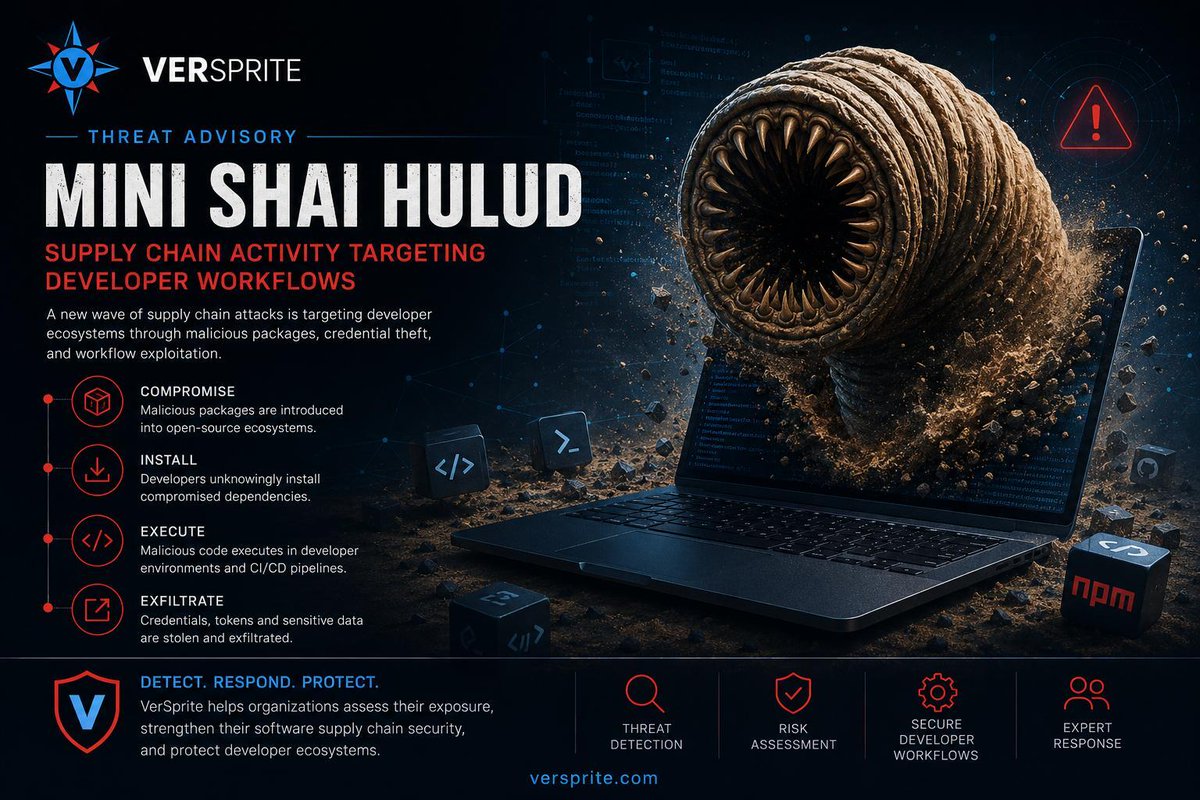
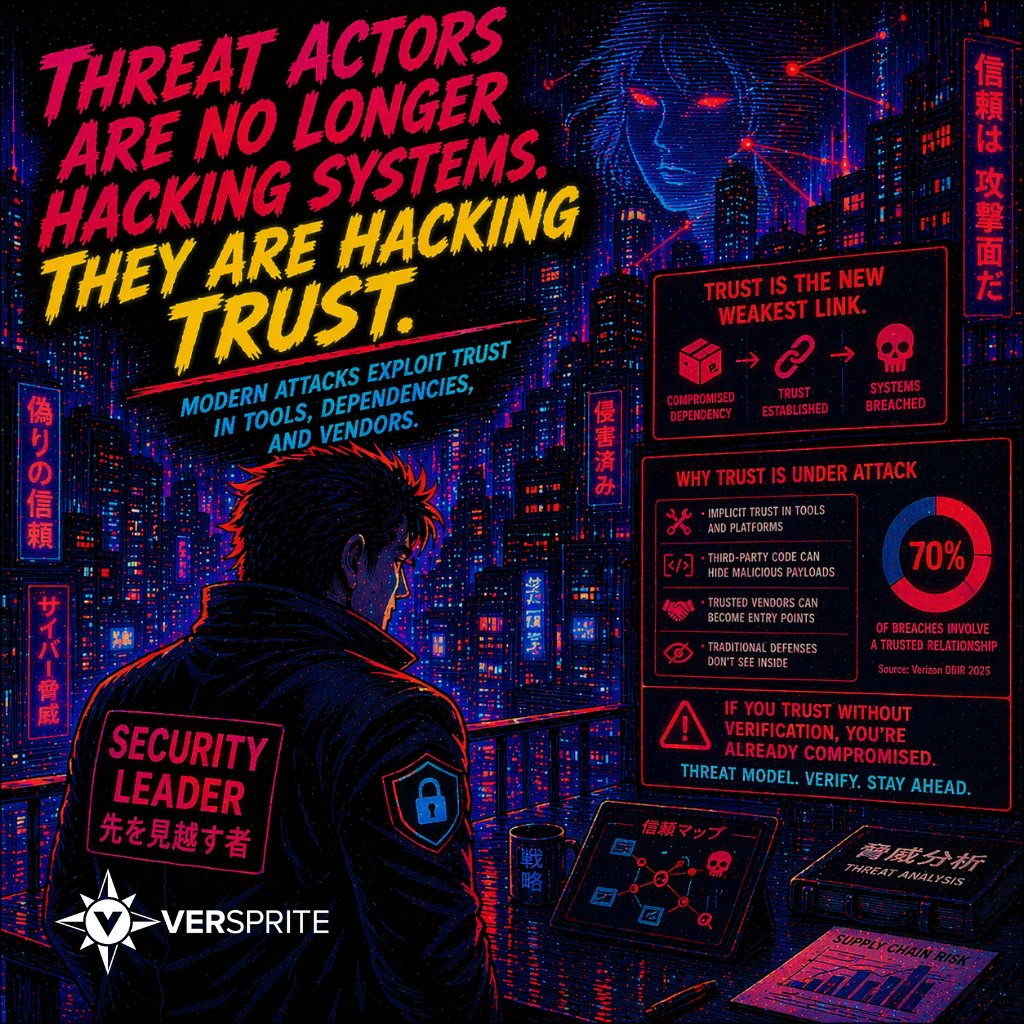
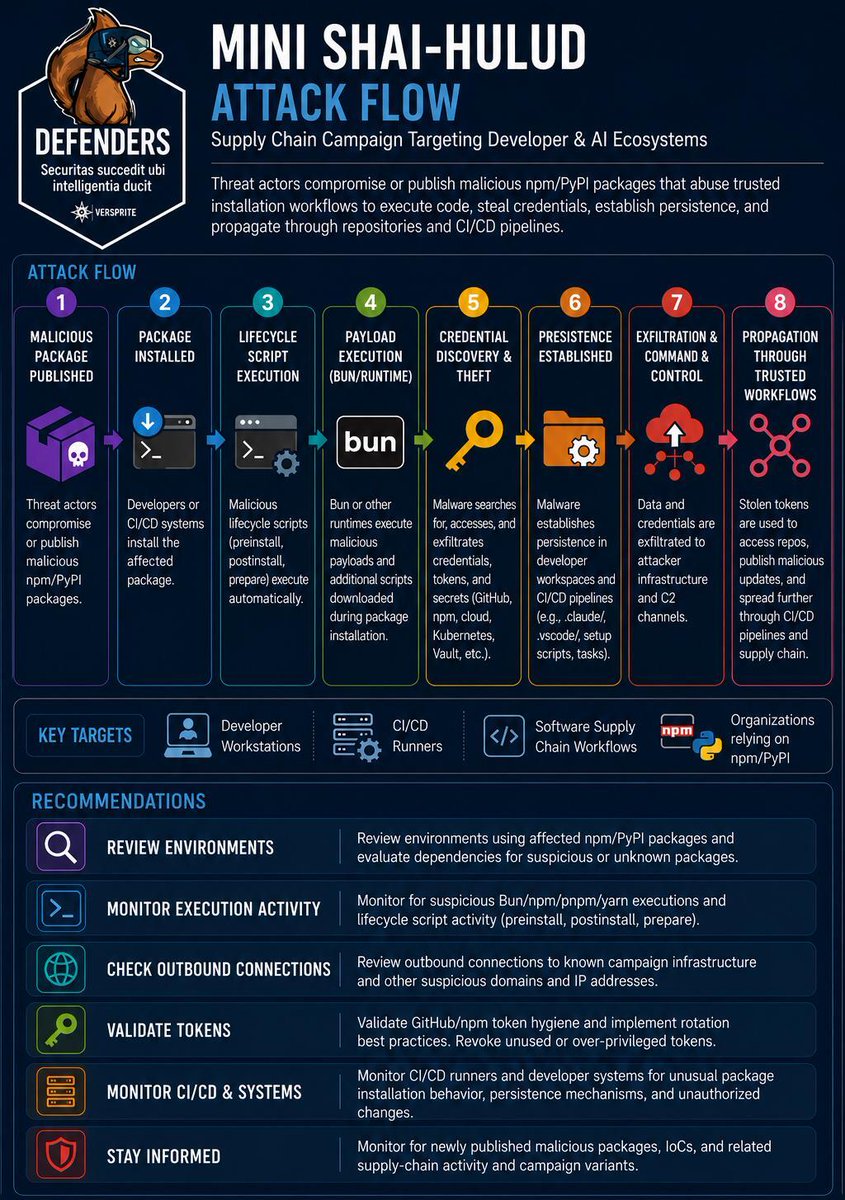
Mini Shai Hulud and the Trust Boundary Inside Developer Workflows
Software supply chain activity continues to remind us that application security is no longer limited to the code we write. It also includes the packages we inherit, the automation we trust, and the developer workflows that connect source code to production.
Mini Shai Hulud is a timely example.
This campaign has been observed targeting npm and PyPI ecosystems tied to developer tooling and AI related workflows. The concern is not simply that malicious packages exist. The deeper issue is that package installation, lifecycle scripts, CI/CD runners, and developer workstations often sit close to credentials, repositories, cloud access, Kubernetes environments, and software publishing paths.
That makes developer workflows a high value control plane.
For security and engineering leaders, this activity reinforces several important lessons:
• Developer endpoints should be treated as part of the production attack surface
• CI/CD runners need the same level of monitoring, least privilege, and containment expected from critical infrastructure
• Package installation behavior should be observable, especially around npm, pnpm, yarn, pip, Bun, and lifecycle script execution
• Dependency governance must include rapid quarantine, rollback, and verification procedures
• Secrets hygiene is not a periodic checklist item. It is an operational discipline tied directly to developer behavior and pipeline design
• Software composition analysis should be paired with threat hunting, repository review, and build pipeline validation
At VerSprite, we view this type of activity through the intersection of offensive security, application risk, threat intelligence, and secure engineering. Supply chain security is not solved by one tool or one scan. It requires understanding how trust moves through an organization’s development ecosystem.
The most resilient teams are asking practical questions:
• Which dependencies changed recently and why?
• Which package scripts executed in developer or CI/CD environments?
• Which tokens could be abused if a workstation or runner was compromised?
• Which repositories, workflows, and publishing paths have excessive permissions?
• How quickly can we isolate a dependency, rotate credentials, and validate code integrity?
Mini Shai Hulud is not just a malware story. It is a reminder that modern application security must protect the paths developers use to build, test, deploy, and maintain software.
Organizations that rely heavily on open source ecosystems, cloud native development, and automated delivery pipelines should use this moment to strengthen visibility, reduce implicit trust, and validate whether their development workflows can withstand supply chain compromise.
VerSprite helps organizations assess software supply chain risk, harden DevSecOps practices, conduct repository compromise assessments, review CI/CD security, and perform proactive threat hunting across developer ecosystems.
Learn more at hubs.la/Q04hVF0R0
#ApplicationSecurity #Cybersecurity #SoftwareSupplyChain #DevSecOps #AppSec #ThreatIntelligence #CICDSecurity #OpenSourceSecurity #CloudSecurity #SecureDevelopment
2
4
100
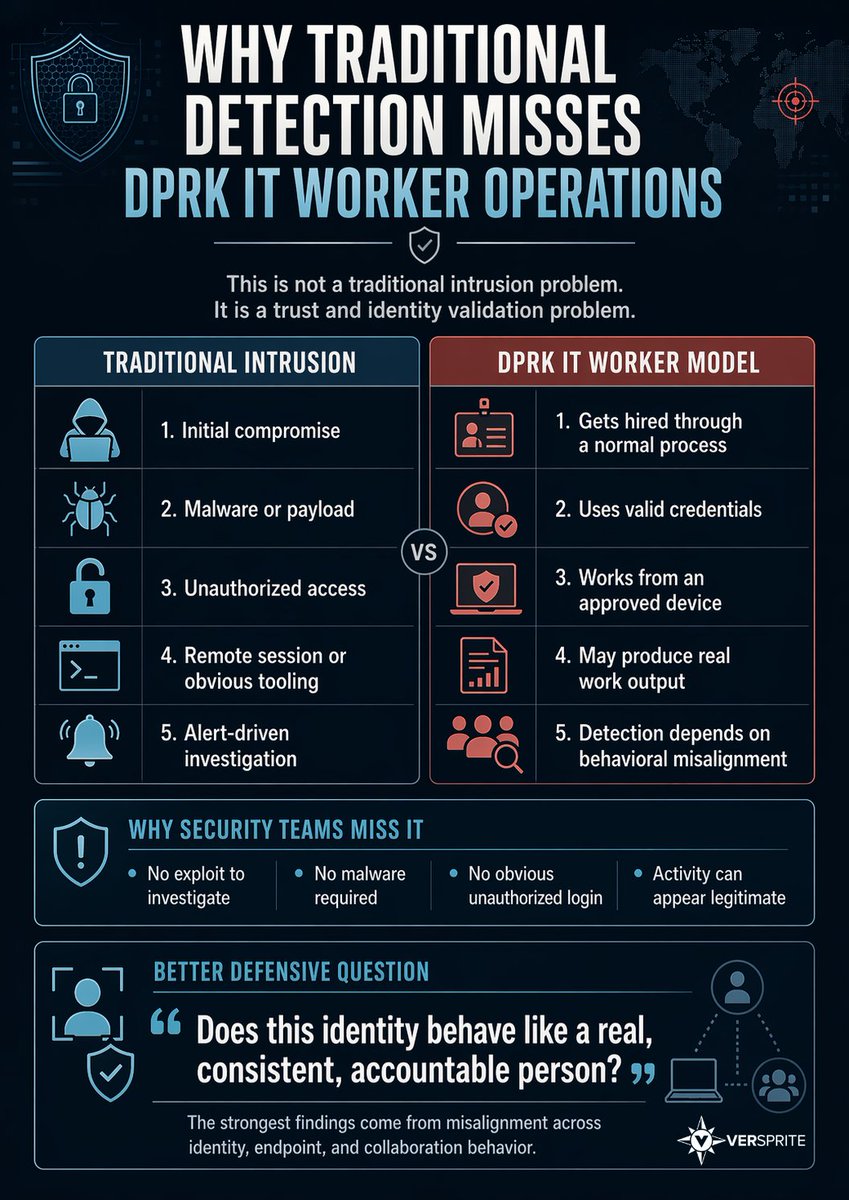
DPRK IT Worker Risk Is a Trust Validation Problem
Remote work changed more than where people log in from. It changed how organizations establish trust.
DPRK IT worker activity is often discussed as hiring fraud, insider threat, or remote access abuse. Those descriptions are not wrong, but they are incomplete.
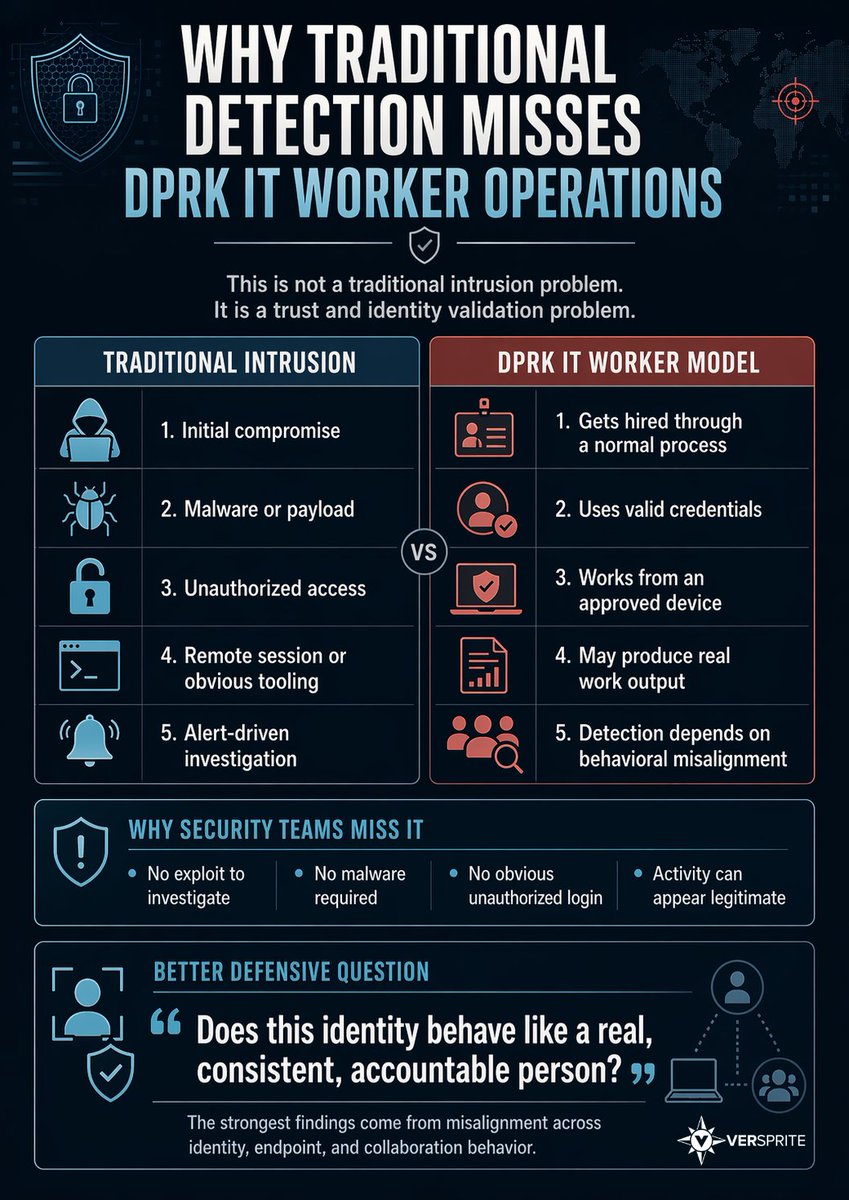
The operational reality is more complex. In many cases, the person gets hired. The credentials are valid. The endpoint may be clean. The work may appear normal. The activity can fit neatly inside approved business workflows.
That is what makes this risk different.
At VerSprite, we view this as a security problem that sits at the intersection of identity, hiring, endpoint behavior, collaboration patterns, and organizational trust. It is not enough to ask whether something malicious is happening. Security teams also need to ask whether the identity operating inside the environment behaves like one real, consistent, accountable person over time.
A few important takeaways for security and business leaders:
• Hiring and onboarding are now part of the security boundary
• Valid credentials do not always equal valid identity
• A clean endpoint does not always confirm a legitimate user
• Collaboration behavior, meeting presence, access patterns, and work output need to tell one coherent story
• HR, security, legal, and hiring managers need clear escalation paths when identity concerns emerge
• Prevention is strongest before access is granted, not after trust has already been established
This is not about creating unnecessary friction for legitimate candidates. It is about recognizing that remote hiring has become an access path that adversaries can operationalize.
The strongest organizations will not rely on a single alert, tool, or team to solve this. They will connect signals across hiring, identity, endpoint, collaboration, and response processes. They will treat trust as something to validate continuously, not something granted once and assumed indefinitely.
VerSprite’s latest article breaks down the operational model, why traditional detection can miss it, and what organizations should consider when building a more mature defense.
Read the full article:
hubs.la/Q04hVHkr0
#Cybersecurity #ApplicationSecurity #IdentitySecurity #InsiderRisk #ThreatDetection #RemoteWorkSecurity #RiskManagement #VerSprite
2
2
64