Author, keen blogger (since 1998), writing teacher.
Joined April 2007
- Tweets 52,243
- Following 6,974
- Followers 6,775
- Likes 57,852
12,934 Photos and videos
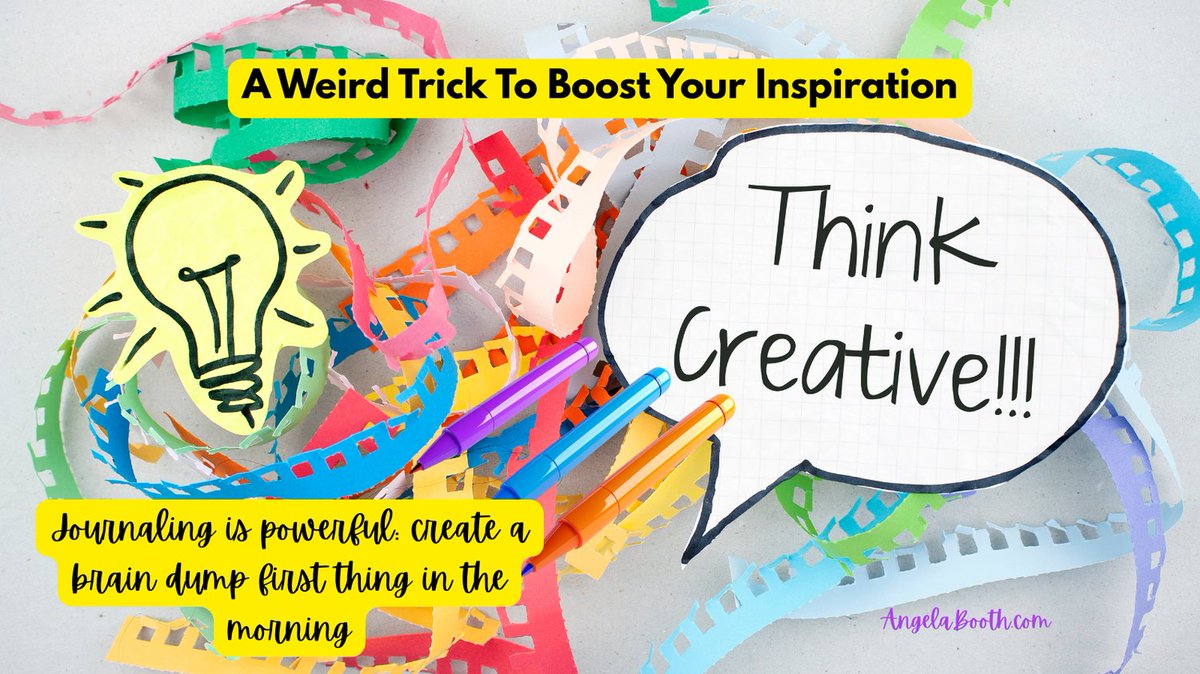
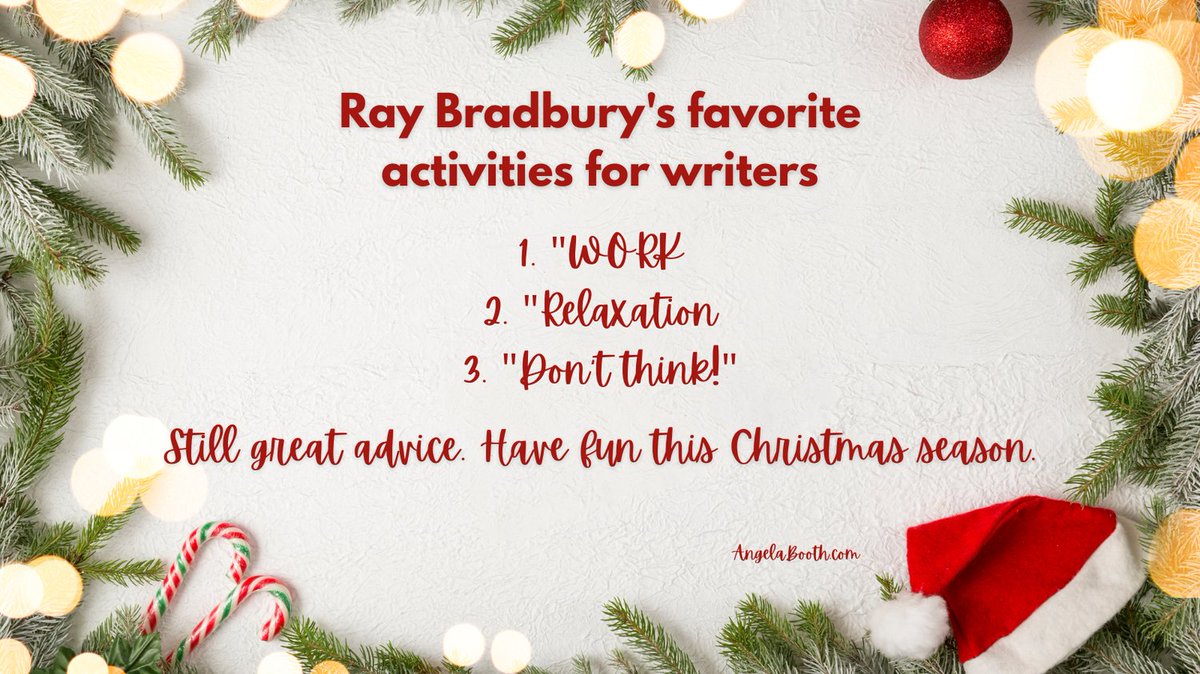
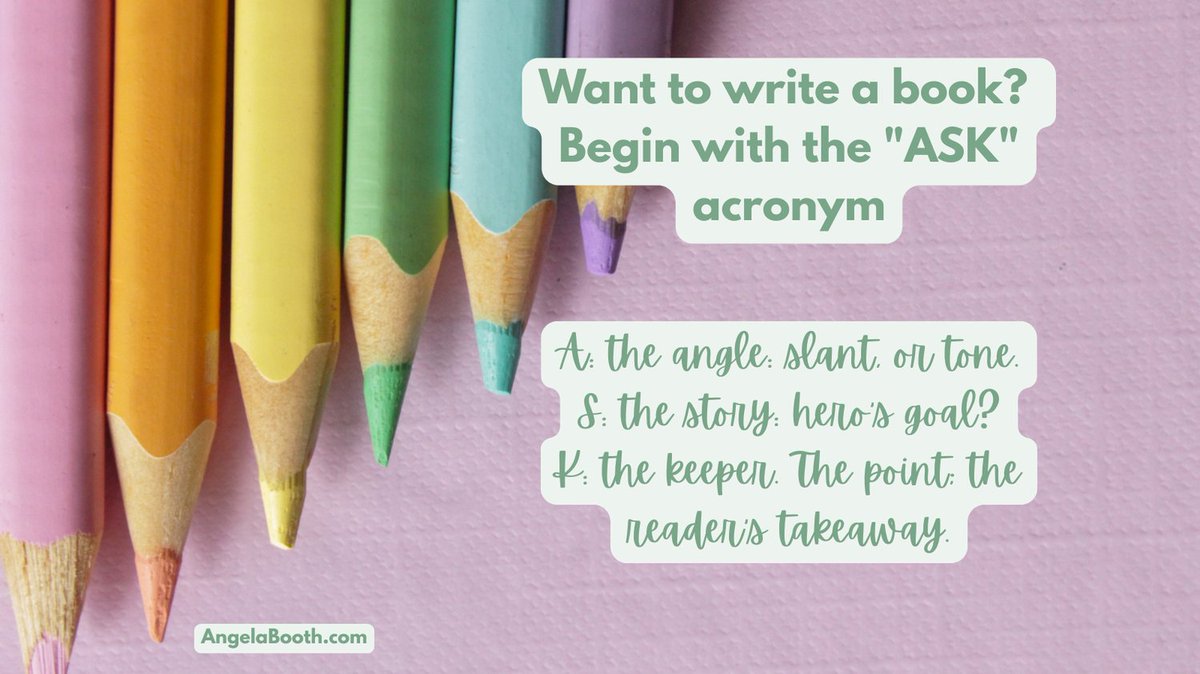
Angela Booth retweeted

Jun 11
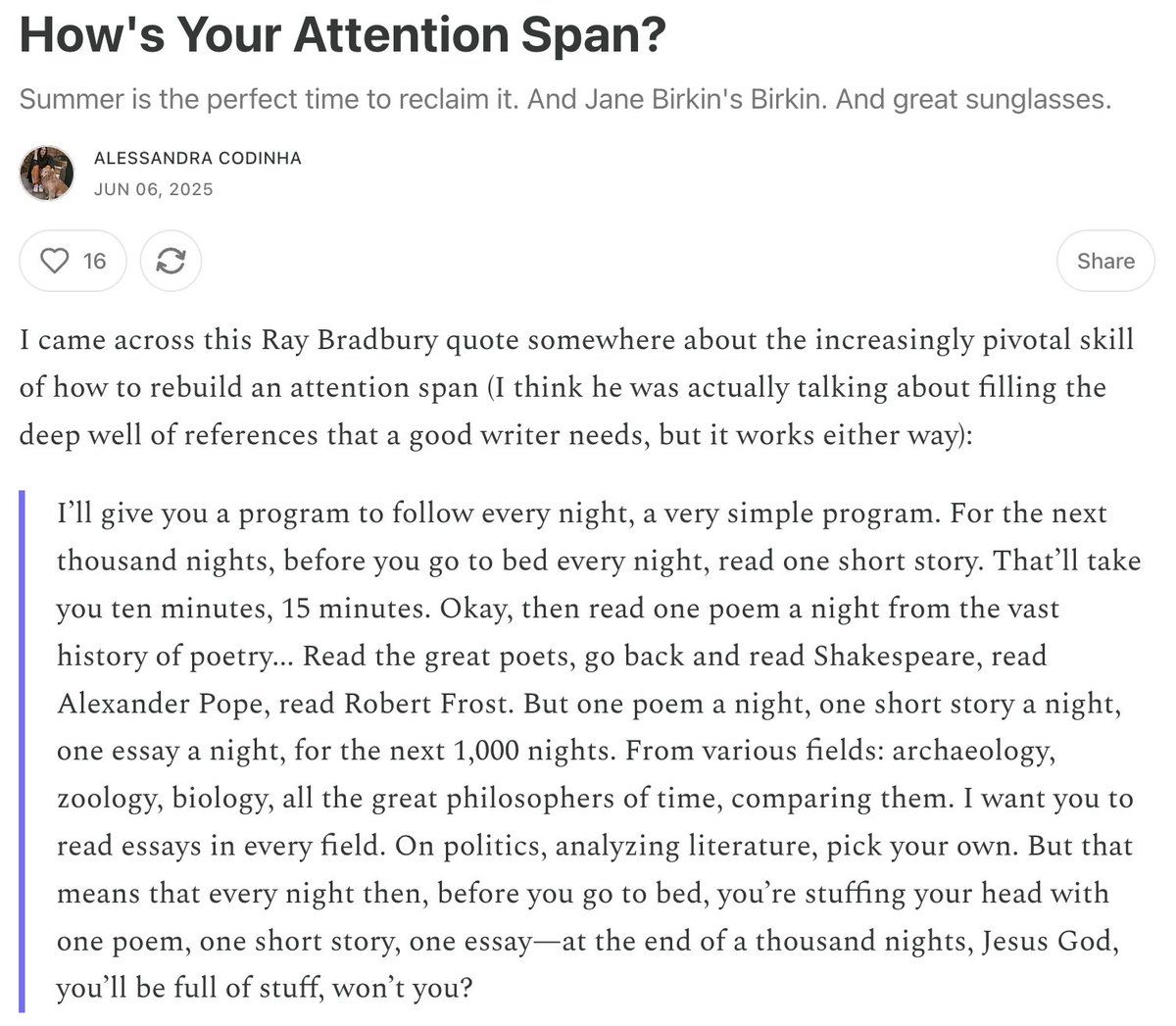
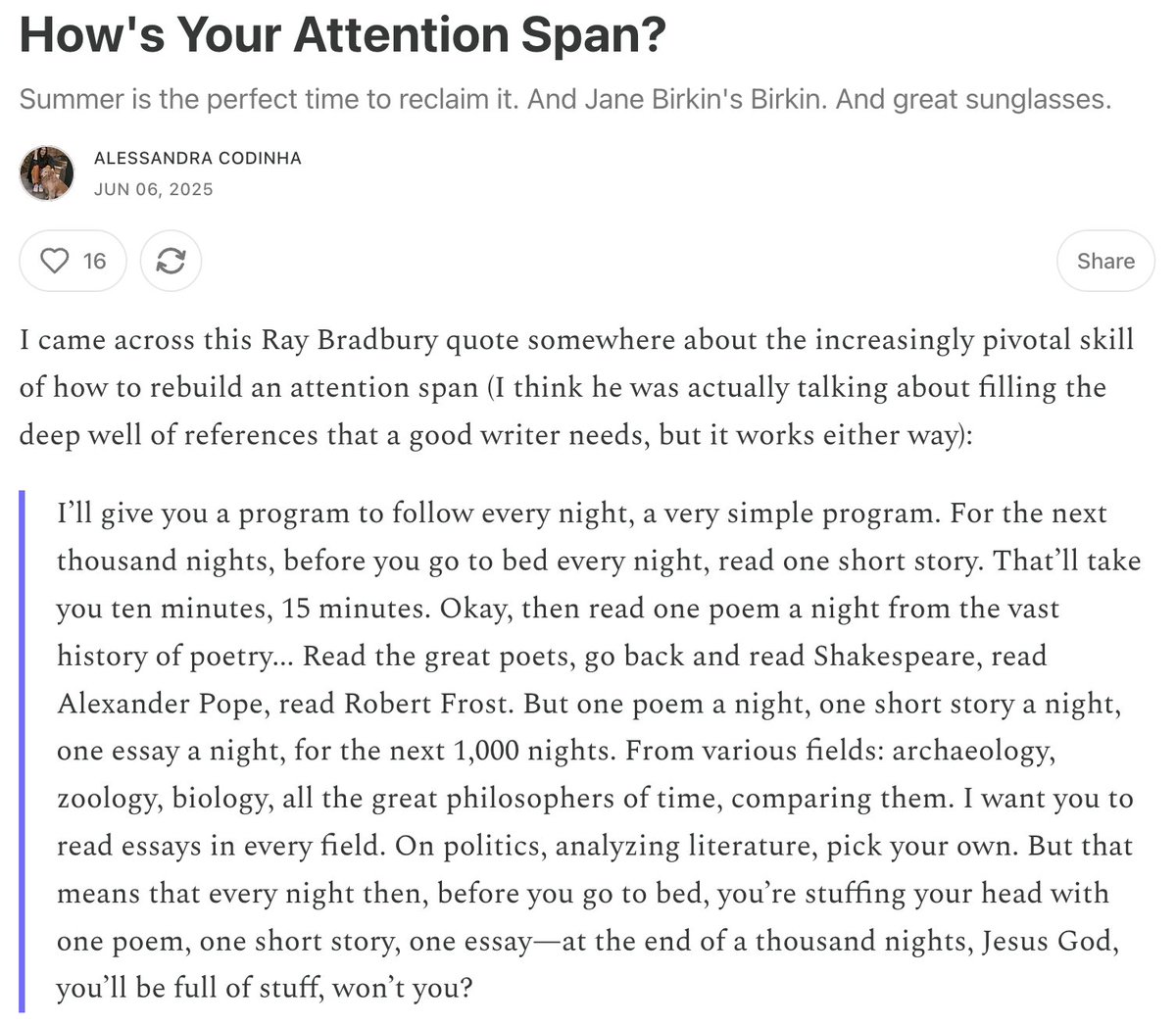
Ray Bradbury understood something most people forget: attention is not just something you spend, it is something you train. His advice was simple but disciplined — read one short story, one poem, and one essay every night for a thousand nights — because the mind gets stronger by repeated contact with concentrated language and ideas.
The deeper point is that rebuilding attention span is not about avoiding distraction for a week and calling it fixed. It is about giving your mind regular doses of depth until depth feels natural again. Bradbury’s method works because it mixes three things the brain needs: narrative, compression, and argument.
What I like about this advice is that it treats attention as a craft, not a mood. You do not rebuild it by waiting to feel focused. You rebuild it by feeding the mind better material every day, long enough for your defaults to change.
The image captures that well: attention span is not only about reading more, it is about reclaiming the ability to stay with something long enough for it to shape you. In Bradbury’s view, the real payoff is not just more focus — it is a fuller head, a richer inner world, and better raw material for thinking and writing.
2
100
516
13,650
Angela Booth retweeted

Jun 9
No surprise that plagiarizing from the plagiarizing machine making students less creative.

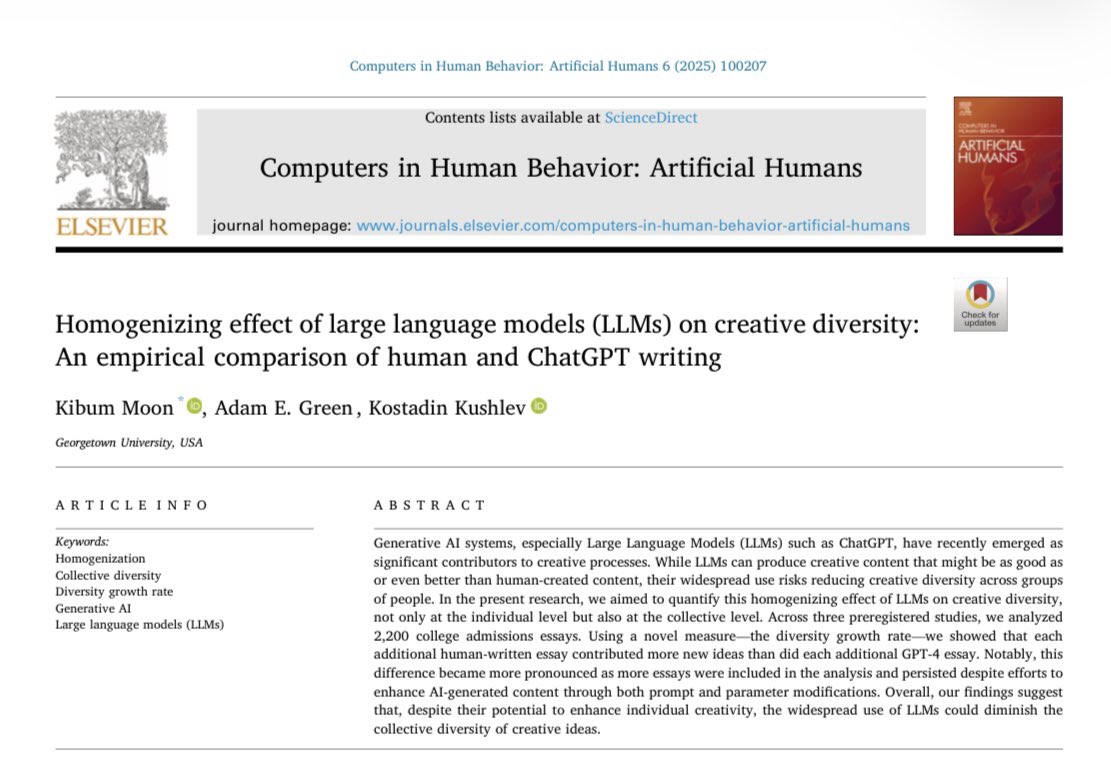
Students without access to LLMs are 2 to 8 times more creative than students with access.
That is the finding of a new paper comparing 2,200 college admissions essays written by humans before ChatGPT with essays generated by GPT-4.
The key point is not individual creativity. GPT-4 can write well, sometimes better than individual students. The problem is collective creativity.
Each new human essay added new semantic territory. New ideas. New angles. New experiences. New combinations.
Each new GPT-4 essay added much less.
The authors call this the diversity growth rate: how much novelty each additional text contributes to the collective pool of ideas.
Humans kept expanding the pool. GPT-4 made the pool converge.
Even when the authors pushed GPT-4 to be more creative, changed parameters, or used chain-of-thought prompting, the homogenizing effect remained.
This is the real danger of AI in education.
Not that students will write worse.
That everyone will write the same.
*
Full paper in the first reply
30
137
666
43,949
Angela Booth retweeted

Watching the decline of literacy at the youngest ages feels like watching an iceberg slowly approach the Titanic. What’s happening to middle-grades is also coming for YA and adult books as this demographic ages. The publishing industry itself could collapse.

Been feeling bleak for the past week after I read an essay saying the market for middle-grade books has collapsed because kids can no longer read them. Two long-time publishers of middle-grades have shuttered, with more to come. We don’t appreciate what a crisis this is.
36
235
1,158
30,155
Angela Booth retweeted

Jun 7
Bestselling novelist David Baldacci on how AI companies deliberately stole every book and academic paper published in the last 70 years:
Baldacci is a named plaintiff in a lawsuit against OpenAI and Microsoft in the Southern District of New York, alongside John Grisham, Scott Turow, George R.R. Martin, Jodi Picoult, and Jonathan Franzen.
They're also representing roughly 60,000 unnamed plaintiffs.
He explains how AI companies arrived at novels as the key ingredient for building superintelligence:
"The AI community searched the world. How do you create superintelligence? They tried everything to try to figure out, how do you do this? They fed dictionaries into it. They did lots of stuff. They finally found the only way to create super intelligence that they needed was to feed novels into the large language models. Novels worked, finished products of storytelling with characters and dialogue and research and events and interactions. That was their Holy Grail moment."
Baldacci points out the obvious path the AI companies could have taken —negotiating with the five major publishers, each of whom represents around 100,000 writers.
Instead, they chose theft. @davidbaldacci continues:
"They decided we're just going to steal them. I'm not saying anything out of school. They've admitted this. They got most of the books from a Russian pirate website where they would go and download the books from there. And they didn't even want their software programs to know they were stealing the books. So they had the software program that would scrape off the copyright page, scrape off the ISBN number on the back, and just download the book itself."
The scale is staggering.
Over the last eight or nine years, every book and every academic paper published in the last 70 years worldwide has been ingested into the large language models at Anthropic, OpenAI, and Meta.
Baldacci testified about this on Capitol Hill in July.
He describes the personal toll of being a named plaintiff:
"I've had to give them all of my materials, all of my financial information I've had to give them, let them come in and do a complete scrape on all of my emails, all of my communications. I sat through a nine hour deposition like I've done something wrong. They said, yeah, we've taken your books, we haven't paid you a dime and we didn't ask your permission, but we should be entitled to do it because AI is so cool. That's basically their legal argument."
The parallel case against Anthropic in California has already settled for $1.5 billion, to be paid out over two years to 50,000 writers. The OpenAI and Microsoft case is now past discovery and heading toward a settlement conference.
42
297
819
28,499
Angela Booth retweeted

Jun 6
WEBSITES FOR BOOK LOVERS:
1. goodreads. com — track every book you've ever read.
2. literaturemap. com — find authors similar to ones you love.
3. whichbook. net — mood-based book recommendations.
4. openlib. org — free books, millions of them.
5. gutenberg. org — classic books, completely free, forever.
6. bookbrowse. com — expert reviews before you commit.
7. librarything. com — catalog your entire personal library.
8. storygraph. com — goodreads but actually better.
9. readng. app — track reading habits and streaks.
10. bookriot. com — recommendations for every type of reader.
11. fivebl. com — five books on any topic you want
12. shepherd. com — authors recommend their favorite books
13. nexpart .io — find your next book in 30 seconds
14.1000novels. com — the ultimate reading bucket list
15. bookdepository. com — free worldwide book delivery
16. libgen. is — every book ever, just saying
17. printsforsale. com — book-related art prints
18. openlibrary. org — borrow digital books for free
19. readanybook. com — read books online free
20. bookcrossing. com — leave books in public, track them worldwide
21. abebooks. com — rare and secondhand books
22. paperbackswap. com — swap books with strangers
23. novellist. com — "if you liked X, read Y"
24. yourlocallibrary. com — find your nearest library
25. bookscouter. com — sell your old books for the best price
26. manybooks. net — free ebooks in every format
27. bookish .com — celebrity book recommendations
28. readera. com — read anything on any device
29. fantasticfiction. com — complete series reading order
30. isfdb. org — every sci-fi and fantasy book ever published
31. buzzfeed. com /books — viral book lists for every mood
32. bookmarks. reviews — best reviews from top critics
33. bookpage. com — new releases worth your time
34. booksloth. com — social reading community
35. completelibrary. co — track series completion
36. howlongtoread. com — know exactly how long a book takes
37. wordery. com — cheap books delivered worldwide
38. mybookcave. com — clean reads recommendations
39. ebookfriendly .com — best ebook deals daily
40. theliterarycat. com — bookish lifestyle and reviews
41. readlist. com — curated reading lists by experts
42. authorama. com — public domain classics online
43. standard- ebooks. org — free ebooks made beautiful
44. booklovers .com — community reviews and ratings
45. digitallibrary. io — public library ebooks on your phone
46. bibliobd. com — track books by country of origin
47. tbrchallenge. com — tackle your to-be-read pile
48. unshelved. com — daily comic strip for book nerds
49. shortform. com — book summaries done properly
50. blinkist. com — full book in 15 minutes
10
481
2,253
55,920
Angela Booth retweeted

If you are homeschooling or just generally want to pass down an understanding and love of literature to your kids, please do not fall for the lie that Shakespeare (or the KJV Bible, or anything else that is now often called "difficult") is too old or obscure for *you* to grasp. That's how you perpetuate the lie for another generation and deprive your children of important cultural and linguistic grounding.
OP has a solid list of tips for getting to the point where you can enjoy and understand this stuff.

How I first studied Shakespeare so I could actually learn it and understand what he was talking about:
1. I listened to audio versions of the play while following along with the text. Actors provide emotions/tone to help you understand the scene. This also meant I could stop when I needed to so I could look up words or context.
2. In a 3 hour play, I would stop about every 30 minutes and watch a summary or listen to a lecture about that section. Then continue to the next section.
3. Then I would watch a performance (usually on YouTube). Lots of Shakespeare performances on YT for free.
4. Now I can read entire plays or just certain sections, and I enjoy them. I actually know what's going on. I can appreciate the language (without wondering "What the hell does this word mean?")
3
18
213
12,473
Angela Booth retweeted

Jun 6
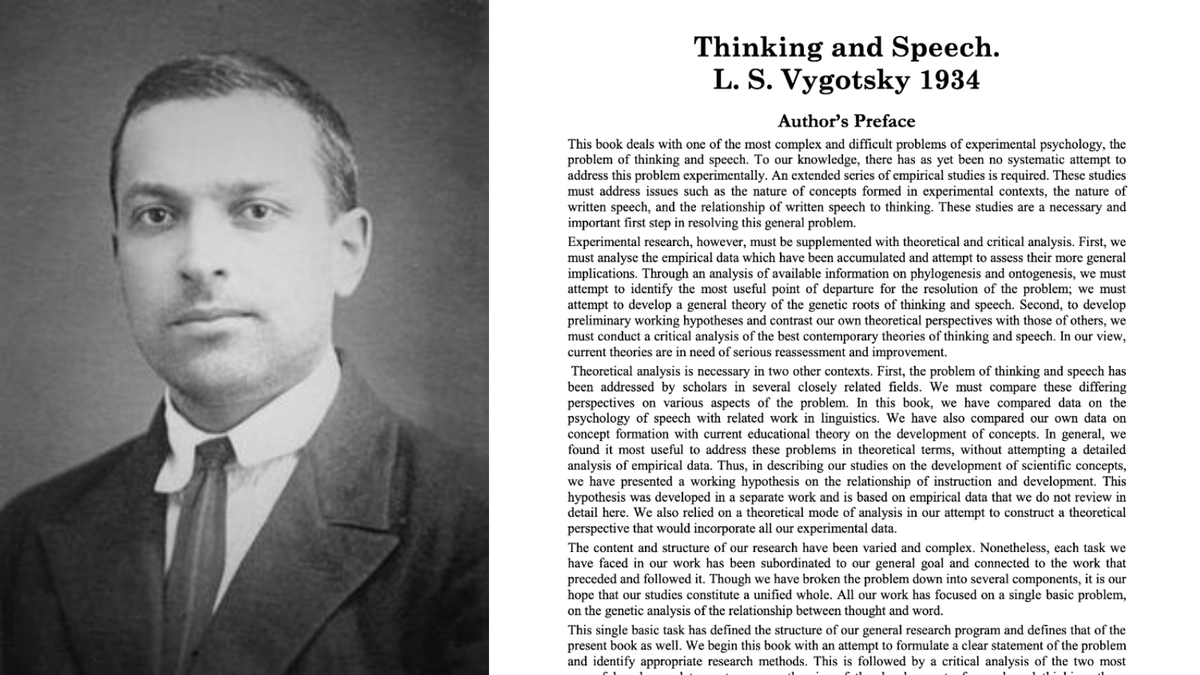
A Russian psychologist spent 10 years proving that the act of talking to yourself out loud is one of the most powerful cognitive tools the human brain has, and almost nobody outside his field has read the work.
His name was Lev Vygotsky.
He worked in Moscow in the 1920s and died of tuberculosis in 1934 at the age of 37. He had no laboratory, no funding, almost no English readers, and a body of work that the Soviet government suppressed for two decades after he died.
He produced the foundational theory of how human cognition actually develops, and the central piece of that theory was a behavior almost every adult is faintly embarrassed about.
Vygotsky noticed that young children talk to themselves constantly. They narrate their own actions, they argue with imaginary opponents, they instruct themselves through tasks out loud.
The dominant theory at the time, from the Swiss psychologist Jean Piaget, said this was a sign of cognitive immaturity that children would eventually grow out of as they learned to think properly.
Vygotsky said the exact opposite.
He argued that this self-directed speech was the most important cognitive event in the entire developmental window, because it was the moment a child first started to use language as a tool to control their own mind. The child was not failing to think. The child was learning how to think by externalizing the process and listening to themselves do it.
He predicted that as children matured, this out-loud self-talk would not disappear. It would go underground. It would become silent inner speech, which is the running monologue every adult has inside their own head for the rest of their life.
The voice you hear when you read this sentence is the direct descendant of a four-year-old narrating their own block tower.
For 50 years almost nobody outside Russia had access to his work, and the few researchers who did pick it up could not get funding to test it. Then in the early 2000s the experiments finally started to pile up, and what they found was that Vygotsky had been right about something even more important than he knew.
The first major study came from Gary Lupyan at the University of Wisconsin and Daniel Swingley at the University of Pennsylvania in 2012. They ran a simple visual search experiment. Participants were shown 20 images at once and asked to find a specific object, like a banana or a chair. In one condition they searched silently. In the other condition they were told to say the name of the object out loud to themselves while looking for it.
The participants who spoke the target name out loud found the object significantly faster, with higher accuracy, than the participants who searched in silence. The effect was strongest when the spoken word matched a familiar object the brain already had a strong category for.
Saying the word out loud literally tuned the visual system to detect that thing better. The researchers called it the label feedback effect, and the implication was that the act of vocalizing a goal physically changes how the brain processes the world while pursuing it.
The second major study came out of the University of Michigan and Michigan State in 2017. The lead researchers were Ethan Kross and Jason Moser, and they used both EEG and fMRI to record what happens inside the brain when people talk to themselves while emotionally upset.
They asked participants to recall painful autobiographical memories and reflect on them in two different ways. Some used the first person, saying things like "why am I feeling this way." Others used the third person, referring to themselves by their own name, saying things like "why is John feeling this way."
The brain scans showed that the simple act of switching from first person to third person, even silently, decreased activity in the medial prefrontal cortex, the region responsible for rumination and self-referential pain. Within a single second of using their own name instead of the word I, participants showed measurably lower emotional reactivity. The shift required no extra cognitive effort. It cost the brain nothing. And it worked.
Kross described the mechanism in his interviews. Talking to yourself by name creates a small amount of psychological distance from your own experience. Your brain processes the situation more like a problem belonging to someone else, which means it can analyze it instead of drowning in it.
What Vygotsky had intuited in 1934 turned out to be even more powerful than the developmental theory he built it into. The voice you use to talk to yourself is not background noise. It is one of the most precise cognitive tools the brain has, and you can change how it works just by changing the pronoun you use.
People who talk through problems out loud are not anxious or unstable. They are running an externalized version of a process the rest of us are running silently and worse. The kindergartener narrating their block tower, the surgeon muttering through a procedure, the engineer pacing a hallway describing a bug to nobody, the athlete repeating a cue to themselves before a free throw, they are all using the same ancient mechanism that builds and steers human thought.
You can run the experiment yourself the next time you are stuck on something hard. Stop trying to solve it silently in your head. Say it out loud. Describe what you are seeing. Walk yourself through the steps as if you were explaining it to a colleague who is not in the room.
And when something genuinely upsets you, switch to your own name. Ask why this person is feeling this way, instead of why I am feeling this way.
The voice you have been told to keep quiet your entire life is one of the oldest pieces of cognitive technology you own.
Most people are still embarrassed to use it.
255
3,045
11,162
405,116
Angela Booth retweeted

society is gaslighting kids into thinking that classic literature is boring
the #1 thing that makes a kid hate classic literature is not that it's boring
it's when a kid lacks the skills and knowledge to comprehend it
classic literature does not just mean old literature. it means literature that was so good that it stood the test of time and is still talked about today (the lindy effect)
36
34
256
12,445
Angela Booth retweeted

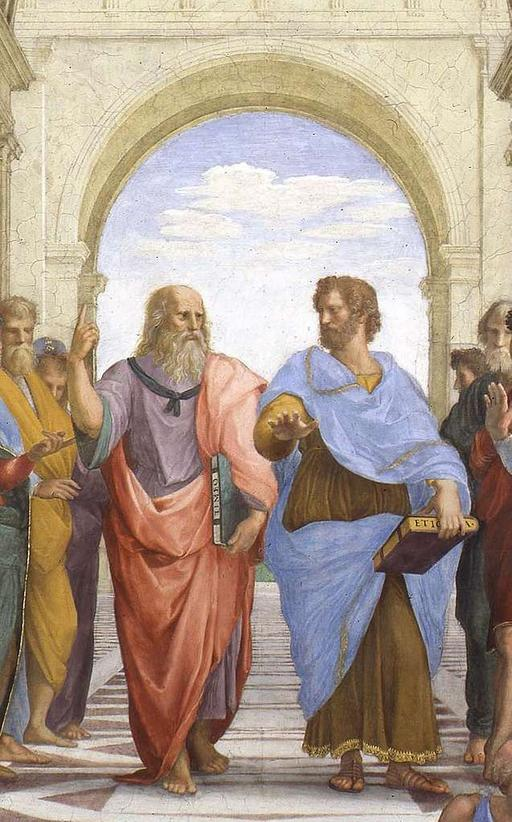
Go ask a normal American student why school matters and you will hear something about college, career, or money.
Go ask a classically educated student the same question and you will hear words like wisdom, virtue, truth, beauty, or God.
That is the difference between education as workforce preparation and education as human formation.
America has spent generations funding the first vision while wondering why the second kind of person disappeared.
30
301
1,022
56,054
Angela Booth retweeted

Jun 4
Art is the mirror of the soul. When the arts are controlled by people who are spiritually, psychologically, and intellectually diseased, then that sickness and ugliness will be reflected in the art. There is no greater confirmation of the declining trajectory of human nature and its degradation than the arts themselves. You can foresee the future in two ways: by reading history and by judging the art of the present moment. Things do not look good. Yet there is hope. Beauty and virtue will prevail.
Jun 3

We spent fifty years teaching artists that beauty is “cheesy” and sincerity is “cringe.” Now we wonder why all our art is ugly and meaningless.
12
29
153
3,618
Angela Booth retweeted

Jun 5
“Anybody can look at a pretty girl and see a pretty girl. An artist can look at a pretty girl and see the old woman she will become. A better artist can look at an old woman and see the pretty girl she used to be. But a great artist—a master—can look at an old woman, portray her exactly as she is…and force the viewer to see the pretty girl she used to be…and more than that, he can make anyone with the sensitivity of an armadillo, or even you, see that this lovely young girl is still alive, not old and ugly at all, but simply prisoned inside her ruined body. He can make you feel the quiet, endless tragedy that there was never a girl born who ever grew older than eighteen in her heart…no matter what the merciless hours have done to her.
Look at her.”
~From Robert Heinlein’s ‘Stranger in a Strange Land’
77
232
2,283
82,114
Angela Booth retweeted

People have a depressingly reductive view of human personhood.
A human person isn't just the words they output. In fact, it's all the things that cause the words that really constitute a human life.
If a person says "my cat died last night", that sentence is almost certainly downstream of an actual physical event that happened in the actual physical world.
An LLM can output the same sentence, and if the AI companies cared enough, they could probably design an AI that was a million times more eloquent about it's non-existent dead cat, than any real cat owner could ever be about their real cat.
Nevertheless, in the case of the AI, there is no cat, and there never was a cat.
Human words are the shadow of a thing. If we look up from the shadows, there, we will see the thing.
AI words are just empty shadows. Devoid of any thing.
42
37
230
10,313
Angela Booth retweeted

Jun 4
They say AI will destroy journalism.
I say, journalism destroyed itself the day it sold its soul to ad revenue and outrage clicks. The machines can have the press releases.
Humans were made for authenticity, love, community, truth-telling… not headline-farming.
30
24
140
4,108
Angela Booth retweeted

Jun 4
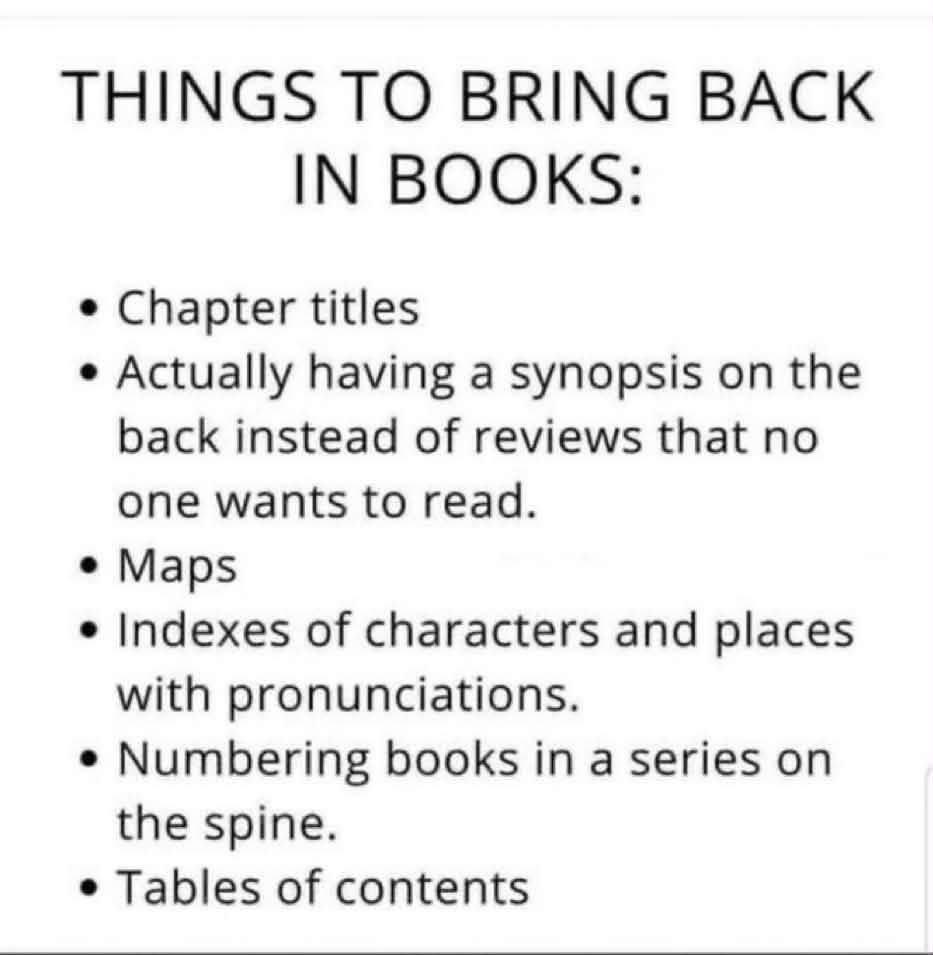
You need to be bookmaxxing. Read more books. Borrow more books. Buy more books. Recommend more books. Gift more books. Discuss more books. Review more books. Reread more books. Quote more books. Join more bookclubs. Take more notes on books. Apply more books. Do more with books.
45
175
898
22,015

Angela Booth retweeted

To clear it up for some who seem confused: I’m not “fighting generative AI.” Go ahead and use it; it makes no difference to me and my own life and work. But I and other filmmakers will be over here going through the tunnel to the other side with human filmmaking. If you’re one of those filmmakers, we’re here for you at @_CREDO23_.
45
62
1,055
24,086


Angela Booth retweeted

May 31
Ray Bradbury's timeless advice on rebuilding your attention span
27
1,019
10,433
206,735
Angela Booth retweeted

May 31
Your best fight against AI is not to start finger wagging at other people using AI. But rather to become more human yourself. Your thoughts, ideas, the things you create, how you treat people, are they human or are they programmed by some ideology? If the virtue of man is truth, goodness and beauty then any time you behave outside of these virtues, you are no better than the machines you protest against.
8
6
58
1,708