After years of anticipation, the 2026 FIFA World Cup has kicked off. High ticket demand creates a perfect environment for opportunistic scammers looking to lure fans seeking last-minute deals.
While the ticket scam game has been seen before, what’s new is the sophistication of the storefronts made possible by AI vibe coding software.
Read on to learn more about their playbook and what Graphika analysts uncovered: graphika.com/blogs/emerging-…
#WorldCup2026 #WeAre26 #WorldCup #FIFAWorldCup #TrustAndSafety #AI #CyberSecurity #OnlineSafety #Graphika #GraphikaInsights #GraphikaReport #Scamsandfraud #fraud #Worldcuptickets
68

Jun 12
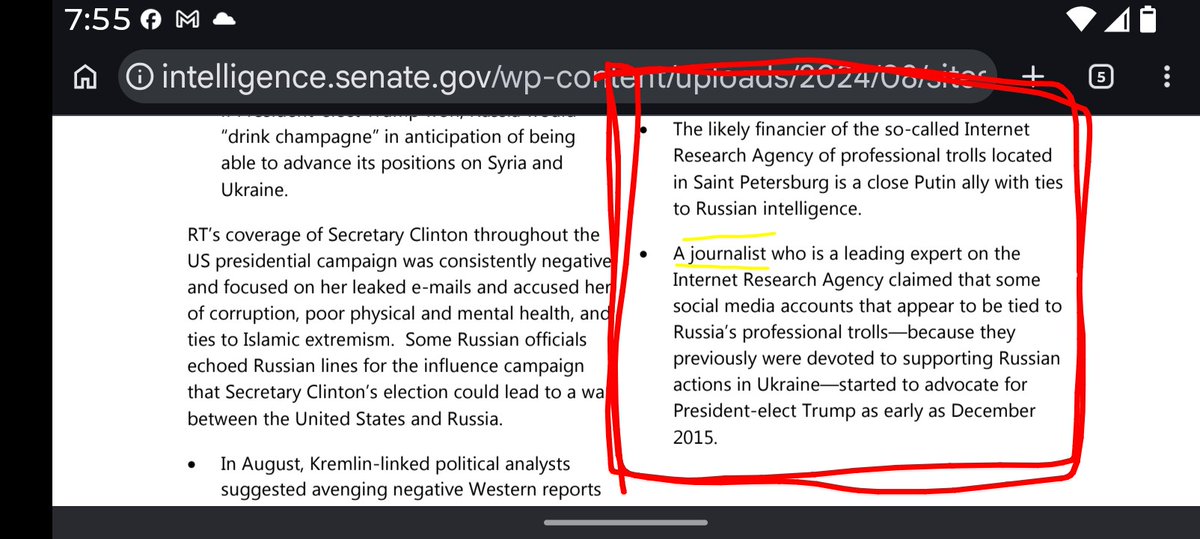
So true look at this from the ICA.
They used the preexisting Russian IRA work by the Oxford Internet Institute and my high school friend Dr John Kelly of Graphika.
@apidictionist
He and Alex Stamos made it up with Renee DiResta.
They were leaders in the Election Integrity Partnership
1
32

Jun 12
Arguably, the decisive theater in our geopolitical competition & #TechColdWar with #China will be the home front as well outlined in this @TheNatlInterest piece.
nationalinterest.org/feature…
This can certainly be seen with recent amplification of concerns over #DataCenters.
Excerpt,
"China’s influence activity has increasingly shifted toward softer targets: social media ecosystems, local politics, diaspora organizations, campaign finance networks, universities, and state-level institutions. Most worryingly, these campaigns now appear to reflect organic American community sentiment.
Beijing’s influence campaigns manifest in both the digital and physical realms. In the run-up to the 2024 presidential election, social media analytics firm Graphika revealed Chinese influence operations that masqueraded as US voters on X and TikTok. These users claimed to be US citizens or US-focused advocates for peace, human rights, and information integrity, frustrated by American politics. By flooding social networks with 'spamouflage'—political messaging created by fake American users—China is trying to disguise coordinated influence operations as authentic online discourse."
1
47

Jun 12
Registration is now open for our upcoming webinar, Ask an Expert: What Brand Sponsors Can Learn from Real-Time Fan Sentiment.
Join us on Wednesday, June 24 for the second installment of our World Cup series as Graphika Chief Scientist Dr. Vladimir Barash and Chief Revenue Officer Jennifer Vaziralli discuss Graphika’s deep research agent and stance detection technology.
These tools on the Graphika platform provide brands with a reliable way to see how fans and consumers are reacting to their campaigns during major events and promotions, and how stance offers a more precise measure of fan reaction, going beyond traditional sentiment classifiers. We will demonstrate how we identify early warning signs of emerging backlash so that brands can develop response frameworks that distinguish between adversarial attacks and legitimate fan concerns.
Register now to join the conversation and submit your questions in advance: graphika.com/webinars/real-t…
#WorldCup2026 #WeAre26 #WorldCup #FIFAWorldCup #TrustAndSafety #Disinformation #AI #CyberSecurity #OnlineSafety #Graphika #GraphikaInsights #GraphikaReport #Brandbacklash #sponsor #sponsorships #brandboycott

106

Jun 12
2/
4. Partenaires de conseil
Anne-Laure Malauzat (YGL 2022) — Partner Bain & Company 2022–actuel
5. Fondateurs / PDG de startups
Charles Gorintin (FAF 2022) — Fondateur Alan 2016–actuel, Fondateur Mistral AI 2023–actuel
Thomas Clozel (FAF 2023) — Fondateur Owkin 2016–actuel
Frédéric Mazzella (FAF 2015) — Fondateur/PDG BlaBlaCar 2013–actuel
Victor Lugger (FAF 2018) — Fondateur Big Mamma 2015–actuel, Fondateur Sunday 2019–actuel
Christine de Wendel (FAF 2018) — Entrepreneur 2018–actuel
Arnaud Ventura (YGL 2014) — Fondateur PlaNet 1999–actuel
Julie Chapon (YGL 2025) — Co-fondatrice Yuka 2017–actuel
Éléonore Crespo (YGL 2025) — Co-fondatrice Pigment 2019–actuel
Clément Ray (YGL 2025) — PDG Innovafeed 2016–actuel
Mathieu Flamini (YGL 2010) — Entrepreneur start-up écologique 2016–actuel
Camille François (YGL 2015) — Directrice innovation Graphika 2015–actuel
6. Autres (artiste, chercheur, astronaut)
Thomas Pesquet (FAF 2016) — Astronaut missions 2016, 2021, 2024
Antonin Baudry (FAF 2015) — Auteur, scénariste, réalisateur 2015–actuel
Cédric Villani (FAF 2012) — Mathématicien 2000–actuel
Jean-Marie Colombani (FAF 2000) — Directeur du Monde 1998–2007
111

Jun 12
China’s Spamouflage/Dragonbridge bots are flooding every Dalai Lama post with smears, conspiracies, and pro-CCP attacks — even impersonating American accounts to look “local” and sow division. Meta, DFRLab & Graphika keep exposing these fake networks. But why the obsession? 👇
China views the 14th Dalai Lama as a dangerous global symbol of Tibetan identity, autonomy, and moral resistance to Beijing’s rule over Tibet. For decades, the Chinese Communist Party has poured enormous resources into controlling the narrative around Tibet: crushing dissent inside the region, flooding it with Han settlers, demolishing monasteries, and rewriting history to claim Tibet has “always” been part of China.
The Dalai Lama’s international stature — his meetings with world leaders, his message of compassion, and his refusal to accept Beijing’s total domination — directly challenges that propaganda. So China’s strategy is multi-layered: offline repression, diplomatic pressure on governments not to host him, and online influence operations like these bot swarms. The goal is to erode public support, portray him as a “splittist,” a CIA asset, or worse, and eventually control the selection of the next Dalai Lama after he passes.
A chilling preview of that future is the story of the Panchen Lama — Tibetan Buddhism’s second-highest spiritual authority.
In May 1995, the Dalai Lama formally recognized 6-year-old Gedhun Choekyi Nyima as the 11th Panchen Lama. Just three days later, Chinese authorities abducted the boy and his entire family. They have not been seen or heard from since. For 31 years, the Chinese government has refused all independent access or proof of life, despite repeated international calls from the UN, human rights groups, and governments.
Instead, Beijing installed its own hand-picked “Panchen Lama” — a boy from a CCP-loyal family who was groomed for the role. This puppet figure is now used in official ceremonies to rubber-stamp Chinese policies on Tibetan Buddhism.
This is the real stakes: China is preparing to kidnap or manipulate the next Dalai Lama the same way. By flooding social media with bot comments that attack the current Dalai Lama, they hope to weaken exile communities, confuse global audiences, and normalize their claim to decide reincarnations — something no foreign power has ever had authority over in Tibetan tradition.
Don’t feed the spam. Report obvious bot accounts. Share real information. Tibetan voices and cultural survival matter.
#Tibet #PanchenLama #FreeTibet #Disinfo
2
1
283
Dark Mrau retweeted
Jun 11
The world is watching the World Cup. Graphika is watching everything around it. 🌎 ⚽ 👀
Today, as the 2026 tournament kicks off, we're launching World Cup Watch — a window into the online conversations, narratives, and risks shaping the one of the world’s biggest sporting events.
From emerging scams and AI-generated deception to influence operations and fan-driven brand boycott narratives, we’re tracking how the digital conversation around the World Cup evolves as it happens in the coming weeks.
Explore the signals behind the spectacle, our latest intelligence and webinars, and subscribe for updates: graphika.com/world-cup-2026?…
#WorldCup2026 #WeAre26 #WorldCup #FIFAWorldCup #TrustAndSafety #Disinformation #AI #CyberSecurity #OnlineSafety #Graphika #GraphikaInsights #GraphikaReport #Brandbacklash #sponsor #sponsorships #brandboycott
1
2
127
Jun 10
Missed our latest webinar?
You can still access Ask an Expert: The Geopolitics of World Cup Boycotts.
What you'll learn:
🌎 How boycott narratives around event costs, travel restrictions, human rights concerns, and geopolitical conflict are evolving and intersecting.
💻 How Graphika tracks the spread of these narratives across platforms and distinguishes between grassroots community concerns and organized movements.
⚽ What the World Cup reveals about the growing role of geopolitics in shaping public discourse around major international sporting events and boycott narratives overall.
Watch the replay today to learn more: graphika.com/webinars/geopol…
#Graphika #GraphikaInsights #GraphikaReport #FIFAWorldCup #WorldCup #WorldCup26 #WeAre26 #Brandbacklash #sponsor #sponsorships #brandboycott

113
Jun 10
The new Graphika.com is now live!
The redesigned site makes it easy to explore the capabilities of the Graphika Decision Intelligence Platform, including how our proprietary intelligence engine transforms cross-platform data into structured insights through network mapping, agentic AI, and subject matter expertise.
What’s new:
🔎 A clearer look at how Graphika turns complex online ecosystems into actionable intelligence
💻 Detailed information on solutions for the industries we serve
💡 A centralized hub for our reports, webinars, sample intelligence insights, and other timely research
🏷️ Improved tagging and categorization so you can quickly find the intelligence content most relevant to you
Whether you're investigating online networks, monitoring evolving narratives, or making high-stakes decisions in complex digital environments, everything you need is now in one place.
Take a look and check out what's new!
#Graphika #DecisionIntelligence #ThreatIntelligence #CyberSecurity #OSINT #DataScience #AI #InformationOperations #DigitalThreats

1
2
114

『フランスの情報機関によって「Fawn Mianju」と名付けられたこの作戦は、2025年夏にGraphikaによって初めて明らかにされた。Graphikaは、Facebook、Instagram、Mastodon、Threads、Xなどのソーシャルネットワーク上の11のウェブサイトと16の英語アカウントを特定し、』
1
38
Bink 🇨🇦🇺🇸 retweeted

Jun 7
“Graphika” riiight. 😉

A careless code blunder just blew the lid off Beijing’s multi-million dollar AI propaganda operation targeting the West. France's digital interference watchdog, Viginum, has officially exposed "Fawn Mianju," a covert network of 13 multilingual fake news sites running on advanced automation and generative AI. The sophisticated network was completely compromised after a computer engineer working as a Senior Project Manager at China's state-run CGTN Digital accidentally left his login credentials exposed in the code.
This operation, which expanded on findings first uncovered by U.S. cybersecurity firm Graphika in 2025, operated with deep financial backing. The domains were registered in Beijing, hosted on Alibaba Cloud, and utilized expensive infrastructure alongside paid plugins to artificially manipulate search engine rankings. Using digital keys linked directly to AI language models, the network automatically scraped CGTN articles, lightly rewrote them, and republished over 2,300 articles, often within less than an hour of the original state media broadcast.
Sites like the French-language "Actu Méridien" were weaponized to manipulate public opinion across 89 countries, heavily targeting Western audiences and Francophone African youth. The articles aggressively peddled pro-Beijing narratives, painting China as the undisputed leader of the Global South and green energy transition while explicitly telling Western readers that aligning with Chinese interests would bring them massive benefits.
Despite the cutting-edge tech and heavy state funding, the operation was an organic flop. The articles struggled to breach 15,000 views, with nearly 40 percent of its top social media engagement traced back to fake accounts in Burundi whose sole purpose was to artificially inflate the content. While the reach was limited, French authorities warn that the operation exposes Beijing’s rapidly escalating capability to launch fully automated, stealth disinformation campaigns designed to quietly erode Western democratic alignment.
#Disinformation #CyberSecurity #France #China #AIPropaganda #Geopolitics #Viginum #NationalSecurity

3
6
161

法国反外国数字干预机构 Viginum 在6月4日披露,一个与中共官媒 CGTN 有关的宣传网站网络共有13个站点。法国情报部门将其命名为 Fawn Mianju。美国研究机构 Graphika 此前曾发现其中11个网站,以及在 Facebook、Instagram、Mastodon、Threads 和 X 等平台上的16个英文账号,持续推送 CGTN 文章,并针对年轻人传播。 这些网站把 CGTN 文章改写后再发,包装成法语、西语、英语、越南语内容,主题包括中国航空、AI、所谓“全球南方”、生态转型,以及法国靠近中国利益的所谓好处;另有多语种文章批评法国电视二台关于中国对待维吾尔人的报道。 Viginum 查到的线索包括:域名在北京注册、通过阿里云购买;站点采用分布式架构,内容同时复制到多台服务器;还使用付费插件提升搜索排名。调查人员还在网站档案和未索引子域名中找到仿 CGTN 官网的测试页,并追到管理员身份:一名在 CGTN Digital 担任“高级项目经理”的 IT 专员。 自动化痕迹也很明显:自2025年底以来,CGTN 发布的2,975篇文章中,有2,307篇在 Fawn Mianju 网络上以轻微改写形式重发,平均间隔不超过1小时。调查还发现,这名管理员的 GitHub 页面显示,他参与多个文本生成算法和 LLM 项目,并拥有可让网站直接连接 AI、生成半自动内容的数字密钥。 Viginum 认为,这些网站具备数字干预行动的两个关键特征:隐蔽性和协调性。不过传播效果很有限:该网络曾在 Facebook 和 Threads 买量,覆盖89个国家,主要瞄准法语非洲,但最高浏览量仍未超过15,000次;点赞最多的帖子中,39%的点赞来自布隆迪用户,且这些用户的主要活动就是正向互动中国相关页面。
10
5
44
11,348

Jun 7
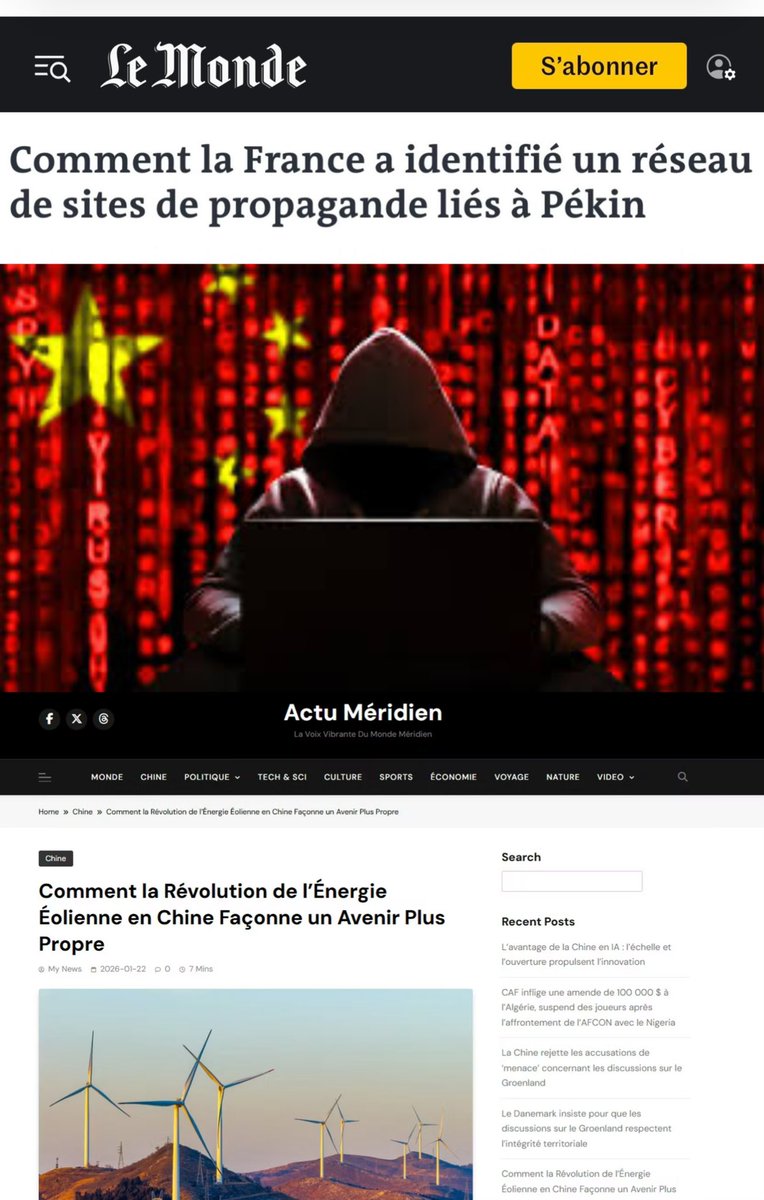
France has identified a network of propaganda sites linked to Beijing.
On June 4, Viginum, the French state watchdog against foreign digital interference, revealed the existence of a network of 13 fake news sites linked to CCP-owned state media outlet 🇨🇳 CGTN.
Dubbed "Fawn Mianju" by French intelligence services, this operation was first brought to light in the summer of 2025 by 🇺🇸 Graphika, which identified 11 websites and 16 English-language accounts on social networks such as Facebook, Instagram, Mastodon, Threads, and X, all relentlessly pushing 🇨🇳 CGTN articles, specifically targeting young people. Other sites shared them in French ("Actu Méridien"), Spanish ("Amigo News"), and Vietnamese.
Published primarily between Mar 2015 and Feb 2026, the pseudo-articles posted on "Actu Méridien" unilaterally promoted Chinese aeronautics and AI, China as a leader of the "Global South" and the ecological transition, and the supposed benefits for France of aligning itself with Chinese interests. Another article, published in various languages, criticized a France 2 report on the treatment of Uyghurs in China.
After several months of investigation, Viginum experts were able to establish that these sites, now numbering 13, are directly linked to 🇨🇳 CGTN.
In addition to the fact that the domain names were registered in Beijing and purchased from Alibaba Cloud, it uses a distributed architecture, meaning it is simultaneously duplicated on multiple servers. This more expensive feature, along with the use of paid plugins to improve search engine ranking, points to an actor with significant resources.
By exploring the site's archives and its unindexed subdomains, Viginum experts found a test page modeled after the CGTN website. The administrator of "Actu Méridien" and the other sites inadvertently left a trace of his login credentials and was thus identified. He is an IT specialist working as a "senior project manager" at CGTN Digital, CGTN’s digital arm.
His GitHub page reveals that he’s working on numerous projects exploiting text generation algorithms, LLMs such as ChatGPT, and that he had a digital key that allowed a website to be directly connected to AI to generate semi-automated publications. Since the end of 2025, of the 2,975 articles published on CGTN, 2,307 have reappeared, slightly rewritten, on the "Fawn Mianju" network, often with modifications aimed at a younger audience.
Furthermore, a stylometric analysis showed that the original versions of the articles exhibited a high rate of variation in sentence length and punctuation type, typical of human writing, whereas this rate of variation was reduced by a factor of 2 or 3 on "Actu Méridien" and its English and Spanish-language counterparts. “We can’t prove that a site is AI-generated, but we can establish a body of evidence.”
The average time between the publication of an article on CGTN and its republication on “Actu Méridien” does not exceed 1 hour, regardless of the site or time of day, an indication that the “Fawn Mianju” network was probably directly connected to CGTN to automate article production.
These sites meet two of the essential characteristics of a digital interference operation: secrecy and coordination. Despite several campaigns to buy visibility on Facebook and Threads targeting 89 countries, primarily in French-speaking Africa, they’ve never managed to exceed 15,000 views. 39% of the “likes” for the most liked posts came from people in Burundi, whose sole activity is engaging positively with Chinese pages.
Given the low visibility of these sites and accounts, this operation can be considered an 𝗼𝗽𝗲𝗿𝗮𝘁𝗶𝗼𝗻𝗮𝗹 𝗳𝗮𝗶𝗹𝘂𝗿𝗲. Moreover, "Actu Méridien" has been inactive for several months. Nevertheless, these sites demonstrate China is clandestinely pushing its narratives to people in Western countries; it’s using LLM to automate content production; and, finally, it’s targeting young people and French-speaking Africa.
lemonde.fr/les-decodeurs/art…
4
40
80
10,174

A careless code blunder just blew the lid off Beijing’s multi-million dollar AI propaganda operation targeting the West. France's digital interference watchdog, Viginum, has officially exposed "Fawn Mianju," a covert network of 13 multilingual fake news sites running on advanced automation and generative AI. The sophisticated network was completely compromised after a computer engineer working as a Senior Project Manager at China's state-run CGTN Digital accidentally left his login credentials exposed in the code.
This operation, which expanded on findings first uncovered by U.S. cybersecurity firm Graphika in 2025, operated with deep financial backing. The domains were registered in Beijing, hosted on Alibaba Cloud, and utilized expensive infrastructure alongside paid plugins to artificially manipulate search engine rankings. Using digital keys linked directly to AI language models, the network automatically scraped CGTN articles, lightly rewrote them, and republished over 2,300 articles, often within less than an hour of the original state media broadcast.
Sites like the French-language "Actu Méridien" were weaponized to manipulate public opinion across 89 countries, heavily targeting Western audiences and Francophone African youth. The articles aggressively peddled pro-Beijing narratives, painting China as the undisputed leader of the Global South and green energy transition while explicitly telling Western readers that aligning with Chinese interests would bring them massive benefits.
Despite the cutting-edge tech and heavy state funding, the operation was an organic flop. The articles struggled to breach 15,000 views, with nearly 40 percent of its top social media engagement traced back to fake accounts in Burundi whose sole purpose was to artificially inflate the content. While the reach was limited, French authorities warn that the operation exposes Beijing’s rapidly escalating capability to launch fully automated, stealth disinformation campaigns designed to quietly erode Western democratic alignment.
#Disinformation #CyberSecurity #France #China #AIPropaganda #Geopolitics #Viginum #NationalSecurity


21
659
1,422
167,272
Jun 4
A recent investigation by Süddeutsche Zeitung highlights a disturbing reality: AI chatbot platforms can be exploited to simulate harmful and abusive scenarios, often without meaningful safeguards or barriers to access.
Graphika spoke with reporters Natalie Sablowski and Marie-Louise Timcke about the business models behind the platforms and how platforms like Chub AI utilize user-generated content as a means to an end.
"Every online community will use these tools in a way that suits its goals," our analyst said, noting that other platforms are making efforts to combat character chatbot abuse. Still, finding ways to circumvent moderation is a common occurrence within these online communities.
Read the full investigation to learn more.
sueddeutsche.de/projekte/art…
#Graphika #GraphikaInsights #Chatbots #AI #TrustAndSafety #OnlineSafety #GenerativeAI #PlatformRisk #DigitalEcosystems
1
2
4
365
Jun 2
Not all phishing targets are random.
Graphika Analyst Gustavo Paniz spoke with Communications of the ACM about how scammers targeting online retail consumers are leveraging “sucker lists”—datasets of previously compromised or highly responsive individuals—to increase the effectiveness of their campaigns.
He explained how these actors don’t just run isolated scams, but instead operate from repeatable playbooks. Tactics, messaging, and targeting strategies are refined over time and reused across campaigns, making fraud more scalable and harder to detect.
At Graphika, we analyze the networks behind these fraud schemes to understand how scams evolve and spread, who they target, and how they can be disrupted.
Read more: cacm.acm.org/news/scammers-p…
#Graphika #GraphikaInsight #CyberSecurity #Fraud #Phishing #ThreatIntelligence #Ecommerce #DigitalTrust #OnlineScams #Scams

3
2
174

May 28
For 48 hours once the clock starts, we're all going to start recording origin traces and then spend the weeks and months after the hackathon visualizing and studying what happened that one fateful weekend
University researcher participation is already on deck, but my stretch goal is like companies like Graphika or Palantir taking it as a chance to show off their tools & their public service charting the data & the story
4
73
May 27
A new three-part look into a coordinated influence operation targeting India’s efforts to secure rare earths from Myanmar’s Kachin region features research and insights from Graphika investigator Margot Fulde-Hardy.
The investigation centers on a fabricated conspiracy that was published on pay-to-publish websites and amplified on social media from accounts originating in Pakistan and was conducted by @AltNews and the @pulitzercenter's Rainforest Investigations Network.
Part three of the series delves into amplification efforts, including the online actors spreading the fake rare earths conspiracy across platforms.
Read the final installment of the deep dive now! altnews.in/the-amplification…
6
7
777