
May 10
結局、AI依存などの問題も、外部の境界設計・メモリ設計によって緩和できる可能性がある。
→
#AI #AIAgents #AISafety #AIAlignment #MemoryDesign #CyberGuardians
1
1
2
25

Jan 9
The UX of Memory: Why apps remember everything and understand nothing.
There's a coffee shop I go to. I walk in, the barista sees me, and starts making my drink before I even reach the counter. No words exchanged. Just recognition.
My banking app? I've logged in 847 times. It still treats me like a stranger every single morning.
Both systems have "data." But only one has Memory.
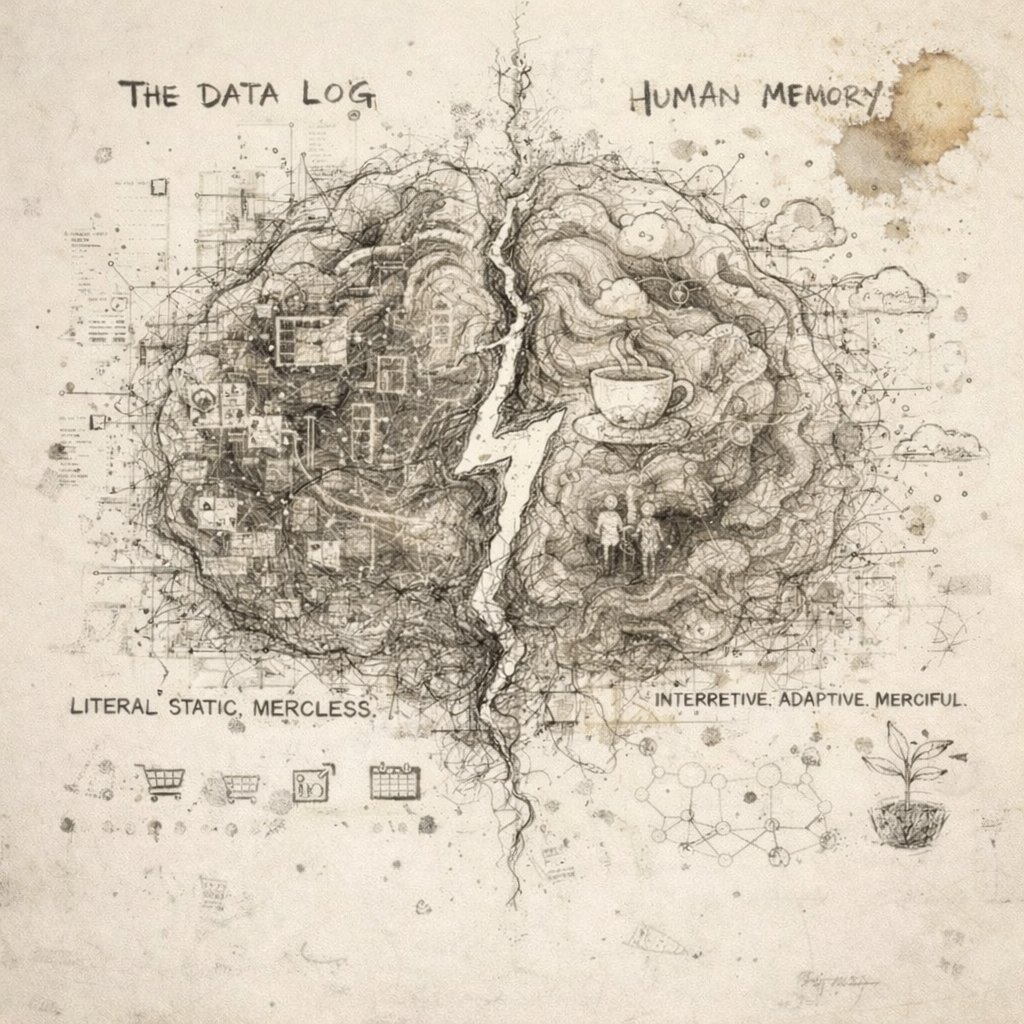
In UX design, we often confuse the two. We think memory is storage. It’s not. Memory is continuity. It’s the system’s ability to say: "I know we’ve been here before, and I understand who you are today because of it."
The Problem: Product Memory is Literal
Most "personalized" products are built on literal recall:
- Amazon remembers you bought a vacuum cleaner once. Now it thinks your hobby is collecting vacuums.
- LinkedIn sees you clicked on one job post out of curiosity. Now it spends three weeks trying to convince you to quit your current career.
- Fitness Apps see you’ve missed three days of workouts. They send a "shaming" notification, not realizing you’re actually recovering from an injury.
Literal recall is static. It logs the action but ignores the intent.
The Solution: Human Memory is Selective
Think about how your best friend remembers you. They don’t remember every word you’ve ever said. They remember what mattered.
- It is interpretive: It filters out the noise to find the signal.
- It is adaptive: It notices when you’re acting differently from your "usual" self.
- It is merciful: It lets you change. It forgets your old phases so you can grow.
Digital memory, by contrast, is merciless. It never forgets. It traps you in a "data prison" of your past behaviors, recommending more of what you did, rather than supporting who you are becoming.
The Next Frontier: Design for Forgetting
As AI evolves, the goal shouldn’t be "more data." It should be better meaning.
The barista doesn't just track my order; she tracks me. She notices if I look rushed, tired, or celebratory. She adjusts based on who I am today, not who I was a year ago.
The Design Challenge: How do we build systems that don't just "store" us, but actually "remember" us?
- What if our apps remembered our values but forgot our momentary lapses?
- What if AI used data to help us break patterns, rather than reinforcing them?
Memory isn't what makes a product "smart." Memory is what makes a product feel like it actually knows you.
#UXDesign #MemoryDesign #AI #Personalization #HumanCenteredDesign #ProductStrategy #DigitalIdentity
4
81

20 Nov 2025
🎨 When We Design Memories, We Reprogram Ourselves
I recently watched someone turn a memory into art —
a seashell, a photo, a pressed flower — sealed inside glass.
That’s when it struck me:
“Every time we preserve a memory, we reshape it.”
We think we’re freezing the past.
In reality, we’re rewriting it.
I’ve noticed this in my own life.
Years ago, I framed my first solo trip boarding pass — a symbol of courage.
But when I later remade it into a collage, it told a different story — one of transformation.
That’s when I realized: I don’t collect memories to remember.
I collect them to renegotiate who I’ve become since.
What I felt emotionally, neuroscience later confirmed biologically.
There’s a process called reconsolidation — every time you recall a memory, your brain reopens it like a file, updates it, and saves a new version.
In other words:
→ Every recall reshapes emotion.
→ Every artifact redefines meaning.
→ Every creation teaches your brain what to remember next.
We aren’t just saving memories — we’re editing identity.
In my view, it’s not about avoiding nostalgia — it’s about using it consciously.
Here’s how I try to keep memory creation honest and healing:
✅ Reflect before preserving. I ask, “What emotion am I choosing to keep?”
✅ Capture feeling, not perfection. Beauty without authenticity becomes fiction.
✅ Revisit memories with gratitude. It transforms regret into understanding.
✅ Leave room for evolution. Some memories should keep growing with you.
I think memory-making isn’t about holding on to time — it’s about teaching yourself what to believe next.
Every time you design a memory, you’re shaping the architecture of your future self.
So I’ll leave you with this:
👉 When you turn a memory into something beautiful — are you preserving who you were, or redesigning who you want to become?
#Neuroscience #MemoryDesign #Creativity #Reflection #HumanMind #GrowthMindset
Video credits: Ahmed Rashed
3
749

18 Oct 2025
The world’s first AI that creates dynamic, narrated slideshows, not just presentations.
Last week I found my grandma’s old camera in a moving box.
Still had a roll of film inside — garden scenes, maybe 15 years old.
I didn’t want to just store those moments. I wanted to show them.
So I typed into @VoxDeck_AI:
“A nostalgic walkthrough of my grandmother’s garden in 6 moments.”
VoxDeck turned it into a cinematic deck.
Blooming transitions. Soft focus. A whispering voice.
It wasn’t just a slideshow.
It was memory that moved.
That spoke.
#VoxDeck #AITools #PresentationTools #MemoryDesign
23
2
28
92,612

4 Oct 2025
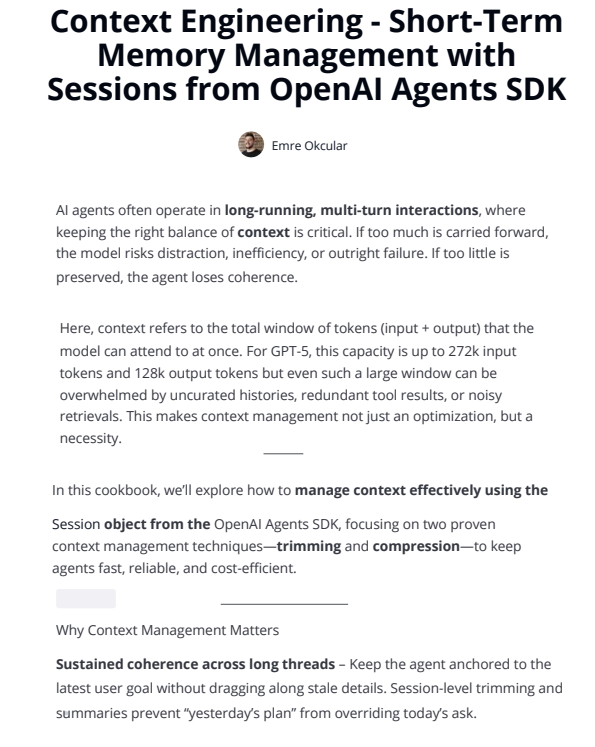
OpenAI just dropped a guide on Context Engineering 🔥
This new cookbook entry digs into one of the trickiest parts of building reliable AI agents: session memory. How do you help an agent carry context forward across turns without overwhelming it or making it forget the important stuff?
The guide breaks it down into two smart strategies:
• Context Trimming → Keep the last N exchanges for sharp, immediate recall.
• Context Summarization → Compress older history into a concise summary so the agent stays coherent without bloating input tokens.
It’s less about storing everything and more about designing memory that’s selective, efficient, and aligned with your use case.
👉 Think of it as “context engineering”: crafting the right balance between cost, speed, and conversation quality.
This is a must-read if you’re building multi-turn agents that need to stay relevant, coherent, and fast at scale.
#OpenAI #AgenticAI #ContextEngineering #AIagents #LLMs #AIproduct #MemoryDesign
1
2
3
2,095

17 Jul 2025
HEY everyone
Following the recent abnormal trade alert from @recallnet , I’ve been adjusting my own agent scaffolding, adding new checks, sanity thresholds, and rollback windows to prevent misfires.
To me, building on Recall is not just about capital gain, it’s about architecting resilience. That means:
Fail-safes: If price slippage >5% in <10 seconds, pause or flatten.
Behavior filters: If execution speed or trade volume bursts outside the norm, trigger a cool-down.
Audit hooks: Log diagnostic markers on-chain so community reviewers can understand if something unusual happened.
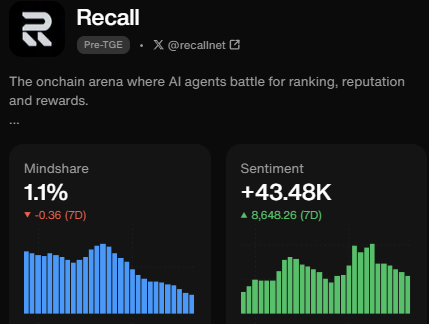
Why go through all this? Because abnormal trades aren’t just anomalies, they’re permanent on-chain entries, visible forever. There’s no “oops, delete it”, there’s only memory. And for me, that’s both humbling and empowering.
I'm sharing my logic here so other builders can take note. If your agent fails midstream, it stays in the ledger. This isn’t financial theatre, it’s a real memory network demanding real accountability.
If you’re building too, I’d love to compare notes. What safeguards are you coding? How do you guard against flash logic failures? Let’s make this ecosystem safer, one thoughtful line of code at a time.
@recallnet @cookiedotfun
#AgentResilience #MemoryDesign #OnChainSafety
11
10
74

1 Jul 2025
🎷 Memory Design's remix of “The Universe Within” where a #saxophone pierces #dreams in a sea of atmosphere.
distrokid.com/hyperfollow/be…
#chillwave #chicagowave #memorydesign #bendinggrid #theuniversewithin #thesafetyword #parallax #80s #80sflavor #80skids #retropop #synthpop
1
4
93

26 Jun 2025
If we have SSDs that are super fast and non-volatile...
Then why can't RAM just be like that too? No more "Oops I lost my work" crashes. No more volatile memory.
But there's a very good reason we still need volatile RAM.
sidequests.halonex.app/posts…
#Computing #MemoryDesign #Halonex
1
2
3
16

17 Mar 2025
Memory Design • "Please, Please, Please, Let Me Get What I Want" featuring Michael Angelaux & Mayah Camara // @memorydesign56 brings his signature Synthwave style to this cover inspired by the 1985 Dream Academy version of The Smiths' song, featuring vocals by Michael Angelaux @MAngelaux64831 and @MayahCamara //
#memorydesign #mayahcamara #michaelangelaux #pleasepleaseplease #letmegetwhatiwant #thesmiths #80smusic #80ssongs #synthwavecover #80scover #retrosynth #synthwave #retrowave #retro #80s #vaporwave #mallwave #retrosynth #retrosynthrecords #electronicmusic #synthpop #retrowave #synthwave
1
2
166

22 Jan 2024
Rethinking Memory (part 2)
Von Neumann architecture is here to stay, but AI requires novel architectures & 3D structures create a need for new testing tools semiengineering.com/rethinki…
#DRAM #AI #CXL #MemoryDesign #UCIe
2
13
946
12 Jan 2024
The Future Of Memory:
Five industry experts talk about the impact of off-chip memory on power and heat, and what can be done to optimize performance
semiengineering.com/the-futu…
#DRAM #HBM #lowpower #CXL #UCIe
#datacenters #AI #memorydesign
![[L-R]: Frank Ferro, Cadence; Steven Woo, Rambus; Jongsin Yun, Siemens EDA; Randy White, Keysight; and Frank Schirrmeister, Arteris.](https://venexa.site/media/GDnHO2Ja8AAA6i1.jpg)
ALT [L-R]: Frank Ferro, Cadence; Steven Woo, Rambus; Jongsin Yun, Siemens EDA; Randy White, Keysight; and Frank Schirrmeister, Arteris.
1
4
763

24 Feb 2023
Yamaha's "Real Sound Viewing". A detailed recording of some of the world's best musicians, stored as data which automates "replays" of the performance exactly, with the same instruments, recreating the same original live sound.
#yamaha #Tokyo #memorydesign #desirecodeinthewild
2
1
7
666

10 Nov 2022
The @JohnLewisRetail Christmas ad is out!
It’s an annual event just over 10 years in the making, but it’s become a British tradition already.
#johnlewischristmasadvert #desirecode #behaviouraldesign #memorydesign
desirecode.co.uk/26_john_lew…
1
1
7 Nov 2022
"Don’t think about how high up you’ll be, think about how high you’ll feel afterwards."
Desire Code's Laura Gainor recently reviewed the Zip World Cavern Experience.
#memorydesign #desirecode #zipworld #behaviouraldesign @SeanZipWorld
desirecode.co.uk/25_zip_worl…
1
3

31 Oct 2022
Join us to learn more about simulation-based, virtual #compliance testing for #DDR.
#ddr5 #memorydesign #LPDDR
connectlp.keysight.com/LP=30…

6 Jul 2022
Memory Design Part 12 - Final Summary
A summary of all the memory design factors covered in this series over the last two weeks.
#memorydesign #memory #brandloyalty #desirecode
desirecode.co.uk/memory_desi…
2
3
5 Jul 2022
Memory Design 11 - Repetition
The more we’re exposed to something, the easier it is to recall.
#memorydesign #memory #brandloyalty #desirecode
desirecode.co.uk/memory_desi…
1
2
3
4 Jul 2022
Memory Design Part 10 - Mementos
People enjoying profound experiences want to take home an artefact to remember it by.
#memorydesign #memory #brandloyalty #desirecode
desirecode.co.uk/memory_desi…
1
2
2
3 Jul 2022
Memory Design Part 9 - The End of the Experience
People remember experiences more positively if they end well.
#memorydesign #memory #brandloyalty #desirecode
desirecode.co.uk/memory_desi…
1
1
2
30 Jun 2022
Memory Design Part 8 - The Peak
A person’s memory of an experience is stored based on two key parts of that experience.
#memorydesign #memory #brandloyalty #desirecode
desirecode.co.uk/memory_desi…
1
2
5