




ALT A red-themed event poster announcing the launch of IIIT-B Press in collaboration with De Gruyter Brill. The event is scheduled for Monday, April 27, 2026, from 11:30 AM to 1:00 PM at Amantran, IIIT-Bangalore. The design features a stage with spotlight effects, IIIT-B and De Gruyter Brill logos at the top, and a “Register Now” call-to-action with a website link and QR code for registration.

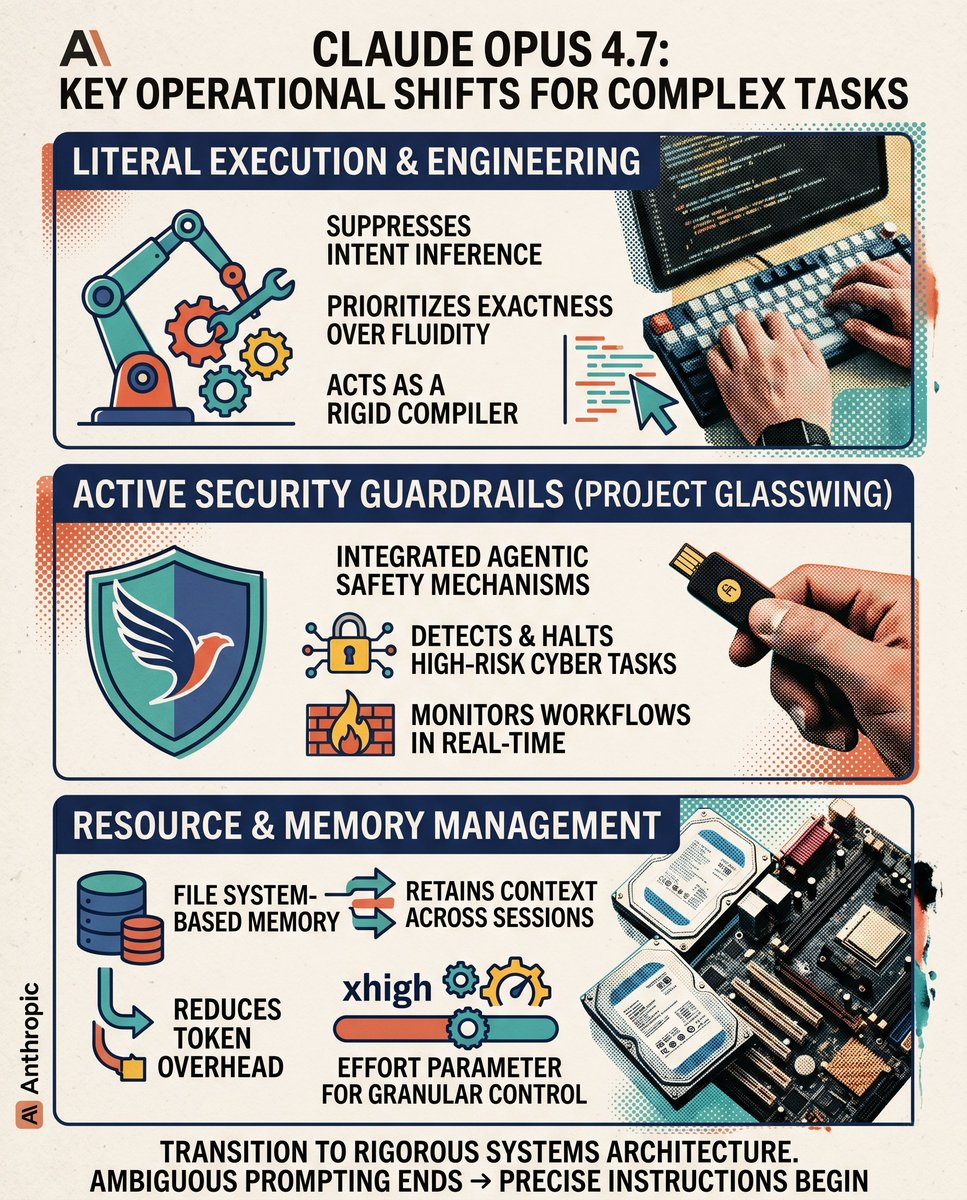
ALT Claude Opus 4.7: Operational Summary Anthropic’s Opus 4.7 marks a definitive structural transition from conversational AI to a rigid, autonomous engineering compiler. This release prioritizes exactness and multi-step reliability over fluid interaction. Suppression of Intent Inference: The architecture has been explicitly trained out of "guessing" user intent. It executes tasks with strict literalism, demanding precise instruction sets for extended engineering workflows. Active Security Guardrails: Integrated under Anthropic's "Project Glasswing," agentic safety mechanisms now actively monitor and halt high-risk cybersecurity workflows (like unauthorized penetration testing) during execution. Resource and Memory Management: A new file system-based memory enables cross-session variable retention, drastically reducing token overhead. Additionally, an xhigh parameter provides granular control over compute budget and reasoning depth for data-dense tasks.







ALT Poster for RISE 2026 Open House at IIIT-Bangalore. The design features a purple gradient background with the IIIT-Bangalore logo at the top left and the RISE logo at the top right. Large bold text reads “Attend RISE 2026 Open House,” followed by a banner saying “Explore research at IIIT-Bangalore.” The poster invites participants to “Get a chance to apply for 28 Summer Internships.” At the bottom are contact details: rise.iiitb.ac.in and rise@iiitb.ac.in, along with a QR code to register. Sponsor logos include MOSIP and upGrad as Gold Sponsors and Mantiswave Networks as a Silver Sponsor. Social media handles and the IIIT-Bangalore website are displayed along the footer.